

Interventions for health workforce retention in rural and remote areas: a systematic review
Open accessThe DOI matches its Crossref record; 64 of the 66 references it cites were found in a registry or an index.
Abstract
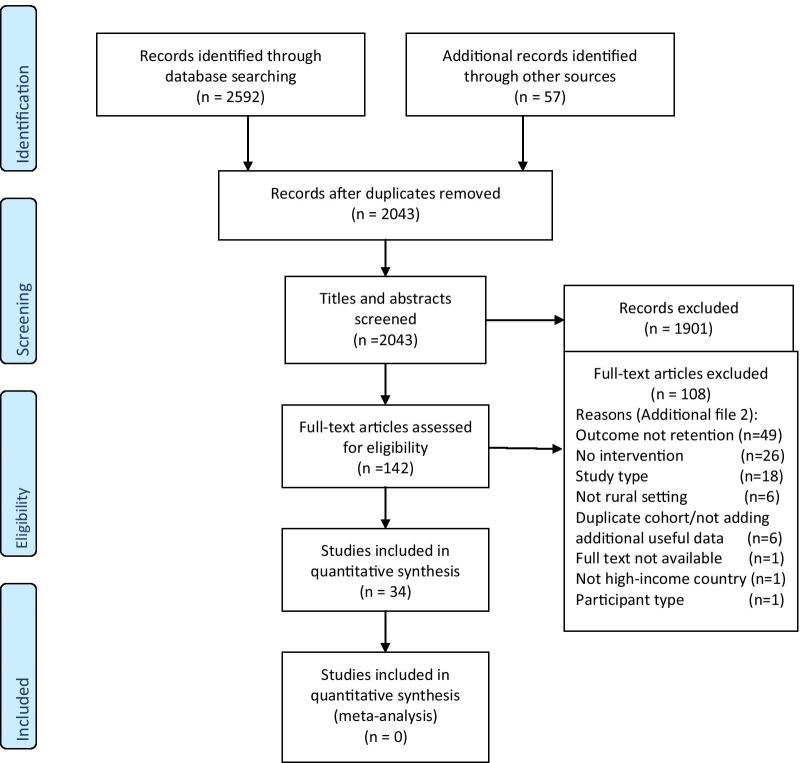
Background: Attracting and retaining sufficient health workers to provide adequate services for residents of rural and remote areas has global significance. High income countries (HICs) face challenges in staffing rural areas, which are often perceived by health workers as less attractive workplaces. The objective of this review was to examine the quantifiable associations between interventions to retain health workers in rural and remote areas of HICs, and workforce retention. Methods: The review considers studies of rural or remote health workers in HICs where participants have experienced interventions, support measures or incentive programs intended to increase retention. Experimental, quasi-experimental and observational study designs including cohort, case–control, cross-sectional and case series studies published since 2010 were eligible for inclusion. The Joanna Briggs Institute methodology for reviews of risk and aetiology was used. Databases searched included MEDLINE (OVID), CINAHL (EBSCO), Embase, Web of Science and Informit. Results: Of 2649 identified articles, 34 were included, with a total of 58,188 participants. All study designs were observational, limiting certainty of findings. Evidence relating to the retention of non-medical health professionals was scant. There is growing evidence that preferential selection of students who grew up in a rural area is associated with increased rural retention. Undertaking substantial lengths of rural training during basic university training or during post-graduate training were each associated with higher rural retention, as was supporting existing rural health professionals to extend their skills or upgrade their qualifications. Regulatory interventions requiring return-of-service (ROS) in a rural area in exchange for visa waivers, access to professional licenses or provider numbers were associated with comparatively low rural retention, especially once the ROS period was complete. Rural retention was higher if ROS was in exchange for loan repayments. Conclusion: Educational interventions such as preferential selection of rural students and distributed training in rural areas are associated with increased rural retention of health professionals. Strongly coercive interventions are associated with comparatively lower rural retention than interventions that involve less coercion. Policy makers seeking rural retention in the medium and longer term would be prudent to strengthen rural training pathways and limit the use of strongly coercive interventions.
Overview
The claims and statistics of this paper haven’t been checked yet.
Free: it reads the open-access text and checks the first 5 claims that cite a source we can check. Create a free account to check every claim.
Integrity signals
Registry
Cites
Statistics
Figures
Verification
Claims the paper makes
The claims and statistics of this paper haven’t been checked yet.
Free: it reads the open-access text and checks the first 5 claims that cite a source we can check. Create a free account to check every claim.
Claims other papers make about this one
Each is checked against this paper’s own text: does it say what the citing paper says it does?
The cited source says what the claim attributes to it.
In the citing paper
“A search for systematic reviews published in the last 10 years examining turnover intention among HCWs on PubMed, PROSPERO and Google Scholar produced nine relevant systematic reviews [11–19]”
From A global overview of healthcare workers’ turnover intention amid COVID-19 pandemic: a systematic review with future directions (2022) · cites this paper as [17]
The cited source says what the claim attributes to it.
In the citing paper
“and many of which were known factors prior to the pandemic [11–19].”
From A global overview of healthcare workers’ turnover intention amid COVID-19 pandemic: a systematic review with future directions (2022) · cites this paper as [17]
In the citing paper
“several systematic reviews highlighted an insufficient number of HWs to enable the provision of quality care, affecting health systems before and during the pandemic, with considerable inequities across countries worldwide [56–60].”
From Health workers’ perspectives on the quality of maternal and newborn health care around the time of childbirth: Results of the Improving MAternal Newborn carE in the EURO Region (IMAgiNE EURO) project in 12 countries of the World Health Organization European Region (2024) · cites this paper as [58]
Self-check
Percentages, sums and reported differences re-computed from the paper’s own numbers.
The self-check needs the paper’s full text.
Citations
Cites
Preferred Reporting Items for Systematic Reviews and Meta-Analyses: the PRISMA statement
Moher, D., Liberati, A., Tetzlaff, J., Altman, D. G., & for the PRISMA Group (2009) · BMJ · doi:10.1136/bmj.b2535 · Cited by 83,823
Preferred reporting items for systematic reviews and meta-analyses: the PRISMA Statement.
(2009) · PubMed Central · Cited by 44,859
Preferred Reporting Items for Systematic Reviews and Meta-Analyses: The PRISMA Statement
Moher, D., Liberati, A., Tetzlaff, J., & Altman, D. G. (2009) · Journal of Clinical Epidemiology · doi:10.1016/j.jclinepi.2009.06.005 · Cited by 19,575
Chapter 7: Systematic reviews of etiology and risk
Moola, S., Munn, Z., Tufanaru, C., Aromataris, E., Sears, K., Sfetic, R., Currie, M., Lisy, K., Qureshi, R., Mattis, P., et al. (2019) · JBI Reviewer's Manual · doi:10.46658/jbirm-17-06 · Cited by 2,114
Chapter 7: Systematic reviews of etiology and risk
(2020) · JBI Manual for Evidence Synthesis · doi:10.46658/jbimes-20-08 · Cited by 1,268 · cited 1×
“This systematic review accords with the Joanna Briggs Institute (JBI) methods for systematic reviews of aetiology and risk evidence [20] and followed an a priori published protocol which more fully describes methods and definitions [21].”
MethodHoltom, B. C., Mitchell, T. R., Lee, T. W.-H., & Eberly, M. B. (2008) · Academy of Management Annals · doi:10.1080/19416520802211552 · Cited by 1,042 · cited 1×
“However, studies reporting job satisfaction without direct turnover or retention outcomes were excluded [22], and we did not use the Grading of Recommendations, Assessment, Development and Evaluation (GRADE) approach for grading the certainty of evidence.”
MethodAnderson, I., Robson, B., Connolly, M., Al-Yaman, F., Bjertness, E., King, A., Tynan, M., Madden, R., Bang, A., Coimbra, C. E. A., et al. (2016) · The Lancet · doi:10.1016/s0140-6736(16)00345-7 · Cited by 990 · cited 1×
“A high proportion of Indigenous peoples live in remote and rural areas, and they experience considerably poorer health outcomes than non-Indigenous citizens [8].”
BackgroundPereira Gray, D. J., Sidaway-Lee, K., White, E., Thorne, A., & Evans, P. H. (2018) · BMJ Open · doi:10.1136/bmjopen-2017-021161 · Cited by 759 · cited 1×
“Hum Resour Health (2021) 19:103 the development of strong professional relationships between health providers and patients which are vital for improving health outcomes of vulnerable populations [2, 3].”
BackgroundWilson, N., Couper, I., de Vries, E., Reid, S., Fish, T., & Marais, B. (2009) · Rural and Remote Health · doi:10.22605/rrh1060 · Cited by 518
Grobler, L., Marais, B. J., & Mabunda, S. (2015) · Cochrane Database of Systematic Reviews · doi:10.1002/14651858.cd005314.pub3 · Cited by 359
Research works printed but not linked: 8
- Dolea C Increasing access to health workers in remote and rural areas through improved retention: global policy recommendations 2010 Geneva World Health Organization 23741785
- Tuttle C Rural-urban differences among older adults 2020 Minneapolis University of Minnesota Rural Health Research Center
- Humphreys JS Improving primary health care workforce retention in small rural and remote communities: how important is ongoing education and training? 2007 Canberra Australian Primary Health Care Research Institute (APHCRI)
- Aromataris E Munn Z Joanna Briggs Institute reviewer's manual 2017 Adelaide The Joanna Briggs Institute
- World Health Organization Increasing access to health workers in remote and rural areas through improved retention—global policy recommendations 2010 Geneva WHO 23741785
- Fleming P Mathews M Retention of specialist physicians in Newfoundland and Labrador Open Med 2012 6 1 e1 9 22567077 PMC3329069
- Patterson DG Family medicine rural training track residencies: 2008–2015 graduate outcomes 2016 Seattle WWAMI Rural Health Research Center, University of Washington
- Russell DJ, et al. Health workforce turnover, stability and employment survival in remote NT health centres 2004–15. In: Proceedings of the 15th national rural health conference, 24–27 March, 2019. Hobart, Tasmania: National Rural Health Alliance.
Cited by
Items 201–300 of 355
Smith, C. L., Zurynski, Y. A., Ellis, L. A., Fisher, G., Churruca, K., Pagano, L., Spanos, S., Long, J. C., Rojas, C., & Braithwaite, J. (2026) · Scientific Reports · doi:10.1038/s41598-026-64124-4 · Cited by 1
Why do family physicians stay in rural practice?
Scott, I. M., Gowans, M. C., & Eva, K. (2026) · Canadian Family Physician · doi:10.46747/cfp.720708472 · Cited by 1
Bunting-Graden, J. A., Sawaneh, F., Mayei, A., Konneh, M., Fatoma, P., Finoh, E. K., Kainwo, L., Konteh, W., Fahnbulleh, M. K., Heyden, K., et al. (2026) · Public Health Challenges · doi:10.1002/puh2.70338 · Cited by 1
“In addition, improving working and living conditions for these staff members is important for motivation, job satisfaction and retention [ 36–38 ].”
Why internal migration threatens local health equity more than global flight
Siddiqui, G. F., & Siddiqui, S. A. (2026) · Tropical Doctor · doi:10.1177/00494755261480448 · Cited by 1
Strengthening the Kansas Rural Physician Workforce: Outcomes of the Scholars in Rural Health Program
Steele, B. D., & McKenney, J. B. (2026) · Family Medicine · doi:10.22454/fammed.2026.0502 · Cited by 1
Lahay, N., Suarayasa, K., & Rahman, A. (2026) · Healthy Tadulako Journal (Jurnal Kesehatan Tadulako) · doi:10.22487/gb027r92 · Cited by 1
Role of Health Equity Research and Policy for Diverse Populations Requiring Hand Surgery Care
Myers, P. L., & Chung, K. C. (2022) · Hand Clinics · doi:10.1016/j.hcl.2022.08.002 · Cited by 1
The Perinatal Workforce Pipeline and Strategies for Meeting Community Need
Coulson, C. C., & Galvin, S. L. (2023) · North Carolina Medical Journal · doi:10.18043/001c.67785 · Cited by 1
A Study on the Outflow Intention of Nursing Students in Non-Metropolitan Area: Honam Region
Kang, P., & Han, A. Y. (2023) · Journal of Korean Academy of Nursing Administration · doi:10.11111/jkana.2023.29.3.234 · Cited by 1
Déserts médicaux en soins de premier recours : un regard économique
Mousquès, J. (2023) · Les Tribunes de la santé · doi:10.3917/seve1.078.0057 · Cited by 1
A Post-Fellowship Support Framework for Rural Doctors: the Queensland experience
Dhupelia, D., Erp, A. V., Collins, J., & Gupta, T. S. (2024) · MedEdPublish · doi:10.12688/mep.20025.2 · Cited by 1
“A 2021 systematic review of 34 papers, all observational studies, concluded that policy makers would be ‘prudent to strengthen rural training pathways and limit the use of strongly coercive interventions’ 8 .”
BackgroundInternational Perspectives and Experiences Enhancing Access to Healthcare
Ozminkowski, R. J. (2024) · IntechOpen eBooks · doi:10.5772/intechopen.1003558 · Cited by 1
Physician Behaviour and Inequalities in Access to Healthcare
Lagarde, M., & Scott, A. (2024) · Emerald Group Publishing Limited eBooks · doi:10.1108/s0573-855520240000297003 · Cited by 1
Simulated GP clinic closure: effects on patient access in the Irish Mid-West
Harbour, Stanley, F. K. T., Casey, M., O’Callaghan, M. E., & Glynn, L. G. (2024) · Rural and Remote Health · doi:10.22605/rrh8843 · Cited by 1
Koffi, A. (2024) · D-Scholarship@Pitt (University of Pittsburgh) · Cited by 1
Sebong, P. H., Pardosi, J. F., Goldman, R. E., Suryo, A. P., & Meliala, A. (2022) · Research Square · doi:10.21203/rs.3.rs-2193331/v1 · Cited by 1
Carson, D. B. (2025) · Australian Journal of Rural Health · doi:10.1111/ajr.70021 · Cited by 1
Huang, L. C., & Helling, K. D. (2025) · The American Journal of Surgery · doi:10.1016/j.amjsurg.2025.116770 · Cited by 1
Aghili Dehkordi, A. A. (2025) · Memorial University Research Repository (Memorial University) · doi:10.48336/5hvk-xh23 · Cited by 1
Midwifery Practice in Conflict Settings: Lived Experiences from Somalia and NigeriaPreprint
Iwu, E., Mohamud, A. M., Hawa, H., Maina, C. P., Abimiku, R. H., Israel-Isah, S., Ayodeji, K. O., Odonye, G., Mary, M., Ahmed, M. S., et al. (2026) · Research Square · doi:10.21203/rs.3.rs-9827575/v1 · Cited by 1
Adegbore, A. K., Adedokun, A. A., Adegoke, J. I., Lawal, M. A., & Oke, M. (2023) · Journal of Public Health · doi:10.1007/s10389-023-01903-7
“This can be particularly challenging for rural and remote areas as there is less motivation and incentive to retain public health officials in such areas (Awofeso 2010; Buchan et al. 2013; Efendi 2012; Russell et al. 2021; Sirili et al. 2022; Wurie et al. 2016).”
Cortie, C. H., Garne, D., Parker-Newlyn, L. A., Ivers, R. G., Mullan, J., Mansfield, K. J., & Bonney, A. D. (2023) · Australian Journal of Rural Health · doi:10.1111/ajr.13053
Mozaffor, M., Nurunnabi, A. S. M., Haseen, F., Sultan, M. T., & Saha, S. (2023) · Mugda Medical College Journal · doi:10.3329/mumcj.v5i2.68811
Sharafutdinova, N. H., & Мухамадеева, О. Р. (2024) · Медико-фармацевтический журнал «Пульс» · doi:10.26787/nydha-2686-6838-2024-26-5-134-139
Balira, R., Mshana, G. H., Mayebe, T., Ndaro, R., Hamill, H., & Hampshire, K. (2024) · Research Square · doi:10.21203/rs.3.rs-4742856/v1 · Cited by 1
Rural nursing recruitment and retention – What needs to change?
Giles, F. C., Perrin, B., Mnatzaganian, G., & Mills, J. E. (2024) · Collegian Journal of the Royal College of Nursing Australia · doi:10.1016/j.colegn.2024.09.001
Valencia-Arías, A., Londoño-Celis, W., & Quiroz-Fabra, J. (2024) · Integrated science · doi:10.1007/978-3-031-64292-0_14
Dahal, K. B. (2025) · Molung Educational Frontier · doi:10.3126/mef.v15i01.73942
Workforce Attrition Among Emergency Medicine Non-Physician Practitioners
Gettel, C. J., Ghosh, R., Rothenberg, C., Balga, T., Chekijian, S. A., Colella, S., Agrawal, P., Holmes, M., & Venkatesh, A. K. (2025) · Annals of Emergency Medicine · doi:10.1016/j.annemergmed.2024.12.013
Callahan, L., Nolan, L., Harkus, S., Ooi, E. H., Sharpe, P., & Stephens, J. H. (2025) · International Journal of Audiology · doi:10.1080/14992027.2025.2454437
“Suggested staff retention strategies include advanced training and practice opportunities, employing staff from rural backgrounds and fostering student placements in rural and remote areas, while financial and immigration incentives did not show clear evidence of effectiveness (Russell et al. 2021).”
A munkaerő-megtartás tényezői a szolgáló és autentikus vezetési stílusok tükrében
Kollár, L. J., & Pierog, A. (2025) · Új Munkaügyi Szemle · doi:10.58269/umsz.2025.1.4
Gordon, J. A., Costner-Lark, A., Allen, K., Dresser, S. C., Shreffler, K. M., Yellseagle, D., & Craft, M. (2025) · doi:10.1136/bmjoq-2025-qshu.241
Tahir, M. (2025) · Pakistan Journal of Life and Social Sciences (PJLSS) · doi:10.57239/pjlss-2025-23.1.00711
Az orvoshiány kihívásai Közép- és Kelet-Európában: Körkép a kirendelés és vezénylés vonatkozásában
Stubnya, B. G., Kozák, A., Ádám, S., Cserháti, Z., Vámosi, P., & Kovács, E. (2025) · IME - Az egészségügyi vezetők szaklapja · doi:10.53020/ime-2025-206
Noya, F. C., Bension, J. B., Huwae, L. B. S., Silalahi, P. Y., Tentua, V., Manuputty, A. G., Matakupan, M. Y., Rutumalessy, E. I., Sutantie, N. A., & Souhoka, K. J. R. (2025) · BMC Medical Education · doi:10.1186/s12909-025-07462-7
“Furthermore, a study by Russel et al. [33] and examples from medical schools such as James Cook University in Australia [34, 35] and Atteneo de Zamboanga University in the Philippines [36] have consistently shown that educational interventions such as preferential selection of rural students are…”
Ormiston, A., Semblat, G., Gorham, R., Carroll, S. L., El‐Masri, M. M., Jacob, J. D., Jones-Bonofiglio, K., Mallette, C., Boyles, C. M., Sheppard-LeMoine, D., et al. (2025) · BMC Family Practice · doi:10.1186/s12875-025-02874-2
Findyartini, A., Putera, A. M., Qorina, F., Putera, I., Syahmar, I., Anugrapaksi, E., Khumaini, A. N. S. P., & Samarasekera, D. D. (2025) · Research Square · doi:10.21203/rs.3.rs-6884235/v1
Amiresmaili, M., Mehrolhassani, M. H., Haghdoost, A. A., & Iranmanesh, M. (2025) · Asia Pacific Journal of Health Management · doi:10.24083/apjhm.v20i2.4041
Development of a Cocurricular Program to Prepare New Graduate Midwives for Rural Practice
Pirrie, S., Thumm, E. B., Kissler, K. J., Anderson, J., Bischoff, L., & Smith, D. C. (2025) · Journal of Midwifery & Women s Health · doi:10.1111/jmwh.70019
Skea, Z., Locock, L., Tse, B., Maclaren, A. S., Angell, L., Cleland, V. J., Dawson, Denison, A. R., Dobson, C., Hollick, R. J., et al. (2025) · Rural and Remote Health · doi:10.22605/rrh9498
Tahir, M. S., Mukhtar, M., & Masih, S. (2025) · Medical Forum Monthly · doi:10.60110/medforum.360813
Réduire la pénurie des médecins généralistes en milieu rural : les leviers d’action prioritaires
Desselles, M., & Henrion, D. (2025) · Santé Publique · doi:10.3917/spub.hs1.2025.0117
Hospital Psychology Services: Representations of structural and functional changes
Reho, M., Bellone, S., Cacciatore, G., Campilongo, L., Chiga, L., Gemma, S., Leonardis, F., Massari, G., Mazzeo, O., Mele, A., et al. (2025) · Rivista di Psicologia Clinica · doi:10.3280/rpc1-2025oa19832
What Makes for a Stable Senior Rural Hospital Medical Workforce? A Qualitative Case Study
Clay, L., Stokes, T., & Blattner, K. (2025) · Australian Journal of Rural Health · doi:10.1111/ajr.70107
Jules, T. E., Mercer, M. O., Schwind, J. S., LaRose-Walthour, P., Drey, J. L., Johns, J., & Tremblay, M. N. (2025) · Frontiers in Public Health · doi:10.3389/fpubh.2025.1619886
Lyssand, A., Lie, S. S., & Røykenes, K. (2025) · Nordisk tidsskrift for helseforskning · doi:10.7557/14.7455
“…av studenter med stedlig preferanse er forbundet med økt lokal tilgang på helsearbeidere (Birks et al., 2010; Hov, 2019; Norbye & Skaalvik, 2013; Russell et al., 2021), noe som igjen understreker betydningen slike deltids-og desentraliserte studier har for bærekraft i helsetjenestene fremover.”
Health workforce policy in Queensland: mapping the state government landscape
Topp, S. M., Nguyen, T., & Elliott, L. M. (2025) · Australian Health Review · doi:10.1071/ah25134
Rahmanpour, M. H., Kavosi, Z., & Delavari, S. (2025) · Family Practice · doi:10.1093/fampra/cmaf090
Esteireiro, K., & Brass, J. (2025) · University of Ottawa Journal of Medicine · doi:10.18192/uojm.v15i2.7276
Pagotto, D. D. P., Marques, W. D. S., de Aquino, É. C., Guimarães, R. A., Júnior, C. V. B., & Isidro-Filho, A. (2025) · Saúde em Debate · doi:10.1590/2358-28982025e19797e
Herbert, J., Brown, L., Schumacher, T. L., Clarke, E. D., & Collins, C. E. (2025) · Journal of the Academy of Nutrition and Dietetics · doi:10.1016/j.jand.2025.156259
Herbert, J., Schumacher, T. L., Brown, L. J., Clarke, E. D., & Collins, C. E. (2023) · Figshare · doi:10.6084/m9.figshare.24151242
Jessup, B., Proudfoot, F., Cross, M., & Barnett, T. (2024) · Figshare · doi:10.6084/m9.figshare.26723906
Herbert, J., Schumacher, T. L., Brown, L. J., Clarke, E. D., & Collins, C. E. (2023) · Figshare · doi:10.6084/m9.figshare.24151236
Herbert, J., Schumacher, T. L., Brown, L. J., Clarke, E. D., & Collins, C. E. (2023) · Figshare · doi:10.6084/m9.figshare.24151251
Newton, J., Carpenter, T., & Zwicker, J. (2024) · Figshare · doi:10.6084/m9.figshare.25621958
Jessup, B., Proudfoot, F., Cross, M., & Barnett, T. (2024) · Figshare · doi:10.6084/m9.figshare.26723912
Herbert, J., Schumacher, T. L., Brown, L. J., Clarke, E. D., & Collins, C. E. (2023) · Figshare · doi:10.6084/m9.figshare.24151248
Couch, A., Haines, T., O'Sullivan, B. G., Menz, H. B., & Williams, C. M. (2023) · Figshare · doi:10.6084/m9.figshare.23812424
Dymmott, A., George, S., Campbell, N., & Brebner, C. (2024) · Figshare · doi:10.6084/m9.figshare.26066181
Self-citationHerbert, J., Schumacher, T. L., Brown, L. J., Clarke, E. D., & Collins, C. (2023) · Figshare · doi:10.6084/m9.figshare.24151257
Couch, A., Haines, T., O'Sullivan, B. G., Menz, H. B., & Williams, C. M. (2023) · Figshare · doi:10.6084/m9.figshare.23812418
Couch, A., Haines, T., O'Sullivan, B. G., Menz, H. B., & Williams, C. M. (2023) · Figshare · doi:10.6084/m9.figshare.23812421
Newton, J., Carpenter, T., & Zwicker, J. (2024) · Figshare · doi:10.6084/m9.figshare.25622079
Herbert, J., Schumacher, T. L., Brown, L. J., Clarke, E. D., & Collins, C. (2023) · Figshare · doi:10.6084/m9.figshare.24151254
Jessup, B., Proudfoot, F., Cross, M., & Barnett, T. (2024) · Figshare · doi:10.6084/m9.figshare.26723909
Herbert, J., Schumacher, T. L., Brown, L. J., Clarke, E. D., & Collins, C. E. (2023) · Figshare · doi:10.6084/m9.figshare.24151239
Dymmott, A., George, S., Campbell, N., & Brebner, C. (2024) · Figshare · doi:10.6084/m9.figshare.26066071
Self-citationCouch, A., Haines, T., O'Sullivan, B. G., Menz, H. B., & Williams, C. M. (2023) · Figshare · doi:10.6084/m9.figshare.23812415
Pagotto, D. D. P. (2025) · RIUnB Institutional Repository (University of Brasília)
Outbreak ethics: Reflections on the human metapneumovirus (hMPV) from an African lens
Obasa, A. E. (2025) · Ethics Medicine and Public Health · doi:10.1016/j.jemep.2025.101184
GP Obstetricians in Rural Australia: Factors Influencing the Provision of Intrapartum Care
Yum, W. Y., Clark, L. A., & Beyera, G. K. (2025) · Australian Journal of Rural Health · doi:10.1111/ajr.70117
Lansdown, K., Han, H., Fernandez, D., Cleland, T., Martin, M. L., Hamer, H. P., & Khareedi, R. (2025) · Australian Journal of Rural Health · doi:10.1111/ajr.70138
Health Careers Opportunity Program: A Pathway to Increase Providers in Underserved Communities
Appel, H. B., McCarthy, J. F., Azhar, S., Coronado, N., & Olson, D. R. (2026) · Journal of Regional Medical Campuses · doi:10.24926/jrmc.v8i3.6797
McKenzie, C. T., & Lockwood, S. A. (2026) · Journal of Public Health Dentistry · doi:10.1111/jphd.70036
Dillon, M., Mills, J. E., Hanson, L. C., Wright, H., & Mnatzaganian, G. (2026) · Journal of Nursing Management · doi:10.1155/jonm/4278991
“Contrary to previous research [19, 35], our study found that nurses in rural and regional areas reported greater intention to remain in the nursing profession than their metropolitan counterparts.”
Shah, H. A., & Sood, P. D. (2026) · Canadian Medical Association Journal · doi:10.1503/cmaj.251772
Gallagher, S., Gardner, M., & Barrett, S. J. (2026) · Australian Journal of Rural Health · doi:10.1111/ajr.70150
Who gets posted where? Power, politics and maldistribution of doctors in Ghana
Atinga, R. A., & Lana, P. M. (2026) · SSM - Health Systems · doi:10.1016/j.ssmhs.2026.100189
One Nation wants to get more doctors in rural areas – but it’s got the wrong approach
Dalton, H. E., & Hayes, K. W. (2026) · The Conversation · doi:10.64628/aa.nx77c5tje
From Backroads to Bedside: Overcoming Rural Nursing Education Barriers
Hudson-Gallogly, K., Haddad, L. M., & Clements, P. T. (2026) · Nurse Educator · doi:10.1097/nne.0000000000002150
Zacharias, A., English, D. J., Selkirk‐Bell, J., Fielden, K., Halliday, B., & McKinstry, C. (2026) · Clinical Anatomy · doi:10.1002/ca.70111
“…board course accreditation requirements is essential for universities, therefore understanding the specific contemporary requirements relating to anatomy is important if rural workforce strategies such as the ‘pipeline’ or ‘grow your own’ approach are to be adopted (Russell et al. 2021).”
Rural health care workforce retention measures: A rapid scoping review
Mengeling, M. A., Sears, R., Buchanan, C. H., Howren, M. B., Samuelson, R. J., Miller, K. L., McConnell, C., Wilson, J. R., Archambault, E. G., Anderson, B. L., et al. (2026) · The Journal of Rural Health · doi:10.1111/jrh.70145
Lin, S., Sinclair, L., Bagnulo, S., Keenan, K., Pascoe, L., Carbone, S., Sibbritt, D. W., & Peng, W. (2026) · Australian Journal of Primary Health · doi:10.1071/py25122
Hevesi, A., Longueville, F. D., Henrion, D., Charlier, J., & Linard, C. (2026) · BELGEO · doi:10.4000/162u4
Diara, J. C., Ugwueke, I. V., & Uneke, C. J. (2026) · Research Square · doi:10.21203/rs.3.rs-9389883/v1
Shah, H. A., & Sood, P. D. (2026) · Canadian Medical Association Journal · doi:10.1503/cmaj.251772-f
Berrú, L. J. G. (2025) · LA Referencia (Red Federada de Repositorios Institucionales de Publicaciones Científicas)
Rache, S. (2026) · CLOK (University of Central Lancashire) · doi:10.17030/uclan.thesis.00059139
Haile, T. G., Manuel, J., & Estai, M. (2026) · Human Resources for Health · doi:10.1186/s12960-026-01069-9
“Adopting longitudinal and implementation-focused study designs in future research would be valuable to assess the impact of RCB on career development, workforce retention and attraction, and, furthermore, on clinical practice and community health outcomes [50, 58].”
Prioritising Health Workforce Solutions for Rural and Regional Queensland: A Delphi Study
Flenady, T., Benveniste, T., Dawson, D. E., Thomas, M. J. W., & McGrail, M. R. (2026) · Australian Journal of Rural Health · doi:10.1111/ajr.70198
Rosa, A. B. D. (2026) · Scholars Crossing (Liberty University)
Keithly, S. C., Perry, P., Sterling, R. A., Coogan, S., Subramaniam, S., Shirley, S. E., Maynard, C. C., Kaminetzky, C. P., & Wong, E. S. (2026) · The Journal of Rural Health · doi:10.1111/jrh.70157
Fallon, Walker, Coghlan, Martin, Erp, V., Elliott, O'Malley, Sangelaji, & Chong (2026) · Rural and Remote Health · doi:10.22605/rrh9871
A Systematic Review on Rural Health Services
FİLİZ, M. (2026) · Journal of International Health Sciences and Management · doi:10.48121/jihsam.1901236
Improving perinatal oral health care access
Cook, S., Quiñonez, R. B., Keels, M. A., Mihas, P., & Brian, Z. A. (2026) · The Journal of the American Dental Association · doi:10.1016/j.adaj.2026.03.005
Lin, S., Pascoe, L., Ward, G., Sinclair, L., Payk, M., Zheng, A., Sibbritt, D. W., & Peng, W. (2026) · International Journal of Environmental Research and Public Health · doi:10.3390/ijerph23050676
“Linking mentorship to recognised competencies and organisational priorities allows it to become part of how the system operates, rather than an additional activity [3].”
InfluentialVange, S. S., Vraa-Jensen, M., Andersen, E. B., Jensen, L. X., Matiangi, M. O., Wao, H., Nygaard, S. S., & Sørensen, J. B. (2026) · Global Health Action · doi:10.1080/16549716.2026.2675808
“These shortages weaken healthcare service delivery and disproportionately affect vulnerable populations [2].”
Šídlo, L., Bělobrádek, J., & Philipp, T. (2026) · BMC Family Practice · doi:10.1186/s12875-026-03374-7
Metadata
- Authors
- Russell, D., Mathew, S., Fitts, M., Liddle, Z., Murakami-Gold, L., Campbell, N., Ramjan, M., Zhao, Y., Hines, S., Humphreys, J. S., & Wakerman, J.
- Affiliations
- Charles Darwin University (AU)
- Flinders University (AU)
- Government of the Northern Territory (AU)
- Monash University (AU)
- Corresponding author
- Russell, Deborah
- ORCID
- Venue
- Human Resources for Health
- Published
- 2021-08-26
- Volume
- 19
- Issue
- 1
- Pages
- 103-103
- ISSN
- 1478-4491 (ISSN-L)
- PMC
- PMC8393462
- OpenAlex
- W3193525039
- Cited by
- 268
- References
- 66
- Citations by year
- 2026: 53 · 2025: 85 · 2024: 66 · 2023: 49 · 2022: 15
- FWCI
- 7.99
- Type
- journal article
- Language
- en
- Open access
- gold
- doi.org
- Licence
- cc-by
- creativecommons.org/licenses/by/4.0 (tdm)
- creativecommons.org/licenses/by/4.0 (vor)
- Locations
- Human Resources for Health (publishedVersion, cc-by)
- PubMed Central (publishedVersion, cc-by)
- PubMed (publishedVersion)
- DOAJ (DOAJ: Directory of Open Access Journals) (submittedVersion, cc-by-sa)
- Funders
- australian research council (DP190100328)
- australian government medical research future fund
- Topics
- Health Sciences › Medicine › Public Health, Environmental and Occupational Health › Global Health Workforce Issues
- Social Sciences › Education › Education in Rural Contexts
- Health Sciences › Health Professions › General Health Professions › Healthcare Systems and Challenges
- Keywords
- health workforce retention, rural health workers, remote areas, rural health workforce shortage, loan repayment, visa waiver, professional licensing, coercive measures, non-medical health professionals, high-income countries
- MeSH terms
- Workforce, Cross-Sectional Studies, Health Workforce, Humans, Medically Underserved Area, Rural Health Services, Observational Studies as Topic
About these checks
Registry, retraction, Cites and statistics results are computed, not judged, with one exception: a printed reference that no index lists is read once by a model before it counts as a citation error. Claims are extracted by a model and kept only when their quote appears verbatim in the text; each cited source is then checked, with a model’s help, for whether it says what the claim relies on. Those verdicts can be wrong — read the claim’s quote and the cited source before relying on one.
Statistics and arithmetic are recomputed, not judged.
Confidence bands are shown only for fields calibrated on our annotated test set. None is calibrated yet, so no band is shown.
What counts as a claim ›How we measure confidence ›How we check this ›
Are you an author, or do you see a problem with this page? Request a review
Data sources
Bibliographic data: Semantic Scholar, OpenAlex, Crossref.
Contains information from the Semantic Scholar Academic Graph Datasets, made available under the ODC Attribution License (ODC-BY 1.0).
Semantic Scholar’s data is described in: Kinney, R., et al. (2023). The Semantic Scholar Open Data Platform. arXiv:2301.10140.
