

Interventions for health workforce retention in rural and remote areas: a systematic review
Open accessThe DOI matches its Crossref record; 64 of the 66 references it cites were found in a registry or an index.
Abstract
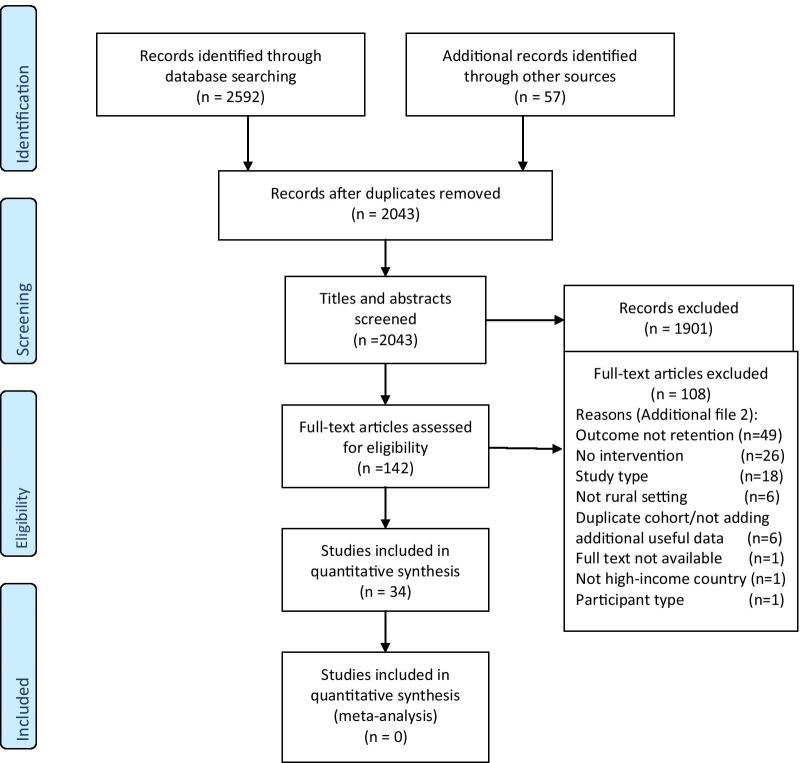
Background: Attracting and retaining sufficient health workers to provide adequate services for residents of rural and remote areas has global significance. High income countries (HICs) face challenges in staffing rural areas, which are often perceived by health workers as less attractive workplaces. The objective of this review was to examine the quantifiable associations between interventions to retain health workers in rural and remote areas of HICs, and workforce retention. Methods: The review considers studies of rural or remote health workers in HICs where participants have experienced interventions, support measures or incentive programs intended to increase retention. Experimental, quasi-experimental and observational study designs including cohort, case–control, cross-sectional and case series studies published since 2010 were eligible for inclusion. The Joanna Briggs Institute methodology for reviews of risk and aetiology was used. Databases searched included MEDLINE (OVID), CINAHL (EBSCO), Embase, Web of Science and Informit. Results: Of 2649 identified articles, 34 were included, with a total of 58,188 participants. All study designs were observational, limiting certainty of findings. Evidence relating to the retention of non-medical health professionals was scant. There is growing evidence that preferential selection of students who grew up in a rural area is associated with increased rural retention. Undertaking substantial lengths of rural training during basic university training or during post-graduate training were each associated with higher rural retention, as was supporting existing rural health professionals to extend their skills or upgrade their qualifications. Regulatory interventions requiring return-of-service (ROS) in a rural area in exchange for visa waivers, access to professional licenses or provider numbers were associated with comparatively low rural retention, especially once the ROS period was complete. Rural retention was higher if ROS was in exchange for loan repayments. Conclusion: Educational interventions such as preferential selection of rural students and distributed training in rural areas are associated with increased rural retention of health professionals. Strongly coercive interventions are associated with comparatively lower rural retention than interventions that involve less coercion. Policy makers seeking rural retention in the medium and longer term would be prudent to strengthen rural training pathways and limit the use of strongly coercive interventions.
Overview
The claims and statistics of this paper haven’t been checked yet.
Free: it reads the open-access text and checks the first 5 claims that cite a source we can check. Create a free account to check every claim.
Integrity signals
Registry
Cites
Statistics
Figures
Verification
Claims the paper makes
The claims and statistics of this paper haven’t been checked yet.
Free: it reads the open-access text and checks the first 5 claims that cite a source we can check. Create a free account to check every claim.
Claims other papers make about this one
Each is checked against this paper’s own text: does it say what the citing paper says it does?
The cited source says what the claim attributes to it.
In the citing paper
“A search for systematic reviews published in the last 10 years examining turnover intention among HCWs on PubMed, PROSPERO and Google Scholar produced nine relevant systematic reviews [11–19]”
From A global overview of healthcare workers’ turnover intention amid COVID-19 pandemic: a systematic review with future directions (2022) · cites this paper as [17]
The cited source says what the claim attributes to it.
In the citing paper
“and many of which were known factors prior to the pandemic [11–19].”
From A global overview of healthcare workers’ turnover intention amid COVID-19 pandemic: a systematic review with future directions (2022) · cites this paper as [17]
In the citing paper
“several systematic reviews highlighted an insufficient number of HWs to enable the provision of quality care, affecting health systems before and during the pandemic, with considerable inequities across countries worldwide [56–60].”
From Health workers’ perspectives on the quality of maternal and newborn health care around the time of childbirth: Results of the Improving MAternal Newborn carE in the EURO Region (IMAgiNE EURO) project in 12 countries of the World Health Organization European Region (2024) · cites this paper as [58]
Self-check
Percentages, sums and reported differences re-computed from the paper’s own numbers.
The self-check needs the paper’s full text.
Citations
Cites
Preferred Reporting Items for Systematic Reviews and Meta-Analyses: the PRISMA statement
Moher, D., Liberati, A., Tetzlaff, J., Altman, D. G., & for the PRISMA Group (2009) · BMJ · doi:10.1136/bmj.b2535 · Cited by 83,823
Preferred reporting items for systematic reviews and meta-analyses: the PRISMA Statement.
(2009) · PubMed Central · Cited by 44,859
Preferred Reporting Items for Systematic Reviews and Meta-Analyses: The PRISMA Statement
Moher, D., Liberati, A., Tetzlaff, J., & Altman, D. G. (2009) · Journal of Clinical Epidemiology · doi:10.1016/j.jclinepi.2009.06.005 · Cited by 19,575
Chapter 7: Systematic reviews of etiology and risk
Moola, S., Munn, Z., Tufanaru, C., Aromataris, E., Sears, K., Sfetic, R., Currie, M., Lisy, K., Qureshi, R., Mattis, P., et al. (2019) · JBI Reviewer's Manual · doi:10.46658/jbirm-17-06 · Cited by 2,114
Chapter 7: Systematic reviews of etiology and risk
(2020) · JBI Manual for Evidence Synthesis · doi:10.46658/jbimes-20-08 · Cited by 1,268 · cited 1×
“This systematic review accords with the Joanna Briggs Institute (JBI) methods for systematic reviews of aetiology and risk evidence [20] and followed an a priori published protocol which more fully describes methods and definitions [21].”
MethodHoltom, B. C., Mitchell, T. R., Lee, T. W.-H., & Eberly, M. B. (2008) · Academy of Management Annals · doi:10.1080/19416520802211552 · Cited by 1,042 · cited 1×
“However, studies reporting job satisfaction without direct turnover or retention outcomes were excluded [22], and we did not use the Grading of Recommendations, Assessment, Development and Evaluation (GRADE) approach for grading the certainty of evidence.”
MethodAnderson, I., Robson, B., Connolly, M., Al-Yaman, F., Bjertness, E., King, A., Tynan, M., Madden, R., Bang, A., Coimbra, C. E. A., et al. (2016) · The Lancet · doi:10.1016/s0140-6736(16)00345-7 · Cited by 990 · cited 1×
“A high proportion of Indigenous peoples live in remote and rural areas, and they experience considerably poorer health outcomes than non-Indigenous citizens [8].”
BackgroundPereira Gray, D. J., Sidaway-Lee, K., White, E., Thorne, A., & Evans, P. H. (2018) · BMJ Open · doi:10.1136/bmjopen-2017-021161 · Cited by 759 · cited 1×
“Hum Resour Health (2021) 19:103 the development of strong professional relationships between health providers and patients which are vital for improving health outcomes of vulnerable populations [2, 3].”
BackgroundWilson, N., Couper, I., de Vries, E., Reid, S., Fish, T., & Marais, B. (2009) · Rural and Remote Health · doi:10.22605/rrh1060 · Cited by 518
Grobler, L., Marais, B. J., & Mabunda, S. (2015) · Cochrane Database of Systematic Reviews · doi:10.1002/14651858.cd005314.pub3 · Cited by 359
Research works printed but not linked: 8
- Dolea C Increasing access to health workers in remote and rural areas through improved retention: global policy recommendations 2010 Geneva World Health Organization 23741785
- Tuttle C Rural-urban differences among older adults 2020 Minneapolis University of Minnesota Rural Health Research Center
- Humphreys JS Improving primary health care workforce retention in small rural and remote communities: how important is ongoing education and training? 2007 Canberra Australian Primary Health Care Research Institute (APHCRI)
- Aromataris E Munn Z Joanna Briggs Institute reviewer's manual 2017 Adelaide The Joanna Briggs Institute
- World Health Organization Increasing access to health workers in remote and rural areas through improved retention—global policy recommendations 2010 Geneva WHO 23741785
- Fleming P Mathews M Retention of specialist physicians in Newfoundland and Labrador Open Med 2012 6 1 e1 9 22567077 PMC3329069
- Patterson DG Family medicine rural training track residencies: 2008–2015 graduate outcomes 2016 Seattle WWAMI Rural Health Research Center, University of Washington
- Russell DJ, et al. Health workforce turnover, stability and employment survival in remote NT health centres 2004–15. In: Proceedings of the 15th national rural health conference, 24–27 March, 2019. Hobart, Tasmania: National Rural Health Alliance.
Cited by
Items 301–355 of 355
Halata, D., Gökdemir, Ö., Javorská, K., Karlsen, M., Hansen, B., Svanholm, C., & Kravtchenko, O. (2026) · Journal of Family Medicine and Primary Care · doi:10.4103/jfmpc.jfmpc_277_25
Do, L. H. M., Biles, J. M., Christian, B., & Sohn, W. (2026) · Australian Dental Journal · doi:10.1111/adj.70054
“The absence of such supports may diminish the attractiveness of rural positions and contribute to workforce instability, particularly in the context of the broader professional and personal demands associated with rural practice [30, 31].”
Ilyin, I. V. (2026) · Economics Management Innovations · doi:10.35433/issn2410-3748-2026-1(38)-20
Enhancing healthcare leadership skills in the remote context
Szakács, S. D. (2025) · doi:10.82465/99
Mardhiah, N., Omalia, N., Fitriati, C. A., & Muhammad, Z. (2026) · NATAPRAJA · doi:10.21831/natapraja.v14i1.88762
Jeffress, K. L. M. (2026) · Teaching and learning in nursing · doi:10.1016/j.teln.2026.05.011
Effect of a mental health nursing competency model: among Indian students
Baskaran, M., Kavitha, J., Jeyadeepa, R., & Rathi, R. (2026) · Bioinformation · doi:10.6026/973206300223050
Ali, T. (2026) · Omdurman Islamic University Journal for Human Sciences · doi:10.52981/oiujhs.v22i2.3622
Educación sin movilidad económica en comunidades rurales ecuatorianas
Wong, J. E. C., Cabrera, J. S. Y., Vaca, F. X. V., & Villanueva, M. S. C. (2026) · Revista Venezolana de Gerencia · doi:10.52080/rvgluz.31.e15.42
Wang, Islam, Ramsden, Guisard, Rostas, & Martiniuk (2026) · Rural and Remote Health · doi:10.22605/rrh9926
Çaylan, Ş. (2026) · Beykoz Akademi Dergisi · doi:10.14514/beykozad.1668989
Balaji, S., Heriot, A. G., Read, M., & Behrenbruch, C. (2026) · ANZ Journal of Surgery · doi:10.1111/ans.70813
Zheng, M., Li, L., Ding, W., Yang, Q., Chen, Y., & Li, N. (2026) · Research Square · doi:10.21203/rs.3.rs-9780300/v1
McElroy, M. (2025) · ResearchOnline at James Cook University (James Cook University) · doi:10.25903/547x-1d63
Yamaguchi, K., Nakanishi, Y., Nishioka, Y., Imamura, T., GROOTE, W. D., & Akahane, M. (2026) · Health Services Insights · doi:10.1177/11786329261461051
“42,43 The low SCR for outpatients is likely owing to residents in the area experiencing difficulties in accessing hospitals.”
Willis, S., Howe, L., Ramachandran, A., Nanyonjo, A., Chandler, R., Hayes, T., Fowler‐Davis, S., & Grafton, K. (2026) · BMJ Leader · doi:10.1136/leader-2025-001465
“32 33 Despite a strong evidence base identifying career progression, supervision, peer support and flexible employment as key enablers of retention, 17 18 national responses have largely relied on short-term incentives or abstract commitments to well-being.”
Climate change and health in the rural context: Vulnerability, capacity and outlook
Rose, D., & Birchall, S. J. (2026) · PLOS Climate · doi:10.1371/journal.pclm.0000974
Barriers and enablers for health system reform
Chávez, D., Main, C., Satish, K., Müller, B., Gill, J., & Kanavos, P. G. (2026) · Frontiers in Health Services · doi:10.3389/frhs.2026.1887541
Rural Health Workforce Development Through the AHEC Scholars Model
Bruno, D., O’Shaughnessy, T., & Taylor, J. D. (2026) · The Journal of Rural Health · doi:10.1111/jrh.70193
Mwene-Batu, P. L., Mulume, A. B., Lembebu, J. C., Mary, M., Ngaboyeka, G. A., Lurhangire, E. O., Bigirinama, R. N., Murhima’alika, C. C., Chiribagula, C. Z., Bisimwa, G. B., et al. (2026) · International Journal of Women s Health · doi:10.2147/ijwh.s621089
“1,11 Structural imbalances in the availability of skilled health professionals (particularly midwives, nurses, and doctors) can hinder access to emergency obstetric and newborn care and compromise the quality of maternal health services.”
Balogun, S. A., Masongo, C., Tijani, H., & Doolan‐Noble, F. (2026) · BMC Health Services Research · doi:10.1186/s12913-026-15090-0
“Most workforce analyses focus on the recruitment and retention of early to mid-career GPs [9– 11].”
Fenyi, S., & Keelson, S. A. (2026) · African Journal of Primary Health Care & Family Medicine · doi:10.4102/phcfm.v18i1.5381
Чубенко, О. В., Гузенко, Н. В., & Чорна, О. В. (2026) · Kharkiv National Medical University Repository (Kharkiv National Medical University)
Oyama, K., Kawazuma, Y., Ae, R., Noda, H., & Matsui, K. (2026) · BMC Family Practice · doi:10.1186/s12875-026-03521-0
Miller, K. L., Hale-Gallardo, J. L., Wilson, J. R., Swee, M. L., Tovar, L. I., & Hicken, B. L. (2026) · The Journal of Rural Health · doi:10.1111/jrh.70206
Job Satisfaction Links Salary to Employee Retention in Primary Healthcare
Hidayatulloh, A. I., & Mahendri, W. (2026) · Journal of Social Research and Innovation · doi:10.67548/josri.v2i2.291
Amoguis, R. N. B. (2026) · British Journal of Multidisciplinary and Advanced Studies · doi:10.37745/bjmas.0588
Siddiqui, A., Karthikeyan, H., Mehta, B. A. R., Jamal, F., & Sharma, R. (2026) · South Asian Research Journal of Nursing and Healthcare · doi:10.36346/sarjnhc.2026.v08i04.005
Self-perceived competencies from physicians enrolled in the Peruvian Rural Service
Flores-Cohaila, J. A., Miranda-Chávez, B., Rivarola-Hidalgo, M., & Corzo, C. A. C. (2026) · Heliyon · doi:10.1016/j.heliyon.2026.e45307
(2025) · repository of the Library and Information Centre, Hungarian Academy of Sciences (REAL-J)
Samuel‐Hodge, C. D., Harrison, L. M., Smith, W., Johnson, K., Feng, A., & Noonan, D. (2026) · Frontiers in Public Health · doi:10.3389/fpubh.2026.1893009
Väyrynen, E., Nedaei, A., Tiensuu, H., Suutala, J., Anttonen, V., Laitala, M., Kukkola, K., & Karki, S. (2026) · BMC Oral Health · doi:10.1186/s12903-026-09812-3
Strategies to Reduce Staff Shortages in a Freestanding Dialysis Clinic in Rural Georgia
Sanders, S. D. (2026) · ScholarWorks (Walden University)
Shiddiqi, P., SKP, R. S. A., Damayanti, P. W., Fatimah, F., & Efewati, Y. (2026) · Jurnal Publikasi Sistem Informasi dan Manajemen Bisnis · doi:10.55606/jupsim.v5i3.8102
Watanabe, J., Matsubara, D., Nakamura, A., & Kotani, K. (2026) · JMA Journal · doi:10.31662/jmaj.2026-0078
“To address the geographic maldistribution of physicians, countries have generally used two models of rural workforce programs: education-based rural training programs without a service obligation and a contract-based sys-tem with a return-of-service obligation (2) .”
The Midwives’ Data Hub as Workforce Policy Intelligence for Staffing, Well‐Being and Equity
Kubota, K., & Shimpuku, Y. (2026) · International Nursing Review · doi:10.1111/inr.70240
“Evidence on rural and remote workforce retention suggests that such responses are most effective when they combine professional, organisational, financial and personal support rather than relying on single incentives (Russell et al. 2021 ; World Health Organization 2021b ).”
Niederbaumer, L., Lichtenberg, M., Schievelbein, D. M., Seydel, A. O., Carlson, N., Garren-Grubbs, T., Currier, D., Williamson, B., Mehlhaff, A., Schmit, M., et al. (2026) · Healthcare · doi:10.3390/healthcare14213767
Effet des mesures incitatives et coercitives sur la rétention régionale des médecins de famille
Fortin, B., & Gbeto, J. (2026) · doi:10.54932/lwqs2278
Mose, F. M. (2026) · SU+ Digital Repository (Strathmore University)
Brimah, B. A. (2025) · Islamic University Journal of Social Sciences
MacAskill, O’Shannessy, Walters, Bajra, Edwards, & Pinidiyapathirage (2026) · Rural and Remote Health · doi:10.22605/rrh10203
Desafíos frente a la formación del talento humano en enfermeria para el cuidado de la salud global
Cáceres, L. R. (2026) · Revista Ciencia y Cuidado · doi:10.22463/17949831.5965
Ali, T. (2026) · Journal of Northern Europe Academy for Studies and Research · doi:10.53348/nea6se33
Kerr, L. D., Seal, A. N., & Singh, N. (2026) · Journal of Medical Imaging and Radiation Oncology · doi:10.1111/1754-9485.70212
Bock, P., O'Sullivan, B. G., & Abouzeid, M. (2026) · Research Square · doi:10.21203/rs.3.rs-10888328/v1
Occupational Stress, Resiliency and Retention among Healthcare Worker
Leonida, L. P., & Martir, E. M. (2026) · International Journal of Science and Management Studies (IJSMS) · doi:10.51386/25815946/ijsms-v9i3p105
Gautier, G., Mutricy, R., Negrello, F., Terrentroy, G., Douine, M., Eeckhout, M., Kallel, H., & Frémery, A. (2026) · Journal of Emergency Medicine · doi:10.1016/j.jemermed.2026.10.015
An, S. (2026) · Korean Medical Education Review · doi:10.17496/kmer.26.049
Decoding Doctor Departure Decisions in Regional Queensland
Hodge, E., Thomson, A., Moses, L., & Pu, L. H.-L. (2026) · Asia Pacific Journal of Health Management · doi:10.24083/apjhm.v21i2.5725
Factors that shape educational mobility for nurses working in rural areas: A scoping review
Wells, L., Grant, J., & Laver, S. (2026) · Nurse Education Today · doi:10.1016/j.nedt.2026.107486
Powe, G., Quick, S., & Filonenko, E. (2026) · Radiography · doi:10.1016/j.radi.2026.103632
Astle, H. (2026) · ScholarWorks (Walden University)
Rural health care and epistemic injustice: Implications for education
Kilbertus, F., Dennis, A. A., & Ajjawi, R. (2026) · Medical Education · doi:10.1111/medu.70357
Jayarathne, Y. G. S. W., Cantwell, B., Keniry, C., Hawkins, Y., Joyce, C., & Hegazi, I. (2026) · Medical Education Online · doi:10.1080/10872981.2026.2760643
McKnight, J., Maina, M., Okiro, E. A., Mumba, N., Kagwanja, N., Karumba, K., Odipo, E., Kiti, M. C., Mwangome, N., Karingu, P., et al. (2026) · NIHR Open Research · doi:10.3310/nihropenres.14393.1
Metadata
- Authors
- Russell, D., Mathew, S., Fitts, M., Liddle, Z., Murakami-Gold, L., Campbell, N., Ramjan, M., Zhao, Y., Hines, S., Humphreys, J. S., & Wakerman, J.
- Affiliations
- Charles Darwin University (AU)
- Flinders University (AU)
- Government of the Northern Territory (AU)
- Monash University (AU)
- Corresponding author
- Russell, Deborah
- ORCID
- Venue
- Human Resources for Health
- Published
- 2021-08-26
- Volume
- 19
- Issue
- 1
- Pages
- 103-103
- ISSN
- 1478-4491 (ISSN-L)
- PMC
- PMC8393462
- OpenAlex
- W3193525039
- Cited by
- 268
- References
- 66
- Citations by year
- 2026: 53 · 2025: 85 · 2024: 66 · 2023: 49 · 2022: 15
- FWCI
- 7.99
- Type
- journal article
- Language
- en
- Open access
- gold
- doi.org
- Licence
- cc-by
- creativecommons.org/licenses/by/4.0 (tdm)
- creativecommons.org/licenses/by/4.0 (vor)
- Locations
- Human Resources for Health (publishedVersion, cc-by)
- PubMed Central (publishedVersion, cc-by)
- PubMed (publishedVersion)
- DOAJ (DOAJ: Directory of Open Access Journals) (submittedVersion, cc-by-sa)
- Funders
- australian research council (DP190100328)
- australian government medical research future fund
- Topics
- Health Sciences › Medicine › Public Health, Environmental and Occupational Health › Global Health Workforce Issues
- Social Sciences › Education › Education in Rural Contexts
- Health Sciences › Health Professions › General Health Professions › Healthcare Systems and Challenges
- Keywords
- health workforce retention, rural health workers, remote areas, rural health workforce shortage, loan repayment, visa waiver, professional licensing, coercive measures, non-medical health professionals, high-income countries
- MeSH terms
- Workforce, Cross-Sectional Studies, Health Workforce, Humans, Medically Underserved Area, Rural Health Services, Observational Studies as Topic
About these checks
Registry, retraction, Cites and statistics results are computed, not judged, with one exception: a printed reference that no index lists is read once by a model before it counts as a citation error. Claims are extracted by a model and kept only when their quote appears verbatim in the text; each cited source is then checked, with a model’s help, for whether it says what the claim relies on. Those verdicts can be wrong — read the claim’s quote and the cited source before relying on one.
Statistics and arithmetic are recomputed, not judged.
Confidence bands are shown only for fields calibrated on our annotated test set. None is calibrated yet, so no band is shown.
What counts as a claim ›How we measure confidence ›How we check this ›
Are you an author, or do you see a problem with this page? Request a review
Data sources
Bibliographic data: Semantic Scholar, OpenAlex, Crossref.
Contains information from the Semantic Scholar Academic Graph Datasets, made available under the ODC Attribution License (ODC-BY 1.0).
Semantic Scholar’s data is described in: Kinney, R., et al. (2023). The Semantic Scholar Open Data Platform. arXiv:2301.10140.
