

A global overview of healthcare workers’ turnover intention amid COVID-19 pandemic: a systematic review with future directions
Open accessThe DOI matches its Crossref record; 88 of the 88 references it cites were found in a registry or an index; 64 of the 133 sources its claims cite were checked for support.
Abstract
Background: Globally, the health workforce has long suffered from labour shortages. This has been exacerbated by the workload increase caused by the COVID-19 pandemic. Major collapses in healthcare systems across the world during the peak of the pandemic led to calls for strategies to alleviate the increasing job attrition problem within the healthcare sector. This turnover may worsen given the overwhelming pressures experienced by the health workforce during the pandemic, and proactive measures should be taken to retain healthcare workers. This review aims to examine the factors affecting turnover intention among healthcare workers during the COVID-19 pandemic. Methods: A mixed studies systematic review was conducted. The PubMed, Embase, Scopus, CINAHL, Web of Science and PsycINFO databases were searched from January 2020 to March 2022. The Joanna Briggs Institute’s Critical Appraisal Tools and the Mixed Methods Appraisal Tool version 2018 were applied by two independent researchers to critically appraise the methodological quality. Findings were synthesised using a convergent integrated approach and categorised thematically. Results: Forty-three studies, including 39 quantitative, two qualitative and two mixed methods studies were included in this review. Eighteen were conducted in the Middle East, ten in the Americas, nine in the Asia–Pacific region and six in Europe. Nurses ( n = 35) were included in the majority of the studies, while physicians ( n = 13), allied health workers ( n = 11) and healthcare administrative or management staff ( n = 7) were included in a smaller proportion. Five themes emerged from the data synthesis: (1) fear of COVID-19 exposure, (2) psychological responses to stress, (3) socio-demographic characteristics, (4) adverse working conditions, and (5) organisational support. Conclusions: A wide range of factors influence healthcare workers’ turnover intention in times of pandemic. Future research should be more focused on specific factors, such as working conditions or burnout, and specific vulnerable groups, including migrant healthcare workers and healthcare profession minorities, to aid policymakers in adopting strategies to support and incentivise them to retain them in their healthcare jobs.
Overview
CoChat Summary
TL;DR
This mixed-studies systematic review synthesizes 43 studies on healthcare workers’ turnover intention during the COVID-19 pandemic and identifies five themes: fear of COVID-19 exposure, psychological responses to stress, socio-demographic characteristics, adverse working conditions, and organisational support. It concludes that turnover intention is shaped by multiple pandemic-exacerbated factors, with fear of exposure being the most prevalent and resilience/social/organisational support appearing protective.
Key findings
- The review included 43 studies: 39 quantitative, 2 qualitative, and 2 mixed methods; 18 were from the Middle East, 10 from the Americas, 9 from Asia–Pacific, and 6 from Europe. Nurses were included in 35 studies, physicians in 13, allied health workers in 11, and administrative/management staff in 7.
- Five themes emerged: (1) fear of COVID-19 exposure, (2) psychological responses to stress, (3) socio-demographic characteristics, (4) adverse working conditions, and (5) organisational support. Fear of COVID-19 exposure was the most prevalent theme, with 12 studies reporting a positive correlation or association with turnover intention.
- Psychological factors linked to higher turnover intention included stress/anxiety, depression, burnout, compassion fatigue, and COVID-19-associated discrimination; resilience was negatively correlated with turnover intention in multiple studies and acted as a protective mechanism in two.
- Adverse working conditions associated with turnover intention included increased workload, long working hours, workplace violence, deployment to other departments, and perceived low rewards; organisational trust, perceived organisational support, quality employer communication, job preparedness, and leadership support were associated with reduced turnover intention.
Methods
- Mixed studies systematic review using Joanna Briggs Institute methodology and a convergent integrated approach; PubMed, Embase, Scopus, CINAHL, Web of Science, and PsycINFO were searched from January 2020 to March 2022.
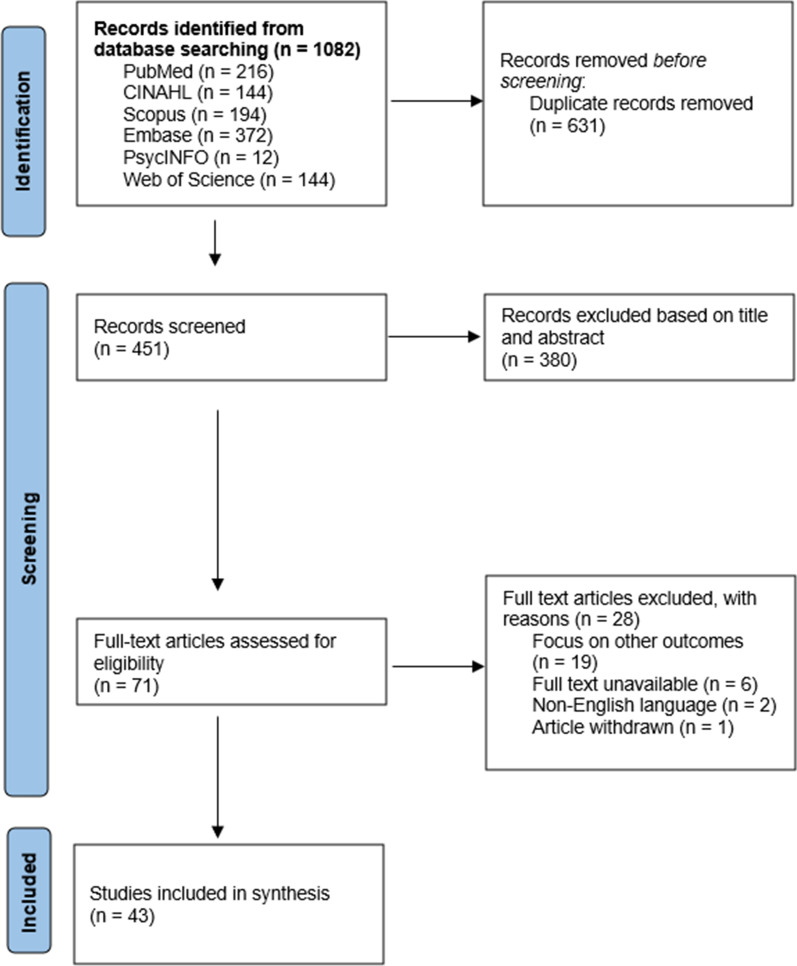
- From 1,082 retrieved articles, 43 met inclusion criteria after screening; two independent reviewers performed selection, critical appraisal, and data extraction, with disagreements resolved by discussion and a third reviewer when needed.
- Methodological quality was appraised with JBI Critical Appraisal Tools and MMAT 2018; findings were synthesized thematically using a three-step thematic synthesis and presented narratively.
Limitations
- Stated by the paper: grey literature and non-English studies were excluded; some included studies did not account for confounding factors; turnover intention was measured rather than actual turnover, though the paper notes evidence that these are correlated; and heterogeneity prevented a meta-analysis.
- Evident from the text: most included studies were quantitative and cross-sectional (39 of 43), limiting causal inference; nurses were included in the vast majority of studies (n = 35), so findings may not equally represent physicians, allied health workers, or administrative/management staff.
Model-written summary. Check it against the paper before relying on it.
Integrity signals
Registry
Cites
Statistics
Figures
Verification
Claims the paper makes
43 Valid · 0 Not valid · 38 Not checked · 33 Own results and interpretations
Every source the paper cites for this claim was checked and supports it.
In the paper
“One integrative review examined the COVID-19 pandemic’s impact on predictors of nurses’ turnover intention”
§ A global overview of healthcare workers’ turnover intention amid COVID-19 pandemic: a systematic review with future directions > Background
What the sources say
- Supportedcites [20] Falatah R The impact of the coronavirus disease (COVID-19) pandemic on nurses’ turnover intention: an integrative review Nurs Rep. 2021 10.3390/nursrep11040075 34968269 PMC8715458 source
The Aim (1.1, p.1) states the review appraised and integrated turnover literature using Whittemore and Knafl's integrative review method, asking 'What are the predictors of nurse turnover before and after the COVID-19 pandemic?' The Conclusions (6) state that on the basis of 43 studies 'the COVID-19 pandemic has impacted both the rates and predictors of nurses' turnover intention,' and the Discussion (3) confirms the shift in most-reported predictors post-COVID-19 (fear, stress, anxiety) versus pre-COVID-19 (satisfaction, commitment, leadership style). Thus the source is indeed an integrative review examining the pandemic's impact on predictors of nurses' turnover intention. (LLM, conf=0.95)
plain- Asserted: passes — The authors put it forward as true.
- Checkable: passes — It can be checked against evidence.
- Load-bearing: passes — The paper’s conclusions depend on it.
- Based: passes — The paper gives a reason why it holds.
- Supported
The sources with a verdict support this claim; the rest weren’t checked yet, have no full text we could read, or their verdicts aren’t rated yet.
In the paper
“A search for systematic reviews published in the last 10 years examining turnover intention among HCWs on PubMed, PROSPERO and Google Scholar produced nine relevant systematic reviews [11–19]”
§ A global overview of healthcare workers’ turnover intention amid COVID-19 pandemic: a systematic review with future directions > Background
What the sources say
- Not checked yetcites [11] Cowden T Cummings G Profetto-McGrath J Leadership practices and staff nurses' intent to stay: a systematic review J Nurs Manag 2011 19 4 461 477 10.1111/j.1365-2834.2011.01209.x 21569143 source
- Not checked yetcites [12] Daouk-Öyry L Anouze AL Otaki F Dumit NY Osman I The JOINT model of nurse absenteeism and turnover: a systematic review Int J Nurs Stud 2014 51 1 93 110 10.1016/j.ijnurstu.2013.06.018 23928322 source
- Supportedcites [13] Halter M Boiko O Pelone F Beighton C Harris R Gale J The determinants and consequences of adult nursing staff turnover: a systematic review of systematic reviews BMC Health Serv Res 2017 17 1 824 10.1186/s12913-017-2707-0 29246221 PMC5732502 source
The cited paper is a systematic review of systematic reviews on adult nursing staff turnover; its Discussion explicitly includes intention to leave among the outcomes considered. In the citing sentence, [11–19] identifies the nine reviews found by the citing authors, so this source supports its role as one relevant review. The citing authors’ search databases and total of nine are not attributed to this individual paper. (LLM, conf=0.86)
- Supportedcites [14] Lai GC Taylor EV Haigh MM Thompson SC Factors affecting the retention of indigenous australians in the health workforce: a systematic review Int J Environ Res Public Health 2018 10.3390/ijerph15050914 29734679 PMC5981953 source
The citation identifies this paper as one of the relevant systematic reviews, rather than attributing the citing authors’ search or its count of nine to this paper alone. The Methods (section 2.2) describe a review of retention and turnover among Indigenous Australian health workers, and the Introduction explicitly discusses turnover intention in that workforce. (LLM, conf=0.88)
- Not checked yetcites [15] Lartey S Cummings G Profetto-McGrath J Interventions that promote retention of experienced registered nurses in health care settings: a systematic review J Nurs Manag 2014 22 8 1027 1041 10.1111/jonm.12105 23758834 source
- Supportedcites [16] Lee J Nursing home nurses' turnover intention: a systematic review Nurs Open 2022 9 1 22 29 10.1002/nop2.1051 34811952 PMC8685779 source
The Abstract (Design) identifies this paper as a systematic review, and the Introduction identifies its subject as nursing-home nurses’ turnover intentions. It therefore fits as one of the relevant reviews cited; the search of PubMed, PROSPERO and Google Scholar and the count of nine describe the citing authors’ search, not a finding attributed to this individual source. (LLM, conf=0.90)
- Supportedcites [17] Russell D Mathew S Fitts M Liddle Z Murakami-Gold L Campbell N Interventions for health workforce retention in rural and remote areas: a systematic review Hum Resour Health 2021 19 1 103 10.1186/s12960-021-00643-7 34446042 PMC8393462 source
The cited work is a 2021 systematic review of health-worker retention, and its Methods > Inclusion criteria list intention to stay or leave among the eligible outcomes. It therefore qualifies as a relevant review in the citing authors’ list; the search procedure and total of nine reviews are the citing authors’ own account, not findings attributed to this individual source. (LLM, conf=0.85)
- Supportedcites [18] Shen X Jiang H Xu H Ye J Lv C Lu Z The global prevalence of turnover intention among general practitioners: a systematic review and meta-analysis BMC Fam Pract 2020 21 1 246 10.1186/s12875-020-01309-4 33250045 PMC7702723 source
The Methods (Search strategy and selection criteria) identify this paper as a systematic review and meta-analysis of turnover intention among general practitioners, who are healthcare workers. In the citing sentence, the grouped citations identify the reviews found by the citing authors; this source qualifies as one such review. (LLM, conf=0.89)
- Not checked yetcites [19] Yildiz B Yildiz H Ayaz AO Relationship between work-family conflict and turnover intention in nurses: a meta-analytic review J Adv Nurs 2021 77 8 3317 3330 10.1111/jan.14846 33855744 source
plain- Asserted: passes — The authors put it forward as true.
- Checkable: passes — It can be checked against evidence.
- Load-bearing: passes — The paper’s conclusions depend on it.
- Based: passes — The paper gives a reason why it holds.
The cited sources support only part of this claim — read each source’s verdict below.
In the paper
“A major contributing factor to the shortages seen in the health workforce is employee turnover [3].”
§ A global overview of healthcare workers’ turnover intention amid COVID-19 pandemic: a systematic review with future directions > Background
What the sources say
- Partly supportedcites [3] Dawson AJ Stasa H Roche MA Homer CSE Duffield C Nursing churn and turnover in Australian hospitals: nurses perceptions and suggestions for supportive strategies BMC Nurs 2014 13 1 11 10.1186/1472-6955-13-11 24708565 PMC3985533 sourceExperimental — accuracy not yet measured
The Background (p.1) treats high nursing turnover as 'a problem currently affecting many countries' whose staff movement 'can negatively impact upon skill-mix, scheduling and continuity of care', and lists costs, morale/productivity and patient-safety consequences — so turnover as a major staffing problem is supported. However, no passage states that turnover is a contributing factor to health workforce shortages; where our copy discusses shortages (Results, 'Low nurse-to-patient ratios'; Discussion, 'Work design'), shortages and reduced staff supply appear as antecedents of workload/dissatisfaction rather than as an outcome of turnover. The claim also generalises beyond the paper's scope, which is nurses in Australian hospital medical and surgical units, not the health workforce overall. (LLM, conf=0.65)
plainstates a cause- Asserted: passes — The authors put it forward as true.
- Checkable: passes — It can be checked against evidence.
- Load-bearing: passes — The paper’s conclusions depend on it.
- Based: passes — The paper gives a reason why it holds.
- Partly supported
The cited sources support only part of this claim — read each source’s verdict below.
In the paper
“Nurses were at a greater risk of experiencing turnover intention during the COVID-19 pandemic compared to pre-pandemic times [53].”
§ A global overview of healthcare workers’ turnover intention amid COVID-19 pandemic: a systematic review with future directions > Results > Data synthesis
What the sources say
- Partly supportedcites [53] Nashwan AJ Abujaber AA Villar RC Nazarene A Al-Jabry MM Fradelos EC Comparing the impact of covid-19 on nurses’ turnover intentions before and during the pandemic in qatar J Pers Med. 2021 11 6 787 810 10.3390/jpm11060456 34073655 PMC8225037 sourceExperimental — accuracy not yet measured
The Discussion (Section 5) and the Results subsection 'Stress Levels during and before COVID-19' state that nurses' turnover intentions were significantly higher during COVID-19 than before (Wilcoxon Z = -11.058, p < 0.01), echoed in the Abstract's conclusion for nurses in Qatar, so the direction of the comparison is supported. However, that finding comes from a single cross-sectional survey of 512 nurses at Hamad Medical Corporation in Qatar (Methods, Section 2; Results, Section 4), whereas the citing sentence attributes elevated turnover intention to 'nurses' generally, so the population is wider than the source studied. The Section 6 Limitations also flag recall bias for the pre-pandemic comparison and a 4.3% response rate, and the paper reports higher turnover-intention scores rather than a measurable 'risk'; it does note the opposite trend in the 21-30 age subgroup (Discussion). (LLM, conf=0.72)
plainstates an association- Asserted: passes — The authors put it forward as true.
- Checkable: passes — It can be checked against evidence.
- Load-bearing: unclear — It is unclear whether the paper’s conclusions depend on it.
- Based: passes — The paper gives a reason why it holds.
- Partly supported
Every source the paper cites for this claim was checked and supports it.
In the paper
“with two studies concluding that it acted as a protective mechanism against factors that contributed to turnover intention [43, 44].”
§ A global overview of healthcare workers’ turnover intention amid COVID-19 pandemic: a systematic review with future directions > Results > Data synthesis
What the sources say
- Supportedcites [43] Labrague LJ, Santos JAA de los. Resilience as a mediator between compassion fatigue, nurses' work outcomes, and quality of care during the COVID-19 pandemic. Appl Nurs Res. 2021; 10.1016/j.apnr.2021.151476 PMC8448586 34544570 source
The Results (Table 3 and accompanying text) show compassion fatigue positively associated with turnover intention (β = 0.301, p = 0.001) while resilience was negatively associated with turnover intention (β = −0.178, p = 0.004) and partially mediated the CF → turnover intention link (β = 0.272, p = 0.001), i.e. 'resilience reduced the effects of CF on ... organizational turnover intention'. The Discussion states this confirms 'its protective role against various mental and psychological consequences of stress-provoking events', and the Abstract Conclusion that 'Psychological resilience reduces the negative impact of CF on frontline nurses' job satisfaction, turnover intention, and the quality of care'. Thus the paraphrase that resilience acted as a protective mechanism against factors contributing to turnover intention is what this source reports, for frontline nurses during the COVID-19 pandemic (the paper does note its cross-sectional design limits causal inference). (LLM, conf=0.85)
- Supportedcites [44] Labrague LJ De Los Santos JAA Fronda DC Perceived COVID-19-associated discrimination, mental health and professional-turnover intention among frontline clinical nurses: the mediating role of resilience Int J Ment Health Nurs 2021 30 6 1674 1683 10.1111/inm.12920 34374480 PMC8447016 source
The Results (p. 2, Table 4 discussion) state that psychological resilience mediated the relationship between COVID-19-associated discrimination and professional-turnover intention and that 'resilience reduced the negative effects of COVID-19-related discrimination and resulted in improved mental health and reduced professional-turnover intention', with resilience itself negatively associated with turnover intention (β = -0.182, p = 0.004). The Discussion repeats this as a key finding, describing resilience as a protective factor, which matches the citing sentence's paraphrase of a protective mechanism against factors contributing to turnover intention. (Minor detail: the indirect path via resilience to turnover intention was reported as full mediation with p = 0.107 / Sobel p = 0.07, but the paper nonetheless frames it as protective.) (LLM, conf=0.85)
plainstates a cause- Asserted: passes — The authors put it forward as true.
- Checkable: passes — It can be checked against evidence.
- Load-bearing: unclear — It is unclear whether the paper’s conclusions depend on it.
- Based: passes — The paper gives a reason why it holds.
- Supported
73 more claims · 37 with their cited sources checked
Create a free account to see all 114 claims and to verify the 69 references still open.
- It may state two separate claims as one. 27
- Probably not a substantial claim. 12
- The quote only partly states this claim. 2
Claims other papers make about this one
Each is checked against this paper’s own text: does it say what the citing paper says it does?
The source backs part of the claim, not all of it — or backs it for a different population, condition or comparison.
In the citing paper
“The implications of mental health problems in these professionals not only refer to their well-being but also include social and organizational consequences, such as increasing rates of absenteeism and turnover intention [9-11], as well as so-called quiet quitting [12].”
From Effectiveness of a Web-Based Self-Guided Intervention (MINDxYOU) for Reducing Stress and Promoting Mental Health Among Health Professionals: Results From a Stepped-Wedge Cluster Randomized Trial (2025) · cites this paper as [11]
Experimental — accuracy not yet measuredIn the citing paper
“several systematic reviews highlighted an insufficient number of HWs to enable the provision of quality care, affecting health systems before and during the pandemic, with considerable inequities across countries worldwide [56–60].”
From Health workers’ perspectives on the quality of maternal and newborn health care around the time of childbirth: Results of the Improving MAternal Newborn carE in the EURO Region (IMAgiNE EURO) project in 12 countries of the World Health Organization European Region (2024) · cites this paper as [60]
Self-check
Percentages, sums and reported differences re-computed from the paper’s own numbers.
Each contradiction between two passages listed here was confirmed by an independent check.
Rated major: it would touch a result — a value a result rests on, reported and recomputed p-values on opposite sides of the significance level, two passages that conflict with no sign which is right, or a cited work retracted before this paper was published.
In the paper
§ A global overview of healthcare workers’ turnover intention amid COVID-19 pandemic: a systematic review with future directions > Results > Data synthesis
“While two American studies found that seniority in nurses was associated with greater turnover intention [34, 50]”
§ A global overview of healthcare workers’ turnover intention amid COVID-19 pandemic: a systematic review with future directions > Results > Study characteristics
“Age and quality of work–life were negatively correlated with turnover intention”
Citations
Cites
Methods for the thematic synthesis of qualitative research in systematic reviews
Thomas, J., & Harden, A. (2008) · BMC Medical Research Methodology · doi:10.1186/1471-2288-8-45 · Cited by 9,312
The Mixed Methods Appraisal Tool (MMAT) version 2018 for information professionals and researchers
Hong, Q. N., Fàbregues, S., Bartlett, G., Boardman, F., Cargo, M., Dagenais, P., Gagnon, M.-P., Griffiths, F., Nicolau, B., O’Cathain, A., et al. (2018) · Education for Information · doi:10.3233/efi-180221 · Cited by 4,737 · cited 1×
“The Mixed Methods Appraisal Tool (MMAT) version 2018 [24] was used to appraise mixed methods studies.”
MethodLabrague, L. J., & Santos, J. A. A. (2021) · Journal of Nursing Management · doi:10.1111/jonm.13168 · Cited by 882 · cited 1×
“Six quantitative studies used the Fear of COVID-19 Scale (FCV-19S) as an instrument to measure the psychological impact of exposure to COVID-19 on HCWs [26, 36, 37, 41, 42, 49], while one study used the Coronavirus Anxiety Scale (CAS) [39], with all studies finding a positive correlation between fear of COVID-19 expos…”
MethodNurse turnover: A literature review
Hayes, L. J., O’Brien-Pallas, L., Duffield, C., Shamian, J., Buchan, J., Hughes, F., Spence Laschinger, H. K., North, N., & Stone, P. W. (2006) · International Journal of Nursing Studies · doi:10.1016/j.ijnurstu.2005.02.007 · Cited by 873 · cited 2×
“In the context of the healthcare sector, turnover intention refers to the willingness of healthcare workers (HCWs) to leave their positions of employment for other positions in either the same or different professions [4].”
BackgroundMental health care for medical staff and affiliated healthcare workers during the COVID-19 pandemic
Walton, M., Murray, E., & Christian, M. D. (2020) · European Heart Journal: Acute Cardiovascular Care · doi:10.1177/2048872620922795 · Cited by 791 · cited 2×
“, childcare, grocery shopping) for HCWs in isolation or quarantine should also not be neglected [86].”
BackgroundMethodological guidance for the conduct of mixed methods systematic reviews
Stern, C., Lizarondo, L., Carrier, J., Godfrey, C., Rieger, K., Salmond, S., Apóstolo, J., Kirkpatrick, P., & Loveday, H. (2020) · JBI Evidence Synthesis · doi:10.11124/jbisrir-d-19-00169 · Cited by 700
Stigma during the COVID-19 pandemic
Bagcchi, S. (2020) · The Lancet Infectious Diseases · doi:10.1016/s1473-3099(20)30498-9 · Cited by 650 · cited 1×
“To make matters worse, frontline HCWs around the world endured episodes of harassment and violence at the hands of members of the public who held irrational beliefs about the transmissibility of COVID-19 [83].”
BackgroundThe validation of the turnover intention scale
Bothma, C. F. C., & Roodt, G. (2013) · SA Journal of Human Resource Management · doi:10.4102/sajhrm.v11i1.507 · Cited by 570 · cited 1×
“Quantitative studies measured turnover intention with the Turnover Intention Scale (TIS-6) [69] or modified versions, Likert scales, or yes–no questions.”
MethodThe Italian health system and the COVID-19 challenge
Armocida, B., Formenti, B., Ussai, S., Palestra, F., & Missoni, E. (2020) · The Lancet Public Health · doi:10.1016/s2468-2667(20)30074-8 · Cited by 554 · cited 1×
“The severity of COVID-19 infections, coupled with the large number of cases, placed immense pressure on healthcare systems as high volumes of patients in need of acute treatment required hospitalisation; some regions suffered from high COVID-19 mortality rates due to shortages of medical workers and equipment [2].”
BackgroundSaid, R. M., & El-Shafei, D. A. (2021) · Environmental Science and Pollution Research · doi:10.1007/s11356-020-11235-8 · Cited by 408 · cited 1×
“In addition, HCWs who worked long hours, or faced an increase in working hours due to the pandemic, were more prone to experiencing turnover intention [40, 50, 55, 59].”
Background
Cited by
Items 201–300 of 422
Boitet, L. M., Meese, K. A., Colón‐López, A., Sweeney, K. L., & Rogers, D. A. (2023) · Journal of Healthcare Risk Management · doi:10.1002/jhrm.21542 · Cited by 4
Licona-Enríquez, J. D., Labra-Zamora, M. G., Ramírez‐Reyes, A. G., & Miranda-Novales, M. G. (2023) · Antibiotics · doi:10.3390/antibiotics12101501 · Cited by 3
“According to a systematic review by Koontalay A. et al., these factors can contribute to the burnout and discontinuity of healthcare practice, and can threaten patients’ safety [19].”
MethodLama Waktu Tunggu Pelayanan Pasien: Studi Kualitatif di Puskesmas Padang Bulan
Banjarnahor, E. I., Ginting, C. N., Manalu, P., & Girsang, E. (2023) · Ahmar Metastasis Health Journal · doi:10.53770/amhj.v3i1.182 · Cited by 3
Ioannidis, J. P. A. (2024) · European Journal of Epidemiology · doi:10.1007/s10654-024-01169-7 · Cited by 3
“Among active physicians 75-84 years old, those who had direct patient care had a modestly higher risk than the general population, while those without direct patient care had a modestly lower risk than the general population with absolute risk differences in the range of 1 in 1000.”
Binkanan, A., Althobaiti, R., & Alqassab, H. (2024) · Chronic Wound Care Management and Research · doi:10.2147/cwcmr.s464380 · Cited by 5
van den Hout, N. J., Bouma, D., Hoffmans, C. C. A., Zwarts, N., Treur, J., & Roelofsma, P. H. M. P. (2024) · Studies in systems, decision and control · doi:10.1007/978-3-031-72075-8_12 · Cited by 3
Rayner, E., Brown, T., Hewitt, A. E., Lunt, A., McKeever, J., Thorpe, M., Leong, A., & Douglas, F. (2025) · Work · doi:10.1177/10519815241311128 · Cited by 4
Clinical data transmission in intensive care unit: what have we learned from COVID-19?
Pota, V., Coletta, F., Visconti, A., Landi, G., & Pace, M. C. (2023) · Advances in Anesthesia and Pain Medicine · doi:10.4081/amsa.2023.26 · Cited by 3
Gómez‐Brufal‐Flores, M., Hueso‐Montoro, C., Esteban‐Burgos, A. A., Montoya‐Juárez, R., Mota‐Romero, E., Capilla-Díaz, C., & Puente‐Fernández, D. (2023) · Journal of Advanced Nursing · doi:10.1111/jan.15815 · Cited by 5
Global Emergency Medicine: A Scoping Review of the Literature from 2022
Hexom, B. J., Quao, N. S. A., Bandolin, N. S., Bonney, J., Collier, A., Dyal, J. W., Lee, J. A., Nicholson, B., Rybarczyk, M. M., Rees, C. A., et al. (2023) · Academic Emergency Medicine · doi:10.1111/acem.14816 · Cited by 4
Shahrin, L., Nowrin, I., Afrin, S., Rahaman, M. Z., Hasan, M. M. A., & Saif‐Ur‐Rahman, K. (2023) · The Lancet Regional Health - Southeast Asia · doi:10.1016/j.lansea.2023.100340 · Cited by 3
Meng, L., Wang, X., Du, J., Lin, X., Zhang, X., & Lu, X. (2023) · SAGE Open · doi:10.1177/21582440231216542 · Cited by 5
“Besides, nurses who are overworked to compensate for the understaffing issue may experience stress and burnout, which may affect the quality of care they provide and increase the chance of making work errors (Poon et al., 2022).”
BackgroundXu, H. G., Johnston, A. N. B., & Ray‐Barruel, G. (2024) · Advanced Emergency Nursing Journal · doi:10.1097/tme.0000000000000516 · Cited by 3
“Furthermore, the COVID pandemic resulted in high volumes of staff turnover and redeployment (Cornish, Klim, & Kelly, 2021; Poon et al., 2022 Utilizing senior and capable nurses, such as nurse practitioners who are not part of the traditional nursing education team, to assist in nursing education…”
BackgroundLanz, J. J., & Tedone, A. M. (2025) · Occupational Health Science · doi:10.1007/s41542-025-00228-z · Cited by 4
“Nevertheless, reviews of turnover intentions during the pandemic are largely correlational (Poon et al., 2022; Tolksdorf et al., 2022).”
Nizigiyimana, A., Acharya, D., & Poder, T. G. (2023) · Health and Quality of Life Outcomes · doi:10.1186/s12955-023-02145-7 · Cited by 5
“This difference could be attributable to variations in participants’ background characteristics, geography, study period, and other frontline workers’ work-related factors such as availability of protective measures during work, work load and level of work satisfaction [36].”
BackgroundBukay, A. (2023) · Creative Nursing · doi:10.1177/10784535231195489 · Cited by 3
“Increased rates of turnover of Registered Nurses related to the impact of the COVID-19 pandemic on the health-care environment have led to a high proportion of newly licensed nurses being hired into acute-care units (Poon et al., 2022).”
BackgroundThe Challenges Experienced by ICU Nurses in Kuwait during the COVID-19 Pandemic
Haddad, A. A., Arber, A., Cox, A., & Gallagher, A. M. (2024) · International Journal of Nursing Studies Advances · doi:10.1016/j.ijnsa.2024.100226 · Cited by 3
CONTRIBUTING FACTORS AND PREVALENCE OF TURNOVER INTENTION AMONG EMERGENCY DEPARTMENT NURSES
Ramzan, S., Nazar, K., & Parveen, T. (2023) · Biological and Clinical Sciences Research Journal · doi:10.54112/bcsrj.v2023i1.346 · Cited by 2
“If few career options are available within the hospital, this problem is even worse (Poon et al., 2022).”
BackgroundLives or livelihoods: A configurational perspective of COVID-19 policies
Paul, J. A., Wang, X., & Bagchi, A. (2024) · Socio-Economic Planning Sciences · doi:10.1016/j.seps.2024.101860 · Cited by 2
Consequences of the Pandemic on Mental Health of Healthcare Workers in the NHS
Vyas, A., Butakhieo, N., & Vyas, L. (2024) · Behavioral Sciences · doi:10.3390/bs14121208 · Cited by 7
Social and health impacts of exoskeleton use on care workers
Saurio, R., Pekkarinen, S., Säynäjäkangas, P., Mänttäri, S. K., Rauttola, A.-P., Oksa, J., & Melkas, H. (2025) · Work · doi:10.1177/10519815251336912 · Cited by 2
“35 The use of exoskeletons in care work has barely been studied, and studies have focused on short tests.”
A Pilot Study of Integrated Digital Tools at a School-Based Health Center Using the RE-AIM Framework
Vu, S., Zepeda, A., Metzger, T., & Tebb, K. (2025) · Healthcare · doi:10.3390/healthcare13151839 · Cited by 3
“…this in context, clinics, especially safety-net clinics like SBHCs, often face challenges including burnout, stress, and the strain of managing increased workloads, and these challenges were exacerbated by the COVID-19 pandemic and continue to be a problem in the post-COVID-19 environment [23–25].”
Ellis-Legault, B., Wilson, K. R., Greyson, D. L., Shulha, H. P., Nilormi, A., & Bettinger, J. A. (2025) · Human Vaccines & Immunotherapeutics · doi:10.1080/21645515.2025.2571277 · Cited by 2
Holzer, S., Simon, M. S., Moffa, G., Endrich, O., Muench, U., McIsaac, M., & Bartáková, J. (2025) · BMC Health Services Research · doi:10.1186/s12913-025-13589-6 · Cited by 2
“…has been further exacerbated during the COVID-19 pandemic, with workers leaving due to challenging conditions, including longer working hours, excessive job demands, turbulent work environments and exposure to potentially morally harmful events (e.g. deciding to turn off a ventilator) [14, 15].”
Németh, Z., Deák, P., Makai, A., & Hock, M. (2025) · BMC Health Services Research · doi:10.1186/s12913-025-13700-x · Cited by 2
Juran, V., Kolesárová, S., & Taha, V. A. (2025) · Healthcare · doi:10.3390/healthcare14010007 · Cited by 3
“OCB encompasses activities such as assisting colleagues, actively engaging in team activities, surpassing job expectations, and fostering a positive work environment, as defined by Gan and De Geus [81,82].”
Kumar, S., Fong, B. L., & Liang, Z. (2026) · Journal of Healthcare Leadership · doi:10.2147/jhl.s557143 · Cited by 4
Enasoni, S., Szekely, D., Zară, F., Dumitru, C. Ș., Manole, A., Dumitru, C., Patrascu, R., & Enache, A. (2026) · Healthcare · doi:10.3390/healthcare14020264 · Cited by 2
Xie, X., Tian, Y., Yang, J., Lei, X., & Li, Y. (2026) · BMC Nursing · doi:10.1186/s12912-026-04326-3 · Cited by 2
Mishra, R., Guyatt, A. L., Medišauskaitė, A., Martin, C., Musuka, S., Katikireddi, S. V., Woolf, K., Pareek, M., & On behalf of the I-CARE Study Collaborative Group (2026) · Journal of the Royal Society of Medicine · doi:10.1177/01410768261419581 · Cited by 2
“6 Workers with depression, anxiety and PTSD were highly likely to report moderate and consistently high attrition intentions and/or actions.”
Diversity and performance in health care: A systematic review of the evidence base
Trinchese, D., Furlan, M., Vainieri, M., & Veronesi, G. (2026) · Health Care Management Review · doi:10.1097/hmr.0000000000000478 · Cited by 2
Wang, X., Liu, M., Zhang, J., Deng, R., Li, M., Jin, X., Dai, H.-X., Wang, Y., Wang, X., & Leung, A. Y. M. (2026) · Journal of Nursing Management · doi:10.1155/jonm/2341935 · Cited by 2
“The reasons that contribute to nurses’ turnover intention are well understood [7].”
Work-related quality of life of occupational therapists in Ireland
Hogan, V., Hynes, S. M., Hogan, M., & Hodgins, M. (2023) · British Journal of Occupational Therapy · doi:10.1177/03080226231208055 · Cited by 2
“However, if this strategy dominates workforce trends, the drain of qualified personnel from the public sector will negatively affect patient services and further exacerbate conditions for those who remain (Poon et al., 2022).”
BackgroundInfluentialHalperin, O., Idilbi, N. M., Robes, D., Biderman, S. N., Malka-Zeevi, H., & Green, G. (2024) · Nursing Outlook · doi:10.1016/j.outlook.2024.102134 · Cited by 2
Rangel, T. L., Timmerman, R. A., Bock, D., Keller, M., & Long, J. D. (2024) · Western Journal of Nursing Research · doi:10.1177/01939459241247802 · Cited by 4
Üzar‐Özçetin, Y. S., & Öcalan, S. (2024) · Perspectives In Psychiatric Care · doi:10.1155/2024/9359259 · Cited by 2
“Te retention within the nursing profession is a worldwide threat for future nursing and healthcare systems, and the retention rate has been dramatically increased soon after the COVID-19 outbreak started [19].”
Eltaybani, S., Igarashi, A., Çal, A., Lai, C. K. Y., Carrasco, C., Sari, D. W., Cho, E., Haugan, G., Bravo, J., AbouZeid, N. A., et al. (2024) · Geriatric Nursing · doi:10.1016/j.gerinurse.2024.06.021 · Cited by 2
Psychological Capital, Emotional Labour, and Burnout among Malaysian Workers
Wahid, A.-S. A., Omar, M. K., & Mohd, I. H. (2024) · Evolutionary Studies in Imaginative Culture · doi:10.70082/esiculture.vi.811 · Cited by 2
“Burnout typically arises from factors such as a large volume of cases, excessive paperwork, insufficient support, a scarcity of personnel resulting from a lack of new recruits, and excessive work demands (Poon et al., 2022; Talaee, et al., 2022).”
BackgroundThomas, A., Iqbal, M. Z., Roberge‐Dao, J., Ahmed, S., Bussières, A., Debigaré, R., Letts, L. J., MacDermid, J. C., Paterson, M., Polatajko, H. J., et al. (2024) · Journal of Evaluation in Clinical Practice · doi:10.1111/jep.14200 · Cited by 4
Five-year analysis of hospital complaints at a Japanese tertiary teaching hospital
Uramatsu, M., Andoh, Y., Kojima, T., Mishima, S., Takahashi, M., Uchida, K., Wada, J., Oto, T., Ishikawa, T., Barach, P. R., et al. (2024) · International Journal for Quality in Health Care · doi:10.1093/intqhc/mzae113 · Cited by 2
Defining “belonging” in a pediatric health system
Beardsley, E., & Yudkin, J. S. (2024) · Journal of Healthcare Administration · doi:10.33546/joha.3631 · Cited by 2
Mapping resilience and co-occurring theoretical constructs in nurses: a scoping review protocol
Rosenblatt, A., Domínguez-Cancino, K. A., Chung, C., Mecham, K., Bennett, M. J., Greenwood, J., & Palmieri, P. (2025) · JBI Evidence Synthesis · doi:10.11124/jbies-24-00342 · Cited by 2
Procedural hypnosis: a powerful tool for reducing stress, anxiety and pain in clinical dental care
Nelson, J. N., Duthie, J. H., & Lang, E. V. (2025) · Primary Dental Journal · doi:10.1177/20501684251320694 · Cited by 3
Spencer, S., Hedden, L., Lukewich, J., Marshall, E. G., Mathews, M., Idrees, S., Isenor, J. E., Martin‐Misener, R., Meredith, L., Vaughan, C., et al. (2025) · Frontiers in Health Services · doi:10.3389/frhs.2025.1557654 · Cited by 3
Huang, M.-L. (2025) · Annals of Pharmacy Education Safety and Public Health Advocacy · doi:10.51847/xanb8pckq4 · Cited by 2
Saini, G., Dash, S. S., & Tiwari, A. (2023) · International Journal of Manpower · doi:10.1108/ijm-09-2022-0448 · Cited by 5
Shah, N., Goodwin, A. J., IV, Verdin, R., Clark, J. T., Rheingold, A. A., Ruggiero, K. J., Simpson, A. N., & Ford, D. W. (2023) · Telemedicine Reports · doi:10.1089/tmr.2023.0030 · Cited by 3
“Race White 37 (74) Black 3 (6) American Indian or Alaskan Native 1 (2) Asian 6 (12) Native Hawaiian or Pacific Islander 0 Not reported 3 (6)”
BackgroundDzieciolowska, S., Charest, H., Roy, T., Fafard, J., Carazo, S., Levade, I., Longtin, J., Parkes, L., Beaulac, S.-N., Villeneuve, J., et al. (2023) · Clinical Infectious Diseases · doi:10.1093/cid/ciad535 · Cited by 2
Herrero‐Montes, M., Parás‐Bravo, P., Pargada, D. J. F., Fernández‐de‐las‐Peñas, C., Cacho, L. M. F., & Palacios‐Ceña, D. (2024) · Heliyon · doi:10.1016/j.heliyon.2024.e24661 · Cited by 3
“…the constituents of healthcare as perceived by individuals themselves, across various clinical contexts [11,12], as well as the overall performance of professionals in the care of individuals with COVID-19, in order to produce a genuine and long-lasting shift in the current model of care [13 – 16].”
BackgroundCaetano, A. M., de Macedo, L. R., Lautner, R. Q., & Andrade, P. M. O. (2025) · Saúde Coletiva (Barueri) · doi:10.36489/saudecoletiva.2025v15i95p15818-15835 · Cited by 2
Mohiuddin, A. K. (2023) · Middle East Research Journal of Humanities and Social Sciences · doi:10.36348/merjhss.2022.v02i01.001 · Cited by 5
A review of growth and development of oncology nursing in six European countries
Charalambous, A., Dielenseger, P., Tsitsi, T., Foulkes, M., Dodlek, N., Fernández‐Ortega, P., Grov, E. K., & Utne, I. (2023) · Annals of Palliative Medicine · doi:10.21037/apm-23-82 · Cited by 2
Right Ventricle Thrombus in a Massive Pulmonary Embolism COVID-19 Patient
Gaspar, V., Silva, B., Ambrioso, I., Alves, C., & Alçada, M. (2023) · Cureus · doi:10.7759/cureus.43937 · Cited by 2
“The available resources were scarce, both human and material resources (echocardiogram was not usually available outside working hours, and its use on COVID-19 patients was very limited; hemodialysis was also not available for COVID-19 patients), and supply shortages of medical resources were even more exacerbated by…”
BackgroundSpecialty grand challenge: emergency health services
Chan, T. C. (2023) · Frontiers in Disaster and Emergency Medicine · doi:10.3389/femer.2023.1310474 · Cited by 5
A practical approach to preparing your ICU for epidemics and pandemics
Maves, R. C., & Cawcutt, K. A. (2024) · Current Opinion in Critical Care · doi:10.1097/mcc.0000000000001174 · Cited by 2
de Lange, A. H., Løvseth, L. T., Christensen, M., Medišauskaitė, A., & Teoh, K. (2024) · Frontiers in Psychology · doi:10.3389/fpsyg.2024.1514074 · Cited by 2
Valente, E. P., Mariani, I., Bomben, A., Morano, S., Gemperle, M., Otelea, M. R., Miani, C., Elden, H., Sarantaki, A., Costa, R., et al. (2024) · Journal of Global Health · doi:10.7189/jogh.14.04164 · Cited by 2
Les “Bulles de bien-être” pour les soignants, une piste pour améliorer la qualité de vie au travail
Pradère, P., Degoulet, C., d’Ussel, M., & Credico, C. (2023) · Soins · doi:10.1016/j.soin.2023.03.002 · Cited by 1
Zou, Y., & Cui, L. (2024) · Management Science Informatization and Economic Innovation Development Conference (MSIEID) · doi:10.4108/eai.8-12-2023.2344749 · Cited by 2
Tawiah, P. A., Emmanuel, B. A., Okyere, P., Adu-Fosu, G., & Ashinyo, M. E. (2026) · Heliyon · doi:10.1016/j.heliyon.2026.e45068 · Cited by 2
Scanlan, G. M., Gordon, L. J., Walker, K. A., & Pope, L. M. (2024) · Advances in Health Sciences Education · doi:10.1007/s10459-024-10360-0 · Cited by 1
“Given the exodus of staff leaving the healthcare system (Poon et al., 2022), it is critical, policy makers, managers, and medical educators have a more holistic understanding of the role social dynamics play in identity construction and the interplay between the individual, the people, and the…”
Setting national nursing research priorities in Qatar: A Delphi survey
Alomari, A. M. A., Mannethodi, K., Singh, K., Kunjavara, J., Joy, G. V., Pitiquen, E. E., & Lenjawi, B. A. (2024) · Nursing Open · doi:10.1002/nop2.70010 · Cited by 3
Impact of COVID-19 pandemic on HTAsiaLink network members
Sitanggang, R. J., Chavarina, K. K., Sarin, K. C., Wadhwa, R., Wiweko, B., Purba, F. D., Ghazali, I. M. M., Jacobsen, J. H. W., Dilokthornsakul, P., Mayxay, M., et al. (2024) · International Journal of Technology Assessment in Health Care · doi:10.1017/s0266462324000357 · Cited by 1
The Effect of the COVID-19 Pandemic on Nurse Retention
Richemond, D. J. (2024) · Open Journal of Social Sciences · doi:10.4236/jss.2024.1212007 · Cited by 1
Karhula, K., Halonen, J., Mänttäri, S. K., Punakallio, A., Puttonen, S., Sihvola, M., Säynäjäkangas, P., & Sallinen, M. (2025) · Industrial Health · doi:10.2486/indhealth.2024-0211 · Cited by 1
“…and social support as WMSs 26–28 ) and The target population targeted exclusively nurses in four of the systematic reviews 30, 31, 34, 36) and licensed military nurses in military hospitals in one 29) , health care employees in general in five 2, 26–28, 33) , Sirois and Owens 2021 28)”
Olorunfemi, O., Asana, T. E., Osunde, R. N., & Omotoriogun, M. I. (2025) · Journal of Nursing Science and Professional Practice · doi:10.4103/jnspp.jnspp_24_24 · Cited by 1
Health care worker mental health and coping during the COVID-19 pandemic: Qualitative perspectives
Pavlacic, J. M., Hood, C. O., Shah, N., Jones, T., & Rheingold, A. A. (2025) · Psychology Health & Medicine · doi:10.1080/13548506.2025.2539941 · Cited by 1
“The COVID-19 pandemic has strained public health care systems internationally (Haldane et al., 2021), contributing to elevated staff turnover rates (Poon et al., 2022), scarcity of medical equipment (Kaye et al., 2021), reallocation of space and resources (Carenzo et al., 2020), and barriers to…”
Moss, R., Rivas, C. A., Mann, A., Pareek, M., Woolf, K., I-CARE Study Collaborative Group, Woodhams, C., Krammer, S. M. S., Guyatt, A. L., Medišauskaitė, A., et al. (2025) · BMC Health Services Research · doi:10.1186/s12913-025-13348-7 · Cited by 1
“Workload pressures, poor work-life balance, mental ill-health, and poor development opportunities are major reasons why healthcare workers (HCWs) leave [2, 3] and these problems have been exacerbated by understaffing and the pandemic [4, 5].”
Cerela-Boltunova, O., Millere, I., & Trups-Kalne, I. (2025) · Nursing Reports · doi:10.3390/nursrep15110395 · Cited by 1
“Such a tool is particularly relevant in a context where the healthcare system is facing increasing challenges in terms of workforce retention, improving working conditions and reducing professional burnout [5,6].”
Newland, J., Mek, A., Boli‐Neo, R., Neuendorf, N., Vallely, L. M., Maalsen, A., & Kelly‐Hanku, A. (2026) · Health & Place · doi:10.1016/j.healthplace.2025.103601 · Cited by 2
Sunde, E., Djupedal, I. L. R., Vedaa, Ø., Pallesen, S., Bjorvatn, B., Waage, S., Nielsen, M. B., Lie, S. A., Kysnes, B. B., & Harris, A. (2026) · Journal of Occupational Rehabilitation · doi:10.1007/s10926-026-10383-x · Cited by 1
Callens, D., Heukelom, J., Webster, A., Angrisani, A., Mastroleo, F., Tomasik, B., Portik, D., Fairweather, D. S., Alajõe, H., Kristensen, M. H., et al. (2026) · Radiotherapy and Oncology · doi:10.1016/j.radonc.2026.111721 · Cited by 1
GLOBAL HEALTH ISSUES WITH CONFLICT ESCALATION AMONG PANDEMIC, CLIMATE, AND ECONOMIC CRISES
Mohiuddin, A. K. (2023) · Innovare Journal of Health Sciences · doi:10.22159/ijhs.2023.v11i1.47147 · Cited by 1
The Development and Evaluation of the Nursing Leadership Excellence in Practice Program (L-EPP)
Dwyer, M., Chilcott, K., Finn, S., Sih, K., Codee, J., Middleton, A., & van Dam, P. (2025) · Healthcare · doi:10.3390/healthcare13111298 · Cited by 1
“The arrival of the L-EPP in the midst of the pandemic likely played a role in decreasing staff members’ intention to leave, as it represents a much-needed form of organisational support [37].”
The effects of temporary staff on observable teamwork outcomes within operating rooms
Butler, L., Kozlow, A., Mitchell, C., Cintron, R. S., Greenberg, C. C., Marks, L. B., Ra, J., & Mazur, L. M. (2025) · Frontiers in Health Services · doi:10.3389/frhs.2025.1514431 · Cited by 2
Hogan, V., Power, M., Hogan, M., & Hodgins, M. (2025) · Journal of Applied Research in Intellectual Disabilities · doi:10.1111/jar.70087 · Cited by 1
Pekson, E. A. F. (2025) · African Journal of Health Nursing and Midwifery · doi:10.52589/ajhnm-br28ykil · Cited by 1
Health Workforce Attrition in Lithuania: Migration and Career Exit Intentions
Šablinskas, L., & Stankūnas, M. (2025) · Healthcare · doi:10.3390/healthcare13192470 · Cited by 1
“These patterns are consistent with earlier evidence indicating that financial and working-condition factors are the dominant push factors among early-career professionals, whereas later-career physicians are more affected by burnout and systemic pressures [21,23].”
Wagelaar, E. M., Hogeveen, L. S., Jonkman, N. H., & Bakker, A. (2025) · PLoS ONE · doi:10.1371/journal.pone.0334716 · Cited by 2
“Post-pandemic research shows that healthcare employees may still suffer from depression symptoms and higher perceived stress levels than the general population [28,29], potentially leading intentions to leave the organization or healthcare sector entirely [30,31].”
Sun, R., Lv, K., Chen, X., Liao, L., He, Z., Wang, H., Chen, Y., & Lan, Y. (2026) · BMC Psychiatry · doi:10.1186/s12888-026-07827-2 · Cited by 1
Healthcare workforce capacity and service delivery outcomes
UZOKA, I. S., Chukwuogu, E. C., Analike, R. C., & Obiagwu, C. O. (2023) · World Journal of Biology Pharmacy and Health Sciences · doi:10.30574/wjbphs.2023.16.1.0399 · Cited by 2
Recent trends in US government healthcare & behavioral health workforce departures
Fusilier, N., Stelson, E., & Dill, J. (2026) · Health Affairs Scholar · doi:10.1093/haschl/qxag032 · Cited by 1
“28,34,35 While the United States has built back these workforces amidst a population with rising care needs associated with an aging population and increasing behavioral health challenges, 36 it is imperative that we seek to expand government healthcare and behavioral health job opportunities.”
Joedelle Hanzel L. Micua, R., & Eduardo V. Soriano Jr. (2026) · INTERNATIONAL JOURNAL OF SOCIAL SCIENCE AND EDUCATION RESEARCH STUDIES · doi:10.55677/ijssers/v06i05y2026-18 · Cited by 1
Zhong, Q., Li, C., & Zhao, J. S. (2026) · BMC Nursing · doi:10.1186/s12912-026-04972-7 · Cited by 1
“Nevertheless, nurse shortages have emerged as a global public health concern [2].”
Greene, A. C., Mankarious, M. M., Matzelle‐Zywicki, M., Patel, A., Reyes, L., Tsai, A., Santos, M. C., Moore, M. M., & Kulaylat, A. N. (2023) · Journal of Surgical Research · doi:10.1016/j.jss.2023.09.029 · Cited by 1
Maruf, M. A., Weng, Y., Chiu, Y.-W., & Chiou, H. (2024) · Frontiers in Public Health · doi:10.3389/fpubh.2023.1321045 · Cited by 1
Mengjiao, Z., Arshad, M. A., & Yating, L. (2024) · International Journal of Academic Research in Business and Social Sciences · doi:10.6007/ijarbss/v14-i1/20003 · Cited by 2
Síndrome de burnout en el personal de salud del seguro social campesino
Conde-Chávez, A. L., Cortez-Andrade, G. E., González-Salas, R., & Toro-Toro, J. (2023) · Revista Arbitrada Interdisciplinaria de Ciencias de la Salud Salud y Vida · doi:10.35381/s.v.v7i2.3527 · Cited by 1
Zin, T. P., Abhicharttibutra, K., & Wichaikhum, O. (2024) · Pacific Rim International Journal of Nursing Research · doi:10.60099/prijnr.2024.266967 · Cited by 2
Dotsey, S. (2024) · Discover Social Science and Health · doi:10.1007/s44155-024-00126-9 · Cited by 1
Dalena, P., Zago, A., Troisi, A., Trobia, G. L., Lucarelli, A., Bressan, S., Fasoli, S., Martelossi, S., Lubrano, R., Parrino, R., et al. (2024) · BMJ Paediatrics Open · doi:10.1136/bmjpo-2024-002926 · Cited by 1
Bachmann, A. O., Cohen, C., Abt, M., Gilles, I., Delmas, P., & Bucher, C. O. (2024) · International Journal of Qualitative Studies on Health and Well-Being · doi:10.1080/17482631.2024.2432687 · Cited by 2
Healthcare workers’ sustainable employability in relation to quality of care: an umbrella review
van de Voort, I., Leistikow, I. P., & Weenink, J.-W. (2025) · BMJ Open · doi:10.1136/bmjopen-2024-095126 · Cited by 5
COVID-19 Pneumonia Complicated by Pneumomediastinum: A Case Report
Cardoso, J., Castro, I., Gaspar, V., & Esteves, C. (2022) · Cureus · doi:10.7759/cureus.32508 · Cited by 1
“Also, healthcare workers faced numerous physical and mental challenges due to increased workloads, constant exposure to infection, and burnout [7], which may have impacted patient management during the COVID-19 pandemic and predisposed COVID-19 patients to remain in patient-ventilator asynchrony leading to unfavorable…”
BackgroundMontez, K. G., Cholera, R., Hanson, K. M., DeWitt, L. H., & Palakshappa, D. (2023) · North Carolina Medical Journal · doi:10.18043/001c.87527 · Cited by 4
“Given the differences between clinic and health care system workflows, along with unprecedented levels of medical provider turnover during COVID-19 and beyond, staff capacity to screen for and address food and nutrition insecurity remains a challenge [16, 17].”
Covid-19 Pandemisi Sürecinde İşten Ayrılma Niyeti ve Demografik Faktörler
KEÇELİ, S. (2023) · Journal of Empirical Economics and Social Sciences · doi:10.46959/jeess.1357541 · Cited by 1
Integrating health justice into the biopsychosocial-spiritual model to promote well-being
Torres‐Deas, L. M., Lypson, M. L., & Puchalski, C. M. (2023) · BMJ Leader · doi:10.1136/leader-2023-000785 · Cited by 4
Zhou, X., Chen, M., Wang, Y., Li, Q., Huang, X., & Deng, H. (2024) · Research Square · doi:10.21203/rs.3.rs-3848184/v1 · Cited by 1
Stochastic modelling of multifractal exchange rates: Recent and emerging methods and techniques
Anh, V., Tieng, Q. M., & Tse, Y. K. (2000)
Metadata
- Authors
- Poon, Y.-S. R., Lin, Y. P., Griffiths, P., Yong, K. K., Seah, B., & Liaw, S. Y.
- Affiliations
- Tan Tock Seng Hospital (SG)
- National Institute for Health and Care Research (GB)
- National Healthcare Group (SG)
- National University of Singapore (SG)
- Corresponding author
- Seah, Betsy
- Venue
- Human Resources for Health
- Published
- 2022-09-24
- Volume
- 20
- Issue
- 1
- Pages
- 70-70
- ISSN
- 1478-4491 (ISSN-L)
- PMC
- PMC9509627
- OpenAlex
- W4296954279
- Semantic Scholar
- 9763f9705b57004e6b6c3ebd917811d6993367a1
- Cited by
- 394
- References
- 88
- Citations by year
- 2026: 64 · 2025: 86 · 2024: 139 · 2023: 102 · 2022: 3
- FWCI
- 23.05
- Type
- journal article
- Language
- en
- Open access
- gold
- doi.org
- Licence
- cc-by
- creativecommons.org/licenses/by/4.0 (tdm)
- creativecommons.org/licenses/by/4.0 (vor)
- Locations
- Human Resources for Health (publishedVersion, cc-by)
- PubMed Central (publishedVersion, cc-by)
- PubMed (publishedVersion)
- ePrints Soton (University of Southampton) (acceptedVersion)
- DOAJ (DOAJ: Directory of Open Access Journals) (submittedVersion, cc-by-sa)
- Figshare (cc-by)
- Funders
- Alice Lee Centre for Nursing Studies, Yong Loo Lin School of Medicine, National University of Singapore (Research fellow start-up fund)
- Topics
- Health Sciences › Medicine › Public Health, Environmental and Occupational Health › Global Health Workforce Issues
- Health Sciences › Health Professions › General Health Professions › Healthcare Systems and Challenges
- Health Sciences › Nursing › Research and Theory › Nursing education and management
- Keywords
- turnover intention, healthcare workers, COVID-19 pandemic, nurse retention, psychological stress, working conditions, organizational support, burnout, migrant healthcare workers, health workforce shortage
- MeSH terms
- COVID-19, Health Personnel, Humans, Personnel Turnover, Intention, Pandemics
About these checks
Registry, retraction, Cites and statistics results are computed, not judged, with one exception: a printed reference that no index lists is read once by a model before it counts as a citation error. Claims are extracted by a model and kept only when their quote appears verbatim in the text; each cited source is then checked, with a model’s help, for whether it says what the claim relies on. Those verdicts can be wrong — read the claim’s quote and the cited source before relying on one.
The claim verdicts this report counts are experimental: their accuracy is not yet measured.
A language model drew the claims from the paper on 2026-10-05, under version 3 of the claim definition (model deepseek-v4.1-flash, prompt extract-v3).
A second model labelled each claim on 2026-10-05 (model jev-1.13-20260917, definition revision gold-guideline-v0.2).
Cited sources are checked with a language model’s help (qwen3.8-omni-flash and gpt-6-sol).
Statistics and arithmetic are recomputed, not judged.
Confidence bands are shown only for fields calibrated on our annotated test set. None is calibrated yet, so no band is shown.
What counts as a claim ›How we measure confidence ›How we check this ›
Are you an author, or do you see a problem with this page? Request a review
Data sources
Bibliographic data: Semantic Scholar, OpenAlex, Crossref.
Contains information from the Semantic Scholar Academic Graph Datasets, made available under the ODC Attribution License (ODC-BY 1.0).
Semantic Scholar’s data is described in: Kinney, R., et al. (2023). The Semantic Scholar Open Data Platform. arXiv:2301.10140.
