

A global overview of healthcare workers’ turnover intention amid COVID-19 pandemic: a systematic review with future directions
Open accessThe DOI matches its Crossref record; 88 of the 88 references it cites were found in a registry or an index; 64 of the 133 sources its claims cite were checked for support.
Abstract
Background: Globally, the health workforce has long suffered from labour shortages. This has been exacerbated by the workload increase caused by the COVID-19 pandemic. Major collapses in healthcare systems across the world during the peak of the pandemic led to calls for strategies to alleviate the increasing job attrition problem within the healthcare sector. This turnover may worsen given the overwhelming pressures experienced by the health workforce during the pandemic, and proactive measures should be taken to retain healthcare workers. This review aims to examine the factors affecting turnover intention among healthcare workers during the COVID-19 pandemic. Methods: A mixed studies systematic review was conducted. The PubMed, Embase, Scopus, CINAHL, Web of Science and PsycINFO databases were searched from January 2020 to March 2022. The Joanna Briggs Institute’s Critical Appraisal Tools and the Mixed Methods Appraisal Tool version 2018 were applied by two independent researchers to critically appraise the methodological quality. Findings were synthesised using a convergent integrated approach and categorised thematically. Results: Forty-three studies, including 39 quantitative, two qualitative and two mixed methods studies were included in this review. Eighteen were conducted in the Middle East, ten in the Americas, nine in the Asia–Pacific region and six in Europe. Nurses ( n = 35) were included in the majority of the studies, while physicians ( n = 13), allied health workers ( n = 11) and healthcare administrative or management staff ( n = 7) were included in a smaller proportion. Five themes emerged from the data synthesis: (1) fear of COVID-19 exposure, (2) psychological responses to stress, (3) socio-demographic characteristics, (4) adverse working conditions, and (5) organisational support. Conclusions: A wide range of factors influence healthcare workers’ turnover intention in times of pandemic. Future research should be more focused on specific factors, such as working conditions or burnout, and specific vulnerable groups, including migrant healthcare workers and healthcare profession minorities, to aid policymakers in adopting strategies to support and incentivise them to retain them in their healthcare jobs.
Overview
CoChat Summary
TL;DR
This mixed-studies systematic review synthesizes 43 studies on healthcare workers’ turnover intention during the COVID-19 pandemic and identifies five themes: fear of COVID-19 exposure, psychological responses to stress, socio-demographic characteristics, adverse working conditions, and organisational support. It concludes that turnover intention is shaped by multiple pandemic-exacerbated factors, with fear of exposure being the most prevalent and resilience/social/organisational support appearing protective.
Key findings
- The review included 43 studies: 39 quantitative, 2 qualitative, and 2 mixed methods; 18 were from the Middle East, 10 from the Americas, 9 from Asia–Pacific, and 6 from Europe. Nurses were included in 35 studies, physicians in 13, allied health workers in 11, and administrative/management staff in 7.
- Five themes emerged: (1) fear of COVID-19 exposure, (2) psychological responses to stress, (3) socio-demographic characteristics, (4) adverse working conditions, and (5) organisational support. Fear of COVID-19 exposure was the most prevalent theme, with 12 studies reporting a positive correlation or association with turnover intention.
- Psychological factors linked to higher turnover intention included stress/anxiety, depression, burnout, compassion fatigue, and COVID-19-associated discrimination; resilience was negatively correlated with turnover intention in multiple studies and acted as a protective mechanism in two.
- Adverse working conditions associated with turnover intention included increased workload, long working hours, workplace violence, deployment to other departments, and perceived low rewards; organisational trust, perceived organisational support, quality employer communication, job preparedness, and leadership support were associated with reduced turnover intention.
Methods
- Mixed studies systematic review using Joanna Briggs Institute methodology and a convergent integrated approach; PubMed, Embase, Scopus, CINAHL, Web of Science, and PsycINFO were searched from January 2020 to March 2022.
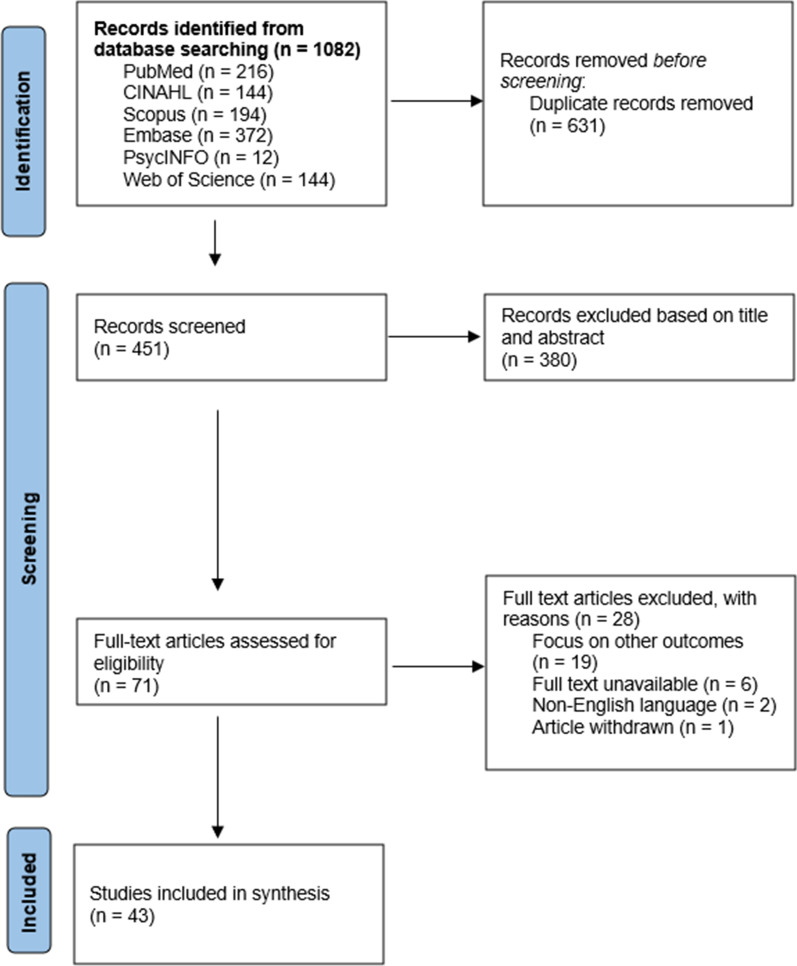
- From 1,082 retrieved articles, 43 met inclusion criteria after screening; two independent reviewers performed selection, critical appraisal, and data extraction, with disagreements resolved by discussion and a third reviewer when needed.
- Methodological quality was appraised with JBI Critical Appraisal Tools and MMAT 2018; findings were synthesized thematically using a three-step thematic synthesis and presented narratively.
Limitations
- Stated by the paper: grey literature and non-English studies were excluded; some included studies did not account for confounding factors; turnover intention was measured rather than actual turnover, though the paper notes evidence that these are correlated; and heterogeneity prevented a meta-analysis.
- Evident from the text: most included studies were quantitative and cross-sectional (39 of 43), limiting causal inference; nurses were included in the vast majority of studies (n = 35), so findings may not equally represent physicians, allied health workers, or administrative/management staff.
Model-written summary. Check it against the paper before relying on it.
Integrity signals
Registry
Cites
Statistics
Figures
Verification
Claims the paper makes
43 Valid · 0 Not valid · 38 Not checked · 33 Own results and interpretations
Every source the paper cites for this claim was checked and supports it.
In the paper
“One integrative review examined the COVID-19 pandemic’s impact on predictors of nurses’ turnover intention”
§ A global overview of healthcare workers’ turnover intention amid COVID-19 pandemic: a systematic review with future directions > Background
What the sources say
- Supportedcites [20] Falatah R The impact of the coronavirus disease (COVID-19) pandemic on nurses’ turnover intention: an integrative review Nurs Rep. 2021 10.3390/nursrep11040075 34968269 PMC8715458 source
The Aim (1.1, p.1) states the review appraised and integrated turnover literature using Whittemore and Knafl's integrative review method, asking 'What are the predictors of nurse turnover before and after the COVID-19 pandemic?' The Conclusions (6) state that on the basis of 43 studies 'the COVID-19 pandemic has impacted both the rates and predictors of nurses' turnover intention,' and the Discussion (3) confirms the shift in most-reported predictors post-COVID-19 (fear, stress, anxiety) versus pre-COVID-19 (satisfaction, commitment, leadership style). Thus the source is indeed an integrative review examining the pandemic's impact on predictors of nurses' turnover intention. (LLM, conf=0.95)
plain- Asserted: passes — The authors put it forward as true.
- Checkable: passes — It can be checked against evidence.
- Load-bearing: passes — The paper’s conclusions depend on it.
- Based: passes — The paper gives a reason why it holds.
- Supported
The sources with a verdict support this claim; the rest weren’t checked yet, have no full text we could read, or their verdicts aren’t rated yet.
In the paper
“A search for systematic reviews published in the last 10 years examining turnover intention among HCWs on PubMed, PROSPERO and Google Scholar produced nine relevant systematic reviews [11–19]”
§ A global overview of healthcare workers’ turnover intention amid COVID-19 pandemic: a systematic review with future directions > Background
What the sources say
- Not checked yetcites [11] Cowden T Cummings G Profetto-McGrath J Leadership practices and staff nurses' intent to stay: a systematic review J Nurs Manag 2011 19 4 461 477 10.1111/j.1365-2834.2011.01209.x 21569143 source
- Not checked yetcites [12] Daouk-Öyry L Anouze AL Otaki F Dumit NY Osman I The JOINT model of nurse absenteeism and turnover: a systematic review Int J Nurs Stud 2014 51 1 93 110 10.1016/j.ijnurstu.2013.06.018 23928322 source
- Supportedcites [13] Halter M Boiko O Pelone F Beighton C Harris R Gale J The determinants and consequences of adult nursing staff turnover: a systematic review of systematic reviews BMC Health Serv Res 2017 17 1 824 10.1186/s12913-017-2707-0 29246221 PMC5732502 source
The cited paper is a systematic review of systematic reviews on adult nursing staff turnover; its Discussion explicitly includes intention to leave among the outcomes considered. In the citing sentence, [11–19] identifies the nine reviews found by the citing authors, so this source supports its role as one relevant review. The citing authors’ search databases and total of nine are not attributed to this individual paper. (LLM, conf=0.86)
- Supportedcites [14] Lai GC Taylor EV Haigh MM Thompson SC Factors affecting the retention of indigenous australians in the health workforce: a systematic review Int J Environ Res Public Health 2018 10.3390/ijerph15050914 29734679 PMC5981953 source
The citation identifies this paper as one of the relevant systematic reviews, rather than attributing the citing authors’ search or its count of nine to this paper alone. The Methods (section 2.2) describe a review of retention and turnover among Indigenous Australian health workers, and the Introduction explicitly discusses turnover intention in that workforce. (LLM, conf=0.88)
- Not checked yetcites [15] Lartey S Cummings G Profetto-McGrath J Interventions that promote retention of experienced registered nurses in health care settings: a systematic review J Nurs Manag 2014 22 8 1027 1041 10.1111/jonm.12105 23758834 source
- Supportedcites [16] Lee J Nursing home nurses' turnover intention: a systematic review Nurs Open 2022 9 1 22 29 10.1002/nop2.1051 34811952 PMC8685779 source
The Abstract (Design) identifies this paper as a systematic review, and the Introduction identifies its subject as nursing-home nurses’ turnover intentions. It therefore fits as one of the relevant reviews cited; the search of PubMed, PROSPERO and Google Scholar and the count of nine describe the citing authors’ search, not a finding attributed to this individual source. (LLM, conf=0.90)
- Supportedcites [17] Russell D Mathew S Fitts M Liddle Z Murakami-Gold L Campbell N Interventions for health workforce retention in rural and remote areas: a systematic review Hum Resour Health 2021 19 1 103 10.1186/s12960-021-00643-7 34446042 PMC8393462 source
The cited work is a 2021 systematic review of health-worker retention, and its Methods > Inclusion criteria list intention to stay or leave among the eligible outcomes. It therefore qualifies as a relevant review in the citing authors’ list; the search procedure and total of nine reviews are the citing authors’ own account, not findings attributed to this individual source. (LLM, conf=0.85)
- Supportedcites [18] Shen X Jiang H Xu H Ye J Lv C Lu Z The global prevalence of turnover intention among general practitioners: a systematic review and meta-analysis BMC Fam Pract 2020 21 1 246 10.1186/s12875-020-01309-4 33250045 PMC7702723 source
The Methods (Search strategy and selection criteria) identify this paper as a systematic review and meta-analysis of turnover intention among general practitioners, who are healthcare workers. In the citing sentence, the grouped citations identify the reviews found by the citing authors; this source qualifies as one such review. (LLM, conf=0.89)
- Not checked yetcites [19] Yildiz B Yildiz H Ayaz AO Relationship between work-family conflict and turnover intention in nurses: a meta-analytic review J Adv Nurs 2021 77 8 3317 3330 10.1111/jan.14846 33855744 source
plain- Asserted: passes — The authors put it forward as true.
- Checkable: passes — It can be checked against evidence.
- Load-bearing: passes — The paper’s conclusions depend on it.
- Based: passes — The paper gives a reason why it holds.
The cited sources support only part of this claim — read each source’s verdict below.
In the paper
“A major contributing factor to the shortages seen in the health workforce is employee turnover [3].”
§ A global overview of healthcare workers’ turnover intention amid COVID-19 pandemic: a systematic review with future directions > Background
What the sources say
- Partly supportedcites [3] Dawson AJ Stasa H Roche MA Homer CSE Duffield C Nursing churn and turnover in Australian hospitals: nurses perceptions and suggestions for supportive strategies BMC Nurs 2014 13 1 11 10.1186/1472-6955-13-11 24708565 PMC3985533 sourceExperimental — accuracy not yet measured
The Background (p.1) treats high nursing turnover as 'a problem currently affecting many countries' whose staff movement 'can negatively impact upon skill-mix, scheduling and continuity of care', and lists costs, morale/productivity and patient-safety consequences — so turnover as a major staffing problem is supported. However, no passage states that turnover is a contributing factor to health workforce shortages; where our copy discusses shortages (Results, 'Low nurse-to-patient ratios'; Discussion, 'Work design'), shortages and reduced staff supply appear as antecedents of workload/dissatisfaction rather than as an outcome of turnover. The claim also generalises beyond the paper's scope, which is nurses in Australian hospital medical and surgical units, not the health workforce overall. (LLM, conf=0.65)
plainstates a cause- Asserted: passes — The authors put it forward as true.
- Checkable: passes — It can be checked against evidence.
- Load-bearing: passes — The paper’s conclusions depend on it.
- Based: passes — The paper gives a reason why it holds.
- Partly supported
The cited sources support only part of this claim — read each source’s verdict below.
In the paper
“Nurses were at a greater risk of experiencing turnover intention during the COVID-19 pandemic compared to pre-pandemic times [53].”
§ A global overview of healthcare workers’ turnover intention amid COVID-19 pandemic: a systematic review with future directions > Results > Data synthesis
What the sources say
- Partly supportedcites [53] Nashwan AJ Abujaber AA Villar RC Nazarene A Al-Jabry MM Fradelos EC Comparing the impact of covid-19 on nurses’ turnover intentions before and during the pandemic in qatar J Pers Med. 2021 11 6 787 810 10.3390/jpm11060456 34073655 PMC8225037 sourceExperimental — accuracy not yet measured
The Discussion (Section 5) and the Results subsection 'Stress Levels during and before COVID-19' state that nurses' turnover intentions were significantly higher during COVID-19 than before (Wilcoxon Z = -11.058, p < 0.01), echoed in the Abstract's conclusion for nurses in Qatar, so the direction of the comparison is supported. However, that finding comes from a single cross-sectional survey of 512 nurses at Hamad Medical Corporation in Qatar (Methods, Section 2; Results, Section 4), whereas the citing sentence attributes elevated turnover intention to 'nurses' generally, so the population is wider than the source studied. The Section 6 Limitations also flag recall bias for the pre-pandemic comparison and a 4.3% response rate, and the paper reports higher turnover-intention scores rather than a measurable 'risk'; it does note the opposite trend in the 21-30 age subgroup (Discussion). (LLM, conf=0.72)
plainstates an association- Asserted: passes — The authors put it forward as true.
- Checkable: passes — It can be checked against evidence.
- Load-bearing: unclear — It is unclear whether the paper’s conclusions depend on it.
- Based: passes — The paper gives a reason why it holds.
- Partly supported
Every source the paper cites for this claim was checked and supports it.
In the paper
“with two studies concluding that it acted as a protective mechanism against factors that contributed to turnover intention [43, 44].”
§ A global overview of healthcare workers’ turnover intention amid COVID-19 pandemic: a systematic review with future directions > Results > Data synthesis
What the sources say
- Supportedcites [43] Labrague LJ, Santos JAA de los. Resilience as a mediator between compassion fatigue, nurses' work outcomes, and quality of care during the COVID-19 pandemic. Appl Nurs Res. 2021; 10.1016/j.apnr.2021.151476 PMC8448586 34544570 source
The Results (Table 3 and accompanying text) show compassion fatigue positively associated with turnover intention (β = 0.301, p = 0.001) while resilience was negatively associated with turnover intention (β = −0.178, p = 0.004) and partially mediated the CF → turnover intention link (β = 0.272, p = 0.001), i.e. 'resilience reduced the effects of CF on ... organizational turnover intention'. The Discussion states this confirms 'its protective role against various mental and psychological consequences of stress-provoking events', and the Abstract Conclusion that 'Psychological resilience reduces the negative impact of CF on frontline nurses' job satisfaction, turnover intention, and the quality of care'. Thus the paraphrase that resilience acted as a protective mechanism against factors contributing to turnover intention is what this source reports, for frontline nurses during the COVID-19 pandemic (the paper does note its cross-sectional design limits causal inference). (LLM, conf=0.85)
- Supportedcites [44] Labrague LJ De Los Santos JAA Fronda DC Perceived COVID-19-associated discrimination, mental health and professional-turnover intention among frontline clinical nurses: the mediating role of resilience Int J Ment Health Nurs 2021 30 6 1674 1683 10.1111/inm.12920 34374480 PMC8447016 source
The Results (p. 2, Table 4 discussion) state that psychological resilience mediated the relationship between COVID-19-associated discrimination and professional-turnover intention and that 'resilience reduced the negative effects of COVID-19-related discrimination and resulted in improved mental health and reduced professional-turnover intention', with resilience itself negatively associated with turnover intention (β = -0.182, p = 0.004). The Discussion repeats this as a key finding, describing resilience as a protective factor, which matches the citing sentence's paraphrase of a protective mechanism against factors contributing to turnover intention. (Minor detail: the indirect path via resilience to turnover intention was reported as full mediation with p = 0.107 / Sobel p = 0.07, but the paper nonetheless frames it as protective.) (LLM, conf=0.85)
plainstates a cause- Asserted: passes — The authors put it forward as true.
- Checkable: passes — It can be checked against evidence.
- Load-bearing: unclear — It is unclear whether the paper’s conclusions depend on it.
- Based: passes — The paper gives a reason why it holds.
- Supported
73 more claims · 37 with their cited sources checked
Create a free account to see all 114 claims and to verify the 69 references still open.
- It may state two separate claims as one. 27
- Probably not a substantial claim. 12
- The quote only partly states this claim. 2
Claims other papers make about this one
Each is checked against this paper’s own text: does it say what the citing paper says it does?
The source backs part of the claim, not all of it — or backs it for a different population, condition or comparison.
In the citing paper
“The implications of mental health problems in these professionals not only refer to their well-being but also include social and organizational consequences, such as increasing rates of absenteeism and turnover intention [9-11], as well as so-called quiet quitting [12].”
From Effectiveness of a Web-Based Self-Guided Intervention (MINDxYOU) for Reducing Stress and Promoting Mental Health Among Health Professionals: Results From a Stepped-Wedge Cluster Randomized Trial (2025) · cites this paper as [11]
Experimental — accuracy not yet measuredIn the citing paper
“several systematic reviews highlighted an insufficient number of HWs to enable the provision of quality care, affecting health systems before and during the pandemic, with considerable inequities across countries worldwide [56–60].”
From Health workers’ perspectives on the quality of maternal and newborn health care around the time of childbirth: Results of the Improving MAternal Newborn carE in the EURO Region (IMAgiNE EURO) project in 12 countries of the World Health Organization European Region (2024) · cites this paper as [60]
Self-check
Percentages, sums and reported differences re-computed from the paper’s own numbers.
Each contradiction between two passages listed here was confirmed by an independent check.
Rated major: it would touch a result — a value a result rests on, reported and recomputed p-values on opposite sides of the significance level, two passages that conflict with no sign which is right, or a cited work retracted before this paper was published.
In the paper
§ A global overview of healthcare workers’ turnover intention amid COVID-19 pandemic: a systematic review with future directions > Results > Data synthesis
“While two American studies found that seniority in nurses was associated with greater turnover intention [34, 50]”
§ A global overview of healthcare workers’ turnover intention amid COVID-19 pandemic: a systematic review with future directions > Results > Study characteristics
“Age and quality of work–life were negatively correlated with turnover intention”
Citations
Cites
Methods for the thematic synthesis of qualitative research in systematic reviews
Thomas, J., & Harden, A. (2008) · BMC Medical Research Methodology · doi:10.1186/1471-2288-8-45 · Cited by 9,312
The Mixed Methods Appraisal Tool (MMAT) version 2018 for information professionals and researchers
Hong, Q. N., Fàbregues, S., Bartlett, G., Boardman, F., Cargo, M., Dagenais, P., Gagnon, M.-P., Griffiths, F., Nicolau, B., O’Cathain, A., et al. (2018) · Education for Information · doi:10.3233/efi-180221 · Cited by 4,737 · cited 1×
“The Mixed Methods Appraisal Tool (MMAT) version 2018 [24] was used to appraise mixed methods studies.”
MethodLabrague, L. J., & Santos, J. A. A. (2021) · Journal of Nursing Management · doi:10.1111/jonm.13168 · Cited by 882 · cited 1×
“Six quantitative studies used the Fear of COVID-19 Scale (FCV-19S) as an instrument to measure the psychological impact of exposure to COVID-19 on HCWs [26, 36, 37, 41, 42, 49], while one study used the Coronavirus Anxiety Scale (CAS) [39], with all studies finding a positive correlation between fear of COVID-19 expos…”
MethodNurse turnover: A literature review
Hayes, L. J., O’Brien-Pallas, L., Duffield, C., Shamian, J., Buchan, J., Hughes, F., Spence Laschinger, H. K., North, N., & Stone, P. W. (2006) · International Journal of Nursing Studies · doi:10.1016/j.ijnurstu.2005.02.007 · Cited by 873 · cited 2×
“In the context of the healthcare sector, turnover intention refers to the willingness of healthcare workers (HCWs) to leave their positions of employment for other positions in either the same or different professions [4].”
BackgroundMental health care for medical staff and affiliated healthcare workers during the COVID-19 pandemic
Walton, M., Murray, E., & Christian, M. D. (2020) · European Heart Journal: Acute Cardiovascular Care · doi:10.1177/2048872620922795 · Cited by 791 · cited 2×
“, childcare, grocery shopping) for HCWs in isolation or quarantine should also not be neglected [86].”
BackgroundMethodological guidance for the conduct of mixed methods systematic reviews
Stern, C., Lizarondo, L., Carrier, J., Godfrey, C., Rieger, K., Salmond, S., Apóstolo, J., Kirkpatrick, P., & Loveday, H. (2020) · JBI Evidence Synthesis · doi:10.11124/jbisrir-d-19-00169 · Cited by 700
Stigma during the COVID-19 pandemic
Bagcchi, S. (2020) · The Lancet Infectious Diseases · doi:10.1016/s1473-3099(20)30498-9 · Cited by 650 · cited 1×
“To make matters worse, frontline HCWs around the world endured episodes of harassment and violence at the hands of members of the public who held irrational beliefs about the transmissibility of COVID-19 [83].”
BackgroundThe validation of the turnover intention scale
Bothma, C. F. C., & Roodt, G. (2013) · SA Journal of Human Resource Management · doi:10.4102/sajhrm.v11i1.507 · Cited by 570 · cited 1×
“Quantitative studies measured turnover intention with the Turnover Intention Scale (TIS-6) [69] or modified versions, Likert scales, or yes–no questions.”
MethodThe Italian health system and the COVID-19 challenge
Armocida, B., Formenti, B., Ussai, S., Palestra, F., & Missoni, E. (2020) · The Lancet Public Health · doi:10.1016/s2468-2667(20)30074-8 · Cited by 554 · cited 1×
“The severity of COVID-19 infections, coupled with the large number of cases, placed immense pressure on healthcare systems as high volumes of patients in need of acute treatment required hospitalisation; some regions suffered from high COVID-19 mortality rates due to shortages of medical workers and equipment [2].”
BackgroundSaid, R. M., & El-Shafei, D. A. (2021) · Environmental Science and Pollution Research · doi:10.1007/s11356-020-11235-8 · Cited by 408 · cited 1×
“In addition, HCWs who worked long hours, or faced an increase in working hours due to the pandemic, were more prone to experiencing turnover intention [40, 50, 55, 59].”
Background
Cited by
Items 301–400 of 422
future role of healthcare mentors and coaches in navigating workplace culture
Martin, R. A., Copley, J., Dunwoodie, R., Forbes, R., Joyce, L. R., Mandrusiak, A., Noble, C., Pearson, A., Radford, J. C., WILKINSON, T. J., et al. (2023) · Focus on Health Professional Education A Multi-Professional Journal · doi:10.11157/fohpe.v24i1.706 · Cited by 1
Imai, H., Fukushima, H., Miyakoshi, C., & Matsuishi, K. (2023) · Psychiatry and Clinical Neurosciences Reports · doi:10.1002/pcn5.105 · Cited by 1
Cho, A.-R., Park, J., Kwon, S., Choi, J.-M., Yu, W. R., Ha, D., & Lee, E. (2023) · Research Square · doi:10.21203/rs.3.rs-3608647/v1
Alattas, M. M. A. (2023) · University of North Texas Digital Library (University of North Texas) · doi:10.12794/metadc2179256
Vezhnovets, T. A., & Vozniuk, V. Y. (2023) · Україна Здоров’я нації · doi:10.32782/2077-6594/2023.4/12
Essien, E. A., Mahmood, M. Y., Adiukwu, F. N., et al. (2023) · Cambridge Prisms Global Mental Health · doi:10.1017/gmh.2024.25.pr2
Essien, E. A., Mahmood, M. Y., Adiukwu, F. N., et al. (2023) · Cambridge Prisms Global Mental Health · doi:10.1017/gmh.2024.25.pr3
Essien, E. A., Mahmood, M. Y., Adiukwu, F. N., et al. (2024) · Cambridge Prisms Global Mental Health · doi:10.1017/gmh.2024.25.pr5
da Costa, M. P. (2023) · Cambridge Prisms Global Mental Health · doi:10.1017/gmh.2024.25.pr1
da Costa, M. P. (2024) · Cambridge Prisms Global Mental Health · doi:10.1017/gmh.2024.25.pr4
Essien, E. A., Mahmood, M. Y., Adiukwu, F. N., et al. (2024) · Cambridge Prisms Global Mental Health · doi:10.1017/gmh.2024.25.pr6
Mental Health in Healthcare Workers and its Associations with Psychosocial Work Conditions
García-Iglesias, J. J., YILDIRIM, M., Gómez-Salgado, J., & Goh, Y. S. S. (2024) · Frontiers research topics · doi:10.3389/978-2-8325-4771-7
Public Health, Public Health Education, and their Future Prospects
(2024) · Frontiers research topics · doi:10.3389/978-2-8325-4776-2
Coccia, M., & Benati, I. (2024) · SSRN Electronic Journal · doi:10.2139/ssrn.4792318
Medicina en la era digital: alcances y perspectivas
Hincapie Sanchez, J., Tapia Conyer, R., Fajardo Dolci, G., Montoya Rodríguez, A. A., Tapia Conyer, R. C., Saucedo Martínez, E. R., Olaiz Fernández, G. A., Vicuña De Anda, F. J., Alcaide Cruz, M. R., Carrasco Cruz, A., et al. (2024) · doi:10.22201/pub.9786073088763e.2024
Győr-Moson-Sopron vármegye orvosainak körében gyakori a kiégés
Balog, B., Palotai, G., Szijjártó, L., & Ádám, S. (2024) · Orvosi Hetilap · doi:10.1556/650.2024.33030 · Cited by 6
Manton, D., Williams, M., & Hayen, A. D. (2024) · PubMed Central
Health Care Workers’ Reflections, Experiences, and Sequela throughout the COVID-19 Pandemic
Casagrande, Y., Newton, K., Strum, E. M., & Unger, J. B. (2024) · Journal of Occupational and Environmental Medicine · doi:10.1097/jom.0000000000003176
“17 20 In this qualitative study, only 15% of the participants spontaneously mentioned burnout.”
Hemşirelikte Örgütsel Davranış: Güncel Yaklaşım ve Yönelimler
Demirtaş, H., Baykal, Ü., Kantek, F., Yeşilbaş, H., ÖZEN, T. A., Çınar, H. G., Vatan, F., Çamveren, H., Yılmaz, A., Duygulu, S., et al. (2024) · Akademisyen Kitabevi eBooks · doi:10.37609/akya.3150
Habibov, N., Auchynnikava, A., & Lyu, Y. (2024) · Journal of Health Organization and Management · doi:10.1108/jhom-07-2024-0279
SAĞLIK HİZMETLERİNDE İŞTEN AYRILMA NEDENLERİ: ÖZEL BİR HASTANEDE RETROSPEKTİF BİR ÇALIŞMA
ŞEN, H., & Uğrak, U. (2024) · 3 SEKTÖR SOSYAL EKONOMİ DERGİSİ · doi:10.15659/3.sektor-sosyal-ekonomi.24.12.2454
Mohamad, A. R., Ali, K. B., & Noor, K. M. (2024) · International Journal of Entrepreneurship and Management Practices · doi:10.35631/ijemp.728018 · Cited by 2
Staff turnover and leadership style: a narrative review of their relationship in health sciences
Ultreras-Rodríguez, A., Nieves-Lizárraga, D. O., Olguín-Martínez, C. M., & Bueno-Fernández, M. M. (2023) · Health Leadership and Quality of Life · doi:10.56294/hl2023207 · Cited by 1
Wichmann, B., & Wichmann, R. M. (2025) · Networks and Spatial Economics · doi:10.1007/s11067-025-09667-1
“The collapse of health care systems and adverse working conditions contributed to exits from the health care workforce (Azzopardi-Muscat et al. 2023; Frogner and Dill 2022; Poon et al. 2022).”
Lin, Y. P., Chan, L. Y. C., & Chan, E. (2025) · Nursing in Critical Care · doi:10.1111/nicc.13301
Self-citationRamania, N. S., APRIANTONO, T. A., Winata, B., Syafriani, R., Bahri, S., Iwo, M. I., & Nugraha, A. B. (2025) · Physiotherapy Quarterly · doi:10.5114/pq/182853
“A previous literature review concluded that healthcare workers suffered psychological and health complications when dealing with CoVid-19 [3]. despite realising that in May 2022, most countries have transitioned from a pandemic to an endemic state, the level of vigilance regarding the spread of…”
The Importance of Job Satisfaction, Work Engagement, and Sufficient Staffing in the Nursing Practice
Bundalian, K. (2025) · World Journal of Nursing Research · doi:10.31586/wjnr.2025.6033
Barene, S., Krustrup, P., Litleskare, S., & Holtermann, A. (2025) · European Journal of Sport Science · doi:10.1002/ejsc.12330
Brown, M. E. L., Burford, B. C., Price, C., Fu, Y., & Vance, G. H. S. (2025) · The Clinical Teacher · doi:10.1111/tct.70120
“Quantitative studies have highlighted pandemic factors influencing ‘turnover intention’ e.g., fear, stress, and lack of support [7].”
Postoccupancy Evaluation of a New Hospital: The Relationship With Work Engagement
Petäjä, H., Krook, P., Kuha, S., Katajisto, J., & Kanste, O. I. (2025) · HERD Health Environments Research & Design Journal · doi:10.1177/19375867251351026 · Cited by 2
“Turnover intention re fl ects the probability and willingness that an employee will leave an organization and look for a new position in either the same or different professions (Lu et al., 2023; Poon et al., 2022).”
Aksungur, A., Uğrak, U., Çınar, Ş., & Şen, H. (2026) · BMC Health Services Research · doi:10.1186/s12913-026-14642-8 · Cited by 1
“This interpretation is also consistent with previous studies showing that health workforce migration may reduce workforce capacity, increase pressure on the remaining staff, and weaken health service delivery in source countries [23, 42, 43].”
Sabrina, S., & Meilani, Y. F. C. P. (2025) · Journal of Economics and Management Scienties · doi:10.37034/jems.v7i4.145
Impact of Vohenstrauß Hospital Closure on Patient Distribution at Weiden Hospital
Förstel, M., Förstel, S., Gallistl, M., & Rothgang, E. M. (2025) · Lecture notes in operations research · doi:10.1007/978-3-031-92575-7_59
Chavhan, R., Savariapitchai, M., Dhore, P. S., & Raut, M. (2025) · Lecture notes in networks and systems · doi:10.1007/978-981-96-5754-4_5
Attard, C., Rubeis, V. D., MacMillan, H. L., Barlow, J., Ratcliffe, J., Duku, E., Bennett, T. A., & González, A. (2025) · Children and Youth Services Review · doi:10.1016/j.childyouth.2025.108584
Tiu, C. J. S., Alberto, N. R. I., Baron, M. B. C., Mercado, M., & Baticulon, R. E. (2025) · PLOS Global Public Health · doi:10.1371/journal.pgph.0004861 · Cited by 3
Fruscione, S., Malta, G., Coco, D. L., Campanella, A. F., & Cirrincione, L. (2024) · EuroMediterranean Biomedical Journal · doi:10.4081/embj.2023.2
“Moreover, the repercussions of untreated mental health problems among healthcare workers may have long-term consequences, affecting overall job satisfaction and professional longevity [14].”
Owusu, M. F., Ampon-Wireko, S., & Kaba, P. (2025) · Advances in Global Health · doi:10.1525/agh.2025.2475092
Németh, Z. (2025) · Pécsi Egyetemi Archívum (University of Pécs) · doi:10.15170/pte.2025.012
CARDOSO, R. T., Filho, M. G., & RODRIGUES, G. J. (2025) · Anais ... Encontro Nacional de Engenharia de Produção/Anais do Encontro Nacional de Engenharia de Produção · doi:10.14488/enegep2025_tn_wpg_429_2102_49994
Yang, C., Si, H., & Dong, Y. (2025) · BMC Public Health · doi:10.1186/s12889-025-25168-9
Reutimann, E. D., Thakkar, V. J., McMinn, K. R., Goans, C., Kowalske, K. J., Mandell, S. P., Salazar, E., & Roaten, K. (2025) · Journal of Burn Care & Research · doi:10.1093/jbcr/iraf214 · Cited by 2
Building Resilience Through a Structured Mentoring Program in an Interprofessional Health Practice
McMurry, S. V., & Funk, C. L. (2025) · Emerald Group Publishing Limited eBooks · doi:10.1108/978-1-80592-216-220251019
Mufaddal, T., Otho, M. S., & Siddiqui, M. B. (2025) · Journal of Women and Child Health · doi:10.62807/jowach.v2i3.2025.13-18
Maternal Occupation and Child Stunting in Urban Karachi: A Cross-Sectional Study
Samrina, H. S., & Kalsoom, E. (2025) · Journal of Women and Child Health · doi:10.62807/jowach.v2i3.2025.19-25
Merss, K. B., Zuelsdorff, M. L., Casal, M. D. P., Krainak, K., Ernst, J., & Zahner, S. J. (2025) · Nursing Outlook · doi:10.1016/j.outlook.2025.102619
Vaezi, A., Esteghamati, A., Ghaemi, F., Peysepar, R., Deravi, N., & Meysamie, A. (2025) · BMC Health Services Research · doi:10.1186/s12913-025-13511-0
“Another critical issue was the shortage of HCWs, driven by high rates of COVID-19 infections among HCWs, extended sick leaves, their reassignment to acute care facilities for COVID-19 patients [17], and increased turn-over and resignations [18].”
Positive Leadership as a Mediator Between Quiet Quitting and Emotion Use in Healthcare Workers
ŞENOL, L., & ŞENELDİR, O. (2025) · Journal of Business Research - Turk · doi:10.20491/isarder.2025.2155 · Cited by 1
Stirling, V., Fitzgerald, D., Moores, A., & Wenke, R. (2024) · Figshare · doi:10.6084/m9.figshare.26047020
Bradford, N., Moore, E., Taylor, K., Cook, O., Gent, L., Beane, T., Williams, N., Alexander, K., Pitt, E., Still, J., et al. (2024) · Figshare · doi:10.6084/m9.figshare.26650200
Mambrey, V., Dreher, A., & Loerbroks, A. (2024) · Figshare · doi:10.6084/m9.figshare.27099098
Ripoll, J., Chela-Àlvarez, X., Briones-Vozmediano, E., Fiol de-Roque, M. A., Zamanillo‐Campos, R., Ricci‐Cabello, I., Llobera, J., Calafat-Villalonga, C., & Serrano-Ripoll, M. J. (2024) · Figshare · doi:10.6084/m9.figshare.26680876
Mambrey, V., Dreher, A., & Loerbroks, A. (2024) · Figshare · doi:10.6084/m9.figshare.27099092
Mambrey, V., Dreher, A., & Loerbroks, A. (2024) · Figshare · doi:10.6084/m9.figshare.27099101
Mambrey, V., Dreher, A., & Loerbroks, A. (2024) · Figshare · doi:10.6084/m9.figshare.27099095
Nagarajan, R., Ramachandran, P., Dilipkumar, R., & Kaur, P. (2024) · Figshare · doi:10.6084/m9.figshare.26723864
Unni, D., & Venugopalan, M. (2025) · Journal of Workplace Behavioral Health · doi:10.1080/15555240.2025.2568876
“…and employee attrition have undermined organizational stability for a very long time, the recent convergence of post-pandemic strain and mounting skill gaps and talent deficit, along with psychological stress, has increased the magnitude of these challenges to a critical degree (Poon et al., 2022).”
Clinical data transmission in intensive care unit: what have we learned from COVID-19?
Pota, V., Coletta, F., Visconti, A., Landi, G., & Pace, M. C. (2023) · Advances in Anesthesia and Pain Medicine · doi:10.4081/aapm.2023.26
The Mediating Role of Reward Adequacy on Promotion and Career Development in Physician Retention
Fenyi, S., & Keelson, S. (2025) · African Journal Of Applied Research · doi:10.26437/snvqc718
Akinsola, O. S. (2025) · International Journal of Innovative Research and Scientific Studies · doi:10.53894/ijirss.v8i12.11077
“The review also highlighted adverse working conditions, and psychological responses such as stress, depression, anxiety, and fatigue were positively associated with turnover intention in diverse countries, including Germany, the United Kingdom, Saudi Arabia, and Iran [30].”
Isolation in White Coats: The Political Economy of Loneliness Among Global Healthcare Migrants
Lee, T., Lee, L., Hu, C., Mélin, N., Bouchez, L. C., & Lee, D. (2025) · IGI Global eBooks · doi:10.4018/979-8-3373-5811-6.ch006
Amaike, C., Ifeanyichukwu, O., Oguine, K. U., Yakse, J. H., Odumah, G. O., & Oluwole, O. (2025) · Journal of Community Medicine and Primary Health Care · doi:10.4314/jcmphc.v37i3.9
Global healthcare systems—an overview
Reddy, S. (2026) · Elsevier eBooks · doi:10.1016/b978-0-443-33020-9.00005-0
Hayes, R., Smith, A. K. J., Paparini, S., Apea, V., Holt, M., & Orkin, C. M. (2026) · Global Public Health · doi:10.1080/17441692.2025.2607848
Risk Governance in Clinical Education for Healthcare Students: A Scoping Review
Tong, R. R., Suh, J. M., Cheshire, L., & Naccarella, L. (2026) · The Clinical Teacher · doi:10.1111/tct.70355
Giannelli, A., Ostan, R., Pannuti, R., Biasco, G., & Varani, S. (2026) · Journal of Palliative Medicine · doi:10.1177/10966218261423502
Liu, J., Zou, S., Tang, J., & Mai, H. (2026) · Journal of Human Resources in Hospitality & Tourism · doi:10.1080/15332845.2026.2634512
“Maslach (2003) suggested that workplace thriving is a way to alleviate employees’ burnout related to excessive contact with others and highly repetitive work tasks in service industries (Poon et al., 2022).”
Ayala, Y. D. S. M., Herrera, P. M. R., & Chambergo, E. J. S. (2025) · Entrepreneur & Business · doi:10.18050/entrepreneur.v4i2a3
Patynowska, K. A., McConnell, T., Finucane, A. M., Maun, E., Fantoni, E. R., Clemo, J., Leone, E., Wynne, N., & Hasson, F. (2026) · Palliative Medicine · doi:10.1177/02692163261426184
“13 Despite extensive research on the wellbeing of healthcare professionals, there remains a significant gap in the literature concerning healthcare assistants.”
Burrowes, S. A. B., Drainoni, M., & Barlam, T. F. (2026) · PLoS ONE · doi:10.1371/journal.pone.0345788
“The healthcare workforce experienced significant attrition in part due to increased work burden and the mental health toll of the pandemic [34,35].”
Betts, V., Reinisch, C. E., & Marshall, B. L. (2026) · Journal of Comprehensive Nursing Research and Care · doi:10.33790/jcnrc1100223
Šehanović, L., & Hadžiahmetović, N. (2026) · Human Systems Management · doi:10.1177/01672533261438011
Byrne, A., Preston, R., Calleja, P., Cameron, D. M., George, S., Munt, R., Zupan, B., Delport, S., Jakimowicz, S., Harvey, C. L., et al. (2026) · Journal of Nursing Management · doi:10.1155/jonm/2722679
“Burnout of HCPs is well documented as an outcome from the COVID-19 pandemic [5, 22].”
Healthcare Professionals' Work Motivation in Crisis Settings: A Mixed‐Methods Study From India
Butakhieo, N., Rawat, S., Vyas, A., & Vyas, L. (2026) · Public Administration and Development · doi:10.1002/pad.70077
“In this respect, our results diverge from research conducted in other contexts, which has found an increase in turnover intention among healthcare professionals during the COVID‐19 pandemic (such as Kuriyama et al. 2023; Poon et al. 2022).”
InfluentialHe, M., Cheng, P., Liu, Y., Zhang, Z., Yang, Y., Ho, K. Y., & Li, Y. (2026) · Journal of Nursing Management · doi:10.1155/jonm/6626385
Mengapa Generasi Z Bertahan? Peran Empathic Leadership dalam Menekan Turnover Pekerja Generasi Z
Emmanuella, E. J., Putri, C. N. R., Ferdinan, R. S., & Ferdinan, B. A. (2026) · MODUS · doi:10.24002/modus.v38i1.13821
“Turnover intention merupakan keinginan disengaja dari pekerja untuk berhenti dari pekerjaan saat ini (Bennani & Hassi, 2024; Bright, 2020; Sheng et al., 2022).”
Moral Injury in Gaza: The Impact on Healthcare Professionals
Irfan, B., Alamrain, A. A., Alinaby, K., Hussein, H., Shammala, A. A., Halimy, M., Al-Khaldi, M., Kassab, A., Almedana, F., Toman, H., et al. (2026) · Health Science Reports · doi:10.1002/hsr2.72252
Muzaini, A., Kelana, B. W. Y., Hamid, N. Z. A., Mohamed, N. A., & Mahmod, A. (2026) · International Journal of Academic Research in Business and Social Sciences · doi:10.6007/ijarbss/v16-i5/28201
Ku, M., Cavanagh, J. M., Bartram, T., & Afshari, L. (2026) · Personnel Review · doi:10.1108/pr-03-2025-0296
Deterrents to Turnover Intention Among Hospital Nurses in South Korea: A Path Analysis
Kang, K., Taylor, E. J., Bae, H.-J., & Chun, J. (2026) · Journal of Healthcare Management · doi:10.1097/jhm-d-24-00135 · Cited by 1
Cui, Z. Y., Bethi, S., & Branjerdporn, G. (2026) · Australasian Psychiatry · doi:10.1177/10398562261447698
Hammond, D., Pardiwala, T., Hou, S., Marshall, S. K., Mah, J. W. T., & Coelho, J. S. (2026) · BMC Health Services Research · doi:10.1186/s12913-026-14753-2
“With the challenges that arose during this pandemic, clinicians across healthcare fields have expressed increased turnover intention, citing factors such as higher psychological responses to stress and adverse working conditions [7].”
Li, K., Johar, E. R., & Zheng, J. (2026) · BMC Public Health · doi:10.1186/s12889-026-27898-w
“Greater attention to specific vulnerable groups may help policymakers develop strategies to support and incentivize healthcare workers to remain in their jobs [31].”
Spencer, T. R., Strain, B., HADAWAY, L. C., Schears, G., Steere, L., Hopkins, T., & Weathers, E. (2026) · The Journal of Vascular Access · doi:10.1177/11297298261451300 · Cited by 1
“5 A shrinking and inexperienced nursing workforce, 6,7 limited PVAD-focused education, reduced use of central venous catheters due to CLABSI concerns, and increased reliance on vascular access escalation protocols 8,9 have collectively undermined safe and reliable PVAD access.”
Fable Hospital 3.0: the business case for building better healthcare facilities
Ashley, D. I. A. S., Berry, L. L., Hall, E., Hamilton, K. D., Sadler, B., Svec, P., Auld, J., & Bernal, M. (2026) · BMJ Leader · doi:10.1136/leader-2025-001522
Analyzing voluntary employee turnover: A data-driven explanatory modeling approach
Pöppel, E., Schiller, A., & Weinfurtner, L. (2026) · Decision Support Systems · doi:10.1016/j.dss.2026.114713
Enhancing mental toughness among healthcare leaders to support employee engagement
Cavan, S. A., & Stamatis, A. (2026) · Frontiers in Organizational Psychology · doi:10.3389/forgp.2026.1787997
Suárez-Máximo, J. D., Velázquez, E. M. V., & Suárez-Máximo, J. D. (2026) · ACC CIETNA Revista de la Escuela de Enfermería · doi:10.35383/cietna.v13i1.1344
Johansen, S. B., Bentzen, T. Ø., & Christensen, S. L. (2026) · Social Science & Medicine · doi:10.1016/j.socscimed.2026.119555 · Cited by 10
Farisi, M. S. A., Tiarapuspa, Saputra, D., & Purnama, L. (2026) · Jurnal Ekonomi Trisakti · doi:10.25105/jet.v6i2.26699
Maamoen, A., Bondjers, K., Langerud, A. K., Dyb, G. A., Stensland, S. Ø., Zwart, J., Rosseland, L. A., Jm, C., Reitan, S. K., Atar, D., et al. (2026) · Acta Anaesthesiologica Scandinavica · doi:10.1111/aas.70296
“In contrast, a global overview from earlier phases of the pandemic [49] found that “fear of COVID-19 exposure” was associated with turnover intention across 43 studies, highlighting the salient infection risk.”
The bright and the dark side of team diversity: Uncovering the effective functioning drivers
Trinchese, D., Pennucci, F., & Vainieri, M. (2026) · Journal of Health Organization and Management · doi:10.1108/jhom-09-2025-0626
“However, in contexts characterized by rigid hierarchical structures or organizational cultures oriented towards stability, such as the healthcare sector, change is often perceived as a threat rather than an opportunity (Hom et al ., 2019; Poon et al ., 2022).”
Sheen, J. A., Lee, B., Skvarc, D., Chan, E. S., Clancy, E. M., Rasmussen, B., Hutchinson, A. M., Buntine, P., Blencowe, P., McGuire, B., et al. (2026) · Research Square · doi:10.21203/rs.3.rs-9877531/v1
Computational Analysis of Employees Learning from Phishing Simulations
Bouma, D., Hoffmans, C. C. A., van den Hout, N. J., Zwarts, N., Jan Treur, A., & Roelofsma, P. H. M. P. (2026) · Studies in systems, decision and control · doi:10.1007/978-3-032-23886-3_4
Improving health workforce retention in remote Australia: a best-worst scaling study
Budhathoki, N. K., Humphreys, J. S., Mathew, S., Cass, A., Watts, Y., Edelman, A., McCarthy, L., Menezes, L., Zhao, Y., Williams, R., et al. (2026) · BMC Health Services Research · doi:10.1186/s12913-026-15095-9
“Despite Australia’s status as a high-income country, considerable inequities in health status are evident [3], with First Nations Australians experiencing the highest rates of burden of disease, preventable hospital admissions and potentially avoidable deaths [4, 5].”
Ali, J. M., Abosse, Z., Sendekie, T. Y., Stekelenburg, J., Shawula, S., Demissie, A., Goji, M., Goshu, M., Wubetu, G. Y., & Ayalew, F. (2026) · BMC Health Services Research · doi:10.1186/s12913-026-15239-x
“Persistent shortages are further exacerbated by high levels of workforce turnover and attrition, which continue to undermine health system performance and the continuity of healthcare services [4].”
Inpatient Nurses’ Anticipatory Perspectives on Assistive Robots: Qualitative Study
Tan, M. W., Chan, T. L. T., & Taye, C. S. M. (2026) · JMIR Nursing · doi:10.2196/91106
“Interest in assistive robots has grown in response to workforce shortages, aging populations, infection-control demands, and pressure to improve productivity in health care systems [7-9].”
Maduka, C. P., Adesemoye, A. C., Sydney, E., & Ohunyon, G. (2022) · International Journal of Multidisciplinary Research and Growth Evaluation · doi:10.54660/.ijmrge.2022.3.6.1136-1149
Thanh, N. D., Thanh, T. C., Nguyet, H. T. M., & Xiem, C. H. (2026) · Health Science Reports · doi:10.1002/hsr2.73018
“One of the prominent causal factors identified for this phenomenon was employee attrition, primarily associated with the work environment including workload and occupational hazards exacerbated by the pandemic [9].”
Inoue, M., Isobe, T., Takahashi, Y., Morita, K., & Ikeda, M. (2026) · Journal of Nursing Management · doi:10.1155/jonm/2914169
“Societal-level changes, such as the COVID-19 pandemic; facility-level changes, such as organizational restructuring; and unit-level changes, including changes in supervisors or colleagues, can sometimes threaten nurses’ career continuity [2, 3].”
Metadata
- Authors
- Poon, Y.-S. R., Lin, Y. P., Griffiths, P., Yong, K. K., Seah, B., & Liaw, S. Y.
- Affiliations
- Tan Tock Seng Hospital (SG)
- National Institute for Health and Care Research (GB)
- National Healthcare Group (SG)
- National University of Singapore (SG)
- Corresponding author
- Seah, Betsy
- Venue
- Human Resources for Health
- Published
- 2022-09-24
- Volume
- 20
- Issue
- 1
- Pages
- 70-70
- ISSN
- 1478-4491 (ISSN-L)
- PMC
- PMC9509627
- OpenAlex
- W4296954279
- Semantic Scholar
- 9763f9705b57004e6b6c3ebd917811d6993367a1
- Cited by
- 394
- References
- 88
- Citations by year
- 2026: 64 · 2025: 86 · 2024: 139 · 2023: 102 · 2022: 3
- FWCI
- 23.05
- Type
- journal article
- Language
- en
- Open access
- gold
- doi.org
- Licence
- cc-by
- creativecommons.org/licenses/by/4.0 (tdm)
- creativecommons.org/licenses/by/4.0 (vor)
- Locations
- Human Resources for Health (publishedVersion, cc-by)
- PubMed Central (publishedVersion, cc-by)
- PubMed (publishedVersion)
- ePrints Soton (University of Southampton) (acceptedVersion)
- DOAJ (DOAJ: Directory of Open Access Journals) (submittedVersion, cc-by-sa)
- Figshare (cc-by)
- Funders
- Alice Lee Centre for Nursing Studies, Yong Loo Lin School of Medicine, National University of Singapore (Research fellow start-up fund)
- Topics
- Health Sciences › Medicine › Public Health, Environmental and Occupational Health › Global Health Workforce Issues
- Health Sciences › Health Professions › General Health Professions › Healthcare Systems and Challenges
- Health Sciences › Nursing › Research and Theory › Nursing education and management
- Keywords
- turnover intention, healthcare workers, COVID-19 pandemic, nurse retention, psychological stress, working conditions, organizational support, burnout, migrant healthcare workers, health workforce shortage
- MeSH terms
- COVID-19, Health Personnel, Humans, Personnel Turnover, Intention, Pandemics
About these checks
Registry, retraction, Cites and statistics results are computed, not judged, with one exception: a printed reference that no index lists is read once by a model before it counts as a citation error. Claims are extracted by a model and kept only when their quote appears verbatim in the text; each cited source is then checked, with a model’s help, for whether it says what the claim relies on. Those verdicts can be wrong — read the claim’s quote and the cited source before relying on one.
The claim verdicts this report counts are experimental: their accuracy is not yet measured.
A language model drew the claims from the paper on 2026-10-05, under version 3 of the claim definition (model deepseek-v4.1-flash, prompt extract-v3).
A second model labelled each claim on 2026-10-05 (model jev-1.13-20260917, definition revision gold-guideline-v0.2).
Cited sources are checked with a language model’s help (qwen3.8-omni-flash and gpt-6-sol).
Statistics and arithmetic are recomputed, not judged.
Confidence bands are shown only for fields calibrated on our annotated test set. None is calibrated yet, so no band is shown.
What counts as a claim ›How we measure confidence ›How we check this ›
Are you an author, or do you see a problem with this page? Request a review
Data sources
Bibliographic data: Semantic Scholar, OpenAlex, Crossref.
Contains information from the Semantic Scholar Academic Graph Datasets, made available under the ODC Attribution License (ODC-BY 1.0).
Semantic Scholar’s data is described in: Kinney, R., et al. (2023). The Semantic Scholar Open Data Platform. arXiv:2301.10140.
