

School-based gardening, cooking and nutrition intervention increased vegetable intake but did not reduce BMI: Texas sprouts - a cluster randomized controlled trial
Open accessThe DOI matches its Crossref record; 81 of the 81 references it cites were found in a registry or an index.
Abstract
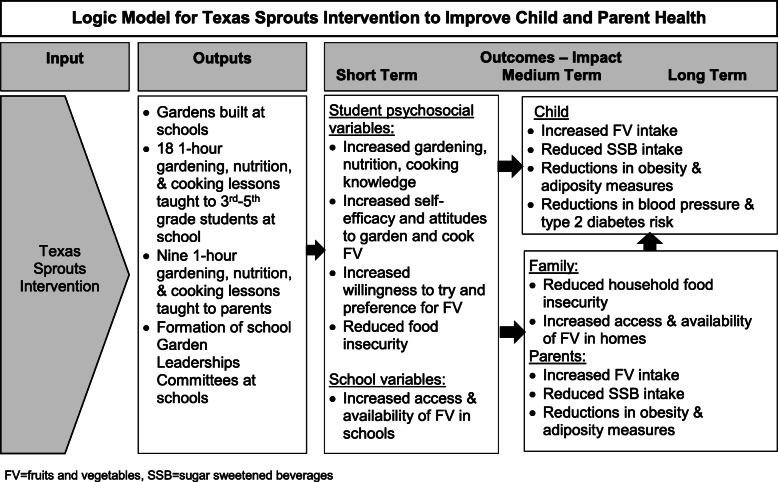
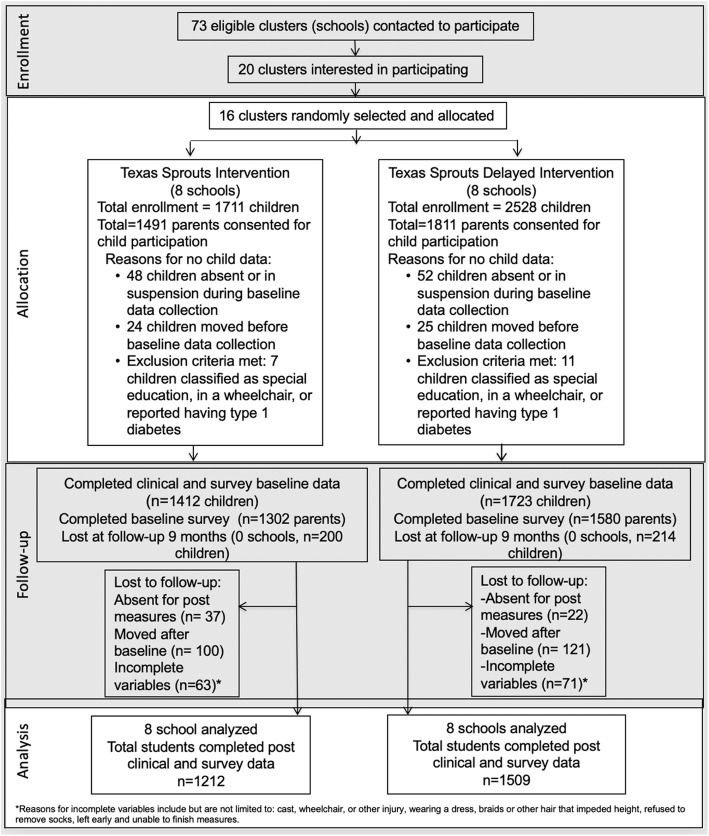
Background: Although school garden programs have been shown to improve dietary behaviors, there has not been a cluster-randomized controlled trial (RCT) conducted to examine the effects of school garden programs on obesity or other health outcomes. The goal of this study was to evaluate the effects of a one-year school-based gardening, nutrition, and cooking intervention (called Texas Sprouts) on dietary intake, obesity outcomes, and blood pressure in elementary school children. Methods: This study was a school-based cluster RCT with 16 elementary schools that were randomly assigned to either the Texas Sprouts intervention (n = 8 schools) or to control (delayed intervention, n = 8 schools). The intervention was one school year long (9 months) and consisted of: a) Garden Leadership Committee formation; b) a 0.25-acre outdoor teaching garden; c) 18 student gardening, nutrition, and cooking lessons taught by trained educators throughout the school-year; and d) nine monthly parent lessons. The delayed intervention was implemented the following academic year and received the same protocol as the intervention arm. Child outcomes measured were anthropometrics (i.e., BMI parameters, waist circumference, and body fat percentage via bioelectrical impedance), blood pressure, and dietary intake (i.e., vegetable, fruit, and sugar sweetened beverages) via survey. Data were analyzed with complete cases and with imputations at random. Generalized weighted linear mixed models were used to test the intervention effects and to account for clustering effect of sampling by school. Results: A total of 3135 children were enrolled in the study (intervention n = 1412, 45%). Average age was 9.2 years, 64% Hispanic, 47% male, and 69% eligible for free and reduced lunch. The intervention compared to control resulted in increased vegetable intake (+ 0.48 vs. + 0.04 frequency/day,p = 0.02). There were no effects of the intervention compared to control on fruit intake, sugar sweetened beverages, any of the obesity measures or blood pressure. Conclusion: While this school-based gardening, nutrition, and cooking program did not reduce obesity markers or blood pressure, it did result in increased vegetable intake. It is possible that a longer and more sustained effect of increased vegetable intake is needed to lead to reductions in obesity markers and blood pressure. Clinical trials number: NCT02668744.
Overview
The claims and statistics of this paper haven’t been checked yet.
Free: it reads the open-access text and checks the first 5 claims that cite a source we can check. Create a free account to check every claim.
Integrity signals
Registry
Cites
Statistics
Figures
Verification
Claims the paper makes
The claims and statistics of this paper haven’t been checked yet.
Free: it reads the open-access text and checks the first 5 claims that cite a source we can check. Create a free account to check every claim.
Claims other papers make about this one
Each is checked against this paper’s own text: does it say what the citing paper says it does?
The source backs part of the claim, not all of it — or backs it for a different population, condition or comparison.
In the citing paper
“increased water intake without significant changes in juice or soft drink intake [60]”
From Effects of school-based nutrition literacy Intervention on obesity prevention in school-age students: a systematic review and meta-analysis (2026) · cites this paper as [60]
Experimental — accuracy not yet measuredThe source backs part of the claim, not all of it — or backs it for a different population, condition or comparison.
In the citing paper
“Lessons covered choosing healthier snacks, reducing sugary drink intake, increasing fruit and vegetable consumption, and making appropriate choices across common settings, such as school, home, and when eating out [43, 53–56, 64].”
From Effects of school-based nutrition literacy Intervention on obesity prevention in school-age students: a systematic review and meta-analysis (2026) · cites this paper as [64]
Experimental — accuracy not yet measuredThe source backs part of the claim, not all of it — or backs it for a different population, condition or comparison.
In the citing paper
“Several curricula place individual eating habits within a broader food-systems context by showing how food moves “from farm to table,” how processing changes foods, and how packaging and energy use create environmental impacts [44, 48, 64].”
From Effects of school-based nutrition literacy Intervention on obesity prevention in school-age students: a systematic review and meta-analysis (2026) · cites this paper as [64]
Experimental — accuracy not yet measuredThe source backs part of the claim, not all of it — or backs it for a different population, condition or comparison.
In the citing paper
“Many programs supported self-management by fostering goal-setting, healthy eating behaviors, and the exploration of new foods [53, 64].”
From Effects of school-based nutrition literacy Intervention on obesity prevention in school-age students: a systematic review and meta-analysis (2026) · cites this paper as [64]
Experimental — accuracy not yet measuredThe cited source says what the claim attributes to it.
In the citing paper
“A substantial proportion of interventions incorporated experiential and skill-based learning, particularly cooking, food preparation, tasting, and sensory activities [45–48, 50, 52, 56, 59–61, 63].”
From Effects of school-based nutrition literacy Intervention on obesity prevention in school-age students: a systematic review and meta-analysis (2026) · cites this paper as [60]
1 more claim about this paper
Create a free account to see every claim other papers make about this one.
Self-check
Percentages, sums and reported differences re-computed from the paper’s own numbers.
The self-check needs the paper’s full text.
Citations
Cites
Harris, P. A., Taylor, R., Thielke, R., Payne, J., Gonzalez, N., & Conde, J. G. (2009) · Journal of Biomedical Informatics · doi:10.1016/j.jbi.2008.08.010 · Cited by 51,384 · cited 1×
“Study data were collected and managed using REDCap (Research Electronic Data Capture) [48].”
MethodThe Ecology of Human Development: Experiments by Nature and Design
Bronfenbrenner, U. (1979) · Harvard University Press eBooks · doi:10.4159/9780674028845 · Cited by 26,084
Interrater reliability: The kappa statistic
McHugh, M. L. (2012) · Biochemia Medica · doi:10.11613/bm.2012.031 · Cited by 19,877 · cited 1×
“71 with percentage agreements ranging from 57 to 87%, which suggested moderate to strong agreement [40].”
BackgroundThe ecology of human development : experiments by nature and design
Bronfenbrenner, U. (1979) · Cited by 12,580
Foundations of Clinical Research: Applications to Practice,
(2002) · Survey of Ophthalmology · doi:10.1016/s0039-6257(02)00362-4 · Cited by 9,489 · cited 1×
“Test-retest percent agreement was between 71 and 84% for all seven items, which is considered to be moderately reproducible [41].”
BackgroundThe prevention and treatment of missing data in clinical trials
Little, R. J., D'Agostino, R., Cohen, M. L., Dickersin, K., Emerson, S. S., Farrar, J. T., Frangakis, C., Hogan, J. W., Molenberghs, G., Murphy, S. A., et al. (2012) · New England Journal of Medicine · doi:10.1056/nejmsr1203730 · Cited by 1,884
Wang, X., Ouyang, Y., Liu, J., Zhu, M., Zhao, G., Bao, W., & Hu, F. B. (2014) · BMJ · doi:10.1136/bmj.g4490 · Cited by 1,596
Design and Analysis of Cluster Randomization Trials in Health Research
DONNER, A. P., & Klar, N. S. (2000) · Cited by 1,236
Cicchetti, D., & Lynch, M. (1993) · Psychiatry · doi:10.1080/00332747.1993.11024624 · Cited by 1,152 · cited 1×
“, school, family, community) that reciprocally interact with each other and the child over time to shape development and behaviors [31, 32].”
BackgroundFoundations of clinical research application to practice
Portney, L. (1993) · Medical Entomology and Zoology · Cited by 1,135
Research works printed but not linked: 3
- 34. Extension TAMA. Learn, grow, eat & Grow! 2014.
- 36. Centers for Disease Control and Prevention: CDC growth Charts. Atlanta, GA, U. S. Department of Health and Human Services, Centers for Disease Control and Prevention, National Center for Health Statistics, 2000 (U.S. Publ. no. 314).
- 74. Whole School WC, Whole Child. Association for Supervision and Curriculum Development (ASCD).http://www.ascd.org/programs/learning-and-health/ wscc-model.aspx. last assess on March 3rd, 2020.
Cited by
Items 101–162 of 162
Education and Climate Change: Synthesizing the Evidence to Guide Future Research
Kraft, M. A., Malik, S., & Falken, G. T. (2026) · American Educational Research Journal · doi:10.3102/00028312261478064 · Cited by 1
Gatzemeier, J., Wilkinson, L. L., Price, M. J., & Lee, M. D. (2024) · Public Health Nutrition · doi:10.1017/s1368980024000697 · Cited by 1
“Interventional studies indicate that cooking and education classes improve healthy eating (32) and reduce snacking because of the anticipation of a full meal for dinner and switching unhealthy for healthy snacks (29) .”
BackgroundProtective effect of optimal vegetable intake on blood pressure levels in children
Xu, F., Xu, S., Qü, P., Zhong, H., Chen, L., An, X., Chen, J., & Liang, X. (2025) · Public Health · doi:10.1016/j.puhe.2025.01.035 · Cited by 1
Martins, R. C., Brito, F. D. S. B., & Curioni, C. C. (2025) · PLoS ONE · doi:10.1371/journal.pone.0322617 · Cited by 1
“However, recent changes in these practices may not be immediately reflected in BMI/age [47,48], as in the case of morning-shift students.”
Breheny, K., Spiga, F., Tomlinson, E., Summerbell, C., & Higgins, J. P. T. (2025) · Public Health Research · doi:10.3310/gjjh1321 · Cited by 1
Traditional Healing and Biomedicine Use in Urban American Indians Living with Diabetes
Kambuga, E. E. (2023) · ScholarWorks (Walden University) · Cited by 1
Posri, S., Powwattana, A., Lagampan, S., Chongsuwat, R., Boonmanunt, S. W., & Wongkampun, S. (2026) · BMC Public Health · doi:10.1186/s12889-026-27909-w
“…reduced sugar-sweetened beverage and salty snack consumption [59], increased water intake without significant changes in juice or soft drink intake [60], increased intake of several fruits and vegetables on recall measures [48], improved tasting-related behavioral determinants and intention to…”
Actions et initiatives visant à encourager la consommation de fruits et légumes auprès des enfants
Lanckriet, S., Tricart, L., Chambrier, C., Komati, N., & Lecerf, J. (2024) · Pratiques en nutrition · doi:10.1016/j.pranut.2023.12.011
Butskaya, T. V., Балыкова, Л. А., Ledyaykina, L. V., Evstifeeva, I. A., Vereschagina, V. S., & Ledyaykina, S. A. (2024) · Современные проблемы науки и образования · doi:10.17513/spno.33311
Vázquez-Bolea, N., Andueza, N., Cuervo, M., & Navas‐Carretero, S. (2024) · Children · doi:10.3390/children11050559
Determinantes conductuales del consumo de frutas y verduras en escolares: Una perspectiva
de Santander, C. U. I., Vergara, A. P. M., Moreno, A. G. M., de Guadalajara, U., López-Espinoza, A., y Nutrición, R. D. I. E. C. A., Martínez-Rodríguez, T. Y., Universidad del Sinú, C., Bernal-Gómez, S. J., de Guadalajara, U., et al. (2024) · Journal of Behavior and Feeding · doi:10.32870/jbf.v4i7.53
Development Of Digital-Based Work Group Management Using Artificial Intelligence Education Copilot
Aman, A. (2025) · Journal of Information Systems Engineering & Management · doi:10.52783/jisem.v10i33s.5471
Agley, J. D., Deemer, S. E., & Allison, D. B. (2025) · BMC Medical Research Methodology · doi:10.1186/s12874-025-02590-6
“A large cluster randomized controlled trial of a school gardening intervention reported “no effects of the intervention compared to control on fruit intake, sugar sweetened beverages, any of the obesity measures, or blood pressure” [10].”
Initiatives pour encourager la consommation de fruits et légumes chez les enfants
Lecerf, J., Amiot, M. J., Belzunces, L., Langé, C., Marette, S., Lanckriet, S., Komati, N., Tricart, L., & Chambrier, C. (2025) · Cahiers de Nutrition et de Diététique · doi:10.1016/j.cnd.2025.06.006
Strengthening equity in gardening initiatives for children and youth: a rapid review
Gillies, C., & Baay, C. (2025) · BMC Public Health · doi:10.1186/s12889-025-25392-3
“Nonetheless, engaging parents from low-SES backgrounds remained a challenge, even when initiatives offered incentives such as free childcare or flexible scheduling [40, 49, 66].”
InfluentialKarpouzis, F., Lindberg, R., Walsh, A. C., Shah, S., Abbott, G., & Ball, K. (2024) · Figshare · doi:10.6084/m9.figshare.25329793
Karpouzis, F., Lindberg, R., Walsh, A. C., Shah, S., Abbott, G., & Ball, K. (2024) · Figshare · doi:10.6084/m9.figshare.26687384
Karpouzis, F., Lindberg, R., Walsh, A. C., Shah, S., Abbott, G., & Ball, K. (2024) · Figshare · doi:10.6084/m9.figshare.26687378
Karpouzis, F., Lindberg, R., Walsh, A. C., Shah, S., Abbott, G., & Ball, K. (2024) · Figshare · doi:10.6084/m9.figshare.26687387
Karpouzis, F., Walsh, A. C., S., S., Ball, K., & Lindberg, R. (2024) · Figshare · doi:10.6084/m9.figshare.26691241
Karpouzis, F., Lindberg, R., Walsh, A. C., Shah, S., Abbott, G., & Ball, K. (2024) · Figshare · doi:10.6084/m9.figshare.26687369
Karpouzis, F., Lindberg, R., Walsh, A. C., Shah, S., Abbott, G., & Ball, K. (2024) · Figshare · doi:10.6084/m9.figshare.25329682
Karpouzis, F., A., W., S., S., Ball, K., & R., L. (2024) · Figshare · doi:10.6084/m9.figshare.25376162
Karpouzis, F., Lindberg, R., Walsh, A. C., Shah, S., Abbott, G., & Ball, K. (2024) · Figshare · doi:10.6084/m9.figshare.26687375
Karpouzis, F., Lindberg, R., Walsh, A. C., Shah, S., Abbott, G., & Ball, K. (2024) · Figshare · doi:10.6084/m9.figshare.26687372
Karpouzis, F., Lindberg, R., Walsh, A. C., Shah, S., Abbott, G., & Ball, K. (2024) · Figshare · doi:10.6084/m9.figshare.26687363
Karpouzis, F., Lindberg, R., Walsh, A. C., Shah, S., Abbott, G., & Ball, K. (2024) · Figshare · doi:10.6084/m9.figshare.26687381
Chan, C. L., Tan, P. Y., & Gong, Y. Y. (2022) · Figshare · doi:10.6084/m9.figshare.20155654
Karpouzis, F., Lindberg, R., Walsh, A. C., Shah, S., Abbott, G., & Ball, K. (2024) · Figshare · doi:10.6084/m9.figshare.26687360
Karpouzis, F., Lindberg, R., Walsh, A. C., Shah, S., Abbott, G., & Ball, K. (2024) · Figshare · doi:10.6084/m9.figshare.26687366
Karpouzis, F., Walsh, A. C., S., S., K., B., & Lindberg, R. (2024) · Figshare · doi:10.6084/m9.figshare.25376132
Sanchez, K. (2024) · eScholarship (California Digital Library)
Jiménez-Rivero, M., Poche, A., Haushalter, K., Hudson, E. A., Larson, D. N., Nikah, K., Garcia, M. B., Roth, M., Davis, J. N., & Joya, C. (2026) · Journal of Cancer Education · doi:10.1007/s13187-026-02839-8
Self-citationYang, J., Li, N., Zhang, T., Li, X., Zheng, L., & Zhu, M. (2026) · Frontiers in Nutrition · doi:10.3389/fnut.2026.1775403
González, D., Padilla, K. A. B., Caballero, A., Sabo, S. J., Camarena, B., Caire‐Juvera, G., Trejo, G.-N., Ponce, J. A., Contreras, A., Portillo, G. E., et al. (2026) · Frontiers in Public Health · doi:10.3389/fpubh.2026.1735714
“It is increasingly clear that family and community participation in obesity prevention strategies is crucial for their long-term success (18–20).”
Silvestri, F., Curzi, D., Zimatore, G., Bonavolontá, V., Migliaccio, S., Cardinali, L., Baldari, C., Guidetti, L., & Gallotta, M. C. (2026) · Nutrients · doi:10.3390/nu18060926
“These findings align with those of Davis et al. [46], who examined the effects of a one-year multicomponent healthy habits intervention (including a nutritional intervention) on a large cohort of primary school children.”
González, P. S. M., Carballido, N. H., Maneiro, R., & del Bosque, R. A. (2026) · Healthcare · doi:10.3390/healthcare14060764
“…to previous research, certain nutritional elements of the MD may contribute to improved perceived energy levels and mood help optimize energy levels and mood, which could be a possible reason why a relationship has been noted between diet quality and more self-determined motivational profiles [42].”
Attributes of Thriving School Gardens in the US
Daspin, J. M., Jiménez-Rivero, M., Martin, B., Cooper, M. H., Nikah, K., Waugh, L., & Davis, J. N. (2026) · Journal of Nutrition Education and Behavior · doi:10.1016/j.jneb.2026.03.006
Self-citationJeong, S., Moon, J., Uygun, M. N., & Park, D.-S. (2026) · HortScience · doi:10.21273/hortsci19372-26
Haushalter, K., Sharma, S. V., Burgermaster, M., Poulos, N. S., Hudson, E. A., Daspin, J. M., Jiménez-Rivero, M., & Davis, J. N. (2026) · Scientific Reports · doi:10.1038/s41598-026-52687-1
“Parents completed questionnaires reporting their child’s demographics, including age (years), race and ethnicity (White, Hispanic, Black/Asian/Multiracial), sex (male, female), and free and reduced-priced lunch program enrollment (receives, does not receive) 28–30 .”
Self-citationByczkovski, L. M., Paiva, C. F., Melo, J. D. A., da Costa, J. L. M. N., dos Santos, E. F., & Novello, D. (2026) · Periódicos Brasil Pesquisa Científica · doi:10.36557/2674-9432.2026v5n4p67-88
Aisyah, S., Syarah, E. S., Mustapa, N., Amini, M., & Chandrawati, T. (2026) · lnternational Electronic Journal of Elementary Education · doi:10.26822/iejee.2026.454
Olguín-Hernández, Z., Hernández-Islas, A., Martínez-Andrade, G. O., Cortés, T. L. F., Delgadillo-Badillo, E., Rojo-López, M. I., Julve, J., Niño-Narvión, J., Calderón‐Ramos, Z. G., & Ramírez‐Moreno, E. (2026) · Nutrire · doi:10.1186/s41110-026-00502-2
“Furthermore, evidence suggests that children have difficulty accurately reporting dietary information due to cognitive limitations in memory and portion-size estimation [14].”
Syafnita, T., Eliza, D., & Ramelan, H. (2026) · Aulad Journal on Early Childhood · doi:10.31004/aulad.v9i1.1561
Vega‐López, S., Liedike, B., Todd, M. K., Ghan, E., Crespo, N. C., Bruening, M., Hartmann, L., Quintero, A. L., & Ray, F. (2026) · Journal of Nutrition · doi:10.1016/j.tjnut.2026.101715
Kempler, J. V., Nanayakkara, J., Margerison, C., Berner, A., & Booth, A. (2026) · BMC Public Health · doi:10.1186/s12889-026-28875-z
“More-over, randomised controlled trials of the US Sprouts program have found the initiative, which includes both nutrition education and integrated cooking activities, improves children’s dietary intake [53, 54].”
Ganiyat, S. T., Ejoh, S. I., Omolade, O. E., & Lawal, R. O. (2026) · International journal of research and scientific innovation · doi:10.51244/ijrsi.2026.1315ph00156
Bioimpedance: From Body Composition Assessment to Emerging Technologies in Clinical Nutrition
Pita, R. N., Fernández, I. M., Martínez, O., & Miranda, J. M. (2026) · Nutrients · doi:10.3390/nu18172889
Dionicio, P., Lopez, Z., Sánchez, K. D., Tequida, B. V., Laprada, A. N., Paullada, J. P., Valencia, D. G. G., Vélez, M. I. O., Singh, S., & Crespo, N. C. (2026) · Annals of Behavioral Medicine · doi:10.1093/abm/kaag056
Bober, J., & Gaszyńska, E. (2026) · Frontiers in Nutrition · doi:10.3389/fnut.2026.1892494
“…nutrition interventions in the United States increased vegetable intake but did not reduce BMI in the Texas Sprouts cluster RCT of 3,135 children (27), suggesting that single environment exposures are insufficient and should be combined with clinical pathways for children with established…”
InfluentialCo‐Creating Healthy Mini‐Donuts With and for Peruvian Children Using Andean Ingredients
Eduardo, K., Rios-Mera, J. D., & Saldaña, E. (2026) · Journal of Sensory Studies · doi:10.1111/joss.70189
Kurz, S., & Thompson, H. J. (2026) · European Journal of Education and Pedagogy · doi:10.24018/ejedu.2026.7.5.70657
Gayatri, R. W., Bramantoro, T., Setyowati, D., & Nor, N. A. M. (2026) · Journal of International Society of Preventive and Community Dentistry · doi:10.4103/jispcd.jispcd_24_26
al., S. S. A. E. (2024) · Letters in High Energy Physics
Olson, R. M. (2025) · K-State Research Exchange (Kansas State University)
da Silva, B. B. R., Lopes, L. P. N., Cunha, J. S., & Tavares, L. F. (2026) · Journal of School Health · doi:10.1111/josh.70243
Passos, H. G. S. (2026) · riUfes (Universidade Federal do Espírito Santo)
Andrade, A. V. A. (2026) · Academica-e (Universidad Pública de Navarra)
Exploring Community-Driven Public Health: Participatory Action Research Applications
Ingram, M., & Sabo, S. (2026) · Frontiers research topics · doi:10.3389/978-2-8325-8924-3
SCHOOL GARDENS AND THEIR SOCIOENVIRONMENTAL IMPORTANCE WORLDWIDE WITH A FOCUS ON BRAZIL AND AFRICA
da Silva, V., da Silva, F. D. A., & Costa, D. D. A. (2026) · ENVIRONMENTAL SMOKE · doi:10.32435/envsmoke-2026-0008
Metadata
- Authors
- Davis, J. N., Pérez, A., Asigbee, F. M., Landry, M. J., Vandyousefi, S., Ghaddar, R., Hoover, A., Jeans, M., Nikah, K., Fischer, B., Pont, S. J., Richards, D., Hoelscher, D. M., & Van Den Berg, A. E.
- Affiliations
- The University of Texas at Austin (US)
- Michael & Susan Dell Center for Healthy Living (US)
- Corresponding author
- Davis, Jaimie N.
- ORCID
- Venue
- International Journal of Behavioral Nutrition and Physical Activity
- Published
- 2021-01-23
- Volume
- 18
- Issue
- 1
- Pages
- 18-18
- ISSN
- 1479-5868 (ISSN-L)
- PMC
- PMC7825209
- OpenAlex
- W3124920108
- Cited by
- 136
- References
- 81
- Citations by year
- 2026: 17 · 2025: 27 · 2024: 37 · 2023: 23 · 2022: 22 · 2021: 10
- FWCI
- 19.90
- Type
- journal article
- Language
- en
- Open access
- gold
- doi.org
- Licence
- cc-by
- creativecommons.org/licenses/by/4.0 (tdm)
- creativecommons.org/licenses/by/4.0 (vor)
- Locations
- International Journal of Behavioral Nutrition and Physical Activity (publishedVersion, cc-by)
- PubMed Central (publishedVersion, cc-by)
- PubMed (publishedVersion)
- DOAJ (DOAJ: Directory of Open Access Journals) (submittedVersion, cc-by-sa)
- eScholarship (California Digital Library) (submittedVersion, cc-by)
- Funders
- National Institutes of Health (1R01HL123865)
- Whole Kids Foundation
- Sprouts Healthy Communities Foundation
- Topics
- Health Sciences › Medicine › Public Health, Environmental and Occupational Health › Obesity, Physical Activity, Diet
- Life Sciences › Agricultural and Biological Sciences › General Agricultural and Biological Sciences › Diverse Educational Innovations Studies
- Health Sciences › Nursing › Nutrition and Dietetics › Nutrition, Health and Food Behavior
- Keywords
- school gardens, school-based intervention, vegetable consumption, childhood obesity, body mass index, blood pressure, culinary education, nutrition education, elementary school students, sugar-sweetened beverages, fruit consumption
- MeSH terms
- Blood Pressure, Body Composition, Child, Cooking, Diet, Female, Hispanic or Latino, Humans, Male, School Health Services, Schools, Students, Texas, Vegetables, Body Mass Index, Gardening, Nutritional Sciences, Waist Circumference, Pediatric Obesity
About these checks
Registry, retraction, Cites and statistics results are computed, not judged, with one exception: a printed reference that no index lists is read once by a model before it counts as a citation error. Claims are extracted by a model and kept only when their quote appears verbatim in the text; each cited source is then checked, with a model’s help, for whether it says what the claim relies on. Those verdicts can be wrong — read the claim’s quote and the cited source before relying on one.
Statistics and arithmetic are recomputed, not judged.
Confidence bands are shown only for fields calibrated on our annotated test set. None is calibrated yet, so no band is shown.
What counts as a claim ›How we measure confidence ›How we check this ›
Are you an author, or do you see a problem with this page? Request a review
Data sources
Bibliographic data: Semantic Scholar, OpenAlex, Crossref.
Contains information from the Semantic Scholar Academic Graph Datasets, made available under the ODC Attribution License (ODC-BY 1.0).
Semantic Scholar’s data is described in: Kinney, R., et al. (2023). The Semantic Scholar Open Data Platform. arXiv:2301.10140.
