

The DOI matches its Crossref record; 60 of the 60 references it cites were found in a registry or an index.
Targeting translocator protein (18 kDa) (TSPO) dampens pro-inflammatory microglia reactivity in the retina and protects from degeneration
Open accessAbstract
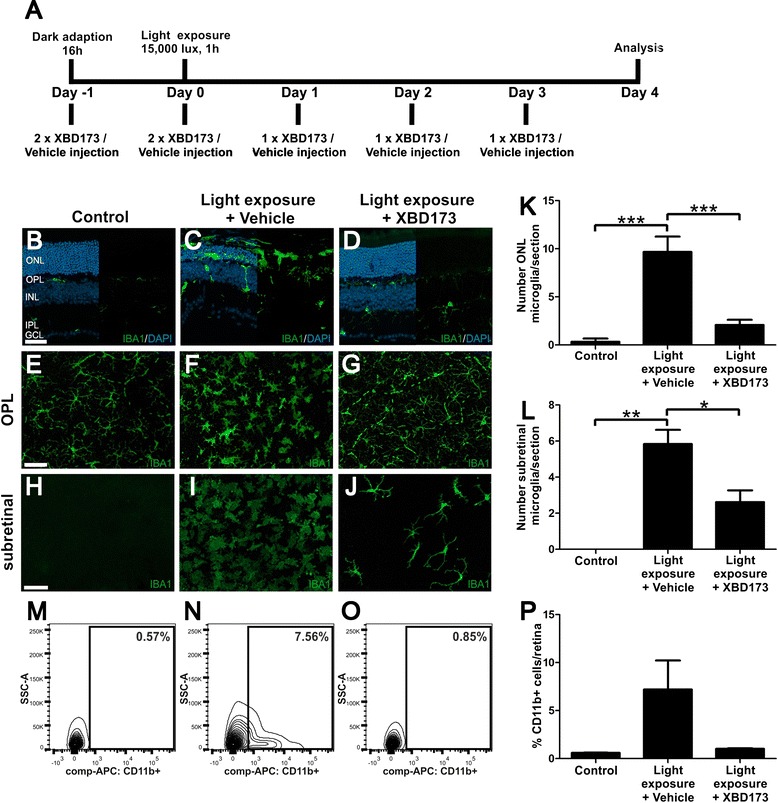
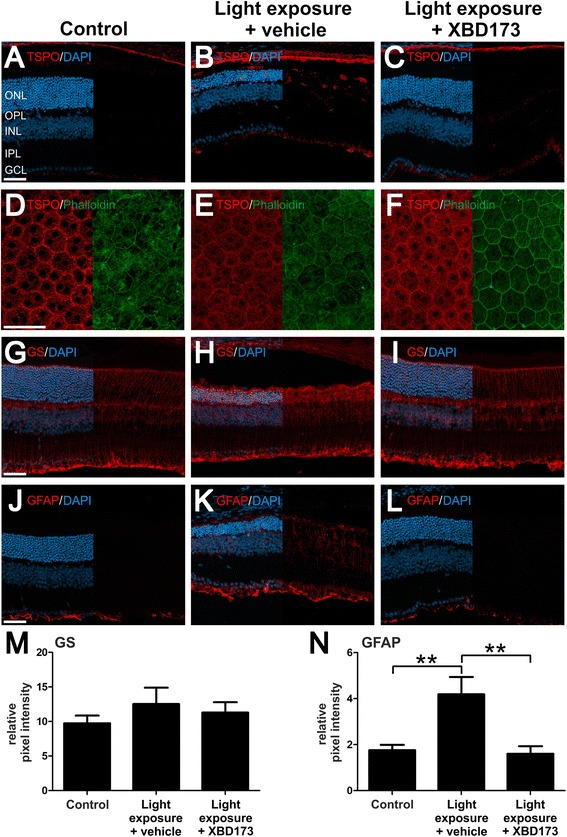
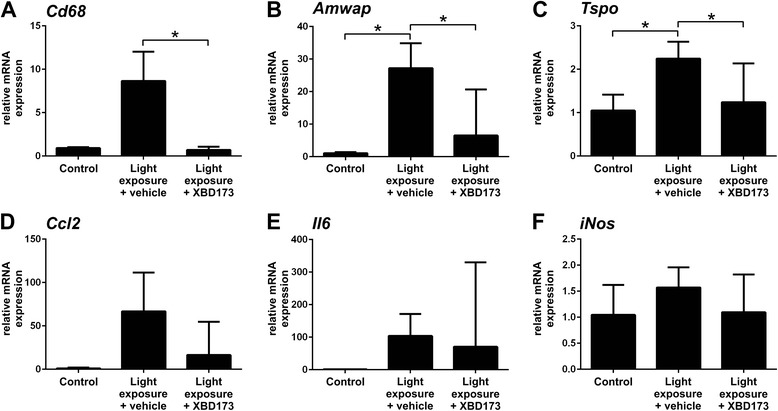
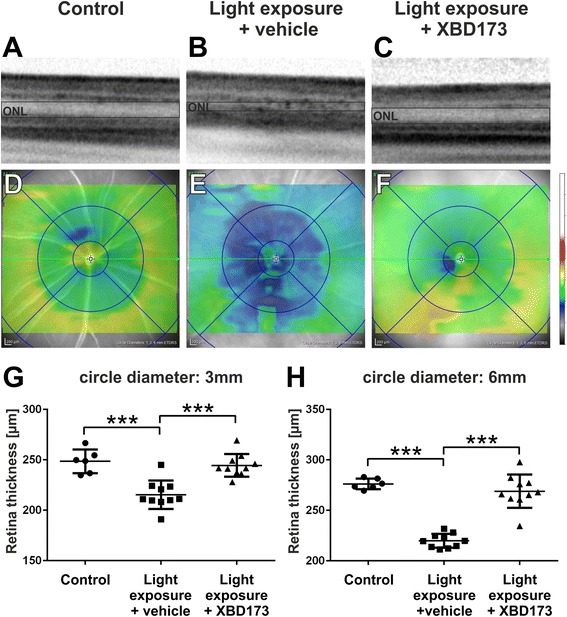
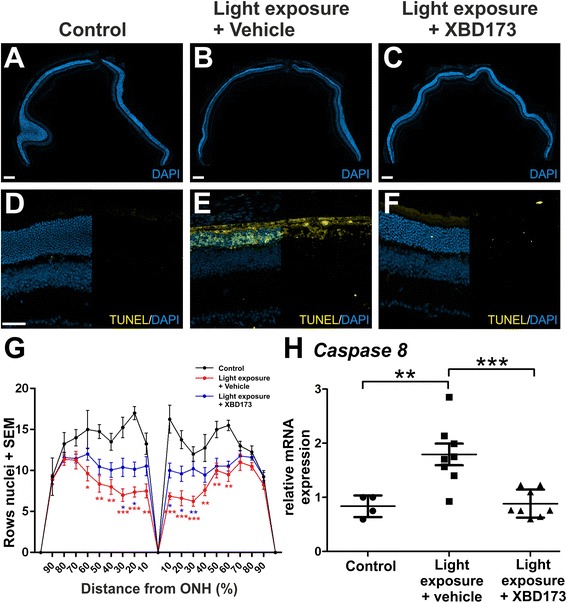
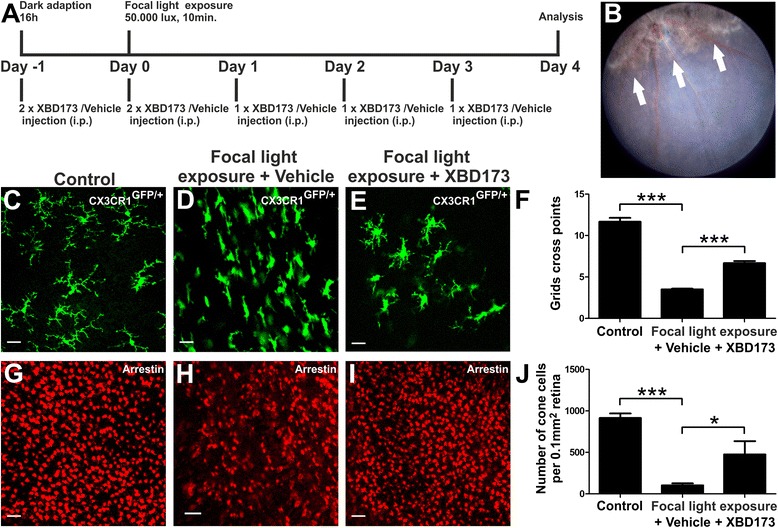
BACKGROUND: Reactive microglia are commonly seen in retinal degenerative diseases, and neurotoxic microglia responses can contribute to photoreceptor cell death. We and others have previously shown that translocator protein (18 kDa) (TSPO) is highly induced in retinal degenerations and that the selective TSPO ligand XBD173 (AC-5216, emapunil) exerts strong anti-inflammatory effects on microglia in vitro and ex vivo. Here, we investigated whether targeting TSPO with XBD173 has immuno-modulatory and neuroprotective functions in two mouse models of acute retinal degeneration using bright white light exposure. METHODS: BALB/cJ and Cx3cr1(GFP/+) mice received intraperitoneal injections of 10 mg/kg XBD173 or vehicle for five consecutive days, starting 1 day prior to exposure to either 15,000 lux white light for 1 h or 50,000 lux focal light for 10 min, respectively. The effects of XBD173 treatment on microglia and Müller cell reactivity were analyzed by immuno-stainings of retinal sections and flat mounts, fluorescence-activated cell sorting (FACS) analysis, and mRNA expression of microglia markers using quantitative real-time PCR (qRT-PCR). Optical coherence tomography (OCT), terminal deoxynucleotidyl transferase dUTP nick end labeling (TUNEL) stainings, and morphometric analyses were used to quantify the extent of retinal degeneration and photoreceptor apoptosis. RESULTS: Four days after the mice were challenged with bright white light, a large number of amoeboid-shaped alerted microglia appeared in the degenerating outer retina, which was nearly completely prevented by treatment with XBD173. This treatment also down-regulated the expression of TSPO protein in microglia but did not change the TSPO levels in the retinal pigment epithelium (RPE). RT-PCR analysis showed that the microglia/macrophage markers Cd68 and activated microglia/macrophage whey acidic protein (Amwap) as well as the pro-inflammatory genes Ccl2 and Il6 were reduced after XBD173 treatment. Light-induced degeneration of the outer retina was nearly fully blocked by XBD173 treatment. We further confirmed these findings in an independent mouse model of focal light damage. Retinas of animals receiving XBD173 therapy displayed significantly more ramified non-reactive microglia and more viable arrestin-positive cone photoreceptors than vehicle controls. CONCLUSIONS: Targeting TSPO with XBD173 effectively counter-regulates microgliosis and ameliorates light-induced retinal damage, highlighting a new pharmacological concept for the treatment of retinal degenerations.
Overview
The claims and statistics of this paper haven’t been checked yet.
Run the check — free, no account needed. It reads the open-access text and checks the sources it cites.
Integrity signals
Registry
Cites
Statistics
Figures
Verification
Claims the paper makes
The claims and statistics of this paper haven’t been checked yet.
Run the check — free, no account needed. It reads the open-access text and checks the sources it cites.
Claims other papers make about this one
Each is checked against this paper’s own text: does it say what the citing paper says it does?
In the citing paper
“Furthermore, increased TSPO expression may not be indicative of the inflammatory phenotype of microglia (Scholz et al, 2015).”
From Microglia Priming with Aging and Stress (2017) · cites this paper as Scholz et al, 2015
Self-check
Percentages, sums and reported differences re-computed from the paper’s own numbers.
The self-check needs the paper’s full text.
Citations
Cites
Resting microglial cells are highly dynamic surveillants of brain parenchyma in vivo
Nimmerjahn, A., Kirchhoff, F., & Helmchen, F. (2005) · Science · doi:10.1126/science.1110647 · Cited by 5,827
Kettenmann, H., Hanisch, U.-K., Noda, M., & Verkhratsky, A. (2011) · Physiological Reviews · doi:10.1152/physrev.00011.2010 · Cited by 3,547
Inflammation in neurodegenerative diseases
Amor, S., Puentes, F., Baker, D., & Van Der Valk, P. (2010) · Immunology · doi:10.1111/j.1365-2567.2009.03225.x · Cited by 1,355
Aloisi, F. (2001) · Glia · doi:10.1002/glia.1106 · Cited by 1,310
Wu, D. C., Jackson-Lewis, V., Vila, M., Tieu, K., Teismann, P., Vadseth, C., Choi, D.-K., Ischiropoulos, H., & Przedborski, S. (2002) · The Journal of Neuroscience · doi:10.1523/jneurosci.22-05-01763.2002 · Cited by 1,183
Rupprecht, R., Papadopoulos, V., Rammes, G., Baghai, T. C., Fan, J., Akula, N., Groyer, G., Adams, D., & Schumacher, M. (2010) · Nature Reviews Drug Discovery · doi:10.1038/nrd3295 · Cited by 930
Microglia derived from aging mice exhibit an altered inflammatory profile
Sierra, A., Gottfried‐Blackmore, A. C., McEwen, B. S., & Bulloch, K. (2007) · Glia · doi:10.1002/glia.20468 · Cited by 688
Para-Inflammation in the Aging Retina
Xu, H., Chen, M., & Forrester, J. V. (2009) · Progress in Retinal and Eye Research · doi:10.1016/j.preteyeres.2009.06.001 · Cited by 659 · cited 1×
“of microglia physiology contribute to degenerative pathologies of the retina and the entire CNS [3, 5–14].”
BackgroundSelf-citationWenzel, A., Grimm, C., Samardzija, M., & Remé, C. E. (2004) · Progress in Retinal and Eye Research · doi:10.1016/j.preteyeres.2004.08.002 · Cited by 655
Self-citationGupta, N., Brown, K. E., & Milam, A. H. (2003) · Experimental Eye Research · doi:10.1016/s0014-4835(02)00332-9 · Cited by 582
Cited by
Sorted by citations
Items 101–111 of 111
The Mitochondrial 18 kDa Translocator Protein as a Biomarker of Radiation-Induced Neuroinflammatory
Родина, А. В. (2024) · Medical Radiology and radiation safety · doi:10.33266/1024-6177-2024-69-3-35-45 · Cited by 1
Eye-brain axis: the crosstalk between neurons and immune cells
Liu, C., Fang, Z., He, Z., Mao, Y., & Yang, H. (2026) · Eye Discovery · doi:10.1016/j.edisc.2026.100023 · Cited by 1
Mikroglia und Immuntherapien bei degenerativen Netzhauterkrankungen
Karlstetter, M., Dannhausen, K., & Langmann, T. (2017) · Medizinische Genetik · doi:10.1007/s11825-017-0132-8 · Cited by 1
Self-citationTang, X., Liu, W., Liang, J., Zhu, X., Ge, X., Fang, D., Ling, L., Yuan, F., Zeng, K., Chen, Q., et al. (2024) · Inflammation · doi:10.1007/s10753-024-02152-w · Cited by 1
Cell type-specific complement expression from healthy and diseased retinaePreprint
Pauly, D., Schäfer, N., Graßmann, F., Pfaller, A. M., Straub, T., Weber, B. H. F., Hauck, S. M., & Grosche, A. (2018) · bioRxiv (Cold Spring Harbor Laboratory) · doi:10.1101/413088
Gong, J. (2020) · eDiss (Georg-August-Universität Göttingen) · doi:10.53846/goediss-8039
Therapeutic and immunomodulatory functions of the translocator protein in Alzheimer's disease
Fairley, L. H. (2022) · DR-NTU (Nanyang Technological University) · doi:10.32657/10356/160865
Fairley, L. H., Sahara, N., Aoki, I., Ji, B., Suhara, T., Higuchi, M., & Barron, A. M. (2021) · Figshare · doi:10.6084/m9.figshare.14252304
Péntek, L., Czeiter, E., Amrein, K., Szentivanyi, A., Kovács, B., Balogh, B., Szarka, G., Ross, L., Völgyi, B., & Kovács‐Öller, T. (2026) · Research Square · doi:10.21203/rs.3.rs-10757355/v1
TSPO in systemic-ocular immunometabolic crosstalk: mechanisms and therapeutic implications
Yang, Z., Zhang, X., Tian, D., Li, X., Zhao, X., Wang, E., & Chen, Y. (2026) · Frontiers in Immunology · doi:10.3389/fimmu.2026.1929816
Metadata
- Authors
- Scholz, R., Caramoy, A., Bhuckory, M. B., Rashid, K., Chen, M., Xu, H., Grimm, C., & Langmann, T.
- Affiliations
- University of Cologne (DE)
- Queen's University Belfast (GB)
- University of Zurich (CH)
- Corresponding author
- Langmann, Thomas
- Venue
- Journal of Neuroinflammation
- Published
- 2015-11-02
- Volume
- 12
- Issue
- 1
- Pages
- 201-201
- ISSN
- 1742-2094 (ISSN-L)
- PMC
- PMC4630900
- OpenAlex
- W1944096616
- Cited by
- 111
- References
- 60
- Citations by year
- 2026: 5 · 2025: 5 · 2024: 11 · 2023: 5 · 2022: 12 · 2021: 18 · 2020: 10 · 2019: 11 · 2018: 13 · 2017: 13 · 2016: 7 · 2015: 1
- FWCI
- 4.92
- Type
- journal article
- Language
- en
- Open access
- gold
- doi.org
- Licence
- cc-by
- Locations
- Journal of Neuroinflammation (publishedVersion, cc-by)
- Europe PMC (PubMed Central) (publishedVersion, cc-by)
- PubMed Central (publishedVersion, cc-by)
- PubMed (publishedVersion)
- Kölner Universitäts PublikationsServer (Universität zu Köln) (publishedVersion)
- Zurich Open Repository and Archive (University of Zurich) (acceptedVersion, cc-by)
- Research Portal (Queen's University Belfast) (submittedVersion, cc-by)
- Zurich Open Repository and Archive (University of Zurich) (submittedVersion, cc-by)
- Zurich Open Repository and Archive (University of Zurich)
- Funders
- Deutsche Forschungsgemeinschaft (LA1203/6-2, LA1203/9-1, LA1203/10-1, FOR2240)
- Velux Stiftung (Project 967)
- Hans und Marlies Stoock Foundation (S 061-10.013)
- Pro Retina Foundation (ProRetinaStip LA)
- Bayer (Bayer Graduate Program in Pharmacology)
- Fight for Sight UK (1425/1426)
- Topics
- Health Sciences › Medicine › Ophthalmology › Retinal Development and Disorders
- Life Sciences › Neuroscience › Neurology › Neuroinflammation and Neurodegeneration Mechanisms
- Health Sciences › Medicine › Ophthalmology › Glaucoma and retinal disorders
- Keywords
- translocator protein (TSPO), microglia, retinal degeneration, light-induced retinal damage, photoreceptor apoptosis, neuroprotection, anti-inflammatory activity, Müller cells, CX3CR1, MCP-1, interleukin-6, retinal pigment epithelium, choroidal neovascularization
- MeSH terms
- Animals, Disease Models, Animal, Female, Flow Cytometry, Immunohistochemistry, Inflammation, Male, Mice, Inbred BALB C, Mice, Inbred C57BL, Mice, Transgenic, Purines, Retinal Degeneration, Microglia, Receptors, GABA, Reverse Transcriptase Polymerase Chain Reaction, In Situ Nick-End Labeling, Tomography, Optical Coherence, Mice, Real-Time Polymerase Chain Reaction
About these checks
Registry, retraction, Cites and statistics results are computed, not judged, with one exception: a printed reference that no index lists is read once by a model before it counts as a citation error. Claims are extracted by a model and kept only when their quote appears verbatim in the text; each cited source is then checked, with a model’s help, for whether it says what the claim relies on. Those verdicts can be wrong — read the claim’s quote and the cited source before relying on one.
Statistics and arithmetic are recomputed, not judged.
Confidence bands are shown only for fields calibrated on our annotated test set. None is calibrated yet, so no band is shown.
What counts as a claim ›How we measure confidence ›How we check this ›
Are you an author, or do you see a problem with this page? Request a review
