

Excess cerebral TNF causing glutamate excitotoxicity rationalizes treatment of neurodegenerative diseases and neurogenic pain by anti-TNF agents
Open accessThe DOI matches its Crossref record; 252 of the 252 references it cites were found in a registry or an index.
Abstract
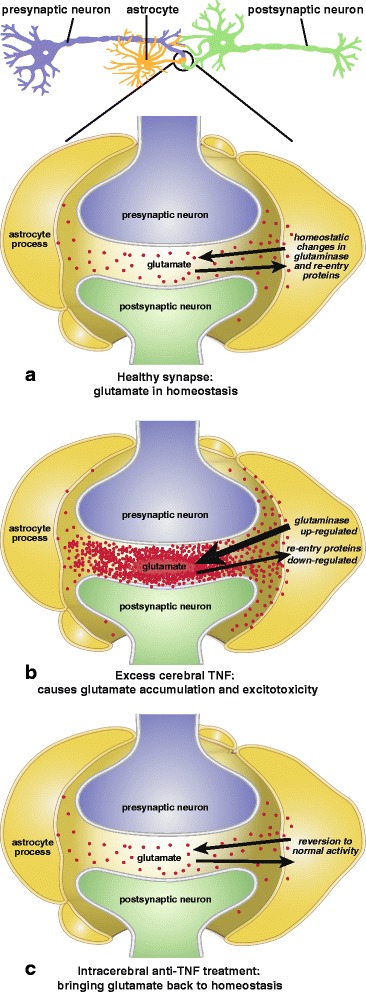
The basic mechanism of the major neurodegenerative diseases, including neurogenic pain, needs to be agreed upon before rational treatments can be determined, but this knowledge is still in a state of flux. Most have agreed for decades that these disease states, both infectious and non-infectious, share arguments incriminating excitotoxicity induced by excessive extracellular cerebral glutamate. Excess cerebral levels of tumor necrosis factor (TNF) are also documented in the same group of disease states. However, no agreement exists on overarching mechanism for the harmful effects of excess TNF, nor, indeed how extracellular cerebral glutamate reaches toxic levels in these conditions. Here, we link the two, collecting and arguing the evidence that, across the range of neurodegenerative diseases, excessive TNF harms the central nervous system largely through causing extracellular glutamate to accumulate to levels high enough to inhibit synaptic activity or kill neurons and therefore their associated synapses as well. TNF can be predicted from the broader literature to cause this glutamate accumulation not only by increasing glutamate production by enhancing glutaminase, but in addition simultaneously reducing glutamate clearance by inhibiting re-uptake proteins. We also discuss the effects of a TNF receptor biological fusion protein (etanercept) and the indirect anti-TNF agents dithio-thalidomides, nilotinab, and cannabinoids on these neurological conditions. The therapeutic effects of 6-diazo-5-oxo-norleucine, ceptriaxone, and riluzole, agents unrelated to TNF but which either inhibit glutaminase or enhance re-uptake proteins, but do not do both, as would anti-TNF agents, are also discussed in this context. By pointing to excess extracellular glutamate as the target, these arguments greatly strengthen the case, put now for many years, to test appropriately delivered ant-TNF agents to treat neurodegenerative diseases in randomly controlled trials.
Overview
The claims and statistics of this paper haven’t been checked yet.
Free: it reads the open-access text and checks the first 5 claims that cite a source we can check. Create a free account to check every claim.
Integrity signals
Registry
Cites
Statistics
Figures
Verification
Claims the paper makes
The claims and statistics of this paper haven’t been checked yet.
Free: it reads the open-access text and checks the first 5 claims that cite a source we can check. Create a free account to check every claim.
Claims other papers make about this one
Each is checked against this paper’s own text: does it say what the citing paper says it does?
The cited source says what the claim attributes to it.
In the citing paper
“Nevertheless, excessive TNF led to a high-level accumulation of extracellular glutamate to inhibit the synaptic activity or kill neurons, which rationalized the treatment of neurogenic pain by anti-TNF agents (Clark and Vissel, 2016).”
From Picroside Ⅱ attenuates neuropathic pain by regulating inflammation and spinal excitatory synaptic transmission (2024) · cites this paper as Clark and Vissel, 2016
Self-check
Percentages, sums and reported differences re-computed from the paper’s own numbers.
The self-check needs the paper’s full text.
Citations
Cites
Glutamate neurotoxicity and diseases of the nervous system
CHOI, D. (1988) · Neuron · doi:10.1016/0896-6273(88)90162-6 · Cited by 7,972 · cited 1×
“As reviewed [66, 71], should extracellular cerebral glutamate become excessive, whether through excess release or poor clearance, or both, a harmful excitotoxicity ensues.”
BackgroundCui, C., Cui, J., Jin, F., Cui, Y., Li, R., Jiang, X., Tian, Y., Wang, K., Jiang, P., & Gao, J. (2017) · Cellular Physiology and Biochemistry · doi:10.1159/000479571 · Cited by 5,203
An endotoxin-induced serum factor that causes necrosis of tumors
Carswell, E. A., Old, L. J., Kassel, R. L., Green, S., Fiore, N., & Williamson, B. (1975) · Proceedings of the National Academy of Sciences · doi:10.1073/pnas.72.9.3666 · Cited by 4,532
Danbolt, N. C. (2001) · Progress in Neurobiology · doi:10.1016/s0301-0082(00)00067-8 · Cited by 4,227 · cited 1×
“As reviewed in 2001 [96], glutamate re-uptake from the synaptic cleft noted above is controlled by fluctuations in a unique family of amino acid transport, or re-uptake, proteins that act as signal terminators.”
BackgroundIL-23 drives a pathogenic T cell population that induces autoimmune inflammation
Langrish, C. L., Chen, Y., Blumenschein, W. M., Mattson, J., Basham, B., Sedgwick, J. D., McClanahan, T., Kastelein, R. A., & Cua, D. J. (2005) · The Journal of Experimental Medicine · doi:10.1084/jem.20041257 · Cited by 4,099 · cited 1×
“Nevertheless, data on other proinflammatory or anti-inflammatory cytokines such as IL-1β, IL-4, IL-17, and IL-23 [29–31] continue to add to the principles behind this concept and may well generate related therapeutic avenues.”
BackgroundBenveniste, H., Drejer, J., Schousboe, A., & Diemer, N. H. (1984) · Journal of Neurochemistry · doi:10.1111/j.1471-4159.1984.tb05396.x · Cited by 2,859 · cited 1×
“These conditions (Table 1) came to include AD [72], PD [73], Huntington’s disease [74], amyotropic lateral sclerosis [75], stroke [76], viral encephelitides [77, 78], septic encephalopathy [79], defective post-operative cognition [80], post-irradiation brain function [81], pain [82, 83], bacterial meningitis [84], epi…”
BackgroundDrug Transport across the Blood–Brain Barrier
Pardridge, W. M. (2012) · Journal of Cerebral Blood Flow & Metabolism · doi:10.1038/jcbfm.2012.126 · Cited by 1,994
Two Phase 3 Trials of Bapineuzumab in Mild-to-Moderate Alzheimer's Disease
Salloway, S., Sperling, R., Fox, N. C., Blennow, K., Klunk, W., Raskind, M., Sabbagh, M., Honig, L. S., Porsteinsson, A. P., Ferris, S., et al. (2014) · New England Journal of Medicine · doi:10.1056/nejmoa1304839 · Cited by 1,960 · cited 1×
“It may also explain why removing soluble Aβ or its plaque, still the goal of the many clinical trials [12], does not retard human disease progression, since the other secondary DAMPs, S100 proteins and HMGB1, are still actively inducing TNF.”
BackgroundThe molecular logic of endocannabinoid signalling
Piomelli, D. (2003) · Nature Reviews Neuroscience · doi:10.1038/nrn1247 · Cited by 1,957 · cited 1×
“In physiological terms, these may be considered as part neurotransmitter, part cytokine, and part hormone and have been identified and studied at length (see [184, 185] for reviews.”
BackgroundElliott, M. J., Maini, R. N., Feldmann, M., Kalden, J. R., Antoni, C., Smolen, J. S., Leeb, B., Breedveld, F. C., Macfarlane, J. D., Bijl, J. A., et al. (1994) · The Lancet · doi:10.1016/s0140-6736(94)90628-9 · Cited by 1,682 · cited 1×
“After being recognized as an early step in the inflammatory cytokine cascade [20], TNF began to achieve its present wide acceptance as a master cytokine in disease pathogenesis through infliximab, the first of the specific neutralizing biological anti-TNF agents, becoming a striking clinical success in treating RA [21…”
Background
Research works printed but not linked: 1
- Pagan F Society for Neuroscience (SfN) 2015 Annual Meeting. Abstract 12.01. Presented October 18, 2015 2015
Cited by
Items 101–134 of 134
Targeting tumor necrosis factor in the brain relieves neuropathic pain
Ignatowski, T. A., & Spengler, R. N. (2018) · World Journal of Anesthesiology · doi:10.5313/wja.v7.i2.10 · Cited by 4
Chapman, B. J., & Jones, G. B. (2020) · EMJ Gastroenterology · doi:10.33590/emjgastroenterol/20-00180 · Cited by 4
Pulukool, S. K., Bhagavatham, S. K. S., Kannan, V., Sukumar, P., Dandamudi, R. B., Ghaisas, S., Kunchala, H., Saieesh, D., Naik, A. A., Pargaonkar, A., et al. (2021) · Scientific Reports · doi:10.1038/s41598-021-97509-8 · Cited by 4
Duan, D., Wang, L., Feng, Y., Hu, D., & Cui, D. (2024) · Canadian Journal of Physiology and Pharmacology · doi:10.1139/cjpp-2023-0171 · Cited by 3
Hydromethylthionine sustains truncated tau‐dependent inflammation‐lowering effects in mouse brain
Santos, R. X., Lee, S. H., Lofthouse, R. A., Melis, V., Robinson, L., Leith, M., Dreesen, E., Armstrong, P., Vorley, T., Goatman, E. A., et al. (2025) · FEBS Journal · doi:10.1111/febs.70021 · Cited by 3
“The anti-tau antibodies CB7 and s1D12, recognising epitopes within the N-terminus (13 – 25) and the core repeat domain (341 – 353) of tau, respectively, were produced by the Scottish Biologics Facility (Aberdeen, UK) [58,61].”
Jin, J., Xu, X., Xu, X., Yin, M., & Yin, Y. (2025) · Neurochemical Research · doi:10.1007/s11064-025-04576-8 · Cited by 2
Immunomodulatory Effects of Anti-Epileptic Drug Lacosamide on Mammalian Macrophages
Atalay, B. R., Ayaz, F., & Aydemir, E. (2026) · Cell Biochemistry and Biophysics · doi:10.1007/s12013-026-01994-5 · Cited by 2
“Low amounts of TNF-α promote proper brain function, while large levels have been connected to neurological disorders [63].”
Desmond, L. W., & Lowry, C. A. (2026) · Brain Behavior and Immunity Integrative · doi:10.1016/j.bbii.2026.100166 · Cited by 2
Clark, I. A. (2021) · International Journal for Parasitology · doi:10.1016/j.ijpara.2021.10.002 · Cited by 2
Self-citationOn Overcoming Barriers to Application of Neuroinflammation Research
Tobinick, E. L., Ignatowski, T. A., & Spengler, R. N. (2017) · InTech eBooks · doi:10.5772/intechopen.68940 · Cited by 2
Neurologic and Psychiatric Effects of Cytokines and Targeted Biological Therapies
Beckwith, N., & Helfgott, S. M. (2019) · Springer eBooks · doi:10.1007/978-3-030-16928-2_29 · Cited by 1
Wininger, K. M., Ayasoufi, K., Wolf, D. M., Hinson, D. T., Jin, F., Hansen, M. J., & Johnson, A. J. (2025) · The FASEB Journal · doi:10.1096/fj.202501045r · Cited by 1
Li, F., & Zheng, L. (2026) · Frontiers in Oncology · doi:10.3389/fonc.2025.1691189 · Cited by 1
Burnjaković, B., Moy, H., Sič, A., & Knežević, N. N. (2026) · International Journal of Molecular Sciences · doi:10.3390/ijms27177852 · Cited by 1
Rezaei, N., Abhari, A. P., Etemadifar, M., & Yazdanpanah, N. (2022) · Mini-Reviews in Medicinal Chemistry · doi:10.2174/1389557522666220504135853 · Cited by 1
Vélez-Huerta, J. (2018) · El Repositorio Academico Digital de la UANL (Universidad Autónoma de Nuevo León) · Cited by 1
Sex differences in neuropathic pain and the role of TNF signaling
del Rivero, T., Bethea, J. R., & Marenda, J. (2017) · iDEA - Drexel University Institutional Repository · doi:10.17918/etd-7747 · Cited by 1
Spengler, R. N., & Ignatowski, T. A. (2018) · Journal of Neurology and Neurobiology · doi:10.16966/2379-7150.e111
“Prolonged, elevated TNF α may reduce gray matter volume, since increased TNF α appears to decrease neurogenesis in a neuropathic pain model and enhances production of glutamate, which is neurotoxic when in excess [2-4].”
BackgroundUpcoming value of gene expression analysis in rheumatology
Chetina, E. V., & Markova, G. A. (2018) · Biomeditsinskaya Khimiya · doi:10.18097/pbmc20186403221
Prospects for the Use of Gene Expression Analysis in Rheumatology
Chetina, E. V., & Markova, G. A. (2019) · Biochemistry (Moscow) Supplement Series B Biomedical Chemistry · doi:10.1134/s1990750819010049
Rheumatic pain management: molecular aspects
Chetina, E. V., & Sharapova, E. P. (2020) · Modern Rheumatology Journal · doi:10.14412/1996-7012-2020-1-93-100
Ashford, J. W. (2018) · Faculty Opinions – Post-Publication Peer Review of the Biomedical Literature · doi:10.3410/f.734280398.793553881
GENERAL PATHOGENETIC MECHANISMS OF NEUROTOXICITY
Ivanov, M. B. (2025) · International Journal of Applied and Fundamental Research (Международный журнал прикладных и фундаментальных исследований) · doi:10.17513/mjpfi.13736
Vélez-Huerta, J. (2024) · El Repositorio Academico Digital de la UANL (Universidad Autónoma de Nuevo León)
Guzzo, E. F. M. (2023) · Lume (Universidade Federal do Rio Grande do Sul)
Hou, Z., Jin, Y., Ruan, M., Jiang, Y., Fu, Y., Yang, J., Ge, J., & Long, Z. (2026) · Immunology · doi:10.1111/imm.70171
Sánchez, L., Rodriguez, C. M., & Pitossi, F. J. (2026) · Journal of Neurochemistry · doi:10.1111/jnc.70540
The Role of Astrocytes in the Inflammatory Response in Neurodiseases
Peng, S., Wang, L., Ouyang, J., & 刘如恩 (2026) · MedComm · doi:10.1002/mco2.71069
“This loss of metabolic support has been repeatedly documented in experimental models of various neurodegenerative diseases, including AD, PD, HD, and ALS [ 31, 180, 264, 265 ].”
Lestari, I. T., Anggadiredja, K., & Garmana, A. N. (2024) · doi:10.3897/pharmacia.71.e134309.figure5
Lestari, I. T., Anggadiredja, K., & Garmana, A. N. (2024) · doi:10.3897/pharmacia.71.e134309.figure7
Lestari, I. T., Anggadiredja, K., & Garmana, A. N. (2024) · doi:10.3897/pharmacia.71.e134309.figure3
Lestari, I. T., Anggadiredja, K., & Garmana, A. N. (2024) · doi:10.3897/pharmacia.71.e134309.figure4
Lestari, I. T., Anggadiredja, K., & Garmana, A. N. (2024) · doi:10.3897/pharmacia.71.e134309.figure6
Lestari, I. T., Anggadiredja, K., & Garmana, A. N. (2024) · doi:10.3897/pharmacia.71.e134309.figure2
Metadata
- Authors
- Clark, I. A., & Vissel, B.
- Affiliations
- Australian National University (AU)
- Garvan Institute of Medical Research (AU)
- Corresponding author
- Clark, Ian A.
- Venue
- Journal of Neuroinflammation
- Published
- 2016-09-05
- Volume
- 13
- Issue
- 1
- Pages
- 236-236
- ISSN
- 1742-2094 (ISSN-L)
- PMC
- PMC5011997
- OpenAlex
- W2515408417
- Cited by
- 123
- References
- 252
- Citations by year
- 2026: 6 · 2025: 14 · 2024: 10 · 2023: 8 · 2022: 16 · 2021: 14 · 2020: 18 · 2019: 11 · 2018: 17 · 2017: 9
- FWCI
- 1.08
- Type
- journal article
- Language
- en
- Open access
- gold
- doi.org
- Licence
- cc-by
- Locations
- Journal of Neuroinflammation (publishedVersion, cc-by)
- PubMed Central (publishedVersion, cc-by)
- PubMed (publishedVersion)
- ANU Open Research (Australian National University) (submittedVersion, cc-by)
- UTS ePRESS (University of Technology Sydney) (submittedVersion)
- Funders
- National Health and Medical Research Council (NHMRC) of Australia (project grant #1083569)
- Topics
- Life Sciences › Neuroscience › Neurology › Neuroinflammation and Neurodegeneration Mechanisms
- Life Sciences › Neuroscience › Cellular and Molecular Neuroscience › Neuroscience and Neuropharmacology Research
- Health Sciences › Medicine › Physiology (medical) › Pain Mechanisms and Treatments
- Keywords
- TNF-α, glutamate excitotoxicity, neurodegenerative diseases, neuropathic pain, anti-TNF therapy, glutaminase, glutamate clearance, etanercept, cannabinoids, riluzole, synaptic inhibition, neuroinflammation
- MeSH terms
- Animals, Cerebral Cortex, Humans, Neuralgia, Tumor Necrosis Factor-alpha, Glutamic Acid, Neurodegenerative Diseases
About these checks
Registry, retraction, Cites and statistics results are computed, not judged, with one exception: a printed reference that no index lists is read once by a model before it counts as a citation error. Claims are extracted by a model and kept only when their quote appears verbatim in the text; each cited source is then checked, with a model’s help, for whether it says what the claim relies on. Those verdicts can be wrong — read the claim’s quote and the cited source before relying on one.
Statistics and arithmetic are recomputed, not judged.
Confidence bands are shown only for fields calibrated on our annotated test set. None is calibrated yet, so no band is shown.
What counts as a claim ›How we measure confidence ›How we check this ›
Are you an author, or do you see a problem with this page? Request a review
Data sources
Bibliographic data: Semantic Scholar, OpenAlex, Crossref.
Contains information from the Semantic Scholar Academic Graph Datasets, made available under the ODC Attribution License (ODC-BY 1.0).
Semantic Scholar’s data is described in: Kinney, R., et al. (2023). The Semantic Scholar Open Data Platform. arXiv:2301.10140.
