

The DOI matches its Crossref record; 208 of the 208 references it cites were found in a registry or an index.
Mobility related physical and functional losses due to aging and disease - a motivation for lower limb exoskeletons
Open accessAbstract
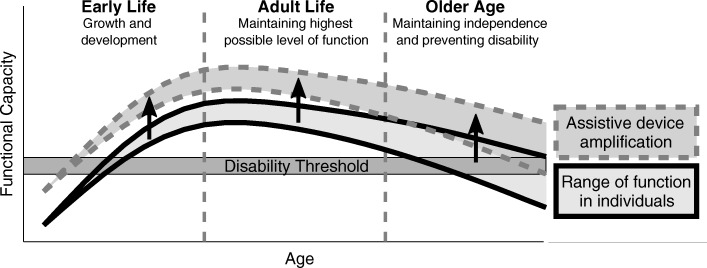
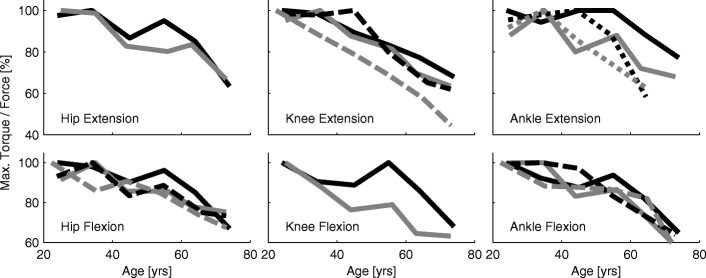
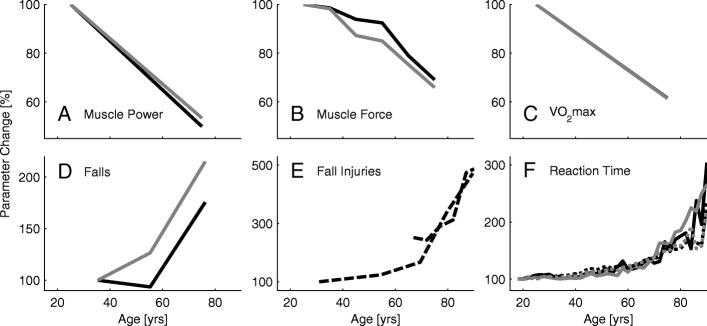
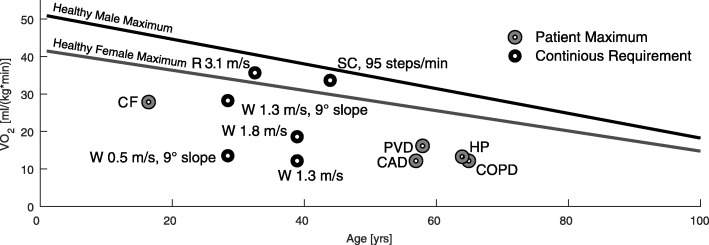
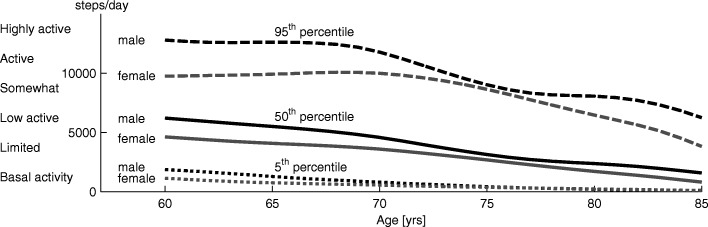
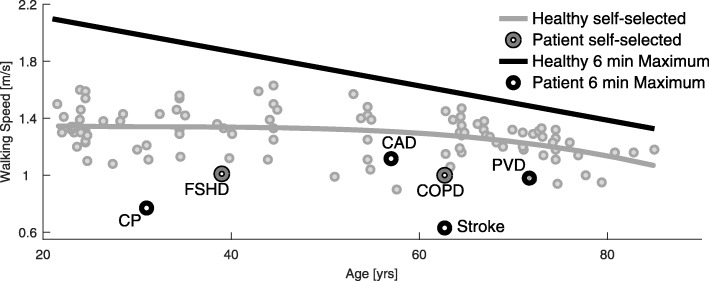
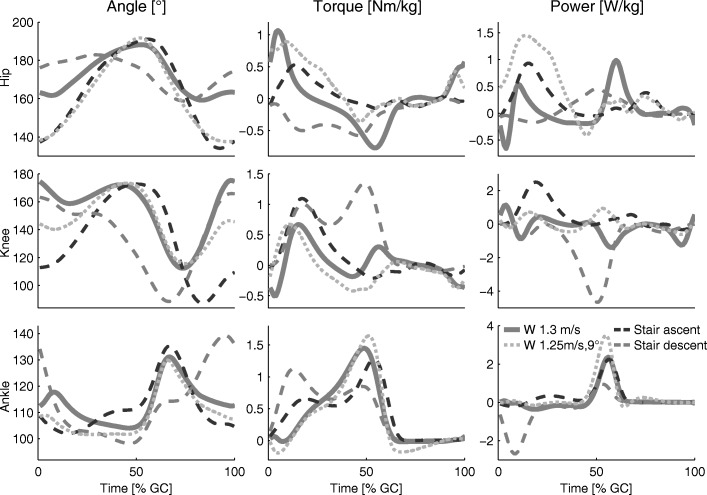
Background: Physical and functional losses due to aging and diseases decrease human mobility, independence, and quality of life. This study is aimed at summarizing and quantifying these losses in order to motivate solutions to overcome them with a special focus on the possibilities by using lower limb exoskeletons. Methods: A narrative literature review was performed to determine a broad range of mobility-related physical and functional measures that are affected by aging and selected cardiovascular, respiratory, musculoskeletal, and neurological diseases. Results: The study identified that decreases in limb maximum muscle force and power (33% and 49%, respectively, 25–75 yrs) and in maximum oxygen consumption (40%, 20–80 yrs) occur for older adults compared to young adults. Reaction times more than double (18–90 yrs) and losses in the visual, vestibular, and somatosensory systems were reported. Additionally, we found decreases in steps per day (75%, 60–85 yrs), maximum walking speed (24% 25–75 yrs), and maximum six-minute and self-selected walking speed (38% and 21%, respectively, 20–85 yrs), while we found increases in the number of falls relative to the number of steps per day (800%), injuries due to falls (472%, 30–90 yrs) and deaths caused by fall (4000%, 65–90 yrs). Measures were identified to be worse for individuals with impaired mobility. Additional detrimental effects identified for them were the loss of upright standing and locomotion, freezing in movement, joint stress, pain, and changes in gait patterns. Discussion: This review shows that aging and chronic conditions result in wide-ranging losses in physical and sensory capabilities. While the impact of these losses are relatively modest for level walking, they become limiting during more demanding tasks such as walking on inclined ground, climbing stairs, or walking over longer periods, and especially when coupled with a debilitating disease. As the physical and functional parameters are closely related, we believe that lost functional capabilities can be indirectly improved by training of the physical capabilities. However, assistive devices can supplement the lost functional capabilities directly by compensating for losses with propulsion, weight support, and balance support. Conclusions: Exoskeletons are a new generation of assistive devices that have the potential to provide both, training capabilities and functional compensation, to enhance human mobility.
Overview
The claims and statistics of this paper haven’t been checked yet.
Run the check — free, no account needed. It reads the open-access text and checks the sources it cites.
Integrity signals
Registry
Cites
Statistics
Figures
Verification
Claims the paper makes
The claims and statistics of this paper haven’t been checked yet.
Run the check — free, no account needed. It reads the open-access text and checks the sources it cites.
Claims other papers make about this one
Each is checked against this paper’s own text: does it say what the citing paper says it does?
In the citing paper
“In general, COVID-19 is acquired by transmission of a respiratory virus via close contact, droplet spray or aerosol, with the duration of viral stability and viability maintained depending on various objects or surfaces [16].”
Self-check
Percentages, sums and reported differences re-computed from the paper’s own numbers.
The self-check needs the paper’s full text.
Citations
Cites
Vos, T., Abajobir, A. A., Abate, K. H., Abbafati, C., Abbas, K. M., Abd-Allah, F., Abdulkader, R. S., Abdulle, A. M., Abebo, T. A., Abera, S. F., et al. (2017) · The Lancet · doi:10.1016/s0140-6736(17)32154-2 · Cited by 13,220
‘Small Changes' to Diet and Physical Activity Behaviors for Weight Management
Hills, A. P., Byrne, N. M., Lindstrom, R. C., & Hill, J. O. (2013) · Obesity Facts · doi:10.1159/000345030 · Cited by 9,526
Vos, T., Barber, R. M., Bell, B., Bertozzi-Villa, A., Biryukov, S., Bolliger, I., Charlson, F., Davis, A., Degenhardt, L., Dicker, D., et al. (2015) · The Lancet · doi:10.1016/s0140-6736(15)60692-4 · Cited by 6,414
(1992) · Applied Ergonomics · doi:10.1016/0003-6870(92)90318-p · Cited by 5,774
Parkinson's disease: clinical features and diagnosis
Jankovic, J. (2008) · Journal of Neurology, Neurosurgery & Psychiatry · doi:10.1136/jnnp.2007.131045 · Cited by 5,720
Human balance and posture control during standing and walking
Winter, D. (1995) · Gait & Posture · doi:10.1016/0966-6362(96)82849-9 · Cited by 3,638
Fowkes, F. G. R., Rudan, D., Rudan, I., Aboyans, V., Denenberg, J. O., McDermott, M. M., Norman, P. E., Sampson, U. K., Williams, L. J., Mensah, G. A., et al. (2013) · The Lancet · doi:10.1016/s0140-6736(13)61249-0 · Cited by 3,508
Sarcopenia: origins and clinical relevance
Rosenberg, I. H. (1997) · The Journal of Nutrition · doi:10.1093/jn/127.5.990s · Cited by 2,399
Comfortable and maximum walking speed of adults aged 20—79 years: reference values and determinants
Bohannon, R. W. (1997) · Age and Ageing · doi:10.1093/ageing/26.1.15 · Cited by 2,346
Using Pedometers to Increase Physical Activity and Improve Health: A Systematic Review
Bravata, D. M., Smith-Spangler, C., Sundaram, V., Gienger, A. L., Lin, N., Lewis, R., Stave, C. D., Olkin, I., & Sirard, J. R. (2007) · JAMA · doi:10.1001/jama.298.19.2296 · Cited by 2,064
Research works printed but not linked: 1
- Lipfert SW. Kinematic and Dynamic Similarities Between Walking and Running. Hamburg: Verlag Dr. Kovac; 2010. ISBN: 978-3-8300-5030-8.
Cited by
Sorted by citations
Items 101–200 of 249
Javadzade, N., Omranifard, V., Zargar, F., Marzban, A., & Esmaeili, S. V. (2024) · Journal of Health Psychology · doi:10.1177/13591053241302472 · Cited by 5
Physiotherapy Considerations from Test Results with ASSIST-FEE.v3 Elbow Assisting Device
Frisina, F., Morales-Cruz, C., Scerbo, F., Mazzotta, R., & Ceccarelli, M. (2025) · Mechanisms and machine science · doi:10.1007/978-3-031-96081-9_20 · Cited by 5
Lee, Y. S., Lee, D. Y., & Jun, E. J. (2025) · Buildings · doi:10.3390/buildings15224164 · Cited by 5
Hongying, Z., Chunmei, H., Lijuan, C., Miao, T., Xie, J., Hongmei, J., Hu, J. Y., Yang, H., & Yang, M. (2025) · Medicine · doi:10.1097/md.0000000000042961 · Cited by 5
A matter of life and longer life
Kostick, K. M., Fowler, L. R., & Scott, C. T. (2019) · Journal of Aging Studies · doi:10.1016/j.jaging.2019.100800 · Cited by 5
Böhme, M., Weiske, F., Jäkel, J., Zentner, J., & Witt, M. (2022) · Wearable Technologies · doi:10.1017/wtc.2022.1 · Cited by 5
Guastafierro, E., Toppo, C., Corso, B., Romano, R., Campioni, R., Brambilla, E., Facchini, C., Bordoni, S., & Leonardi, M. (2022) · Frontiers in Medicine · doi:10.3389/fmed.2022.854779 · Cited by 5
Empowering Lower Limb Disorder Identification through PoseNet and Artificial Intelligence
Siddiqui, H. U. R., Saleem, A. A., Raza, M. A., Villar, S. G., López, L. A. D., Díez, I. D. L. T., Rustam, F., & Dudley, S. (2023) · Diagnostics · doi:10.3390/diagnostics13182881 · Cited by 5
Moeller, T., Beyerlein, M., Herzog, M., Barisch‐Fritz, B., Marquardt, C., Dežman, M., Mombaur, K., Asfour, T., Wöll, A., Stein, T., et al. (2025) · Progress in Biomedical Engineering · doi:10.1088/2516-1091/ada333 · Cited by 6
Liu, W., & Bai, J. (2024) · Frontiers in Bioengineering and Biotechnology · doi:10.3389/fbioe.2024.1372757 · Cited by 4
Shen, W., Kuys, B., & Benson, A. C. (2025) · Disability and Rehabilitation Assistive Technology · doi:10.1080/17483107.2025.2547040 · Cited by 4
Toward better assistive lower-limb exoskeletons: Insights from stroke survivors through co-design
Claeys, R., Embrechts, E., Debeuf, R., Firouzi, M., Bourazeri, A., Raedt, S. D., Moeyersons, C., Filtjens, B., Verstraten, T., Beckwée, D., et al. (2025) · Assistive Technology · doi:10.1080/10400435.2025.2541730 · Cited by 4
Wei, X., Li, C., Liu, D., Chen, J., Ju, Y., Jin, L., Liu, B., & Zhang, Y. (2025) · BMC Public Health · doi:10.1186/s12889-025-21479-z · Cited by 4
Design and implementation of a stumble recovery controller for a knee exoskeleton
Eveld, M. E., King, S. T., Zelik, K. E., & Goldfarb, M. T. (2021) · IEEE/RSJ International Conference on Intelligent Robots and Systems (IROS) · doi:10.1109/iros51168.2021.9636879 · Cited by 4
Intrinsic motivation for using a wearable hip exoskeleton
Roggeman, S., Firouzi, M., Lefeber, N., Keersmaecker, E. D., Cuypers, L., Swinnen, E., Joos, E., Schiltz, M., & Hatem, S. M. (2022) · Technology and Disability · doi:10.3233/tad-210362 · Cited by 4
Salient Targets and Fear of Falling Changed the Gait Pattern and Joint Kinematic of Older Adults
Luo, Y. G., Lu, X., Grimaldi, N. S., Ahrentzen, S. B., & Hu, B. (2022) · Sensors · doi:10.3390/s22239352 · Cited by 4
Otlet, V., & Ronsse, R. (2023) · Journal of Neurophysiology · doi:10.1152/jn.00181.2023 · Cited by 4
Fernández-Peña, E., Formiglio, E., Gervasi, M., Benelli, P., Bertuccioli, A., Russo, G., Giustino, V., & Patti, A. (2024) · Frontiers in Aging · doi:10.3389/fragi.2024.1504789 · Cited by 4
Kawakami, K., Tanabe, S., Kinoshita, D., Kitabatake, R., Koshisaki, H., Fujimura, K., Kanada, Y., & Sakurai, H. (2025) · Journal of Rehabilitation Medicine · doi:10.2340/jrm.v57.41993 · Cited by 4
Llopis, P., Oviedo-Trespalacios, Ó., Alonso, F., Faus, M., & Useche, S. A. (2025) · Sustainable Futures · doi:10.1016/j.sftr.2025.100982 · Cited by 7
Bardenheier, B. H., Resnik, L. J., Jutkowitz, E., & Gravenstein, S. (2022) · Aging Clinical and Experimental Research · doi:10.1007/s40520-022-02132-w · Cited by 5
Luo, J., Liu, Q., Gama, Z., Gesang, D., Zhu, Y., Yang, L., Bai, D., Zhao, Q., & Xiao, M. (2023) · Patient Preference and Adherence · doi:10.2147/ppa.s400346 · Cited by 4
Decision support framework for predicting rate of gait recovery with optimized treatment planning
Khera, P., & Kumar, N. (2023) · Expert Systems with Applications · doi:10.1016/j.eswa.2023.121721 · Cited by 4
Automated Treadmill Control Strategy for Gait Rehabilitation Based on Human-Machine Interaction
Macedo, B. C., Moreno-Arevalo, B. S., Machado, F., Morais, J. V., de Mello, R. C., & Frizera, A. (2023) · IEEE CHILEAN Conference on Electrical, Electronics Engineering, Information and Communication Technologies (CHILECON) · doi:10.1109/chilecon60335.2023.10418721 · Cited by 4
Luo, Y. G., Chen, Y., Huang, G., & Hu, B. (2024) · Experimental Gerontology · doi:10.1016/j.exger.2024.112580 · Cited by 3
Liu, S., Li, Q., Sun, H., Zhou, Q., & Nie, B. (2024) · Traffic Injury Prevention · doi:10.1080/15389588.2024.2408402 · Cited by 3
Hu, Y., Yu, J., Xu, Z., Gao, Y. H., Yang, L., & Li, L. (2025) · Frontiers in Endocrinology · doi:10.3389/fendo.2025.1530067 · Cited by 3
Hamelryckx, S., Vlerken, C. V., Flynn, L., Wu, M. M., Vanderborght, B., & Verstraten, T. (2025) · International Conference on Rehabilitation Robotics · doi:10.1109/icorr66766.2025.11062935 · Cited by 3
Human-Interface Dynamics of Knee Exoskeletons with Lateral and Anteroposterior Attachment
Wang, Y., Pérez, J. A. M., Gregg, R. D., & Thomas, G. C. (2025) · International Conference on Rehabilitation Robotics · doi:10.1109/icorr66766.2025.11062962 · Cited by 3
Luo, Y., Wu, D. C. W., Zhang, H., Cheng, W. L. A., & Lin, M. (2025) · Journal of China Tourism Research · doi:10.1080/19388160.2025.2525891 · Cited by 5
Gait stability prediction through synthetic time-series and vision-based data
Cordeiro, M. C., Catháin, C. Ó., Nascimento, V. B., & Rodrigues, T. B. (2025) · Frontiers in Sports and Active Living · doi:10.3389/fspor.2025.1646146 · Cited by 3
Ren, J., Wang, A., Li, H., Gao, S., Duan, H., & Meng, L. (2025) · IEEE Transactions on Consumer Electronics · doi:10.1109/tce.2025.3605267 · Cited by 3
Kumar, R., Ramkumar, J., Gurjar, M., & Rai, S. (2025) · Expert Review of Medical Devices · doi:10.1080/17434440.2025.2560660 · Cited by 3
Wang, Y., Jin, Z. Y., Gao, M., & Wu, X. (2025) · Frontiers in Public Health · doi:10.3389/fpubh.2025.1699018 · Cited by 3
Lee, S., Lee, S., Kim, S.-W., Park, H., Lim, K., & Jung, H. (2022) · International Journal of Environmental Research and Public Health · doi:10.3390/ijerph19159754 · Cited by 3
Claeys, R., Embrechts, E., Firouzi, M., Vlieger, D. D., Verstraten, T., Beckwée, D., & Swinnen, E. (2024) · Disability and Rehabilitation · doi:10.1080/09638288.2024.2436981 · Cited by 3
Jenhani, S., & Gritli, H. (2024) · Springer eBooks · doi:10.1007/978-981-97-8983-2_13 · Cited by 3
Faraldi, M., Provinciali, M., Rosa, M. D., Moresi, R., Sansoni, V., Gomarasca, M., Gerosa, L., Malvandi, A. M., Lattanzio, F., Banfi, G., et al. (2025) · GeroScience · doi:10.1007/s11357-025-01510-2 · Cited by 3
Ryu, D.-H., Choi, B., Kong, Y.-K., Park, S., Shim, H.-H., & Park, J. (2025) · Journal of Agromedicine · doi:10.1080/1059924x.2025.2583408 · Cited by 3
Borooghani, D., Hadi, A., Alipour, K., & Tarvirdizadeh, B. (2022) · Journal of Intelligent & Robotic Systems · doi:10.1007/s10846-022-01629-w · Cited by 3
Dynamic analysis and design of a multipurpose lower limb exoskeleton for rehabilitation
Li, G., Su, Q., Xi, W., Song, Z., Bao, R., & Du, Z. (2022) · International Journal of Advanced Robotic Systems · doi:10.1177/17298806221135140 · Cited by 3
Preliminary Development of a Robotic Hip-Knee Exoskeleton With 3D-Printed Backdrivable Actuators
Sanchez, A., Rossos, T., Mihailidis, A., & Laschowski, B. (2023) · doi:10.1115/detc2023-116406 · Cited by 3
Design and Modelling of a Human Upper Limb for Rehabilitation Exoskeleton
Rangan, R. P., Johnson, J. W., Ramesh, B. S., Maheswari, C., Vaisali, S., & Shankar, S. (2024) · Journal of Engineering Science and Technology Review · doi:10.25103/jestr.172.02 · Cited by 3
Prevalence and factors associated with low functional mobility in older adults
Oliveira, F. N., Damião, E. P., dos Santos, L., Galvão, L. L., Machado, H. R., Silva, R. R., Tribess, S., Júnior, J. S. V., & Santos, D. D. A. T. (2024) · Aging Medicine · doi:10.1002/agm2.12323 · Cited by 3
Multidisciplinary development of Smart Jacket for elder care
Vuohijoki, T., Ihalainen, T., Merilampi, S. L., & Virkki, J. (2022) · Finnish Journal of eHealth and eWelfare · doi:10.23996/fjhw.112214 · Cited by 3
A Low-Cost Wearable Exoskeleton for Sitting and Standing Assistance
Blalack, K., Wang, L. L., Maldonado, M., Marbury, L., Zare, S., & Sun, Y. (2024) · Wearable and Implantable Body Sensor Networks · doi:10.1109/bsn63547.2024.10780629 · Cited by 2
Aging in Place: The Evolution of Accessible Housing over Two Decades
Campbell, N. (2025) · Journal of Aging and Environment · doi:10.1080/26892618.2025.2506050 · Cited by 2
Morales-Cruz, C., Ofanaike, E., & Ceccarelli, M. (2025) · Anales de Ingeniería Mecánica · doi:10.63450/aim.1.34.2025 · Cited by 2
Energy‐Efficient Actuation for Wearable Exoskeletons: A Virtual Prototype
Ghaffar, A., Rehman, A., Riaz, M. T., & Mahmud, M. M. S. A. (2025) · Applied Bionics and Biomechanics · doi:10.1155/abb/7248941 · Cited by 2
Yu, X., Wang, C., Hou, M., Yang, R., & Kim, W. (2025) · Engineering Applications of Artificial Intelligence · doi:10.1016/j.engappai.2025.113363 · Cited by 2
Design and Biomechanical Evaluation of a Soft Lower Limb Exoskeleton for Elderly Assistance
Jin, Y., Zheng, Y., Li, Z., Cai, S., Bao, G., Jamwal, P. K., & Hussain, S. (2025) · IEEE Transactions on Medical Robotics and Bionics · doi:10.1109/tmrb.2025.3646750 · Cited by 2
Hip Exoskeleton Assistance During Sit-to-Stand Transitions
Grimmer, M., Mohseni, O., Seiler, J., Sharbafi, M. A., Findeisen, R., Andre Seyfarth, A., & Kupnik, M. (2026) · Biomechanics · doi:10.3390/biomechanics6010015 · Cited by 2
Self-citationTranshumanización: mitad humano y mitad robot
Wilches, C. B. (2021) · Revista Fe y Libertad · doi:10.55614/27093824.v4i1.88 · Cited by 2
International Symposium on Technikpsychologie (TecPsy) 2023
Gerber, N., & Zimmermann, V. (2023) · Sciendo eBooks · doi:10.2478/9788366675896 · Cited by 4
A descriptive study of physical function and performance in older black men with low back pain
Fullwood, D., Booker, S. Q., Fallon, E., Means, S., Asto-Flores, E., Stickley, Z. L., Elie-Turenne, M.-C., & Wilkie, D. J. (2023) · Geriatric Nursing · doi:10.1016/j.gerinurse.2023.06.021 · Cited by 2
de Abreu, D. C. C., Peres-Ueno, M. J., & Porto, J. M. (2024) · Brazilian Journal of Physical Therapy · doi:10.1016/j.bjpt.2024.101143 · Cited by 2
Machado, F., Loureiro, M., de Mello, R. C., Díaz, C. A. R., & Frizera, A. (2025) · Elsevier eBooks · doi:10.1016/b978-0-12-819877-3.00012-3 · Cited by 2
Iida, T., Taguchi, R., Miyashita, R., Aoi, S., Ikeda, H., Higa, N., Kanagawa, K., Okuyama, Y., & Ito, Y. (2025) · Geriatrics · doi:10.3390/geriatrics10030076 · Cited by 2
Simulation of Energy Regeneration in Human Locomotion for Efficient Exoskeleton Actuation
Laschowski, B., Inkol, K. A., Mihailidis, A., & McPhee, J. (2022) · IEEE/RAS-EMBS International Conference on Biomedical Robotics and Biomechatronics (BioRob) · doi:10.1109/biorob52689.2022.9925349 · Cited by 2
Badr, A. F. (2021) · Saudi Journal of Health Systems Research · doi:10.1159/000516346 · Cited by 2
The Effectiveness of Yoga Exercise on Muscle Strength in the Elderly
Kumara, G. (2022) · INTERNATIONAL JOURNAL OF MULTIDISCIPLINARY RESEARCH AND ANALYSIS · doi:10.47191/ijmra/v5-i8-41 · Cited by 2
Kumar, P. P., Darshini, I. S., & Prashanth, K. V. H. (2023) · Elsevier eBooks · doi:10.1016/b978-0-443-19084-1.00026-0 · Cited by 2
Deep Learning for Motion Classification in Ankle Exoskeletons Using Surface EMG and IMU SignalsPreprint
Estévez, S. R., Mallah, J., Kazieczko, D., Tang, C., & Occhipinti, L. G. (2024) · Research Square · doi:10.21203/rs.3.rs-5446652/v1 · Cited by 2
Stigma and the use of umbrellas, hiking poles and walking sticks to aid walking in Hong Kong
Maximo, T., Fong, K. N. K., & Lau, N. M. L. (2024) · Hong Kong Journal of Occupational Therapy · doi:10.1177/15691861241254862 · Cited by 1
A Review of Knee Exoskeleton Design Aspects for Improving User Comfort
Mannion, K., Séguin, É., & Doumit, M. (2024) · IEEE International Conference on Human-Machine Systems (ICHMS) · doi:10.1109/ichms59971.2024.10555841 · Cited by 1
Maulida, N. S., Kamelia, L., & Nurmalasari, R. R. (2024) · International Conference on Wireless and Telematics (ICWT) · doi:10.1109/icwt62080.2024.10674680 · Cited by 1
Fanget, Q., Verdilos, A., Adelou, S., Reynaud, V., Boisgard, S., Descamps, S., Pereira, B., Richard, R., Coudeyre, E., & Costes, F. (2024) · PLoS ONE · doi:10.1371/journal.pone.0314524 · Cited by 1
Direct User Control of Knee Exoskeletons
Bucknor-Smartt, Z., Mustafa, J., Graves, L., Bannick, W., Korwani, M., & Thomas, G. C. (2025) · Systems and Information Engineering Design Symposium · doi:10.1109/sieds65500.2025.11021159 · Cited by 1
Scheer, E. R., Choi, M., Srinivasan, D., Sellers, E., Rogers, C. C., & Valdez, R. S. (2025) · Ergonomics · doi:10.1080/00140139.2025.2567471 · Cited by 1
A Short Review of Automatic Control for Lower Limb Exoskeleton
Moustafa, E., Khalifa, A., Sayed, A., & Karar, M. E. (2025) · International Conference on Electronic Engineering (ICEEM) · doi:10.1109/iceem66692.2025.11225198 · Cited by 1
ASSIST Project: Plans and Expected Results
Ceccarelli, M. (2026) · Mechanisms and machine science · doi:10.1007/978-3-032-15271-8_1 · Cited by 1
User preference-based human-in-the-loop tuning of exoskeleton assistance during walking
Schäfer, N., Zhao, G., Li, B., Kupnik, M., Andre Seyfarth, A., Beckerle, P., & Grimmer, M. (2026) · npj Biomedical Innovations. · doi:10.1038/s44385-026-00085-7 · Cited by 2
Self-citationDesign and Testing of ASSIST-Knee for Motion Assistance of Knee Articulations
Ceccarelli, M., Morales-Cruz, C., Ofonaike, E. U., Joshi, A., & Russo, M. (2026) · Mechanisms and machine science · doi:10.1007/978-3-032-30274-8_24 · Cited by 1
Yakubu, M. Z., Immurana, M., & Saani, M. R. (2026) · Preventive Medicine Reports · doi:10.1016/j.pmedr.2026.103577 · Cited by 1
The characteristics of the body mass frequency index in dysmobility syndrome: A pilot study
Sun, W., Wang, P., & Zhao, Y. (2024) · Experimental Gerontology · doi:10.1016/j.exger.2024.112414 · Cited by 1
Shin, H. J., & Kim, S. Y. (2025) · The Journal of Korean Physical Therapy · doi:10.18857/jkpt.2025.37.2.71 · Cited by 1
Brancato, G., Schuld, C., Heutehaus, L., Jersch, P., Maier, D. D., Freund, P., Pouw, M. H., Scivoletto, G., _, _., Weidner, N., et al. (2025) · Topics in Spinal Cord Injury Rehabilitation · doi:10.46292/sci25-00009 · Cited by 1
Development of Impact Absorber Mechanism for Wearable Exoskeleton Using Shape Memory Alloy Spring
Kim, H., Jeon, H., Jeong, Y., & Kim, Y. (2021) · Biosystems & biorobotics · doi:10.1007/978-3-030-70316-5_135 · Cited by 1
Predicting conveyance to the emergency department for older adults who fall
Charlton, K., Stagg, H., & Burrow, E. (2022) · Journal of Paramedic Practice · doi:10.12968/jpar.2022.14.4.162 · Cited by 1
A method for selecting stumble recovery response in a knee exoskeleton
Eveld, M. E., King, S. T., Zelik, K. E., & Goldfarb, M. T. (2023) · Proceedings - IEEE International Conference on Robotics and Automation/Proceedings · doi:10.1109/icra48891.2023.10160789 · Cited by 1
Interleg coordination is not strictly controlled during walkingPreprint
Arai, T., Ota, K., Funato, T., Tsuchiya, K., Aoyagi, T., & Aoi, S. (2023) · bioRxiv (Cold Spring Harbor Laboratory) · doi:10.1101/2023.01.24.525466 · Cited by 1
Examining the Experience of People Aging with Scoliosis: A Narrative Analysis
Pan, Q. (2023) · Open Access Victoria University of Wellington | Te Herenga Waka (Figshare) · doi:10.26686/wgtn.24131118 · Cited by 1
Fortalecimiento de la musculatura respiratoria en mujeres mayores en Atención Primaria
Rodríguez, J. O., Robledo, F. P., González, J. L. S., Calvo-Arenillas, J. I., Cruz, J. J., & Nogueras, A. M. M. (2020) · Fisioterapia · doi:10.1016/j.ft.2020.03.005
Federika, L. W. Z., Hamzah, Z., & Probosari, N. (2020) · Padjadjaran Journal of Dental Researchers and Students · doi:10.24198/pjdrs.v4i2.28867
Jee, K. S., Kamat, S. R., Ng, P. K., & Saptari, A. (2021) · Australian Journal of Mechanical Engineering · doi:10.1080/14484846.2021.1939245
Husien, H., Mahommed, S., Mohamed, A. A. E., & Elsherbeny, E. M. M. (2021) · NILES Journal forGeriatric and Gerontology/NILES Journal for Geriatric and Gerontology · doi:10.21608/niles.2022.188062
Coppola, C., Lizardi, V., & Ribsam, V. (2021) · Orthopaedic Nursing · doi:10.1097/nor.0000000000000724
Park, S., Min, S., Choi, J., Yang, M. J., Yeom, D., Shin, W., Park, C., & Kim, J. (2023) · International Conference on Ubiquitous Robots (UR) · doi:10.1109/ur57808.2023.10202396
Characteristics of the Body Mass Frequency Index: a Novel Evaluation Index for Dysmotility SyndromePreprint
Sun, W., Wang, P., Guo, H., & Zhao, Y. (2023) · Research Square · doi:10.21203/rs.3.rs-3225341/v1
Rehabilitation of the Lower Limb Motor Skills for Patients Using Cable-Driven Robot
Salem, A. S., Khalaf, A. A., Fouda, A. K., Ammar, H. H., & Shalaby, R. (2023) · Lecture notes in networks and systems · doi:10.1007/978-981-99-3043-2_5
Impacto da pandemia de Covid-19 na mobilidade de idosos
Felipe, S. G. B. (2021) · doi:10.47749/t/unicamp.2021.1236859
Assessment quality of life among women with rheumatoid arthritis at Suez Canal University Hospital
Mohammed, F. (2023) · Trends in Nursing and Health Care Journal · doi:10.21608/tnhcj.2023.209320.1017
Prasad, S. S., & Kim, Y. (2024) · SSRN Electronic Journal · doi:10.2139/ssrn.4851072
Enhanced Rocker-based Inverted Pendulum Model for Human Dynamic Analysis in Lower Limb Exoskeletons
Zhang, Z., Xiang, Q., Liu, Y., Deng, H., Wang, J., & Guo, S. (2024) · IEEE International Conference on Mechatronics and Automation (ICMA) · doi:10.1109/icma61710.2024.10632970
A proportional fusion adaptation algorithm to reduce noise in sEMG signals of the lower limb
Hao, L., Song, Y., Chen, Q., Li, Y., & Zhang, Q. (2024) · Measurement Science and Technology · doi:10.1088/1361-6501/ad8256
Xiong, J., Zhang, H., & Ma, H. (2024) · Patient Preference and Adherence · doi:10.2147/ppa.s484608
Prasad, S. S., & Kim, Y. (2025) · Multibody System Dynamics · doi:10.1007/s11044-024-10046-w
Evaluation of Ankle Joint Movements in Frontal Plane for a Normal Coordinated Gait
Gunaratne, P. N., & Tamura, H. (2025) · Proceedings of International Conference on Artificial Life and Robotics · doi:10.5954/icarob.2025.os21-4
Li, S., Xiang, Y.-Y., Woo, D. K., & Kim, J. (2025) · Exercise Science · doi:10.15857/ksep.2025.00031 · Cited by 1
Development and Validation of a Lower Limb Flexibility Measurement Tool for the Elderly
Feng, B., & Zhao, Y. (2025) · Lecture notes in computer science · doi:10.1007/978-3-031-93505-3_12
Metadata
- Authors
- Grimmer, M., Riener, R., Walsh, C. J., & Seyfarth, A.
- Affiliations
- Technische Universität Darmstadt (DE)
- ETH Zurich (CH)
- Harvard University (US)
- Corresponding author
- Grimmer, Martin
- Venue
- Journal of NeuroEngineering and Rehabilitation
- Published
- 2019-01-03
- Volume
- 16
- Issue
- 1
- Pages
- 2-2
- ISSN
- 1743-0003 (ISSN-L)
- PMC
- PMC6318939
- OpenAlex
- W2945684207
- Cited by
- 249
- References
- 206
- Citations by year
- 2026: 33 · 2025: 61 · 2024: 43 · 2023: 25 · 2022: 30 · 2021: 35 · 2020: 14 · 2019: 8
- FWCI
- 1.75
- Type
- journal article
- Language
- en
- Update notices
- correction (2020-02-19)
- Open access
- gold
- doi.org
- Locations
- Journal of NeuroEngineering and Rehabilitation (publishedVersion, cc-by)
- Europe PMC (PubMed Central) (publishedVersion, cc-by)
- PubMed Central (publishedVersion, cc-by)
- PubMed (publishedVersion)
- Technischen Universität Darmstadt (acceptedVersion, cc-by)
- DOAJ (DOAJ: Directory of Open Access Journals) (submittedVersion)
- Infoscience (Ecole Polytechnique Fédérale de Lausanne) (submittedVersion, cc-by-nc-nd)
- TUbilio (Technical University of Darmstadt) (submittedVersion)
- Repository for Publications and Research Data (ETH Zurich) (submittedVersion, cc-by)
- Technischen Universität Darmstadt (cc-by)
- ETH Zürich Research Collection (cc-by)
- Funders
- H2020 European Research Council (601003)
- Robert Bosch Stiftung (32.5.G412.0003.0)
- Deutsche Forschungsgemeinschaft (GR 4689/2-1)
- Schweizerischer Nationalfonds zur Förderung der Wissenschaftlichen Forschung
- Topics
- Physical Sciences › Engineering › Biomedical Engineering › Prosthetics and Rehabilitation Robotics
- Health Sciences › Health Professions › Physical Therapy, Sports Therapy and Rehabilitation › Balance, Gait, and Falls Prevention
- Health Sciences › Health Professions › Occupational Therapy › Assistive Technology in Communication and Mobility
- Keywords
- aging, mobility loss, lower limb exoskeleton, assistive devices, VO2max, reaction time, sensory impairment, falls, walking speed, gait, cardiovascular disease, musculoskeletal disorders, neurological disorders, respiratory diseases, functional compensation, mobility training
- MeSH terms
- Exoskeleton Device, Adult, Aged, Aged, 80 and over, Aging, Cardiovascular Diseases, Female, Humans, Lung Diseases, Male, Middle Aged, Motor Activity, Neuromuscular Diseases, Quality of Life, Lower Extremity, Young Adult
About these checks
Registry, retraction, Cites and statistics results are computed, not judged, with one exception: a printed reference that no index lists is read once by a model before it counts as a citation error. Claims are extracted by a model and kept only when their quote appears verbatim in the text; each cited source is then checked, with a model’s help, for whether it says what the claim relies on. Those verdicts can be wrong — read the claim’s quote and the cited source before relying on one.
Statistics and arithmetic are recomputed, not judged.
Confidence bands are shown only for fields calibrated on our annotated test set. None is calibrated yet, so no band is shown.
What counts as a claim ›How we measure confidence ›How we check this ›
Are you an author, or do you see a problem with this page? Request a review
