

Screening and concurrent brief intervention of conjoint hazardous or harmful alcohol and tobacco use in hospital out-patients in Thailand: a randomized controlled trial
Open accessThe DOI matches its Crossref record; 54 of the 54 references it cites were found in a registry or an index.
Abstract
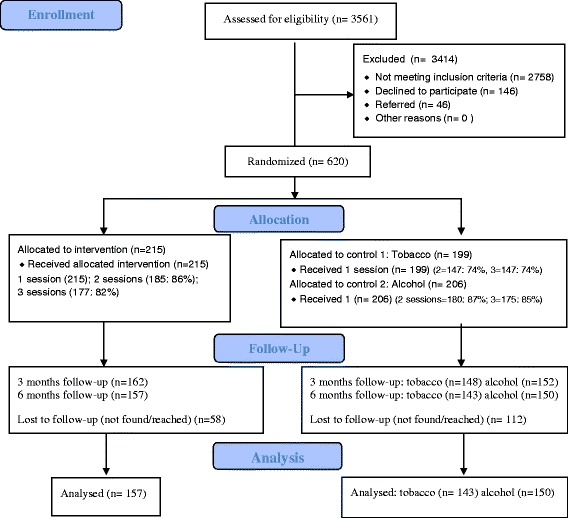
BACKGROUND: The aim of this study was to conduct a cluster randomized control trial to assess the efficacy of screening and brief intervention (SBI) for conjoint alcohol and tobacco use among hospital out-patients. METHOD: In all 620 hospital out-patients who screened positive for both tobacco and alcohol moderate risk in four hospitals were randomized into 2 control and 1 intervention condition using the hospital as a unit of randomization (2 intervention and 2 control hospitals) to 405 patients in the two control groups (tobacco only intervention, n=199, and alcohol only intervention, n=206) and 215 in the intervention group. The intervention or control consisted of three counselling sessions. RESULTS: Results of the interaction (Group × Time) effects using GEE indicated that there were statistically significant differences between the three study groups over the 6-month follow-up on the ASSIST tobacco score (Wald χ(2) = 8.43, P=0.004), and past week tobacco use abstinence (Wald χ(2)=7.34, P=0.007). Although there were no significant interaction effects on the other outcomes (Alcohol ASSIST score, low alcohol risk score, past week tobacco abstinence or low alcohol risk score, and past week tobacco abstinence and low alcohol risk score), the scores in all of the six outcome measures showed consistent improvements. For past week tobacco abstinence the tobacco only intervention was more effective than the alcohol only intervention and the integrated alcohol and tobacco intervention. For the outcome of low alcohol risk, the alcohol only intervention and the integrated alcohol and tobacco intervention was more effective than the tobacco only or alcohol only intervention. CONCLUSIONS: The study found that for past week tobacco abstinence the tobacco only intervention was more effective than the alcohol only intervention and the polydrug use (alcohol and tobacco) integrated intervention.
Overview
The claims and statistics of this paper haven’t been checked yet.
Free: it reads the open-access text and checks the first 5 claims that cite a source we can check. Create a free account to check every claim.
Integrity signals
Registry
Cites
Statistics
Figures
Verification
Claims the paper makes
The claims and statistics of this paper haven’t been checked yet.
Free: it reads the open-access text and checks the first 5 claims that cite a source we can check. Create a free account to check every claim.
Claims other papers make about this one
Each is checked against this paper’s own text: does it say what the citing paper says it does?
The source backs part of the claim, not all of it — or backs it for a different population, condition or comparison.
In the citing paper
“Blinding of outcome assessment (detection bias) All outcomes High risk”
From Psychosocial and pharmacologic interventions to reduce harmful alcohol use in low- and middle-income countries (2023) · cites this paper as Pengpid 2015
Experimental — accuracy not yet measuredThe source backs part of the claim, not all of it — or backs it for a different population, condition or comparison.
In the citing paper
“Incomplete outcome data (attrition bias) All outcomes High risk”
From Psychosocial and pharmacologic interventions to reduce harmful alcohol use in low- and middle-income countries (2023) · cites this paper as Pengpid 2015
Experimental — accuracy not yet measuredThe cited source says what the claim attributes to it.
In the citing paper
“However, there were some studies that found a similar reduction in alcohol-related outcomes between both the intervention and control groups, thus a null effect [22,28,30,79,80,82,88].”
From Patient-level interventions to reduce alcohol-related harms in low- and middle-income countries: A systematic review and meta-summary (2022) · cites this paper as [82]
The cited source says what the claim attributes to it.
In the citing paper
“Blinding of participants and personnel (performance bias) All outcomes High risk”
From Psychosocial and pharmacologic interventions to reduce harmful alcohol use in low- and middle-income countries (2023) · cites this paper as Pengpid 2015
The cited source says what the claim attributes to it.
In the citing paper
“Random sequence generation (selection bias) Unclear risk”
From Psychosocial and pharmacologic interventions to reduce harmful alcohol use in low- and middle-income countries (2023) · cites this paper as Pengpid 2015
3 more claims about this paper
Create a free account to see every claim other papers make about this one.
Self-check
Percentages, sums and reported differences re-computed from the paper’s own numbers.
The self-check needs the paper’s full text.
Citations
Cites
Motivational interviewing: preparing people for change.
Miller, W. R., & Rollnick, S. (2002) · Guilford Press eBooks · Cited by 7,915
Sobell, L. C., & Sobell, M. B. (1992) · Measuring Alcohol Consumption · doi:10.1007/978-1-4612-0357-5_3 · Cited by 4,110
Motivational Interviewing: Preparing People for Change, 2nd ed.
Miller, W., & Rollnick, S. (2003) · Journal For Healthcare Quality · doi:10.1097/01445442-200305000-00013 · Cited by 2,634
Group, W. A. W. (2002) · Addiction · doi:10.1046/j.1360-0443.2002.00185.x · Cited by 1,982
Physician advice for smoking cessation
Stead, L. F., Buitrago, D., Preciado, N., Sanchez, G., Hartmann-Boyce, J., & Lancaster, T. (2013) · Cochrane Database of Systematic Reviews · doi:10.1002/14651858.cd000165.pub4 · Cited by 1,955
Alcohol: No Ordinary Commodity. Research and public policy
Babor, T. F., Caetano, R., Casswell, S., Edwards, G., Giesbrecht, N., Graham, K., Grube, J. W., Hill, L., Holder, H. D., Homel, R. J., et al. (2003) · Cited by 1,718
Effectiveness of brief alcohol interventions in primary care populations
Kaner, E. F., Beyer, F. R., Muirhead, C., Campbell, F., Pienaar, E. D., Bertholet, N., Daeppen, J. B., Saunders, J. B., & Burnand, B. (2018) · Cochrane Database of Systematic Reviews · doi:10.1002/14651858.cd004148.pub4 · Cited by 1,665
Alcohol: No Ordinary Commodity
Babor, T. F., Caetano, R., Casswell, S., Edwards, G., Giesbrecht, N., Graham, K., Grube, J. W., Hill, L., Holder, H., Homel, R., et al. (2010) · Oxford University Press eBooks · doi:10.1093/acprof:oso/9780199551149.001.0001 · Cited by 1,239
Validation of the alcohol smoking and substance involvement screening test (ASSIST)
Humeniuk, R., Ali, R., Babor, T. F., Farrell, M., Formigoni, M. L., Jittiwutikarn, J., De Lacerda, R. B., Ling, W., Marsden, J., Monteiro, M., et al. (2008) · Addiction · doi:10.1111/j.1360-0443.2007.02114.x · Cited by 1,144 · cited 1×
“, alcohol brief intervention in Thailand: [33–38]), the present study combines two aspects that rarely are analyzed: a focus widened from a single substance to a brief integrative multi-substance (alcohol and tobacco) intervention and the efficacy of the inclusion of booster sessions for poly drug use [39].”
Moyer, A., Finney, J. W., Swearingen, C. E., & Vergun, P. (2002) · Addiction · doi:10.1046/j.1360-0443.2002.00018.x · Cited by 1,092
Missing Data in Clinical Studies
Molenberghs, G., & Kenward, M. G. (2007) · Wiley eBooks · doi:10.1002/9780470510445 · Cited by 962
Combined pharmacotherapy and behavioural interventions for smoking cessation
Stead, L. F., Koilpillai, P., Fanshawe, T. R., & Lancaster, T. (2016) · Cochrane Database of Systematic Reviews · doi:10.1002/14651858.cd008286.pub3 · Cited by 829
Timeline Follow-Back: A Technique for Assessing Self-Reported Alcohol Consumption
Sobell, L. C., & Sobell, M. B. (1992) · NSUWorks (Nova Southeastern University) · Cited by 779
Effectiveness of brief alcohol interventions in primary care populations
Kaner, E. F. S., Dickinson, H. O., Beyer, F. R., Campbell, F., Schlesinger, C., Heather, N., Saunders, J. B., Burnand, B., & Pienaar, E. D. (2007) · Cochrane Database of Systematic Reviews · doi:10.1002/14651858.cd004148.pub3 · Cited by 746 · cited 1×
“Several meta-analyses have shown that screening using short questionnaires followed by brief intervention (comprising simple advice or psychological counselling) significantly reduces alcohol consumption in primary care populations [25–29].”
Assessing competence in the use of motivational interviewing
Moyers, T. B., Martin, T., Manuel, J. K., Hendrickson, S. M. L., & Miller, W. R. (2005) · Journal of Substance Abuse Treatment · doi:10.1016/j.jsat.2004.11.001 · Cited by 738 · cited 1×
“To help protect against research counsellor drift, the brief intervention was completely manualized, including a Motivational Interviewing (MI) protocol and used to guide the research counsellor through the session content [40].”
MethodWhitlock, E. P., Polen, M. R., Green, C. A., Orleans, T., & Klein, J. (2004) · Annals of Internal Medicine · doi:10.7326/0003-4819-140-7-200404060-00017 · Cited by 717
Bertholet, N. (2005) · Archives of Internal Medicine · doi:10.1001/archinte.165.9.986 · Cited by 710
Reliability of the Timeline Followback for cocaine, cannabis, and cigarette use
Robinson, S. M., Sobell, L. C., Sobell, M. B., & Leo, G. I. (2014) · Psychology of Addictive Behaviors · doi:10.1037/a0030992 · Cited by 699 · cited 1×
“, those in the treatment and control arms) completed baseline measures which included a Demographic Questionnaire, the ASSIST [36], the timeline follow back (TLFB) interview (for alcohol and cigarette use and past 7 days) [41–44] and health seeking behaviour for substance use.”
Method(2010) · Cited by 476
Aveyard, P., Begh, R., Parsons, A., & West, R. (2012) · Addiction · doi:10.1111/j.1360-0443.2011.03770.x · Cited by 390 · cited 1×
“Likewise, several meta-analyses found that physician advice for smoking cessation [30], brief opportunistic smoking cessation interventions [31] and combined pharmacotherapy and behavioural interventions for smoking cessation [32] are effective to increase abstinence in smoking.”
BackgroundNEWCOMBE, D. A. L., HUMENIUK, R. E., & ALI, R. (2005) · Drug and Alcohol Review · doi:10.1080/09595230500170266 · Cited by 288
Brief interventions for heavy alcohol users admitted to general hospital wards
McQueen, J., Howe, T. E., Allan, L., Mains, D., & Hardy, V. (2011) · Cochrane Database of Systematic Reviews · doi:10.1002/14651858.cd005191.pub3 · Cited by 285 · cited 1×
“The alcohol outcomes were reasonably good, and comparable to those reported in previous studies with hospital patients [48, 49], and the self-reported past 7 days tobacco use abstinence was also good (with the lowest, 17.”
ResultBallesteros, J., Duffy, J. C., Querejeta, I., Ariño, J., & González‐Pinto, A. (2004) · Alcoholism: Clinical and Experimental Research · doi:10.1097/01.alc.0000122106.84718.67 · Cited by 251
Effectiveness of smoking cessation interventions among adults: a systematic review of reviews
Lemmens, V., Oenema, A., Knut, I. K., & Brug, J. (2008) · European Journal of Cancer Prevention · doi:10.1097/cej.0b013e3282f75e48 · Cited by 220 · cited 1×
“0 %, in the single tobacco use intervention), compared to previous studies [50, 51].”
ResultHumeniuk, R., Ali, R., Babor, T., Souza‐Formigoni, M. L. O., de Lacerda, R. B., Ling, W., McRee, B., Newcombe, D., Pal, H., Poznyak, V., et al. (2012) · Addiction · doi:10.1111/j.1360-0443.2011.03740.x · Cited by 211 · cited 1×
“Participants who scored in the high risk category (27 or higher for any of the substances), or who had frequently injected drugs in the last three months (more than 4 times per month on average) were excluded from enrolment into the study and were referred to specialist substance use treatment services [37].”
BackgroundCombined pharmacotherapy and behavioural interventions for smoking cessation
Stead, L. F., & Lancaster, T. (2012) · Cochrane Database of Systematic Reviews · doi:10.1002/14651858.cd008286.pub2 · Cited by 204
FACILITATION OF HUMAN TOBACCO SELF‐ADMINISTRATION BY ETHANOL: A BEHAVIORAL ANALYSIS1
Griffiths, R. R., Bigelow, G. E., & Liebson, I. (1976) · Journal of the Experimental Analysis of Behavior · doi:10.1901/jeab.1976.25-279 · Cited by 197
Joseph, A. M., Willenbring, M. L., Nugent, S. M., & Nelson, D. B. (2004) · Journal of Studies on Alcohol · doi:10.15288/jsa.2004.65.681 · Cited by 180 · cited 2×
“Further, the existing literature on the concurrent treatment of smoking and drinking indicates that there may be some benefit to combining services for these addictive behaviours [11, 15–19].”
BackgroundAli, R. L., Meena, S., Eastwood, B., Richards, I., & Marsden, J. (2013) · Drug and Alcohol Dependence · doi:10.1016/j.drugalcdep.2013.03.001 · Cited by 155 · cited 2×
“For early identification of substance use problems in primary care the ASSIST [4] and for the brief intervention the WHO brief intervention package for the ASSIST-linked brief intervention for hazardous and harmful substance use were used [38].”
MethodBray, R. M., Marsden, M. E., & Peterson, M. R. (1991) · American Journal of Public Health · doi:10.2105/ajph.81.7.865 · Cited by 140 · cited 1×
“Smoking increases during alcohol consumption [7], and heavy drinkers are less likely to attempt to quit smoking and are less likely to be successful when they make an attempt [8–10].”
BackgroundSobell, L. C., Agrawal, S., Annis, H., Ayala-Velazquez, H., Echeverria, L., Leo, G. I., Rybakowski, J. K., Sandahl, C., Saunders, B., Thomas, S., et al. (2001) · Substance Use & Misuse · doi:10.1081/ja-100102628 · Cited by 138 · cited 1×
“, those in the treatment and control arms) completed baseline measures which included a Demographic Questionnaire, the ASSIST [36], the timeline follow back (TLFB) interview (for alcohol and cigarette use and past 7 days) [41–44] and health seeking behaviour for substance use.”
MethodThe effects of alcohol on cigarette craving in heavy smokers and tobacco chippers.
Sayette, M. A., Martin, C. S., Wertz, J. M., Perrott, M. A., & Peters, A. R. (2005) · Psychology of Addictive Behaviors · doi:10.1037/0893-164x.19.3.263 · Cited by 124
Alcohol use and initial smoking lapses among heavy drinkers in smoking cessation treatment
Kahler, C. W., Spillane, N. S., & Metrik, J. (2010) · Nicotine & Tobacco Research · doi:10.1093/ntr/ntq083 · Cited by 118 · cited 1×
“, those in the treatment and control arms) completed baseline measures which included a Demographic Questionnaire, the ASSIST [36], the timeline follow back (TLFB) interview (for alcohol and cigarette use and past 7 days) [41–44] and health seeking behaviour for substance use.”
MethodFunk, M., Wutzke, S., Kaner, E., Anderson, P., Pas, L., McCormick, R., Gual, A., Barfod, S., Saunders, J., & World Health Organization Brief Intervention Study Group (2005) · Journal of Studies on Alcohol · doi:10.15288/jsa.2005.66.379 · Cited by 110 · cited 1×
“International studies have shown that 20-30 % of patients who routinely present in primary care are hazardous or harmful drinkers [5].”
BackgroundResponse to nicotine dependence treatment in smokers with current and past alcohol problems
Taylor Hays, J., Schroeder, D. R., Offord, K. P., Croghan, I. T., Patten, C. A., Hurt, R. D., Jorenby, D. E., & Fiore, M. C. (1999) · Annals of Behavioral Medicine · doi:10.1007/bf02884841 · Cited by 104 · cited 1×
“Smoking increases during alcohol consumption [7], and heavy drinkers are less likely to attempt to quit smoking and are less likely to be successful when they make an attempt [8–10].”
BackgroundKahler, C. W., Borland, R., Hyland, A., McKee, S. A., Thompson, M. E., & Cummings, K. M. (2009) · Drug and Alcohol Dependence · doi:10.1016/j.drugalcdep.2008.10.006 · Cited by 81
Addressing heavy drinking in smoking cessation treatment: A randomized clinical trial.
Kahler, C. W., Metrik, J., LaChance, H. R., Ramsey, S. E., Abrams, D. B., Monti, P. M., & Brown, R. A. (2008) · Journal of Consulting and Clinical Psychology · doi:10.1037/a0012717 · Cited by 79 · cited 7×
“We would have expected that participants receiving the integrated or concurrent alcohol and tobacco use intervention were significantly more likely to be abstinent from tobacco use than those receiving a tobacco use only intervention, as found in a previous study [17].”
BackgroundMethodResultInfluentialEfficacy of Nicotine Patch in Smokers With a History of Alcoholism
Hughes, J. R., Novy, P., Hatsukami, D. K., Jensen, J., & Callas, P. W. (2003) · Alcoholism: Clinical & Experimental Research · doi:10.1097/01.alc.0000071742.86555.4d · Cited by 74 · cited 2×
“Further, the existing literature on the concurrent treatment of smoking and drinking indicates that there may be some benefit to combining services for these addictive behaviours [11, 15–19].”
BackgroundSmoking, Alcohol Drinking and Esophageal Cancer: Findings from the JACC Study
Sakata, K., Hoshiyama, Y., Morioka, S., Hashimoto, T., Takeshita, T., & Tamakoshi, A. (2005) · Journal of Epidemiology · doi:10.2188/jea.15.s212 · Cited by 70 · cited 1×
“The integration of a brief intervention for tobacco use and problem drinking is important because of (1) the prevalence of problem drinking is higher among smokers than non-smokers [1, 11], (2) alcohol consumption has been identified as a trigger for smoking and for relapse to smoking among those who have already quit…”
BackgroundNoknoy, S., Rangsin, R., Saengcharnchai, P., Tantibhaedhyangkul, U., & McCambridge, J. (2010) · Alcohol and Alcoholism · doi:10.1093/alcalc/agq013 · Cited by 64 · cited 1×
“, alcohol brief intervention in Thailand: [33–38]), the present study combines two aspects that rarely are analyzed: a focus widened from a single substance to a brief integrative multi-substance (alcohol and tobacco) intervention and the efficacy of the inclusion of booster sessions for poly drug use [39].”
BackgroundChanges in cigarette consumption and drinking outcomes: Findings from Project MATCH
Friend, K. B., & Pagano, M. E. (2005) · Journal of Substance Abuse Treatment · doi:10.1016/j.jsat.2005.07.001 · Cited by 61 · cited 2×
“Further, the existing literature on the concurrent treatment of smoking and drinking indicates that there may be some benefit to combining services for these addictive behaviours [11, 15–19].”
BackgroundAekplakorn, W., Hogan, M. C., Tiptaradol, S., Wibulpolprasert, S., Punyaratabandhu, P., & Lim, S. S. (2007) · Addictive Behaviors · doi:10.1016/j.addbeh.2007.10.010 · Cited by 54 · cited 3×
“0 % [1], and in a large national study among high school students, Saingam et al.”
BackgroundPengpid, S., Peltzer, K., Skaal, L., & Van der Heever, H. (2013) · BMC Public Health · doi:10.1186/1471-2458-13-644 · Cited by 49 · cited 1×
“The alcohol outcomes were reasonably good, and comparable to those reported in previous studies with hospital patients [48, 49], and the self-reported past 7 days tobacco use abstinence was also good (with the lowest, 17.”
ResultSelf-citationConcurrent brief versus intensive smoking intervention during alcohol dependence treatment.
Cooney, N. L., Litt, M. D., Cooney, J. L., Pilkey, D. T., Steinberg, H. R., & Oncken, C. A. (2007) · Psychology of Addictive Behaviors · doi:10.1037/0893-164x.21.4.570 · Cited by 45 · cited 1×
“0 %, in the single tobacco use intervention), compared to previous studies [50, 51].”
ResultDo brief interventions which target alcohol consumption also reduce cigarette smoking?
McCambridge, J., & Jenkins, R. J. (2008) · Drug and Alcohol Dependence · doi:10.1016/j.drugalcdep.2008.03.011 · Cited by 38 · cited 1×
“Contrary to a previous review [47], this study found a”
ResultSmoking characteristics of female veterans
Whitlock, E. P., Ferry, L. H., Burchette, R. J., & Abbey, D. E. (1995) · Addictive Behaviors · doi:10.1016/0306-4603(95)00011-z · Cited by 33 · cited 1×
“Smoking increases during alcohol consumption [7], and heavy drinkers are less likely to attempt to quit smoking and are less likely to be successful when they make an attempt [8–10].”
BackgroundSelf-help strategies for cutting down or stopping substance use: a guide.
HUMENIUK, R. E., Edwards, S., Ali, R. L., & Meena, S. (2010) · Cited by 32
Gmel, G. E., Gaume, J., Bertholet, N., Flückiger, J., & Daeppen, J. (2012) · Journal of Substance Abuse Treatment · doi:10.1016/j.jsat.2012.07.005 · Cited by 32 · cited 1×
“, alcohol brief intervention in Thailand: [33–38]), the present study combines two aspects that rarely are analyzed: a focus widened from a single substance to a brief integrative multi-substance (alcohol and tobacco) intervention and the efficacy of the inclusion of booster sessions for poly drug use [39].”
BackgroundBrief intervention: The ASSIST-linked brief intervention for hazardous and harmful substance use.
HUMENIUK, R. E., Edwards, S. H., Ali, R. L., Poznyak, V. B., & Monteiro, M. G. (2010) · Cited by 29
Bernstein, S. L., Bijur, P. E., Cooperman, N. A., Jearld, S., Arnsten, J. H., Moadel, A. B., & Gallagher, E. J. (2012) · Journal of Substance Abuse Treatment · doi:10.1016/j.jsat.2012.05.005 · Cited by 24
Diehl, A., & Scherbaum, N. (2008) · Fortschritte der Neurologie · Psychiatrie · doi:10.1055/s-2007-980076 · Cited by 24 · cited 2×
“Compared to one specific substance use dependence, conjoint nicotine and alcohol dependence are more severe and have a more unfavourable course [6].”
BackgroundCunningham, J., Selby, P., & van Mierlo, T. (2006) · Nicotine & Tobacco Research · doi:10.1080/14622200601039865 · Cited by 21 · cited 1×
“The integration of a brief intervention for tobacco use and problem drinking is important because of (1) the prevalence of problem drinking is higher among smokers than non-smokers [1, 11], (2) alcohol consumption has been identified as a trigger for smoking and for relapse to smoking among those who have already quit…”
BackgroundDrinking-Smoking Status and Health Risk Behaviors among High School Students in Thailand
Saingam, D., Assanangkornchai, S., & Geater, A. F. (2012) · Journal of Drug Education · doi:10.2190/de.42.2.d · Cited by 21 · cited 1×
“[2] found 10 % of boys and 3 % of girls were co-users of alcohol and tobacco.”
BackgroundSUBSTANCE USE PATTERN AMONG PRIMARY HEALTH CARE ATTENDEES IN SOUTHERN THAILAND
Nima, P., & Assanangkornchai, S. (2013) · ASEAN Journal of Psychiatry · Cited by 5
Research works printed but not linked: 1
- Zimmer V. A brief intervention for alcohol problems and smoking. Delivered by general practitioners: a randomised controlled trial. 2007 Inaugural-Dissertation zur Erlangung des Doktorgrades der Philosophischen Fakultät der Westfälischen Wilhelms-Universität zu Münster (Westf).
Cited by
Joseph, J., & Basu, D. (2017) · Alcohol and Alcoholism · doi:10.1093/alcalc/agw054 · Cited by 52
Kumar, N., Janmohamed, K., Jiang, J., Ainooson, J., Billings, A., Chen, G. Q., Chumo, F., Cueto, L. N., NIAURA, R. S., & Zhang, A. (2020) · Addictive Behaviors · doi:10.1016/j.addbeh.2020.106612 · Cited by 47
Staton, C. A., Vissoci, J. R. N., El-Gabri, D., Adewumi, K., Concepcion, T., Elliott, S. A., Evans, D. R., Galson, S. W., Pate, C. T., Reynolds, L. M., et al. (2022) · PLOS Medicine · doi:10.1371/journal.pmed.1003961 · Cited by 41
“Pengpid and colleagues (2015) [82] Thailand Brief intervention Outpatient clinic 620 Low Drinks per week ASSIST”
BackgroundResultInfluentialPreusse, M., Neuner, F., & Ertl, V. (2020) · Frontiers in Psychiatry · doi:10.3389/fpsyt.2020.00768 · Cited by 38
“(104) Thailand Four district hospitals in Nakhon Patthom province n=206 (0.”
BackgroundMethodInfluentialBrown, J., West, R., Beard, E., Brennan, A., Drummond, C., Gillespie, D., Hickman, M., Holmes, J., Kaner, E., & Michie, S. (2016) · BMC Public Health · doi:10.1186/s12889-016-3223-6 · Cited by 23
Metadata
- Authors
- Pengpid, S., Peltzer, K., Puckpinyo, A., Viripiromgool, S., Thamma-aphiphol, K., Suthisukhon, K., Dumee, D., & Kongtapan, T.
- Affiliations
- Mahidol University (TH)
- Human Sciences Research Council (ZA)
- Corresponding author
- Peltzer, Karl
- Venue
- Substance Abuse Treatment, Prevention, and Policy
- Published
- 2015-05-27
- Volume
- 10
- Issue
- 1
- Pages
- 22-22
- ISSN
- 1747-597X (ISSN-L)
- PMC
- PMC4448213
- OpenAlex
- W2119930567
- Semantic Scholar
- 12f30df51069dbf2d67f47d1749fb78756d4f80b
- Cited by
- 16
- References
- 53
- Citations by year
- 2025: 1 · 2023: 4 · 2022: 2 · 2021: 2 · 2020: 2 · 2019: 2 · 2017: 1 · 2016: 2
- FWCI
- 0.79
- Type
- journal article
- Language
- en
- Open access
- gold
- doi.org
- Locations
- Substance Abuse Treatment Prevention and Policy (publishedVersion, cc-by)
- Europe PMC (PubMed Central) (publishedVersion, cc-by)
- PubMed Central (publishedVersion, cc-by)
- PubMed (publishedVersion)
- Funders
- Thai Health Promotion Foundation
- Topics
- Health Sciences › Medicine › Epidemiology › Substance Abuse Treatment and Outcomes
- Health Sciences › Medicine › Public Health, Environmental and Occupational Health › Smoking Behavior and Cessation
- Social Sciences › Psychology › Applied Psychology › Behavioral Health and Interventions
- Keywords
- screening and brief intervention, dual substance use, hospital outpatients, smoking abstinence, alcohol risk, ASSIST, integrated intervention, brief counseling
- MeSH terms
- Adolescent, Adult, Alcohol Drinking, Counseling, Female, Humans, Male, Middle Aged, Outpatients, Psychotherapy, Brief, Thailand, Substance Abuse Detection, Single-Blind Method, Treatment Outcome, Young Adult, Tobacco Use
About these checks
Registry, retraction, Cites and statistics results are computed, not judged, with one exception: a printed reference that no index lists is read once by a model before it counts as a citation error. Claims are extracted by a model and kept only when their quote appears verbatim in the text; each cited source is then checked, with a model’s help, for whether it says what the claim relies on. Those verdicts can be wrong — read the claim’s quote and the cited source before relying on one.
Statistics and arithmetic are recomputed, not judged.
Confidence bands are shown only for fields calibrated on our annotated test set. None is calibrated yet, so no band is shown.
What counts as a claim ›How we measure confidence ›How we check this ›
Are you an author, or do you see a problem with this page? Request a review
Data sources
Bibliographic data: Semantic Scholar, OpenAlex, Crossref.
Contains information from the Semantic Scholar Academic Graph Datasets, made available under the ODC Attribution License (ODC-BY 1.0).
Semantic Scholar’s data is described in: Kinney, R., et al. (2023). The Semantic Scholar Open Data Platform. arXiv:2301.10140.
