

Making sense of implementation theories, models and frameworks
Open accessThe DOI matches its Crossref record; 160 of the 165 references it cites were found in a registry or an index; 23 of the 74 sources its claims cite were checked for support.
Abstract
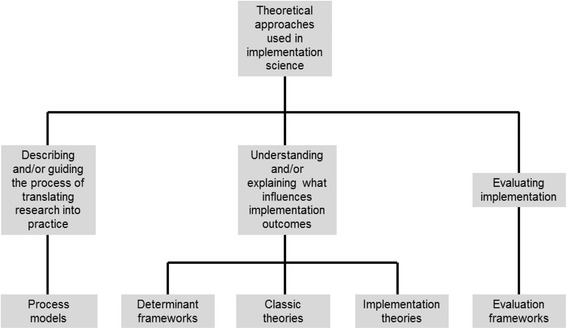
BACKGROUND: Implementation science has progressed towards increased use of theoretical approaches to provide better understanding and explanation of how and why implementation succeeds or fails. The aim of this article is to propose a taxonomy that distinguishes between different categories of theories, models and frameworks in implementation science, to facilitate appropriate selection and application of relevant approaches in implementation research and practice and to foster cross-disciplinary dialogue among implementation researchers. DISCUSSION: Theoretical approaches used in implementation science have three overarching aims: describing and/or guiding the process of translating research into practice (process models); understanding and/or explaining what influences implementation outcomes (determinant frameworks, classic theories, implementation theories); and evaluating implementation (evaluation frameworks). This article proposes five categories of theoretical approaches to achieve three overarching aims. These categories are not always recognized as separate types of approaches in the literature. While there is overlap between some of the theories, models and frameworks, awareness of the differences is important to facilitate the selection of relevant approaches. Most determinant frameworks provide limited "how-to" support for carrying out implementation endeavours since the determinants usually are too generic to provide sufficient detail for guiding an implementation process. And while the relevance of addressing barriers and enablers to translating research into practice is mentioned in many process models, these models do not identify or systematically structure specific determinants associated with implementation success. Furthermore, process models recognize a temporal sequence of implementation endeavours, whereas determinant frameworks do not explicitly take a process perspective of implementation.
Overview
CoChat Summary
TL;DR
This article proposes a taxonomy of five categories of theories, models and frameworks used in implementation science, organized by three overarching aims: describing/guiding translation of research into practice, understanding/explaining influences on implementation outcomes, and evaluating implementation. It argues that recognizing differences and overlaps among process models, determinant frameworks, classic theories, implementation theories, and evaluation frameworks can facilitate appropriate selection and cross-disciplinary dialogue.
Key findings
- The paper delineates five categories of theoretical approaches—process models, determinant frameworks, classic theories, implementation theories, and evaluation frameworks—to achieve three overarching aims: describing and/or guiding the process of translating research into practice; understanding and/or explaining what influences implementation outcomes; and evaluating implementation.
- Eight commonly cited determinant frameworks are compared in Table 2; the paper states they account for five types of determinants: characteristics of the implementation object, users/adopters, end users, context, and the strategy or other means of facilitating implementation, with outcomes varying across frameworks.
- Theoretical Domains Framework was constructed from a synthesis of 128 constructs related to behaviour change found in 33 behaviour change theories, sorted into 14 theoretical domains (originally 12 domains). Proctor et al. propose eight conceptually distinct implementation outcomes for evaluation: acceptability, adoption, appropriateness, costs, feasibility, fidelity, penetration, and sustainability.
- Most determinant frameworks provide limited “how-to” support because determinants are often too generic; process models mention barriers and enablers but do not identify or systematically structure specific determinants, and process models recognize a temporal sequence whereas determinant frameworks do not explicitly take a process perspective.
Methods
- Narrative review of selective literature: six textbooks providing comprehensive overviews of implementation science and evidence-based practice implementation were consulted, along with several overview papers on theories, models and frameworks.
- Implementation Science was searched using the terms “theory”, “model” and “framework”; titles and abstracts were scanned, and relevant articles were read in full.
- The analysis is a conceptual synthesis that identifies three overarching aims and proposes a five-category taxonomy; no systematic review, meta-analysis, or formal quality appraisal is reported.
Limitations
- The paper states it is not intended as a complete catalogue of all individual approaches available in implementation science, and that the proposed categories are not always recognized as separate types of approaches in the literature.
- The paper states there is considerable overlap between some categories, which can complicate selection and labelling of approaches.
- The text makes evident that the review is selective and narrative rather than systematic, so the taxonomy is conceptual and does not resolve inconsistent terminology across the field.
Model-written summary. Check it against the paper before relying on it.
Integrity signals
Registry
Cites
Statistics
Figures
Verification
Claims the paper makes
8 Valid · 4 Not valid · 18 Not checked · 44 Own results and interpretations
The sources with a verdict support this claim; the rest weren’t checked yet, have no full text we could read, or their verdicts aren’t rated yet.
In the paper
“Poor theoretical underpinning makes it difficult to understand and explain how and why implementation succeeds or fails, thus restraining opportunities to identify factors that predict the likelihood of implementation success and develop better strategies to achieve more successful implementation.”
§ Making sense of implementation theories, models and frameworks > Background
What the sources say
- Not checked yetcites [1] Eccles M Grimshaw J Walker A Johnston M Pitts N Changing the behavior of healthcare professionals: the use of theory in promoting the uptake of research findings J Clin Epidemiol 2005 58 107 12 15680740 source
- Supportedcites [3] Michie S Johnston M Abraham C Lawton R Parker D Walker A Making psychological theory useful for implementing evidence based practice: a consensus approach Qual Saf Health Care 2005 14 26 33 15692000 PMC1743963 source
Split into 2 atoms — 2 confirmed, 0 partially supported, 0 disputed, 0 misattributed, 0 unverifiable. Expand the claim to see per-atom verdicts.
- Not checked yetcites [4] Sales A Smith J Curran G Kochevar L Models, strategies, and tools: theory in implementing evidence-based findings into health care practice J Gen Intern Med 2006 21 S43 9 16637960 PMC2557135
- Supportedcites [5] Kitson AL Harvey G McCormack B Enabling the implementation of evidence-based practice: a conceptual framework Qual Health Care 1998 7 149 58 10185141 PMC2483604 source
Split into 2 atoms — 2 confirmed, 0 partially supported, 0 disputed, 0 misattributed, 0 unverifiable. Expand the claim to see per-atom verdicts.
plainstates a cause- Asserted: passes — The authors put it forward as true.
- Checkable: passes — It can be checked against evidence.
- Load-bearing: passes — The paper’s conclusions depend on it.
- Based: passes — The paper gives a reason why it holds.
The sources with a verdict support this claim; the rest weren’t checked yet, have no full text we could read, or their verdicts aren’t rated yet.
In the paper
“Furthermore, many theories, models and frameworks have spawned instruments that serve evaluation purposes, e.g. tools linked to PARIHS [132,133], CFIR [134] and Theoretical Domains Framework [135].”
§ Making sense of implementation theories, models and frameworks > Discussion > Evaluating implementation
What the sources say
- Supportedcites [132] Estabrooks CA Squires JE Cummings GG Birdell JM Norton PG Development and assessment of the Alberta Context Tool BMC Health Serv Res 2009 9 234 20003531 PMC2805628 source
The Background (page unavailable) says the authors used the PARiHS framework to conceptualize organizational context and developed the Alberta Context Tool to assess it. This supports the citation as an example of a framework-linked assessment instrument; it does not need to establish the sentence’s separate examples linked to other frameworks. (LLM, conf=0.91)
- Not checked yetcites [133] McCormack B McCarthy G Wright J Slater P Coffey A Development and testing of the Context Assessment Index (CAI) Worldviews Evid Based Nurs 2009 6 27 35 19207560 source
- Supportedcites [134] Damschroder LJ Lowery JC Evaluation of a large-scale weight management program using the consolidated framework for implementation research (CFIR) Implement Sci 2013 8 51 23663819 PMC3656778 source
The Data collection procedures section describes a semi-structured interview guide whose questions probed CFIR constructs to evaluate implementation of the MOVE! program. The Conclusion also says the CFIR resource provides example interview guides. This supports citing the paper as an example of a framework linked to an evaluation instrument; it does not need to establish the sentence’s broader claim about other frameworks. (LLM, conf=0.90)
- Supportedcites [135] Dyson J Lawton R Jackson C Cheater F Development of a theory-based instrument to identify barriers and levers to best hand hygiene practice among healthcare practitioners Implement Sci 2013 8 111 24059289 PMC3850814 source
This citation supplies the Theoretical Domains Framework example, not evidence for every framework in the sentence. The Background says the paper presents the development and testing of a TDF-based instrument to assess barriers and levers to hand hygiene practice, supporting its identification as an evaluation tool. (LLM, conf=0.92)
plainstates a cause- Asserted: passes — The authors put it forward as true.
- Checkable: passes — It can be checked against evidence.
- Load-bearing: unclear — It is unclear whether the paper’s conclusions depend on it.
- Based: passes — The paper gives a reason why it holds.
- Supported
The cited sources support only part of this claim — read each source’s verdict below.
In the paper
“For instance, Theoretical Domains Framework (e.g. [127,128]), and Normalization Process Theory [129] and COM-B (e.g. [130,131]) have all been widely used as evaluation frameworks.”
§ Making sense of implementation theories, models and frameworks > Discussion > Evaluating implementation
What the sources say
- Not checked yetcites [127] Phillips CJ Marshall AP Chaves NJ Lin IB Loy CT Rees G Experiences of using Theoretical Domains Framework across diverse clinical environments: a qualitative study J Multidiscip Healthc 2015 8 139 46 25834455 PMC4370908
- Supportedcites [128] Fleming A Bradley C Cullinan S Byrne S Antibiotic prescribing in long-term care facilities: a qualitative, multidisciplinary investigation BMJ Open 2014 4 11 25377014 PMC4225237 source
The Introduction says the TDF has been used in many types of studies, and the Methods and Discussion show this study using TDF and COM-B to analyse prescribing behaviour and identify intervention functions. This paper therefore serves as an example of their use as evaluation frameworks. Normalization Process Theory has its own citation in the citing sentence and is not attributed to this source. (LLM, conf=0.86)
- Supportedcites [129] McEvoy R Ballini L Maltoni S O’Donnell CA Mair FS MacFarlane A A qualitative systematic review of studies using the normalization process theory to research implementation processes Implement Sci 2014 9 2 24383661 PMC3905960 source
The citation [129] is attached to Normalization Process Theory, not to the other two frameworks. The Results (‘How is NPT being operationalized?’; page unavailable) report that, in almost all studies reviewed, NPT was used as a framework for analysing and reporting implementation findings. The review included 29 studies, supporting the characterization of its widespread use as an evaluation framework. (LLM, conf=0.90)
- Partly supportedcites [130] Connell LA McMahon NE Redfern J Watkins CL Eng JJ Development of a behaviour change intervention to increase upper limb exercise in stroke rehabilitation Implement Sci 2015 10 34 25885251 PMC4358857 sourceExperimental — accuracy not yet measured
The Methods (Stage 2; page not provided) describe using COM-B to analyse target behaviours while developing an intervention. This supports COM-B as a framework used in this study, but the paper does not establish that it is widely used as an evaluation framework. This citation does not bear on the sentence’s separate claims about the Theoretical Domains Framework or Normalization Process Theory. (LLM, conf=0.82)
- Supportedcites [131] Praveen D Patel A Raghu A Clifford GD Maulik PK Abdul AM Development and field evaluation of a mobile clinical decision support system for cardiovascular diseases in rural India JMIR mHealth uHealth 2014 2 25487047 PMC4275493 source
This source is cited as an example of COM-B use, not for the other two frameworks. The Methods (Evaluation and Analysis) say COM-B was used to design and analyze interview data, and the Results (Field Testing: Qualitative Evaluation) present the findings in its three domains. It therefore supports the cited example of COM-B as an evaluation framework, though this single study does not itself establish how widely COM-B is used. (LLM, conf=0.89)
boosted- Asserted: passes — The authors put it forward as true.
- Checkable: passes — It can be checked against evidence.
- Load-bearing: unclear — It is unclear whether the paper’s conclusions depend on it.
- Based: passes — The paper gives a reason why it holds.
The cited sources support only part of this claim — read each source’s verdict below.
In the paper
“Although evaluation frameworks may be considered in a category of their own, theories, models and frameworks from the other four categories can also be applied for evaluation purposes because they specify concepts and constructs that may be operationalized and measured.”
§ Making sense of implementation theories, models and frameworks > Discussion > Evaluating implementation
What the sources say
- Not checked yetcites [127] Phillips CJ Marshall AP Chaves NJ Lin IB Loy CT Rees G Experiences of using Theoretical Domains Framework across diverse clinical environments: a qualitative study J Multidiscip Healthc 2015 8 139 46 25834455 PMC4370908
- Partly supportedcites [128] Fleming A Bradley C Cullinan S Byrne S Antibiotic prescribing in long-term care facilities: a qualitative, multidisciplinary investigation BMJ Open 2014 4 11 25377014 PMC4225237 sourceExperimental — accuracy not yet measured
The Introduction describes the TDF as a framework with defined domains and constructs, and Methods > Analysis says the authors assigned interview codes to those domains. This supports the possibility of applying a framework’s constructs in an analysis, but the paper does not discuss four categories other than evaluation frameworks or establish that frameworks across those categories can be used for evaluation and measurement. Page numbers are not available in our copy. (LLM, conf=0.78)
- Partly supportedcites [129] McEvoy R Ballini L Maltoni S O’Donnell CA Mair FS MacFarlane A A qualitative systematic review of studies using the normalization process theory to research implementation processes Implement Sci 2014 9 2 24383661 PMC3905960 sourceExperimental — accuracy not yet measured
In Results, under “How is NPT being operationalized?” (page unavailable), the review reports that NPT constructs were used to analyze implementation and that an NPT-based instrument was developed to measure normalization processes. This supports NPT as an example of a theory used for analysis and measurement, but the paper does not address the citing sentence’s distinction between evaluation frameworks and four other categories or establish that all four can be used this way. (LLM, conf=0.84)
- Partly supportedcites [130] Connell LA McMahon NE Redfern J Watkins CL Eng JJ Development of a behaviour change intervention to increase upper limb exercise in stroke rehabilitation Implement Sci 2015 10 34 25885251 PMC4358857 sourceExperimental — accuracy not yet measured
The Discussion (page unavailable) says that specified behaviour-change techniques and toolkit performance measures could be used to measure intervention fidelity and investigate mechanisms in a future evaluation study. This supports the idea that a framework or taxonomy used for intervention development can also inform evaluation. The paper does not discuss four other categories of theories, models and frameworks or establish the claim for all of them. (LLM, conf=0.83)
- Partly supportedcites [131] Praveen D Patel A Raghu A Clifford GD Maulik PK Abdul AM Development and field evaluation of a mobile clinical decision support system for cardiovascular diseases in rural India JMIR mHealth uHealth 2014 2 25487047 PMC4275493 sourceExperimental — accuracy not yet measured
The Methods (Evaluation and Analysis; page unavailable) say the COM-B theory was used to design and analyze evaluation interviews, and the Results (Field Testing: Qualitative Evaluation; page unavailable) organize findings under its capability, opportunity, and motivation domains. This supports the claim by example, but the paper does not establish the broader assertion about theories, models, and frameworks across the other four categories or say that their constructs can generally be measured. (LLM, conf=0.82)
plainstates a cause- Asserted: passes — The authors put it forward as true.
- Checkable: passes — It can be checked against evidence.
- Load-bearing: passes — The paper’s conclusions depend on it.
- Based: passes — The paper gives a reason why it holds.
A result the paper states — it cites no source for it, so there is none to check. The quote shows it is in the paper.
In the paper
“And while the relevance of addressing barriers and enablers to translating research into practice is mentioned in many process models, these models do not identify or systematically structure specific determinants associated with implementation success.”
§ Making sense of implementation theories, models and frameworks > Abstract > Summary
plain- Asserted: passes — The authors put it forward as true.
- Checkable: passes — It can be checked against evidence.
- Load-bearing: passes — The paper’s conclusions depend on it.
- Based: passes — The paper gives a reason why it holds.
22 more claims
Create a free account to see all 74 claims and to verify the 51 references still open.
- Probably not a substantial claim. 31
- It may state two separate claims as one. 21
Claims other papers make about this one
Each is checked against this paper’s own text: does it say what the citing paper says it does?
The cited source doesn’t support the claim as written.
In the citing paper
“frameworks provide explicit guidance and justification for proposed hypotheses to be tested that strengthen proposals, projects, trials, and products, both research and practice based [2, 4].”
From Ten recommendations for using implementation frameworks in research and practice (2020) · cites this paper as [2]
Checked by a reasoning model — may be wrong.
Experimental — accuracy not yet measuredThe source backs part of the claim, not all of it — or backs it for a different population, condition or comparison.
In the citing paper
“Additional constructs were added in the updated CFIR to acknowledge scientific advancement since 2009 that are common across many process frameworks [8] and collective-level change theories [72].”
From The updated consolidated framework for implementation research based on user feedback (2022) · cites this paper as [8]
Experimental — accuracy not yet measuredThe source backs part of the claim, not all of it — or backs it for a different population, condition or comparison.
In the citing paper
“There are over 100 identified KT theories, models and frameworks to choose from (e.g., Nilsen, 2015 [5]; Tabak et al., 2012 [14]; Straus et al., 2013 [15]).”
From Scoping review identifies significant number of knowledge translation theories, models, and frameworks with limited use (2018) · cites this paper as [5]
Experimental — accuracy not yet measuredThe source backs part of the claim, not all of it — or backs it for a different population, condition or comparison.
In the citing paper
“For intermediaries and practitioners, they can provide shared language to familiarize stakeholders with implementation and function as practical tools for planning, executing, and evaluating real-world implementation efforts.”
From Ten recommendations for using implementation frameworks in research and practice (2020) · cites this paper as [2]
Experimental — accuracy not yet measuredThe source backs part of the claim, not all of it — or backs it for a different population, condition or comparison.
In the citing paper
“When used in research, they can guide the design and conduct of studies, inform the theoretical and empirical thinking of research teams, and aid interpretation of findings.”
From Ten recommendations for using implementation frameworks in research and practice (2020) · cites this paper as [2]
Experimental — accuracy not yet measured
18 more claims about this paper
Create a free account to see every claim other papers make about this one.
Self-check
Percentages, sums and reported differences re-computed from the paper’s own numbers.
Each contradiction between two passages listed here was confirmed by an independent check.
Rated minor: it would not touch a result — a value no result rests on, a p-value that stays on the same side of the significance level, or a conflict that is clerical, resolved elsewhere in the paper, or outside its own findings.
In the paper
§ Making sense of implementation theories, models and frameworks > Summary
“A framework such as the Active Implementation Frameworks [68] appears to have a dual aim”
§ Making sense of implementation theories, models and frameworks > References
“68. Holmes BJ Finegood DT Riley BL Best A Brownson RC Colditz GA Proctor EK Systems Thinking in Dissemination and Implementation Research”
Rated minor: it would not touch a result — a value no result rests on, a p-value that stays on the same side of the significance level, or a conflict that is clerical, resolved elsewhere in the paper, or outside its own findings.
In the paper
§ Making sense of implementation theories, models and frameworks > Discussion > Theories, models and frameworks in implementation science
“model by Davies et al. [43]”
§ Making sense of implementation theories, models and frameworks > References
“43. Davis SM Peterson JC Helfrich CD Cunningham-Sabo L Introduction and conceptual model for utilization of prevention research”
Rated minor: it would not touch a result — a value no result rests on, a p-value that stays on the same side of the significance level, or a conflict that is clerical, resolved elsewhere in the paper, or outside its own findings.
In the paper
§ Making sense of implementation theories, models and frameworks > References
“121. May C Finch T Mair F Ballini L Dowrick C Eccles M Understanding the implementation of complex interventions in health care: the normalization process model Implement Sci 2007 7 148”
§ Making sense of implementation theories, models and frameworks > References
“74. Ashton CM Khan MM Johnson ML Walder A Stanberry E Beyth RJ A quasi-experimental test of an intervention to increase the use of thiazide-based treatment regimens for people with hypertension Implement Sci 2007 2 5”
Rated minor: it would not touch a result — a value no result rests on, a p-value that stays on the same side of the significance level, or a conflict that is clerical, resolved elsewhere in the paper, or outside its own findings.
In the paper
§ Making sense of implementation theories, models and frameworks > Discussion > Theories, models and frameworks in implementation science
“COM-B Capacity-Opportunities-Motivation-Behaviour”
§ Making sense of implementation theories, models and frameworks > Discussion > Understanding and explaining what influences implementation outcomes
“COM-B (Capability, Opportunity, Motivation and Behaviour)”
Citations
Cites
Self-efficacy: Toward a unifying theory of behavioral change
Bandura, A. (1977) · Psychological Review · doi:10.1037/0033-295x.84.2.191 · Cited by 43,925
Rogers, E. M., Singhal, A., & Quinlan, M. M. (2019) · An Integrated Approach to Communication Theory and Research · doi:10.4324/9780203710753-35 · Cited by 37,322
The Structure of Scientific Revolutions
Kuhn, T. S., & Schlegel, R. (1963) · Physics Today · doi:10.1063/1.3050879 · Cited by 35,538
Damschroder, L. J., Aron, D. C., Keith, R. E., Kirsh, S. R., Alexander, J. A., & Lowery, J. C. (2009) · Implementation Science · doi:10.1186/1748-5908-4-50 · Cited by 14,496 · cited 9×
“Other frameworks have relied on existing determinant frameworks and relevant theories in various disciplines, e.g. the frameworks by Gurses et al. [58] and CFIR (Consolidated Framework for Implementation Research) [60].”
InfluentialValente, T. W. (2003) · Genetics in Medicine · doi:10.1097/01.gim.0000061743.67794.c4 · Cited by 13,723
Michie, S., van Stralen, M. M., & West, R. (2011) · Implementation Science · doi:10.1186/1748-5908-6-42 · Cited by 13,697
Absorptive Capacity: A Review, Reconceptualization, and Extension
Zahra, S. A., & George, G. (2002) · The Academy of Management Review · doi:10.5465/amr.2002.6587995 · Cited by 10,758
Self-efficacy: Toward a unifying theory of behavioral change
Bandura, A. (1978) · Advances in Behaviour Research and Therapy · doi:10.1016/0146-6402(78)90002-4 · Cited by 10,586
The Structure of Scientific Revolutions.
Bohm, D., & Kuhn, T. S. (1964) · The Philosophical Quarterly · doi:10.2307/2217783 · Cited by 9,130
Proctor, E., Silmere, H., Raghavan, R., Hovmand, P., Aarons, G., Bunger, A., Griffey, R., & Hensley, M. (2011) · Administration and Policy in Mental Health and Mental Health Services Research · doi:10.1007/s10488-010-0319-7 · Cited by 8,721
Research works printed but not linked: 9
- Davies P Walker A Grimshaw J Theories of behavior change in studies of guideline implementation Proc Br Psychol Soc 2003 11 120
- Dubin R Theory Building 1978 New York Free Press
- Stetler CB Rycroft-Malone J Bucknall T Stetler model Models and Frameworks for Implementing Evidence-Based Practice: Linking Evidence to Action 2010 Oxford Wiley-Blackwell 51 82
- Logan J Graham I Rycroft-Malone J Bucknall T The Ottawa Model of Research Use Models and Frameworks for Implementing Evidence-Based Practice: Linking Evidence to Action 2010 Oxford Wiley-Blackwell 83 108
- Rycroft-Malone J Rycroft-Malone J Bucknall T Promoting Action on Research Implementation in Health Services (PARIHS) Models and Frameworks for Implementing Evidence-Based Practice: Linking Evidence to Action 2010 Oxford Wiley-Blackwell 109 36
- Michie S Atkins L West R A guide to using the Behaviour Change Wheel 2014 London Silverback Publishing
- Fishbein M Ajzen I Belief, Attitude, Intention, and Behaviour 1975 New York John Wiley
- Bandura A Social Foundations of Thought and Action: A Cognitive Social Theory 1986 Englewood-Cliffs, NJ Prentice-Hall
- DiMaggio PJ Powell WW The New Institutionalism and Organizational Analysis 1991 Chicago, IL University of Chicago Press
Cited by
Items 601–700 of 1,032
de Plaza, M. A. P., Yadav, L., & Kitson, A. A. (2023) · Frontiers in Health Services · doi:10.3389/frhs.2023.1154614 · Cited by 40
mHealth in psychiatry: time for methodological change
Nicholas, J., Boydell, K., & Christensen, H. (2016) · Evidence-Based Mental Health · doi:10.1136/eb-2015-102278 · Cited by 34
Bellagamba, D., Vionnet, L., Margot‐Cattin, I., & Vaucher, P. (2020) · PLoS ONE · doi:10.1371/journal.pone.0233125 · Cited by 45
VanderKaay, S., Dix, L., Rivard, L. M., Missiuna, C. A., Ng, S., Pollock, N., Whalen, S. S., Eisen, I., Kyte, C., Phoenix, M. P., et al. (2021) · International Journal of Disability Development and Education · doi:10.1080/1034912x.2021.1895975 · Cited by 44
Hawkinson, L. E., Yates, L., Minnig, M. C., Register‐Mihalik, J. K., Golightly, Y. M., & Padua, D. A. (2022) · Journal of Athletic Training · doi:10.4085/1062-6050-0215.22 · Cited by 43
Frameworks for measuring population health: A scoping review
Chan, S. L., Ho, C. Z.-H., Khaing, N. E. E., Ho, E., Pong, C. Y., Guan, J. S., Chua, C., Li, Z., Lim, T., Lam, S. W., et al. (2024) · PLoS ONE · doi:10.1371/journal.pone.0278434 · Cited by 54
Fontaine, G., Mooney, M., Porat‐Dahlerbruch, J., Cahir, K., Ellen, M., Spinewine, A., Taylor, N., Laritz, R., Bourbeau-Allard, È., & Grimshaw, J. (2025) · Implementation Science · doi:10.1186/s13012-025-01436-5 · Cited by 56
Nevedal, A., Kowalski, C. P., Finley, E. P., Fix, G. M., Hamilton, A. B., & Koenig, C. J. (2025) · Implementation Science · doi:10.1186/s13012-025-01474-z · Cited by 53
Beales, D. J., Fried, K., Nicholas, M. K., Blyth, F., Finniss, D. G., & Moseley, G. L. (2016) · Best Practice & Research Clinical Rheumatology · doi:10.1016/j.berh.2016.08.011 · Cited by 37
The Role of Leadership in Organizational Implementation and Sustainment in Service Agencies
Moullin, J. C., Ehrhart, M. G., & Aarons, G. A. (2017) · Research on Social Work Practice · doi:10.1177/1049731517718361 · Cited by 48
Bonell, C. P., Moore, G. F., Warren, E. A., & Moore, L. (2018) · Trials · doi:10.1186/s13063-018-2589-4 · Cited by 53
A research utilisation framework for informing global health and development policies and programmes
Kim, C. Y., Wilcher, R., Petruney, T., Krueger, K., Wynne, L., & Zan, T. (2018) · Health Research Policy and Systems · doi:10.1186/s12961-018-0284-2 · Cited by 69
Khan, S. N. (2018) · Journal of Cleaner Production · doi:10.1016/j.jclepro.2018.06.075 · Cited by 38
Kowalski, C. P., Veeser, M., & Heisler, M. (2018) · BMC Family Practice · doi:10.1186/s12875-018-0797-3 · Cited by 38
Morrow, A., Hogden, E., Kang, Y., Steinberg, J., Canfell, K., Solomon, M. J., Kench, J. G., Gill, A. J., Shaw, T. J., Pachter, N., et al. (2019) · Trials · doi:10.1186/s13063-019-3457-6 · Cited by 36
Sween-Cadieux, E. M., Dagenais, C., Somé, D. T., & Ridde, V. (2019) · PLoS ONE · doi:10.1371/journal.pone.0220105 · Cited by 34
Systematic review of determinants influencing knowledge implementation in occupational therapy
Pellerin, M., Lamontagne, M., Viau‐Guay, A., & Poulin, V. (2019) · Australian Occupational Therapy Journal · doi:10.1111/1440-1630.12612 · Cited by 41
Implementation of e‐mental health for depression and anxiety: A critical scoping review
Ellis, L. A., Augustsson, H., Grødahl, A. I., Pomare, C., Churruca, K., Long, J. C., Ludlow, K., Zurynski, Y. A., & Braithwaite, J. (2020) · Journal of Community Psychology · doi:10.1002/jcop.22309 · Cited by 41
Maniatopoulos, G., Hunter, D. J., Erskine, J., & Hudson, B. (2020) · Journal of Health Organization and Management · doi:10.1108/jhom-05-2019-0144 · Cited by 44
Steffen, K. M., Holdsworth, L. M., Ford, M. A., Lee, G. M., Asch, S. M., & Proctor, E. K. (2021) · Implementation Science · doi:10.1186/s13012-021-01080-9 · Cited by 41
Davis, M. M., Gunn, R., Kenzie, E., Dickinson, C., Conway, C., Chau, A., Michaels, L., Brantley, S., Check, D. K., & Elder, N. (2021) · Journal of General Internal Medicine · doi:10.1007/s11606-021-06610-1 · Cited by 34
Davies, N., Souza, T. D., Rait, G., Meehan, J., & Sampson, E. L. (2021) · PLoS ONE · doi:10.1371/journal.pone.0252464 · Cited by 39
Sarkies, M., Robinson, S., Ludwick, T., Braithwaite, J., Nilsén, P., Aarons, G. A., Weiner, B. J., & Moullin, J. C. (2021) · Journal of Health Organization and Management · doi:10.1108/jhom-02-2021-0056 · Cited by 43
Vroom, E. B., & Massey, O. T. (2021) · The Journal of Behavioral Health Services & Research · doi:10.1007/s11414-021-09765-1 · Cited by 38
Implementation-related research in mathematics education: the search for identity
Koichu, B., Aguilar, M. S., & Misfeldt, M. (2021) · ZDM · doi:10.1007/s11858-021-01302-w · Cited by 62
Guerin, R. J., Harden, S. M., Rabin, B. A., Rohlman, D. S., Cunningham, T. R., TePoel, M. R. W., Parish, M., & Glasgow, R. E. (2021) · International Journal of Environmental Research and Public Health · doi:10.3390/ijerph182111050 · Cited by 41
Laurens, K. R., Graham, L. J., Dix, K., Harris, F. A. J., Tzoumakis, S., Williams, K. E., Schofield, J., Prendergast, T., Waddy, N., Taiwo, M., et al. (2021) · School Mental Health · doi:10.1007/s12310-021-09482-2 · Cited by 52
Borek, A., Santillo, M., Wanat, M., Butler, C., & Tonkin-Crine, S. K. (2022) · JAC-Antimicrobial Resistance · doi:10.1093/jacamr/dlac007 · Cited by 48
McNett, M., Tucker, S., Zadvinskis, I. M., Tolles, D., Thomas, B. K., Gorsuch, P., & Gallagher‐Ford, L. (2022) · Global Implementation Research and Applications · doi:10.1007/s43477-022-00051-6 · Cited by 39
Selove, R., Foster, M., Mack, R., Sanderson, M., & Hull, P. C. (2016) · Journal of Public Health Management and Practice · doi:10.1097/phh.0000000000000367 · Cited by 36
The Intersection of Implementation Science and Pharmacy Practice Transformation
Smith, M., Blanchard, C., & Vuernick, E. L. (2019) · Annals of Pharmacotherapy · doi:10.1177/1060028019867253 · Cited by 35
Godbee, K., Gunn, J., Lautenschlager, N. T., Curran, E., & Palmer, V. J. (2019) · Primary Health Care Research & Development · doi:10.1017/s1463423619000744 · Cited by 33
“Implementation science is a relatively new area of health research that focusses on bridging such gaps in practice, with implementation models used to describe the process of changing routine practice (Nilsen, 2015).”
Qualitative Comparative Analysis: A Mixed-Method Tool for Complex Implementation Questions
Hill, L. G., Cooper, B. R., & Parker, L. A. (2019) · The Journal of Primary Prevention · doi:10.1007/s10935-019-00536-5 · Cited by 33
“Implementation science has produced theoretical frameworks that model core components spanning several levels of program implementation, including these structural and process components (Nilsen, 2015; Tabak, Khoong, Chambers, & Brownson, 2012).”
BackgroundAdvancing implementation frameworks with a mixed methods case study in child behavioral health
Barwick, M., Barac, R., Kimber, M., Akrong, L., Johnson, S. N., Cunningham, C. E., Bennett, K., Ashbourne, G., & Godden, T. (2020) · Translational Behavioral Medicine · doi:10.1093/tbm/ibz005 · Cited by 33
Enabling a service thinking mindset: practices for the global service ecosystem
Alkire, L., Russell‐Bennett, R., Previte, J., & Fisk, R. P. (2022) · Journal of service management · doi:10.1108/josm-02-2022-0070 · Cited by 36
Chung, V. C., Ho, F. F., Lao, L., Liu, J., Lee, M. S., Chan, K. W., & Nilsen, P. (2022) · Phytomedicine · doi:10.1016/j.phymed.2022.154591 · Cited by 43
Self-citationCummings, M. J., Goldberg, E., Mwaka, S., Kabajaasi, O., Vittinghoff, E., Cattamanchi, A., Katamba, A., Kenya‐Mugisha, N., Jacob, S. T., & Davis, J. L. (2017) · Implementation Science · doi:10.1186/s13012-017-0654-0 · Cited by 38
Wright, N. J., Abantanga, F. A., Amoah, M., Appeadu‐Mensah, W., Bokhary, Z. M., Bvulani, B., Davies, J. I., Miti, S., Nandi, B., Nimako, B., et al. (2019) · Wellcome Open Research · doi:10.12688/wellcomeopenres.15113.1 · Cited by 36
Neal, J. W., & Neal, Z. P. (2019) · Implementation Science · doi:10.1186/s13012-019-0860-z · Cited by 38
Implementation Science and Nutrition Education and Behavior: Opportunities for Integration
Swindle, T., Curran, G. M., & Johnson, S. L. (2019) · Journal of Nutrition Education and Behavior · doi:10.1016/j.jneb.2019.03.001 · Cited by 44
Identifying strategies to promote team science in dissemination and implementation research
Aarons, G. A., Reeder, K., Miller, C. J., & Stadnick, N. A. (2019) · Journal of Clinical and Translational Science · doi:10.1017/cts.2019.413 · Cited by 41
Ziemann, A., Brown, L., Sadler, E., Ocloo, J. E., Boaz, A., & Sandall, J. (2019) · Systematic Reviews · doi:10.1186/s13643-019-1180-8 · Cited by 40
Dugstad, J., Sundling, V., Nilsen, E. R., & Eide, H. (2020) · BMC Health Services Research · doi:10.1186/s12913-020-4998-9 · Cited by 40
Considering the intersection between implementation science and COVID-19
Chambers, D. (2020) · Implementation Research and Practice · doi:10.1177/0020764020925994 · Cited by 34
Estevao, C., Fancourt, D. E., Dazzan, P., Chaudhuri, К. R., Sevdalis, N., Woods, A., Crane, N., Bind, R. H., Sawyer, K. M., Rebecchini, L., et al. (2020) · BJPsych Bulletin · doi:10.1192/bjb.2020.122 · Cited by 35
Ezezika, O. C., Ragunathan, A., El-Bakri, Y., & Barrett, K. (2021) · PLoS ONE · doi:10.1371/journal.pone.0249638 · Cited by 71
Facilitators for and barriers to radiography research in public healthcare in Nordic countries
Bolejko, A., Andersson, B. T., Debess, J. E., Fridell, K., Henner, A., Sanderud, A., Saukko, E., & Mussmann, B. R. (2021) · Radiography · doi:10.1016/j.radi.2021.08.007 · Cited by 33
Chadwick, E., & Billings, J. (2022) · Psychology and Psychotherapy Theory Research and Practice · doi:10.1111/papt.12387 · Cited by 46
Coffey, A., Hartigan, I., Timmons, S., Buckley, C., Lehane, E. A., O’Loughlin, C., O’Connell, S., & Cornally, N. (2021) · Implementation Science Communications · doi:10.1186/s43058-021-00241-7 · Cited by 41
Villalobos, A. V. K., Blachman-Demner, D. R., Percy‐Laurry, A., Belis, D., & Bhattacharya, M. (2023) · Implementation Science Communications · doi:10.1186/s43058-023-00462-y · Cited by 38
Urquhart, R., Kendell, C., Cornelissen, E., Powell, B. J., Madden, L. L., Kissmann, G., Richmond, S. A., & Bender, J. L. (2021) · BMJ Open · doi:10.1136/bmjopen-2020-042503 · Cited by 32
Villarreal‐Zegarra, D., Alarcon-Ruiz, C. A., Meléndez‐Torres, G. J., Torres-Puente, R., Navarro‐Flores, A., Cavero, V., Ambrosio-Melgarejo, J., Rojas-Vargas, J., Almeida-Huanca, G., Albitres‐Flores, L., et al. (2022) · JMIR Mental Health · doi:10.2196/34760 · Cited by 40
The Next Generation of Quality Indicators for Group Design Research in Special Education
Toste, J. R., Logan, J. A. R., Shogren, K. A., & Boyd, B. A. (2023) · Exceptional Children · doi:10.1177/00144029221150801 · Cited by 37
Theories, models and frameworks for health systems integration. A scoping review
Piquer‐Martinez, C., Urionagüena, A., Benrimoj, S. I., Calvo, B., Dineen‐Griffin, S., García‐Cárdenas, V., Fernández-Llimós, F., Martínez‐Martínez, F., & Gastelurrutia, M. Á. (2024) · Health Policy · doi:10.1016/j.healthpol.2024.104997 · Cited by 56
Williams, N. J., Ehrhart, M. G., Aarons, G. A., Esp, S. M., Sklar, M., Carandang, K. M., Vega, N. R., Brookman-Frazee, L. I., & Marcus, S. C. (2024) · Implementation Science · doi:10.1186/s13012-024-01356-w · Cited by 41
Duffy, D. J., Richards, D., Hisler, G. C., & Timulák, L. (2025) · Journal of Medical Internet Research · doi:10.2196/47927 · Cited by 43
Canfield, J. P. (2015) · Oxford University Press eBooks · doi:10.1093/acprof:oso/9780190213053.003.0005 · Cited by 33
Lynch, E. A., Cadilhac, D. A.-M., Luker, J. A., & Hillier, S. (2015) · Implementation Science · doi:10.1186/s13012-016-0487-2 · Cited by 39
Wang, B., STANTON, B. F., Deveaux, L., Lunn, S., Rolle, G., Adderley, R., Poitier, M., Koci, V., Marshall, S. P., & Gomez, P. (2017) · Implementation Science · doi:10.1186/s13012-016-0539-7 · Cited by 33
Reed, J. E., Green, S. A., & Howe, C. (2018) · International Journal for Quality in Health Care · doi:10.1093/intqhc/mzy158 · Cited by 39
Turner, K. L., Trogdon, J. G., Weinberger, M., Stover, A. M., Ferreri, S. P., Farley, J. F., Ray, N., Patti, M., Renfro, C. P., & Shea, C. M. (2018) · Implementation Science · doi:10.1186/s13012-018-0799-5 · Cited by 38
Midwives' use of best available evidence in practice: An integrative review
Leo, A. D., Bayes, S. J., Geraghty, S., & Butt, J. (2019) · Journal of Clinical Nursing · doi:10.1111/jocn.15027 · Cited by 44
Toomey, E. C., Matvienko‐Sikar, K., Doherty, E., Harrington, J. M., Hayes, C. B., Heary, C., Hennessy, M., Kelly, C. N. M., McHugh, S., McSharry, J., et al. (2020) · British Journal of Health Psychology · doi:10.1111/bjhp.12407 · Cited by 36
Translation research in occupational health and safety settings: Common ground and future directions
Cunningham, T. R., Tinc, P. J., Guerin, R. J., & Schulte, P. A. (2020) · Journal of Safety Research · doi:10.1016/j.jsr.2020.06.015 · Cited by 41
Masheder, J., Fjorback, L. O., & Parsons, C. E. (2020) · BMC Psychology · doi:10.1186/s40359-020-00453-x · Cited by 38
Bennett, S. H., Laver, K., MacAndrew, M., Beattie, E., Clemson, L. M., Runge, C. E., & Richardson, L. (2020) · International Psychogeriatrics · doi:10.1017/s1041610220001702 · Cited by 37
Ramos‐Morcillo, A. J., Fernández‐Salazar, S., Leal‐Costa, C., & Ruzafa‐Martínez, M. (2020) · Journal of Nursing Management · doi:10.1111/jonm.13220 · Cited by 32
Kononowech, J., Hagedorn, H., Hall, C., Helfrich, C. D., Lambert‐Kerzner, A., Miller, S. C., Sales, A. E., & Damschroder, L. J. (2021) · Implementation Science Communications · doi:10.1186/s43058-021-00121-0 · Cited by 37
Preparing Nursing Contexts for Evidence‐Based Practice Implementation: Where Should We Go From Here?
Cassidy, C. E., Flynn, R., & Shuman, C. J. (2021) · Worldviews on Evidence-Based Nursing · doi:10.1111/wvn.12487 · Cited by 40
Implementation Science in Suicide Prevention
Reifels, L., Krishnamoorthy, S., Kõlves, K., & Francis, J. (2022) · Crisis · doi:10.1027/0227-5910/a000846 · Cited by 40
Lessard, D., Ortiz-Paredes, D., Park, H., Varsaneux, O., Worthington, J. R., Basta, N. E., MacDonald, S. E., Lebouché, B., Cox, J., Ismail, S. J., et al. (2022) · Vaccine X · doi:10.1016/j.jvacx.2022.100150 · Cited by 32
Ezezika, O. C., Mengistu, M., Opoku, E., Farheen, A., Chauhan, A., & Barrett, K. (2022) · PLOS Global Public Health · doi:10.1371/journal.pgph.0001283 · Cited by 41
Malhotra, A., Thompson, R. R., Kagoya, F., Masiye, F., Mbewe, P., Mosepele, M., Phiri, J., Sambo, J., Barker, A. R., Cameron, D., et al. (2022) · Implementation Science · doi:10.1186/s13012-022-01248-x · Cited by 35
Using Implementation Science in Nursing Research
Roberts, N. A., Young, A., & Duff, J. S. (2023) · Seminars in Oncology Nursing · doi:10.1016/j.soncn.2023.151399 · Cited by 41
Allen, C. G., Barbero, C., Shantharam, S. S., & Moeti, R. (2018) · Journal of Public Health Management and Practice · doi:10.1097/phh.0000000000000846 · Cited by 37
George, A. S., LeFevre, A. E., Jacobs, T., Kinney, M. V., Buse, K., Chopra, M., Daelmans, B. M. E. G., Haakenstad, A., Huicho, L., Khosla, R., et al. (2019) · BMJ Global Health · doi:10.1136/bmjgh-2018-001316 · Cited by 35
Appraising and addressing design and implementation failure in global health: A pragmatic framework
Eboreime, E., Olawepo, J. O., Banke-Thomas, A. O., Abejirinde, I. O., & Abímbọ́lá, Ṣ. (2020) · Global Public Health · doi:10.1080/17441692.2020.1814379 · Cited by 37
Changing Behavior Using the Transtheoretical Model
DiClemente, C. C., & Graydon, M. M. (2020) · Cambridge University Press eBooks · doi:10.1017/9781108677318.010 · Cited by 38
Digital technologies in dentistry in Saudi Arabia: Perceptions, practices and challenges
Radwan, H. A., Alsharif, A., Alsharif, M., Aloufi, M. R., & Alshammari, B. S. (2023) · Digital Health · doi:10.1177/20552076231197095 · Cited by 31
Klasnja, P., Meza, R. D., Pullmann, M. D., Mettert, K. D., Hawkes, R. J., Palazzo, L. G., Weiner, B. J., & Lewis, C. C. (2024) · Implementation Research and Practice · doi:10.1177/26334895241248851 · Cited by 42
Nair, M., Nygren, J., Nilsén, P., Gama, F., Neher, M., Larsson, I., & Svedberg, P. (2025) · Frontiers in Digital Health · doi:10.3389/fdgth.2025.1550459 · Cited by 50
Advancing Implementation Research and Practice in Behavioral Health Systems
Powell, B. J., & Beidas, R. S. (2016) · Administration and Policy in Mental Health and Mental Health Services Research · doi:10.1007/s10488-016-0762-1 · Cited by 34
Types of internal facilitation activities in hospitals implementing evidence-based interventions
Baloh, J., Zhu, X., & Ward, M. M. (2017) · Health Care Management Review · doi:10.1097/hmr.0000000000000145 · Cited by 33
O'Donnell, A. J., & Kaner, E. (2017) · International Journal of Environmental Research and Public Health · doi:10.3390/ijerph14040350 · Cited by 36
Ramaswamy, R., Shidhaye, R. R., & Nanda, S. (2018) · International Journal of Mental Health Systems · doi:10.1186/s13033-018-0181-7 · Cited by 38
McHugh, S., Sinnott, C., Racine, E., Timmons, S., Byrne, M., & Kearney, P. M. (2018) · Implementation Science · doi:10.1186/s13012-018-0798-6 · Cited by 36
Carcone, A. I., Coyle, K. K., Gurung, S., Cain, D. N., Dilones, R. E., Jadwin-Cakmak, L. A., Parsons, J. T., & Naar, S. (2019) · JMIR Research Protocols · doi:10.2196/11202 · Cited by 32
Fulop, N., Ramsay, A. I. G., Hunter, R. M., McKevitt, C., Perry, C., Turner, S., Boaden, R., Papachristou, I., Rudd, A. G., Tyrrell, P. J., et al. (2019) · Health Services and Delivery Research · doi:10.3310/hsdr07070 · Cited by 38
Patients experiences of bedside handover: findings from a meta‐synthesis
Bressan, V., Cadorin, L., Stevanin, S., & Palese, A. (2019) · Scandinavian Journal of Caring Sciences · doi:10.1111/scs.12673 · Cited by 56
Ziegler, E., Valaitis, R. K., Yost, J., Carter, N., & Risdon, C. (2019) · PLoS ONE · doi:10.1371/journal.pone.0215873 · Cited by 36
Deinse, T. B. V., Bunger, A. C., Burgin, S., Wilson, A. B., & Cuddeback, G. S. (2019) · Health & Justice · doi:10.1186/s40352-019-0098-5 · Cited by 40
A practitioner behaviour change intervention for deprescribing in the hospital setting
Scott, S., May, H. M., Patel, M., Wright, D. J., & Bhattacharya, D. (2020) · Age and Ageing · doi:10.1093/ageing/afaa169 · Cited by 36
Buckley, P. R., Fagan, A. A., Pampel, F. C., & Hemphill, S. A. (2020) · Evaluation Review · doi:10.1177/0193841x20933776 · Cited by 31
Psihopaidas, D., Cohen, S. M., West, T., Avery, L., Dempsey, A., Brown, K., Heath, C. D., Cajina, A., Phillips, H. J., Young, S., et al. (2020) · PLoS Medicine · doi:10.1371/journal.pmed.1003128 · Cited by 31
Wilhelm, A. K., Schwedhelm, M. C., Bigelow, M., Bates, N., Hang, M., Ortega, L. E., Pergament, S. L., & Allen, M. (2021) · BMC Public Health · doi:10.1186/s12889-021-11644-5 · Cited by 45
Harris, K., & Russ, S. J. (2021) · Future Healthcare Journal · doi:10.7861/fhj.2021-0122 · Cited by 38
Implementation Science Research in Pediatric Critical Care Medicine
Woods-Hill, C. Z., Wolfe, H. A., Malone, S. M., Steffen, K. M., Agulnik, A., Flaherty, B. F., Barbaro, R. P., Dewan, M. L., Kudchadkar, S. R., & and the Excellence in Pediatric Implementation Science (ECLIPSE) for the Pediatric Acute Lung Injury and Sepsis Investigators (PALISI) Network (2023) · Pediatric Critical Care Medicine · doi:10.1097/pcc.0000000000003335 · Cited by 32
Kerins, C., McHugh, S., McSharry, J., Reardon, C. M., Hayes, C., Perry, I. J., Geaney, F., Seery, S., & Kelly, C. (2020) · International Journal of Behavioral Nutrition and Physical Activity · doi:10.1186/s12966-020-00948-1 · Cited by 30
“To date, many implementation studies have assessed determinants individually, assuming a linear relationship between the determinants and the outcomes [106].”
BackgroundChild Welfare Practice Model Implementation Projects: Lessons Learned
Sanclimenti, J. G., Caceda-Castro, L. E., & DeSantis, J. (2016) · Journal of Public Child Welfare · doi:10.1080/15548732.2016.1275920 · Cited by 33
Haynes-Brown, T. K. (2022) · Journal of Mixed Methods Research · doi:10.1177/15586898221094970 · Cited by 68
Metadata
- Authors
- Nilsen, P.
- Venue
- Implementation Science
- Published
- 2015-04-21
- Volume
- 10
- Issue
- 1
- Pages
- 53-53
- ISSN
- 1748-5908 (ISSN-L)
- PMC
- PMC4406164
- OpenAlex
- W2101270539
- Semantic Scholar
- 20f099905076f17d25fc7ec3e4571339fea40ad7
- Cited by
- 4,447
- References
- 165
- Citations by year
- 2026: 480 · 2025: 470 · 2024: 614 · 2023: 528 · 2022: 519 · 2021: 531 · 2020: 491 · 2019: 309 · 2018: 228 · 2017: 161 · 2016: 85 · 2015: 22
- FWCI
- 301.59
- Type
- journal article
- Language
- en
- Open access
- gold
- doi.org
- Locations
- Implementation Science (publishedVersion, cc-by)
- PubMed Central (publishedVersion, cc-by)
- PubMed (publishedVersion)
- DiVA (Linkoping University) (submittedVersion, other-oa)
- Topics
- Health Sciences › Health Professions › General Health Professions › Health Policy Implementation Science
- Health Sciences › Health Professions › General Health Professions › Health Sciences Research and Education
- Health Sciences › Medicine › Public Health, Environmental and Occupational Health › Clinical practice guidelines implementation
- Keywords
- implementation theory, implementation model, implementation framework, process model, implementation outcomes, barriers and facilitators, research-to-practice translation, implementation evaluation, implementation research
- MeSH terms
- Humans, Program Development, Models, Organizational, Evidence-Based Medicine, Translational Research, Biomedical
About these checks
Registry, retraction, Cites and statistics results are computed, not judged, with one exception: a printed reference that no index lists is read once by a model before it counts as a citation error. Claims are extracted by a model and kept only when their quote appears verbatim in the text; each cited source is then checked, with a model’s help, for whether it says what the claim relies on. Those verdicts can be wrong — read the claim’s quote and the cited source before relying on one.
The claim verdicts this report counts are experimental: their accuracy is not yet measured.
A language model drew the claims from the paper on 2026-10-04, under version 3 of the claim definition (model deepseek-v4.1-flash, prompt extract-v3).
A second model labelled each claim on 2026-10-04 (model jev-1.13-20260917, definition revision gold-guideline-v0.2).
Cited sources are checked with a language model’s help (gpt-6-sol).
Statistics and arithmetic are recomputed, not judged.
Confidence bands are shown only for fields calibrated on our annotated test set. None is calibrated yet, so no band is shown.
What counts as a claim ›How we measure confidence ›How we check this ›
Are you an author, or do you see a problem with this page? Request a review
Data sources
Bibliographic data: Semantic Scholar, OpenAlex, Crossref.
Contains information from the Semantic Scholar Academic Graph Datasets, made available under the ODC Attribution License (ODC-BY 1.0).
Semantic Scholar’s data is described in: Kinney, R., et al. (2023). The Semantic Scholar Open Data Platform. arXiv:2301.10140.
