

Making sense of implementation theories, models and frameworks
Open accessThe DOI matches its Crossref record; 160 of the 165 references it cites were found in a registry or an index; 23 of the 74 sources its claims cite were checked for support.
Abstract
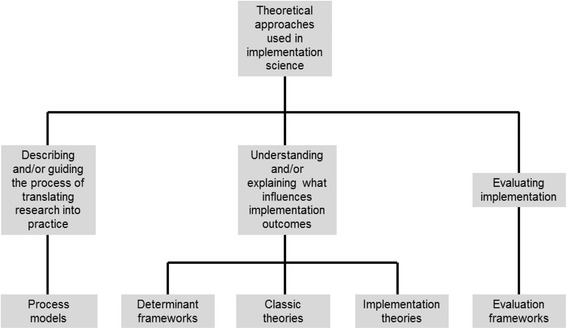
BACKGROUND: Implementation science has progressed towards increased use of theoretical approaches to provide better understanding and explanation of how and why implementation succeeds or fails. The aim of this article is to propose a taxonomy that distinguishes between different categories of theories, models and frameworks in implementation science, to facilitate appropriate selection and application of relevant approaches in implementation research and practice and to foster cross-disciplinary dialogue among implementation researchers. DISCUSSION: Theoretical approaches used in implementation science have three overarching aims: describing and/or guiding the process of translating research into practice (process models); understanding and/or explaining what influences implementation outcomes (determinant frameworks, classic theories, implementation theories); and evaluating implementation (evaluation frameworks). This article proposes five categories of theoretical approaches to achieve three overarching aims. These categories are not always recognized as separate types of approaches in the literature. While there is overlap between some of the theories, models and frameworks, awareness of the differences is important to facilitate the selection of relevant approaches. Most determinant frameworks provide limited "how-to" support for carrying out implementation endeavours since the determinants usually are too generic to provide sufficient detail for guiding an implementation process. And while the relevance of addressing barriers and enablers to translating research into practice is mentioned in many process models, these models do not identify or systematically structure specific determinants associated with implementation success. Furthermore, process models recognize a temporal sequence of implementation endeavours, whereas determinant frameworks do not explicitly take a process perspective of implementation.
Overview
CoChat Summary
TL;DR
This article proposes a taxonomy of five categories of theories, models and frameworks used in implementation science, organized by three overarching aims: describing/guiding translation of research into practice, understanding/explaining influences on implementation outcomes, and evaluating implementation. It argues that recognizing differences and overlaps among process models, determinant frameworks, classic theories, implementation theories, and evaluation frameworks can facilitate appropriate selection and cross-disciplinary dialogue.
Key findings
- The paper delineates five categories of theoretical approaches—process models, determinant frameworks, classic theories, implementation theories, and evaluation frameworks—to achieve three overarching aims: describing and/or guiding the process of translating research into practice; understanding and/or explaining what influences implementation outcomes; and evaluating implementation.
- Eight commonly cited determinant frameworks are compared in Table 2; the paper states they account for five types of determinants: characteristics of the implementation object, users/adopters, end users, context, and the strategy or other means of facilitating implementation, with outcomes varying across frameworks.
- Theoretical Domains Framework was constructed from a synthesis of 128 constructs related to behaviour change found in 33 behaviour change theories, sorted into 14 theoretical domains (originally 12 domains). Proctor et al. propose eight conceptually distinct implementation outcomes for evaluation: acceptability, adoption, appropriateness, costs, feasibility, fidelity, penetration, and sustainability.
- Most determinant frameworks provide limited “how-to” support because determinants are often too generic; process models mention barriers and enablers but do not identify or systematically structure specific determinants, and process models recognize a temporal sequence whereas determinant frameworks do not explicitly take a process perspective.
Methods
- Narrative review of selective literature: six textbooks providing comprehensive overviews of implementation science and evidence-based practice implementation were consulted, along with several overview papers on theories, models and frameworks.
- Implementation Science was searched using the terms “theory”, “model” and “framework”; titles and abstracts were scanned, and relevant articles were read in full.
- The analysis is a conceptual synthesis that identifies three overarching aims and proposes a five-category taxonomy; no systematic review, meta-analysis, or formal quality appraisal is reported.
Limitations
- The paper states it is not intended as a complete catalogue of all individual approaches available in implementation science, and that the proposed categories are not always recognized as separate types of approaches in the literature.
- The paper states there is considerable overlap between some categories, which can complicate selection and labelling of approaches.
- The text makes evident that the review is selective and narrative rather than systematic, so the taxonomy is conceptual and does not resolve inconsistent terminology across the field.
Model-written summary. Check it against the paper before relying on it.
Integrity signals
Registry
Cites
Statistics
Figures
Verification
Claims the paper makes
8 Valid · 4 Not valid · 18 Not checked · 44 Own results and interpretations
The sources with a verdict support this claim; the rest weren’t checked yet, have no full text we could read, or their verdicts aren’t rated yet.
In the paper
“Poor theoretical underpinning makes it difficult to understand and explain how and why implementation succeeds or fails, thus restraining opportunities to identify factors that predict the likelihood of implementation success and develop better strategies to achieve more successful implementation.”
§ Making sense of implementation theories, models and frameworks > Background
What the sources say
- Not checked yetcites [1] Eccles M Grimshaw J Walker A Johnston M Pitts N Changing the behavior of healthcare professionals: the use of theory in promoting the uptake of research findings J Clin Epidemiol 2005 58 107 12 15680740 source
- Supportedcites [3] Michie S Johnston M Abraham C Lawton R Parker D Walker A Making psychological theory useful for implementing evidence based practice: a consensus approach Qual Saf Health Care 2005 14 26 33 15692000 PMC1743963 source
Split into 2 atoms — 2 confirmed, 0 partially supported, 0 disputed, 0 misattributed, 0 unverifiable. Expand the claim to see per-atom verdicts.
- Not checked yetcites [4] Sales A Smith J Curran G Kochevar L Models, strategies, and tools: theory in implementing evidence-based findings into health care practice J Gen Intern Med 2006 21 S43 9 16637960 PMC2557135
- Supportedcites [5] Kitson AL Harvey G McCormack B Enabling the implementation of evidence-based practice: a conceptual framework Qual Health Care 1998 7 149 58 10185141 PMC2483604 source
Split into 2 atoms — 2 confirmed, 0 partially supported, 0 disputed, 0 misattributed, 0 unverifiable. Expand the claim to see per-atom verdicts.
plainstates a cause- Asserted: passes — The authors put it forward as true.
- Checkable: passes — It can be checked against evidence.
- Load-bearing: passes — The paper’s conclusions depend on it.
- Based: passes — The paper gives a reason why it holds.
The sources with a verdict support this claim; the rest weren’t checked yet, have no full text we could read, or their verdicts aren’t rated yet.
In the paper
“Furthermore, many theories, models and frameworks have spawned instruments that serve evaluation purposes, e.g. tools linked to PARIHS [132,133], CFIR [134] and Theoretical Domains Framework [135].”
§ Making sense of implementation theories, models and frameworks > Discussion > Evaluating implementation
What the sources say
- Supportedcites [132] Estabrooks CA Squires JE Cummings GG Birdell JM Norton PG Development and assessment of the Alberta Context Tool BMC Health Serv Res 2009 9 234 20003531 PMC2805628 source
The Background (page unavailable) says the authors used the PARiHS framework to conceptualize organizational context and developed the Alberta Context Tool to assess it. This supports the citation as an example of a framework-linked assessment instrument; it does not need to establish the sentence’s separate examples linked to other frameworks. (LLM, conf=0.91)
- Not checked yetcites [133] McCormack B McCarthy G Wright J Slater P Coffey A Development and testing of the Context Assessment Index (CAI) Worldviews Evid Based Nurs 2009 6 27 35 19207560 source
- Supportedcites [134] Damschroder LJ Lowery JC Evaluation of a large-scale weight management program using the consolidated framework for implementation research (CFIR) Implement Sci 2013 8 51 23663819 PMC3656778 source
The Data collection procedures section describes a semi-structured interview guide whose questions probed CFIR constructs to evaluate implementation of the MOVE! program. The Conclusion also says the CFIR resource provides example interview guides. This supports citing the paper as an example of a framework linked to an evaluation instrument; it does not need to establish the sentence’s broader claim about other frameworks. (LLM, conf=0.90)
- Supportedcites [135] Dyson J Lawton R Jackson C Cheater F Development of a theory-based instrument to identify barriers and levers to best hand hygiene practice among healthcare practitioners Implement Sci 2013 8 111 24059289 PMC3850814 source
This citation supplies the Theoretical Domains Framework example, not evidence for every framework in the sentence. The Background says the paper presents the development and testing of a TDF-based instrument to assess barriers and levers to hand hygiene practice, supporting its identification as an evaluation tool. (LLM, conf=0.92)
plainstates a cause- Asserted: passes — The authors put it forward as true.
- Checkable: passes — It can be checked against evidence.
- Load-bearing: unclear — It is unclear whether the paper’s conclusions depend on it.
- Based: passes — The paper gives a reason why it holds.
- Supported
The cited sources support only part of this claim — read each source’s verdict below.
In the paper
“For instance, Theoretical Domains Framework (e.g. [127,128]), and Normalization Process Theory [129] and COM-B (e.g. [130,131]) have all been widely used as evaluation frameworks.”
§ Making sense of implementation theories, models and frameworks > Discussion > Evaluating implementation
What the sources say
- Not checked yetcites [127] Phillips CJ Marshall AP Chaves NJ Lin IB Loy CT Rees G Experiences of using Theoretical Domains Framework across diverse clinical environments: a qualitative study J Multidiscip Healthc 2015 8 139 46 25834455 PMC4370908
- Supportedcites [128] Fleming A Bradley C Cullinan S Byrne S Antibiotic prescribing in long-term care facilities: a qualitative, multidisciplinary investigation BMJ Open 2014 4 11 25377014 PMC4225237 source
The Introduction says the TDF has been used in many types of studies, and the Methods and Discussion show this study using TDF and COM-B to analyse prescribing behaviour and identify intervention functions. This paper therefore serves as an example of their use as evaluation frameworks. Normalization Process Theory has its own citation in the citing sentence and is not attributed to this source. (LLM, conf=0.86)
- Supportedcites [129] McEvoy R Ballini L Maltoni S O’Donnell CA Mair FS MacFarlane A A qualitative systematic review of studies using the normalization process theory to research implementation processes Implement Sci 2014 9 2 24383661 PMC3905960 source
The citation [129] is attached to Normalization Process Theory, not to the other two frameworks. The Results (‘How is NPT being operationalized?’; page unavailable) report that, in almost all studies reviewed, NPT was used as a framework for analysing and reporting implementation findings. The review included 29 studies, supporting the characterization of its widespread use as an evaluation framework. (LLM, conf=0.90)
- Partly supportedcites [130] Connell LA McMahon NE Redfern J Watkins CL Eng JJ Development of a behaviour change intervention to increase upper limb exercise in stroke rehabilitation Implement Sci 2015 10 34 25885251 PMC4358857 sourceExperimental — accuracy not yet measured
The Methods (Stage 2; page not provided) describe using COM-B to analyse target behaviours while developing an intervention. This supports COM-B as a framework used in this study, but the paper does not establish that it is widely used as an evaluation framework. This citation does not bear on the sentence’s separate claims about the Theoretical Domains Framework or Normalization Process Theory. (LLM, conf=0.82)
- Supportedcites [131] Praveen D Patel A Raghu A Clifford GD Maulik PK Abdul AM Development and field evaluation of a mobile clinical decision support system for cardiovascular diseases in rural India JMIR mHealth uHealth 2014 2 25487047 PMC4275493 source
This source is cited as an example of COM-B use, not for the other two frameworks. The Methods (Evaluation and Analysis) say COM-B was used to design and analyze interview data, and the Results (Field Testing: Qualitative Evaluation) present the findings in its three domains. It therefore supports the cited example of COM-B as an evaluation framework, though this single study does not itself establish how widely COM-B is used. (LLM, conf=0.89)
boosted- Asserted: passes — The authors put it forward as true.
- Checkable: passes — It can be checked against evidence.
- Load-bearing: unclear — It is unclear whether the paper’s conclusions depend on it.
- Based: passes — The paper gives a reason why it holds.
The cited sources support only part of this claim — read each source’s verdict below.
In the paper
“Although evaluation frameworks may be considered in a category of their own, theories, models and frameworks from the other four categories can also be applied for evaluation purposes because they specify concepts and constructs that may be operationalized and measured.”
§ Making sense of implementation theories, models and frameworks > Discussion > Evaluating implementation
What the sources say
- Not checked yetcites [127] Phillips CJ Marshall AP Chaves NJ Lin IB Loy CT Rees G Experiences of using Theoretical Domains Framework across diverse clinical environments: a qualitative study J Multidiscip Healthc 2015 8 139 46 25834455 PMC4370908
- Partly supportedcites [128] Fleming A Bradley C Cullinan S Byrne S Antibiotic prescribing in long-term care facilities: a qualitative, multidisciplinary investigation BMJ Open 2014 4 11 25377014 PMC4225237 sourceExperimental — accuracy not yet measured
The Introduction describes the TDF as a framework with defined domains and constructs, and Methods > Analysis says the authors assigned interview codes to those domains. This supports the possibility of applying a framework’s constructs in an analysis, but the paper does not discuss four categories other than evaluation frameworks or establish that frameworks across those categories can be used for evaluation and measurement. Page numbers are not available in our copy. (LLM, conf=0.78)
- Partly supportedcites [129] McEvoy R Ballini L Maltoni S O’Donnell CA Mair FS MacFarlane A A qualitative systematic review of studies using the normalization process theory to research implementation processes Implement Sci 2014 9 2 24383661 PMC3905960 sourceExperimental — accuracy not yet measured
In Results, under “How is NPT being operationalized?” (page unavailable), the review reports that NPT constructs were used to analyze implementation and that an NPT-based instrument was developed to measure normalization processes. This supports NPT as an example of a theory used for analysis and measurement, but the paper does not address the citing sentence’s distinction between evaluation frameworks and four other categories or establish that all four can be used this way. (LLM, conf=0.84)
- Partly supportedcites [130] Connell LA McMahon NE Redfern J Watkins CL Eng JJ Development of a behaviour change intervention to increase upper limb exercise in stroke rehabilitation Implement Sci 2015 10 34 25885251 PMC4358857 sourceExperimental — accuracy not yet measured
The Discussion (page unavailable) says that specified behaviour-change techniques and toolkit performance measures could be used to measure intervention fidelity and investigate mechanisms in a future evaluation study. This supports the idea that a framework or taxonomy used for intervention development can also inform evaluation. The paper does not discuss four other categories of theories, models and frameworks or establish the claim for all of them. (LLM, conf=0.83)
- Partly supportedcites [131] Praveen D Patel A Raghu A Clifford GD Maulik PK Abdul AM Development and field evaluation of a mobile clinical decision support system for cardiovascular diseases in rural India JMIR mHealth uHealth 2014 2 25487047 PMC4275493 sourceExperimental — accuracy not yet measured
The Methods (Evaluation and Analysis; page unavailable) say the COM-B theory was used to design and analyze evaluation interviews, and the Results (Field Testing: Qualitative Evaluation; page unavailable) organize findings under its capability, opportunity, and motivation domains. This supports the claim by example, but the paper does not establish the broader assertion about theories, models, and frameworks across the other four categories or say that their constructs can generally be measured. (LLM, conf=0.82)
plainstates a cause- Asserted: passes — The authors put it forward as true.
- Checkable: passes — It can be checked against evidence.
- Load-bearing: passes — The paper’s conclusions depend on it.
- Based: passes — The paper gives a reason why it holds.
A result the paper states — it cites no source for it, so there is none to check. The quote shows it is in the paper.
In the paper
“And while the relevance of addressing barriers and enablers to translating research into practice is mentioned in many process models, these models do not identify or systematically structure specific determinants associated with implementation success.”
§ Making sense of implementation theories, models and frameworks > Abstract > Summary
plain- Asserted: passes — The authors put it forward as true.
- Checkable: passes — It can be checked against evidence.
- Load-bearing: passes — The paper’s conclusions depend on it.
- Based: passes — The paper gives a reason why it holds.
22 more claims
Create a free account to see all 74 claims and to verify the 51 references still open.
- Probably not a substantial claim. 31
- It may state two separate claims as one. 21
Claims other papers make about this one
Each is checked against this paper’s own text: does it say what the citing paper says it does?
The cited source doesn’t support the claim as written.
In the citing paper
“frameworks provide explicit guidance and justification for proposed hypotheses to be tested that strengthen proposals, projects, trials, and products, both research and practice based [2, 4].”
From Ten recommendations for using implementation frameworks in research and practice (2020) · cites this paper as [2]
Checked by a reasoning model — may be wrong.
Experimental — accuracy not yet measuredThe source backs part of the claim, not all of it — or backs it for a different population, condition or comparison.
In the citing paper
“Additional constructs were added in the updated CFIR to acknowledge scientific advancement since 2009 that are common across many process frameworks [8] and collective-level change theories [72].”
From The updated consolidated framework for implementation research based on user feedback (2022) · cites this paper as [8]
Experimental — accuracy not yet measuredThe source backs part of the claim, not all of it — or backs it for a different population, condition or comparison.
In the citing paper
“There are over 100 identified KT theories, models and frameworks to choose from (e.g., Nilsen, 2015 [5]; Tabak et al., 2012 [14]; Straus et al., 2013 [15]).”
From Scoping review identifies significant number of knowledge translation theories, models, and frameworks with limited use (2018) · cites this paper as [5]
Experimental — accuracy not yet measuredThe source backs part of the claim, not all of it — or backs it for a different population, condition or comparison.
In the citing paper
“For intermediaries and practitioners, they can provide shared language to familiarize stakeholders with implementation and function as practical tools for planning, executing, and evaluating real-world implementation efforts.”
From Ten recommendations for using implementation frameworks in research and practice (2020) · cites this paper as [2]
Experimental — accuracy not yet measuredThe source backs part of the claim, not all of it — or backs it for a different population, condition or comparison.
In the citing paper
“When used in research, they can guide the design and conduct of studies, inform the theoretical and empirical thinking of research teams, and aid interpretation of findings.”
From Ten recommendations for using implementation frameworks in research and practice (2020) · cites this paper as [2]
Experimental — accuracy not yet measured
18 more claims about this paper
Create a free account to see every claim other papers make about this one.
Self-check
Percentages, sums and reported differences re-computed from the paper’s own numbers.
Each contradiction between two passages listed here was confirmed by an independent check.
Rated minor: it would not touch a result — a value no result rests on, a p-value that stays on the same side of the significance level, or a conflict that is clerical, resolved elsewhere in the paper, or outside its own findings.
In the paper
§ Making sense of implementation theories, models and frameworks > Summary
“A framework such as the Active Implementation Frameworks [68] appears to have a dual aim”
§ Making sense of implementation theories, models and frameworks > References
“68. Holmes BJ Finegood DT Riley BL Best A Brownson RC Colditz GA Proctor EK Systems Thinking in Dissemination and Implementation Research”
Rated minor: it would not touch a result — a value no result rests on, a p-value that stays on the same side of the significance level, or a conflict that is clerical, resolved elsewhere in the paper, or outside its own findings.
In the paper
§ Making sense of implementation theories, models and frameworks > Discussion > Theories, models and frameworks in implementation science
“model by Davies et al. [43]”
§ Making sense of implementation theories, models and frameworks > References
“43. Davis SM Peterson JC Helfrich CD Cunningham-Sabo L Introduction and conceptual model for utilization of prevention research”
Rated minor: it would not touch a result — a value no result rests on, a p-value that stays on the same side of the significance level, or a conflict that is clerical, resolved elsewhere in the paper, or outside its own findings.
In the paper
§ Making sense of implementation theories, models and frameworks > References
“121. May C Finch T Mair F Ballini L Dowrick C Eccles M Understanding the implementation of complex interventions in health care: the normalization process model Implement Sci 2007 7 148”
§ Making sense of implementation theories, models and frameworks > References
“74. Ashton CM Khan MM Johnson ML Walder A Stanberry E Beyth RJ A quasi-experimental test of an intervention to increase the use of thiazide-based treatment regimens for people with hypertension Implement Sci 2007 2 5”
Rated minor: it would not touch a result — a value no result rests on, a p-value that stays on the same side of the significance level, or a conflict that is clerical, resolved elsewhere in the paper, or outside its own findings.
In the paper
§ Making sense of implementation theories, models and frameworks > Discussion > Theories, models and frameworks in implementation science
“COM-B Capacity-Opportunities-Motivation-Behaviour”
§ Making sense of implementation theories, models and frameworks > Discussion > Understanding and explaining what influences implementation outcomes
“COM-B (Capability, Opportunity, Motivation and Behaviour)”
Citations
Cites
Self-efficacy: Toward a unifying theory of behavioral change
Bandura, A. (1977) · Psychological Review · doi:10.1037/0033-295x.84.2.191 · Cited by 43,925
Rogers, E. M., Singhal, A., & Quinlan, M. M. (2019) · An Integrated Approach to Communication Theory and Research · doi:10.4324/9780203710753-35 · Cited by 37,322
The Structure of Scientific Revolutions
Kuhn, T. S., & Schlegel, R. (1963) · Physics Today · doi:10.1063/1.3050879 · Cited by 35,538
Damschroder, L. J., Aron, D. C., Keith, R. E., Kirsh, S. R., Alexander, J. A., & Lowery, J. C. (2009) · Implementation Science · doi:10.1186/1748-5908-4-50 · Cited by 14,496 · cited 9×
“Other frameworks have relied on existing determinant frameworks and relevant theories in various disciplines, e.g. the frameworks by Gurses et al. [58] and CFIR (Consolidated Framework for Implementation Research) [60].”
InfluentialValente, T. W. (2003) · Genetics in Medicine · doi:10.1097/01.gim.0000061743.67794.c4 · Cited by 13,723
Michie, S., van Stralen, M. M., & West, R. (2011) · Implementation Science · doi:10.1186/1748-5908-6-42 · Cited by 13,697
Absorptive Capacity: A Review, Reconceptualization, and Extension
Zahra, S. A., & George, G. (2002) · The Academy of Management Review · doi:10.5465/amr.2002.6587995 · Cited by 10,758
Self-efficacy: Toward a unifying theory of behavioral change
Bandura, A. (1978) · Advances in Behaviour Research and Therapy · doi:10.1016/0146-6402(78)90002-4 · Cited by 10,586
The Structure of Scientific Revolutions.
Bohm, D., & Kuhn, T. S. (1964) · The Philosophical Quarterly · doi:10.2307/2217783 · Cited by 9,130
Proctor, E., Silmere, H., Raghavan, R., Hovmand, P., Aarons, G., Bunger, A., Griffey, R., & Hensley, M. (2011) · Administration and Policy in Mental Health and Mental Health Services Research · doi:10.1007/s10488-010-0319-7 · Cited by 8,721
Research works printed but not linked: 9
- Davies P Walker A Grimshaw J Theories of behavior change in studies of guideline implementation Proc Br Psychol Soc 2003 11 120
- Dubin R Theory Building 1978 New York Free Press
- Stetler CB Rycroft-Malone J Bucknall T Stetler model Models and Frameworks for Implementing Evidence-Based Practice: Linking Evidence to Action 2010 Oxford Wiley-Blackwell 51 82
- Logan J Graham I Rycroft-Malone J Bucknall T The Ottawa Model of Research Use Models and Frameworks for Implementing Evidence-Based Practice: Linking Evidence to Action 2010 Oxford Wiley-Blackwell 83 108
- Rycroft-Malone J Rycroft-Malone J Bucknall T Promoting Action on Research Implementation in Health Services (PARIHS) Models and Frameworks for Implementing Evidence-Based Practice: Linking Evidence to Action 2010 Oxford Wiley-Blackwell 109 36
- Michie S Atkins L West R A guide to using the Behaviour Change Wheel 2014 London Silverback Publishing
- Fishbein M Ajzen I Belief, Attitude, Intention, and Behaviour 1975 New York John Wiley
- Bandura A Social Foundations of Thought and Action: A Cognitive Social Theory 1986 Englewood-Cliffs, NJ Prentice-Hall
- DiMaggio PJ Powell WW The New Institutionalism and Organizational Analysis 1991 Chicago, IL University of Chicago Press
Cited by
The updated consolidated framework for implementation research based on user feedback
Damschroder, L. J., Reardon, C. M., Widerquist, M. A. O., & Lowery, J. (2022) · Implementation Science · doi:10.1186/s13012-022-01245-0 · Cited by 4,452
“Additional constructs were added in the updated CFIR to acknowledge scientific advancement since 2009 that are common across many process frameworks [8] and collective-level change theories [72].”
BackgroundMethodInfluentialSystematic review of the Exploration, Preparation, Implementation, Sustainment (EPIS) framework
Moullin, J. C., Dickson, K. S., Stadnick, N. A., Rabin, B., & Aarons, G. A. (2019) · Implementation Science · doi:10.1186/s13012-018-0842-6 · Cited by 1,223
Waltz, T. J., Powell, B. J., Fernández, M. E., Abadie, B., & Damschroder, L. J. (2019) · Implementation Science · doi:10.1186/s13012-019-0892-4 · Cited by 1,136
Pfadenhauer, L. M., Gerhardus, A., Mozygemba, K., Lysdahl, K. B., Booth, A., Hofmann, B., Wahlster, P., Polus, S., Burns, J., Brereton, L., et al. (2017) · Implementation Science · doi:10.1186/s13012-017-0552-5 · Cited by 1,016
“An implementation theory attempts to explain the causal mechanisms of implementation [10]; it is therefore analogous to a programme theory, which attempts”
BackgroundInfluentialNilsen, P., & Bernhardsson, S. (2019) · BMC Health Services Research · doi:10.1186/s12913-019-4015-3 · Cited by 1,014
Implementation Mapping: Using Intervention Mapping to Develop Implementation Strategies
Fernandez, M. E., ten Hoor, G. A., van Lieshout, S., Rodriguez, S. A., Beidas, R. S., Parcel, G., Ruiter, R. A. C., Markham, C. M., & Kok, G. (2019) · Frontiers in Public Health · doi:10.3389/fpubh.2019.00158 · Cited by 914
“Implementation science literature demonstrates a growing body of work on dissemination and implementation models and frameworks in the last several years (8, 9).”
BackgroundBraithwaite, J., Churruca, K., Long, J. C., Ellis, L. A., & Herkes, J. (2018) · BMC Medicine · doi:10.1186/s12916-018-1057-z · Cited by 845
May, C. R., Cummings, A., Girling, M., Bracher, M., Mair, F. S., May, C. M., Murray, E., Myall, M., Rapley, T., & Finch, T. (2018) · Implementation Science · doi:10.1186/s13012-018-0758-1 · Cited by 683
Damschroder, L. J., Reardon, C. M., Opra Widerquist, M. A., & Lowery, J. (2022) · Implementation Science · doi:10.1186/s13012-021-01181-5 · Cited by 784
“Theories that guide conceptualization of context abound and are often encapsulated within determinant frameworks [4, 5]; these frameworks delineate determinants (i.”
BackgroundReis, R. S., Salvo, D., Ogilvie, D., Lambert, E. V., Goenka, S., & Brownson, R. C. (2016) · The Lancet · doi:10.1016/s0140-6736(16)30728-0 · Cited by 719
Smith, J. D., Li, D. H., & Rafferty, M. R. (2020) · Implementation Science · doi:10.1186/s13012-020-01041-8 · Cited by 706
An introduction to effectiveness-implementation hybrid designs
Landes, S. J., McBain, S. A., & Curran, G. M. (2019) · Psychiatry Research · doi:10.1016/j.psychres.2019.112513 · Cited by 516
“The use of established implementation frameworks (Nilsen, 2015; Tabak et al., 2012) can aid in designing effectiveness trials for dissemination and implementation.”
MethodUnderstanding and applying the RE-AIM framework: Clarifications and resources
Holtrop, J. S., Estabrooks, P. A., Gaglio, B., Harden, S. M., Kessler, R. S., King, D. K., Kwan, B. M., Ory, M. G., Rabin, B. A., Shelton, R. C., et al. (2021) · Journal of Clinical and Translational Science · doi:10.1017/cts.2021.789 · Cited by 549
Skivington, K., Matthews, L., Simpson, S. A., Craig, P., Baird, J., Blazeby, J. M., Boyd, K. A., Craig, N., French, D. P., McIntosh, E., et al. (2021) · Health Technology Assessment · doi:10.3310/hta25570 · Cited by 522
Ten recommendations for using implementation frameworks in research and practice
Moullin, J. C., Dickson, K. S., Stadnick, N. A., Albers, B., Nilsen, P., Broder-Fingert, S., Mukasa, B., & Aarons, G. A. (2020) · Implementation Science Communications · doi:10.1186/s43058-020-00023-7 · Cited by 488
An Overview of Research and Evaluation Designs for Dissemination and Implementation
Brown, C. H., Curran, G., Palinkas, L. A., Aarons, G. A., Wells, K. B., Jones, L., Collins, L. M., Duan, N., Mittman, B. S., Wallace, A., et al. (2017) · Annual Review of Public Health · doi:10.1146/annurev-publhealth-031816-044215 · Cited by 509
“A tacit assumption of this pipeline is that wide-scale use of evidence-based clinical/preventive interventions generally requires a targeted information dissemination and often a concerted, deliberate strategy for implementation to move to this end of the diffusion, dissemination, and implementation continuum (53, 81,…”
BackgroundGeerligs, L., Rankin, N. M., Shepherd, H. L., & Butow, P. (2018) · Implementation Science · doi:10.1186/s13012-018-0726-9 · Cited by 480
Woodward, E. N., Matthieu, M. M., Uchendu, U. S., Rogal, S., & Kirchner, J. E. (2019) · Implementation Science · doi:10.1186/s13012-019-0861-y · Cited by 470
Birken, S. A., Powell, B. J., Shea, C. M., Haines, E. R., Alexis Kirk, M., Leeman, J., Rohweder, C., Damschroder, L., & Presseau, J. (2017) · Implementation Science · doi:10.1186/s13012-017-0656-y · Cited by 471
Shelton, R. C., Chambers, D. A., & Glasgow, R. E. (2020) · Frontiers in Public Health · doi:10.3389/fpubh.2020.00134 · Cited by 448
Clarity out of chaos: Use of theory in implementation research
Damschroder, L. J. (2020) · Psychiatry Research · doi:10.1016/j.psychres.2019.06.036 · Cited by 422
“Nilsen classified published implementation frameworks into three categories (Nilsen, 2015); the white boxes in Fig.”
Means, A. R., Kemp, C. G., Gwayi-Chore, M.-C., Gimbel, S., Soi, C., Sherr, K., Wagenaar, B. H., Wasserheit, J. N., & Weiner, B. J. (2020) · Implementation Science · doi:10.1186/s13012-020-0977-0 · Cited by 418
“Author questionnaire respondents, in addition to CFIR utilizers from HICs, identified spread and scale as key missing constructs [50].”
BackgroundInfluentialKnowledge translation in health: how implementation science could contribute more
Wensing, M., & Grol, R. (2019) · BMC Medicine · doi:10.1186/s12916-019-1322-9 · Cited by 413
The Handbook of Behavior Change
(2020) · Cambridge University Press eBooks · doi:10.1017/9781108677318 · Cited by 407
Artificial intelligence and the implementation challenge
Shaw, J., Rudzicz, F., Jamieson, T., & Goldfarb, A. (2019) · Journal of Medical Internet Research · doi:10.2196/13659 · Cited by 389
“We have described use cases (and attendant value propositions) of ML in health care as more likely relating to decision support and less likely to automation, which begins to illustrate the implementation object of focus in ML initiatives [6,7].”
BackgroundMethodFoster, A., Croot, L., Brazier, J., Harris, J., & O’Cathain, A. (2018) · Journal of Patient-Reported Outcomes · doi:10.1186/s41687-018-0072-3 · Cited by 386
Birken, S. A., Powell, B. J., Presseau, J., Kirk, M. A., Lorencatto, F., Gould, N. J., Shea, C. M., Weiner, B. J., Francis, J. J., Yu, Y., et al. (2017) · Implementation Science · doi:10.1186/s13012-016-0534-z · Cited by 385
Why sex and gender matter in implementation research
Tannenbaum, C., Greaves, L., & Graham, I. D. (2016) · BMC Medical Research Methodology · doi:10.1186/s12874-016-0247-7 · Cited by 386
“For example, in Nilsen’s review [17] of implementation theories, models and frameworks, only 2 make minor references to gender [18, 19].”
MethodSpreading and scaling up innovation and improvement
Greenhalgh, T., & Papoutsi, C. (2019) · BMJ · doi:10.1136/bmj.l2068 · Cited by 382
Qualitative approaches to use of the RE-AIM framework: rationale and methods
Holtrop, J. S., Rabin, B. A., & Glasgow, R. E. (2018) · BMC Health Services Research · doi:10.1186/s12913-018-2938-8 · Cited by 375
Moore, J. L., Potter, K., Blankshain, K., Kaplan, S. L., O'Dwyer, L. C., & Sullivan, J. E. (2018) · Journal of Neurologic Physical Therapy · doi:10.1097/npt.0000000000000229 · Cited by 363
A framework for value-creating learning health systems
Menear, M., Blanchette, M.-A., Demers-Payette, O., & Roy, D. (2019) · Health Research Policy and Systems · doi:10.1186/s12961-019-0477-3 · Cited by 343
Finch, T. L., Girling, M., May, C. R., Mair, F. S., Murray, E., Treweek, S., McColl, E., Steen, I. N., Cook, C., Vernazza, C. R., et al. (2018) · BMC Medical Research Methodology · doi:10.1186/s12874-018-0591-x · Cited by 337
Koorts, H., Eakin, E., Estabrooks, P., Timperio, A., Salmon, J., & Bauman, A. (2018) · International Journal of Behavioral Nutrition and Physical Activity · doi:10.1186/s12966-018-0678-0 · Cited by 335
Torous, J., Linardon, J., Goldberg, S. B., Sun, S., Bell, I., Nicholas, J., Hassan, L., Hua, Y., Milton, A., & Firth, J. (2025) · World Psychiatry · doi:10.1002/wps.21299 · Cited by 323
The struggle of translating science into action: Foundational concepts of implementation science
Rapport, F., Clay‐Williams, R., Churruca, K., Shih, P., Hogden, A., & Braithwaite, J. (2018) · Journal of Evaluation in Clinical Practice · doi:10.1111/jep.12741 · Cited by 319
Carlson, L. E., Ismaila, N., Addington, E. L., Asher, G. N., Atreya, C., Balneaves, L. G., Bradt, J., Fuller-Shavel, N., Goodman, J., Hoffman, C. J., et al. (2023) · Journal of Clinical Oncology · doi:10.1200/jco.23.00857 · Cited by 309
Stover, A. M., Haverman, L., van Oers, H. A., Greenhalgh, J., Potter, C. M., On behalf of the ISOQOL PROMs/PREMs in Clinical Practice Implementation Science Work Group, Ahmed, S., Greenhalgh, J., Gibbons, E., Haverman, L., et al. (2021) · Quality of Life Research · doi:10.1007/s11136-020-02564-9 · Cited by 308
Cassar, S., Salmon, J., Timperio, A., Naylor, P.-J., van Nassau, F., Contardo Ayala, A. M., & Koorts, H. (2019) · International Journal of Behavioral Nutrition and Physical Activity · doi:10.1186/s12966-019-0876-4 · Cited by 304
McNeely, J., Kumar, P. C., Rieckmann, T., Sedlander, E., Farkas, S., Chollak, C., Kannry, J. L., Vega, A., Waite, E. A., Peccoralo, L. A., et al. (2018) · Addiction Science & Clinical Practice · doi:10.1186/s13722-018-0110-8 · Cited by 303
“Implementation models and frameworks can both guide the introduction of new practices, and inform our understanding of why the introduction of a given practice or intervention may succeed or fail [27].”
BackgroundLiberati, E. G., Ruggiero, F., Galuppo, L., Gorli, M., González-Lorenzo, M., Maraldi, M., Ruggieri, P., Polo Friz, H., Scaratti, G., Kwag, K. H., et al. (2017) · Implementation Science · doi:10.1186/s13012-017-0644-2 · Cited by 301
“It does do not, however, address how change takes place or the causal mechanisms leading to the adoption or non-adoption of CDSSs — hence, it is not, in itself, a theory [47].”
BackgroundHarnessing the power of theorising in implementation science
Kislov, R., Pope, C., Martin, G. P., & Wilson, P. M. (2019) · Implementation Science · doi:10.1186/s13012-019-0957-4 · Cited by 289
“The gradual maturation of implementation science as a discipline is also reflected in laudable endeavours to systematise and make sense of this theoretical knowledge [3 – 6] as well as to critically reflect on the current state of the field in general [7, 8].”
Perry, C. K., Damschroder, L. J., Hemler, J. R., Woodson, T. T., Ono, S. S., & Cohen, D. J. (2019) · Implementation Science · doi:10.1186/s13012-019-0876-4 · Cited by 288
Pragmatic approaches to analyzing qualitative data for implementation science: an introduction
Ramanadhan, S., Revette, A. C., Lee, R. M., & Aveling, E. L. (2021) · Implementation Science Communications · doi:10.1186/s43058-021-00174-1 · Cited by 280
McCreight, M. S., Rabin, B. A., Glasgow, R. E., Ayele, R. A., Leonard, C. A., Gilmartin, H. M., Frank, J. W., Hess, P. L., Burke, R. E., & Battaglia, C. T. (2019) · Translational Behavioral Medicine · doi:10.1093/tbm/ibz085 · Cited by 274
Designing and undertaking randomised implementation trials: guide for researchers
Wolfenden, L., Foy, R., Presseau, J., Grimshaw, J. M., Ivers, N. M., Powell, B. J., Taljaard, M., Wiggers, J., Sutherland, R., Nathan, N., et al. (2021) · BMJ · doi:10.1136/bmj.m3721 · Cited by 270
Langley, J., Wolstenholme, D., & Cooke, J. (2018) · BMC Health Services Research · doi:10.1186/s12913-018-3397-y · Cited by 272
Woodward, E. N., Singh, R. S., Ndebele-Ngwenya, P., Melgar Castillo, A., Dickson, K. S., & Kirchner, J. E. (2021) · Implementation Science Communications · doi:10.1186/s43058-021-00146-5 · Cited by 270
The physician’s experience of changing clinical practice: a struggle to unlearn
Gupta, D. M., Boland, R. J., & Aron, D. C. (2017) · Implementation Science · doi:10.1186/s13012-017-0555-2 · Cited by 269
Changing Behavior Using the Theory of Planned Behavior
Ajzen, I., & Schmidt, P. (2020) · The Handbook of Behavior Change · doi:10.1017/9781108677318.002 · Cited by 266
Getting a clinical innovation into practice: An introduction to implementation strategies
Kirchner, J. E., Smith, J. L., Powell, B. J., Waltz, T. J., & Proctor, E. K. (2020) · Psychiatry Research · doi:10.1016/j.psychres.2019.06.042 · Cited by 258
Lennon, M. R., Bouamrane, M.-M., Devlin, A. M., O'Connor, S., O'Donnell, C., Chetty, U., Agbakoba, R., Bikker, A., Grieve, E., Finch, T., et al. (2017) · Journal of Medical Internet Research · doi:10.2196/jmir.6900 · Cited by 264
“Increasingly, in implementation research, the use of theory has been advocated in order to allow us to develop an improved understanding and explanation of why service innovations or digital health technologies become an integrated part of routine service delivery or not [29].”
Kirk, M. A., Moore, J. E., Wiltsey Stirman, S., & Birken, S. A. (2020) · Implementation Science · doi:10.1186/s13012-020-01021-y · Cited by 254
Ibrahim, N., Thompson, D., Nixdorf, R., Kalha, J., Mpango, R., Moran, G., Mueller-Stierlin, A., Ryan, G., Mahlke, C., Shamba, D., et al. (2020) · Social Psychiatry and Psychiatric Epidemiology · doi:10.1007/s00127-019-01739-1 · Cited by 251
Planning for Implementation Success Using RE-AIM and CFIR Frameworks: A Qualitative Study
King, D. K., Shoup, J. A., Raebel, M. A., Anderson, C. B., Wagner, N. M., Ritzwoller, D. P., & Bender, B. G. (2020) · Frontiers in Public Health · doi:10.3389/fpubh.2020.00059 · Cited by 247
“At minimum, justification for why a framework or combination of frameworks were selected should be provided (30).”
BackgroundValaitis, R. K., Carter, N., Lam, A., Nicholl, J., Feather, J., & Cleghorn, L. (2017) · BMC Health Services Research · doi:10.1186/s12913-017-2046-1 · Cited by 244
“Nilsen P. Making sense of implementation theories, models and frameworks.”
BackgroundKwan, B. M., McGinnes, H. L., Ory, M. G., Estabrooks, P. A., Waxmonsky, J. A., & Glasgow, R. E. (2019) · Frontiers in Public Health · doi:10.3389/fpubh.2019.00345 · Cited by 243
Digital Behaviour Change Interventions to Break and Form Habits
Pinder, C., Vermeulen, J., Cowan, B. R., & Beale, R. (2018) · ACM Transactions on Computer-Human Interaction · doi:10.1145/3196830 · Cited by 235
Cowie, J., Nicoll, A., Dimova, E. D., Campbell, P., & Duncan, E. A. (2020) · BMC Health Services Research · doi:10.1186/s12913-020-05434-9 · Cited by 231
“Level 5 Category of implementation theory, model and framework as defined in Nilsen (2015) [29] (Table 1, p3): ● Classic Theories: defined as theories that originate from fields external to implementation science, e.g. psychology, sociology and organizational theory, which can be applied to provide…”
BackgroundMethodJoseph-Williams, N., Abhyankar, P., Boland, L., Bravo, P., Brenner, A. T., Brodney, S., Coulter, A., Giguère, A., Hoffman, A., Körner, M., et al. (2021) · Medical Decision Making · doi:10.1177/0272989x20978208 · Cited by 228
“20 PtDAs are not ‘‘magic bullets’’ that will always deliver the intended benefits to patients; their usefulness will ultimately depend on context and implementation.”
BackgroundStrifler, L., Cardoso, R., McGowan, J., Cogo, E., Nincic, V., Khan, P. A., Scott, A., Ghassemi, M., MacDonald, H., Lai, Y., et al. (2018) · Journal of Clinical Epidemiology · doi:10.1016/j.jclinepi.2018.04.008 · Cited by 227
Lynch, E. A., Mudge, A., Knowles, S., Kitson, A. L., Hunter, S. C., & Harvey, G. (2018) · BMC Health Services Research · doi:10.1186/s12913-018-3671-z · Cited by 220
“While previous manuscripts about implementation theories, models and frameworks are helpful for researchers with good background knowledge in implementation science to make sense of the different theoretical approaches available (for example, by providing a taxonomy to distinguish between different categories of imple…”
BackgroundZimon, D., Tyan, J., & Sroufe, R. (2020) · International Journal for Quality Research · doi:10.24874/ijqr14.01-14 · Cited by 217
Gama, F., Tyskbo, D., Nygren, J., Barlow, J., Reed, J., & Svedberg, P. (2022) · Journal of Medical Internet Research · doi:10.2196/32215 · Cited by 216
“Selected articles were thematically analyzed against the Nilsen taxonomy of implementation frameworks, and the Greenhalgh framework for the nonadoption, abandonment, scale-up, spread, and sustainability (NASSS) of health care technologies.”
BackgroundMethodInfluentialShoesmith, A., Hall, A., Wolfenden, L., Shelton, R. C., Powell, B. J., Brown, H., McCrabb, S., Sutherland, R., Yoong, S., Lane, C., et al. (2021) · Implementation Science · doi:10.1186/s13012-021-01134-y · Cited by 209
“’s Implementation Outcomes Framework [69]; Enabling Conditions Framework [24]; and Durlak and DuPre’s Implementation Framework [22].”
BackgroundInfluentialSustainability of public health interventions: where are the gaps?
Walugembe, D. R., Sibbald, S., Le Ber, M. J., & Kothari, A. (2019) · Health Research Policy and Systems · doi:10.1186/s12961-018-0405-y · Cited by 204
Mobilising knowledge in complex health systems: a call to action
Holmes, B. J., Best, A., Davies, H., Hunter, D., Kelly, M. P., Marshall, M., & Rycroft-Malone, J. (2017) · Evidence and Policy · doi:10.1332/174426416x14712553750311 · Cited by 199
“First, we observe few discussions about how seemingly minor barriers interact in ways that are difficult to predict (Nilson, 2015).”
BackgroundPromoting digitally enabled growth in SMEs: a framework proposal
North, K., Aramburu, N., & Lorenzo, O. J. (2019) · Journal of Enterprise Information Management · doi:10.1108/jeim-04-2019-0103 · Cited by 199
Research capacity building frameworks for allied health professionals – a systematic review
Matus, J., Walker, A., & Mickan, S. (2018) · BMC Health Services Research · doi:10.1186/s12913-018-3518-7 · Cited by 196
T-CaST: an implementation theory comparison and selection tool
Birken, S. A., Rohweder, C. L., Powell, B. J., Shea, C. M., Scott, J., Leeman, J., Grewe, M. E., Alexis Kirk, M., Damschroder, L., Aldridge, W. A., et al. (2018) · Implementation Science · doi:10.1186/s13012-018-0836-4 · Cited by 194
Rapley, T., Girling, M., Mair, F. S., Murray, E., Treweek, S., McColl, E., Steen, I. N., May, C. R., & Finch, T. L. (2018) · BMC Medical Research Methodology · doi:10.1186/s12874-018-0590-y · Cited by 193
Varsi, C., Ekstedt, M., Gammon, D., & Ruland, C. M. (2015) · Journal of Medical Internet Research · doi:10.2196/jmir.5091 · Cited by 191
Advancing complexity science in healthcare research: the logic of logic models
Mills, T., Lawton, R., & Sheard, L. (2019) · BMC Medical Research Methodology · doi:10.1186/s12874-019-0701-4 · Cited by 190
Reprint of: An introduction to effectiveness-implementation hybrid designs
Landes, S. J., McBain, S. A., & Curran, G. M. (2020) · Psychiatry Research · doi:10.1016/j.psychres.2019.112630 · Cited by 190
Abu-Odah, H., Molassiotis, A., & Liu, J. (2020) · BMC Palliative Care · doi:10.1186/s12904-020-00558-5 · Cited by 188
Estabrooks, P. A., Brownson, R. C., & Pronk, N. P. (2018) · Preventing Chronic Disease · doi:10.5888/pcd15.180525 · Cited by 187
Raine, R., Fitzpatrick, R., Barratt, H., Bevan, G., Black, N., Boaden, R., Bower, P., Campbell, M., Denis, J.-L., Devers, K., et al. (2016) · Health Services and Delivery Research · doi:10.3310/hsdr04160 · Cited by 186
Vis, C., Mol, M., Kleiboer, A., Bührmann, L., Finch, T., Smit, J., & Riper, H. (2018) · JMIR Mental Health · doi:10.2196/mental.9769 · Cited by 183
(2018) · doi:10.2196/preprints.9769 · Cited by 183
Education policy implementation: A literature review and proposed framework
(2017) · OECD Education Working Papers · doi:10.1787/fc467a64-en · Cited by 181
“…determinant frameworks, “each type of determinant typically comprises a number of individual barriers (hinders, impediments) and/or enablers (facilitators), which are seen as independent variables that have an impact on implementation outcomes, i.e. the dependent variable” (Nilsen, 2015, p. 4[79]).”
BackgroundTitzler, I., Saruhanjan, K., Berking, M., Riper, H., & Ebert, D. D. (2018) · Internet Interventions · doi:10.1016/j.invent.2018.01.002 · Cited by 176
“The ten-stages model for planning change belongs to the process models, and it aims to describe and guide the process of translating theories and research results into practice when implementing a new intervention (Grol et al., 2007; Nilsen, 2015).”
MethodDugstad, J., Eide, T., Nilsen, E. R., & Eide, H. (2019) · BMC Health Services Research · doi:10.1186/s12913-019-4191-1 · Cited by 174
“Information about such barriers and facilitators is useful for controlling the implementation strategy and a determinant of innovation framework helps to focus this study on the essential processes of behavioural change, which are complex in clinical settings [41, 42].”
BackgroundReardon, C. M., Damschroder, L. J., Ashcraft, L. E., Kerins, C., Bachrach, R. L., Nevedal, A. L., Domlyn, A. M., Dodge, J., Chinman, M., & Rogal, S. (2025) · Implementation Science · doi:10.1186/s13012-025-01450-7 · Cited by 172
Implementation science in resource-poor countries and communities
Yapa, H. M., & Bärnighausen, T. (2018) · Implementation Science · doi:10.1186/s13012-018-0847-1 · Cited by 171
Davis, R., & D’Lima, D. (2020) · Implementation Science · doi:10.1186/s13012-020-01051-6 · Cited by 170
Conceptual framework of equity-focused implementation research for health programs (EquIR)
Eslava-Schmalbach, J., Garzón-Orjuela, N., Elias, V., Reveiz, L., Tran, N., & Langlois, E. V. (2019) · International Journal for Equity in Health · doi:10.1186/s12939-019-0984-4 · Cited by 160
“Implementation is “the process of putting to use or integrating new practices within a setting” [1] and includes within its considerations relevant aspects such as the communities where it is thought to be carried out, the barriers and facilitators for it, the specific needs of the population, which differ for each in…”
BackgroundMcKay, H., Naylor, P.-J., Lau, E., Gray, S. M., Wolfenden, L., Milat, A., Bauman, A., Race, D., Nettlefold, L., & Sims-Gould, J. (2019) · International Journal of Behavioral Nutrition and Physical Activity · doi:10.1186/s12966-019-0868-4 · Cited by 169
Dopp, A. R., Parisi, K. E., Munson, S. A., & Lyon, A. R. (2020) · Implementation Science Communications · doi:10.1186/s43058-020-00020-w · Cited by 169
“Abbreviations CFIR: Consolidated Framework for Implementation Research; CSGM: Concept Systems Global MAX; EBP: Evidence-based practice; ERIC: Expert Recommendations for Implementing Change; i-PARIHS: Integrated Promoting Action on Research Implementation in Health Services framework; UCD: User-centered design Acknowle…”
BackgroundInfluentialUsing implementation science theories and frameworks in global health
Ridde, V., Pérez, D., & Robert, E. (2020) · BMJ Global Health · doi:10.1136/bmjgh-2019-002269 · Cited by 169
Kilbourne, A. M., Goodrich, D. E., Miake-Lye, I., Braganza, M. Z., & Bowersox, N. W. (2019) · Medical Care · doi:10.1097/mlr.0000000000001144 · Cited by 167
Bullock, H. L., Lavis, J. N., Wilson, M. G., Mulvale, G., & Miatello, A. (2021) · Implementation Science · doi:10.1186/s13012-021-01082-7 · Cited by 166
A scoping review of full-spectrum knowledge translation theories, models, and frameworks
Esmail, R., Hanson, H. M., Holroyd-Leduc, J., Brown, S., Strifler, L., Straus, S. E., Niven, D. J., & Clement, F. M. (2020) · Implementation Science · doi:10.1186/s13012-020-0964-5 · Cited by 166
Esponda, G. M., Hartman, S., Qureshi, O., Sadler, E., Cohen, A., & Kakuma, R. (2020) · The Lancet Psychiatry · doi:10.1016/s2215-0366(19)30125-7 · Cited by 165
Low, L.-F., Fletcher, J., Goodenough, B., Jeon, Y.-H., Etherton-Beer, C., MacAndrew, M., & Beattie, E. (2015) · PLOS ONE · doi:10.1371/journal.pone.0140711 · Cited by 164
“Theories are seldom used, possibly because of the proliferation of theories, models and frameworks, many with limited empirical validation [115].”
BackgroundTrends in guideline implementation: an updated scoping review
Peters, S., Sukumar, K., Blanchard, S., Ramasamy, A., Malinowski, J., Ginex, P., Senerth, E., Corremans, M., Munn, Z., Kredo, T., et al. (2022) · Implementation Science · doi:10.1186/s13012-022-01223-6 · Cited by 163
“%) of those employed a least one theory or framework, as described by Nilsen [39].”
MethodInfluentialHarnessing Implementation Science to Increase the Impact of Health Equity Research
Chinman, M., Woodward, E. N., Curran, G. M., & Hausmann, L. R. M. (2017) · Medical Care · doi:10.1097/mlr.0000000000000769 · Cited by 163
“Implementation science has developed a number of frameworks that aim to promote successful implementation of evidence-based clinical interventions.(33) One such framework— the Consolidated Framework for Implementation Research (CFIR(34))—describes 5 domains (and 39 subdomains) that can either facilitate or hinder impl…”
Hogg, H. D. J., Al-Zubaidy, M., Technology Enhanced Macular Services Study Reference Group, Talks, J., Denniston, A. K., Kelly, C. J., Malawana, J., Papoutsi, C., Teare, M. D., Keane, P. A., et al. (2023) · Journal of Medical Internet Research · doi:10.2196/39742 · Cited by 163
Understanding the patient privacy perspective on health information exchange: A systematic review
Shen, N., Bernier, T., Sequeira, L., Strauss, J., Silver, M. P., Carter-Langford, A., & Wiljer, D. (2019) · International Journal of Medical Informatics · doi:10.1016/j.ijmedinf.2019.01.014 · Cited by 161
Hull, L., Athanasiou, T., & Russ, S. (2017) · Annals of Surgery · doi:10.1097/sla.0000000000002013 · Cited by 158
“To facilitate surgical researchers encouraged to integrate implementation science into future studies, implementation factors that ought to be considered when designing, conducting, and reporting an implementation study, together with key references to guide decision making, are presented in Box 1.(7,23,25,26,30,33,34…”
Defining and assessing context in healthcare implementation studies: a systematic review
Rogers, L., De Brún, A., & McAuliffe, E. (2020) · BMC Health Services Research · doi:10.1186/s12913-020-05212-7 · Cited by 158
Metadata
- Authors
- Nilsen, P.
- Venue
- Implementation Science
- Published
- 2015-04-21
- Volume
- 10
- Issue
- 1
- Pages
- 53-53
- ISSN
- 1748-5908 (ISSN-L)
- PMC
- PMC4406164
- OpenAlex
- W2101270539
- Semantic Scholar
- 20f099905076f17d25fc7ec3e4571339fea40ad7
- Cited by
- 4,447
- References
- 165
- Citations by year
- 2026: 480 · 2025: 470 · 2024: 614 · 2023: 528 · 2022: 519 · 2021: 531 · 2020: 491 · 2019: 309 · 2018: 228 · 2017: 161 · 2016: 85 · 2015: 22
- FWCI
- 301.59
- Type
- journal article
- Language
- en
- Open access
- gold
- doi.org
- Locations
- Implementation Science (publishedVersion, cc-by)
- PubMed Central (publishedVersion, cc-by)
- PubMed (publishedVersion)
- DiVA (Linkoping University) (submittedVersion, other-oa)
- Topics
- Health Sciences › Health Professions › General Health Professions › Health Policy Implementation Science
- Health Sciences › Health Professions › General Health Professions › Health Sciences Research and Education
- Health Sciences › Medicine › Public Health, Environmental and Occupational Health › Clinical practice guidelines implementation
- Keywords
- implementation theory, implementation model, implementation framework, process model, implementation outcomes, barriers and facilitators, research-to-practice translation, implementation evaluation, implementation research
- MeSH terms
- Humans, Program Development, Models, Organizational, Evidence-Based Medicine, Translational Research, Biomedical
About these checks
Registry, retraction, Cites and statistics results are computed, not judged, with one exception: a printed reference that no index lists is read once by a model before it counts as a citation error. Claims are extracted by a model and kept only when their quote appears verbatim in the text; each cited source is then checked, with a model’s help, for whether it says what the claim relies on. Those verdicts can be wrong — read the claim’s quote and the cited source before relying on one.
The claim verdicts this report counts are experimental: their accuracy is not yet measured.
A language model drew the claims from the paper on 2026-10-04, under version 3 of the claim definition (model deepseek-v4.1-flash, prompt extract-v3).
A second model labelled each claim on 2026-10-04 (model jev-1.13-20260917, definition revision gold-guideline-v0.2).
Cited sources are checked with a language model’s help (gpt-6-sol).
Statistics and arithmetic are recomputed, not judged.
Confidence bands are shown only for fields calibrated on our annotated test set. None is calibrated yet, so no band is shown.
What counts as a claim ›How we measure confidence ›How we check this ›
Are you an author, or do you see a problem with this page? Request a review
Data sources
Bibliographic data: Semantic Scholar, OpenAlex, Crossref.
Contains information from the Semantic Scholar Academic Graph Datasets, made available under the ODC Attribution License (ODC-BY 1.0).
Semantic Scholar’s data is described in: Kinney, R., et al. (2023). The Semantic Scholar Open Data Platform. arXiv:2301.10140.
