

Implementation, context and complexity
Open accessThe DOI matches its Crossref record; 101 of the 101 references it cites were found in a registry or an index; 30 of the 121 sources its claims cite were checked for support.
Abstract
BACKGROUND: Context is a problem in research on health behaviour change, knowledge translation, practice implementation and health improvement. This is because many intervention and evaluation designs seek to eliminate contextual confounders, when these represent the normal conditions into which interventions must be integrated if they are to be workable in practice. DISCUSSION: We present an ecological model of the ways that participants in implementation and health improvement processes interact with contexts. The paper addresses the problem of context as it affects processes of implementation, scaling up and diffusion of interventions. We extend our earlier work to develop Normalisation Process Theory and show how these processes involve interactions between mechanisms of resource mobilisation, collective action and negotiations with context. These mechanisms are adaptive. They contribute to self-organisation in complex adaptive systems. CONCLUSION: Implementation includes the translational efforts that take healthcare interventions beyond the closed systems of evaluation studies into the open systems of 'real world' contexts. The outcome of these processes depends on interactions and negotiations between their participants and contexts. In these negotiations, the plasticity of intervention components, the degree of participants' discretion over resource mobilisation and actors' contributions, and the elasticity of contexts, all play important parts. Understanding these processes in terms of feedback loops, adaptive mechanisms and the practical compromises that stem from them enables us to see the mechanisms specified by NPT as core elements of self-organisation in complex systems.
Overview
CoChat Summary
TL;DR
This conceptual paper extends Normalisation Process Theory (NPT) to treat implementation contexts as complex adaptive social systems, where outcomes emerge from negotiations among participants, intervention components, and contexts. It argues that intervention plasticity, contextual elasticity, coupling, and normative/relational restructuring shape implementation, scaling up/out, and fidelity.
Key findings
- Implementation contexts are dynamic, emergent, and negotiated rather than fixed backdrops; the paper defines context as “complex adaptive systems that form the dynamic environment(s) in which implementation processes are situated.”
- Outcomes depend on the plasticity of intervention components, participants’ discretion over resource mobilisation and actors’ contributions, the elasticity of contexts, and the extent of normative and relational restructuring.
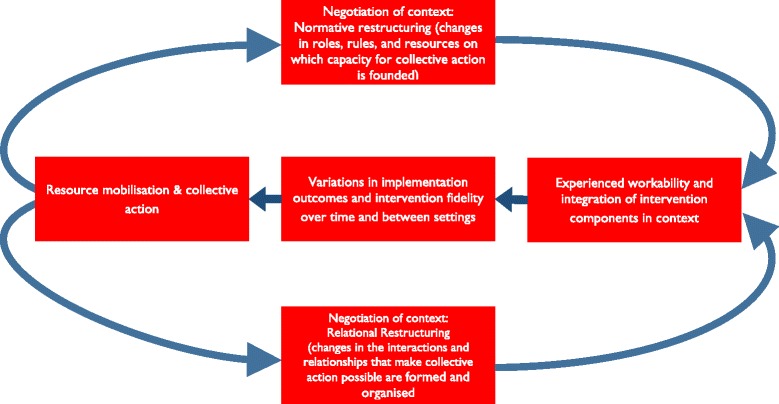
- The paper proposes six propositions: differences in resource mobilisation/actors’ contributions explain variations over time; normative/relational restructuring explains variations between settings; greater intervention plasticity reduces strain on host contexts; greater contextual elasticity reduces strain on actors; tighter coupling reduces discretion and requires more adaptive work for integration; looser coupling increases discretion and requires more adaptive work for workability.
- Illustrative cases include the MOVE trial, which had positive outcomes and was sustained at 2-year follow-up, and the WISE trial, which failed because a plastic intervention was enacted in an inelastic primary care context.
Methods
- Theoretical/conceptual paper, not an empirical study; it develops and extends NPT by engaging with ideas about complex adaptive systems.
- Uses conceptual definitions in Tables 1 and 2, a figure presenting implementation as feedback loops, and six verifiable propositions; draws on prior literature and process evaluation examples such as MOVE, WISE, and CAREDEM.
- No sample, data collection, or statistical analysis is reported.
Limitations
- The paper states that future work will explore methodological implications, including study design, measurement, and evaluation raised by understanding implementation as non-linear, emergent, and dynamic, and will link micro-/meso-level propositions to macro-level “whole systems” models.
- Evident from the text: the propositions are conceptual and are not empirically tested in this paper.
- Evident from the text: the cited trials are illustrative examples from other studies, not new empirical evidence generated here.
Model-written summary. Check it against the paper before relying on it.
Integrity signals
Registry
Cites
Statistics
Figures
Verification
Claims the paper makes
9 Valid · 5 Not valid · 35 Not checked · 66 Own results and interpretations
Some cited sources support this claim and some don’t — read each source’s verdict below.
In the paper
“This led to a successful intervention.”
§ Implementation, context and complexity > Contexts are negotiated
What the sources say
- Not checked yetcites [57] Kennedy A Vassilev I James E Rogers A Implementing a social network intervention designed to enhance and diversify support for people with long-term conditions. a qualitative study Implement Sci 2016 11 1 1 15 26926837 PMC4772323
- Partly supportedcites [84] Blickem C Kennedy A Jariwala P Morris R Bowen R Vassilev I Brooks H Blakeman T Rogers A Aligning everyday life priorities with people’s self-management support networks: an exploration of the work and implementation of a needs-led telephone support system BMC Health Serv Res 2014 14 1 262 10.1186/1472-6963-14-262 24938492 PMC4071856 sourceExperimental — accuracy not yet measured
Our copy does support the 'successful intervention' element: Background > Study aims states 'The BRIGHT trial led to significant improvement in health outcomes' and Results (opening paragraph) concedes 'although the trial resulted in improved patient outcomes'. However, this paper reports those outcome figures only in passing ('These results will be reported in more detail elsewhere') — it is a nested qualitative study of the work of delivering PLANS, not the trial report, and its own findings stress that 'PLANS received a mixed reception', with men particularly resistant and viewing it as an unwanted intrusion in their social life (Discussion). Nothing in our copy makes the causal attribution the citing sentence draws, i.e. that shifting focus to normative/relational restructuring of informal social networks is what produced the success; the paper instead frames normative assumptions as a source of tension ('challenging to normative assumptions about where participants were in life', Results; Conclusions) and describes the emphasis shift as towards personal and community resources rather than as the mechanism of the improved outcomes. (LLM, conf=0.70)
- Disputedcites [85] Reeves D Blickem C Vassilev I Brooks H Kennedy A Richardson G The contribution of social networks to the health and self-management of patients with long-term conditions: a longitudinal study PloS One 2014 9 e98340 10.1371/journal.pone.0098340 24887107 PMC4041782 sourceExperimental — accuracy not yet measured
Our copy of Reeves et al. (2014) is an observational longitudinal study (Methods, Design and Sample Characteristics / Measures of Network Change: baseline face-to-face name-generator interviews plus a 12-month postal follow-up); it designs, delivers and evaluates no intervention, and its Discussion (Summary of Findings) explicitly frames the network-investment benefit as conditional: 'This result clearly needs validation in further studies but if correct, the implication is that considerable health service cost saving could accrue from investing in increasing the illness support people receive from their personal networks.' The paper does re-orientate attention from individual self-management to networks (Introduction; Discussion, Conclusion — 'more meaningfully construed as a collective and networked phenomena'), but it never describes 'normative and relational restructuring' of informal networks, and the same Summary of Findings cautions that network characteristics were largely responding to patient health need ('rally around', positive care law) rather than being deliberately restructured. So the attribution of a resulting 'successful intervention' to this source runs against what our copy states. (LLM, conf=0.68)
Checked by a reasoning model — may be wrong.
- Partly supportedcites [86] Blickem C Kennedy A Vassilev I Morris R Brooks H Jariwala P Linking people with long-term health conditions to healthy community activities: development of patient-Led assessment for network support (PLANS) Health Expect 2013 16 e48 e59 10.1111/hex.12088 23731452 PMC3908360 sourceExperimental — accuracy not yet measured
Our copy does support the developmental shift the claim describes: the paper used normalization process theory to guide development of PLANS, orienting it to patients' existing relationships and network support, and the Discussion speaks of 'shifting the emphasis in health provision away from a focus on individuals towards social engagement, well-being and network support' (Discussion). But the paper is a development-and-pilot study only: its strongest outcome statements are pilot acceptability/usability ('There was general support for the PLANS tool'; 'All participants felt that their results were useful and relevant to them', Methods – Piloting the PLANS tool / Box 2), while the Discussion hedges that 'the approach we have developed here may have limitations' and that PLANS 'could also be expected to perform better if [part] of a complex intervention... rather than when used on its own'. No demonstration that the resulting intervention was 'successful' is attributed here; the only patient-outcome evidence in the paper (reduced isolation, increased confidence) is reported from another work it cites (Woodall & South's CHAT social prescribing evaluation, ref. 19, Resources for self-care support: beyond the individual). (LLM, conf=0.70)
plainstates a cause- Asserted: passes — The authors put it forward as true.
- Checkable: passes — It can be checked against evidence.
- Load-bearing: passes — The paper’s conclusions depend on it.
- Based: passes — The paper gives a reason why it holds.
The sources with a verdict support this claim; the rest weren’t checked yet, have no full text we could read, or their verdicts aren’t rated yet.
In the paper
“Changes in the organisation of clinical work in surgery [15, 16], the delivery of telemedicine systems at scale [17, 18] and the scaling out and spread of new health technologies [19, 20], all provide evidence of the role of environmental mechanisms in shaping interventions.”
§ Implementation, context and complexity > Background
What the sources say
- Supportedcites [15] Kellogg KC Operating room: relational spaces and microinstitutional change in surgery1 Am J Sociol 2009 115 3 657 711 10.1086/603535 20503740 source
The Introduction describes how a new regulation prompted two teaching hospitals to introduce programs intended to change surgical residents’ work practices. It reports that practice changed at one hospital but not the other; the paper attributes that difference to relational spaces and interactions within the hospitals. This supports the surgery-related example of how context shapes change, without attributing the telemedicine or technology-spread examples to this source. Page numbers are unavailable in our copy. (LLM, conf=0.88)
- Not checked yetcites [16] Kellogg KC Breen E Ferzoco SJ Zinner MJ Ashley SW Resistance to change in surgical residency: an ethnographic study of work hours reform J Am Coll Surg 2006 202 4 630 636 10.1016/j.jamcollsurg.2005.11.024 16571434 source
- Supportedcites [17] Sanders C Rogers A Bowen R Bower P Hirani S Cartwright M Fitzpatrick R Knapp M Barlow J Hendy J Exploring barriers to participation and adoption of telehealth and telecare within the whole system demonstrator trial: a qualitative study BMC Health Serv Res 2012 12 1 220 10.1186/1472-6963-12-220 22834978 PMC3413558 source
The Participants and methods section describes the Whole System Demonstrator trial across three sites, with participating Primary Care Trusts and Local Authorities. The Discussion explicitly says that service changes and existing provider relationships highlight the importance of organizational context for adopting telehealth and telecare. This supports the telemedicine-delivery and environmental-context portion of the citing sentence; the surgery and spread examples are separately cited. (LLM, conf=0.87)
- Supportedcites [18] Agbakoba R, McGee-Lennon M, Bouamrane M-M, Watson N, Mair FS: Implementation factors affecting the large-scale deployment of digital health and well-being technologies: a qualitative study of the initial phases of the ‘Living-It-Up’ programme. Health Informatics J 2015:1460458215594651. [Epub ahead of print] PMC5228630 26276795 source
The citation is attached to the scaling and spread of new health technologies, not to the surgery or telemedicine examples. The Introduction describes context and stakeholder collaboration as factors in deployment at scale, while the Results section on cultural shifts in work practices reports that organisational behaviours and ways of working affected the integration of new technologies. These passages support the claim that the implementation environment shapes such interventions. (LLM, conf=0.88)
- Not checked yetcites [19] Burri RV Doing distinctions: boundary work and symbolic capital in radiology Soc Stud Sci 2008 38 1 35 62 10.1177/0306312707082021 source
- Not checked yetcites [20] Cox H, Webster A. Translating biomedical science into clinical practice: molecular diagnostics and the determination of malignancy. Health: 2012;17(4):391-406. 23074299 source
plainstates a cause- Asserted: passes — The authors put it forward as true.
- Checkable: passes — It can be checked against evidence.
- Load-bearing: passes — The paper’s conclusions depend on it.
- Based: passes — The paper gives a reason why it holds.
- Supported
The cited sources support only part of this claim — read each source’s verdict below.
In the paper
“Attempts to understand the dynamics of implementation and to evaluate their effects are either front-loaded into clinical trials in the form of programme theories that specify their expected mode of operation and outcomes or revealed in retrospective ‘process’ evaluations of activity over time and the effects of this activity on outcomes [1, 2].”
§ Implementation, context and complexity > Background
What the sources say
- Not checked yetcites [1] Hawe P Lessons from complex interventions to improve health Annu Rev Public Health 2015 36 307 323 10.1146/annurev-publhealth-031912-114421 25581153 source
- Partly supportedcites [2] Grant A Treweek S Dreischulte T Foy R Guthrie B Process evaluations for cluster-randomised trials of complex interventions: a proposed framework for design and reporting Trials 2013 14 1 15 10.1186/1745-6215-14-15 23311722 PMC3600672 sourceExperimental — accuracy not yet measured
The Theory and Process evaluation purpose sections support using theory to specify expected changes and process evaluations to examine implementation and its relationship to outcomes (page numbers unavailable). But the Background says process evaluations can run parallel to trials or follow them, and Reporting process evaluations treats both pre-specified and post-hoc designs as legitimate. The claim’s characterization of process evaluations as retrospective is therefore too narrow. (LLM, conf=0.88)
plain- Asserted: passes — The authors put it forward as true.
- Checkable: passes — It can be checked against evidence.
- Load-bearing: passes — The paper’s conclusions depend on it.
- Based: passes — The paper gives a reason why it holds.
The sources with a verdict support this claim; the rest weren’t checked yet, have no full text we could read, or their verdicts aren’t rated yet.
In the paper
“Process evaluations by Hooker et al. [66, 67], Kennedy et al. [51, 68], Bamford et al. [69], Clarke et al. [46] Godfrey et al. [70] and Ong et al. [71], all show how complex intervention trials are shaped in this way.”
§ Implementation, context and complexity > Context is a dynamic accomplishment
What the sources say
- Supportedcites [66] Hooker L Small R Humphreys C Hegarty K Taft A Applying normalization process theory to understand implementation of a family violence screening and care model in maternal and child health nursing practice: a mixed method process evaluation of a randomised controlled trial Implement Sci 2015 10 1 39 10.1186/s13012-015-0230-4 25890352 PMC4379540 source
The Methods identify this as a process evaluation of a cluster randomised trial. The Discussion says implementation depended on social, organisational and environmental context, and the Results table identifies specific barriers and enablers. This supports the claim as it applies to Hooker et al. (LLM, conf=0.93)
- Not checked yetcites [67] Hooker L, Small R, Taft A: Understanding sustained domestic violence identification in maternal and child health nurse care: process evaluation from a 2‐year follow‐up of the MOVE trial. J Adv Nurs 2015 26564793 source
- Supportedcites [51] Kennedy A Rogers A Chew-Graham C Blakeman T Bowen R Gardner C Lee V Morris R Protheroe J Implementation of a self-management support approach (WISE) across a health system: a process evaluation explaining what did and did not work for organisations, clinicians and patients Implement Sci 2014 9 1 129 10.1186/s13012-014-0129-5 25331942 PMC4210530 source
The Introduction identifies this as a process evaluation alongside a randomised trial of a complex intervention. The Discussion explains that how WISE was interpreted in its particular primary-care context contributed to its failure to become embedded in everyday practice. This supports the claim as applied to Kennedy et al.; it does not assess the other named studies. (LLM, conf=0.93)
- Supportedcites [68] Kennedy A Rogers A Bowen R Lee V Blakeman T Gardner C Morris R Protheroe J Chew-Graham C Implementing, embedding and integrating self-management support tools for people with long-term conditions in primary care nursing: a qualitative study Int J Nurs Stud 2014 51 8 1103 1113 10.1016/j.ijnurstu.2013.11.008 24373719 source
The Introduction identifies this qualitative study as a process evaluation of a randomised trial. The Discussion explains how practice finances, performance targets, nurses’ autonomy and established routines affected whether the intervention’s tools were used—supporting the claim that contextual dynamics shaped the trial’s implementation. (LLM, conf=0.92)
- Supportedcites [69] Bamford C Poole M Brittain K Chew-Graham C Fox C Iliffe S Manthorpe J Robinson L team C Understanding the challenges to implementing case management for people with dementia in primary care in England: a qualitative study using normalization process theory BMC Health Serv Res 2014 14 1 549 10.1186/s12913-014-0549-6 25409598 PMC4232624 source
The Background describes CAREDEM’s process evaluation as examining the social and organisational factors affecting implementation of a complex dementia case-management intervention. The Discussion (Implications for practice and future research) reports that existing care systems and organisational upheaval in English primary care helped shape what could be implemented in the feasibility study. (LLM, conf=0.90)
plainstates a cause- Asserted: passes — The authors put it forward as true.
- Checkable: passes — It can be checked against evidence.
- Load-bearing: passes — The paper’s conclusions depend on it.
- Based: passes — The paper gives a reason why it holds.
- Supported
The sources with a verdict support this claim; the rest weren’t checked yet, have no full text we could read, or their verdicts aren’t rated yet.
In the paper
“NPT studies (e.g. [18, 48–52]) have focused on contextual and relational integration [21, 23]—the work that actors do to when they realise and execute interventions in organisational and relational settings.”
§ Implementation, context and complexity > The problem of context
What the sources say
- Supportedcites [18] Agbakoba R, McGee-Lennon M, Bouamrane M-M, Watson N, Mair FS: Implementation factors affecting the large-scale deployment of digital health and well-being technologies: a qualitative study of the initial phases of the ‘Living-It-Up’ programme. Health Informatics J 2015:1460458215594651. [Epub ahead of print] PMC5228630 26276795 source
The Data analysis and theoretical framework section (page unavailable) says the study used NPT to analyse social processes in implementing and integrating the Living-It-Up programme. The Results section on roles and collective aims describes stakeholders developing relationships across organisational structures. This supports citing the paper as an example of an NPT study of implementation in organisational and relational settings; the separate citations [21, 23] accompany the specific terminology. (LLM, conf=0.88)
- Supportedcites [48] Atkins S Lewin S Ringsberg K Thorson A Provider experiences of the implementation of a new tuberculosis treatment programme: a qualitative study using the normalisation process model BMC Health Serv Res 2011 11 1 275 10.1186/1472-6963-11-275 22004533 PMC3215962 source
The cited paper is an example of a study using the normalisation process model to examine implementation. Its Methods section describes the model as addressing the work of putting practices into effect, and its Results examine both relational integration and contextual integration in the clinic setting. The separate definition cited to [21, 23] need not be attributed to this paper. (LLM, conf=0.86)
- Supportedcites [49] Bamford C Heaven B May C Moynihan P Implementing nutrition guidelines for older people in residential care homes: a qualitative study using normalization process theory Implement Sci 2012 7 1 106 10.1186/1748-5908-7-106 23110857 PMC3514214 source
The cited paper is itself an NPT study: its Abstract (Methods) says the care-home findings were mapped to NPT constructs. Its Background describes NPT as focusing on the individual and collective work of making an intervention work. The separate citations [21, 23] appear to support the specific phrase “contextual and relational integration,” rather than this paper. (LLM, conf=0.91)
- Supportedcites [50] Drew S Judge A May C Farmer A Cooper C Javaid MK Gooberman-Hill R Implementation of secondary fracture prevention services after hip fracture: a qualitative study using extended Normalization Process Theory Implement Sci 2015 10 1 57 10.1186/s13012-015-0243-z 25903563 PMC4470053 source
The Background identifies this as a study using extended Normalization Process Theory to examine participants’ collective work implementing healthcare services in complex organizational contexts. The Results (Capacity) describe the cooperative work and relationships involved. This supports its citation as an example of an NPT study; the sentence cites other sources for the specific terminology “contextual and relational integration.” (LLM, conf=0.90)
- Supportedcites [51] Kennedy A Rogers A Chew-Graham C Blakeman T Bowen R Gardner C Lee V Morris R Protheroe J Implementation of a self-management support approach (WISE) across a health system: a process evaluation explaining what did and did not work for organisations, clinicians and patients Implement Sci 2014 9 1 129 10.1186/s13012-014-0129-5 25331942 PMC4210530 source
The Methods describe an NPT-based process evaluation across organisational, practice-staff and patient levels. The Introduction’s ‘Process evaluation question’ section defines collective action in terms of the relationships and work needed to put an intervention into practice, matching the claim’s description of this study’s focus. The supplied copy gives no page numbers. (LLM, conf=0.88)
- Supportedcites [52] Franx G Oud M de Lange J Wensing M Grol R Implementing a stepped-care approach in primary care: results of a qualitative study Implement Sci 2012 7 1 8 10.1186/1748-5908-7-8 22293362 PMC3292960 source
The paper is an example of an NPT study: Methods > Analysis says the authors used NPT constructs to interpret the implementation of stepped care, and Discussion examines clinicians’ shared understanding, engagement, and organization of care. The specific terminology “contextual and relational integration” is attached to different citations in the citing sentence, not attributed specifically to this paper. (LLM, conf=0.88)
- Not checked yetcites [21] May C A rational model for assessing and evaluating complex interventions in health care BMC Health Serv Res 2006 6 86 1 11 16827928 PMC1534030
- Not checked yetcites [23] May C Finch T Implementation, embedding, and integration: an outline of normalization process theory Sociology 2009 43 3 535 554 10.1177/0038038509103208 source
plain- Asserted: passes — The authors put it forward as true.
- Checkable: passes — It can be checked against evidence.
- Load-bearing: unclear — It is unclear whether the paper’s conclusions depend on it.
- Based: passes — The paper gives a reason why it holds.
- Supported
47 more claims · 2 with their cited sources checked
Create a free account to see all 115 claims and to verify the 91 references still open.
- Probably not a substantial claim. 47
- It may state two separate claims as one. 23
- The quote only partly states this claim. 2
Claims other papers make about this one
Each is checked against this paper’s own text: does it say what the citing paper says it does?
The source backs part of the claim, not all of it — or backs it for a different population, condition or comparison.
In the citing paper
“NPT is a theory of implementation that focuses on what people—both individuals and groups—do rather than what they believe or intend, and it has been built up from studies of practice in many different healthcare systems.”
From Using Normalization Process Theory in feasibility studies and process evaluations of complex healthcare interventions: a systematic review (2018) · cites this paper as [10]
Experimental — accuracy not yet measuredThe cited source says what the claim attributes to it.
In the citing paper
“Normalization Process Theory (NPT) identifies, characterises and explains key mechanisms that promote and inhibit the implementation, embedding and integration of new health techniques, technologies and other complex interventions.”
From Using Normalization Process Theory in feasibility studies and process evaluations of complex healthcare interventions: a systematic review (2018) · cites this paper as [10]
The cited source says what the claim attributes to it.
In the citing paper
“NPT is a theory of implementation that focuses on what people—both individuals and groups—do rather than what they believe or intend, and it has been built up from studies of practice in many different healthcare systems.”
From Using Normalization Process Theory in feasibility studies and process evaluations of complex healthcare interventions: a systematic review (2018) · cites this paper as [10]
The cited source says what the claim attributes to it.
In the citing paper
“In the most recent iteration of the theory—Extended Normalization Process Theory (ENPT) [9, 10]—we pointed to the dynamic role of implementation contexts in the mobilisation and negotiation of implementation processes.”
From Using Normalization Process Theory in feasibility studies and process evaluations of complex healthcare interventions: a systematic review (2018) · cites this paper as [10]
The cited source says what the claim attributes to it.
In the citing paper
“In its most recent iteration, we have shown how the basic mechanisms characterised in NPT function as self-organising mechanisms in complex adaptive social systems [10].”
From Using Normalization Process Theory in feasibility studies and process evaluations of complex healthcare interventions: a systematic review (2018) · cites this paper as [10]
2 more claims about this paper
Create a free account to see every claim other papers make about this one.
Self-check
Percentages, sums and reported differences re-computed from the paper’s own numbers.
Each contradiction between two passages listed here was confirmed by an independent check.
Rated minor: it would not touch a result — a value no result rests on, a p-value that stays on the same side of the significance level, or a conflict that is clerical, resolved elsewhere in the paper, or outside its own findings.
In the paper
§ Implementation, context and complexity > Context is a dynamic accomplishment
“and Ong et al. [71]”
§ Implementation, context and complexity > References
“71. Sanders T, Foster NE, Ong BN. Perceptions of general practitioners towards the use of a new system for treating back pain: a qualitative interview study.”
Citations
Cites
Damschroder, L. J., Aron, D. C., Keith, R. E., Kirsh, S. R., Alexander, J. A., & Lowery, J. C. (2009) · Implementation Science · doi:10.1186/1748-5908-4-50 · Cited by 14,496 · cited 4×
“[35]—raises questions about how to discriminate between factors that are at work far beyond the investigative remit of the researcher.”
BackgroundInfluentialThe Theory of Social and Economic Organization.
Delatour, G. S., Weber, M., Henderson, A. M., & Parsons, T. (1948) · American Sociological Review · doi:10.2307/2086579 · Cited by 11,300
Powers, C. H., & Giddens, A. (1988) · Social Forces · doi:10.2307/2579442 · Cited by 8,828
Diffusion of Innovations in Service Organizations: Systematic Review and Recommendations
GREENHALGH, T., ROBERT, G., MACFARLANE, F., BATE, P., & KYRIAKIDOU, O. (2004) · The Milbank Quarterly · doi:10.1111/j.0887-378x.2004.00325.x · Cited by 7,448 · cited 1×
“[33], Rycroft-Malone et al.”
Gluesing, J. C. (2012) · Leadership in Science and Technology: A Reference Handbook · doi:10.4135/9781412994231.n14 · Cited by 3,210
The challenge of complexity in health care
Plsek, P. E., & Greenhalgh, T. (2001) · BMJ · doi:10.1136/bmj.323.7313.625 · Cited by 2,578
(2009) · The SAGE Glossary of the Social and Behavioral Sciences · doi:10.4135/9781412972024.n747 · Cited by 2,442
Implementing, Embedding, and Integrating Practices: An Outline of Normalization Process Theory
May, C., & Finch, T. (2009) · Sociology · doi:10.1177/0038038509103208 · Cited by 2,115
Self-citationThe dynamic sustainability framework: addressing the paradox of sustainment amid ongoing change
Chambers, D. A., Glasgow, R. E., & Stange, K. C. (2013) · Implementation Science · doi:10.1186/1748-5908-8-117 · Cited by 1,724 · cited 1×
“Elasticity The extent to which contexts can be stretched or compressed in ways that make space for intervention components and allow them to fit [89].”
BackgroundOntologies, socio-technical transitions (to sustainability), and the multi-level perspective
Geels, F. W. (2010) · Research Policy · doi:10.1016/j.respol.2010.01.022 · Cited by 1,718 · cited 1×
“Even so, it is hard to accommodate the complicated and interdependent relationships between different structural elements of ‘whole systems’, or to track the pathways through which different macro-level actors and processes shape implementation contexts at meso- and micro-level [39–41].”
Background
Research works printed but not linked: 2
- MRC A framework for development and evaluation of complex interventions to improve health 2000 London Medical Research Council
- Harre R Social being 1993 2 Oxford Blackwell Publishers
Cited by
Items 101–200 of 1,000
Critical reflections on methodological challenge in arts and dementia evaluation and research
Gray, K., Evans, S. C., Griffiths, A., & Schneider, J. M. (2017) · Dementia · doi:10.1177/1471301217734478 · Cited by 50
Understanding Implementation of Complex Interventions in Primary Care Teams
Luig, T., Asselin, J. D., Sharma, A. M., & Campbell-Scherer, D. L. (2018) · The Journal of the American Board of Family Medicine · doi:10.3122/jabfm.2018.03.170273 · Cited by 54
“5 Despite the challenges that a flexible approach poses for a trial protocol, 2,4 we found that the impact of the intervention depends vitally on this dynamic design.”
BackgroundDick, S., Whelan, E., Davoren, M. P., Dockray, S., Heavin, C., Linehan, C., & Byrne, M. (2019) · BMC Public Health · doi:10.1186/s12889-019-7583-6 · Cited by 53
Prevention of non-communicable disease: best buys, wasted buys, and contestable buys
Isaranuwatchai, W., Teerawattananon, Y., Archer, R. A., Luz, A., Sharma, M., Rattanavipapong, W., Anothaisintawee, T., Bacon, R. L., Bhatia, T., Bump, J. B., et al. (2020) · BMJ · doi:10.1136/bmj.m141 · Cited by 47
Changing Behavior: A Theory- and Evidence-Based Approach
Hagger, M. S., Cameron, L. D., Hamilton, K., Hankonen, N. E., & Lintunen, T. (2020) · Cambridge University Press eBooks · doi:10.1017/9781108677318.001 · Cited by 63
Rogers, L., Brún, A. D., Birken, S. A., Davies, C., & McAuliffe, É. (2021) · Journal of Health Organization and Management · doi:10.1108/jhom-07-2020-0296 · Cited by 51
“Although some researchers have previously observed context as nuisance variance to be eliminated, context represents the normal conditions of practice that shape a healthcare team’s capacity to implement change (May et al., 2016).”
BackgroundShuman, C. J., Ehrhart, M. G., Torres, E. M., Veliz, P., Kath, L. M., VanAntwerp, K., Banaszak‐Holl, J., Titler, M. G., & Aarons, G. A. (2020) · Worldviews on Evidence-Based Nursing · doi:10.1111/wvn.12402 · Cited by 46
A mixed-methods process evaluation of Family Navigation implementation for autism spectrum disorder
Broder‐Fingert, S., Qin, S., Goupil, J., Rosenberg, J., Augustyn, M. C., Blum, N., Bennett, A. E., Weitzman, C. C., Guevara, J. P., Fenick, A. M., et al. (2018) · Autism · doi:10.1177/1362361318808460 · Cited by 61
“Understanding implementation complexity is critical to developing formal implementation strategies for dissemination (May et al., 2016; Pfadenhauer et al., 2017).”
BackgroundPlanning and Implementation Intention Interventions
Rhodes, R. E., Grant, S. J., & de Bruijn, G. (2020) · Cambridge University Press eBooks · doi:10.1017/9781108677318.039 · Cited by 49
An implementation science primer for psycho-oncology: translating robust evidence into practice
Rankin, N. M., Butow, P. N., Hack, T. F., Shaw, J., Shepherd, H. L., Ugalde, A., & Sales, A. E. (2019) · Journal of Psychosocial Oncology Research and Practice · doi:10.1097/or9.0000000000000014 · Cited by 51
The Building Blocks of Implementation Frameworks and Models in Primary Care: A Narrative Review
Huybrechts, I., Declercq, A., Verté, E., Raeymaeckers, P., & Anthierens, S. (2021) · Frontiers in Public Health · doi:10.3389/fpubh.2021.675171 · Cited by 53
“” It is thus key to carefully define specific interventions that aim to transform current practices, while at the same time tailoring them to local circumstances (9, 10).”
BackgroundJohnson, M. J., Leaf, A., Pearson, F., Clark, H. W., Dimitrov, B. D., Pope, C. J., & May, C. R. (2017) · BMJ Open · doi:10.1136/bmjopen-2017-017727 · Cited by 49
Self-citationShuman, C. J., Powers, K., Banaszak‐Holl, J., & Titler, M. G. (2018) · Journal of Nursing Scholarship · doi:10.1111/jnu.12452 · Cited by 52
Howell, D., Richardson, A. M., May, C. R., Calman, L. A., Fazelzad, R., Moradian, S., & Foster, C. L. (2019) · Systematic Reviews · doi:10.1186/s13643-019-0952-5 · Cited by 47
“DH and LC will do independent screening of all titles and abstracts; AR, CF and DH will be responsible for the review of the final paper for eligibility; A research coordinator and SM will be responsible for the abstract data into tables; CM will guide the NPT framework analysis.”
InfluentialSelf-citationAugustsson, H., Churruca, K., & Braithwaite, J. (2020) · BMC Health Services Research · doi:10.1186/s12913-020-05929-5 · Cited by 47
Allan, S., Bradstreet, S., Mcleod, H., Farhall, J., Lambrou, M., Gleeson, J., Clark, A., EMPOWER Group, & Gumley, A. (2019) · Journal of Medical Internet Research · doi:10.2196/14366 · Cited by 44
Balushi, H. A., Watts, H., & Akudjedu, T. N. (2024) · Radiography · doi:10.1016/j.radi.2024.01.012 · Cited by 48
Studying robots outside the lab: HRI as ethnography
Blond, L. (2019) · Paladyn Journal of Behavioral Robotics · doi:10.1515/pjbr-2019-0007 · Cited by 52
Russell, G. M., Kunin, M., Harris, M., Lévesque, J., Descôteaux, S., Scott, C. M., Lewis, V. J., Dionne, É., Advocat, J. R., Dahrouge, S., et al. (2019) · BMJ Open · doi:10.1136/bmjopen-2018-027869 · Cited by 46
Currie, K., Laidlaw, R., Ness, V., Gozdzielewska, L., Malcom, W., Sneddon, J., Seaton, R. A., & Flowers, P. (2020) · Antimicrobial Resistance and Infection Control · doi:10.1186/s13756-020-00767-w · Cited by 45
Attitudes and Persuasive Communication Interventions
Hamilton, K., & Johnson, B. T. (2020) · Cambridge University Press eBooks · doi:10.1017/9781108677318.031 · Cited by 61
Changing Behavior Using Integrated Theories
Hagger, M. S., & Hamilton, K. (2020) · Cambridge University Press eBooks · doi:10.1017/9781108677318.015 · Cited by 51
Key factors for implementing mindfulness-based burnout interventions in surgery
Lebares, C. C., Guvva, E. V., Desai, A., Herschberger, A., Ascher, N. L., Harris, H. W., & O’Sullivan, P. (2020) · The American Journal of Surgery · doi:10.1016/j.amjsurg.2019.10.025 · Cited by 43
Puthoopparambil, S. J., Phelan, M., & MacFarlane, A. E. (2021) · Health Policy · doi:10.1016/j.healthpol.2021.05.018 · Cited by 45
“First, as with other complex interventions, context matters [26] and it matters that context is fluid and adaptable [27] .”
Patel, B., Usherwood, T., Harris, M., Patel, A., Panaretto, K., Zwar, N., & Peiris, D. (2018) · Implementation Science · doi:10.1186/s13012-018-0830-x · Cited by 42
Scalia, P., Elwyn, G. J., & Durand, M. (2017) · BMC Medical Informatics and Decision Making · doi:10.1186/s12911-017-0517-2 · Cited by 43
“More work is needed to understand how social context and the relationships between actors within the social system affects ‘real world’ implementation [33].”
BackgroundHealth by Design: Interweaving Health Promotion into Environments and Settings
Springer, A. E., Evans, A. E., Ortuño, J., Salvo, D., & Arévalo, M. T. V. (2017) · Frontiers in Public Health · doi:10.3389/fpubh.2017.00268 · Cited by 44
“org September 2017 | Volume 5 | Article 268 complexity of context and emphasizes a process of co-learning with people from a given context to identify environmental modifications and make adaptations to these approaches over time (28, 29).”
BackgroundInfluentialBardwell, G., Strıke, C., Mitra, S., Scheim, A. I., Barnaby, L., Altenberg, J., & Kerr, T. H. (2019) · Health & Place · doi:10.1016/j.healthplace.2019.102245 · Cited by 48
Davies, C., Fattori, F., O’Donnell, D., Donnelly, S., Shé, É. N., Shea, M. O., Prihodová, L., Gleeson, C., Flynn, Á., Rock, B., et al. (2019) · BMC Health Services Research · doi:10.1186/s12913-019-4802-x · Cited by 48
Gumley, A. I., Bradstreet, S., Ainsworth, J. D., Allan, S., Álvarez‐Jiménez, M., Birchwood, M. J., Briggs, A. H., Bucci, S., Cotton, S., Engel, L., et al. (2022) · Health Technology Assessment · doi:10.3310/hlze0479 · Cited by 44
Yadav, U. N., Lloyd, J. E., Baral, K. P., Bhatta, N., Mehata, S., & Harris, M. (2021) · BMJ Open · doi:10.1136/bmjopen-2020-045175 · Cited by 43
Gask, L., Coupe, N., & Green, G. (2019) · BMC Health Services Research · doi:10.1186/s12913-019-4398-1 · Cited by 42
Klasnja, P., Meza, R. D., Pullmann, M. D., Mettert, K. D., Hawkes, R. J., Palazzo, L. G., Weiner, B. J., & Lewis, C. C. (2024) · Implementation Research and Practice · doi:10.1177/26334895241248851 · Cited by 42
“Function goal: There is considerable variation in whether an implementation strategy brings about improvements in outcomes, and this variation is often attributed to differences in the context in which implementation occurs (May et al., 2016; Squires et al., 2015).”
Maniatopoulos, G., Hunter, D. J., Erskine, J., & Hudson, B. (2020) · Journal of Health Organization and Management · doi:10.1108/jhom-05-2019-0144 · Cited by 44
Enablers and challenges to occupational therapists’ research engagement: A qualitative study
Bona, L. D., Wenborn, J., Field, B., Hynes, S. M., Ledgerd, R., Mountain, G. A., & Swinson, T. (2017) · British Journal of Occupational Therapy · doi:10.1177/0308022617719218 · Cited by 43
“This is consistent with understandings from implementation science that individual and organisational contexts are hugely influential, to the extent that what one person considers a challenge, another may consider an enabler (Damschroder et al., 2009; May et al., 2016).”
Sersli, S., DeVries, D. N., Gislason, M., Scott, N. A., & Winters, M. (2018) · Transportation Research Part A Policy and Practice · doi:10.1016/j.tra.2018.07.012 · Cited by 43
Leadership in Early Education in Times of Change
Hamburg, L. I. E. E. I. T. O. C. 2., Strehmel, P., Heıkka, J., Hujala, E., Rodd, J., Waniganayake, M., & Budrich, V. B. (2019) · Verlag Barbara Budrich eBooks · doi:10.3224/84742199 · Cited by 43
Xia, H., An, W., Li, J., & Zhang, Z. (2020) · Socio-Economic Planning Sciences · doi:10.1016/j.seps.2020.100941 · Cited by 43
A Case Study of a Whole System Approach to Improvement in an Acute Hospital Setting
Ward, M. E., Daly, A., McNamara, M. S., Garvey, S., & Teeling, S. P. (2022) · International Journal of Environmental Research and Public Health · doi:10.3390/ijerph19031246 · Cited by 42
Implementing a digital patient feedback system: an analysis using normalisation process theory
Ong, B. N., Hodgson, D. E., Small, N., Nahar, P., & Sanders, C. (2020) · BMC Health Services Research · doi:10.1186/s12913-020-05234-1 · Cited by 41
“In a recent paper May and colleagues [43] put forward a theoretical expansion of NPT by considering it in relation to understanding context as a process.”
BackgroundTarrant, M., Haslam, C., Carter, M., Calitri, R., & Haslam, S. A. (2020) · Cambridge University Press eBooks · doi:10.1017/9781108677318.044 · Cited by 43
Preparing Nursing Contexts for Evidence‐Based Practice Implementation: Where Should We Go From Here?
Cassidy, C. E., Flynn, R., & Shuman, C. J. (2021) · Worldviews on Evidence-Based Nursing · doi:10.1111/wvn.12487 · Cited by 40
Ristkari, T., Kurki, M., Suominen, A., Gilbert, S., Sinokki, A., Kinnunen, M., Huttunen, J., McGrath, P., & Sourander, A. (2019) · Journal of Medical Internet Research · doi:10.2196/11446 · Cited by 35
“Dissemination refers to how knowledge of the new practices is extended actively and passively, whereas implementation refers to the action of accommodating new practices into real treatment environments [17].”
Goodridge, D. M., Rana, M., Harrison, E., Rotter, T., Dobson, R., Groot, G., Udod, S. A., & Lloyd, J. (2018) · BMC Health Services Research · doi:10.1186/s12913-018-3045-6 · Cited by 40
Livet, M., Blanchard, C., Frail, C., Sorensen, T. D., & McClurg, M. R. (2019) · JACCP JOURNAL OF THE AMERICAN COLLEGE OF CLINICAL PHARMACY · doi:10.1002/jac5.1155 · Cited by 38
“Recommendation 4: To be meaningful, data will need to be interpreted within the unique health care environment from which it is collected.(40,42,43) Meaningful interpretation of fidelity data always requires some level of contextualization.”
BackgroundGoldthorpe, J., Epton, T., Keyworth, C., Calam, R. M., & Armitage, C. J. (2020) · Obesity Reviews · doi:10.1111/obr.13001 · Cited by 39
“environment) is crucial when making decisions about the best way to improve reach, implementation, and adoption of complex, multicomponent interventions.(11)”
BackgroundMcInnes, E., Dale, S., Craig, L., Phillips, R., Fasugba, O., Schadewaldt, V., Cheung, N. W., Cadilhac, D. A.-M., Grimshaw, J., Levi, C. R., et al. (2020) · Implementation Science · doi:10.1186/s13012-020-01057-0 · Cited by 39
“The NPT concepts of coherence (does the new practice make sense?), cognitive participation (how engaged are individuals with practice change), collection action (how were the new practices integrated and use facilitated) and reflexive monitoring (value of and impact of the new practices on the team) focus on individua…”
BackgroundMethodInfluentialGuerin, R. J., Harden, S. M., Rabin, B. A., Rohlman, D. S., Cunningham, T. R., TePoel, M. R. W., Parish, M., & Glasgow, R. E. (2021) · International Journal of Environmental Research and Public Health · doi:10.3390/ijerph182111050 · Cited by 41
“D&I processes should be considered as a set of complex, non-linear, and iterative accomplishments that are emergent and dynamic [87].”
BackgroundInfluentialPrecision medicine in Australia: now is the time to get it right
O’Shea, R., Ma, A. S., Jamieson, R. V., & Rankin, N. M. (2022) · The Medical Journal of Australia · doi:10.5694/mja2.51777 · Cited by 39
Improving implementation of health promotion interventions for maternal and newborn health
Smith, H. J. J., Portela, A. G., & Marston, C. (2017) · BMC Pregnancy and Childbirth · doi:10.1186/s12884-017-1450-1 · Cited by 37
“Such reporting should also contain information on the changing relationships between different actors, processes and structural factors [22].”
BackgroundImplementing pharmaceutical track-and-trace systems: a realist review
Kootstra, J., & Kleinhout‐Vliek, T. (2021) · BMJ Global Health · doi:10.1136/bmjgh-2020-003755 · Cited by 40
“19 Thus, contextual factors significantly impact the implementation of PTTSs, but few papers address their interaction during implementation.”
Ramanuj, P., Talley, R. M., Breslau, J. A., Wang, S. S., & Pincus, H. A. (2018) · Community Mental Health Journal · doi:10.1007/s10597-018-0251-y · Cited by 37
“The importance of context has gained prominence in implementation science but is poorly defined (Edwards and Barker 2014; May et al. 2016).”
BackgroundLewis, N. V., Dowrick, A., Sohal, A. H., Feder, G. S., & Griffiths, C. (2019) · Health & Social Care in the Community · doi:10.1111/hsc.12733 · Cited by 39
Changing Behavior Using the Transtheoretical Model
DiClemente, C. C., & Graydon, M. M. (2020) · Cambridge University Press eBooks · doi:10.1017/9781108677318.010 · Cited by 38
McCreight, M. S., Gilmartin, H., Leonard, C., Mayberry, A., Kelley, L. R., Lippmann, B., Coy, A. S., Radcliff, T. A., Côté, M. J., & Burke, R. E. (2019) · Journal of General Internal Medicine · doi:10.1007/s11606-019-04968-x · Cited by 35
Changing Behavior Using the Health Belief Model and Protection Motivation Theory
Orbell, S., Zahid, H., & Henderson, C. J. (2020) · Cambridge University Press eBooks · doi:10.1017/9781108677318.004 · Cited by 40
Riordan, F., McHugh, S., O’Donovan, C., Mtshede, M. N., & Kearney, P. M. (2020) · Journal of General Internal Medicine · doi:10.1007/s11606-020-05676-7 · Cited by 37
Langley, J., Wassall, R. R., Geddis‐Regan, A., Watson, S., Verey, A., McKenna, G. J., Brocklehurst, P. R., & Tsakos, G. (2022) · Gerodontology · doi:10.1111/ger.12629 · Cited by 35
Exploring the intersection of hermeneutics and implementation: a scoping review
MacLeod, M., McCaffrey, G., Wilson, E., Zimmer, L. V., Snadden, D., Zimmer, P., Jónatansdóttir, S., Fyfe, T., Koopmans, E., Ulrich, C., et al. (2023) · Systematic Reviews · doi:10.1186/s13643-023-02176-7 · Cited by 37
“Linearity is frequently at odds with the knowledge to be gained, the way people learn, and the complexity of implementing change within organizations [19, 20].”
BackgroundGrigorovich, A., Kulandaivelu, Y., Newman, K., Bianchi, A., Khan, S. S., Iaboni, A., & McMurray, J. (2021) · Journal of Medical Internet Research · doi:10.2196/22831 · Cited by 33
“The selected studies were not overtly informed by implementation science theory [28].”
Fulop, N., Ramsay, A. I. G., Hunter, R. M., McKevitt, C., Perry, C., Turner, S., Boaden, R., Papachristou, I., Rudd, A. G., Tyrrell, P. J., et al. (2019) · Health Services and Delivery Research · doi:10.3310/hsdr07070 · Cited by 38
Dissemination of CATCH My Breath, a middle school E-Cigarette prevention program
Kelder, S. H., Mantey, D. S., Dusen, D. V., Vaughn, T., Bianco, M., & Springer, A. E. (2020) · Addictive Behaviors · doi:10.1016/j.addbeh.2020.106698 · Cited by 34
Optimizing Making Every Contact Count (MECC) interventions: A strategic behavioral analysis.
Haighton, C., Newbury‐Birch, D., Durlik, C., Sallis, A., Chadborn, T., Porter, L., Harling, M., & Rodrigues, A. (2021) · Health Psychology · doi:10.1037/hea0001100 · Cited by 34
Silva, B. B., & Fegadolli, C. (2020) · BMC Health Services Research · doi:10.1186/s12913-020-4898-z · Cited by 42
“The interfaces observed in this study reaffirm that health service implementation is a result of multidimensional interactions between the individuals in the context in which they are inserted [50].”
BackgroundHarkko, J., Sipilä, N., Nordquist, H., Lallukka, T. M., Appelqvist‐Schmidlechner, K., Donnelly, M., & Kouvonen, A. M. (2023) · Implementation Science · doi:10.1186/s13012-023-01316-w · Cited by 35
“Informed by the socio-ecological [7, 35, 36] and complex adaptive [37] systems approaches these ‘resource systems’ were perceived as multi-layered, self-organizing, interacting with each other, with outcomes that are contingent and intrinsically uncertain.”
BackgroundO'Donnell, A. J., & Kaner, E. (2017) · International Journal of Environmental Research and Public Health · doi:10.3390/ijerph14040350 · Cited by 36
Burrows, K. E., Abelson, J., Miller, P. A., Levine, M., & Vanstone, M. G. (2020) · BMC Health Services Research · doi:10.1186/s12913-020-05087-8 · Cited by 32
“This study design and methodology was based on the rationale that the study of health professional role integration is complex, context dependent, and involves social processes [17].”
MethodChanging Behavior by Changing Environments
Marteau, T. M., Fletcher, P. C., Hollands, G. J., & Munafo, M. R. (2020) · Cambridge University Press eBooks · doi:10.1017/9781108677318.014 · Cited by 35
Team-based primary health care for non-communicable diseases: complexities in South India
Lall, D., Engel, N., Devadasan, N., Horstman, K., & Criel, B. (2020) · Health Policy and Planning · doi:10.1093/heapol/czaa121 · Cited by 35
Analysing healthcare coordination using translational mobilization
Allen, D. A. (2018) · Journal of Health Organization and Management · doi:10.1108/jhom-05-2017-0116 · Cited by 37
“The importance of understanding context for research and quality improvement purposes is well established (The Health Foundation, 2014; May et al., 2016).”
BackgroundMethodInfluentialAdapting Translational Research Methods to Water, Sanitation, and Hygiene
Setty, K., Cronk, R., George, S., Anderson, D. M., O’Flaherty, G., & Bartram, J. (2019) · International Journal of Environmental Research and Public Health · doi:10.3390/ijerph16204049 · Cited by 35
Lane, C., Wolfenden, L., Hall, A. E., Sutherland, R., Naylor, P., Oldmeadow, C. J., Leigh, L., Shoesmith, A., Bauman, A. E., McCarthy, N., et al. (2022) · International Journal of Behavioral Nutrition and Physical Activity · doi:10.1186/s12966-022-01345-6 · Cited by 32
“Panel discourse was informed by: reviews of similar studies with comparable outcomes [40, 49–51]; quantified attenuation in effect sizes associated with physical activity interventions adapted for scale-up [20]; evidence of the inverse dose-response relationship between physical activity and health outcomes [52], supp…”
ResultEvaluation of Get Healthy at Work, a state-wide workplace health promotion program in Australia
Crane, M. A., Bohn-Goldbaum, E. E., Lloyd, B., Rissel, C. E., Bauman, A. E., Indig, D., Khanal, S., & Grunseit, A. C. (2019) · BMC Public Health · doi:10.1186/s12889-019-6493-y · Cited by 33
Changing Behavior Using the Reflective-Impulsive Model
Deutsch, R., & Strack, F. (2020) · Cambridge University Press eBooks · doi:10.1017/9781108677318.012 · Cited by 37
Negotiating space for knowledge co-production
Verwoerd, L., Brouwers, H., Kunseler, E., Regeer, B. J., & de Hoop, E. (2022) · Science and Public Policy · doi:10.1093/scipol/scac045 · Cited by 32
Changing Behavior Using the Common-Sense Model of Self-Regulation
Cameron, L. D., Fleszar‐Pavlović, S. E., & Khachikian, T. (2020) · Cambridge University Press eBooks · doi:10.1017/9781108677318.005 · Cited by 32
Shin, H. D., Durocher, K., Sequeira, L., Zaheer, J., Torous, J. B., & Strudwick, G. (2023) · BMC Health Services Research · doi:10.1186/s12913-023-09254-5 · Cited by 32
Siegle, A., Villalobos, M., Bossert, J., Krug, K., Hagelskamp, L., Krisam, J., Handtke, V., Deis, N., Jünger, J., Wensing, M., et al. (2018) · Trials · doi:10.1186/s13063-018-2814-1 · Cited by 34
“A hospital context is not a fixed organizational structure but an unstable, unfolding process [36].”
BackgroundJones, S. E., Hamilton, S., Bell, R., Araújo‐Soares, V., Glinianaia, S. V., Milne, E. M. G., White, M. J., Willmore, M., & Shucksmith, J. (2019) · BMC Health Services Research · doi:10.1186/s12913-019-4122-1 · Cited by 28
Developing Behavior Change Interventions
Hankonen, N. E., & Hardeman, W. (2020) · Cambridge University Press eBooks · doi:10.1017/9781108677318.021 · Cited by 38
Cioffi, C. C., Hibbard, P. F., Hagaman, A. M., Tillson, M. D., & Vest, N. A. (2023) · Implementation Research and Practice · doi:10.1177/26334895231180635 · Cited by 31
“Given the array of available interventions and complexity of intervention-context fi t, community partners and practitioners may experience barriers to intervention selection and implementation (May et al., 2016).”
BackgroundManaging expectations: cognitive authority and experienced control in complex healthcare processes
Hunt, K. J., & May, C. R. (2017) · BMC Health Services Research · doi:10.1186/s12913-017-2366-1 · Cited by 33
“The theory responds to an important problem in the behavioural sciences: how can we best understand the dynamics of human agency under conditions of constraint [30]? This is the fundamental problem of structure and agency that runs through contemporary sociology.”
BackgroundSelf-citationDeveloping an intervention around referral and admissions to intensive care: a mixed-methods study
Bassford, C., Griffiths, F., Svantesson, M., Ryan, M., Krucien, N., Dale, J., Rees, S., Rees, K., Ignatowicz, A., Parsons, H., et al. (2019) · Health Services and Delivery Research · doi:10.3310/hsdr07390 · Cited by 27
Conte, K. P., Grøn, S., Loblay, V., Green, A. S., Milat, A., Persson, L., Innes‐Hughes, C., Mitchell, J., Thackway, S. V., Williams, M., et al. (2017) · Implementation Science · doi:10.1186/s13012-017-0686-5 · Cited by 28
“[57] How a new organisational practice, classification, technique or artefact becomes routine.”
BackgroundHolm, A., Karlsson, V., & Dreyer, P. (2021) · International Journal of Qualitative Studies on Health and Well-Being · doi:10.1080/17482631.2021.1971598 · Cited by 27
“Implementation challenges may be countered by adoption of a specific implementation plan or strategy (Hallberg & Richards, 2015; May et al., 2016; Peters et al., 2013).”
Stylianides, K. C., Bejerholm, U., Denvall, V., Knutagård, M., & Johanson, S. (2022) · Social Policy and Administration · doi:10.1111/spol.12808 · Cited by 28
Bradley, C., Irie, W. C., & Geng, E. (2024) · Frontiers in Public Health · doi:10.3389/fpubh.2023.1286156 · Cited by 29
“Context can sometimes be treated as a problem in the social sciences and, more specifically, implementation science (28).”
BackgroundCummings, A. J., Lund, S., Campling, N. C., May, C. R., Richardson, A. M., & Myall, M. (2017) · BMJ Open · doi:10.1136/bmjopen-2017-017056 · Cited by 27
Self-citationTinc, P. J., Gadomski, A., Sorensen, J. A., Weinehall, L., Jenkins, P., & Lindvall, K. (2018) · Safety Science · doi:10.1016/j.ssci.2018.04.008 · Cited by 28
Design, Implementation, and Evaluation of Behavior Change Interventions: A Ten-Task Guide
Abraham, C., & Denford, S. (2020) · Cambridge University Press eBooks · doi:10.1017/9781108677318.019 · Cited by 36
Markey, K., MacFarlane, A. E., & Manning, M. (2023) · Journal of Advanced Nursing · doi:10.1111/jan.15821 · Cited by 26
Impact of the Macmillan specialist Care at Home service: a mixed methods evaluation across six sites
Johnston, B. M., Patterson, A., Bird, L., Wilson, E., Almack, K., Mathews, G., & Seymour, J. E. (2018) · BMC Palliative Care · doi:10.1186/s12904-018-0281-9 · Cited by 29
“[74] discuss the need to understand complex interventions as non-linear, emergent and dynamic processes and the consequent implications for evaluation management and selection of feedback methods.”
BackgroundPloeg, J., Wong, S. T., Hassani, K., Yous, M., Fortin, M., Kendall, C., Liddy, C. E., Markle‐Reid, M., Petrovic, B., Dionne, É., et al. (2019) · Primary Health Care Research & Development · doi:10.1017/s1463423619000483 · Cited by 26
McKnight, J., Maina, M., Zosi, M., Kimemia, G. W., Onyango, T., Schultsz, C., English, M., & Tosas-Auguet, O. (2019) · Global Health Action · doi:10.1080/16549716.2020.1761657 · Cited by 27
Dyadic Behavior Change Interventions
Scholz, U., Berli, C., Lüscher, J., & Knoll, N. (2020) · Cambridge University Press eBooks · doi:10.1017/9781108677318.043 · Cited by 29
Mangione-Smith, R. M., Roth, C. P., Britto, M. T., Chen, A. Y., McGalliard, J., Boat, T. F., Adams, J., & McGlynn, E. A. (2017) · Hospital Pediatrics · doi:10.1542/hpeds.2016-0182 · Cited by 26
Jacob, N., Moriarty, Y., Lloyd, A., Mann, M. K., Tume, L. N., Sefton, G., Powell, C., Roland, D., Trubey, R., Hood, K., et al. (2019) · BMJ Open · doi:10.1136/bmjopen-2018-028796 · Cited by 31
Rothman, A. J., Klein, W. M. P., & Sheeran, P. (2020) · Cambridge University Press eBooks · doi:10.1017/9781108677318.020 · Cited by 30
Defining paediatric neurorehabilitation: You cannot improve what you cannot characterize
Forsyth, R. J., & Whyte, J. (2024) · Developmental Medicine & Child Neurology · doi:10.1111/dmcn.15919 · Cited by 26
Ominyi, J., & Alabi, A. (2025) · Hospitals · doi:10.3390/hospitals2010004 · Cited by 27
“This aligns with the findings of May et al. [9], who advocate for piloting interventions to generate initial evidence of success.”
Metadata
- Authors
- May, C. R., Johnson, M., & Finch, T.
- Affiliations
- University Hospital Southampton NHS Foundation Trust (GB)
- Newcastle University (GB)
- Corresponding author
- May, Carl R.
- Venue
- Implementation Science
- Published
- 2016-10-19
- Volume
- 11
- Issue
- 1
- Pages
- 141-141
- ISSN
- 1748-5908 (ISSN-L)
- PMC
- PMC5069794
- OpenAlex
- W2535269105
- Semantic Scholar
- 6473263e7f0252fc52c284ce2b6f5c6d170975f8
- Cited by
- 978
- References
- 101
- Citations by year
- 2026: 85 · 2025: 96 · 2024: 112 · 2023: 108 · 2022: 133 · 2021: 125 · 2020: 150 · 2019: 71 · 2018: 61 · 2017: 34
- FWCI
- 103.70
- Type
- journal article
- Language
- en
- Open access
- gold
- doi.org
- Licence
- Locations
- Implementation Science (publishedVersion, cc-by)
- PubMed Central (publishedVersion, cc-by)
- PubMed (publishedVersion)
- ePrints Soton (University of Southampton) (acceptedVersion)
- Northumbria Research Link (Northumbria University) (acceptedVersion)
- LSHTM Research Online (London School of Hygiene and Tropical Medicine) (acceptedVersion)
- Newcastle University ePrints (Newcastle Univesity) (cc-by)
- Funders
- Economic and Social Research Council (ES-062-23-3274)
- Topics
- Health Sciences › Health Professions › General Health Professions › Health Policy Implementation Science
- Social Sciences › Public Administration › Evaluation and Performance Assessment
- Health Sciences › Medicine › Public Health, Environmental and Occupational Health › Clinical practice guidelines implementation
- Keywords
- Normalisation Process Theory, health behavior change, knowledge translation, practice implementation, scaling up interventions, diffusion of innovations, ecological model, complex adaptive systems, self-organization, resource mobilization, collective action, adaptive mechanisms, feedback loops, health improvement
- MeSH terms
- Delivery of Health Care, Humans, Translational Research, Biomedical
About these checks
Registry, retraction, Cites and statistics results are computed, not judged, with one exception: a printed reference that no index lists is read once by a model before it counts as a citation error. Claims are extracted by a model and kept only when their quote appears verbatim in the text; each cited source is then checked, with a model’s help, for whether it says what the claim relies on. Those verdicts can be wrong — read the claim’s quote and the cited source before relying on one.
The claim verdicts this report counts are experimental: their accuracy is not yet measured.
A language model drew the claims from the paper on 2026-10-07, under version 3 of the claim definition (model deepseek-v4.1-flash, prompt extract-v3).
A second model labelled each claim on 2026-10-07 (model jev-1.13-20260917, definition revision gold-guideline-v0.2).
Cited sources are checked with a language model’s help (qwen3.8-omni-flash and gpt-6-sol).
Statistics and arithmetic are recomputed, not judged.
Confidence bands are shown only for fields calibrated on our annotated test set. None is calibrated yet, so no band is shown.
What counts as a claim ›How we measure confidence ›How we check this ›
Are you an author, or do you see a problem with this page? Request a review
Data sources
Bibliographic data: Semantic Scholar, OpenAlex, Crossref.
Contains information from the Semantic Scholar Academic Graph Datasets, made available under the ODC Attribution License (ODC-BY 1.0).
Semantic Scholar’s data is described in: Kinney, R., et al. (2023). The Semantic Scholar Open Data Platform. arXiv:2301.10140.
