

Implementation, context and complexity
Open accessThe DOI matches its Crossref record; 101 of the 101 references it cites were found in a registry or an index; 30 of the 121 sources its claims cite were checked for support.
Abstract
BACKGROUND: Context is a problem in research on health behaviour change, knowledge translation, practice implementation and health improvement. This is because many intervention and evaluation designs seek to eliminate contextual confounders, when these represent the normal conditions into which interventions must be integrated if they are to be workable in practice. DISCUSSION: We present an ecological model of the ways that participants in implementation and health improvement processes interact with contexts. The paper addresses the problem of context as it affects processes of implementation, scaling up and diffusion of interventions. We extend our earlier work to develop Normalisation Process Theory and show how these processes involve interactions between mechanisms of resource mobilisation, collective action and negotiations with context. These mechanisms are adaptive. They contribute to self-organisation in complex adaptive systems. CONCLUSION: Implementation includes the translational efforts that take healthcare interventions beyond the closed systems of evaluation studies into the open systems of 'real world' contexts. The outcome of these processes depends on interactions and negotiations between their participants and contexts. In these negotiations, the plasticity of intervention components, the degree of participants' discretion over resource mobilisation and actors' contributions, and the elasticity of contexts, all play important parts. Understanding these processes in terms of feedback loops, adaptive mechanisms and the practical compromises that stem from them enables us to see the mechanisms specified by NPT as core elements of self-organisation in complex systems.
Overview
CoChat Summary
TL;DR
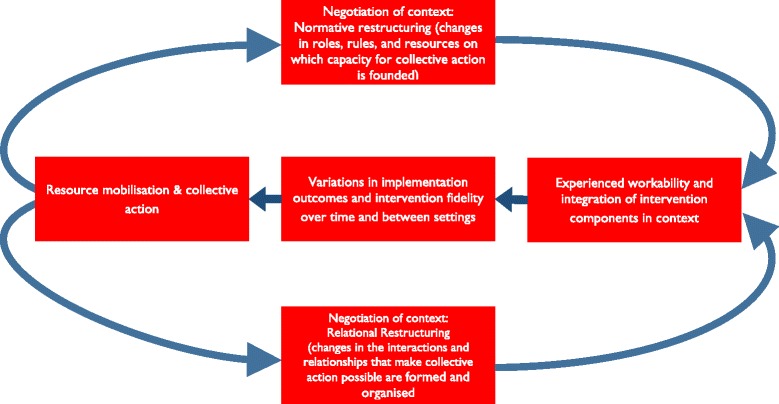
This conceptual paper extends Normalisation Process Theory (NPT) to treat implementation contexts as complex adaptive social systems, where outcomes emerge from negotiations among participants, intervention components, and contexts. It argues that intervention plasticity, contextual elasticity, coupling, and normative/relational restructuring shape implementation, scaling up/out, and fidelity.
Key findings
- Implementation contexts are dynamic, emergent, and negotiated rather than fixed backdrops; the paper defines context as “complex adaptive systems that form the dynamic environment(s) in which implementation processes are situated.”
- Outcomes depend on the plasticity of intervention components, participants’ discretion over resource mobilisation and actors’ contributions, the elasticity of contexts, and the extent of normative and relational restructuring.
- The paper proposes six propositions: differences in resource mobilisation/actors’ contributions explain variations over time; normative/relational restructuring explains variations between settings; greater intervention plasticity reduces strain on host contexts; greater contextual elasticity reduces strain on actors; tighter coupling reduces discretion and requires more adaptive work for integration; looser coupling increases discretion and requires more adaptive work for workability.
- Illustrative cases include the MOVE trial, which had positive outcomes and was sustained at 2-year follow-up, and the WISE trial, which failed because a plastic intervention was enacted in an inelastic primary care context.
Methods
- Theoretical/conceptual paper, not an empirical study; it develops and extends NPT by engaging with ideas about complex adaptive systems.
- Uses conceptual definitions in Tables 1 and 2, a figure presenting implementation as feedback loops, and six verifiable propositions; draws on prior literature and process evaluation examples such as MOVE, WISE, and CAREDEM.
- No sample, data collection, or statistical analysis is reported.
Limitations
- The paper states that future work will explore methodological implications, including study design, measurement, and evaluation raised by understanding implementation as non-linear, emergent, and dynamic, and will link micro-/meso-level propositions to macro-level “whole systems” models.
- Evident from the text: the propositions are conceptual and are not empirically tested in this paper.
- Evident from the text: the cited trials are illustrative examples from other studies, not new empirical evidence generated here.
Model-written summary. Check it against the paper before relying on it.
Integrity signals
Registry
Cites
Statistics
Figures
Verification
Claims the paper makes
9 Valid · 5 Not valid · 35 Not checked · 66 Own results and interpretations
Some cited sources support this claim and some don’t — read each source’s verdict below.
In the paper
“This led to a successful intervention.”
§ Implementation, context and complexity > Contexts are negotiated
What the sources say
- Not checked yetcites [57] Kennedy A Vassilev I James E Rogers A Implementing a social network intervention designed to enhance and diversify support for people with long-term conditions. a qualitative study Implement Sci 2016 11 1 1 15 26926837 PMC4772323
- Partly supportedcites [84] Blickem C Kennedy A Jariwala P Morris R Bowen R Vassilev I Brooks H Blakeman T Rogers A Aligning everyday life priorities with people’s self-management support networks: an exploration of the work and implementation of a needs-led telephone support system BMC Health Serv Res 2014 14 1 262 10.1186/1472-6963-14-262 24938492 PMC4071856 sourceExperimental — accuracy not yet measured
Our copy does support the 'successful intervention' element: Background > Study aims states 'The BRIGHT trial led to significant improvement in health outcomes' and Results (opening paragraph) concedes 'although the trial resulted in improved patient outcomes'. However, this paper reports those outcome figures only in passing ('These results will be reported in more detail elsewhere') — it is a nested qualitative study of the work of delivering PLANS, not the trial report, and its own findings stress that 'PLANS received a mixed reception', with men particularly resistant and viewing it as an unwanted intrusion in their social life (Discussion). Nothing in our copy makes the causal attribution the citing sentence draws, i.e. that shifting focus to normative/relational restructuring of informal social networks is what produced the success; the paper instead frames normative assumptions as a source of tension ('challenging to normative assumptions about where participants were in life', Results; Conclusions) and describes the emphasis shift as towards personal and community resources rather than as the mechanism of the improved outcomes. (LLM, conf=0.70)
- Disputedcites [85] Reeves D Blickem C Vassilev I Brooks H Kennedy A Richardson G The contribution of social networks to the health and self-management of patients with long-term conditions: a longitudinal study PloS One 2014 9 e98340 10.1371/journal.pone.0098340 24887107 PMC4041782 sourceExperimental — accuracy not yet measured
Our copy of Reeves et al. (2014) is an observational longitudinal study (Methods, Design and Sample Characteristics / Measures of Network Change: baseline face-to-face name-generator interviews plus a 12-month postal follow-up); it designs, delivers and evaluates no intervention, and its Discussion (Summary of Findings) explicitly frames the network-investment benefit as conditional: 'This result clearly needs validation in further studies but if correct, the implication is that considerable health service cost saving could accrue from investing in increasing the illness support people receive from their personal networks.' The paper does re-orientate attention from individual self-management to networks (Introduction; Discussion, Conclusion — 'more meaningfully construed as a collective and networked phenomena'), but it never describes 'normative and relational restructuring' of informal networks, and the same Summary of Findings cautions that network characteristics were largely responding to patient health need ('rally around', positive care law) rather than being deliberately restructured. So the attribution of a resulting 'successful intervention' to this source runs against what our copy states. (LLM, conf=0.68)
Checked by a reasoning model — may be wrong.
- Partly supportedcites [86] Blickem C Kennedy A Vassilev I Morris R Brooks H Jariwala P Linking people with long-term health conditions to healthy community activities: development of patient-Led assessment for network support (PLANS) Health Expect 2013 16 e48 e59 10.1111/hex.12088 23731452 PMC3908360 sourceExperimental — accuracy not yet measured
Our copy does support the developmental shift the claim describes: the paper used normalization process theory to guide development of PLANS, orienting it to patients' existing relationships and network support, and the Discussion speaks of 'shifting the emphasis in health provision away from a focus on individuals towards social engagement, well-being and network support' (Discussion). But the paper is a development-and-pilot study only: its strongest outcome statements are pilot acceptability/usability ('There was general support for the PLANS tool'; 'All participants felt that their results were useful and relevant to them', Methods – Piloting the PLANS tool / Box 2), while the Discussion hedges that 'the approach we have developed here may have limitations' and that PLANS 'could also be expected to perform better if [part] of a complex intervention... rather than when used on its own'. No demonstration that the resulting intervention was 'successful' is attributed here; the only patient-outcome evidence in the paper (reduced isolation, increased confidence) is reported from another work it cites (Woodall & South's CHAT social prescribing evaluation, ref. 19, Resources for self-care support: beyond the individual). (LLM, conf=0.70)
plainstates a cause- Asserted: passes — The authors put it forward as true.
- Checkable: passes — It can be checked against evidence.
- Load-bearing: passes — The paper’s conclusions depend on it.
- Based: passes — The paper gives a reason why it holds.
The sources with a verdict support this claim; the rest weren’t checked yet, have no full text we could read, or their verdicts aren’t rated yet.
In the paper
“Changes in the organisation of clinical work in surgery [15, 16], the delivery of telemedicine systems at scale [17, 18] and the scaling out and spread of new health technologies [19, 20], all provide evidence of the role of environmental mechanisms in shaping interventions.”
§ Implementation, context and complexity > Background
What the sources say
- Supportedcites [15] Kellogg KC Operating room: relational spaces and microinstitutional change in surgery1 Am J Sociol 2009 115 3 657 711 10.1086/603535 20503740 source
The Introduction describes how a new regulation prompted two teaching hospitals to introduce programs intended to change surgical residents’ work practices. It reports that practice changed at one hospital but not the other; the paper attributes that difference to relational spaces and interactions within the hospitals. This supports the surgery-related example of how context shapes change, without attributing the telemedicine or technology-spread examples to this source. Page numbers are unavailable in our copy. (LLM, conf=0.88)
- Not checked yetcites [16] Kellogg KC Breen E Ferzoco SJ Zinner MJ Ashley SW Resistance to change in surgical residency: an ethnographic study of work hours reform J Am Coll Surg 2006 202 4 630 636 10.1016/j.jamcollsurg.2005.11.024 16571434 source
- Supportedcites [17] Sanders C Rogers A Bowen R Bower P Hirani S Cartwright M Fitzpatrick R Knapp M Barlow J Hendy J Exploring barriers to participation and adoption of telehealth and telecare within the whole system demonstrator trial: a qualitative study BMC Health Serv Res 2012 12 1 220 10.1186/1472-6963-12-220 22834978 PMC3413558 source
The Participants and methods section describes the Whole System Demonstrator trial across three sites, with participating Primary Care Trusts and Local Authorities. The Discussion explicitly says that service changes and existing provider relationships highlight the importance of organizational context for adopting telehealth and telecare. This supports the telemedicine-delivery and environmental-context portion of the citing sentence; the surgery and spread examples are separately cited. (LLM, conf=0.87)
- Supportedcites [18] Agbakoba R, McGee-Lennon M, Bouamrane M-M, Watson N, Mair FS: Implementation factors affecting the large-scale deployment of digital health and well-being technologies: a qualitative study of the initial phases of the ‘Living-It-Up’ programme. Health Informatics J 2015:1460458215594651. [Epub ahead of print] PMC5228630 26276795 source
The citation is attached to the scaling and spread of new health technologies, not to the surgery or telemedicine examples. The Introduction describes context and stakeholder collaboration as factors in deployment at scale, while the Results section on cultural shifts in work practices reports that organisational behaviours and ways of working affected the integration of new technologies. These passages support the claim that the implementation environment shapes such interventions. (LLM, conf=0.88)
- Not checked yetcites [19] Burri RV Doing distinctions: boundary work and symbolic capital in radiology Soc Stud Sci 2008 38 1 35 62 10.1177/0306312707082021 source
- Not checked yetcites [20] Cox H, Webster A. Translating biomedical science into clinical practice: molecular diagnostics and the determination of malignancy. Health: 2012;17(4):391-406. 23074299 source
plainstates a cause- Asserted: passes — The authors put it forward as true.
- Checkable: passes — It can be checked against evidence.
- Load-bearing: passes — The paper’s conclusions depend on it.
- Based: passes — The paper gives a reason why it holds.
- Supported
The cited sources support only part of this claim — read each source’s verdict below.
In the paper
“Attempts to understand the dynamics of implementation and to evaluate their effects are either front-loaded into clinical trials in the form of programme theories that specify their expected mode of operation and outcomes or revealed in retrospective ‘process’ evaluations of activity over time and the effects of this activity on outcomes [1, 2].”
§ Implementation, context and complexity > Background
What the sources say
- Not checked yetcites [1] Hawe P Lessons from complex interventions to improve health Annu Rev Public Health 2015 36 307 323 10.1146/annurev-publhealth-031912-114421 25581153 source
- Partly supportedcites [2] Grant A Treweek S Dreischulte T Foy R Guthrie B Process evaluations for cluster-randomised trials of complex interventions: a proposed framework for design and reporting Trials 2013 14 1 15 10.1186/1745-6215-14-15 23311722 PMC3600672 sourceExperimental — accuracy not yet measured
The Theory and Process evaluation purpose sections support using theory to specify expected changes and process evaluations to examine implementation and its relationship to outcomes (page numbers unavailable). But the Background says process evaluations can run parallel to trials or follow them, and Reporting process evaluations treats both pre-specified and post-hoc designs as legitimate. The claim’s characterization of process evaluations as retrospective is therefore too narrow. (LLM, conf=0.88)
plain- Asserted: passes — The authors put it forward as true.
- Checkable: passes — It can be checked against evidence.
- Load-bearing: passes — The paper’s conclusions depend on it.
- Based: passes — The paper gives a reason why it holds.
The sources with a verdict support this claim; the rest weren’t checked yet, have no full text we could read, or their verdicts aren’t rated yet.
In the paper
“Process evaluations by Hooker et al. [66, 67], Kennedy et al. [51, 68], Bamford et al. [69], Clarke et al. [46] Godfrey et al. [70] and Ong et al. [71], all show how complex intervention trials are shaped in this way.”
§ Implementation, context and complexity > Context is a dynamic accomplishment
What the sources say
- Supportedcites [66] Hooker L Small R Humphreys C Hegarty K Taft A Applying normalization process theory to understand implementation of a family violence screening and care model in maternal and child health nursing practice: a mixed method process evaluation of a randomised controlled trial Implement Sci 2015 10 1 39 10.1186/s13012-015-0230-4 25890352 PMC4379540 source
The Methods identify this as a process evaluation of a cluster randomised trial. The Discussion says implementation depended on social, organisational and environmental context, and the Results table identifies specific barriers and enablers. This supports the claim as it applies to Hooker et al. (LLM, conf=0.93)
- Not checked yetcites [67] Hooker L, Small R, Taft A: Understanding sustained domestic violence identification in maternal and child health nurse care: process evaluation from a 2‐year follow‐up of the MOVE trial. J Adv Nurs 2015 26564793 source
- Supportedcites [51] Kennedy A Rogers A Chew-Graham C Blakeman T Bowen R Gardner C Lee V Morris R Protheroe J Implementation of a self-management support approach (WISE) across a health system: a process evaluation explaining what did and did not work for organisations, clinicians and patients Implement Sci 2014 9 1 129 10.1186/s13012-014-0129-5 25331942 PMC4210530 source
The Introduction identifies this as a process evaluation alongside a randomised trial of a complex intervention. The Discussion explains that how WISE was interpreted in its particular primary-care context contributed to its failure to become embedded in everyday practice. This supports the claim as applied to Kennedy et al.; it does not assess the other named studies. (LLM, conf=0.93)
- Supportedcites [68] Kennedy A Rogers A Bowen R Lee V Blakeman T Gardner C Morris R Protheroe J Chew-Graham C Implementing, embedding and integrating self-management support tools for people with long-term conditions in primary care nursing: a qualitative study Int J Nurs Stud 2014 51 8 1103 1113 10.1016/j.ijnurstu.2013.11.008 24373719 source
The Introduction identifies this qualitative study as a process evaluation of a randomised trial. The Discussion explains how practice finances, performance targets, nurses’ autonomy and established routines affected whether the intervention’s tools were used—supporting the claim that contextual dynamics shaped the trial’s implementation. (LLM, conf=0.92)
- Supportedcites [69] Bamford C Poole M Brittain K Chew-Graham C Fox C Iliffe S Manthorpe J Robinson L team C Understanding the challenges to implementing case management for people with dementia in primary care in England: a qualitative study using normalization process theory BMC Health Serv Res 2014 14 1 549 10.1186/s12913-014-0549-6 25409598 PMC4232624 source
The Background describes CAREDEM’s process evaluation as examining the social and organisational factors affecting implementation of a complex dementia case-management intervention. The Discussion (Implications for practice and future research) reports that existing care systems and organisational upheaval in English primary care helped shape what could be implemented in the feasibility study. (LLM, conf=0.90)
plainstates a cause- Asserted: passes — The authors put it forward as true.
- Checkable: passes — It can be checked against evidence.
- Load-bearing: passes — The paper’s conclusions depend on it.
- Based: passes — The paper gives a reason why it holds.
- Supported
The sources with a verdict support this claim; the rest weren’t checked yet, have no full text we could read, or their verdicts aren’t rated yet.
In the paper
“NPT studies (e.g. [18, 48–52]) have focused on contextual and relational integration [21, 23]—the work that actors do to when they realise and execute interventions in organisational and relational settings.”
§ Implementation, context and complexity > The problem of context
What the sources say
- Supportedcites [18] Agbakoba R, McGee-Lennon M, Bouamrane M-M, Watson N, Mair FS: Implementation factors affecting the large-scale deployment of digital health and well-being technologies: a qualitative study of the initial phases of the ‘Living-It-Up’ programme. Health Informatics J 2015:1460458215594651. [Epub ahead of print] PMC5228630 26276795 source
The Data analysis and theoretical framework section (page unavailable) says the study used NPT to analyse social processes in implementing and integrating the Living-It-Up programme. The Results section on roles and collective aims describes stakeholders developing relationships across organisational structures. This supports citing the paper as an example of an NPT study of implementation in organisational and relational settings; the separate citations [21, 23] accompany the specific terminology. (LLM, conf=0.88)
- Supportedcites [48] Atkins S Lewin S Ringsberg K Thorson A Provider experiences of the implementation of a new tuberculosis treatment programme: a qualitative study using the normalisation process model BMC Health Serv Res 2011 11 1 275 10.1186/1472-6963-11-275 22004533 PMC3215962 source
The cited paper is an example of a study using the normalisation process model to examine implementation. Its Methods section describes the model as addressing the work of putting practices into effect, and its Results examine both relational integration and contextual integration in the clinic setting. The separate definition cited to [21, 23] need not be attributed to this paper. (LLM, conf=0.86)
- Supportedcites [49] Bamford C Heaven B May C Moynihan P Implementing nutrition guidelines for older people in residential care homes: a qualitative study using normalization process theory Implement Sci 2012 7 1 106 10.1186/1748-5908-7-106 23110857 PMC3514214 source
The cited paper is itself an NPT study: its Abstract (Methods) says the care-home findings were mapped to NPT constructs. Its Background describes NPT as focusing on the individual and collective work of making an intervention work. The separate citations [21, 23] appear to support the specific phrase “contextual and relational integration,” rather than this paper. (LLM, conf=0.91)
- Supportedcites [50] Drew S Judge A May C Farmer A Cooper C Javaid MK Gooberman-Hill R Implementation of secondary fracture prevention services after hip fracture: a qualitative study using extended Normalization Process Theory Implement Sci 2015 10 1 57 10.1186/s13012-015-0243-z 25903563 PMC4470053 source
The Background identifies this as a study using extended Normalization Process Theory to examine participants’ collective work implementing healthcare services in complex organizational contexts. The Results (Capacity) describe the cooperative work and relationships involved. This supports its citation as an example of an NPT study; the sentence cites other sources for the specific terminology “contextual and relational integration.” (LLM, conf=0.90)
- Supportedcites [51] Kennedy A Rogers A Chew-Graham C Blakeman T Bowen R Gardner C Lee V Morris R Protheroe J Implementation of a self-management support approach (WISE) across a health system: a process evaluation explaining what did and did not work for organisations, clinicians and patients Implement Sci 2014 9 1 129 10.1186/s13012-014-0129-5 25331942 PMC4210530 source
The Methods describe an NPT-based process evaluation across organisational, practice-staff and patient levels. The Introduction’s ‘Process evaluation question’ section defines collective action in terms of the relationships and work needed to put an intervention into practice, matching the claim’s description of this study’s focus. The supplied copy gives no page numbers. (LLM, conf=0.88)
- Supportedcites [52] Franx G Oud M de Lange J Wensing M Grol R Implementing a stepped-care approach in primary care: results of a qualitative study Implement Sci 2012 7 1 8 10.1186/1748-5908-7-8 22293362 PMC3292960 source
The paper is an example of an NPT study: Methods > Analysis says the authors used NPT constructs to interpret the implementation of stepped care, and Discussion examines clinicians’ shared understanding, engagement, and organization of care. The specific terminology “contextual and relational integration” is attached to different citations in the citing sentence, not attributed specifically to this paper. (LLM, conf=0.88)
- Not checked yetcites [21] May C A rational model for assessing and evaluating complex interventions in health care BMC Health Serv Res 2006 6 86 1 11 16827928 PMC1534030
- Not checked yetcites [23] May C Finch T Implementation, embedding, and integration: an outline of normalization process theory Sociology 2009 43 3 535 554 10.1177/0038038509103208 source
plain- Asserted: passes — The authors put it forward as true.
- Checkable: passes — It can be checked against evidence.
- Load-bearing: unclear — It is unclear whether the paper’s conclusions depend on it.
- Based: passes — The paper gives a reason why it holds.
- Supported
47 more claims · 2 with their cited sources checked
Create a free account to see all 115 claims and to verify the 91 references still open.
- Probably not a substantial claim. 47
- It may state two separate claims as one. 23
- The quote only partly states this claim. 2
Claims other papers make about this one
Each is checked against this paper’s own text: does it say what the citing paper says it does?
The source backs part of the claim, not all of it — or backs it for a different population, condition or comparison.
In the citing paper
“NPT is a theory of implementation that focuses on what people—both individuals and groups—do rather than what they believe or intend, and it has been built up from studies of practice in many different healthcare systems.”
From Using Normalization Process Theory in feasibility studies and process evaluations of complex healthcare interventions: a systematic review (2018) · cites this paper as [10]
Experimental — accuracy not yet measuredThe cited source says what the claim attributes to it.
In the citing paper
“Normalization Process Theory (NPT) identifies, characterises and explains key mechanisms that promote and inhibit the implementation, embedding and integration of new health techniques, technologies and other complex interventions.”
From Using Normalization Process Theory in feasibility studies and process evaluations of complex healthcare interventions: a systematic review (2018) · cites this paper as [10]
The cited source says what the claim attributes to it.
In the citing paper
“NPT is a theory of implementation that focuses on what people—both individuals and groups—do rather than what they believe or intend, and it has been built up from studies of practice in many different healthcare systems.”
From Using Normalization Process Theory in feasibility studies and process evaluations of complex healthcare interventions: a systematic review (2018) · cites this paper as [10]
The cited source says what the claim attributes to it.
In the citing paper
“In the most recent iteration of the theory—Extended Normalization Process Theory (ENPT) [9, 10]—we pointed to the dynamic role of implementation contexts in the mobilisation and negotiation of implementation processes.”
From Using Normalization Process Theory in feasibility studies and process evaluations of complex healthcare interventions: a systematic review (2018) · cites this paper as [10]
The cited source says what the claim attributes to it.
In the citing paper
“In its most recent iteration, we have shown how the basic mechanisms characterised in NPT function as self-organising mechanisms in complex adaptive social systems [10].”
From Using Normalization Process Theory in feasibility studies and process evaluations of complex healthcare interventions: a systematic review (2018) · cites this paper as [10]
2 more claims about this paper
Create a free account to see every claim other papers make about this one.
Self-check
Percentages, sums and reported differences re-computed from the paper’s own numbers.
Each contradiction between two passages listed here was confirmed by an independent check.
Rated minor: it would not touch a result — a value no result rests on, a p-value that stays on the same side of the significance level, or a conflict that is clerical, resolved elsewhere in the paper, or outside its own findings.
In the paper
§ Implementation, context and complexity > Context is a dynamic accomplishment
“and Ong et al. [71]”
§ Implementation, context and complexity > References
“71. Sanders T, Foster NE, Ong BN. Perceptions of general practitioners towards the use of a new system for treating back pain: a qualitative interview study.”
Citations
Cites
Damschroder, L. J., Aron, D. C., Keith, R. E., Kirsh, S. R., Alexander, J. A., & Lowery, J. C. (2009) · Implementation Science · doi:10.1186/1748-5908-4-50 · Cited by 14,496 · cited 4×
“[35]—raises questions about how to discriminate between factors that are at work far beyond the investigative remit of the researcher.”
BackgroundInfluentialThe Theory of Social and Economic Organization.
Delatour, G. S., Weber, M., Henderson, A. M., & Parsons, T. (1948) · American Sociological Review · doi:10.2307/2086579 · Cited by 11,300
Powers, C. H., & Giddens, A. (1988) · Social Forces · doi:10.2307/2579442 · Cited by 8,828
Diffusion of Innovations in Service Organizations: Systematic Review and Recommendations
GREENHALGH, T., ROBERT, G., MACFARLANE, F., BATE, P., & KYRIAKIDOU, O. (2004) · The Milbank Quarterly · doi:10.1111/j.0887-378x.2004.00325.x · Cited by 7,448 · cited 1×
“[33], Rycroft-Malone et al.”
Gluesing, J. C. (2012) · Leadership in Science and Technology: A Reference Handbook · doi:10.4135/9781412994231.n14 · Cited by 3,210
The challenge of complexity in health care
Plsek, P. E., & Greenhalgh, T. (2001) · BMJ · doi:10.1136/bmj.323.7313.625 · Cited by 2,578
(2009) · The SAGE Glossary of the Social and Behavioral Sciences · doi:10.4135/9781412972024.n747 · Cited by 2,442
Implementing, Embedding, and Integrating Practices: An Outline of Normalization Process Theory
May, C., & Finch, T. (2009) · Sociology · doi:10.1177/0038038509103208 · Cited by 2,115
Self-citationThe dynamic sustainability framework: addressing the paradox of sustainment amid ongoing change
Chambers, D. A., Glasgow, R. E., & Stange, K. C. (2013) · Implementation Science · doi:10.1186/1748-5908-8-117 · Cited by 1,724 · cited 1×
“Elasticity The extent to which contexts can be stretched or compressed in ways that make space for intervention components and allow them to fit [89].”
BackgroundOntologies, socio-technical transitions (to sustainability), and the multi-level perspective
Geels, F. W. (2010) · Research Policy · doi:10.1016/j.respol.2010.01.022 · Cited by 1,718 · cited 1×
“Even so, it is hard to accommodate the complicated and interdependent relationships between different structural elements of ‘whole systems’, or to track the pathways through which different macro-level actors and processes shape implementation contexts at meso- and micro-level [39–41].”
Background
Research works printed but not linked: 2
- MRC A framework for development and evaluation of complex interventions to improve health 2000 London Medical Research Council
- Harre R Social being 1993 2 Oxford Blackwell Publishers
Cited by
Items 301–400 of 1,000
Lancaster, K., Gendera, S., Treloar, C., Rhodes, T., Shahbazi, J., Byrne, M., Nielsen, S., Degenhardt, L. J., & Farrell, M. (2024) · International Journal of Drug Policy · doi:10.1016/j.drugpo.2024.104359 · Cited by 17
Rodrigues, A., Nichol, B., Wilson, R., Charlton, C., Gibson, B., Finch, T. L., Haighton, C., Maniatopoulos, G., Giles, E. L., Harrison, D., et al. (2024) · BMJ Open · doi:10.1136/bmjopen-2024-084208 · Cited by 17
“Furthermore, for the purpose of anonymity of survey participants, it is uncertain how many organisations the participants represented, thus assumptions that can be made around the generalisability to organisations across the NENC are limited.”
BackgroundSelf-citationImplementation of maternal and perinatal death reviews: a scoping review protocol
Kinney, M. V., Walugembe, D. R., Wanduru, P., Waiswa, P., & George, A. S. (2019) · BMJ Open · doi:10.1136/bmjopen-2019-031328 · Cited by 18
Hitch, D., Leech, K., Neale, S., & Malcolm, A. (2020) · PLoS ONE · doi:10.1371/journal.pone.0235055 · Cited by 20
Implementation Science: Increasing the Public Health Impact of Audiology Research
Studts, C. R. (2022) · American Journal of Audiology · doi:10.1044/2022_aja-21-00205 · Cited by 17
“Rather, context is multilevel, with multiple domains that interact with each other and change over time (May et al., 2016).”
BackgroundToomey, C., Kennedy, N., MacFarlane, A. E., Glynn, L. G., Forbes, J., Skou, S. T., & Roos, E. M. (2022) · BMC Musculoskeletal Disorders · doi:10.1186/s12891-022-05599-w · Cited by 16
“Research highlights that the successful implementation of evidence into practice requires a comprehensive approach adapted to the translation of evidence into a specific setting with local stakeholders so that barriers to implementation in the local context can be understood and addressed [19, 20].”
BackgroundLinnerud, S., Kvæl, L. A. H., Graverholt, B., Idland, G., Taraldsen, K., & Brovold, T. (2023) · BMC Health Services Research · doi:10.1186/s12913-023-10394-x · Cited by 16
“Contex-tual factors could influence the success of the implementation strategy, important, as what appear to be a barrier in one context could occur as a facilitator in another and contextual factors could influence the success of implementation [34].”
BackgroundAnderson, P., O'Donnell, A. J., Kaner, E., Gual, A., Schulte, B., Gómez, A. P., de Vries, H., Rey, G. N., & Rehm, J. T. (2017) · F1000Research · doi:10.12688/f1000research.11173.3 · Cited by 17
Webb, T. L., & de Bruin, M. (2020) · Cambridge University Press eBooks · doi:10.1017/9781108677318.037 · Cited by 17
Cresswell, K. M., Anderson, S., Mozaffar, H., Elizondo, A., Geiger, M., & Williams, R. (2023) · Journal of Medical Internet Research · doi:10.2196/38310 · Cited by 18
“Structural complexity [9,10] • Health and social care delivery includes a large number of organizations that vary in size from single individuals to extremely large organizations.”
Geven, B. M., Maaskant, J. M., van Woensel, J. B. M., Verbruggen, S. C. A. T., & Ista, E. (2022) · Nursing in Critical Care · doi:10.1111/nicc.12841 · Cited by 15
Redwood, S., Pithara, C., Stone, T. J., Treloar, E., Donovan, J., & Luyt, K. (2023) · Implementation Science · doi:10.1186/s13012-023-01275-2 · Cited by 17
“Clinicians worked as advocates for the improvements, legitimised changes, provided training and contributed their expertise to secure commitment and drive motivation [7, 24].”
BackgroundInfluentialKrishnamoorthy, S., Mathieu, S. L., Armstrong, G. T., Ross, V. L., Francis, J., Reifels, L., & Kõlves, K. (2024) · Archives of Suicide Research · doi:10.1080/13811118.2024.2368127 · Cited by 16
“From an implementation practice perspective, this data offers important insights into what can be expected in the translation process, what may lead interventions to succeed or fail (May et al., 2016).”
Tenbensel, T., Silwal, P. R., Walton, L., & Ayeleke, R. O. (2021) · International Journal of Integrated Care · doi:10.5334/ijic.5602 · Cited by 15
Morgan‐Trimmer, S., Kudlicka, A., Warmoth, K., Leroi, I., Oyebode, J. R., Pool, J., Woods, B. T., & Clare, L. (2021) · BMJ Open · doi:10.1136/bmjopen-2021-051255 · Cited by 15
“20 21 The core functions relate to ways in which the intervention activities produce mechanisms of action, and must be retained for an intervention to be effective, while the activities (form) of an intervention may be adapted.”
O’Malley, D. M., Alfano, C. M., Doose, M., Kinney, A. Y., Lee, S. J. C., Nekhlyudov, L., Duberstein, P. R., & Hudson, S. V. (2021) · Translational Behavioral Medicine · doi:10.1093/tbm/ibab109 · Cited by 15
Protocol for a mixed methods process evaluation of the Promoting Resilience in Nurses (PRiN) trial
Bui, M. V., McInnes, E., Ennis, G., & Foster, K. (2022) · International Journal of Mental Health Nursing · doi:10.1111/inm.12989 · Cited by 16
“NPT is defined as a ‘middle range theory’, a generalizable framework for understanding the processes and critical factors relating to the implementation, integration, and normalization of a set of practices into a healthcare setting, such as the PRiN resilience programme (May et al .”
BackgroundTinc, P. J., Gadomski, A., Sorensen, J. A., Weinehall, L., Jenkins, P., & Lindvall, K. (2017) · American Journal of Industrial Medicine · doi:10.1002/ajim.22787 · Cited by 17
“Within the NIH T0-T4 model, there is little room to explore the target population's culture and environment beyond small, localized pilot tests, a task that is vital to successfully implementing AgFF health and safety and other public health research.(49) As is evidenced by the references included in this review, AgFF…”
BackgroundMethodShé, É. N., Davies, C., Blake, C. M., Crowley, R. K., McCann, A. H., Fullen, B. M., O’Donnell, D., O'Connor, J., Kelly, S., Darcy, M., et al. (2018) · HRB Open Research · doi:10.12688/hrbopenres.12790.1 · Cited by 17
Bilodeau, K., Tremblay, D., & Durand, M. (2018) · Journal of Multidisciplinary Healthcare · doi:10.2147/jmdh.s152947 · Cited by 15
“A good number of papers emphasize that the characteristics of the context may influence the implementation of the intervention, acting as either barrier or facilitator.(21) In oncology care, several promising interventions have not been integrated into primary care practice due to context-related implementation proble…”
BackgroundKnowles, S. E., Cotterill, S., Coupe, N., & Spence, M. (2019) · BMC Health Services Research · doi:10.1186/s12913-019-4139-5 · Cited by 15
“NPT has recently been expanded to explicitly focus on change over time [25], and elsewhere we have highlighted the importance of describing how interventions change over time [26].”
BackgroundGoldthorpe, J., Epton, T., Keyworth, C., Calam, R. M., Brooks, J. M., & Armitage, C. J. (2020) · BMJ Open · doi:10.1136/bmjopen-2020-038625 · Cited by 15
Enabulele, A. B. O., Oyebamiji, I., Ikubanni, O., Okwah, M. N., Babalola, W. S., Azeez, O. M., & Olaniyi, A. O. (2025) · Cureus · doi:10.7759/cureus.100513 · Cited by 16
Kemp, C. G., Edwards, A., White, L. A., Kore, G., Thurman, P. J., Gaines, T., King, P. T., Cole, M., & Orellana, E. R. (2024) · Current HIV/AIDS Reports · doi:10.1007/s11904-024-00706-z · Cited by 15
“Lack of attention to the differences in development versus implementation contexts may limit generalizability and contribute to implementation failure in marginalized communities [78].”
BackgroundErnstzen, D. V., Hillier, S., & Louw, Q. A. (2019) · BMC Medical Research Methodology · doi:10.1186/s12874-019-0771-3 · Cited by 14
“Contextual knowledge considers the real world (authentic) circumstances within which the CPG will be implemented [7, 12, 15] and is therefore an essential component to consider during CPG development.”
BackgroundSchreurs, R. H. P., Joore, M. A., Cate, H. T., & ten Cate‐Hoek, A. J. (2021) · BMJ Open · doi:10.1136/bmjopen-2020-048331 · Cited by 16
A translational research framework for nurse practitioners
Ryder, M., & Jacob, E. R. (2021) · Journal of Nursing Management · doi:10.1111/jonm.13496 · Cited by 17
“Using a theory/model/framework also fosters interdisciplinary dialogue during the consultative phases throughout the interactive implementation process working within a context (May et al., 2016).”
BackgroundTeeling, S. P., Davies, C., Barnard, M., O’Connor, L., Coffey, A., Lambert, V., McNamara, M. S., Tuohy, D., Frawley, T., Redmond, C., et al. (2021) · International Journal of Environmental Research and Public Health · doi:10.3390/ijerph182211932 · Cited by 16
Ierano, C., Rajkhowa, A., Gotterson, F., Marshall, C. L., Peel, T. N., Ayton, D., & Thursky, K. (2022) · International Journal of Nursing Studies · doi:10.1016/j.ijnurstu.2022.104186 · Cited by 14
Murray, J., Baxter, R., Lawton, R., Hardicre, N., Shannon, R., Langley, J., Partridge, R., Moore, S. G., & O'Hara, J. K. (2023) · Health Expectations · doi:10.1111/hex.13682 · Cited by 15
Parker, V., Lieschke, G., & Giles, M. (2017) · BMC Nursing · doi:10.1186/s12912-017-0249-8 · Cited by 15
“Normalization Process Theory (NPT), first described by May in 2007 [28] and extended by May, Johnson and Finch in 2015 [29], will be used to guide the implementa-”
MethodGrøn, S., Loblay, V., Conte, K. P., Green, A. S., Innes‐Hughes, C., Milat, A., Mitchell, J., Persson, L., Thackway, S. V., Williams, M., et al. (2020) · Health Promotion International · doi:10.1093/heapro/daaa001 · Cited by 15
Wikström, E., Severin, J., Jonsdottir, I. H., & Åkerström, M. (2021) · Journal of Health Organization and Management · doi:10.1108/jhom-10-2021-0382 · Cited by 15
“…results on hindering and supporting conditions and mechanisms, this study could contribute more knowledge in relation to the central questions identified by studies previously conducted by May (2013) and colleagues (May et al., 2009, 2016), Langley and Denis (2011) and Wright and Zammuto (2013).”
BackgroundResultInfluentialScantlebury, A., Adamson, J., Salisbury, C., Brant, H., Anderson, H., Baxter, H., Bloor, K. E., Cowlishaw, S., Doran, T., Gaughan, J., et al. (2022) · BMJ Open · doi:10.1136/bmjopen-2022-063495 · Cited by 14
O’Donnell, D., Davies, C., Devaney, C., Radomska, A., O’Shea, M., O’Donoghue, G., De Brún, A., Donnelly, S., Whitty, H., Harnett, P., et al. (2025) · Systematic Reviews · doi:10.1186/s13643-025-02862-8 · Cited by 13
“The conditions of context directly influence how an intervention works and the effectiveness of implementation efforts [16, 17].”
Kinney, M. V., Bergh, A., Rhoda, N. R., Pattinson, R., & George, A. S. (2022) · BMJ Global Health · doi:10.1136/bmjgh-2022-009242 · Cited by 15
Björne, P., McGill, P., Deveau, R., & Hofvander, B. (2023) · Journal of Applied Research in Intellectual Disabilities · doi:10.1111/jar.13112 · Cited by 13
Implementation of Advance Care Planning in Norway
Sævareid, T. J. L., Aasmul, I., & Hjorth, N. E. (2023) · Zeitschrift für Evidenz Fortbildung und Qualität im Gesundheitswesen · doi:10.1016/j.zefq.2023.05.017 · Cited by 13
Brooks, H. L., Devereux‐Fitzgerald, A., Richmond, L., Caton, N., Cherry, M. G., Bee, P., Lovell, K., Downs, J. L., Edwards, B. M., Vassilev, I., et al. (2023) · BMC Psychiatry · doi:10.1186/s12888-023-04881-y · Cited by 14
“This highlights the need for pre-implementation preparation to fully understand local delivery contexts and the needs of all those who might benefit from such interventions [94].”
BackgroundStewart, J., McCorry, N., Reid, H., Hart, N. D., & Kee, F. (2021) · BJGP Open · doi:10.3399/bjgpo.2021.0189 · Cited by 13
“NPT has developed over time, with the most recent iteration of the framework, extended NPT (eNPT), enabling examination of how context-intervention interactions affect implementation (10).”
BackgroundFernandes, B., Neelakantan, L., Shah, H., Sumant, S., Collins, P. Y., Velloza, J., Bampton, E., Ranganathan, S., Sibisi, R., Bashir, T., et al. (2023) · JMIR Public Health and Surveillance · doi:10.2196/42963 · Cited by 14
Understanding how PrEP is made successful: Implementation science needs an evidence-making approach
Smith, A. K. J., Lancaster, K., Rhodes, T., & Holt, M. (2023) · Global Public Health · doi:10.1080/17441692.2023.2250426 · Cited by 14
“…’ approach further extends the concerns of implementation science, which focuses on the complexity of interventions in translation (May & Finch, 2009; May et al., 2016; Peters et al., 2013), by seeing both intervention and context as becoming together, rather than conceptualising public health…”
BackgroundInfluentialPromoting assisted decision-making in acute care settings for care planning purposes: Study protocol
O’Donnell, D., Shé, É. N., Davies, C., Donnelly, S., Cooney, T., O'Coimín, D., O’Shea, D., Kyne, L., O'Sullivan, D., Rock, B., et al. (2018) · HRB Open Research · doi:10.12688/hrbopenres.12797.1 · Cited by 13
“However, these mechanisms are often not recognized in the reporting literature, except in reference to general barriers and facilitators to implementation (May et al., 2016; Wilson et al., 2017).”
BackgroundAsthana, S., Gradinger, F., Elston, J., Martin, S., & Byng, R. (2020) · International Journal of Integrated Care · doi:10.5334/ijic.5196 · Cited by 13
Autonomy-Supportive Interventions
Reeve, J., & Cheon, S. H. (2020) · Cambridge University Press eBooks · doi:10.1017/9781108677318.035 · Cited by 15
Critical and Qualitative Approaches to Behavior Change
Chamberlain, K., & Lyons, A. C. (2020) · Cambridge University Press eBooks · doi:10.1017/9781108677318.030 · Cited by 16
Jorm, C. M., Iedema, R. A. M., Piper, D. A., Goodwin, N., & Searles, A. (2021) · Journal of Health Organization and Management · doi:10.1108/jhom-06-2020-0218 · Cited by 14
“May et al., 2016).”
Horton, S., Barnston, D., Barnston, J., Bell, C., Bell, J. M., Coath, C., Duffy, I., Isaksen, J., & Watson, L. (2021) · Aphasiology · doi:10.1080/02687038.2021.1907296 · Cited by 13
“Organisational systems are themselves dynamic, entailing multiple and diverse activity settings, which interact with the intervention and may produce changes in both the intervention itself and the setting (e.g., Hawe et al., 2009; May et al., 2016).”
InfluentialLoblay, V., Garvey, K., Shiell, A., Kavanagh, S., & Hawe, P. (2021) · Critical Public Health · doi:10.1080/09581596.2021.2006147 · Cited by 15
“Further, with complexity thinking, implementation is thought of as an organisational process of adaptive self-organising (Lanham et al., 2013; May et al., 2016).”
BackgroundUsing Implementation Science to Optimize School Mental Health During the Covid-19 Pandemic
Short, K. H., Bullock, H. L., Crooks, C. V., & Georgiades, K. (2022) · Canadian Journal of Community Mental Health · doi:10.7870/cjcmh-2022-021 · Cited by 16
“An implementation focus requires attention to the program elements, sustained delivery support, and ongoing work to build a receptive and identity-affirming strength-based host environment (May et al., 2016).”
BackgroundLehn, S. F., Thuesen, J., Bunkenborg, G., Zwisler, A., & Rod, M. H. (2018) · Implementation Science · doi:10.1186/s13012-018-0730-0 · Cited by 13
“In practice, health professionals balance the demands of externally imposed implementation processes with the routine demands of their daily work [7, 8, 10, 11].”
BackgroundThe Science of Behavior Change: The Road Ahead
Hagger, M. S., Cameron, L. D., Hamilton, K., Hankonen, N. E., & Lintunen, T. (2020) · Cambridge University Press eBooks · doi:10.1017/9781108677318.046 · Cited by 16
Carter, H. M., Beard, D. J., Harvey, A., Leighton, P. A., Moffatt, F., Smith, B. E., Webster, K. E., & Logan, P. (2023) · Implementation Science Communications · doi:10.1186/s43058-023-00499-z · Cited by 13
“In more recent years (2013 onwards), the theory developed further to pay attention to dynamic implementation contexts [16, 17].”
BackgroundMethodAdamu, A. A., Jalo, R. I., Ndwandwe, D. E., & Wiysonge, C. S. (2024) · Vaccines · doi:10.3390/vaccines12020111 · Cited by 13
“This finding is similar to those obtainable for other health interventions and aligns with existing implementation science theories [21,46–48].”
ResultFisher, G., Smith, C. L., Pagano, L., Spanos, S., Zurynski, Y. A., & Braithwaite, J. (2025) · The Lancet Planetary Health · doi:10.1016/s2542-5196(25)00056-7 · Cited by 12
Rycroft‐Malone, J. (2018) · International Journal of Health Policy and Management · doi:10.15171/ijhpm.2018.02 · Cited by 13
Goldthorpe, J., Sanders, C., Macey, R., Gough, L., Rogers, J., Tickle, M., & Pretty, I. (2018) · BMC Health Services Research · doi:10.1186/s12913-018-3424-z · Cited by 12
“Previous research supports the use of referral management and diversion from secondary care to specialist or advanced primary care services to manage demand for less complex procedures, however the context in which new systems are implemented should be considered [15].”
BackgroundConte, K. P., & Hawe, P. (2018) · Frontiers in Public Health · doi:10.3389/fpubh.2018.00243 · Cited by 14
Kosse, R. C., Murray, E., Bouvy, M. L., de Vries, T. W., Stevenson, F. A., & Koster, E. S. (2019) · Research in Social and Administrative Pharmacy · doi:10.1016/j.sapharm.2019.05.004 · Cited by 13
“The context of an intervention is important when trying to implement it in clinical practice.(13,19) In the current study, a mHealth intervention for adolescents with asthma in the community pharmacy was used as an example.”
BackgroundOlaniran, A., Oludipe, M., Hill, Z. E., Ogunyemi, A. O., Umar, N., Ohiri, K., Schellenberg, J., & Marchant, T. (2021) · Qualitative Health Research · doi:10.1177/10497323211058699 · Cited by 13
“For this study, we defined context as a set of characteristics and circumstances that interacts, influences, modifies, facilitates or constrains an intervention and its implementation (May et al., 2016).”
BackgroundGilbert, A. W., Jones, J., Stokes, M. J., & May, C. R. (2022) · Health Expectations · doi:10.1111/hex.13425 · Cited by 14
Self-citationUnderstanding How Newly Implemented Rehabilitation Best Practices Are Sustained: A Realist Review
Ataman, R., Ahmed, S., Zidan, A., & Thomas, A. (2022) · Archives of Physical Medicine and Rehabilitation · doi:10.1016/j.apmr.2022.05.016 · Cited by 12
Cornwall, N., Swaithes, L., Woodcock, C., Healey, E. L., & Hider, S. (2022) · Rheumatology Advances in Practice · doi:10.1093/rap/rkac094 · Cited by 13
“Context is a key consideration for implementation science [14] and, as such, there is no ‘one-size-fitsall’ approach.”
BackgroundVermunt, P., Reijmer, Y. D., van Biessum, C., de Groot, V., van den Berg, B., & Nies, H. L. G. R. (2023) · BMC Health Services Research · doi:10.1186/s12913-023-09538-w · Cited by 12
Dietary management of type 2 diabetes mellitus among South Asian immigrants: A mixed‐methods study
Wan, C. S., Rawat, P., Gulyani, P., Elmi, Y., & Ng, A. (2023) · Nutrition & Dietetics · doi:10.1111/1747-0080.12820 · Cited by 12
“11 According to the knowledge to action framework, 12 identifying South Asian immigrants' problems with managing diabetes in relation to their dietary patterns and perceived barriers and facilitators to follow dietary advice provided by health professionals is needed to inform the development of a…”
Fisher, R. J., Russell, L., Riley-Bennett, F., Cameron, T. M., Walker, M. F., & Sackley, C. M. (2023) · BMJ Open · doi:10.1136/bmjopen-2022-071217 · Cited by 12
Abildsnes, E., Meland, E., Mildestvedt, T., Stea, T. H., Berntsen, S., & Samdal, G. B. (2017) · BMC Public Health · doi:10.1186/s12889-016-3981-1 · Cited by 12
“In opposition to this view, we maintain that contextual factors represent the normal conditions into which interventions must be integrated if they are to be workable in practice [65].”
BackgroundEvaluating multi-criteria decision-making in health technology assessment
Kelley, L., Egan, R. G., Stockley, D. B., & Johnson, A. P. (2018) · Health Policy and Technology · doi:10.1016/j.hlpt.2018.05.002 · Cited by 12
Motivational Interviewing Interventions
Berman, A. H., Beckman, M., & Lindqvist, H. (2020) · Cambridge University Press eBooks · doi:10.1017/9781108677318.045 · Cited by 14
Perry, C., Boaden, R., Black, G. B., Clarke, C. S., Darley, S., Ramsay, A. I. G., Shackley, D., Vindrola‐Padros, C., & Fulop, N. (2022) · International Journal of Health Policy and Management · doi:10.34172/ijhpm.2022.6389 · Cited by 12
“May et al 9 have emphasised the importance of context and argue that much evaluative work seeks to eliminate contextual confounders, rather than viewing context as the state into which change must be integrated.”
Kellett, K., Robison, J. T., McAbee‐Sevick, H., Gitlin, L. N., Piersol, C. V., & Fortinsky, R. H. (2022) · The Gerontologist · doi:10.1093/geront/gnac068 · Cited by 12
Engeltjes, B., Rosman, A. N., Scheele, F., Vis, C., & Wouters, E. (2022) · JMIR Formative Research · doi:10.2196/33709 · Cited by 13
THE IMPLEMENTATION GAP IN EMERGING DISEASE RISK MANAGEMENT IN THE WILDLIFE TRADE
Stephen, C., Carmo, L. P., Valle, D. D. L. N. M., Friker, B., Sousa, F. M., Vidondo, B., & Berezowski, J. A. (2022) · Journal of Wildlife Diseases · doi:10.7589/jwd-d-21-00199 · Cited by 13
Robling, M. R., Cannings-John, R. L., Channon, S., Hood, K., Moody, G., Poole, R., & Sanders, J. (2018) · BMJ Open · doi:10.1136/bmjopen-2017-020152 · Cited by 12
“18 NPT identifies implementation as occurring in a dynamic, non-linear and emergent fashion.”
BackgroundNugus, P., Ranmuthugala, G., Lamothe, J., Greenfield, D., Travaglia, J., Kolne, K., Kryluk, J., & Braithwaite, J. (2018) · Journal of Health Organization and Management · doi:10.1108/jhom-09-2017-0239 · Cited by 13
Rees, S., Bassford, C. R., Dale, J. R., Fritz, Z. B. M., Griffiths, F. E., Parsons, H. M., Perkins, G. D., & Slowther, A. (2019) · Journal of Evaluation in Clinical Practice · doi:10.1111/jep.13167 · Cited by 13
“May and colleagues have argued that when implementing an intervention, contextual factors should be seen as the “normal conditions” of practice into which the intervention needs to be integrated, rather than as confounders to be eliminated.(32) All our sites shared the context of a busy NHS hospital, which created cha…”
BackgroundNorrie, C., Woolham, J., Samsi, K., & Manthorpe, J. (2019) · Health & Social Care in the Community · doi:10.1111/hsc.12923 · Cited by 12
Reciprocal coproduction as a basis for the diffusion of global health innovations
Dearing, J. W., Masquillier, C., van Olmen, J., Zieff, S. G., Liu, A., & Rollins, A. L. (2023) · BMJ Global Health · doi:10.1136/bmjgh-2023-013134 · Cited by 12
Leveraging Artificial Intelligence for Expediting Implementation Efforts
Younas, A., & Reynolds, S. S. (2024) · Creative Nursing · doi:10.1177/10784535241239059 · Cited by 15
“Nevertheless, this iterative process of designing and selecting methods and strategies for implementing evidence is challenging because of the complexity of health-care settings where implementation is desired (Dryden-Palmer et al., 2020; May et al., 2016).”
Harris, R. V., Lowers, V., Van Der Zande, M., Stanley, M., & Cooke, R. (2023) · Community Dentistry and Oral Epidemiology · doi:10.1111/cdoe.12842 · Cited by 11
Carpenter, D. M., Kiser, S., Smith, M. G., Mashburn, P., Westrick, S. C., Hastings, T. J., Hannings, A. N., Rosenthal, M., Baloh, J., Gamble, A., et al. (2024) · Clinical and Translational Science · doi:10.1111/cts.13725 · Cited by 12
Ooijen, W. B., Giesen, J., Bakker‐Jacobs, A., Vermeulen, H., & Waal, G. H. (2024) · Journal of Nursing Scholarship · doi:10.1111/jnu.13029 · Cited by 13
“Implementation science highlights that evidence-based decision making in clinical practice is highly dependent on such contextual factors (May et al., 2016).”
Navigating paradoxes in ‘doing’ transition policy: aligning institutional logics
Kok, K. P. W., Kunseler, E., & Verwoerd, L. (2025) · Science and Public Policy · doi:10.1093/scipol/scaf055 · Cited by 15
Maximizing User Engagement with Behavior Change Interventions
Yardley, L., Morrison, L. G., Müller, I., & Bradbury, K. J. (2020) · Cambridge University Press eBooks · doi:10.1017/9781108677318.025 · Cited by 13
Changing Behavior Using Control Theory
Mansell, W. (2020) · Cambridge University Press eBooks · doi:10.1017/9781108677318.009 · Cited by 13
Nicoll, A., Maxwell, M., & Williams, B. (2021) · Implementation Science Communications · doi:10.1186/s43058-021-00159-0 · Cited by 14
“Intervention components have more or less plasticity to be moulded, contexts more or less elasticity to accommodate new interventions, and healthcare professionals have to maintain a service while implementing non-routine interventions [33].”
BackgroundHarvey, G. (2022) · International Journal of Health Policy and Management · doi:10.34172/ijhpm.2022.7088 · Cited by 13
Oesch, S., Verweij, L., Clack, L., Finch, T. L., Riguzzi, M., & Naef, R. (2023) · BMJ Open · doi:10.1136/bmjopen-2023-074142 · Cited by 13
Self-citationWebster, A. (2017) · Regenerative Medicine · doi:10.2217/rme-2017-0028 · Cited by 11
Evidence-based practices in Finland based on nurse professionals’ descriptions
Holopainen, A., Siltanen, H., Tuomikoski, A., Tuomisto, S., & Parisod, H. (2019) · International Journal of Evidence-Based Healthcare · doi:10.1097/xeb.0000000000000181 · Cited by 15
O’Connor, C. M. C., Gresham, M. D., Poulos, R. G., Hudson, W., Jackman, J., Clemson, L. M., McGilton, K. S., Cameron, I. D., Radoslovich, H., & Poulos, C. J. (2020) · Disability and Rehabilitation · doi:10.1080/09638288.2020.1797910 · Cited by 12
“However, this contrasts with a recent development in NPT acknowledging the complexity of contexts in implementation interactions [51].”
BackgroundDiez‐Canseco, F., Rojas-Vargas, J., Toyama, M., Mendoza, M., Cavero, V., Maldonado, H., Caballero, J., & Cutipé, Y. (2020) · Revista Panamericana de Salud Pública · doi:10.26633/rpsp.2020.134 · Cited by 13
Roura, M., LeMaster, J. W., Hannigan, A., Papyan, A., McCarthy, S., Nurse, D., Villarroel, N., & MacFarlane, A. E. (2021) · PLoS ONE · doi:10.1371/journal.pone.0251192 · Cited by 11
“Given the importance of sense-making and engagement to initiate implementation work [22,41] and the need for supportive contexts to resource implementation work [42], these findings do not bode well for the successful implementation of an ethnic identifier in Irish general practice at this time.”
Backgroundvan de Kolk, I., Gerards, S. M. P. L., Verhees, A. H., Kremers, S., & Gubbels, J. S. (2021) · Implementation Science · doi:10.1186/s13012-021-01161-9 · Cited by 13
“The role of context has become more important in intervention implementation [29, 30].”
BackgroundBrooks, H. L., Devereux‐Fitzgerald, A., Richmond, L., Caton, N., Newton, A., Downs, J. L., Lovell, K., Bee, P., Cherry, M. G., Young, B., et al. (2022) · BMC Health Services Research · doi:10.1186/s12913-022-08521-1 · Cited by 11
“Further research to implement such interventions should consider similar preparation and planning in order to fully understand local contextual factors that could impact intervention uptake and use in order to support equality, diversity and inclusion in future use and evaluation of such interventions [47, 48].”
BackgroundTan, R. K. J., Tang, W., & Tucker, J. D. (2022) · Current Opinion in HIV and AIDS · doi:10.1097/coh.0000000000000769 · Cited by 11
Anderson, P., O'Donnell, A. J., Kaner, E., Gual, A., Schulte, B., Gómez, A. P., de Vries, H., Rey, G. N., & Rehm, J. T. (2017) · F1000Research · doi:10.12688/f1000research.11173.1 · Cited by 11
Uberoi, D., Ojo, T., Sriharan, A., & Lau, L. L. (2023) · Global Health Research and Policy · doi:10.1186/s41256-023-00284-4 · Cited by 12
Falb, K., Kullenberg, S., Yuan, C. T., & Blackwell, A. (2024) · Conflict and Health · doi:10.1186/s13031-024-00597-2 · Cited by 10
“Building on determinant frameworks, the ENPT theo-rises how the dynamic elements of a context play a role in shaping service providers’ opportunity and potential for implementation of an intervention [19].”
BackgroundMethodHoffmeister, L. V., Gama, A. F., Gonçalves, B., Figueiredo, C., Cordeiro, J. V., Polley, M. J., de Moura, G. M. S. S., & Dias, S. (2024) · PLoS ONE · doi:10.1371/journal.pone.0306404 · Cited by 12
Metadata
- Authors
- May, C. R., Johnson, M., & Finch, T.
- Affiliations
- University Hospital Southampton NHS Foundation Trust (GB)
- Newcastle University (GB)
- Corresponding author
- May, Carl R.
- Venue
- Implementation Science
- Published
- 2016-10-19
- Volume
- 11
- Issue
- 1
- Pages
- 141-141
- ISSN
- 1748-5908 (ISSN-L)
- PMC
- PMC5069794
- OpenAlex
- W2535269105
- Semantic Scholar
- 6473263e7f0252fc52c284ce2b6f5c6d170975f8
- Cited by
- 978
- References
- 101
- Citations by year
- 2026: 85 · 2025: 96 · 2024: 112 · 2023: 108 · 2022: 133 · 2021: 125 · 2020: 150 · 2019: 71 · 2018: 61 · 2017: 34
- FWCI
- 103.70
- Type
- journal article
- Language
- en
- Open access
- gold
- doi.org
- Licence
- Locations
- Implementation Science (publishedVersion, cc-by)
- PubMed Central (publishedVersion, cc-by)
- PubMed (publishedVersion)
- ePrints Soton (University of Southampton) (acceptedVersion)
- Northumbria Research Link (Northumbria University) (acceptedVersion)
- LSHTM Research Online (London School of Hygiene and Tropical Medicine) (acceptedVersion)
- Newcastle University ePrints (Newcastle Univesity) (cc-by)
- Funders
- Economic and Social Research Council (ES-062-23-3274)
- Topics
- Health Sciences › Health Professions › General Health Professions › Health Policy Implementation Science
- Social Sciences › Public Administration › Evaluation and Performance Assessment
- Health Sciences › Medicine › Public Health, Environmental and Occupational Health › Clinical practice guidelines implementation
- Keywords
- Normalisation Process Theory, health behavior change, knowledge translation, practice implementation, scaling up interventions, diffusion of innovations, ecological model, complex adaptive systems, self-organization, resource mobilization, collective action, adaptive mechanisms, feedback loops, health improvement
- MeSH terms
- Delivery of Health Care, Humans, Translational Research, Biomedical
About these checks
Registry, retraction, Cites and statistics results are computed, not judged, with one exception: a printed reference that no index lists is read once by a model before it counts as a citation error. Claims are extracted by a model and kept only when their quote appears verbatim in the text; each cited source is then checked, with a model’s help, for whether it says what the claim relies on. Those verdicts can be wrong — read the claim’s quote and the cited source before relying on one.
The claim verdicts this report counts are experimental: their accuracy is not yet measured.
A language model drew the claims from the paper on 2026-10-07, under version 3 of the claim definition (model deepseek-v4.1-flash, prompt extract-v3).
A second model labelled each claim on 2026-10-07 (model jev-1.13-20260917, definition revision gold-guideline-v0.2).
Cited sources are checked with a language model’s help (qwen3.8-omni-flash and gpt-6-sol).
Statistics and arithmetic are recomputed, not judged.
Confidence bands are shown only for fields calibrated on our annotated test set. None is calibrated yet, so no band is shown.
What counts as a claim ›How we measure confidence ›How we check this ›
Are you an author, or do you see a problem with this page? Request a review
Data sources
Bibliographic data: Semantic Scholar, OpenAlex, Crossref.
Contains information from the Semantic Scholar Academic Graph Datasets, made available under the ODC Attribution License (ODC-BY 1.0).
Semantic Scholar’s data is described in: Kinney, R., et al. (2023). The Semantic Scholar Open Data Platform. arXiv:2301.10140.
