

The FRAME: an expanded framework for reporting adaptations and modifications to evidence-based interventions
Open accessThe DOI matches its Crossref record; 56 of the 56 references it cites were found in a registry or an index; 41 of the 69 sources its claims cite were checked for support.
Abstract
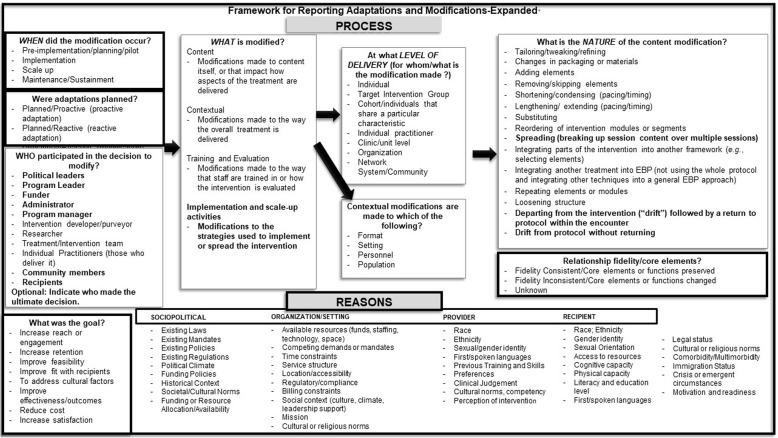
BACKGROUND: This paper describes the process and results of a refinement of a framework to characterize modifications to interventions. The original version did not fully capture several aspects of modification and adaptation that may be important to document and report. Additionally, the earlier framework did not include a way to differentiate cultural adaptation from adaptations made for other reasons. Reporting additional elements will allow for a more precise understanding of modifications, the process of modifying or adapting, and the relationship between different forms of modification and subsequent health and implementation outcomes. DISCUSSION: We employed a multifaceted approach to develop the updated FRAME involving coding documents identified through a literature review, rapid coding of qualitative interviews, and a refinement process informed by multiple stakeholders. The updated FRAME expands upon Stirman et al.'s original framework by adding components of modification to report: (1) when and how in the implementation process the modification was made, (2) whether the modification was planned/proactive (i.e., an adaptation) or unplanned/reactive, (3) who determined that the modification should be made, (4) what is modified, (5) at what level of delivery the modification is made, (6) type or nature of context or content-level modifications, (7) the extent to which the modification is fidelity-consistent, and (8) the reasons for the modification, including (a) the intent or goal of the modification (e.g., to reduce costs) and (b) contextual factors that influenced the decision. Methods of using the framework to assess modifications are outlined, along with their strengths and weaknesses, and considerations for research to validate these measurement strategies. CONCLUSION: The updated FRAME includes consideration of when and how modifications occurred, whether it was planned or unplanned, relationship to fidelity, and reasons and goals for modification. This tool that can be used to support research on the timing, nature, goals and reasons for, and impact of modifications to evidence-based interventions.
Overview
CoChat Summary
TL;DR
This paper refines the FRAME (Framework for Reporting Adaptations and Modifications-Enhanced) to better document how, when, why, and by whom evidence-based interventions are modified. It expands the original framework to capture planned vs. unplanned changes, timing across implementation phases, fidelity consistency, and cultural and contextual reasons for modification.
Key findings
- The updated FRAME adds 8 reporting aspects: timing in the implementation process, planned/proactive vs. unplanned/reactive, who decided, what was modified, level of delivery, type/nature of modifications, fidelity consistency, and reasons/goals for modification.
- The authors’ refinement process used multiple data sources: coding literature identified through a review, rapid coding of qualitative interviews with 55 mental health providers and administrators, and stakeholder feedback.
- The literature review process examined a total of 170 individual articles describing adaptations to interventions, with a “stop rule” that halted article review after no new aspects were found in 10 original sources from each additional systematic review.
- The paper explicitly adds cultural adaptation as a distinct reason for modification and specifies goals such as improving feasibility, acceptability, reach/engagement, fit, reducing costs, improving clinical outcomes, or aligning with cultural values, norms, or priorities.
Methods
- Pragmatic, multifaceted framework refinement combining literature review, qualitative interview data, and stakeholder consultation.
- Literature review and snowballing of published frameworks, reviews, and articles on adaptations/modifications; qualitative rapid coding of interview responses from 55 providers/administrators.
- Data from both sources were consolidated, collapsed into subcategories by consensus among the three authors, and then presented to stakeholder groups for further refinement.
Limitations
- The paper states it did not use a systematic review or traditional thematic analysis; it says these approaches did not align with the project goals.
- The authors note that comprehensively cataloging modifications may be difficult in some contexts, especially when an intervention has not been exhaustively described and tested; this is a limitation of applying FRAME in practice, not of the paper’s own analysis.
- The paper also says the feasibility of using a comprehensive framework will vary across research and applied settings, and that further evaluation of different ways to use FRAME is needed.
Model-written summary. Check it against the paper before relying on it.
Integrity signals
Registry
Cites
Statistics
Figures
Verification
Claims the paper makes
20 Valid · 4 Not valid · 4 Not checked · 42 Own results and interpretations
Some cited sources support this claim and some don’t — read each source’s verdict below.
In the paper
“Further, we recognized that other aspects of reporting that may be important for improving understanding of modification and its impact, such as when in the implementation process the modification was made, were also not included [28–31].”
§ The FRAME: an expanded framework for reporting adaptations and modifications to evidence-based interventions > Background
What the sources say
- Disputedcites [28] Rabin B, McCreight M, Glasgow R, editors. Systematic multi-method documentation of adaptations in five health system interventions. Implementation Sci 2018;13. sourceExperimental — accuracy not yet measured
The Methods > Adaptation Framework section says the original Stirman framework was expanded to include when adaptations were made. But the framework presented in this cited paper itself includes a WHEN category for the stage of the project at which an adaptation occurred. Thus, this source does not support the claim that this aspect was absent from the prior frameworks cited; it documents one that included it. (LLM, conf=0.87)
Checked by a reasoning model — may be wrong.
- Partly supportedcites [29] Escoffery C Lebow-Skelley E Udelson H Böing EA Wood R Fernandez ME A scoping study of frameworks for adapting public health evidence-based interventions Transl Behav Med 2018 9 1 1 10 PMC6305563 29346635 sourceExperimental — accuracy not yet measured
The Discussion (Implications for future research; page unavailable) says adaptations should be documented to better understand their impact and calls for reporting guidelines. But the paper does not establish that the reviewed frameworks omitted reporting when, during implementation, a modification was made; its Introduction notes that a taxonomy of adaptation timing had been developed. (LLM, conf=0.80)
- Could not verifycites [30] Brown CH Curran G Palinkas LA Aarons GA Wells KB Jones L An overview of research and evaluation designs for dissemination and implementation Annu Rev Public Health 2017 38 1 22 28384085 PMC5384265 sourceExperimental — accuracy not yet measured
The Introduction (page unavailable) describes adaptations during preparation and implementation, and the Between-Site Designs section describes changing an implementation strategy if it fails. Neither passage addresses whether prior frameworks included reporting when a modification was made. Searches for modification timing and reporting found no passage that settles that claim. (LLM, conf=0.69)
- Could not verifycites [31] Ramsay JE, Janevic MR, Hogan CK, Edwards DL, Connell CM. Using the replicating effective programs framework to adapt a heart health intervention. Health Promot Pract. 2018. PMC6476690 29759012 sourceExperimental — accuracy not yet measured
The Background says adaptation processes are often poorly documented, and the Discussion (REP Framework: Limitations) says REP lacks explicit options for making certain modifications. Neither passage says prior frameworks omitted reporting when in implementation a modification was made; searches for that timing and reporting point found no such statement. (LLM, conf=0.72)
hedged- Asserted: passes — The authors put it forward as true.
- Checkable: passes — It can be checked against evidence.
- Load-bearing: passes — The paper’s conclusions depend on it.
- Based: passes — The paper gives a reason why it holds.
- Disputed
Every source the paper cites for this claim was checked and supports it.
In the paper
“Stirman and colleagues previously developed a Framework for Modification and Adaptations [16].”
§ The FRAME: an expanded framework for reporting adaptations and modifications to evidence-based interventions > Background
What the sources say
- Supportedcites [16] Stirman SW Miller CJ Toder K Calloway A Development of a framework and coding system for modifications and adaptations of evidence-based interventions Implementation Sci. 2013 8 65 PMC3686699 23758995 source
The paper’s Abstract (Methods) says the authors developed a system for classifying modifications to interventions, and the Background describes the intended framework. This supports identifying the work as the framework developed by Stirman and colleagues. (LLM, conf=0.94)
plain- Asserted: passes — The authors put it forward as true.
- Checkable: passes — It can be checked against evidence.
- Load-bearing: passes — The paper’s conclusions depend on it.
- Based: passes — The paper gives a reason why it holds.
- Supported
The cited sources support only part of this claim — read each source’s verdict below.
In the paper
“Without understanding forms of modification that occur, the systematic evaluation of processes and strategies that lead to more and less successful implementation may be hindered [2, 17–19].”
§ The FRAME: an expanded framework for reporting adaptations and modifications to evidence-based interventions > Background
What the sources say
- Supportedcites [2] Stirman SW Gutner C Edmunds J Evans AC Beidas R Relationships between clinician-level attributes and fidelity-consistent and fidelity-inconsistent modifications to an evidence-based psychotherapy Implementation Sci. 2015 10 1 115 PMC4534152 26268633 source
The Discussion says it is important to differentiate types of modifications and that measuring them and monitoring outcomes are necessary to understand their impact. The paper also links identifying factors associated with modifications to understanding how to improve evidence-based treatment delivery. This supports the citing sentence’s hedged point about evaluating implementation strategies. (LLM, conf=0.88)
- Supportedcites [17] Baumann AA Powell BJ Kohl PL Tabak RG Penalba V Proctor EK Cultural adaptation and implementation of evidence-based parent-training: a systematic review and critique of guiding evidence Child Youth Serv Rev 2015 53 113 120 25960585 PMC4419735 source
The Discussion (page unavailable) calls for documenting what was adapted and how, and says that identifying the diversity of adaptations helps researchers examine intervention impact. The Implementation section (page unavailable) says frameworks enable systematic evaluation and that evaluating outcomes helps identify which implementation strategies work best. Together, these passages support the claim's hedged point that failing to understand modifications may hinder such evaluation. (LLM, conf=0.86)
- Not checked — no full text of the sourcecites [18] Glasziou P Altman DG Bossuyt P Boutron I Clarke M Julious S Reducing waste from incomplete or unusable reports of biomedical research Lancet. 2014 383 9913 267 276 24411647 source
- Partly supportedcites [19] Baumann AA Domenech Rodríguez MM Amador NG Forgatch MS Parra-Cardona JR Parent management training-Oregon model (PMTO™) in Mexico City: integrating cultural adaptation activities in an implementation model Clin Psychol: Sci and Pract. 2014 21 1 32 47 PMC4457334 26052184 sourceExperimental — accuracy not yet measured
In “Implementation and Cultural Adaptation” (page unavailable), the paper says most implementation frameworks do not make adaptation explicit and calls for adaptation to be planned and evaluated throughout implementation. The Discussion (page unavailable) also stresses documenting adaptations so researchers can evaluate them. It does not explicitly say that failing to understand forms of modification hinders systematic comparison of strategies leading to more versus less successful implementation. (LLM, conf=0.78)
hedgedstates a possible cause- Asserted: passes — The authors put it forward as true.
- Checkable: passes — It can be checked against evidence.
- Load-bearing: passes — The paper’s conclusions depend on it.
- Based: passes — The paper gives a reason why it holds.
- Supported
The cited sources support only part of this claim — read each source’s verdict below.
In the paper
“The process, nature, and outcomes of modifications to evidence-based programs/practices (EBPs) have often not been well documented, despite considerable recent interest in the field of implementation science [5, 6].”
§ The FRAME: an expanded framework for reporting adaptations and modifications to evidence-based interventions > Background
What the sources say
- Partly supportedcites [5] von Thiele Schwarz U Förberg U Sundell K Hasson H Colliding ideals–an interview study of how intervention researchers address adherence and adaptations in replication studies BMC Med Res Methodol 2018 18 1 36 29739337 PMC5941334 sourceExperimental — accuracy not yet measured
The Background (page unavailable) says interventions are seldom described well enough to determine adaptations, and the Discussion says many adaptations are left out of journal reports. This supports the claim about poor documentation of modifications, but the paper does not establish that their outcomes are often poorly documented or explicitly characterize the degree of recent interest across implementation science. (LLM, conf=0.83)
- Not checked — no full text of the sourcecites [6] Sundell K Beelmann A Hasson H von Thiele Schwarz U Novel programs, international adoptions, or contextual adaptations? Meta-analytical results from German and Swedish intervention research J Clin Child Adolesc Psychol 2016 45 6 784 796 25864716 source
plain- Asserted: passes — The authors put it forward as true.
- Checkable: passes — It can be checked against evidence.
- Load-bearing: passes — The paper’s conclusions depend on it.
- Based: passes — The paper gives a reason why it holds.
- Partly supported
The cited sources support only part of this claim — read each source’s verdict below.
In the paper
“In fact, modifications that focus on increasing the fit of the EBPs with the target population can lead to improved engagement, acceptability, and clinical outcomes, particularly when working with minority populations [8–10].”
§ The FRAME: an expanded framework for reporting adaptations and modifications to evidence-based interventions > Background
What the sources say
- Not checked — no full text of the sourcecites [8] Steinka-Fry KT Tanner-Smith EE Dakof GA Henderson C Culturally sensitive substance use treatment for racial/ethnic minority youth: a meta-analytic review J Subst Abus Treat 2017 75 22 37 28237051 source
- Partly supportedcites [9] Rathod S Gega L Degnan A Pikard J Khan T Husain N The current status of culturally adapted mental health interventions: a practice-focused review of meta-analyses Neuropsychiatr Dis Treat 2018 14 165 178 29379289 PMC5757988 sourceExperimental — accuracy not yet measured
The Results (Cultural factors as moderators of effect of adapted interventions; page unavailable) report that some culturally adapted interventions had greater clinical effects, including when adaptations addressed patients’ cultural values and beliefs. The Introduction links a lack of cultural adaptation to poor uptake among minority populations. The paper does not establish improved acceptability or directly show improved engagement from these modifications, and its Conclusion says the effective components and populations remain uncertain. (LLM, conf=0.84)
- Not checked — no full text of the sourcecites [10] Bernal GE, Domenech Rodríguez MM. Cultural adaptations: tools for evidence-based practice with diverse populations: American Psychological Association; 2012. source
plainstates a cause- Asserted: passes — The authors put it forward as true.
- Checkable: passes — It can be checked against evidence.
- Load-bearing: unclear — It is unclear whether the paper’s conclusions depend on it.
- Based: passes — The paper gives a reason why it holds.
11 more claims · 6 with their cited sources checked
Create a free account to see all 70 claims and to verify the 3 references still open.
- It may state two separate claims as one. 26
- Probably not a substantial claim. 45
Claims other papers make about this one
Each is checked against this paper’s own text: does it say what the citing paper says it does?
The cited source says what the claim attributes to it.
In the citing paper
“Published guidance highlights the importance of Adapting the innovation [76], and the updated CFIR notes the importance of adapting the setting as well [77].”
From The updated consolidated framework for implementation research based on user feedback (2022) · cites this paper as [76]
The cited source says what the claim attributes to it.
In the citing paper
“Retrospective in nature, this study provides guidance in evaluating the implementation of a newborn care package but is limited in providing more in-depth instruction on systematic detail on modifications and adaptations to tailor interventions for this setting (79–81).”
The cited source says what the claim attributes to it.
In the citing paper
“Interviews will capture any adaptations to the ICU-PAUSE tool based on the FRAME method, such as the timing, participants, and nature of each modification [20].”
From Improving Communication in Intensive Care Unit to Ward Transitions: Protocol for Multisite National Implementation of the ICU-PAUSE Handoff Tool (2023) · cites this paper as [20]
The cited source says what the claim attributes to it.
In the citing paper
“Adaptations will be noted and codified using the Framework for Reporting Adaptations and Modifications-Expanded (FRAME) method of tracking adaptations in our postimplementation interviews [20].”
From Improving Communication in Intensive Care Unit to Ward Transitions: Protocol for Multisite National Implementation of the ICU-PAUSE Handoff Tool (2023) · cites this paper as [20]
Citations
Cites
Damschroder, L. J., Aron, D. C., Keith, R. E., Kirsh, S. R., Alexander, J. A., & Lowery, J. C. (2009) · Implementation Science · doi:10.1186/1748-5908-4-50 · Cited by 14,496
The social determinants of health: It’s time to consider the causes of the causes
Braveman, P., & Gottlieb, L. (2014) · Public Health Reports® · doi:10.1177/00333549141291s206 · Cited by 3,861
Advancing a Conceptual Model of Evidence-Based Practice Implementation in Public Service Sectors
Aarons, G. A., Hurlburt, M., & Horwitz, S. M. (2011) · Administration and Policy in Mental Health and Mental Health Services Research · doi:10.1007/s10488-010-0327-7 · Cited by 3,240
Implementation strategies: recommendations for specifying and reporting
Proctor, E. K., Powell, B. J., & McMillen, J. C. (2013) · Implementation Science · doi:10.1186/1748-5908-8-139 · Cited by 2,585
The dynamic sustainability framework: addressing the paradox of sustainment amid ongoing change
Chambers, D. A., Glasgow, R. E., & Stange, K. C. (2013) · Implementation Science · doi:10.1186/1748-5908-8-117 · Cited by 1,724
Wiltsey Stirman, S., Kimberly, J., Cook, N., Calloway, A., Castro, F., & Charns, M. (2012) · Implementation Science · doi:10.1186/1748-5908-7-17 · Cited by 1,355
Reducing waste from incomplete or unusable reports of biomedical research
Glasziou, P., Altman, D. G., Bossuyt, P., Boutron, I., Clarke, M., Julious, S., Michie, S., Moher, D., & Wager, E. (2014) · The Lancet · doi:10.1016/s0140-6736(13)62228-x · Cited by 1,319
The Cultural Adaptation of Prevention Interventions: Resolving Tensions Between Fidelity and Fit
Castro, F. G., Barrera, M., & Martinez, C. R. (2004) · Prevention Science · doi:10.1023/b:prev.0000013980.12412.cd · Cited by 1,228
Bernal, G., Bonilla, J., & Bellido, C. (1995) · Journal of Abnormal Child Psychology · doi:10.1007/bf01447045 · Cited by 1,120
The Sustainability of Evidence-Based Interventions and Practices in Public Health and Health Care
Shelton, R. C., Cooper, B. R., & Stirman, S. W. (2018) · Annual Review of Public Health · doi:10.1146/annurev-publhealth-040617-014731 · Cited by 806
Self-citation
Research works printed but not linked: 2
- Rabin B, McCreight M, Glasgow R, editors. Systematic multi-method documentation of adaptations in five health system interventions. Implementation Sci 2018;13. · DOI · Paper page
- Rogers EM. Diffusion of innovations: New York The Free Press, A Division of Simon & Schuster, Inc; 2010.
Cited by
Items 201–300 of 1,315
McCreight, M. S., Rohs, C., Lee, M., Sjoberg, H., Ayele, R. A., Battaglia, C. T., Glasgow, R. E., & Rabin, B. A. (2022) · Frontiers in Health Services · doi:10.3389/frhs.2022.970409 · Cited by 18
Estabrooks, P. A., & Glasgow, R. E. (2023) · Frontiers in Public Health · doi:10.3389/fpubh.2023.1123349 · Cited by 19
“, tailoring) is critical for implementation success and sustainability (33, 34).”
BackgroundKohn, M., Chadwick, K. A., & Steinman, L. E. (2023) · Prevention Science · doi:10.1007/s11121-023-01519-z · Cited by 23
“Informed by the FRAME adaptations framework (Wiltsey-Stirman et al., 2019) and Rabin et al.”
BackgroundMethodMackie, T. I., Ramella, L., Schaefer, A. J., Sridhar, M., Carter, A. S., Eisenhower, A., Ibitamuno, G., Petruccelli, M., Hudson, S. V., & Sheldrick, R. C. (2020) · Journal of Clinical and Translational Science · doi:10.1017/cts.2020.14 · Cited by 22
“Rabin et al. adapted the 2013 FRAME model to capture modifications in alignment with the framework of RE-AIM (Reach, Effectiveness, Adoption, Implementation, and Maintenance), in an interview guide to investigate modifications in the dimensions of Who, What, When, and Why?”
BackgroundMethodInfluentialVanDevanter, N., Vu, M., Nguyen, A. M., Nguyen, T., Minh, H. V., Nguyen, N. T., & Shelley, D. (2020) · Implementation Science · doi:10.1186/s13012-020-01035-6 · Cited by 20
Nooraie, R. Y., Lyons, P. G., Baumann, A. A., & Saboury, B. (2021) · PET Clinics · doi:10.1016/j.cpet.2021.07.002 · Cited by 19
Self-citationNkimbeng, M. J., Han, H.-R., Szanton, S. L., Alexander, K. A., Davey-Rothwell, M. A., Giger, J. T., Gitlin, L. N., Joo, J. H., Koeuth, S., Marx, K., et al. (2021) · The Gerontologist · doi:10.1093/geront/gnab190 · Cited by 17
The economics of adaptations to evidence-based practices
Salloum, R. G., Wagner, T. H., Midboe, A. M., Daniels, S. I., Quanbeck, A., & Chambers, D. (2022) · Implementation Science Communications · doi:10.1186/s43058-022-00345-8 · Cited by 18
Arena, L. C., Soloe, C. S., Schlueter, D., Ferriola-Bruckenstein, K., DeGroff, A. S., Tangka, F. K. L., Hoover, S., Melillo, S. N., & Subramanian, S. (2022) · Journal of Community Health · doi:10.1007/s10900-022-01154-9 · Cited by 17
Smith, J. D., Agrawal, A. H., Wicklund, C. A. L., Duquette, D. A., Friedewald, J. J., Rasmussen, L. V., Gacki‐Smith, J., Tandon, S. D., Muhammad, L. N., Yancy, C. W., et al. (2023) · BMJ Open · doi:10.1136/bmjopen-2022-067657 · Cited by 17
Lau, A. S., Huey, S. J., & Baumann, A. A. (2023) · Behaviour Research and Therapy · doi:10.1016/j.brat.2023.104377 · Cited by 19
Self-citationJang, Y., Hepburn, K. W., Haley, W. E., Park, J., Park, N. S., Ko, L. K., & Kim, M. T. (2024) · BMC Geriatrics · doi:10.1186/s12877-024-04715-w · Cited by 15
Rudrabhatla, A., Hendrix, N. M., Gillespie, S. E., Ulven, K., Jergel, A., Greenfield, E., Guerra, K. A. S., & Pickard, K. E. (2024) · Administration and Policy in Mental Health and Mental Health Services Research · doi:10.1007/s10488-024-01343-9 · Cited by 18
“…ImPACT treatment session, providers rated whether they made any of six types of adaptations to Project ImPACT based on the Framework for Reporting Adaptations and Modifications-Enhanced (FRAME; Stirman et al., 2019) and a seventh category to capture adaptations not specified within this framework.”
Li, W. W., McIntyre, R., Reid, C., & Chao, M. (2024) · Mindfulness · doi:10.1007/s12671-024-02440-4 · Cited by 23
“Cultural adaptation of MBIs involves making thought-ful modifications to the protocols and delivery of MBIs to enhance their cultural appropriateness and effectiveness for First Nations peoples (Stirman et al., 2019).”
A Scoping Study of Cultural Adaptation Frameworks
Leung, J., Sekar, S., Madrigal, L., & Escoffery, C. (2024) · Health Promotion Practice · doi:10.1177/15248399241292317 · Cited by 26
“…components modified, (e) the level of delivery the modification(s) was made, (f) type of context or content-level modifications, (g) the extent to which the modification has fidelity to the original program, and (h) the reasons for the changes (Stirman et al., 2013; Wiltsey Stirman et al., 2019).”
Coronado, G. D., Schneider, J. L., Green, B. B., Coury, J., Schwartz, M., Kulkarni‐Sharma, Y. R., & Baldwin, L. M. (2020) · Implementation Science · doi:10.1186/s13012-020-01037-4 · Cited by 16
Adapting Diabetes Shared Medical Appointments to Fit Context for Practice-Based Research (PBR)
Kwan, B. M., Rementer, J., Ritchie, N. D., Nederveld, A., Phimphasone‐Brady, P., Sajatovic, M., Nease, D. E., & Waxmonsky, J. A. (2020) · The Journal of the American Board of Family Medicine · doi:10.3122/jabfm.2020.05.200049 · Cited by 19
Rabin, B. A., Cain, K. L., & Glasgow, R. E. (2024) · Annual Review of Public Health · doi:10.1146/annurev-publhealth-071321-041652 · Cited by 25
Kennedy, S. M., Wilkie, D. P., Henry, L. M., Moe-Hartman, J., President, K. F., Townson, K., Anthony, L. G., & Hawks, J. L. (2022) · Cognitive and Behavioral Practice · doi:10.1016/j.cbpra.2022.04.006 · Cited by 16
Zetterlund, J., Schwarz, U. V. T., Hasson, H., & Neher, M. (2022) · Frontiers in Health Services · doi:10.3389/frhs.2022.883072 · Cited by 20
Hoskins, K., Sanchez, A. L., Hoffacker, C. P., Momplaisir, F. M., Gross, R., Brady, K. A., Pettit, A. R., Zentgraf, K. A., Mills, C., Coley, D., et al. (2022) · Frontiers in Public Health · doi:10.3389/fpubh.2022.872746 · Cited by 19
Modification of the Individual Placement and Support Model of Supported Employment
Drake, R. E., Bond, G. R., & Mascayano, F. (2023) · Psychiatric Services · doi:10.1176/appi.ps.20220484 · Cited by 20
Nederveld, A., Phimphasone‐Brady, P., Gurfinkel, D., Waxmonsky, J. A., Kwan, B. M., & Holtrop, J. S. (2023) · BMC Family Practice · doi:10.1186/s12875-023-02006-8 · Cited by 16
Hasson, H., Rundgren, E. H., Strehlenert, H., Gärdegård, A., Uvhagen, H., Klinga, C., Rundgren, Å. H., & Schwarz, U. V. T. (2023) · Implementation Research and Practice · doi:10.1177/26334895231189198 · Cited by 22
“Possible adaptations to consider included aspects for EBI content and format (e.g., adding, shortening, and reordering) as well as context (e.g., personnel; Miller-Day et al., 2013; Moore et al., 2013; Stirman et al., 2019).”
InfluentialLeveraging Implementation Science in Human-Centred Design for Digital Health
Waddell, A., Seguin, J. P., Wu, L., Stragalinos, P., Wherton, J. P., Watterson, J., Prawira, C. O., Olivier, P. L., Manning, V., Lubman, D. I., et al. (2024) · CHI Conference on Human Factors in Computing Systems · doi:10.1145/3613904.3642161 · Cited by 37
“Furthermore, implementation science faces an ongoing tension between fidelity of evidence-based programs and the need for adaptation within different contexts [95].”
En Route to Implementation Science 3.0
Albers, B., Shlonsky, A., & Mildon, R. L. (2020) · Springer eBooks · doi:10.1007/978-3-030-03874-8_1 · Cited by 30
Cultural adaptation of two school-based smoking prevention programs in Bogotá, Colombia
Sánchez-Franco, S., Arias, L. F., Jaramillo, J., Murray, J., Hunter, R. F., Llorente, B. A., Bauld, L., Good, S., West, J., Kee, F., et al. (2021) · Translational Behavioral Medicine · doi:10.1093/tbm/ibab019 · Cited by 19
Cruden, G., Campbell, M. R., & Saldana, L. (2021) · Journal of Substance Abuse Treatment · doi:10.1016/j.jsat.2021.108388 · Cited by 15
Mensah, K., Kaboré, C., Zeba, S., Bouchon, M., Duchesne, V., Pourette, D., Beaudrap, P. D., & Dumont, A. (2021) · BMC Women s Health · doi:10.1186/s12905-021-01392-4 · Cited by 18
“This adaptation was the result of a dialogue between midwives and laboratory staff in both centers to facilitate the integration of screening activities into the existing work structure, revealing a context modification according to Stirman’s classification [27].”
MethodPearson, N., Finch, M., Sutherland, R., Kingsland, M., Wolfenden, L., Wedesweiler, T., Herrmann, V., & Yoong, S. L. (2022) · Journal of Medical Internet Research · doi:10.2196/27760 · Cited by 19
Sengupta, K., Lobo, L., & Krishnamurthy, V. (2022) · Journal of Developmental & Behavioral Pediatrics · doi:10.1097/dbp.0000000000001060 · Cited by 18
“The adaptations were captured and delineated for future reference using the framework of Stirman et al to characterize modifications to interventions.(24) All adaptations were decided by the multidisciplinary ‟hub” team that facilitated the clinics, based on a baseline survey and results from a pilot cohort of pediatr…”
MethodDonenberg, G. R., Merrill, K. G., Obiezu‐Umeh, C., Nwaozuru, U., Blachman-Demner, D. R., Subramanian, S., Fournier, A. P., & Iwelunmor, J. (2022) · Global Implementation Research and Applications · doi:10.1007/s43477-022-00042-7 · Cited by 14
Anderson, D. M., Birken, S. A., Bartram, J., & Freeman, M. C. (2022) · Frontiers in Health Services · doi:10.3389/frhs.2022.896234 · Cited by 18
Duby, Z., Bunce, B., Fowler, C., Jonas, K., Govindasamy, D., Wagner, C., Mangoale, K., Ambrose, A., & Mathews, C. (2022) · Frontiers in Health Services · doi:10.3389/frhs.2022.903583 · Cited by 15
Lange, B. C. L., Nelson, A. M., Lang, J. M., & Stirman, S. W. (2022) · Implementation Science Communications · doi:10.1186/s43058-022-00348-5 · Cited by 17
Self-citationReach Out and Read Implementation: A Scoping Review
Uthirasamy, N., Reddy, M., Hemler, J. R., Devine, K. A., Cordoba, D., Pai, S., Ramachandran, U., Mackie, T. I., & Jiménez, M. E. (2022) · Academic Pediatrics · doi:10.1016/j.acap.2022.11.012 · Cited by 21
Steinman, L. E., Santos, É. C., Chadwick, K. A., Mayotte, C., Johnson, S. S., Kohn, M., Kelley, J., Denison, P., Montes, C., Spencer-Brown, L., et al. (2023) · Health Promotion Practice · doi:10.1177/15248399231175843 · Cited by 14
Mangale, D. I., Onyango, A., Mugo, C., Mburu, C. W., Chhun, N., Wamalwa, D. C., Njuguna, I. N., Means, A. R., John-Stewart, G. C., Weiner, B. J., et al. (2023) · Implementation Science Communications · doi:10.1186/s43058-023-00446-y · Cited by 16
“FRAME-IS is derived from FRAME, which specifically focuses on categorizing adaptations to interventions, and can be applied to guide the adaptation process [31].”
MethodCook, J. M., Simiola, V., McCarthy, E., Ellis, A., & Stirman, S. W. (2018) · Practice Innovations · doi:10.1037/pri0000070 · Cited by 14
Self-citationRed, Yellow, and Green Light Changes: Adaptations to Extension Health Promotion Programs
Balis, L. E., Kennedy, L. E., Houghtaling, B., & Harden, S. M. (2021) · Prevention Science · doi:10.1007/s11121-021-01222-x · Cited by 17
Dietary Policies and Programs: Moving Beyond Efficacy and Into “Real-World” Settings
Yi, S. S., Lee, M. S. L., Russo, R. G., Li, Y., Trinh‐Shevrin, C., & Kwon, S. C. (2021) · Health Equity · doi:10.1089/heq.2020.0050 · Cited by 17
“while also rigorously documenting both planned and unplanned adaptations over time.(50) In implementation science, growing attention toward program and policy sustainability, as well as to”
BackgroundAdaptation in rural water, sanitation, and hygiene programs: A qualitative study in Nepal
Anderson, D. M., Gupta, A. K., Birken, S. A., Sakas, Z., & Freeman, M. C. (2022) · International Journal of Hygiene and Environmental Health · doi:10.1016/j.ijheh.2022.113919 · Cited by 19
Implementation Science: Increasing the Public Health Impact of Audiology Research
Studts, C. R. (2022) · American Journal of Audiology · doi:10.1044/2022_aja-21-00205 · Cited by 17
“…is implemented outside the setting in which it was developed and tested, adaptations are typically made—either reactively, in response to implementation challenges encountered along the way, or proactively, to increase the “fit” of the practice or program in its new setting (Stirman et al., 2019).”
BackgroundSimpson, M. L., Ruru, S., OETZEL, J. G., Meha, P., Nock, S., Holmes, K., Adams, H., Akapita, N., Clark, M., Ngaia, K., et al. (2022) · Implementation Science Communications · doi:10.1186/s43058-022-00374-3 · Cited by 17
Nettlefold, L., Gray, S. M., Sims‐Gould, J., & McKay, H. A. (2023) · Kinesiology Review · doi:10.1123/kr.2022-0034 · Cited by 14
Beheshti, M., Naeimi, T., Hudson, T. E., Feng, C., Mongkolwat, P., Riewpaiboon, W., Seiple, W., Vedanthan, R., & Rizzo, J. (2023) · Trials · doi:10.1186/s13063-023-07173-8 · Cited by 18
“Aim 3 We will perform a content analysis of the transcripts and notes using NVIVO software [36].”
MethodTerminology for Dissemination and Implementation Research
Rabin, B. A., Viglione, C., & Brownson, R. C. (2023) · Oxford University Press eBooks · doi:10.1093/oso/9780197660690.003.0002 · Cited by 18
Hasson, H., Gröndal, H., Rundgren, Å. H., Avby, G., Uvhagen, H., & Schwarz, U. V. T. (2020) · Implementation Science Communications · doi:10.1186/s43058-020-00005-9 · Cited by 17
“Most of the literature on the adherence and adaptation dilemma is conceptual or theoretical, building convincing arguments for either the importance of high adherence or the burning need for local adaptations [23, 26].”
BackgroundCouturier, J. L., Pellegrini, D., Miller, C., Agar, P., Webb, C., Anderson, K. E., Barwick, M. A., Dimitropoulos, G., Findlay, S. M., Kimber, M., et al. (2021) · Implementation Science Communications · doi:10.1186/s43058-021-00143-8 · Cited by 17
“The FRAME: an expanded framework for reporting adaptations and modifications to evidence-based interventions.”
MethodInfluentialSelf-citationCommentary: Challenges and opportunites in the assessment of fidelity and related constructs
Stirman, S. W. (2020) · Administration and Policy in Mental Health and Mental Health Services Research · doi:10.1007/s10488-020-01069-4 · Cited by 14
Self-citationRoadmap for implementing a multi-tiered system of supports framework to improve school attendance.
Graczyk, P. A., & Kearney, C. A. (2024) · Current Psychology · doi:10.1007/s12144-023-05478-0 · Cited by 14
“A second resource, the Framework for Reporting Adaptations and Modifications (FRAME; Stirman et al., 2019) was developed to help stakeholders understand and document the adaptation process for evidence-based practices (EBPs) and to determine the influence of the adaptations on EBPs and their…”
Sakurai, T., Sugimoto, T., & Arai, H. (2025) · Geriatrics and gerontology international/Geriatrics & gerontology international · doi:10.1111/ggi.70088 · Cited by 16
Ma, J. K., Walden, K., McBride, C. B., Levett, C. L. C., Colistro, R., Plashkes, T., Thorson, T., Shu, H., & Ginis, K. A. M. (2021) · Spinal Cord · doi:10.1038/s41393-021-00685-7 · Cited by 14
“The implementation intervention will consist of two training sessions, provision of the ProACTIVE SCI intervention toolkit, and PA coaching forms which are used to guide and document the PA coaching sessions (see Supplementary Files).”
MethodInfluentialReal‐world effectiveness of the Bright Bodies healthy lifestyle intervention for childhood obesity
Samuels, S. L., Hu, P., Maciejewski, K. R., Li, F., Dziura, J. D., Savoye, M., & Sharifi, M. (2022) · Obesity · doi:10.1002/oby.23627 · Cited by 14
“’s well-established framework for describing adaptations and modifications to interventions, we categorized adaptations according to relevant categories, including when modifications occurred, whether adaptations were planned/proactive or unplanned/ reactive, what was modified, and goals and reasons for modification […”
BackgroundMethodBeyond Effectiveness: Implementation Science 101 for Clinicians and Clinical Researchers
Ramly, E., & Brown, H. W. (2023) · Urogynecology · doi:10.1097/spv.0000000000001322 · Cited by 17
McLaughlin, M. J., Nathan, A., Thornton, A., Schipperijn, J., Trost, S. G., & Christian, H. E. (2023) · International Journal of Behavioral Nutrition and Physical Activity · doi:10.1186/s12966-023-01457-7 · Cited by 16
“Similar to a previous study exploring the extent, type and reasons for adaptations to a secondary school physical activity intervention using the FRAME [15, 30], our adaptations were largely coded as fidelity consistent, and most were proposed to have a positive effect.”
BackgroundMethodResultInfluentialLevinson, J., Hickey, E., Fuchu, P., Chu, A., Barnett, M. L., Stadnick, N. A., Feinberg, E., & Broder‐Fingert, S. (2023) · BMC Family Practice · doi:10.1186/s12875-023-02072-y · Cited by 16
Zapata, J. P., Zamantakis, A., & Queiroz, A. A. F. L. N. (2023) · Journal of Racial and Ethnic Health Disparities · doi:10.1007/s40615-023-01678-3 · Cited by 13
“For example, researchers can utilize Stirman, Baumann, and Miller’s (2019) FRAME-IS [47, 48].”
Greene, M. C., Muro, M., Kane, J. C., Young, E., Paniagua-Ávila, A., Miller-Suchet, L., Nouel, M., Bonz, A. G., Cristobal, M., Schojan, M., et al. (2024) · International Journal of Environmental Research and Public Health · doi:10.3390/ijerph21020166 · Cited by 13
Adaptation in Dissemination and Implementation Science
Baumann, A. A., Stirman, S. W., & Cabassa, L. J. (2023) · Oxford University Press eBooks · doi:10.1093/oso/9780197660690.003.0008 · Cited by 14
Self-citationThe Secret Sauce? Taking the Mystery Out of Scaling-Up School-Based Physical Activity Interventions
McKay, H. A., Kennedy, S. G., MACDONALD, H. M., Naylor, P., & Lubans, D. R. (2024) · Journal of Physical Activity and Health · doi:10.1123/jpah.2024-0274 · Cited by 20
“88,89 The goal is to retain core functions (drivers of an EBI ’ s primary outcomes 90,91 ; eg, goal setting) while adapting form (approaches used to achieve core functions; eg, one-on-one interviews) to better suit a given context.”
Velloza, J., Ndimande-Khoza, M. N., Mills, L., Concepcion, T. L., Gumede, S., Chauke, H., Verhey, R., Chibanda, D., Hosek, S., Weiner, B. J., et al. (2024) · Journal of the International AIDS Society · doi:10.1002/jia2.26274 · Cited by 15
Mogk, J. M., Idu, A., Bobb, J. F., Key, D. L., Wong, E. S., Palazzo, L. G., Stefanik-Guizlo, K., King, D., Beatty, T. C., Dorsey, C. N., et al. (2024) · JMIR Formative Research · doi:10.2196/59088 · Cited by 16
“Designated evaluators (LP and CND) conducted a formative evaluation grounded in the Dynamic Sustainability Framework [55,56] and the Framework for Reporting Adaptations and Modifications to Evidence-based Implementation Strategies [57,58].”
MethodTreichler, E. B. H., Rabin, B. A., Spaulding, W. D., Thomas, M. L., Salyers, M. P., Granholm, E. L., Cohen, A. N., & Light, G. A. (2021) · Pilot and Feasibility Studies · doi:10.1186/s40814-021-00820-4 · Cited by 14
“We will also continue documenting adaptations in a systematic way using FRAME [45].”
MethodInfluentialAdapting Interventions for Occupational Therapy Practice: Application of the FRAME Coding Structure
Piller, A., Juckett, L., & Hunter, E. G. (2021) · OTJR Occupational Therapy Journal of Research · doi:10.1177/15394492211011609 · Cited by 14
“This skepticism stems from concern that practitioners may adapt interventions without sufficient fidelity (e.g., adherence) to an intervention’s “core components” or the elements of the intervention that are crucial for effectiveness (Chambers & Norton, 2016; Wiltsey Stirman et al., 2013).”
BackgroundMethodInfluentialBalis, L. E., & Harden, S. M. (2021) · Journal of Physical Activity and Health · doi:10.1123/jpah.2021-0034 · Cited by 16
Drake, C., Lewinski, A. A., Rader, A., Schexnayder, J. K., Bosworth, H. B., Goldstein, K. M., Gierisch, J. M., White‐Clark, C., McCant, F., & Zullig, L. L. (2022) · Current Hypertension Reports · doi:10.1007/s11906-022-01193-6 · Cited by 20
Stakeholder and Equity Data-Driven Implementation: a Mixed Methods Pilot Feasibility Study
Aschbrenner, K. A., Kruse, G. R., Emmons, K. M., Singh, D. P., Barber-Dubois, M. E., Miller, A. M., Thomas, A. N., & Bartels, S. J. (2022) · Prevention Science · doi:10.1007/s11121-022-01442-9 · Cited by 15
“A set of questions aligned with the Framework for Reporting Adaptations and Modifications-Expanded (FRAME) (Wiltsey Stirman et al., 2019) was used to elicit descriptions of the adaptations made to improve outreach and return of the FIT kit, including asking about the types of changes made, why the…”
MethodNicol, G. E., Ricchio, A., Metts, C. L., Yingling, M. D., Ramsey, A. T., Schweiger, J. A., Miller, J. P., & Lenze, E. J. (2020) · JMIR mhealth and uhealth · doi:10.2196/18609 · Cited by 14
Nittas, V., Chavez, S. J., & Daniore, P. (2025) · JMIR mhealth and uhealth · doi:10.2196/59965 · Cited by 18
“Our findings, and FRAME, highlight the importance of justifying adaptations, clearly outlining adaptation elements, involving a broad range of stakeholders (from experts to community members), and conducting evaluations [26].”
Cohen, F., Hermosilla, S., Knox, J., Agaba, G. S., Obalim, G., Kajungu, R., Mangen, P. O., & Stark, L. (2021) · BMC Public Health · doi:10.1186/s12889-021-10921-7 · Cited by 13
Cultural Adaptation of the Mothers and Babies Intervention for Use in Tribal Communities
Ward, E. A., Dogs, E. I. C.-T., Gier, E. E., Littlefield, L., & Tandon, S. D. (2022) · Frontiers in Psychiatry · doi:10.3389/fpsyt.2022.807432 · Cited by 25
Parascandola, M. J., Neta, G. I., Bloch, M., Gopal, S., & Ward, K. D. (2022) · The Journal of Smoking Cessation · doi:10.1155/2022/6835146 · Cited by 13
Lee, C. N., Sullivan, J., Foraker, R. E., Myckatyn, T. M., Olsen, M. A. A., Phommasathit, C., Boateng, J., Parrish, K. L., Rizer, M. K., Huerta, T. R., et al. (2022) · MDM Policy & Practice · doi:10.1177/23814683221131317 · Cited by 16
“We recorded all changes to BREASTChoice using the expanded Framework for Reporting Adaptations and Modifications (FRAME).(21) This included FRAME process domains (modification timing, whether it was planned or not, who participated, modification content, modification nature) and reasons (goal of the modification, soci…”
Stirman, S. W., Bash, H. A. J. L., Nelson, D. B., Orazem, R. J., Klein, A., & Sayer, N. A. (2022) · Frontiers in Public Health · doi:10.3389/fpubh.2022.984505 · Cited by 14
Self-citationSteinman, L. E., Parrish, A. T., Kohn, M., Wu, S., Hara-Hubbard, K. K., Brown, L., Imam, S., Baquero, B. I., Hannon, P. A., & Snowden, M. B. (2023) · Frontiers in Public Health · doi:10.3389/fpubh.2022.1079082 · Cited by 17
Iwelunmor, J., Tucker, J. D., Ezechi, O., Nwaozuru, U., Obiezu‐Umeh, C., Gbaja-Biamila, T. A., Oladele, D. A., Musa, A. Z., & Airhihenbuwa, C. O. (2023) · Current HIV/AIDS Reports · doi:10.1007/s11904-023-00652-2 · Cited by 15
“Utilizing FRAME-IS [46, 47] as a guide, our modification occurred during the pre-implementation phase of our project.”
BackgroundMethodInfluentialAdams, W. E., Rogers, E. S., McKnight, L., & Lynde, D. (2023) · Administration and Policy in Mental Health and Mental Health Services Research · doi:10.1007/s10488-023-01267-w · Cited by 16
Gaugler, J. E., Baier, R. R., Baker, Z. G., Boltz, M. P., Fortinsky, R. H., Gustavson, A. M., Hodgson, N. A., Jutkowitz, E., McPhillips, M., Parker, L. J., et al. (2023) · Journal of the American Medical Directors Association · doi:10.1016/j.jamda.2023.07.025 · Cited by 15
Dimitropoulos, G., Singh, M., Sauerwein, J., Pedram, P., Kimber, M., Pradel, M., Eckhardt, S., Forsberg, S., Keery, H., Allan, E., et al. (2024) · International Journal of Eating Disorders · doi:10.1002/eat.24144 · Cited by 13
A modified action framework to develop and evaluate academic-policy engagement interventions
Mäkelä, P., Boaz, A., & Oliver, K. A. (2024) · Implementation Science · doi:10.1186/s13012-024-01359-7 · Cited by 17
Brewer, S. K., Corbin, C. M., Baumann, A. A., Stirman, S. W., Jones, J. M., Pullmann, M. D., Lyon, A. R., Panel, M. E., Aalsma, M. C., Aldridge, W. A., et al. (2024) · Implementation Science Communications · doi:10.1186/s43058-024-00592-x · Cited by 18
Self-citationImplementing Nutrition Education Programs in Congregate Dining Service Settings: A Scoping Review
Juckett, L., Lee, K., Bunger, A. C., & Brostow, D. P. (2020) · The Gerontologist · doi:10.1093/geront/gnaa109 · Cited by 15
Fisher, L., Glasgow, R. E., & Huebschmann, A. G. (2021) · Diabetes Technology & Therapeutics · doi:10.1089/dia.2020.0383 · Cited by 10
“Because of the uniqueness of each clinic and patient panel, this often requires that eHealth systems be customized and adapted to more adequately fit the care setting, rather than using a standard, off the shelf program.(53,54) It also means that HCTs need to be carefully engaged, informed, and educated about their us…”
BackgroundGorman, J. R., Drizin, J. H., Al-Ghadban, F., & Rendle, K. A. S. (2021) · Translational Behavioral Medicine · doi:10.1093/tbm/ibab083 · Cited by 15
Curran, M., Komesidou, R., & Hogan, T. P. (2022) · Language Speech and Hearing Services in Schools · doi:10.1044/2021_lshss-21-00050 · Cited by 19
Juckett, L., Bunck, L. E., & Thomas, K. S. (2021) · Public Policy & Aging Report · doi:10.1093/ppar/prab032 · Cited by 12
Brunner, J., Farmer, M. M., Bean‐Mayberry, B., Coffinier, C., Than, C. T., Hamilton, A. B., & Finley, E. P. (2022) · Frontiers in Health Services · doi:10.3389/frhs.2022.946802 · Cited by 13
“All text relevant to use of implementation strategies was first coded deductively in accordance with the Expert Recommendations for Implementation Change (ERIC) taxonomy of implementation strategies (11); subsequently, all text descriptive of adaptations to the CV template intervention or implementation plan was coded…”
BackgroundMethodInfluentialAschbrenner, K. A., Bond, G. R., Pratt, S. I., Jue, K., Williams, G. M., Banerjee, S., & Bartels, S. J. (2020) · Implementation Research and Practice · doi:10.1177/2633489520943200 · Cited by 14
“…that support the adaptation of EBPs (Chambers et al., 2013) and methodological advances in studying modifications and adaptations to interventions and programs (Stirman et al., 2013, 2015, 2019), there is limited empirical evidence regarding the impact of adaptations that occur in routine care.”
BackgroundCollaborative Approach to Reach Everyone with Familial Hypercholesterolemia: CARE-FH Protocol
Jones, L. K., Williams, M. S., Ladd, I., Cawley, D., Ge, S., Hao, J., Hassen, D. A., Hu, Y., Kirchner, H. L., Kobylinski, M., et al. (2022) · Journal of Personalized Medicine · doi:10.3390/jpm12040606 · Cited by 15
“Guided by the framework for reporting adaptations and modifications (FRAME), we will report the following data: (1) when and how a modification was made, (2) whether the modification was planned/proactive or unplanned/reactive, (3) who decided to make the modification, (4) what is modified, (5) at what level of delive…”
MethodHarnessing Implementation Science in Clinical Psychology: Past, Present, and Future
Beidas, R. S., Boyd, M. R., Casline, E. P., Scott, K., Patel, Z. S., Mills, C., Mustanski, B. S., Schriger, S. H., Williams, F. S., Waller, C., et al. (2025) · Annual Review of Clinical Psychology · doi:10.1146/annurev-clinpsy-081423-021727 · Cited by 14
“Adaptation involves purposeful changes to an intervention or its implementation with the goal of improving effectiveness and contextual fit (Wiltsey Stirman et al. 2019).”
Osilla, K. C., Dopp, A. R., Watkins, K. E., Ceballos, V., Hurley, B., Meredith, L. S., Leamon, I. M., Jacobsohn, V., & Komaromy, M. S. (2022) · Addiction Science & Clinical Practice · doi:10.1186/s13722-022-00302-9 · Cited by 12
“We sought to bring a high level of rigor to documenting our adaptation processes and outcomes by following the MAP [1] and using the FRAME [2] to code adaptations.”
BackgroundMethodInfluentialGiusto, A. M., Missen, M. V., Kosgei, G., Njiriri, F., Puffer, E. S., Kwobah, E., Barasa, J., Turissini, M., Rasmussen, J. M., Ott, M. A., et al. (2023) · Research on Child and Adolescent Psychopathology · doi:10.1007/s10802-023-01075-8 · Cited by 16
Strehlenert, H., Rundgren, E. H., Sjunnestrand, M., & Hasson, H. (2023) · The British Journal of Social Work · doi:10.1093/bjsw/bcad170 · Cited by 19
“Our review contributes to the literature within social work; FRAME has been used previously to characterise adaptations of EBIs in the healthcare settings, as well as in preventive public health programmes, but not for EBIs in social service settings (Cook et al. , 2014; Lau et al. , 2017; Escoffery et al. , 2018; Rab…”
InfluentialMinton, H. M., Murray, L., Allan, M. J., Perry, R., Bettencourt, A. F., Gross, D. A., Strano, L., & Breitenstein, S. M. (2024) · JMIR Pediatrics and Parenting · doi:10.2196/55280 · Cited by 22
Fang, Z., Martin, M., Copeland, L., Evans, R., & Shenderovich, Y. (2024) · Trauma Violence & Abuse · doi:10.1177/15248380241266183 · Cited by 15
“The review is guided by the FRAME framework (Stirman et al., 2019), which is recognized as one of the most comprehensive and up-to-date adaptation classification frameworks.”
BackgroundMethodInfluentialHanlon, C., Smartt, C., Mutiso, V. N., Yaro, P., Misganaw, E., Read, U., Mayston, R., Birhanu, R., Dako-Gyeke, P., Ndetei, D. M., et al. (2025) · Epidemiology and Psychiatric Sciences · doi:10.1017/s2045796025000186 · Cited by 11
“The FRAME (Framework for Reporting Adaptations and Modifications Expanded) implementation tool (Wiltsey Stirman et al. , 2019) will be used to document intervention adaptations and their justification.”
Mark, M. M. (2021) · Prevention Science · doi:10.1007/s11121-021-01248-1 · Cited by 12
“This simple approach would join other judgment-based variables currently in adaptation/modification classification systems, such as the coding of whether a change is consistent, inconsistent, or neutral with respect to fidelity/core functions (Kirk et al., 2020; Stirman et al., 2019).”
BackgroundEssay, A. M., Schlechter, C. R., Mershon, C. A., Fial, A., Ellison, J., Rosenkranz, R. R., & Dzewaltowski, D. A. (2021) · Preventive Medicine · doi:10.1016/j.ypmed.2021.106769 · Cited by 12
“…in a “one-size-fits-all” approach is the solution to population health problems, there has been a push for studying the adaptation of such interventions to increase effectiveness within the context of the systems in which they are delivered (Chambers and Norton, 2016; Wiltsey Stirman et al., 2019).”
BackgroundPickard, K. E., Meyer, A. T., Reyes, N., Tanda, T., & Reaven, J. (2021) · Autism · doi:10.1177/13623613211065797 · Cited by 12
“, 2021), it was critical to understand the rationale and context for adaptations, and the extent to which adaptations appeared fidelity consistent (Georgiadis et al., 2020; Stirman et al., 2019).”
Background
Metadata
- Authors
- Wiltsey Stirman, S., Baumann, A. A., & Miller, C. J.
- Affiliations
- Washington University in St. Louis (US)
- Harvard University (US)
- Venue
- Implementation Science
- Published
- 2019-06-06
- Volume
- 14
- Issue
- 1
- Pages
- 58-58
- ISSN
- 1748-5908 (ISSN-L)
- PMC
- PMC6554895
- OpenAlex
- W2948736612
- Semantic Scholar
- 56ebee1f12bc4d774af4af45ec6d2283838708f6
- Cited by
- 1,329
- References
- 56
- Citations by year
- 2026: 207 · 2025: 206 · 2024: 230 · 2023: 245 · 2022: 188 · 2021: 163 · 2020: 79 · 2019: 8
- FWCI
- 149.04
- Type
- journal article
- Language
- en
- Open access
- gold
- doi.org
- Licence
- cc-by
- creativecommons.org/licenses/by/4.0/ (tdm)
- creativecommons.org/licenses/by/4.0/ (vor)
- Locations
- Implementation Science (publishedVersion, cc-by)
- PubMed Central (publishedVersion, cc-by)
- PubMed (publishedVersion)
- DOAJ (DOAJ: Directory of Open Access Journals) (submittedVersion, cc-by-sa)
- Funders
- National Institute of Mental Health (R01 MH 106506, U01HL133994-03S, UL1TR00234, R01HG009351, U24HL136790-02, 5R25MH08091607)
- Quality Enhancement Research Initiative (QUE 15-289)
- Topics
- Health Sciences › Health Professions › General Health Professions › Health Policy Implementation Science
- Social Sciences › Public Administration › Evaluation and Performance Assessment
- Health Sciences › Medicine › Public Health, Environmental and Occupational Health › Clinical practice guidelines implementation
- Keywords
- FRAME framework, intervention adaptation, cultural adaptation, reporting framework, implementation fidelity, implementation outcomes, evidence-based interventions
- MeSH terms
- Clinical Competence, Delivery of Health Care, Humans, Psychotherapy, Organizational Culture, Evidence-Based Medicine, Clinical Coding
About these checks
Registry, retraction, Cites and statistics results are computed, not judged, with one exception: a printed reference that no index lists is read once by a model before it counts as a citation error. Claims are extracted by a model and kept only when their quote appears verbatim in the text; each cited source is then checked, with a model’s help, for whether it says what the claim relies on. Those verdicts can be wrong — read the claim’s quote and the cited source before relying on one.
The claim verdicts this report counts are experimental: their accuracy is not yet measured.
A language model drew the claims from the paper on 2026-10-10, under version 3 of the claim definition (model deepseek-v4.1-flash, prompt extract-v3).
A second model labelled each claim on 2026-10-10 (model jev-1.13-20260917, definition revision gold-guideline-v0.2).
Cited sources are checked with a language model’s help (gpt-6-sol).
Statistics and arithmetic are recomputed, not judged.
Confidence bands are shown only for fields calibrated on our annotated test set. None is calibrated yet, so no band is shown.
What counts as a claim ›How we measure confidence ›How we check this ›
Are you an author, or do you see a problem with this page? Request a review
Data sources
Bibliographic data: Semantic Scholar, OpenAlex, Crossref.
Contains information from the Semantic Scholar Academic Graph Datasets, made available under the ODC Attribution License (ODC-BY 1.0).
Semantic Scholar’s data is described in: Kinney, R., et al. (2023). The Semantic Scholar Open Data Platform. arXiv:2301.10140.
