

The FRAME: an expanded framework for reporting adaptations and modifications to evidence-based interventions
Open accessThe DOI matches its Crossref record; 56 of the 56 references it cites were found in a registry or an index; 41 of the 69 sources its claims cite were checked for support.
Abstract
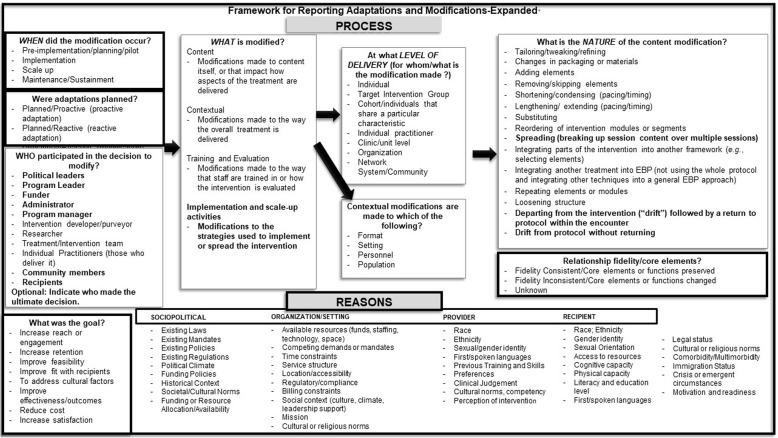
BACKGROUND: This paper describes the process and results of a refinement of a framework to characterize modifications to interventions. The original version did not fully capture several aspects of modification and adaptation that may be important to document and report. Additionally, the earlier framework did not include a way to differentiate cultural adaptation from adaptations made for other reasons. Reporting additional elements will allow for a more precise understanding of modifications, the process of modifying or adapting, and the relationship between different forms of modification and subsequent health and implementation outcomes. DISCUSSION: We employed a multifaceted approach to develop the updated FRAME involving coding documents identified through a literature review, rapid coding of qualitative interviews, and a refinement process informed by multiple stakeholders. The updated FRAME expands upon Stirman et al.'s original framework by adding components of modification to report: (1) when and how in the implementation process the modification was made, (2) whether the modification was planned/proactive (i.e., an adaptation) or unplanned/reactive, (3) who determined that the modification should be made, (4) what is modified, (5) at what level of delivery the modification is made, (6) type or nature of context or content-level modifications, (7) the extent to which the modification is fidelity-consistent, and (8) the reasons for the modification, including (a) the intent or goal of the modification (e.g., to reduce costs) and (b) contextual factors that influenced the decision. Methods of using the framework to assess modifications are outlined, along with their strengths and weaknesses, and considerations for research to validate these measurement strategies. CONCLUSION: The updated FRAME includes consideration of when and how modifications occurred, whether it was planned or unplanned, relationship to fidelity, and reasons and goals for modification. This tool that can be used to support research on the timing, nature, goals and reasons for, and impact of modifications to evidence-based interventions.
Overview
CoChat Summary
TL;DR
This paper refines the FRAME (Framework for Reporting Adaptations and Modifications-Enhanced) to better document how, when, why, and by whom evidence-based interventions are modified. It expands the original framework to capture planned vs. unplanned changes, timing across implementation phases, fidelity consistency, and cultural and contextual reasons for modification.
Key findings
- The updated FRAME adds 8 reporting aspects: timing in the implementation process, planned/proactive vs. unplanned/reactive, who decided, what was modified, level of delivery, type/nature of modifications, fidelity consistency, and reasons/goals for modification.
- The authors’ refinement process used multiple data sources: coding literature identified through a review, rapid coding of qualitative interviews with 55 mental health providers and administrators, and stakeholder feedback.
- The literature review process examined a total of 170 individual articles describing adaptations to interventions, with a “stop rule” that halted article review after no new aspects were found in 10 original sources from each additional systematic review.
- The paper explicitly adds cultural adaptation as a distinct reason for modification and specifies goals such as improving feasibility, acceptability, reach/engagement, fit, reducing costs, improving clinical outcomes, or aligning with cultural values, norms, or priorities.
Methods
- Pragmatic, multifaceted framework refinement combining literature review, qualitative interview data, and stakeholder consultation.
- Literature review and snowballing of published frameworks, reviews, and articles on adaptations/modifications; qualitative rapid coding of interview responses from 55 providers/administrators.
- Data from both sources were consolidated, collapsed into subcategories by consensus among the three authors, and then presented to stakeholder groups for further refinement.
Limitations
- The paper states it did not use a systematic review or traditional thematic analysis; it says these approaches did not align with the project goals.
- The authors note that comprehensively cataloging modifications may be difficult in some contexts, especially when an intervention has not been exhaustively described and tested; this is a limitation of applying FRAME in practice, not of the paper’s own analysis.
- The paper also says the feasibility of using a comprehensive framework will vary across research and applied settings, and that further evaluation of different ways to use FRAME is needed.
Model-written summary. Check it against the paper before relying on it.
Integrity signals
Registry
Cites
Statistics
Figures
Verification
Claims the paper makes
20 Valid · 4 Not valid · 4 Not checked · 42 Own results and interpretations
Some cited sources support this claim and some don’t — read each source’s verdict below.
In the paper
“Further, we recognized that other aspects of reporting that may be important for improving understanding of modification and its impact, such as when in the implementation process the modification was made, were also not included [28–31].”
§ The FRAME: an expanded framework for reporting adaptations and modifications to evidence-based interventions > Background
What the sources say
- Disputedcites [28] Rabin B, McCreight M, Glasgow R, editors. Systematic multi-method documentation of adaptations in five health system interventions. Implementation Sci 2018;13. sourceExperimental — accuracy not yet measured
The Methods > Adaptation Framework section says the original Stirman framework was expanded to include when adaptations were made. But the framework presented in this cited paper itself includes a WHEN category for the stage of the project at which an adaptation occurred. Thus, this source does not support the claim that this aspect was absent from the prior frameworks cited; it documents one that included it. (LLM, conf=0.87)
Checked by a reasoning model — may be wrong.
- Partly supportedcites [29] Escoffery C Lebow-Skelley E Udelson H Böing EA Wood R Fernandez ME A scoping study of frameworks for adapting public health evidence-based interventions Transl Behav Med 2018 9 1 1 10 PMC6305563 29346635 sourceExperimental — accuracy not yet measured
The Discussion (Implications for future research; page unavailable) says adaptations should be documented to better understand their impact and calls for reporting guidelines. But the paper does not establish that the reviewed frameworks omitted reporting when, during implementation, a modification was made; its Introduction notes that a taxonomy of adaptation timing had been developed. (LLM, conf=0.80)
- Could not verifycites [30] Brown CH Curran G Palinkas LA Aarons GA Wells KB Jones L An overview of research and evaluation designs for dissemination and implementation Annu Rev Public Health 2017 38 1 22 28384085 PMC5384265 sourceExperimental — accuracy not yet measured
The Introduction (page unavailable) describes adaptations during preparation and implementation, and the Between-Site Designs section describes changing an implementation strategy if it fails. Neither passage addresses whether prior frameworks included reporting when a modification was made. Searches for modification timing and reporting found no passage that settles that claim. (LLM, conf=0.69)
- Could not verifycites [31] Ramsay JE, Janevic MR, Hogan CK, Edwards DL, Connell CM. Using the replicating effective programs framework to adapt a heart health intervention. Health Promot Pract. 2018. PMC6476690 29759012 sourceExperimental — accuracy not yet measured
The Background says adaptation processes are often poorly documented, and the Discussion (REP Framework: Limitations) says REP lacks explicit options for making certain modifications. Neither passage says prior frameworks omitted reporting when in implementation a modification was made; searches for that timing and reporting point found no such statement. (LLM, conf=0.72)
hedged- Asserted: passes — The authors put it forward as true.
- Checkable: passes — It can be checked against evidence.
- Load-bearing: passes — The paper’s conclusions depend on it.
- Based: passes — The paper gives a reason why it holds.
- Disputed
Every source the paper cites for this claim was checked and supports it.
In the paper
“Stirman and colleagues previously developed a Framework for Modification and Adaptations [16].”
§ The FRAME: an expanded framework for reporting adaptations and modifications to evidence-based interventions > Background
What the sources say
- Supportedcites [16] Stirman SW Miller CJ Toder K Calloway A Development of a framework and coding system for modifications and adaptations of evidence-based interventions Implementation Sci. 2013 8 65 PMC3686699 23758995 source
The paper’s Abstract (Methods) says the authors developed a system for classifying modifications to interventions, and the Background describes the intended framework. This supports identifying the work as the framework developed by Stirman and colleagues. (LLM, conf=0.94)
plain- Asserted: passes — The authors put it forward as true.
- Checkable: passes — It can be checked against evidence.
- Load-bearing: passes — The paper’s conclusions depend on it.
- Based: passes — The paper gives a reason why it holds.
- Supported
The cited sources support only part of this claim — read each source’s verdict below.
In the paper
“Without understanding forms of modification that occur, the systematic evaluation of processes and strategies that lead to more and less successful implementation may be hindered [2, 17–19].”
§ The FRAME: an expanded framework for reporting adaptations and modifications to evidence-based interventions > Background
What the sources say
- Supportedcites [2] Stirman SW Gutner C Edmunds J Evans AC Beidas R Relationships between clinician-level attributes and fidelity-consistent and fidelity-inconsistent modifications to an evidence-based psychotherapy Implementation Sci. 2015 10 1 115 PMC4534152 26268633 source
The Discussion says it is important to differentiate types of modifications and that measuring them and monitoring outcomes are necessary to understand their impact. The paper also links identifying factors associated with modifications to understanding how to improve evidence-based treatment delivery. This supports the citing sentence’s hedged point about evaluating implementation strategies. (LLM, conf=0.88)
- Supportedcites [17] Baumann AA Powell BJ Kohl PL Tabak RG Penalba V Proctor EK Cultural adaptation and implementation of evidence-based parent-training: a systematic review and critique of guiding evidence Child Youth Serv Rev 2015 53 113 120 25960585 PMC4419735 source
The Discussion (page unavailable) calls for documenting what was adapted and how, and says that identifying the diversity of adaptations helps researchers examine intervention impact. The Implementation section (page unavailable) says frameworks enable systematic evaluation and that evaluating outcomes helps identify which implementation strategies work best. Together, these passages support the claim's hedged point that failing to understand modifications may hinder such evaluation. (LLM, conf=0.86)
- Not checked — no full text of the sourcecites [18] Glasziou P Altman DG Bossuyt P Boutron I Clarke M Julious S Reducing waste from incomplete or unusable reports of biomedical research Lancet. 2014 383 9913 267 276 24411647 source
- Partly supportedcites [19] Baumann AA Domenech Rodríguez MM Amador NG Forgatch MS Parra-Cardona JR Parent management training-Oregon model (PMTO™) in Mexico City: integrating cultural adaptation activities in an implementation model Clin Psychol: Sci and Pract. 2014 21 1 32 47 PMC4457334 26052184 sourceExperimental — accuracy not yet measured
In “Implementation and Cultural Adaptation” (page unavailable), the paper says most implementation frameworks do not make adaptation explicit and calls for adaptation to be planned and evaluated throughout implementation. The Discussion (page unavailable) also stresses documenting adaptations so researchers can evaluate them. It does not explicitly say that failing to understand forms of modification hinders systematic comparison of strategies leading to more versus less successful implementation. (LLM, conf=0.78)
hedgedstates a possible cause- Asserted: passes — The authors put it forward as true.
- Checkable: passes — It can be checked against evidence.
- Load-bearing: passes — The paper’s conclusions depend on it.
- Based: passes — The paper gives a reason why it holds.
- Supported
The cited sources support only part of this claim — read each source’s verdict below.
In the paper
“The process, nature, and outcomes of modifications to evidence-based programs/practices (EBPs) have often not been well documented, despite considerable recent interest in the field of implementation science [5, 6].”
§ The FRAME: an expanded framework for reporting adaptations and modifications to evidence-based interventions > Background
What the sources say
- Partly supportedcites [5] von Thiele Schwarz U Förberg U Sundell K Hasson H Colliding ideals–an interview study of how intervention researchers address adherence and adaptations in replication studies BMC Med Res Methodol 2018 18 1 36 29739337 PMC5941334 sourceExperimental — accuracy not yet measured
The Background (page unavailable) says interventions are seldom described well enough to determine adaptations, and the Discussion says many adaptations are left out of journal reports. This supports the claim about poor documentation of modifications, but the paper does not establish that their outcomes are often poorly documented or explicitly characterize the degree of recent interest across implementation science. (LLM, conf=0.83)
- Not checked — no full text of the sourcecites [6] Sundell K Beelmann A Hasson H von Thiele Schwarz U Novel programs, international adoptions, or contextual adaptations? Meta-analytical results from German and Swedish intervention research J Clin Child Adolesc Psychol 2016 45 6 784 796 25864716 source
plain- Asserted: passes — The authors put it forward as true.
- Checkable: passes — It can be checked against evidence.
- Load-bearing: passes — The paper’s conclusions depend on it.
- Based: passes — The paper gives a reason why it holds.
- Partly supported
The cited sources support only part of this claim — read each source’s verdict below.
In the paper
“In fact, modifications that focus on increasing the fit of the EBPs with the target population can lead to improved engagement, acceptability, and clinical outcomes, particularly when working with minority populations [8–10].”
§ The FRAME: an expanded framework for reporting adaptations and modifications to evidence-based interventions > Background
What the sources say
- Not checked — no full text of the sourcecites [8] Steinka-Fry KT Tanner-Smith EE Dakof GA Henderson C Culturally sensitive substance use treatment for racial/ethnic minority youth: a meta-analytic review J Subst Abus Treat 2017 75 22 37 28237051 source
- Partly supportedcites [9] Rathod S Gega L Degnan A Pikard J Khan T Husain N The current status of culturally adapted mental health interventions: a practice-focused review of meta-analyses Neuropsychiatr Dis Treat 2018 14 165 178 29379289 PMC5757988 sourceExperimental — accuracy not yet measured
The Results (Cultural factors as moderators of effect of adapted interventions; page unavailable) report that some culturally adapted interventions had greater clinical effects, including when adaptations addressed patients’ cultural values and beliefs. The Introduction links a lack of cultural adaptation to poor uptake among minority populations. The paper does not establish improved acceptability or directly show improved engagement from these modifications, and its Conclusion says the effective components and populations remain uncertain. (LLM, conf=0.84)
- Not checked — no full text of the sourcecites [10] Bernal GE, Domenech Rodríguez MM. Cultural adaptations: tools for evidence-based practice with diverse populations: American Psychological Association; 2012. source
plainstates a cause- Asserted: passes — The authors put it forward as true.
- Checkable: passes — It can be checked against evidence.
- Load-bearing: unclear — It is unclear whether the paper’s conclusions depend on it.
- Based: passes — The paper gives a reason why it holds.
11 more claims · 6 with their cited sources checked
Create a free account to see all 70 claims and to verify the 3 references still open.
- It may state two separate claims as one. 26
- Probably not a substantial claim. 45
Claims other papers make about this one
Each is checked against this paper’s own text: does it say what the citing paper says it does?
The cited source says what the claim attributes to it.
In the citing paper
“Published guidance highlights the importance of Adapting the innovation [76], and the updated CFIR notes the importance of adapting the setting as well [77].”
From The updated consolidated framework for implementation research based on user feedback (2022) · cites this paper as [76]
The cited source says what the claim attributes to it.
In the citing paper
“Retrospective in nature, this study provides guidance in evaluating the implementation of a newborn care package but is limited in providing more in-depth instruction on systematic detail on modifications and adaptations to tailor interventions for this setting (79–81).”
The cited source says what the claim attributes to it.
In the citing paper
“Interviews will capture any adaptations to the ICU-PAUSE tool based on the FRAME method, such as the timing, participants, and nature of each modification [20].”
From Improving Communication in Intensive Care Unit to Ward Transitions: Protocol for Multisite National Implementation of the ICU-PAUSE Handoff Tool (2023) · cites this paper as [20]
The cited source says what the claim attributes to it.
In the citing paper
“Adaptations will be noted and codified using the Framework for Reporting Adaptations and Modifications-Expanded (FRAME) method of tracking adaptations in our postimplementation interviews [20].”
From Improving Communication in Intensive Care Unit to Ward Transitions: Protocol for Multisite National Implementation of the ICU-PAUSE Handoff Tool (2023) · cites this paper as [20]
Citations
Cites
Damschroder, L. J., Aron, D. C., Keith, R. E., Kirsh, S. R., Alexander, J. A., & Lowery, J. C. (2009) · Implementation Science · doi:10.1186/1748-5908-4-50 · Cited by 14,496
The social determinants of health: It’s time to consider the causes of the causes
Braveman, P., & Gottlieb, L. (2014) · Public Health Reports® · doi:10.1177/00333549141291s206 · Cited by 3,861
Advancing a Conceptual Model of Evidence-Based Practice Implementation in Public Service Sectors
Aarons, G. A., Hurlburt, M., & Horwitz, S. M. (2011) · Administration and Policy in Mental Health and Mental Health Services Research · doi:10.1007/s10488-010-0327-7 · Cited by 3,240
Implementation strategies: recommendations for specifying and reporting
Proctor, E. K., Powell, B. J., & McMillen, J. C. (2013) · Implementation Science · doi:10.1186/1748-5908-8-139 · Cited by 2,585
The dynamic sustainability framework: addressing the paradox of sustainment amid ongoing change
Chambers, D. A., Glasgow, R. E., & Stange, K. C. (2013) · Implementation Science · doi:10.1186/1748-5908-8-117 · Cited by 1,724
Wiltsey Stirman, S., Kimberly, J., Cook, N., Calloway, A., Castro, F., & Charns, M. (2012) · Implementation Science · doi:10.1186/1748-5908-7-17 · Cited by 1,355
Reducing waste from incomplete or unusable reports of biomedical research
Glasziou, P., Altman, D. G., Bossuyt, P., Boutron, I., Clarke, M., Julious, S., Michie, S., Moher, D., & Wager, E. (2014) · The Lancet · doi:10.1016/s0140-6736(13)62228-x · Cited by 1,319
The Cultural Adaptation of Prevention Interventions: Resolving Tensions Between Fidelity and Fit
Castro, F. G., Barrera, M., & Martinez, C. R. (2004) · Prevention Science · doi:10.1023/b:prev.0000013980.12412.cd · Cited by 1,228
Bernal, G., Bonilla, J., & Bellido, C. (1995) · Journal of Abnormal Child Psychology · doi:10.1007/bf01447045 · Cited by 1,120
The Sustainability of Evidence-Based Interventions and Practices in Public Health and Health Care
Shelton, R. C., Cooper, B. R., & Stirman, S. W. (2018) · Annual Review of Public Health · doi:10.1146/annurev-publhealth-040617-014731 · Cited by 806
Self-citation
Research works printed but not linked: 2
- Rabin B, McCreight M, Glasgow R, editors. Systematic multi-method documentation of adaptations in five health system interventions. Implementation Sci 2018;13. · DOI · Paper page
- Rogers EM. Diffusion of innovations: New York The Free Press, A Division of Simon & Schuster, Inc; 2010.
Cited by
Items 501–600 of 1,315
Kappler, C. B., Coffman, C. J., Stechuchak, K. M., Choate, A., Meyer, C., Zullig, L. L., Hughes, J. M., Drake, C., Sperber, N. R., Kaufman, B. G., et al. (2024) · Implementation Science Communications · doi:10.1186/s43058-024-00544-5 · Cited by 8
“All adaptations to delivery, planned and unplanned, will be reported using Wiltsey Stirman’s Framework for Reporting Adaptions and Modifications Expanded (FRAME), which offers a standardized approach to track modifications [32].”
MethodKepper, M. M., Stamatakis, K. A., Deitch, A., Terhaar, A., Gates, E., Cole, G., French, C. S., Hampton, A., Anderson, L. R., & Eyler, A. A. (2024) · International Journal of Environmental Research and Public Health · doi:10.3390/ijerph21040463 · Cited by 11
Partnering with Schools to Adapt a Team Science Intervention: Processes and Challenges
Kuriyan, A. B., Albright, J., Rushworth, S., Duresso, B., Testa, S. M., Eiraldi, R. B., Marshaleck, E. W., & Wolk, C. B. (2024) · School Mental Health · doi:10.1007/s12310-024-09665-7 · Cited by 9
“The results of the advisory board’s collaborative effort to identify adaptations needed to the TeamSTEPPS training protocol are organized according to the Framework for Reporting Adaptations and Modifications-Expanded (FRAME; Stirman et al., 2019).”
MethodPinto, B. M., Patel, A., Ostendorf, D. M., Huebschmann, A. G., DUNSIGER, S. I., & Kindred, M. M. (2024) · JMIR Research Protocols · doi:10.2196/52494 · Cited by 10
“We will track adaptations throughout the duration of the implementation of webMFT based on a survey adapted from the Framework for Reporting Adaptations and Modifications-Enhanced (FRAME; Table 2) [42] and using qualitative methods (Table 3).”
MethodBlok, A. C., Drake, C., Decosimo, K. P., Zullig, L. L., Hughes, J. M., Sperber, N. R., Kota, S., Franzosa, E. C., Coffman, C. J., Shepherd‐Banigan, M. E., et al. (2024) · Health Services Research · doi:10.1111/1475-6773.14360 · Cited by 8
Tighe, C. A., Phares, A. D., Weiner, D. K., Beehler, G. P., VanSwearingen, J. M., Harvey, A. G., Hilgeman, M. M., Buysse, D. J., & Forman, D. E. (2024) · Behavioral Sleep Medicine · doi:10.1080/15402002.2024.2386602 · Cited by 5
“Adaptations were classified using the Framework for Reporting Adaptations and Modifications-Expanded (FRAME; Wiltsey Stirman et al., 2019).”
Dalen-Lorentsen, T., O’Brien, J. G., & Harøy, J. (2024) · BMJ Open Sport & Exercise Medicine · doi:10.1136/bmjsem-2024-001982 · Cited by 8
Viljoen, M., Seris, N., Shabalala, N., Ndlovu, M., de Vries, P. J., & Franz, L. (2024) · Autism · doi:10.1177/13623613241300774 · Cited by 9
“The Framework for Modification and Adaptations (FRAME) (Stirman et al., 2013; Wiltsey Stirman et al., 2019) guides documentation of adaptations through eight aspects of the adaptation process: (1) when and how in the implementation process the modification was made, (2) whether the modification was…”
InfluentialAdaptation of a Dietary Screener for Asian Americans
Beasley, J. M., Yi, S. S., Lee, M., Park, A., Thorpe, L. E., Kwon, S. C., & Rummo, P. E. (2021) · Health Promotion Practice · doi:10.1177/15248399211034800 · Cited by 5
Sobers, N., Hambleton, I. R., Hassan, S., Anderson, S. G., Brathwaite-Graham, L., Lewis, K., & Ferguson, T. S. (2021) · BMJ Open · doi:10.1136/bmjopen-2021-050548 · Cited by 4
Blonigen, D. M., Smith, J. S., Javier, S. J., Cucciare, M. A., Timko, C., Nevedal, A., Filice, N., Rosenthal, J., & Smelson, D. A. (2022) · Psychiatric Services · doi:10.1176/appi.ps.202100089 · Cited by 6
Hills, H. A., Lengnick‐Hall, R., Johnson, K., Vermeer, W., Brown, C. H., & McGovern, M. P. (2022) · Implementation Research and Practice · doi:10.1177/26334895221096295 · Cited by 6
“First, the pandemic removed structural barriers that previously constrained decisions, for example, new reimbursement options for virtual care (Beidas & Wiltsey Stirman, 2021; Chambers, 2020).”
BackgroundMethodShepherd‐Banigan, M. E., Wells, S. Y., Falkovic, M., Ackland, P. E., Swinkels, C. M., Dedert, E. A., Ruffin, R. A., Houtven, C. H. V., Calhoun, P. S., Edelman, D. E., et al. (2022) · SSM - Mental Health · doi:10.1016/j.ssmmh.2022.100114 · Cited by 7
Developing an Educational and Decision Support Tool for Stage I Lung Cancer Using Decision Science
Housten, A. J., Kozower, B. D., Engelhardt, K. E., Robinson, C. G., Puri, V., Samson, P. S., Cooksey, K. E., & Politi, M. C. (2022) · The Annals of Thoracic Surgery · doi:10.1016/j.athoracsur.2022.07.019 · Cited by 5
Lytle, L. A., Wasser, H., Godino, J., Lin, P., & Tate, D. F. (2022) · Obesity Science & Practice · doi:10.1002/osp4.633 · Cited by 6
Adapting Curricula for Children With Language Comprehension Deficits
Bridges, M. S., Curran, M. K., Neal, C., Piasta, S. B., Fleming, K., & Hogan, T. P. (2023) · Language Speech and Hearing Services in Schools · doi:10.1044/2023_lshss-22-00189 · Cited by 11
Harrison, J., Stokes, T., Hahne, J., & Shen, M. J. (2023) · Innovation in Aging · doi:10.1093/geroni/igad087 · Cited by 6
“The FRAME (Wiltsey Stirman et al., 2019) model provides a systematic approach to develop and report modifications and adaptions to interventions using a series of characteristics, including (a) when and how modifications were made, (b) whether the modification was planned or reactive, (c) who…”
BackgroundMethodInfluentialReszel, J., Daub, O., Leese, J., Augustsson, H., Bellows, D. M., Cassidy, C. E., Crowner, B. E., Dunn, S., Goodwin, L. B., Hoens, A. M., et al. (2023) · Implementation Science Communications · doi:10.1186/s43058-023-00525-0 · Cited by 9
Kirbach, K., Marshall-Moreno, I., Shen, A., Cullen, C., Sanigepalli, S., Bobadilla, A., MacElhern, L., Grunvald, E., Kallenberg, G., Tristão Parra, M., et al. (2024) · Frontiers in Nutrition · doi:10.3389/fnut.2024.1338727 · Cited by 4
Hashmi, A., Darakamon, M. C., Aung, K. K., Mu, M., Misa, P., Jittamala, P., Chu, C., Phyo, A. P., Turner, C., Nosten, F., et al. (2023) · Frontiers in Public Health · doi:10.3389/fpubh.2023.1144642 · Cited by 4
Huebschmann, A. G., Wagner, N. M., Gleason, M. C., Brinton, J. T., Brtnikova, M., Brewer, S. E., Begum, A., Armstrong, R., DeCamp, L. R., McFarlane, A. E., et al. (2024) · Implementation Science · doi:10.1186/s13012-024-01387-3 · Cited by 10
Sandanapitchai, P., & Nixon, R. D. V. (2025) · Behavior Therapy · doi:10.1016/j.beth.2025.03.003 · Cited by 4
Vincenzo, J. L., Wingood, M., Scott, A. J., Moore, R. A., Caulley, J. M., & Curran, G. M. (2025) · Journal of Geriatric Physical Therapy · doi:10.1519/jpt.0000000000000447 · Cited by 4
Clinician-Reported Person-Centered Culturally Responsive Practices for Youth with OCD and Anxiety
Flowers, S. N., Sanchez, A. L., Siddiqui, A., Weiss, M., & Becker‐Haimes, E. M. (2025) · Children · doi:10.3390/children12081034 · Cited by 7
“Adaptation refers to the intentional modification of interventions to enhance their relevance, accessibility, and effectiveness for a particular client or population [18–21].”
Cheng, A. L., Abraham, J., Hartz, S. M., Laber, E. B., & Miller, J. P. (2025) · JMIR Research Protocols · doi:10.2196/77532 · Cited by 8
Murphy, G. T., Sampalli, T., Carson, A., Embrett, M. G., Sim, M., Chamberland-Rowe, C., Indar, A., MacInnis, M., Murphy-Boyle, K., Rigby, J. A., et al. (2025) · Health Research Policy and Systems · doi:10.1186/s12961-025-01395-9 · Cited by 5
“Furthermore, the work of Stirman et al. underscores the significance of feed-back mechanisms in the implementation of interventions [225].”
Cook, N., Gunn, R., McGrath, R., Donovan, J., Pisciotta, M., Owens-Jasey, C., Fein, H. L., Templeton, A. R., Larson, Z., & Gold, R. B. (2025) · BMJ Open · doi:10.1136/bmjopen-2025-100340 · Cited by 9
“25–28 43 44 It is critical to engage health centre users as partners to guide the development of a set of evidence-based implementation strategies to address such barriers.”
Quique, Y. M., Pais, A. M., Isaksen, J., & Jagoe, C. (2026) · Aphasiology · doi:10.1080/02687038.2026.2627323 · Cited by 4
Byrnes, A., Flynn, R., Watt, A., Barrimore, S. E., & Young, A. (2023) · Journal of Evaluation in Clinical Practice · doi:10.1111/jep.13935 · Cited by 6
Cunningham, C., O’Doherty, M., Neill, R. D., Adams, M., Kee, F., Cupples, M., Hardeman, W., Simpson, E. E. A., MURPHY, M. H., Callaghan, C., et al. (2024) · Journal of Ageing and Longevity · doi:10.3390/jal4010003 · Cited by 5
“Any adaptations and modifications to the intervention will be recorded using the FRAME methodology to capture adaptations or modifications made by the peer mentors or participants [61].”
MethodPickard, K. E., Islam, N., Demitri, B., Hendrix, N. M., Davies, H., Yohannes, M., Buck, A., Doernberg, E. A., & Kuhn, J. (2024) · Early Childhood Research Quarterly · doi:10.1016/j.ecresq.2024.05.009 · Cited by 4
Rahja, M., Pietsch, A., Radoslovich, H., Galligani, N., Burton, N., Crotty, M., & Laver, K. (2024) · Australian Occupational Therapy Journal · doi:10.1111/1440-1630.12978 · Cited by 4
“We used the updated Framework for Reporting Adap-tations and Modifications-Expanded (FRAME; Wiltsey Stirman et al., 2019) to report adaptations made on the COPE program to be translated into RAC.”
InfluentialMethodology for evaluation of complex school-based health promotion interventions
O’Byrne, Y., Dinneen, J., & Coppinger, T. C. (2024) · Journal of Public Health Policy · doi:10.1057/s41271-024-00510-4 · Cited by 4
Kuroda, Y., Fujita, K., Sugimoto, T., Uchida, K., Yokoyama, Y., Shimazu, T., Saito, J., Arai, H., & Sakurai, T. (2025) · Journal of Alzheimer s Disease · doi:10.1177/13872877251315042 · Cited by 5
Balmer, A. N., Brömdal, A., Mullens, A. B., Kynoch, K., Osborne, S. R., & East, L. (2025) · Scientific Reports · doi:10.1038/s41598-025-89468-1 · Cited by 4
Integrating postnatal care into the redesign of group care beyond birth
Gresh, A., Damme, A. V., Billings, D. L., Rising, S. S., Ibrahim, S., Ajibola, A., Chirwa, E. M., Don-Aki, J., Donoho, N., Hindori, M. P., et al. (2025) · Archives of Public Health · doi:10.1186/s13690-025-01508-4 · Cited by 5
Cultural adaptations in autism interventions: a systematic review
Gómez, L. R., Cummings, C. M., Brunsting, N. C., & Terol, A. K. (2025) · International Journal of Developmental Disabilities · doi:10.1080/20473869.2025.2511660 · Cited by 7
Cruden, G., Crawford, S. A., & Saldana, L. (2021) · Frontiers in Psychology · doi:10.3389/fpsyg.2021.689432 · Cited by 8
Eisman, A. B., Palinkas, L. A., Koffkey, C., Herrenkohl, T. I., Abbasi, U., Fridline, J., Lundahl, L. H., & Kilbourne, A. M. (2022) · Pilot and Feasibility Studies · doi:10.1186/s40814-022-01145-6 · Cited by 4
Mastroleo, N. R., Possemato, K., King, P. R., Balderrama‐Durbin, C. M., Crinnin, C., Cigrang, J. A., Read, J. P., Borsari, B. E., Maisto, S. A., & Rauch, S. A. M. (2022) · Professional Psychology Research and Practice · doi:10.1037/pro0000489 · Cited by 5
Wilson, D. H., Nelson, K. E., Gresh, A., Ricker, A., Littlepage, S., Krienke, L. K., & Brockie, T. (2023) · Global Implementation Research and Applications · doi:10.1007/s43477-022-00070-3 · Cited by 9
da Fonseca, S. F., Ribeiro, A. L. P., Cimini, C. C. R., Soares, T. B. D. C., Delfino-Pereira, P., Nogueira, L. T., de Moura, R. M. F., Motta‐Santos, D., Ribeiro, L. B., Camargos, M., et al. (2023) · American Heart Journal · doi:10.1016/j.ahj.2023.04.006 · Cited by 4
Adaptations of an Effective Evidence-Based Pediatric Weight Management Intervention
Bartee, R. T., Heelan, K. A., Golden, C. A., Hill, J. L., Porter, G. C., Abbey, B. M., George, K., Foster, N. E., & Estabrooks, P. A. (2023) · Prevention Science · doi:10.1007/s11121-023-01557-7 · Cited by 7
“Within this context, adaptation is described as a process of thinking through and applying alterations in the delivery or design of an evidence-based intervention with an effort to improve local fit, effectiveness, or both (Stirman et al., 2019).”
BackgroundMethodInfluentialCollective Health in Brazil and Implementation Science: Challenges and Potentialities
Silva, A. A., Lopes, G. P. D., Claro, H. G., Menezes, P. R., Tanaka, O. Y., & Campos, R. T. O. (2023) · Global Implementation Research and Applications · doi:10.1007/s43477-023-00095-2 · Cited by 8
“This phase is important to anticipate and deliberate on the necessary changes associated with the barriers and potentialities of implementation (Wiltsey et al., 2019).”
Notley, C. J., Brown, T. J., Bauld, L., Clark, A., Duneclift, S., Gilroy, V., Harris, T. J., Hardeman, W., Holland, R., Howard, G., et al. (2023) · BMJ Open · doi:10.1136/bmjopen-2023-076458 · Cited by 5
Translating evidence-based knowledge objects into practice
Scheuer, J. D. (2023) · Frontiers in Health Services · doi:10.3389/frhs.2023.1107096 · Cited by 5
Nardo, E., Parchuri, E., O’Brien, J. A., Crosby, L. E., Porter, J. S., Palermo, T. M., Nikolajski, C., Treadwell, M. J., Hillery, C. A., Szigethy, E., et al. (2023) · BMC Digital Health · doi:10.1186/s44247-023-00051-y · Cited by 10
Greene, M. C., Wimer, G., Larrea, M., Jimenez, I. M., Armijos, A., Angulo, A., Guevara, M. E., Vega, C., Heard, E., Demis, L. Y., et al. (2024) · Cambridge Prisms Global Mental Health · doi:10.1017/gmh.2024.29 · Cited by 10
“To complement the findings from qualitative interviews, the research teamusedtheFRAME-IS tocapture adaptationsmade acrossphases of implementation (Stirman et al., 2019; Miller et al., 2021).”
MethodRangel, E., Rieth, S. R., Mejia, Y., Cervantes, L., Vazquez, B. B., & Brookman-Frazee, L. I. (2024) · Journal of Child and Family Studies · doi:10.1007/s10826-024-02816-z · Cited by 5
“Promotoras, like community mental health therapists, reported lengthening sessions, adding, and removing components to tailor the curriculum for their clients ’ needs (Stirman et al., 2013; 2019; Lau et al., 2017).”
InfluentialCataldi, J. R., Brewer, S. E., Perreira, C., Fisher, M. E. K., Spina, C. I., Cochran, F., Glasgow, R. E., & O’Leary, S. T. (2024) · Translational Behavioral Medicine · doi:10.1093/tbm/ibae012 · Cited by 4
Romero, S. A. D., Au, L., Ortega, R. E. F., Helsten, T. L., Palomino, H., Kaiser, B. N., Echevarria, M., Lukas, K., Freeman, K., Zou, J., et al. (2024) · Contemporary Clinical Trials · doi:10.1016/j.cct.2024.107537 · Cited by 4
Schøler, P. N., Volke, K. H., Andréasson, S., Rasmussen, S., Søndergaard, J., & Nielsen, A. S. (2024) · Addiction Science & Clinical Practice · doi:10.1186/s13722-024-00474-6 · Cited by 6
Reimagining policy implementation science in a global context: a theoretical discussion
List, K., Agamile, P., Alia, D. Y., Cherutich, P., Danforth, K., Kinuthia, J., Means, A. R., Mukui, I., Ngumbau, N. M., Su, Y., et al. (2024) · Frontiers in Health Services · doi:10.3389/frhs.2024.1292688 · Cited by 6
King, D. K., Ondersma, S. J., McRee, B. G., German, J. S., Loree, A. M., Harlowe, A., Alford, D. P., Sedotto, R. N. M., & Weber, M. K. (2024) · Substance Use & Addiction Journal · doi:10.1177/29767342241271404 · Cited by 5
“Constructs from the Framework for Reporting Adaptations and Modifications-Expanded (FRAME) 18,20 were used to describe whether adaptations were planned or unplanned, what was modified (ie, content, context, training, evaluation, or implementation), why it was modified, and lessons learned.”
InfluentialBrito, F. A., Alves, T. F., Santos, N., Michaud, T. L., Eisenhauer, C. M., de Leon, E. B., Squarcini, C. F. R., Kachman, S., Almeida, F. A., & Estabrooks, P. A. (2024) · BMJ Open · doi:10.1136/bmjopen-2024-089186 · Cited by 6
“FRAME includes consideration of when and how modifications occurred, whether it was planned or unplanned, relationship to fidelity, and reasons and goals for modification.”
Kersey, J., Alimi, E., McArthur, A. R., Marquez, H., Baum, C. M., Skidmore, E. R., & Hammel, J. M. (2025) · Brain Injury · doi:10.1080/02699052.2025.2449927 · Cited by 5
“The process for planning and conducting intervention adaptation was guided by the Framework for Reporting Adaptations and Modification – Expanded (FRAME) (32).”
Pettersson, K., Millroth, P., Giannotta, F., Liedgren, P., Lyon, A. R., Hasson, H., & Schwarz, U. V. T. (2025) · Implementation Science · doi:10.1186/s13012-025-01421-y · Cited by 6
Northwood, M., Chambers, T., Fisher, K., Ganann, R., Markle‐Reid, M., Yous, M., Beleno, R., Gaudet, G., Gruneir, A., Leung, H., et al. (2025) · BMC Health Services Research · doi:10.1186/s12913-025-12378-5 · Cited by 6
“Failing to adequately consider equity issues and local community needs when assessing scalability could perpetuate or exacerbate health inequities if programs are scaled up without knowledge of their impact across diverse communities [7, 33].”
Hill, A. L., Housten, A. J., Cooksey, K. E., Goldstein, E., Mozersky, J. T., & Politi, M. C. (2025) · BMJ Open · doi:10.1136/bmjopen-2024-092185 · Cited by 6
Zetterlund, J., Hasson, H., Schwarz, U. V. T., Neher, M., & Wahlström, E. (2025) · Implementation Research and Practice · doi:10.1177/26334895251334552 · Cited by 4
Dissemination and Implementation Science
Morrato, E. H., & Smith, M. Y. (2020) · Springer eBooks · doi:10.1007/978-981-15-3013-5_13 · Cited by 6
Imm, P. S., Price, A. W., & Kirk, A. (2021) · Journal of Applied Research on Children Informing Policy for Children at Risk · doi:10.58464/2155-5834.1431 · Cited by 4
Patel, S. R., Bello, I., Cabassa, L. J., Nossel, I. R., Wall, M. M., Montague, E., Rahim, R., Mathai, C. M., & Dixon, L. B. (2021) · Implementation Science Communications · doi:10.1186/s43058-021-00178-x · Cited by 4
Jelalian, E., Evans, E. W., Darling, K. E., Seifer, R., Vivier, P. M., Goldberg, J. P., Wright, C. M., Tanskey, L. A., Warnick, J. L., Hayes, J. F., et al. (2021) · Childhood Obesity · doi:10.1089/chi.2021.0179 · Cited by 4
Implementation Science for Managers and Healthcare Organizations Responding to Emergencies
Øvretveit, J., & Ohrling, M. (2021) · Global Implementation Research and Applications · doi:10.1007/s43477-021-00025-0 · Cited by 6
Wong, S., Hassett, L. M., Koorts, H., Grunseit, A. C., Tong, A., Tiedemann, A., Greaves, C. J., Haynes, A. S., Milat, A., Harvey, L. A., et al. (2022) · Trials · doi:10.1186/s13063-021-05990-3 · Cited by 4
“The FRAME: an expanded framework for reporting adaptations and modifications to evidence-based interventions.”
MethodInfluentialStudy Protocol: Multi-Level Determinants of Implementation and Sustainment in the Education Sector
McLeod, B. D., Sutherland, K. S., Conroy, M. A., Lyon, A. R., Chapman, J. E., Granger, K. L., & Saldana, L. (2022) · Journal of Emotional and Behavioral Disorders · doi:10.1177/10634266221090160 · Cited by 7
“While integrity measurement can characterize what modifications are made, it cannot determine why (Stirman et al., 2019), and few studies have sought to understand why EBP modifications are made (Marques et al.”
BackgroundMethodInfluentialWalsh, R. J., McKay, V., Hansen, P., Barco, P. P., Jones, K. D., Lee, Y., Patel, R. D., Chen, D., Heinemann, A. W., Lenze, E. J., et al. (2022) · Archives of Physical Medicine and Rehabilitation · doi:10.1016/j.apmr.2022.04.010 · Cited by 4
Eleven Reasons for Adaptation of Swedish Parenting Programs
Pettersson, K., Liedgren, P., Giannotta, F., & Schwarz, U. V. T. (2022) · Frontiers in Health Services · doi:10.3389/frhs.2022.923504 · Cited by 5
“More broadly, sociopolitical factors, such as financial allocations or other political actions, might influence the likelihood of adaptation through indirect means (5).”
BackgroundInfluentialUnderstanding when, why and how shared decision making is used in routine care
Politi, M. C., & Neuman, M. D. (2022) · Patient Education and Counseling · doi:10.1016/j.pec.2022.10.352 · Cited by 4
A Mixed-Methods Investigation Examining Site-Level Variation in Reach Out and Read Implementation
Jiménez, M. E., Hemler, J. R., Uthirasamy, N., Bator, A., Forbes, D. H., Lucas, M., Ramachandran, U., Crabtree, B. F., & Mackie, T. I. (2022) · Academic Pediatrics · doi:10.1016/j.acap.2022.11.015 · Cited by 9
Wallen, E. S., Sippel, J. L., Park, M. E., Etingen, B., Weaver, F. M., Hogan, T. P., Smith, B., Bokhour, B. G., & Wickremasinghe, I. M. (2023) · Journal of Spinal Cord Medicine · doi:10.1080/10790268.2023.2183325 · Cited by 4
“…for specialized implementation settings and populations is scientifically sound and an appropriate and impactful strategy for optimizing program implementation and reach (29) and may offer an important means for VHA to improve reach of Whole Health to Veterans with SCI/D and other disabilities.”
BackgroundTyler, A. N., & Jolles, M. P. (2023) · Journal of Hospital Medicine · doi:10.1002/jhm.13147 · Cited by 4
Wu, J., Bolton, R. E., Anwar, C., Bokhour, B. G., Khanna, A., MULLUR, R. S., Taylor, S. L., & Hyde, J. K. (2023) · Journal of Integrative and Complementary Medicine · doi:10.1089/jicm.2023.0106 · Cited by 4
“28 Using rapid coding in Microsoft Excel, 29–31 team members (C.A., R.E.B., J.H., A.K., and J.W.) coded data into a priori categories derived from our interview guide.”
Frazier, M. C., Balis, L. E., Armbruster, S. D., Estabrooks, P. A., & Harden, S. M. (2023) · Translational Behavioral Medicine · doi:10.1093/tbm/ibad052 · Cited by 4
Kåks, P., Katzen, L. S., Målqvist, M., Bergström, A., & van Wees, S. H. (2024) · Frontiers in Public Health · doi:10.3389/fpubh.2023.1332738 · Cited by 9
Evidence-Based Program Implementation Variability in New Contexts: The Head Start REDI Program
Welsh, J. A., Chilenski, S. M., Daniels, A. M., Letcher, A., & Garcia, A. S. (2024) · Early Childhood Education Journal · doi:10.1007/s10643-024-01648-2 · Cited by 9
“Studies of EBP adaptation have delineated both the kinds of changes made by implementers and the reasons for making them (Moore et al., 2013 ; Wiltsey Stirman et al., 2013, 2019), with the goal of distinguishing detrimental changes from those that might enhance program fit and effective - ness.”
Scale-up and Sustainment of Effective Interventions
Wolfenden, L., Sutherland, R., Shelton, R. C., Yoong, S. L., & Nathan, N. (2023) · Oxford University Press eBooks · doi:10.1093/oso/9780197660690.003.0029 · Cited by 4
Tabak, R. G., Nilsén, P., Woodward, E. N., & Chambers, D. (2023) · Oxford University Press eBooks · doi:10.1093/oso/9780197660690.003.0004 · Cited by 10
Mawey, F. M., Karimah, A., & Kusmiati, T. (2023) · Bali Medical Journal · doi:10.15562/bmj.v12i2.4287 · Cited by 5
Parchuri, E., Nardo, E., O’Brien, J. A., Crosby, L. E., Porter, J. S., Palermo, T. M., Nikolajski, C., Treadwell, M. J., Hillery, C. A., Szigethy, E., et al. (2023) · Research Square · doi:10.21203/rs.3.rs-3073103/v1 · Cited by 4
Process Evaluation in Health Services Research
Wensing, M., & Poß-Doering, R. (2023) · Springer eBooks · doi:10.1007/978-3-031-29998-8_13 · Cited by 3
Fiscella, K. A., Sass, E., Sridhar, S. B., Maguire, J., Lashway, K., Wong, G., Thien, A., Thomas, M., Bisognano, J. D., Rosenberg, T., et al. (2023) · Contemporary Clinical Trials · doi:10.1016/j.cct.2023.107332 · Cited by 4
Palazzo, L. G., Dorsey, C. N., Mogk, J. M., Beatty, T. C., King, D., Stefanik-Guizlo, K., Key, D. L., Matson, T. E., Shea, M. T., Caldeiro, R. M., et al. (2024) · Implementation Research and Practice · doi:10.1177/26334895241301670 · Cited by 5
“The Dynamic Sustainability Framework (DSF) and the Framework for Reporting Adaptations and Modi fi cations to Evidence-based Implementation Strategies (FRAME-IS) guided formative evaluation (Chambers et al., 2013; Miller et al., 2021; Wiltsey Stirman et al., 2019).”
Jaramillo, J., Chavez, J. V., Larson, M. E., & Harkness, A. (2025) · Current HIV/AIDS Reports · doi:10.1007/s11904-024-00719-8 · Cited by 6
“More research is needed to systematically document community-informed strategies and their impact on intervention effectiveness and outcomes [74, 80] for LMSM.”
McGuire, A. P., Riera, A., & Lascano, X. N. (2025) · Contemporary Clinical Trials Communications · doi:10.1016/j.conctc.2025.101445 · Cited by 5
March, C. A., Naame, E., Libman, I. M., Proulx, C. N., Siminerio, L. M., Miller, E. P., & Lyon, A. R. (2025) · JMIR Diabetes · doi:10.2196/64096 · Cited by 6
“The goal of the SPACE adaptation was to maintain fidelity to the core components of the CCM with the addition and removal of some elements to accommodate the differing content and contextual factors [33].”
Wainer, A., Edmunds, S. R., Carter, A. S., Stone, W. L., Sheldrick, R. C., Broder‐Fingert, S., Stern, Y. S., Harrington, E. M., Ibañez, L. V., & Ingersoll, B. R. (2025) · BMC Pediatrics · doi:10.1186/s12887-025-05587-8 · Cited by 4
Understanding adaptations in a community-vetted COVID-19 testing program
Reyes, B. J., Calvillo, S. T., Lomeli, A., Escoto, A. A., Burola, M. L., Cain, K. L., Salgin, L., Balbuena-Bojorquez, M., Engler, A.-M., Seifert, M., et al. (2025) · Frontiers in Health Services · doi:10.3389/frhs.2025.1408940 · Cited by 3
LeCaire, T. J., Schroeder, M., Paniagua, U., Stone, J., Albrecht, T., Houston, S. L., Schrager, S., Carlsson, C. M., & Walaszek, A. (2025) · Implementation Science Communications · doi:10.1186/s43058-025-00754-5 · Cited by 3
“We will also address gaps between priorities and progress during implementation using a structured, iterative process, using iterative RE-AIM [46] or other frameworks to identify and document more local context-specific adaptations, such as ADAPT [54, 55].”
Reichenberger, V., van der Watt, A. S. J., Louw, Q. A., Seedat, S., & Smythe, T. (2025) · EClinicalMedicine · doi:10.1016/j.eclinm.2025.103444 · Cited by 11
“…Ecological Validity Framework 76,77 and the FRAME (Framework for Reporting Adaptations and Modifications to Evidence-based Interventions) check-list 78 —emphasises participatory co-design with local caregivers, iterative piloting, and transparent reporting of who modified each component, why and…”
Dykens, J. A., Sougou, N. M., Gassama, O., Dieng, N. M., Peterson, C. E., Patil, C. L., Awadalla, S., Abboud, S., Ndiaye, I., Diongue, F. B., et al. (2025) · International Journal of Women s Health · doi:10.2147/ijwh.s515070 · Cited by 3
“50 The adaptation process informs the development of the Fidelity Checklist used in Aim 3.”
Liang, S., McKay, S., Lin, F., Zaheed, M., Morrow, A., Douglas, B., Chan, J., Monaghan, H., Chan, P., Kennedy, E., et al. (2025) · BMJ Open · doi:10.1136/bmjopen-2024-090270 · Cited by 4
Roby, E., Mills-Koonce, R., & Mendelsohn, A. L. (2025) · Academic Pediatrics · doi:10.1016/j.acap.2025.103192 · Cited by 4
Williston, S. K., Kruepke, M., Grossman, D., Litwack, S. D., & Niles, B. L. (2021) · Cognitive and Behavioral Practice · doi:10.1016/j.cbpra.2021.06.002 · Cited by 4
Engaging With Program Adaptations in Evaluation: A Range of Existing Options and a New Opportunity
Mark, M. M. (2021) · American Journal of Evaluation · doi:10.1177/10982140211031657 · Cited by 4
“FRAME’s codings for alternative types of context modifications may also be useful to prime the pump.”
BackgroundResultInfluentialWang, V., Dadolf, J., Decosimo, K. P., Robinson, K., Choate, A., Bruening, R., Sperber, N. R., Mahanna, E. P., Houtven, C. H. V., Allen, K. D., et al. (2022) · BMC Health Services Research · doi:10.1186/s12913-022-08270-1 · Cited by 5
“Stirman Wiltsey and colleagues’ FRAME provided a structure for documenting both planned and unplanned intervention adaptations.”
BackgroundMethodInfluentialvan Spreuwel, P. C. J. M., Munk-Overkamp, M. L. C., Smit, L. C., Ziesemer, K. A., van Loveren, C., van der Heijden, G. J. M. G., Bruers, J. J. M., & Jerković‐Ćosić, K. (2022) · PLoS ONE · doi:10.1371/journal.pone.0275501 · Cited by 3
Development and Application of the Scale-Up Reflection Guide (SRG)
Lee, K., Crane, M. A., Grunseit, A. C., O'Hara, B. J., Milat, A., Wolfenden, L., Bauman, A. E., & van Nassau, F. (2023) · International Journal of Environmental Research and Public Health · doi:10.3390/ijerph20116014 · Cited by 4
Salloum, R. G., Romani, M., Bteddini, D. S., El‐Jardali, F., Lee, J., Theis, R. P., LeLaurin, J. H., Hamadeh, R. R., Osman, M. H., Abla, R., et al. (2023) · Implementation Science Communications · doi:10.1186/s43058-023-00456-w · Cited by 4
Metadata
- Authors
- Wiltsey Stirman, S., Baumann, A. A., & Miller, C. J.
- Affiliations
- Washington University in St. Louis (US)
- Harvard University (US)
- Venue
- Implementation Science
- Published
- 2019-06-06
- Volume
- 14
- Issue
- 1
- Pages
- 58-58
- ISSN
- 1748-5908 (ISSN-L)
- PMC
- PMC6554895
- OpenAlex
- W2948736612
- Semantic Scholar
- 56ebee1f12bc4d774af4af45ec6d2283838708f6
- Cited by
- 1,329
- References
- 56
- Citations by year
- 2026: 207 · 2025: 206 · 2024: 230 · 2023: 245 · 2022: 188 · 2021: 163 · 2020: 79 · 2019: 8
- FWCI
- 149.04
- Type
- journal article
- Language
- en
- Open access
- gold
- doi.org
- Licence
- cc-by
- creativecommons.org/licenses/by/4.0/ (tdm)
- creativecommons.org/licenses/by/4.0/ (vor)
- Locations
- Implementation Science (publishedVersion, cc-by)
- PubMed Central (publishedVersion, cc-by)
- PubMed (publishedVersion)
- DOAJ (DOAJ: Directory of Open Access Journals) (submittedVersion, cc-by-sa)
- Funders
- National Institute of Mental Health (R01 MH 106506, U01HL133994-03S, UL1TR00234, R01HG009351, U24HL136790-02, 5R25MH08091607)
- Quality Enhancement Research Initiative (QUE 15-289)
- Topics
- Health Sciences › Health Professions › General Health Professions › Health Policy Implementation Science
- Social Sciences › Public Administration › Evaluation and Performance Assessment
- Health Sciences › Medicine › Public Health, Environmental and Occupational Health › Clinical practice guidelines implementation
- Keywords
- FRAME framework, intervention adaptation, cultural adaptation, reporting framework, implementation fidelity, implementation outcomes, evidence-based interventions
- MeSH terms
- Clinical Competence, Delivery of Health Care, Humans, Psychotherapy, Organizational Culture, Evidence-Based Medicine, Clinical Coding
About these checks
Registry, retraction, Cites and statistics results are computed, not judged, with one exception: a printed reference that no index lists is read once by a model before it counts as a citation error. Claims are extracted by a model and kept only when their quote appears verbatim in the text; each cited source is then checked, with a model’s help, for whether it says what the claim relies on. Those verdicts can be wrong — read the claim’s quote and the cited source before relying on one.
The claim verdicts this report counts are experimental: their accuracy is not yet measured.
A language model drew the claims from the paper on 2026-10-10, under version 3 of the claim definition (model deepseek-v4.1-flash, prompt extract-v3).
A second model labelled each claim on 2026-10-10 (model jev-1.13-20260917, definition revision gold-guideline-v0.2).
Cited sources are checked with a language model’s help (gpt-6-sol).
Statistics and arithmetic are recomputed, not judged.
Confidence bands are shown only for fields calibrated on our annotated test set. None is calibrated yet, so no band is shown.
What counts as a claim ›How we measure confidence ›How we check this ›
Are you an author, or do you see a problem with this page? Request a review
Data sources
Bibliographic data: Semantic Scholar, OpenAlex, Crossref.
Contains information from the Semantic Scholar Academic Graph Datasets, made available under the ODC Attribution License (ODC-BY 1.0).
Semantic Scholar’s data is described in: Kinney, R., et al. (2023). The Semantic Scholar Open Data Platform. arXiv:2301.10140.
