

The FRAME: an expanded framework for reporting adaptations and modifications to evidence-based interventions
Open accessThe DOI matches its Crossref record; 56 of the 56 references it cites were found in a registry or an index; 41 of the 69 sources its claims cite were checked for support.
Abstract
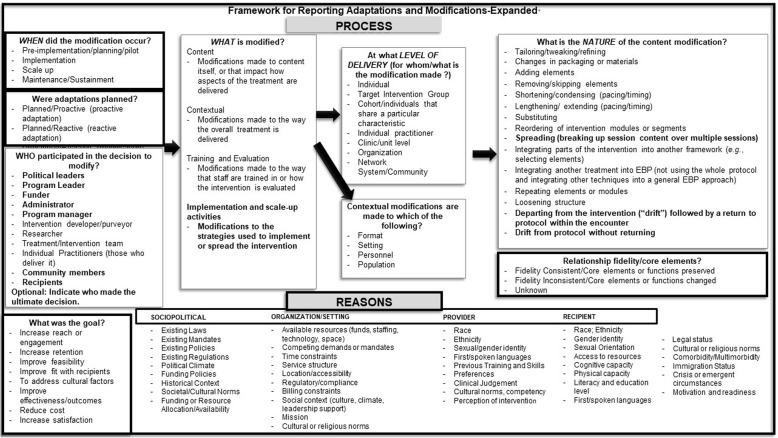
BACKGROUND: This paper describes the process and results of a refinement of a framework to characterize modifications to interventions. The original version did not fully capture several aspects of modification and adaptation that may be important to document and report. Additionally, the earlier framework did not include a way to differentiate cultural adaptation from adaptations made for other reasons. Reporting additional elements will allow for a more precise understanding of modifications, the process of modifying or adapting, and the relationship between different forms of modification and subsequent health and implementation outcomes. DISCUSSION: We employed a multifaceted approach to develop the updated FRAME involving coding documents identified through a literature review, rapid coding of qualitative interviews, and a refinement process informed by multiple stakeholders. The updated FRAME expands upon Stirman et al.'s original framework by adding components of modification to report: (1) when and how in the implementation process the modification was made, (2) whether the modification was planned/proactive (i.e., an adaptation) or unplanned/reactive, (3) who determined that the modification should be made, (4) what is modified, (5) at what level of delivery the modification is made, (6) type or nature of context or content-level modifications, (7) the extent to which the modification is fidelity-consistent, and (8) the reasons for the modification, including (a) the intent or goal of the modification (e.g., to reduce costs) and (b) contextual factors that influenced the decision. Methods of using the framework to assess modifications are outlined, along with their strengths and weaknesses, and considerations for research to validate these measurement strategies. CONCLUSION: The updated FRAME includes consideration of when and how modifications occurred, whether it was planned or unplanned, relationship to fidelity, and reasons and goals for modification. This tool that can be used to support research on the timing, nature, goals and reasons for, and impact of modifications to evidence-based interventions.
Overview
CoChat Summary
TL;DR
This paper refines the FRAME (Framework for Reporting Adaptations and Modifications-Enhanced) to better document how, when, why, and by whom evidence-based interventions are modified. It expands the original framework to capture planned vs. unplanned changes, timing across implementation phases, fidelity consistency, and cultural and contextual reasons for modification.
Key findings
- The updated FRAME adds 8 reporting aspects: timing in the implementation process, planned/proactive vs. unplanned/reactive, who decided, what was modified, level of delivery, type/nature of modifications, fidelity consistency, and reasons/goals for modification.
- The authors’ refinement process used multiple data sources: coding literature identified through a review, rapid coding of qualitative interviews with 55 mental health providers and administrators, and stakeholder feedback.
- The literature review process examined a total of 170 individual articles describing adaptations to interventions, with a “stop rule” that halted article review after no new aspects were found in 10 original sources from each additional systematic review.
- The paper explicitly adds cultural adaptation as a distinct reason for modification and specifies goals such as improving feasibility, acceptability, reach/engagement, fit, reducing costs, improving clinical outcomes, or aligning with cultural values, norms, or priorities.
Methods
- Pragmatic, multifaceted framework refinement combining literature review, qualitative interview data, and stakeholder consultation.
- Literature review and snowballing of published frameworks, reviews, and articles on adaptations/modifications; qualitative rapid coding of interview responses from 55 providers/administrators.
- Data from both sources were consolidated, collapsed into subcategories by consensus among the three authors, and then presented to stakeholder groups for further refinement.
Limitations
- The paper states it did not use a systematic review or traditional thematic analysis; it says these approaches did not align with the project goals.
- The authors note that comprehensively cataloging modifications may be difficult in some contexts, especially when an intervention has not been exhaustively described and tested; this is a limitation of applying FRAME in practice, not of the paper’s own analysis.
- The paper also says the feasibility of using a comprehensive framework will vary across research and applied settings, and that further evaluation of different ways to use FRAME is needed.
Model-written summary. Check it against the paper before relying on it.
Integrity signals
Registry
Cites
Statistics
Figures
Verification
Claims the paper makes
20 Valid · 4 Not valid · 4 Not checked · 42 Own results and interpretations
Some cited sources support this claim and some don’t — read each source’s verdict below.
In the paper
“Further, we recognized that other aspects of reporting that may be important for improving understanding of modification and its impact, such as when in the implementation process the modification was made, were also not included [28–31].”
§ The FRAME: an expanded framework for reporting adaptations and modifications to evidence-based interventions > Background
What the sources say
- Disputedcites [28] Rabin B, McCreight M, Glasgow R, editors. Systematic multi-method documentation of adaptations in five health system interventions. Implementation Sci 2018;13. sourceExperimental — accuracy not yet measured
The Methods > Adaptation Framework section says the original Stirman framework was expanded to include when adaptations were made. But the framework presented in this cited paper itself includes a WHEN category for the stage of the project at which an adaptation occurred. Thus, this source does not support the claim that this aspect was absent from the prior frameworks cited; it documents one that included it. (LLM, conf=0.87)
Checked by a reasoning model — may be wrong.
- Partly supportedcites [29] Escoffery C Lebow-Skelley E Udelson H Böing EA Wood R Fernandez ME A scoping study of frameworks for adapting public health evidence-based interventions Transl Behav Med 2018 9 1 1 10 PMC6305563 29346635 sourceExperimental — accuracy not yet measured
The Discussion (Implications for future research; page unavailable) says adaptations should be documented to better understand their impact and calls for reporting guidelines. But the paper does not establish that the reviewed frameworks omitted reporting when, during implementation, a modification was made; its Introduction notes that a taxonomy of adaptation timing had been developed. (LLM, conf=0.80)
- Could not verifycites [30] Brown CH Curran G Palinkas LA Aarons GA Wells KB Jones L An overview of research and evaluation designs for dissemination and implementation Annu Rev Public Health 2017 38 1 22 28384085 PMC5384265 sourceExperimental — accuracy not yet measured
The Introduction (page unavailable) describes adaptations during preparation and implementation, and the Between-Site Designs section describes changing an implementation strategy if it fails. Neither passage addresses whether prior frameworks included reporting when a modification was made. Searches for modification timing and reporting found no passage that settles that claim. (LLM, conf=0.69)
- Could not verifycites [31] Ramsay JE, Janevic MR, Hogan CK, Edwards DL, Connell CM. Using the replicating effective programs framework to adapt a heart health intervention. Health Promot Pract. 2018. PMC6476690 29759012 sourceExperimental — accuracy not yet measured
The Background says adaptation processes are often poorly documented, and the Discussion (REP Framework: Limitations) says REP lacks explicit options for making certain modifications. Neither passage says prior frameworks omitted reporting when in implementation a modification was made; searches for that timing and reporting point found no such statement. (LLM, conf=0.72)
hedged- Asserted: passes — The authors put it forward as true.
- Checkable: passes — It can be checked against evidence.
- Load-bearing: passes — The paper’s conclusions depend on it.
- Based: passes — The paper gives a reason why it holds.
- Disputed
Every source the paper cites for this claim was checked and supports it.
In the paper
“Stirman and colleagues previously developed a Framework for Modification and Adaptations [16].”
§ The FRAME: an expanded framework for reporting adaptations and modifications to evidence-based interventions > Background
What the sources say
- Supportedcites [16] Stirman SW Miller CJ Toder K Calloway A Development of a framework and coding system for modifications and adaptations of evidence-based interventions Implementation Sci. 2013 8 65 PMC3686699 23758995 source
The paper’s Abstract (Methods) says the authors developed a system for classifying modifications to interventions, and the Background describes the intended framework. This supports identifying the work as the framework developed by Stirman and colleagues. (LLM, conf=0.94)
plain- Asserted: passes — The authors put it forward as true.
- Checkable: passes — It can be checked against evidence.
- Load-bearing: passes — The paper’s conclusions depend on it.
- Based: passes — The paper gives a reason why it holds.
- Supported
The cited sources support only part of this claim — read each source’s verdict below.
In the paper
“Without understanding forms of modification that occur, the systematic evaluation of processes and strategies that lead to more and less successful implementation may be hindered [2, 17–19].”
§ The FRAME: an expanded framework for reporting adaptations and modifications to evidence-based interventions > Background
What the sources say
- Supportedcites [2] Stirman SW Gutner C Edmunds J Evans AC Beidas R Relationships between clinician-level attributes and fidelity-consistent and fidelity-inconsistent modifications to an evidence-based psychotherapy Implementation Sci. 2015 10 1 115 PMC4534152 26268633 source
The Discussion says it is important to differentiate types of modifications and that measuring them and monitoring outcomes are necessary to understand their impact. The paper also links identifying factors associated with modifications to understanding how to improve evidence-based treatment delivery. This supports the citing sentence’s hedged point about evaluating implementation strategies. (LLM, conf=0.88)
- Supportedcites [17] Baumann AA Powell BJ Kohl PL Tabak RG Penalba V Proctor EK Cultural adaptation and implementation of evidence-based parent-training: a systematic review and critique of guiding evidence Child Youth Serv Rev 2015 53 113 120 25960585 PMC4419735 source
The Discussion (page unavailable) calls for documenting what was adapted and how, and says that identifying the diversity of adaptations helps researchers examine intervention impact. The Implementation section (page unavailable) says frameworks enable systematic evaluation and that evaluating outcomes helps identify which implementation strategies work best. Together, these passages support the claim's hedged point that failing to understand modifications may hinder such evaluation. (LLM, conf=0.86)
- Not checked — no full text of the sourcecites [18] Glasziou P Altman DG Bossuyt P Boutron I Clarke M Julious S Reducing waste from incomplete or unusable reports of biomedical research Lancet. 2014 383 9913 267 276 24411647 source
- Partly supportedcites [19] Baumann AA Domenech Rodríguez MM Amador NG Forgatch MS Parra-Cardona JR Parent management training-Oregon model (PMTO™) in Mexico City: integrating cultural adaptation activities in an implementation model Clin Psychol: Sci and Pract. 2014 21 1 32 47 PMC4457334 26052184 sourceExperimental — accuracy not yet measured
In “Implementation and Cultural Adaptation” (page unavailable), the paper says most implementation frameworks do not make adaptation explicit and calls for adaptation to be planned and evaluated throughout implementation. The Discussion (page unavailable) also stresses documenting adaptations so researchers can evaluate them. It does not explicitly say that failing to understand forms of modification hinders systematic comparison of strategies leading to more versus less successful implementation. (LLM, conf=0.78)
hedgedstates a possible cause- Asserted: passes — The authors put it forward as true.
- Checkable: passes — It can be checked against evidence.
- Load-bearing: passes — The paper’s conclusions depend on it.
- Based: passes — The paper gives a reason why it holds.
- Supported
The cited sources support only part of this claim — read each source’s verdict below.
In the paper
“The process, nature, and outcomes of modifications to evidence-based programs/practices (EBPs) have often not been well documented, despite considerable recent interest in the field of implementation science [5, 6].”
§ The FRAME: an expanded framework for reporting adaptations and modifications to evidence-based interventions > Background
What the sources say
- Partly supportedcites [5] von Thiele Schwarz U Förberg U Sundell K Hasson H Colliding ideals–an interview study of how intervention researchers address adherence and adaptations in replication studies BMC Med Res Methodol 2018 18 1 36 29739337 PMC5941334 sourceExperimental — accuracy not yet measured
The Background (page unavailable) says interventions are seldom described well enough to determine adaptations, and the Discussion says many adaptations are left out of journal reports. This supports the claim about poor documentation of modifications, but the paper does not establish that their outcomes are often poorly documented or explicitly characterize the degree of recent interest across implementation science. (LLM, conf=0.83)
- Not checked — no full text of the sourcecites [6] Sundell K Beelmann A Hasson H von Thiele Schwarz U Novel programs, international adoptions, or contextual adaptations? Meta-analytical results from German and Swedish intervention research J Clin Child Adolesc Psychol 2016 45 6 784 796 25864716 source
plain- Asserted: passes — The authors put it forward as true.
- Checkable: passes — It can be checked against evidence.
- Load-bearing: passes — The paper’s conclusions depend on it.
- Based: passes — The paper gives a reason why it holds.
- Partly supported
The cited sources support only part of this claim — read each source’s verdict below.
In the paper
“In fact, modifications that focus on increasing the fit of the EBPs with the target population can lead to improved engagement, acceptability, and clinical outcomes, particularly when working with minority populations [8–10].”
§ The FRAME: an expanded framework for reporting adaptations and modifications to evidence-based interventions > Background
What the sources say
- Not checked — no full text of the sourcecites [8] Steinka-Fry KT Tanner-Smith EE Dakof GA Henderson C Culturally sensitive substance use treatment for racial/ethnic minority youth: a meta-analytic review J Subst Abus Treat 2017 75 22 37 28237051 source
- Partly supportedcites [9] Rathod S Gega L Degnan A Pikard J Khan T Husain N The current status of culturally adapted mental health interventions: a practice-focused review of meta-analyses Neuropsychiatr Dis Treat 2018 14 165 178 29379289 PMC5757988 sourceExperimental — accuracy not yet measured
The Results (Cultural factors as moderators of effect of adapted interventions; page unavailable) report that some culturally adapted interventions had greater clinical effects, including when adaptations addressed patients’ cultural values and beliefs. The Introduction links a lack of cultural adaptation to poor uptake among minority populations. The paper does not establish improved acceptability or directly show improved engagement from these modifications, and its Conclusion says the effective components and populations remain uncertain. (LLM, conf=0.84)
- Not checked — no full text of the sourcecites [10] Bernal GE, Domenech Rodríguez MM. Cultural adaptations: tools for evidence-based practice with diverse populations: American Psychological Association; 2012. source
plainstates a cause- Asserted: passes — The authors put it forward as true.
- Checkable: passes — It can be checked against evidence.
- Load-bearing: unclear — It is unclear whether the paper’s conclusions depend on it.
- Based: passes — The paper gives a reason why it holds.
11 more claims · 6 with their cited sources checked
Create a free account to see all 70 claims and to verify the 3 references still open.
- It may state two separate claims as one. 26
- Probably not a substantial claim. 45
Claims other papers make about this one
Each is checked against this paper’s own text: does it say what the citing paper says it does?
The cited source says what the claim attributes to it.
In the citing paper
“Published guidance highlights the importance of Adapting the innovation [76], and the updated CFIR notes the importance of adapting the setting as well [77].”
From The updated consolidated framework for implementation research based on user feedback (2022) · cites this paper as [76]
The cited source says what the claim attributes to it.
In the citing paper
“Retrospective in nature, this study provides guidance in evaluating the implementation of a newborn care package but is limited in providing more in-depth instruction on systematic detail on modifications and adaptations to tailor interventions for this setting (79–81).”
The cited source says what the claim attributes to it.
In the citing paper
“Interviews will capture any adaptations to the ICU-PAUSE tool based on the FRAME method, such as the timing, participants, and nature of each modification [20].”
From Improving Communication in Intensive Care Unit to Ward Transitions: Protocol for Multisite National Implementation of the ICU-PAUSE Handoff Tool (2023) · cites this paper as [20]
The cited source says what the claim attributes to it.
In the citing paper
“Adaptations will be noted and codified using the Framework for Reporting Adaptations and Modifications-Expanded (FRAME) method of tracking adaptations in our postimplementation interviews [20].”
From Improving Communication in Intensive Care Unit to Ward Transitions: Protocol for Multisite National Implementation of the ICU-PAUSE Handoff Tool (2023) · cites this paper as [20]
Citations
Cites
Damschroder, L. J., Aron, D. C., Keith, R. E., Kirsh, S. R., Alexander, J. A., & Lowery, J. C. (2009) · Implementation Science · doi:10.1186/1748-5908-4-50 · Cited by 14,496
The social determinants of health: It’s time to consider the causes of the causes
Braveman, P., & Gottlieb, L. (2014) · Public Health Reports® · doi:10.1177/00333549141291s206 · Cited by 3,861
Advancing a Conceptual Model of Evidence-Based Practice Implementation in Public Service Sectors
Aarons, G. A., Hurlburt, M., & Horwitz, S. M. (2011) · Administration and Policy in Mental Health and Mental Health Services Research · doi:10.1007/s10488-010-0327-7 · Cited by 3,240
Implementation strategies: recommendations for specifying and reporting
Proctor, E. K., Powell, B. J., & McMillen, J. C. (2013) · Implementation Science · doi:10.1186/1748-5908-8-139 · Cited by 2,585
The dynamic sustainability framework: addressing the paradox of sustainment amid ongoing change
Chambers, D. A., Glasgow, R. E., & Stange, K. C. (2013) · Implementation Science · doi:10.1186/1748-5908-8-117 · Cited by 1,724
Wiltsey Stirman, S., Kimberly, J., Cook, N., Calloway, A., Castro, F., & Charns, M. (2012) · Implementation Science · doi:10.1186/1748-5908-7-17 · Cited by 1,355
Reducing waste from incomplete or unusable reports of biomedical research
Glasziou, P., Altman, D. G., Bossuyt, P., Boutron, I., Clarke, M., Julious, S., Michie, S., Moher, D., & Wager, E. (2014) · The Lancet · doi:10.1016/s0140-6736(13)62228-x · Cited by 1,319
The Cultural Adaptation of Prevention Interventions: Resolving Tensions Between Fidelity and Fit
Castro, F. G., Barrera, M., & Martinez, C. R. (2004) · Prevention Science · doi:10.1023/b:prev.0000013980.12412.cd · Cited by 1,228
Bernal, G., Bonilla, J., & Bellido, C. (1995) · Journal of Abnormal Child Psychology · doi:10.1007/bf01447045 · Cited by 1,120
The Sustainability of Evidence-Based Interventions and Practices in Public Health and Health Care
Shelton, R. C., Cooper, B. R., & Stirman, S. W. (2018) · Annual Review of Public Health · doi:10.1146/annurev-publhealth-040617-014731 · Cited by 806
Self-citation
Research works printed but not linked: 2
- Rabin B, McCreight M, Glasgow R, editors. Systematic multi-method documentation of adaptations in five health system interventions. Implementation Sci 2018;13. · DOI · Paper page
- Rogers EM. Diffusion of innovations: New York The Free Press, A Division of Simon & Schuster, Inc; 2010.
Cited by
Items 1,201–1,300 of 1,315
Wurz, A. J., Ha, L., Sales, V. F., Dani, D., Strahlendorf, C., Marr, K. C., Lotocka-Reysner, H., Lunaczek-Motyka, E., Carrelli, A., Empringham, B., et al. (2026) · JMIR Research Protocols · doi:10.2196/92574
“Relevant reporting guidelines will be followed when preparing and reporting results from this work (eg, FRAME [an expanded framework for reporting adaptations and modifications to evidence-based interventions] and Standards for Reporting Qualitative Research [78,79]).”
Editorial: Designing equity: Reframing health marketing for sustainable social impact
Parkinson, J. E. (2026) · Health Marketing Quarterly · doi:10.1080/07359683.2026.2641890
“Wiltsey Stirman et al. (2019) demonstrate that interventions allowing structured adaptation, while preserving core functions, are more likely to be sustained and equitably implemented across diverse contexts.”
Kepper, M. M., Mackenzie, A., Gomel, A., Gacad, A., Gilbert, A. S., Saseetharran, A., Tsagli, D., Parrish, L., Walsh‐Bailey, C., Foraker, R. E., et al. (2026) · Journal of Medical Internet Research · doi:10.2196/preprints.95289
Adapting Measures of Anxiety and Mood Disorders for Use with Autistic Adults: A Systematic Review
Wilkinson, E. H., Brewe, A. M., Hastings, R. P., Jahoda, A. J., White, S. W., & Bal, V. H. (2026) · Current Developmental Disorders Reports · doi:10.1007/s40474-026-00348-3
“Data were extracted from included studies following a modified FRAME approach [ 34] and the GRIPP2 framework ( [35]; see Table S1).”
Macapagal, K. R., Avila, A. A., Buehler, Z., Gordon, J. D., Knapp, A. A., Hurtado, M., Lorenzo, J., Foran, J. E., Newcomb, M. E., Mustanski, B. S., et al. (2026) · JMIR Research Protocols · doi:10.2196/88465
Montoro‐Rodríguez, J., Reeve, C. L. L., Gallagher-Thompson, D. E., Ramsey, J., Bilbrey, A. C., Kajiyama, B., & Quiñones-Cordero, M. M. (2026) · The Gerontologist · doi:10.1093/geront/gnag029
Yildiz, F., Bartels, S. J., Cauley, C. E., Vrees, M. D., Crabtree, B. F., Marcantonio, E. R., Ritchie, C. S., Hwabejire, J. O., Ricciardi, R., Deiner, S. G., et al. (2026) · Pilot and Feasibility Studies · doi:10.1186/s40814-026-01796-9 · Cited by 1
“Planned adaptations will be mapped and documented according to FRAME [36].”
Okawa, S., Blackwell, S. E., Violato, M., Creswell, C., Ishikawa, S.-I., Obikane, E., Takahashi, T., Arai, H., Nakamura, H., Ishitsuka, K., et al. (2026) · BMJ Open · doi:10.1136/bmjopen-2025-114705
Lay Counselor Delivery of Trauma-Focused Cognitive Behavioral Therapy (TF-CBT): A Systematic Review
Godfrey, L. B., George, N., & Lee, A. H. (2026) · Journal of Child & Adolescent Trauma · doi:10.1007/s40653-026-00852-z
“Modifications improve feasibility, acceptability, and clinical effectiveness of interventions (Wiltsey Stirman et al., 2019 ), yet little is known about which modifications are used for task-shifting.”
InfluentialSmith-Orr, V., & Reyman, E. T. (2026) · International Journal of Wound Research · doi:10.64115/ijwr-2026-299
Johnson, C. M., Kiche, S. W., Mbwayo, A., Okoth, D. A., Nyaboke, O. A., Testorf, A., Dahiya, P., & Dorsey, S. (2026) · PLOS mental health. · doi:10.1371/journal.pmen.0000499
Khan, A., & Madihie, A. (2026) · Counselling and Psychotherapy Research · doi:10.1002/capr.70120 · Cited by 1
Koch, S., Andersen, M. F., Larsen, M. N., Melcher, J. N. S., Bredahl, T. V. G., Meiner, C. B., Lubans, D. R., & Christiansen, L. B. (2026) · Frontiers in Sports and Active Living · doi:10.3389/fspor.2026.1816683
von Klinggraeff, L., Harris, R. A., Estabrooks, P., Coughlin, S. R., & Armstrong, B. (2026) · Contemporary Clinical Trials · doi:10.1016/j.cct.2026.108307
Interventions for preventing eating disorders in adolescents: A scoping review
Lima-Santos, E. F., Avelar, K. P. D. S., & Neufeld, C. B. (2026) · Journal of Child and Adolescent Mental Health · doi:10.2989/17280583.2026.2649939
“It is essential to assess the need for adaptations and implement them while maintaining the core content and documenting this process (Stirman et al., 2019).”
Johnson, E. T., Jackson, M., Benton, S. F., Mahatmya, D., Hawkins, A., Pete, J. P., & Merckerson, C. (2026) · Health Promotion Practice · doi:10.1177/15248399261437137
Chow, J. C., & Martinez, R. G. (2026) · Educational Psychology Review · doi:10.1007/s10648-026-10152-5
Fehlberg, Z., Croy, S., Graham, M. E., Klaic, M., & Best, S. (2026) · Translational Behavioral Medicine · doi:10.1093/tbm/ibag021 · Cited by 1
“Two adaptation frameworks, the Framework for Reporting Adaptations and Modifications to Evidence-based Interventions (FRAME) [33] and Ecological Validity Model (EVM) [34], were used to categorize the process (es) undertaken for the cultural adaptation.”
Do time management interventions support wellbeing in the workplace? A systematic review
Young, A. N., Blasi, Z. D., Foley, S., Bourke, A., Cronin, S., Dwyer, A., & Fitzgibbon, J. (2026) · Applied Psychology Health and Well-Being · doi:10.1111/aphw.70149
“This contribution echoes larger movements across intervention research, which aim to promote greater quality and consistency in how intervention development, delivery and adaptation are documented (e.g. Duncan et al., 2020; Hoffmann et al., 2014; Wiltsey Stirman et al., 2019).”
InfluentialZacharia, E., Tambalis, K. D., & Adamakis, M. (2026) · American Journal of Evaluation · doi:10.1177/10982140261437275
“The Framework for Reporting Adaptations and Modi fi cations (FRAME) is one of the most comprehensive tools developed to date, offering a structured method for documenting the what, why, when, and how of adaptations (Wiltsey Stirman et al., 2019).”
InfluentialParmasad, V., Solomon, D. B., Wiegmann, D., Schweizer-Looby, M., & Safdar, N. (2026) · medRxiv · doi:10.64898/2026.04.28.26351921
Randomized Controlled Trial of a Peer-Delivered High School Preparatory Intervention for ADHD
Sibley, M. H., Dreel, S. J. V., Coxe, S. J., Ortiz, M., Aaronson, B., Matlack, A. D., Rainwater, T., Kircher, B. E., Langberg, J. M., Lyon, A. R., et al. (2026) · Journal of Attention Disorders · doi:10.1177/10870547261440604 · Cited by 1
“To do so, we utilized a modified version of the Framework for Reporting Adaptations and Modifica-tions-Expanded (FRAME; Wiltsey Stirman et al., 2019).”
Swindle, T., McKelvey, L. M., Waller, E., et al. (2026) · Journal of Nutrition Education and Behavior · doi:10.1016/j.jneb.2026.03.008
Balhara, Y. P. S., Dahiya, N., Chhatbar, T., Bhardwaj, P., Sarkar, S., Verma, H., Singh, K., Atri, G., Saini, O. P. S., Verma, P., et al. (2026) · Frontiers in Public Health · doi:10.3389/fpubh.2026.1734787
Gunlicks‐Stoessel, M., Weiler, L. M., Choy-Brown, M., Rydberg, K., Beckley, T., He, Y., Hanson, A. N., & Davis, M. (2026) · Evidence-Based Practice in Child and Adolescent Mental Health · doi:10.1080/23794925.2026.2673937
Siantz, E., Casucci, T., McFarland, M., Incze, M. A., Cabassa, L. J., & Gordon, A. J. (2026) · BMJ Open · doi:10.1136/bmjopen-2025-113565
“⇒ This study will follow established scoping review methods 19 and a theoretically informed analysis 24 of studies that meet our inclusion criteria.”
Wynia, Z., Gasienica, J., Amondson, R., Heil, J., Nolan, C., Cox, L., Truesdell, V., Frank, J. W., & Ashar, Y. K. (2026) · Journal of Pain · doi:10.1016/j.jpain.2026.106322 · Cited by 1
Levasseur, M., & Niemiec, S. L. S. (2026) · Canadian Journal of Occupational Therapy · doi:10.1177/00084174261440963 · Cited by 1
“Se basant sur la science de la mise en œ uvre, Schepens Niemiec et al. appliquent le cadre FRAME (Wiltsey Stirman et al., 2019) Au-delà de l ’ avancement des résultats probants, ce numéro spécial vise à stimuler la ré fl exion sur la façon dont la profession peut, collectivement et globalement, promouvoir des approches…”
InfluentialThumm, E. B., Smith, D. C., Page, K., & Huebschmann, A. G. (2026) · Journal of Midwifery & Women s Health · doi:10.1111/jmwh.70136
Oladipo, O. E., Adewuya, A. O., Ola, B. A., Okewole, A., Ayankola, A. K., Esangbedo, A. E., & Lebimoyo, A. (2026) · Implementation Science Communications · doi:10.1186/s43058-026-00965-4
“The Framework for Reporting Adaptations and Modifica-tions-Enhanced (FRAME) provided standardised taxonomies for characterising adaptations [23].”
InfluentialBeasley, J. M., Leinberger‐Jabari, A., Johnston, E. A., Ameri, T. A., Almarri, M., Gaber, H., Eatazaz, M., Shahawy, O. E., & Sherman, S. E. (2026) · Diabetology · doi:10.3390/diabetology7060102
“Guided by the Framework for Reporting Adaptations and Modifications–Expanded (FRAME) [14], this work documents the rationale, process, and nature of curriculum modifications while preserving core behavior change principles grounded in Social Cognitive Theory.”
Reproducible workflow for online artificial intelligence in digital health
Ghosh, S., Gullapalli, B. T., Gao, D., Gazi, A., Trella, A. L., Xu, Z., Zhang, K., & Murphy, S. (2026) · Philosophical Transactions of the Royal Society A Mathematical Physical and Engineering Sciences · doi:10.1098/rsta.2024.0607 · Cited by 4
Sharma, P., Imsande, K. G., Vitriago, A., Seibel, M., Pritchett, J. C., Rudder, B., Watson, D., Beenken, M. J., Tran, L. T. K., Larson, S., et al. (2026) · BMJ Open · doi:10.1136/bmjopen-2025-113154
“All adaptations will be documented using the Framework for Reporting Adaptations and Modifications-Enhanced (FRAME), 29 specifying what was changed, who suggested it, when, why and with what effect on fidelity.”
Kang‐Yi, C. D., & Nakash, O. (2026) · Pilot and Feasibility Studies · doi:10.1186/s40814-026-01857-z · Cited by 1
“The investigators will use Iterative Decision-Making for the Evaluation of Adaptations (IDEA) [16] and the Framework for Reporting Adaptations and Modifica-tions-Enhanced (FRAME) [17] as guiding frameworks for the adaptation.”
Gustafson, E. L., Quezada, N., Blaisdell, K. N., Bobadilla, G., Stiles‐Shields, C., McCabe, K., Ignoffo, S., Kidambi, A., Staszko, G., Medina, B., et al. (2026) · Implementation Science Communications · doi:10.1186/s43058-026-00980-5
“Across all phases of ADAPT-ITT, modifications to CETA informed by CAB feedback will be documented using the Framework for Reporting Adapta-tions and Modifications to Evidence-based Interventions (FRAME) [42].”
Hoffman, S. J., Fredkove, W. M., Voller, V. K., Broderick, P. C., Moo, H. M., Davis, A., & Gewirtz, A. H. (2026) · Global Health Promotion · doi:10.1177/17579759261443506
Muscente, K. K., Dong, M., & Chacko, A. (2026) · Elsevier eBooks · doi:10.1016/b978-0-443-29009-1.00039-1
Gayathry, V., Moolambally, S. R., Rao, R., Aishwariya, L., Alve, S. S., Mascarenhas, D. A. M., Anagha, S., & Pai, K. K. (2026) · Research Square · doi:10.21203/rs.3.rs-9281018/v1
Ryan, N., Kulkarni, S., Ali-Akpajiak, S., Chase, R., Herrera, E., Nuworzah, E., Laryea, E., Condoll, T., Raj, M., Adwoa, A. B., et al. (2026) · Research Square · doi:10.21203/rs.3.rs-9707682/v1
Glazer, S., Bonanno, K., Gies, L. M., Cirincione, L., Moscato, E. L., Winning, A. M., Leib, S. I., Austin, C. A., Tubbergen, M. V., Johnson, A., et al. (2026) · Journal of Pediatric Rehabilitation Medicine · doi:10.1177/18758894261434357
“23 Figure 1 depicts the elements of the FRAME process that informed adaptations in the current project.”
Rhee, K. E., Hiller-Venegas, S., Viglione, C., Polich, M., Huang, J. S., Kim, J. J., Bajwa, M. S., Zive, M., Eichen, D. M., Strong, D. R., et al. (2026) · Implementation Science Communications · doi:10.1186/s43058-026-01025-7
“We will use the FRAME-IS [70, 71] (which assesses what types of adaptations were made and why) as prompts for these inter-views/meetings and review any immediate changes needed at the research team and CARAB meetings.”
Adapting an Adolescent Depression Prevention Program for Pediatric Primary Care
Davis, M., Dysart, G. C., Kelly, S. D., Houlihan, A. L., & Young, J. F. (2026) · Academic Pediatrics · doi:10.1016/j.acap.2026.103363
Mixed-Methods Evaluation of Caregiver-Assisted Virtual Math Instruction During the COVID-19 Pandemic
Root, J. R., Cox, S. K., McConomy, A., Wade, T., Gilley, D., Williams, A. N., & Dennis, D. (2026) · Research and Practice for Persons with Severe Disabilities · doi:10.1177/15407969261457020
Kim, H., Liu, E., Kajiyama, B., Song, J., Paun, O., Han, S. G., & Gallagher-Thompson, D. E. (2026) · Aging & Mental Health · doi:10.1080/13607863.2026.2693238 · Cited by 1
Romanelli, M., Nguyen, T., Rushton, K., & Marion, J. L. (2026) · JMIR Research Protocols · doi:10.2196/97126
“These refinements will be documented using the Framework for Reporting Adaptations and Modifications-Enhanced, which logs when the modification was made, what was modified, and the rationale for the modification, among other factors, to ensure transparency and analytic consistency [41].”
Oher, N., Bengtsson, A., & Grahn, P. (2026) · Land · doi:10.3390/land15071181
“Research on implementation drift has been developed within implementation science, a field with roots in, for example, psychotherapy, pedagogy, and public health [116–118].”
Jaramillo, J., Casanova, F. O., Prado, G. J., Safren, S. A., Parra‐Cardona, J. R., Feaster, D. J., Hill, B. J., & Harkness, A. (2026) · Sexuality Research and Social Policy · doi:10.1007/s13178-026-01379-6
Lee, G. K., Chun, J., Kuo, H. J., Dueñas, A. D., Curtiss, S. L., Awadu, J. E., Smith, A., & Nimako, D. D. (2026) · Education and Training in Autism and Developmental Disabilities · doi:10.1177/21541647261456972
“Consistent with implementation science frameworks (Boyd et al., 2021; Chambers, 2023; Wiltsey Stirman et al., 2019), the adapted program pre-served key mechanisms of change, which include psychoeducation, strengths-based framing, problem-solving, and group-based delivery while incorporating modi-fi…”
Meng, R., Kong, L., WHO CST Team, & Wang, C. (2026) · Behavioral Sciences · doi:10.3390/bs16071159
“Selected FRAME elements (Wiltsey Stirman et al., 2019) were used after theme development to describe the primary modification focus of each theme, including what was modified, the rationale for modification, and potential fidelity considerations.”
Schoenthaler, A., Calle, F. D. L., D’aguilar, N., León, E. D., Nay, J., Colella, D., Dapkins, I. P., Mandal, S., & Rosal, M. C. (2026) · Frontiers in Health Services · doi:10.3389/frhs.2026.1856884
Sjoberg, H., McCreight, M. S., McKown, L., Battaglia, C. T., Huang, S., Morgan, B., Hale, R., Frank, J. W., Jones, C. D., Glasgow, R. E., et al. (2026) · Translational Behavioral Medicine · doi:10.1093/tbm/ibag046
Fann, J. R., Lostutter, T. W., Andris, L., Bates, N. E., Rhew, I. C., Bauer, A. M., Bennett, I. M., Martin, D. B., Irwin, B., Powers, D. M., et al. (2026) · Contemporary Clinical Trials · doi:10.1016/j.cct.2026.108409
Sofouli, E., Piat, M., & Stirman, S. W. (2026) · Community Mental Health Journal · doi:10.1007/s10597-026-01691-w
Self-citationGliske, K., Buchanan, G. J. R., Carlson, D. D., Cai, Q., Waring, M. E., & Zhang, N. (2026) · Mindfulness · doi:10.1007/s12671-026-02917-4
Sanchez, A. L., Ringle, V. A. M., Baumann, A. A., Calloway, A. L., Goodwine, D. M. D., Flowers, S. N., Kang, C., Rudrabhatla, A., & Becker‐Haimes, E. M. (2026) · Journal of Clinical Child & Adolescent Psychology · doi:10.1080/15374416.2026.2697210
“However, our field currently lacks pragmatic, clinician-friendly systems for tracking EBI adaptations and augmentations (Chambers & Norton, 2016; Healey et al., 2017; Wiltsey Stirman et al., 2019).”
Self-citationKinney, A. R., Nance, M., Penzenik, M. E., Forster, J. E., O’Donnell, F., & Bahraini, N. H. (2026) · Archives of Physical Medicine and Rehabilitation · doi:10.1016/j.apmr.2026.07.017
Harkko, J. (2026) · International Journal of Public Health · doi:10.3389/ijph.2026.1609505
Muralidharan, S., Sweeney‐Magee, M., Charbonneau, K., et al. (2026) · doi:10.2196/preprints.107634
Fenton, S., Brennan, A., Fleming, A., Livingstone, V., Murphy, B. P., Murphy, A., Dempsey, E., & Heavin, C. (2026) · JPGN Reports · doi:10.1002/jpr3.70213
Bettencourt, A. F., Platt, R. E., Martin, K., Serico, J. M., Stavisky, L. B., McIlmoyle, G. S., Cooper, L., Tandon, S. D., & Gross, D. A. (2026) · Cognitive and Behavioral Practice · doi:10.1016/j.cbpra.2026.07.001
Adapting a Very Early Social Communication Program for Health Service Delivery
Sulek, R., Whitehouse, A., & Varcin, K. J. (2026) · Global Implementation Research and Applications · doi:10.1007/s43477-026-00245-2
Kerns, S. E. U., Berhanu, R. E., Hollinshead, D. M., & Garofalini, D. (2026) · Journal of Evidence-Based Social Work · doi:10.1080/26408066.2026.2714266
Mazzuchelli, D. S. R., McDorman, S. A., Arechiga, X. M., Turbides, J., Cardoza, C., Masters, A., Roby, E., Dong, R., Kim, J., Seery, A. M., et al. (2026) · Research Square · doi:10.21203/rs.3.rs-10209463/v1
Kinyina, A., Hellar, A. M., Bandio, R., et al. (2026) · doi:10.12688/verixiv.3620.1
Cheng, A. L., Gou, C. Y., Martin, A., Hartz, S. M., & Abraham, J. (2026) · JMIR Human Factors · doi:10.2196/87365 · Cited by 1
Zollo, A., Hamm, R. F., Lane-Fall, M. B., & Ashcraft, L. E. (2026) · Frontiers in Health Services · doi:10.3389/frhs.2026.1855898 · Cited by 1
“The Adaptations domain corresponds to FRAME, which provides a taxonomy for classifying modifications to evidence-based interventions (11).”
InfluentialMaking Sense of Simulation as a Complex Intervention in Health Care Systems
Schram, A., & Petrosoniak, A. (2026) · Simulation in Healthcare The Journal of the Society for Simulation in Healthcare · doi:10.1097/sih.0000000000000960
Kozuki, N., Luka, L. A., Caroline, I., Nyuany, L. M., Mothupi, M. C., Ayom, A. A., Kuol, J. M. D., Kimemia, G., Cochran-George, M., Machora, D., et al. (2026) · Research Square · doi:10.21203/rs.3.rs-10694575/v1 · Cited by 1
Queiroz, B. N., SANTOS, R. G. S. D., Ventorin, A. C. C., Carvalho, S. M., Lazarini, W. S., Coelho, M. P., & Partelli, A. N. M. (2026) · Research Square · doi:10.21203/rs.3.rs-10360823/v1
Responding to the challenges of evidence synthesis: Some lessons from healthcare
Bastounis, A., Kundakci, B., & Booth, A. (2026) · Research methods in applied linguistics · doi:10.1075/rmal.17.18bas
White, J. T., Politi, M. C., Gallegos, V. C., Reuland, D. S., Rivera, Y. M., Nyren, M. Q., Straus, G., Nieves, C., Triana, V., & Lee, C. N. (2026) · Patient Education and Counseling · doi:10.1016/j.pec.2026.109825
Ringle, V. A. M., Shaw, A. M., Kennedy, S. M., Shepard, B. D., Jensen‐Doss, A., Ginsburg, G. S., & Ehrenreich, J. T. (2026) · Journal of Clinical Child & Adolescent Psychology · doi:10.1080/15374416.2026.2714517
Johnson, A. K., Devlin, S. A., Barkowski, C., Goldstein, A., Latz, E., Campbell, R. K., Sun, J., Wolfe, B. L., Quasebarth, M., Safarloo, A., et al. (2026) · PLoS ONE · doi:10.1371/journal.pone.0355623
“The stepped-wedge design provides a pragmatic and robust approach to testing the effectiveness of health service delivery interventions [26].”
Kochems, K., Teunissen, S. C. C. M., Hesselmann, G. M., Verkammen, M., Uyttewaal, G., Kalthoff, K., de Graeff, A., & de Graaf, E. (2026) · PLoS ONE · doi:10.1371/journal.pone.0354089
Tomayko, E. J., Estabrooks, P. A., Warne, T., Merle, J. L., & Adams, A. (2026) · Translational Behavioral Medicine · doi:10.1093/tbm/ibag056
“These also map to FRAME categories for delivery mode, personnel, and timing/dose, as well as scale-up/scale-out guidance [17].”
InfluentialAustad, K., Nguyen, N., Jadovich, E., Poznanski, B., Laguerre, M., Fernández, A., Drainoni, M., Jack, B. W., Mitchell, S. E., Salloum, R. G., et al. (2026) · Frontiers in Health Services · doi:10.3389/frhs.2026.1876032
Bteddini, D. S., Ashkar, C. E., Abla, R., Schmitzberger, M., Kadi, L. E., Kabakian‐Khasholian, T., Lee, J., Theis, R. P., Khaywa, J., Li, D., et al. (2026) · BMJ Open · doi:10.1136/bmjopen-2026-120118
“Low-cost, contextually tailored strategies are essential to help these settings meet their FCTC obligations.”
Tabak, R. G., Kemner, A. L., Okpetu, E. I., Lindley, K. J., López, J. D., Marshall, T., Nwaozuru, U., Ojji, O. I., Ocholi, E. F., Orji, A. I., et al. (2026) · Translational Behavioral Medicine · doi:10.1093/tbm/ibag037
Tierney‐Hendricks, C., Keefe, L., Bettger, J. P., & Cherney, L. R. (2026) · Aphasiology · doi:10.1080/02687038.2026.2725583
Wingood, M., Caulley, J. M., & Vincenzo, J. L. (2026) · Clinics in Geriatric Medicine · doi:10.1016/j.cger.2026.08.003
Ikoona, E. N., Namulemo, L., Kayita, G. L., Sakwa, R., Vandi, M. A., & Sahr, F. (2026) · Journal of Interventional Epidemiology and Public Health · doi:10.37432/jieph-d-26-00266
Holy, C., Brinson, J., Gibson-Haerle, J., Russell, K. B., Abbott, L. S., Giguère, L., Givogue, A., Guilcher, G. M. T., Heathcote, L. C., Johnson, E., et al. (2026) · Frontiers in Psychology · doi:10.3389/fpsyg.2026.1815418
Lüchinger, R., Audétat, M., Blondon, K., & Perron, N. J. (2026) · Journal of Interprofessional Care · doi:10.1080/13561820.2026.2723239 · Cited by 1
Cunningham, N. R., Zuckerman, J., Kulkarni, M., Searles, A., Fernández-González, A., Serrano‐Ibáñez, E. R., Kovar-Gough, I., & de la Vega, R. (2026) · Journal of Pediatric Psychology · doi:10.1093/jpepsy/jsag064
Silva, H. J. D. A., Saragiotto, B. T., Baroni, M. P., de Souza, C. G., Perea, J., Ferrari, A., Ferretti, G. M., Hespanhol, L., & Salvini, T. F. (2026) · Brazilian Journal of Physical Therapy · doi:10.1016/j.bjpt.2026.101657 · Cited by 1
Aviles, R. G., García-Lirola, M. Á., Gonzalez-Lopez, M. C., Cantalejo, R. S. B., Velázquez, C. B., Isabel‐Gómez, R., Gutierrez-Gil, J. F., Guerrero, M. C. P., & Molina-López, T. (2026) · Frontiers in Health Services · doi:10.3389/frhs.2026.1907196
Cortés, L., García-Escalera, J., Casanova, I., Segura, A., Valiente, R. M., & Chorot, P. (2026) · BMC Psychology · doi:10.1186/s40359-026-05472-8
Venter, M., Hodgins, M., Wand, B. M., Bagg, M. K., Leake, H. B., Rizzo, R. R. N., Mouatt, B., BRAITHWAITE, F., Marsh, S., Stanton, T. R., et al. (2026) · Pain · doi:10.1097/j.pain.0000000000004115
Ruberto, F. (2026) · MAP Education and Humanities · doi:10.53880/2744-2373.2026.7.73
Rodrigues, A., Nichol, B., Robson, C., & Haighton, C. (2026) · Routledge Open Research · doi:10.12688/routledgeopenres.21696.1
Tschida, J. E., Moore, L., Powell, A. C., Willar, K. S., Kalatturu, J., Kingstrom, A., Peeran, I., & Drahota, A. (2026) · Autism · doi:10.1177/13623613261484649
Russo, J. E., & Oliveros, A. D. (2026) · Journal of Child & Adolescent Trauma · doi:10.1007/s40653-026-00975-3
Al-Mansoori, A., Rossi, E., & Boateng, K. (2024) · Annals of Pharmacy Practice and Pharmacotherapy · doi:10.51847/4vmwv1bgxx
Designing Pilot Studies for Embedded Pragmatic Clinical Trials
Mitchell, S. L., Mor, V., Allore, H. G., Travison, T. G., McCarthy, E. P., Unroe, K. T., Gaugler, J. E., Harrison, J., & Brody, A. A. (2026) · NEJM Evidence · doi:10.1056/evidctw2500331
Wang, X., Sun, Z., Lee, G., Dykes, P. C., Hu, Y., Mu, W., Zhang, C., Zou, Z., & Xu, L. (2026) · Journal of Medical Internet Research · doi:10.2196/90982
Cheng, S., & Tammineni, K. (2026) · Trauma Violence & Abuse · doi:10.1177/15248380261480154
Mitchell, S., Asante, K., Chen, L., & Al-Hassan, M. (2026) · Annals of Pharmacy Education Safety and Public Health Advocacy · doi:10.51847/skgtwlzkcc
Brady, B., Boland, R., & Veljanova, I. (2026) · IntechOpen eBooks · doi:10.5772/intechopen.1015395
Hassan, A., McLorg, A., Kamire, V., Baker, V., Osindo, J., Kemigisha, E., Ferguson, J., Mchenga, M., Floyd, S., Kwaro, D., et al. (2026) · PLOS Global Public Health · doi:10.1371/journal.pgph.0006701
Evertsen, C., Størksen, I., Roland, P., & Humphrey, N. (2026) · Social and Emotional Learning: Research, Practice, and Policy · doi:10.1016/j.sel.2026.100236
Metadata
- Authors
- Wiltsey Stirman, S., Baumann, A. A., & Miller, C. J.
- Affiliations
- Washington University in St. Louis (US)
- Harvard University (US)
- Venue
- Implementation Science
- Published
- 2019-06-06
- Volume
- 14
- Issue
- 1
- Pages
- 58-58
- ISSN
- 1748-5908 (ISSN-L)
- PMC
- PMC6554895
- OpenAlex
- W2948736612
- Semantic Scholar
- 56ebee1f12bc4d774af4af45ec6d2283838708f6
- Cited by
- 1,329
- References
- 56
- Citations by year
- 2026: 207 · 2025: 206 · 2024: 230 · 2023: 245 · 2022: 188 · 2021: 163 · 2020: 79 · 2019: 8
- FWCI
- 149.04
- Type
- journal article
- Language
- en
- Open access
- gold
- doi.org
- Licence
- cc-by
- creativecommons.org/licenses/by/4.0/ (tdm)
- creativecommons.org/licenses/by/4.0/ (vor)
- Locations
- Implementation Science (publishedVersion, cc-by)
- PubMed Central (publishedVersion, cc-by)
- PubMed (publishedVersion)
- DOAJ (DOAJ: Directory of Open Access Journals) (submittedVersion, cc-by-sa)
- Funders
- National Institute of Mental Health (R01 MH 106506, U01HL133994-03S, UL1TR00234, R01HG009351, U24HL136790-02, 5R25MH08091607)
- Quality Enhancement Research Initiative (QUE 15-289)
- Topics
- Health Sciences › Health Professions › General Health Professions › Health Policy Implementation Science
- Social Sciences › Public Administration › Evaluation and Performance Assessment
- Health Sciences › Medicine › Public Health, Environmental and Occupational Health › Clinical practice guidelines implementation
- Keywords
- FRAME framework, intervention adaptation, cultural adaptation, reporting framework, implementation fidelity, implementation outcomes, evidence-based interventions
- MeSH terms
- Clinical Competence, Delivery of Health Care, Humans, Psychotherapy, Organizational Culture, Evidence-Based Medicine, Clinical Coding
About these checks
Registry, retraction, Cites and statistics results are computed, not judged, with one exception: a printed reference that no index lists is read once by a model before it counts as a citation error. Claims are extracted by a model and kept only when their quote appears verbatim in the text; each cited source is then checked, with a model’s help, for whether it says what the claim relies on. Those verdicts can be wrong — read the claim’s quote and the cited source before relying on one.
The claim verdicts this report counts are experimental: their accuracy is not yet measured.
A language model drew the claims from the paper on 2026-10-10, under version 3 of the claim definition (model deepseek-v4.1-flash, prompt extract-v3).
A second model labelled each claim on 2026-10-10 (model jev-1.13-20260917, definition revision gold-guideline-v0.2).
Cited sources are checked with a language model’s help (gpt-6-sol).
Statistics and arithmetic are recomputed, not judged.
Confidence bands are shown only for fields calibrated on our annotated test set. None is calibrated yet, so no band is shown.
What counts as a claim ›How we measure confidence ›How we check this ›
Are you an author, or do you see a problem with this page? Request a review
Data sources
Bibliographic data: Semantic Scholar, OpenAlex, Crossref.
Contains information from the Semantic Scholar Academic Graph Datasets, made available under the ODC Attribution License (ODC-BY 1.0).
Semantic Scholar’s data is described in: Kinney, R., et al. (2023). The Semantic Scholar Open Data Platform. arXiv:2301.10140.
