

Conceptualizing outcomes for use with the Consolidated Framework for Implementation Research (CFIR): the CFIR Outcomes Addendum
Open accessThe DOI matches its Crossref record; 61 of the 61 references it cites were found in a registry or an index.
Abstract
Background: The challenges of implementing evidence-based innovations (EBIs) are widely recognized among practitioners and researchers. Context, broadly defined as everything outside the EBI, includes the dynamic and diverse array of forces working for or against implementation efforts. The Consolidated Framework for Implementation Research (CFIR) is one of the most widely used frameworks to guide assessment of contextual determinants of implementation. The original 2009 article invited critique in recognition for the need for the framework to evolve. As implementation science has matured, gaps in the CFIR have been identified and updates are needed. Our team is developing the CFIR 2.0 based on a literature review and follow-up survey with authors. We propose an Outcomes Addendum to the CFIR to address recommendations from these sources to include outcomes in the framework. Main text: We conducted a literature review and surveyed corresponding authors of included articles to identify recommendations for the CFIR. There were recommendations to add both implementation and innovation outcomes from these sources. Based on these recommendations, we make conceptual distinctions between (1) anticipated implementation outcomes and actual implementation outcomes, (2) implementation outcomes and innovation outcomes, and (3) CFIR-based implementation determinants and innovation determinants. Conclusion: An Outcomes Addendum to the CFIR is proposed. Our goal is to offer clear conceptual distinctions between types of outcomes for use with the CFIR, and perhaps other determinant implementation frameworks as well. These distinctions can help bring clarity as researchers consider which outcomes are most appropriate to evaluate in their research. We hope that sharing this in advance will generate feedback and debate about the merits of our proposed addendum.
Overview
The claims and statistics of this paper haven’t been checked yet.
Free: it reads the open-access text and checks the first 5 claims that cite a source we can check. Create a free account to check every claim.
Integrity signals
Registry
Cites
Statistics
Figures
Verification
Claims the paper makes
The claims and statistics of this paper haven’t been checked yet.
Free: it reads the open-access text and checks the first 5 claims that cite a source we can check. Create a free account to check every claim.
Claims other papers make about this one
Each is checked against this paper’s own text: does it say what the citing paper says it does?
The cited source says what the claim attributes to it.
In the citing paper
“An updated Consolidated Framework for Implementation Research (CFIR) distinguished between anticipated (forward-looking) and actual (backward-looking) implementation outcomes [8].”
From Ten years of implementation outcomes research: a scoping review (2023) · cites this paper as [8]
The cited source says what the claim attributes to it.
In the citing paper
“we have reclassified these constructs to more appropriately position them as antecedent assessments [55], on the pathway between implementation determinants and outcomes in the CFIR Outcomes Addendum [19].”
From The updated consolidated framework for implementation research based on user feedback (2022) · cites this paper as [19]
The cited source says what the claim attributes to it.
In the citing paper
“several users suggested that the CFIR be expanded to include (1) implementation and innovation outcomes and (2) determinants to innovation outcomes collected from recipients [19].”
From The updated consolidated framework for implementation research based on user feedback (2022) · cites this paper as [19]
Self-check
Percentages, sums and reported differences re-computed from the paper’s own numbers.
The self-check needs the paper’s full text.
Citations
Cites
Damschroder, L. J., Aron, D. C., Keith, R. E., Kirsh, S. R., Alexander, J. A., & Lowery, J. C. (2009) · Implementation Science · doi:10.1186/1748-5908-4-50 · Cited by 14,496 · cited 2×
“The original 2009 article invited critique in recognition of the need for the framework to evolve [2].”
BackgroundSelf-citationValente, T. W. (2003) · Genetics in Medicine · doi:10.1097/01.gim.0000061743.67794.c4 · Cited by 13,723
Proctor, E., Silmere, H., Raghavan, R., Hovmand, P., Aarons, G., Bunger, A., Griffey, R., & Hensley, M. (2011) · Administration and Policy in Mental Health and Mental Health Services Research · doi:10.1007/s10488-010-0319-7 · Cited by 8,721 · cited 11×
“Proctor et al.’s Implementation Outcomes Framework (IOF) defines Adoption as “the intention, initial decision, or action to try or employ an innovation” [13].”
BackgroundMethodInfluentialThe Triple Aim: Care, Health, And Cost
Berwick, D. M., Nolan, T. W., & Whittington, J. (2008) · Health Affairs · doi:10.1377/hlthaff.27.3.759 · Cited by 5,136 · cited 1×
“Consideration of clinicians (and other employees) motivated evolution of the “Triple Aim” (enhancing patient experience, improving population health, and reducing costs) [35] to the “Quadruple Aim,” which added an aim of improving the work-life and well-being of clinicians and staff [36].”
BackgroundMaking sense of implementation theories, models and frameworks
Nilsen, P. (2015) · Implementation Science · doi:10.1186/s13012-015-0242-0 · Cited by 4,447 · cited 1×
“Theories that guide conceptualization of context abound and are often encapsulated within determinant frameworks [4, 5]; these frameworks delineate determinants (i.”
BackgroundCurran, G. M., Bauer, M., Mittman, B., Pyne, J. M., & Stetler, C. (2012) · Medical Care · doi:10.1097/mlr.0b013e3182408812 · Cited by 4,058 · cited 1×
“, clinical trialists versus implementation scientists) to translate innovations more quickly into practice [49].”
BackgroundFrom Triple to Quadruple Aim: Care of the Patient Requires Care of the Provider
Bodenheimer, T., & Sinsky, C. (2014) · The Annals of Family Medicine · doi:10.1370/afm.1713 · Cited by 3,462 · cited 1×
“Consideration of clinicians (and other employees) motivated evolution of the “Triple Aim” (enhancing patient experience, improving population health, and reducing costs) [35] to the “Quadruple Aim,” which added an aim of improving the work-life and well-being of clinicians and staff [36].”
BackgroundPsychometric assessment of three newly developed implementation outcome measures
Weiner, B. J., Lewis, C. C., Stanick, C., Powell, B. J., Dorsey, C. N., Clary, A. S., Boynton, M. H., & Halko, H. (2017) · Implementation Science · doi:10.1186/s13012-017-0635-3 · Cited by 2,819 · cited 1×
“developed measures for acceptability, appropriateness, and feasibility of an innovation and highlighted their role as potential predictors of adoption or implementation [27].”
BackgroundRE-AIM Planning and Evaluation Framework: Adapting to New Science and Practice With a 20-Year Review
Glasgow, R. E., Harden, S. M., Gaglio, B., Rabin, B., Smith, M. L., Porter, G. C., Ory, M. G., & Estabrooks, P. A. (2019) · Frontiers in Public Health · doi:10.3389/fpubh.2019.00064 · Cited by 2,528
The sociology of expectations in science and technology
Borup, M., Brown, N., Konrad, K., & Van Lente, H. (2006) · Technology Analysis & Strategic Management · doi:10.1080/09537320600777002 · Cited by 1,902 · cited 2×
“They give definition to role, clarify duties, offer some shape of what to expect and how to prepare for opportunities and risks” [17].”
BackgroundThe dynamic sustainability framework: addressing the paradox of sustainment amid ongoing change
Chambers, D. A., Glasgow, R. E., & Stange, K. C. (2013) · Implementation Science · doi:10.1186/1748-5908-8-117 · Cited by 1,724 · cited 1×
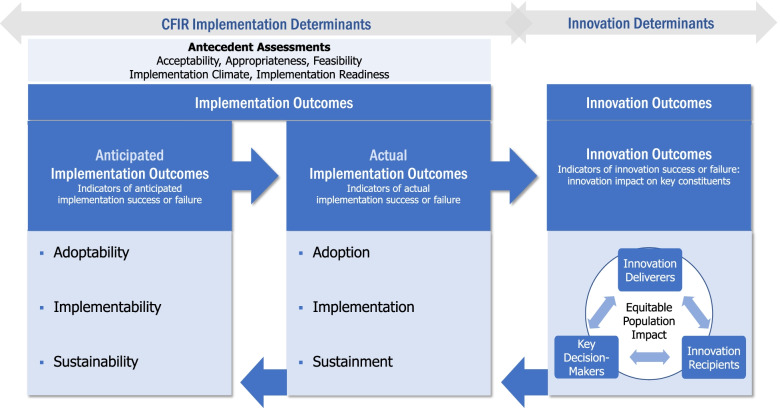
“In addition, left facing arrows across the bottom of the figure illustrate the reinforcing loop that can emerge when the positive impact of an innovation inspires continued commitment to implementation and sustainment [43].”
BackgroundA systematic review of the use of the Consolidated Framework for Implementation Research
Kirk, M. A., Kelley, C., Yankey, N., Birken, S. A., Abadie, B., & Damschroder, L. (2015) · Implementation Science · doi:10.1186/s13012-016-0437-z · Cited by 1,496 · cited 3×
“The Consolidated Framework for Implementation Research (CFIR) is one of the most widely used frameworks within and outside implementation science [8, 10].”
BackgroundMethodSelf-citationBridging Research and Practice
Tabak, R. G., Khoong, E. C., Chambers, D. A., & Brownson, R. C. (2012) · American Journal of Preventive Medicine · doi:10.1016/j.amepre.2012.05.024 · Cited by 1,386 · cited 1×
“Theories that guide conceptualization of context abound and are often encapsulated within determinant frameworks [4, 5]; these frameworks delineate determinants (i.”
BackgroundWiltsey Stirman, S., Baumann, A. A., & Miller, C. J. (2019) · Implementation Science · doi:10.1186/s13012-019-0898-y · Cited by 1,329 · cited 4×
“In a critique by Ilot et al. they recognized that when EBIs are not sustained, the result is a “waste of time, financial resources and leadership effort at a time of economic austerity” [18].”
BackgroundInfluentialSystematic review of the Exploration, Preparation, Implementation, Sustainment (EPIS) framework
Moullin, J. C., Dickson, K. S., Stadnick, N. A., Rabin, B., & Aarons, G. A. (2019) · Implementation Science · doi:10.1186/s13012-018-0842-6 · Cited by 1,223
Waltz, T. J., Powell, B. J., Fernández, M. E., Abadie, B., & Damschroder, L. J. (2019) · Implementation Science · doi:10.1186/s13012-019-0892-4 · Cited by 1,136 · cited 1×
“Knowledge of contextual barriers and facilitators is used to adapt EBIs [6], select and tailor implementation strategies [3, 7], and predict and/or explain implementation outcomes [8, 9].”
BackgroundSelf-citationFeldstein, A. C., & Glasgow, R. E. (2008) · The Joint Commission Journal on Quality and Patient Safety · doi:10.1016/s1553-7250(08)34030-6 · Cited by 987
Implementation Mapping: Using Intervention Mapping to Develop Implementation Strategies
Fernandez, M. E., ten Hoor, G. A., van Lieshout, S., Rodriguez, S. A., Beidas, R. S., Parcel, G., Ruiter, R. A. C., Markham, C. M., & Kok, G. (2019) · Frontiers in Public Health · doi:10.3389/fpubh.2019.00158 · Cited by 914 · cited 2×
“As a result, implementation scientists have prioritized developing methods to understand and measure facets of context, which is necessary for all projects that involve planning, executing, or evaluating implementation efforts [3].”
BackgroundAn Agenda for Research on the Sustainability of Public Health Programs
Scheirer, M. A., & Dearing, J. W. (2011) · American Journal of Public Health · doi:10.2105/ajph.2011.300193 · Cited by 775
Glasgow, R. E. (2006) · Health Education Research · doi:10.1093/her/cyl081 · Cited by 565
Clarity out of chaos: Use of theory in implementation research
Damschroder, L. J. (2020) · Psychiatry Research · doi:10.1016/j.psychres.2019.06.036 · Cited by 422 · cited 1×
“The right facing arrow between implementation and innovation outcomes illustrates the foundational premise within implementation science that successful implementation is a necessary pre-condition to achieving maximum innovation benefits [41].”
BackgroundSelf-citationLennox, L., Maher, L., & Reed, J. (2018) · Implementation Science · doi:10.1186/s13012-017-0707-4 · Cited by 421
Decolonization of knowledge, epistemicide, participatory research and higher education
Hall, B. L., & Tandon, R. (2017) · Research for All · doi:10.18546/rfa.01.1.02 · Cited by 316
Breimaier, H. E., Heckemann, B., Halfens, R. J. G., & Lohrmann, C. (2015) · BMC Nursing · doi:10.1186/s12912-015-0088-4 · Cited by 309
Harnessing the power of theorising in implementation science
Kislov, R., Pope, C., Martin, G. P., & Wilson, P. M. (2019) · Implementation Science · doi:10.1186/s13012-019-0957-4 · Cited by 289 · cited 1×
“Conclusion As implementation science matures as a discipline, frameworks must mature too [60, 61].”
BackgroundImplementation science made too simple: a teaching tool
Curran, G. M. (2020) · Implementation Science Communications · doi:10.1186/s43058-020-00001-z · Cited by 285
Avoiding type III error in program evaluation
Dobson, D., & Cook, T. J. (1980) · Evaluation and Program Planning · doi:10.1016/0149-7189(80)90042-7 · Cited by 266 · cited 1×
“For example, an effective innovation will fail to produce expected outcomes if it is poorly implemented; this may result in a “Type III” error, when evaluators conclude that the innovation is ineffective, when in fact that same innovation may have met or exceeded expectations if it had been properly implemented [42].”
BackgroundThe meaning and measurement of implementation climate
Weiner, B. J., Belden, C. M., Bergmire, D. M., & Johnston, M. (2011) · Implementation Science · doi:10.1186/1748-5908-6-78 · Cited by 260
Miake-Lye, I. M., Delevan, D. M., Ganz, D. A., Mittman, B. S., & Finley, E. P. (2020) · BMC Health Services Research · doi:10.1186/s12913-020-4926-z · Cited by 170
Assessing citation networks for dissemination and implementation research frameworks
Skolarus, T. A., Lehmann, T., Tabak, R. G., Harris, J., Lecy, J., & Sales, A. E. (2017) · Implementation Science · doi:10.1186/s13012-017-0628-2 · Cited by 163
Coincidence analysis: a new method for causal inference in implementation science
Whitaker, R. G., Sperber, N., Baumgartner, M., Thiem, A., Cragun, D., Damschroder, L., Miech, E. J., Slade, A., & Birken, S. (2020) · Implementation Science · doi:10.1186/s13012-020-01070-3 · Cited by 150 · cited 1×
“identified seven CFIR determinants that were correlated with implementation outcomes using a mixed methods approach [9]; other regression- or Boolean-based analyses can be used to identify subsets of determinants that drive implementation outcomes [11].”
MethodSelf-citationDopp, A. R., Parisi, K. E., Munson, S. A., & Lyon, A. R. (2019) · Health Research Policy and Systems · doi:10.1186/s12961-018-0403-0 · Cited by 123 · cited 1×
“Although hospital systems are increasingly prioritizing patient-centered care, convening patient advisory boards, and involving patients in co-design of initiatives [51, 52], these efforts have not yet resulted in true power-sharing between innovation recipients and key decision-makers [53].”
BackgroundDamschroder, L. J., Reardon, C. M., Sperber, N., Robinson, C. H., Fickel, J. J., & Oddone, E. Z. (2017) · Translational Behavioral Medicine · doi:10.1007/s13142-016-0424-6 · Cited by 117 · cited 2×
“identified seven CFIR determinants that were correlated with implementation outcomes using a mixed methods approach [9]; other regression- or Boolean-based analyses can be used to identify subsets of determinants that drive implementation outcomes [11].”
BackgroundMethodSelf-citationReilly, K. L., Kennedy, S., Porter, G., & Estabrooks, P. (2020) · Frontiers in Public Health · doi:10.3389/fpubh.2020.00430 · Cited by 102
Morgan, D., Kosteniuk, J., O’Connell, M. E., Kirk, A., Stewart, N. J., Seitz, D., Bayly, M., Froehlich Chow, A., Elliot, V., Daku, J., et al. (2019) · BMC Health Services Research · doi:10.1186/s12913-019-4548-5 · Cited by 95
Serhal, E., Arena, A., Sockalingam, S., Mohri, L., & Crawford, A. S. (2018) · Journal of Continuing Education in the Health Professions · doi:10.1097/ceh.0000000000000195 · Cited by 84
Ilott, I., Gerrish, K., Booth, A., & Field, B. (2013) · Journal of Evaluation in Clinical Practice · doi:10.1111/j.1365-2753.2012.01876.x · Cited by 78 · cited 1×
“they recognized that when EBIs are not sustained, the result is a “waste of time, financial resources and leadership effort at a time of economic austerity” [18].”
BackgroundOrlando, L. A., Sperber, N. R., Voils, C., Nichols, M., Myers, R. A., Wu, R. R., Rakhra-Burris, T., Levy, K. D., Levy, M., Pollin, T. I., et al. (2018) · Genetics in Medicine · doi:10.1038/gim.2017.144 · Cited by 78 · cited 1×
“while patients are part of the health-care organization and are essential to assessing intervention [innovation] effectiveness, they are a less influential component of implementation success in health-care settings than administrators and physicians” (emphases added) [50].”
BackgroundSelf-citationSmall-Changes Obesity Treatment Among Veterans
Damschroder, L. J., Lutes, L. D., Kirsh, S., Kim, H. M., Gillon, L., Holleman, R. G., Goodrich, D. E., Lowery, J. C., & Richardson, C. R. (2014) · American Journal of Preventive Medicine · doi:10.1016/j.amepre.2014.06.016 · Cited by 73 · cited 1×
“This innovation was tested within a randomized clinical trial [55] and a subset of patient characteristics (innovation determinants) were explored in secondary analyses to help explain Innovation Outcomes [56–59].”
MethodSelf-citationMcDonald, K. M. (2013) · Academic Pediatrics · doi:10.1016/j.acap.2013.04.013 · Cited by 70 · cited 6×
“In a critique by Ilot et al. they recognized that when EBIs are not sustained, the result is a “waste of time, financial resources and leadership effort at a time of economic austerity” [18].”
BackgroundInfluentialAment, S. M. C., Gillissen, F., Moser, A., Maessen, J. M. C., Dirksen, C. D., von Meyenfeldt, M. F., & van der Weijden, T. (2017) · Journal of Evaluation in Clinical Practice · doi:10.1111/jep.12735 · Cited by 70
Lyon, A. R., Whitaker, K. M., Locke, J. J., Cook, C. R., King, K. M., Duong, M. T., Davis, C. J., Weist, M. D., Ehrhart, M. G., & Aarons, G. A. (2018) · Implementation Science · doi:10.1186/s13012-018-0721-1 · Cited by 67 · cited 1×
“Although hospital systems are increasingly prioritizing patient-centered care, convening patient advisory boards, and involving patients in co-design of initiatives [51, 52], these efforts have not yet resulted in true power-sharing between innovation recipients and key decision-makers [53].”
BackgroundMasheb, R. M., Lutes, L. D., Myra Kim, H., Holleman, R. G., Goodrich, D. E., Janney, C. A., Kirsh, S., Richardson, C. R., & Damschroder, L. J. (2015) · Obesity · doi:10.1002/oby.20931 · Cited by 61
Self-citationAcceptance of lean redesigns in primary care: A contextual analysis
Hung, D. Y., Gray, C. P., Martinez, M. C., Schmittdiel, J. A., & Harrison, M. I. (2016) · Health Care Management Review · doi:10.1097/hmr.0000000000000106 · Cited by 61
Weiner, B. J., Mettert, K. D., Dorsey, C. N., Nolen, E. A., Stanick, C., Powell, B. J., & Lewis, C. C. (2020) · Implementation Research and Practice · doi:10.1177/2633489520933896 · Cited by 58
Althaus, C. (2020) · Australian Journal of Public Administration · doi:10.1111/1467-8500.12400 · Cited by 51
Damschroder, L. J., Knighton, A. J., Griese, E. R., Greene, S. M., Lozano, P., Kilbourne, A. M., Buist, D. S. M., Crotty, K., Elwy, A. R., Fleisher, L. A., et al. (2021) · Healthcare · doi:10.1016/j.hjdsi.2020.100455 · Cited by 43
Self-citationA Framework to Guide Implementation Research for Care Transitions Interventions
Dy, S. M., Ashok, M., Wines, R. C., & Rojas Smith, L. (2015) · Journal for Healthcare Quality · doi:10.1097/01.jhq.0000460121.06309.f9 · Cited by 38 · cited 1×
“Other authors addressed this issue by adapting the CFIR to incorporate outcomes from both the RE-AIM framework and the IOF, including the CFIRProcess Redesign [14, 15] and the Care Transitions Framework [16].”
MethodLutes, L. D., DiNatale, E., Goodrich, D. E., Ronis, D. L., Gillon, L., Kirsh, S., Richardson, C. R., & Damschroder, L. J. (2012) · Contemporary Clinical Trials · doi:10.1016/j.cct.2012.09.007 · Cited by 38
Self-citationWeight loss outcomes in patients with pain
Masheb, R. M., Lutes, L. D., Kim, H. M., Holleman, R. G., Goodrich, D. E., Janney, C. A., Kirsh, S., Higgins, D. M., Richardson, C. R., & Damschroder, L. J. (2015) · Obesity · doi:10.1002/oby.21160 · Cited by 37
Self-citationHill, J. N., Locatelli, S. M., Bokhour, B. G., Fix, G. M., Solomon, J., Mueller, N., & LaVela, S. L. (2018) · BMC Research Notes · doi:10.1186/s13104-018-3650-9 · Cited by 35
Vidgen, H. A., Love, P., Wutzke, S. E., Daniels, L., Rissel, C. E., Innes‐Hughes, C., & Baur, L. A. (2018) · Implementation Science · doi:10.1186/s13012-018-0801-2 · Cited by 35
Tinc, P. J., Gadomski, A., Sorensen, J. A., Weinehall, L., Jenkins, P., & Lindvall, K. (2018) · Safety Science · doi:10.1016/j.ssci.2018.04.008 · Cited by 28
Abildso, C. G., Zizzi, S., & Reger-Nash, B. (2010) · PubMed Central · Cited by 27
Weight loss among women and men in the ASPIRE‐VA behavioral weight loss intervention trial
Vimalananda, V. G., Damschroder, L. J., Janney, C. A., Goodrich, D. E., Kim, H. M., Holleman, R. G., Gillon, L., & Lutes, L. D. (2016) · Obesity · doi:10.1002/oby.21574 · Cited by 23
Self-citationFramework for Research on Implementation of Process Redesigns
Ashok, M., Hung, D., Rojas-Smith, L., Halpern, M. T., & Harrison, M. (2018) · Quality Management in Health Care · doi:10.1097/qmh.0000000000000158 · Cited by 23
Power sharing. A transformational strategy for nurse retention, effectiveness, and extra effort.
Trofino, J. (2003) · PubMed · Cited by 22
Balancing reality in embedded research and evaluation: Low vs high embeddedness
Jackson, G. L., Damschroder, L. J., White, B. S., Henderson, B., Vega, R. J., Kilbourne, A. M., & Cutrona, S. L. (2021) · Learning Health Systems · doi:10.1002/lrh2.10294 · Cited by 20
Self-citationCharacterizing evolving frameworks: issues from Esmail et al. (2020) review
Glasgow, R. E., Estabrooks, P. A., & Ory, M. G. (2020) · Implementation Science · doi:10.1186/s13012-020-01009-8 · Cited by 18 · cited 1×
“Conclusion As implementation science matures as a discipline, frameworks must mature too [60, 61].”
BackgroundCallaghan‐Koru, J. A., Islam, M., Khan, M. A., Sowe, A., Islam, J., Mannan, I. I., George, J., & The Bangladesh Chlorhexidine Scale Up Study Group (2020) · Health Policy and Planning · doi:10.1093/heapol/czz156 · Cited by 15
Mental health and behavioral weight loss: 24-month outcomes in Veterans
Janney, C. A., Masheb, R. M., Lutes, L. D., Holleman, R. G., Kim, H. M., Gillon, L., Damschroder, L. J., & Richardson, C. R. (2017) · Journal of Affective Disorders · doi:10.1016/j.jad.2017.03.003 · Cited by 12
Self-citation
Research works printed but not linked: 1
- 46. Petit-McClure SH, Stinson C. Disrupting dis/abilization: a critical explora- tion of research methods to combat white supremacy and ableism in education. Intersect Cri Issues Educ. 2019;3:4.
Cited by
The updated consolidated framework for implementation research based on user feedback
Damschroder, L. J., Reardon, C. M., Widerquist, M. A. O., & Lowery, J. (2022) · Implementation Science · doi:10.1186/s13012-022-01245-0 · Cited by 4,452
Self-citationTen years of implementation outcomes research: a scoping review
Proctor, E. K., Bunger, A. C., Lengnick-Hall, R., Gerke, D. R., Martin, J. K., Phillips, R. J., & Swanson, J. C. (2023) · Implementation Science · doi:10.1186/s13012-023-01286-z · Cited by 424
Technologies in Home-Based Digital Rehabilitation: Scoping Review
Arntz, A. R., Weber, F., Handgraaf, M., Lällä, K., Korniloff, K., Murtonen, K.-P., Chichaeva, J., Kidritsch, A., Heller, M., Sakellari, Ε., et al. (2023) · JMIR Rehabilitation and Assistive Technologies · doi:10.2196/43615 · Cited by 187
“…of the intervention in terms of dedicated outcomes, the design of the intervention itself, and the characteristics of individuals but also the setting in which the approach will be applied, the process of implementation, and factors influenced by policies and government regulations [206].”
BackgroundReardon, C. M., Damschroder, L. J., Ashcraft, L. E., Kerins, C., Bachrach, R. L., Nevedal, A. L., Domlyn, A. M., Dodge, J., Chinman, M., & Rogal, S. (2025) · Implementation Science · doi:10.1186/s13012-025-01450-7 · Cited by 172
“The following attributes may be useful to develop a purposeful sample [23] at the Inner Setting level: • Antecedent Assessments [6, 24], e.g., Organizational Readiness to Change Assessment (ORCA) Scores [25] • Implementation Outcomes (anticipated or actual) [6] • Resource allocation, e.g., over-vs.…”
InfluentialSelf-citationImplementing AI in healthcare—the relevance of trust: a scoping review
Steerling, E., Siira, E., Nilsén, P., Svedberg, P., & Nygren, J. (2023) · Frontiers in Health Services · doi:10.3389/frhs.2023.1211150 · Cited by 159
Metadata
- Authors
- Damschroder, L. J., Reardon, C. M., Opra Widerquist, M. A., & Lowery, J.
- Affiliations
- VA Ann Arbor Healthcare System (US)
- Corresponding author
- Damschroder, Laura J.
- Venue
- Implementation Science
- Published
- 2022-01-22
- Volume
- 17
- Issue
- 1
- Pages
- 7-7
- ISSN
- 1748-5908 (ISSN-L)
- PMC
- PMC8783408
- OpenAlex
- W4206949803
- Semantic Scholar
- 08521891e3bcd553697352db930b1de39027da07
- Cited by
- 784
- References
- 61
- Citations by year
- 2026: 227 · 2025: 177 · 2024: 218 · 2023: 117 · 2022: 45
- FWCI
- 27.08
- Type
- journal article
- Language
- en
- Open access
- gold
- doi.org
- Licence
- cc-by
- creativecommons.org/licenses/by/4.0 (tdm)
- creativecommons.org/licenses/by/4.0 (vor)
- Locations
- Implementation Science (publishedVersion, cc-by)
- PubMed Central (publishedVersion, cc-by)
- PubMed (publishedVersion)
- DOAJ (DOAJ: Directory of Open Access Journals) (submittedVersion, cc-by-sa)
- Funders
- Quality Enhancement Research Initiative (QUE 15-286)
- Health Services Research and Development (LIP 20-116)
- Topics
- Health Sciences › Health Professions › General Health Professions › Health Policy Implementation Science
- Health Sciences › Health Professions › General Health Professions › Health Sciences Research and Education
- Health Sciences › Medicine › Public Health, Environmental and Occupational Health › Clinical practice guidelines implementation
- Keywords
- Consolidated Framework for Implementation Research, implementation outcomes, innovation outcomes, implementation factors, innovation determinants, evidence-based innovation, implementation context, framework evolution
- MeSH terms
- Implementation Science, Humans, Motivation
About these checks
Registry, retraction, Cites and statistics results are computed, not judged, with one exception: a printed reference that no index lists is read once by a model before it counts as a citation error. Claims are extracted by a model and kept only when their quote appears verbatim in the text; each cited source is then checked, with a model’s help, for whether it says what the claim relies on. Those verdicts can be wrong — read the claim’s quote and the cited source before relying on one.
Statistics and arithmetic are recomputed, not judged.
Confidence bands are shown only for fields calibrated on our annotated test set. None is calibrated yet, so no band is shown.
What counts as a claim ›How we measure confidence ›How we check this ›
Are you an author, or do you see a problem with this page? Request a review
Data sources
Bibliographic data: Semantic Scholar, OpenAlex, Crossref.
Contains information from the Semantic Scholar Academic Graph Datasets, made available under the ODC Attribution License (ODC-BY 1.0).
Semantic Scholar’s data is described in: Kinney, R., et al. (2023). The Semantic Scholar Open Data Platform. arXiv:2301.10140.
