

Conceptualizing outcomes for use with the Consolidated Framework for Implementation Research (CFIR): the CFIR Outcomes Addendum
Open accessThe DOI matches its Crossref record; 61 of the 61 references it cites were found in a registry or an index.
Abstract
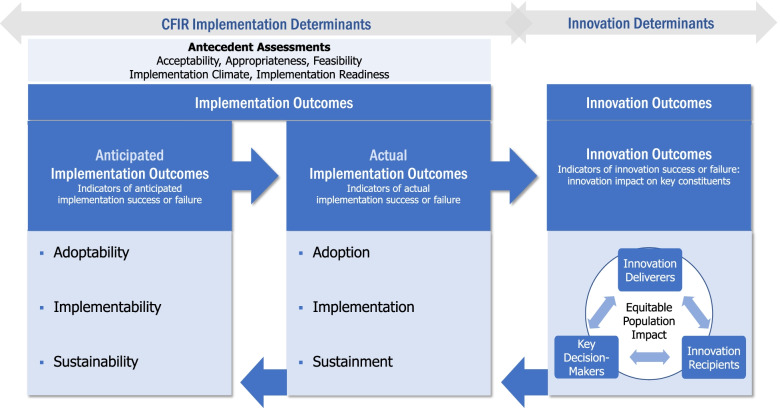
Background: The challenges of implementing evidence-based innovations (EBIs) are widely recognized among practitioners and researchers. Context, broadly defined as everything outside the EBI, includes the dynamic and diverse array of forces working for or against implementation efforts. The Consolidated Framework for Implementation Research (CFIR) is one of the most widely used frameworks to guide assessment of contextual determinants of implementation. The original 2009 article invited critique in recognition for the need for the framework to evolve. As implementation science has matured, gaps in the CFIR have been identified and updates are needed. Our team is developing the CFIR 2.0 based on a literature review and follow-up survey with authors. We propose an Outcomes Addendum to the CFIR to address recommendations from these sources to include outcomes in the framework. Main text: We conducted a literature review and surveyed corresponding authors of included articles to identify recommendations for the CFIR. There were recommendations to add both implementation and innovation outcomes from these sources. Based on these recommendations, we make conceptual distinctions between (1) anticipated implementation outcomes and actual implementation outcomes, (2) implementation outcomes and innovation outcomes, and (3) CFIR-based implementation determinants and innovation determinants. Conclusion: An Outcomes Addendum to the CFIR is proposed. Our goal is to offer clear conceptual distinctions between types of outcomes for use with the CFIR, and perhaps other determinant implementation frameworks as well. These distinctions can help bring clarity as researchers consider which outcomes are most appropriate to evaluate in their research. We hope that sharing this in advance will generate feedback and debate about the merits of our proposed addendum.
Overview
The claims and statistics of this paper haven’t been checked yet.
Free: it reads the open-access text and checks the first 5 claims that cite a source we can check. Create a free account to check every claim.
Integrity signals
Registry
Cites
Statistics
Figures
Verification
Claims the paper makes
The claims and statistics of this paper haven’t been checked yet.
Free: it reads the open-access text and checks the first 5 claims that cite a source we can check. Create a free account to check every claim.
Claims other papers make about this one
Each is checked against this paper’s own text: does it say what the citing paper says it does?
The cited source says what the claim attributes to it.
In the citing paper
“An updated Consolidated Framework for Implementation Research (CFIR) distinguished between anticipated (forward-looking) and actual (backward-looking) implementation outcomes [8].”
From Ten years of implementation outcomes research: a scoping review (2023) · cites this paper as [8]
The cited source says what the claim attributes to it.
In the citing paper
“we have reclassified these constructs to more appropriately position them as antecedent assessments [55], on the pathway between implementation determinants and outcomes in the CFIR Outcomes Addendum [19].”
From The updated consolidated framework for implementation research based on user feedback (2022) · cites this paper as [19]
The cited source says what the claim attributes to it.
In the citing paper
“several users suggested that the CFIR be expanded to include (1) implementation and innovation outcomes and (2) determinants to innovation outcomes collected from recipients [19].”
From The updated consolidated framework for implementation research based on user feedback (2022) · cites this paper as [19]
Self-check
Percentages, sums and reported differences re-computed from the paper’s own numbers.
The self-check needs the paper’s full text.
Citations
Cites
Damschroder, L. J., Aron, D. C., Keith, R. E., Kirsh, S. R., Alexander, J. A., & Lowery, J. C. (2009) · Implementation Science · doi:10.1186/1748-5908-4-50 · Cited by 14,496 · cited 2×
“The original 2009 article invited critique in recognition of the need for the framework to evolve [2].”
BackgroundSelf-citationValente, T. W. (2003) · Genetics in Medicine · doi:10.1097/01.gim.0000061743.67794.c4 · Cited by 13,723
Proctor, E., Silmere, H., Raghavan, R., Hovmand, P., Aarons, G., Bunger, A., Griffey, R., & Hensley, M. (2011) · Administration and Policy in Mental Health and Mental Health Services Research · doi:10.1007/s10488-010-0319-7 · Cited by 8,721 · cited 11×
“Proctor et al.’s Implementation Outcomes Framework (IOF) defines Adoption as “the intention, initial decision, or action to try or employ an innovation” [13].”
BackgroundMethodInfluentialThe Triple Aim: Care, Health, And Cost
Berwick, D. M., Nolan, T. W., & Whittington, J. (2008) · Health Affairs · doi:10.1377/hlthaff.27.3.759 · Cited by 5,136 · cited 1×
“Consideration of clinicians (and other employees) motivated evolution of the “Triple Aim” (enhancing patient experience, improving population health, and reducing costs) [35] to the “Quadruple Aim,” which added an aim of improving the work-life and well-being of clinicians and staff [36].”
BackgroundMaking sense of implementation theories, models and frameworks
Nilsen, P. (2015) · Implementation Science · doi:10.1186/s13012-015-0242-0 · Cited by 4,447 · cited 1×
“Theories that guide conceptualization of context abound and are often encapsulated within determinant frameworks [4, 5]; these frameworks delineate determinants (i.”
BackgroundCurran, G. M., Bauer, M., Mittman, B., Pyne, J. M., & Stetler, C. (2012) · Medical Care · doi:10.1097/mlr.0b013e3182408812 · Cited by 4,058 · cited 1×
“, clinical trialists versus implementation scientists) to translate innovations more quickly into practice [49].”
BackgroundFrom Triple to Quadruple Aim: Care of the Patient Requires Care of the Provider
Bodenheimer, T., & Sinsky, C. (2014) · The Annals of Family Medicine · doi:10.1370/afm.1713 · Cited by 3,462 · cited 1×
“Consideration of clinicians (and other employees) motivated evolution of the “Triple Aim” (enhancing patient experience, improving population health, and reducing costs) [35] to the “Quadruple Aim,” which added an aim of improving the work-life and well-being of clinicians and staff [36].”
BackgroundPsychometric assessment of three newly developed implementation outcome measures
Weiner, B. J., Lewis, C. C., Stanick, C., Powell, B. J., Dorsey, C. N., Clary, A. S., Boynton, M. H., & Halko, H. (2017) · Implementation Science · doi:10.1186/s13012-017-0635-3 · Cited by 2,819 · cited 1×
“developed measures for acceptability, appropriateness, and feasibility of an innovation and highlighted their role as potential predictors of adoption or implementation [27].”
BackgroundRE-AIM Planning and Evaluation Framework: Adapting to New Science and Practice With a 20-Year Review
Glasgow, R. E., Harden, S. M., Gaglio, B., Rabin, B., Smith, M. L., Porter, G. C., Ory, M. G., & Estabrooks, P. A. (2019) · Frontiers in Public Health · doi:10.3389/fpubh.2019.00064 · Cited by 2,528
The sociology of expectations in science and technology
Borup, M., Brown, N., Konrad, K., & Van Lente, H. (2006) · Technology Analysis & Strategic Management · doi:10.1080/09537320600777002 · Cited by 1,902 · cited 2×
“They give definition to role, clarify duties, offer some shape of what to expect and how to prepare for opportunities and risks” [17].”
Background
Research works printed but not linked: 1
- 46. Petit-McClure SH, Stinson C. Disrupting dis/abilization: a critical explora- tion of research methods to combat white supremacy and ableism in education. Intersect Cri Issues Educ. 2019;3:4.
Cited by
The updated consolidated framework for implementation research based on user feedback
Damschroder, L. J., Reardon, C. M., Widerquist, M. A. O., & Lowery, J. (2022) · Implementation Science · doi:10.1186/s13012-022-01245-0 · Cited by 4,452
Self-citationTen years of implementation outcomes research: a scoping review
Proctor, E. K., Bunger, A. C., Lengnick-Hall, R., Gerke, D. R., Martin, J. K., Phillips, R. J., & Swanson, J. C. (2023) · Implementation Science · doi:10.1186/s13012-023-01286-z · Cited by 424
Technologies in Home-Based Digital Rehabilitation: Scoping Review
Arntz, A. R., Weber, F., Handgraaf, M., Lällä, K., Korniloff, K., Murtonen, K.-P., Chichaeva, J., Kidritsch, A., Heller, M., Sakellari, Ε., et al. (2023) · JMIR Rehabilitation and Assistive Technologies · doi:10.2196/43615 · Cited by 187
“…of the intervention in terms of dedicated outcomes, the design of the intervention itself, and the characteristics of individuals but also the setting in which the approach will be applied, the process of implementation, and factors influenced by policies and government regulations [206].”
BackgroundReardon, C. M., Damschroder, L. J., Ashcraft, L. E., Kerins, C., Bachrach, R. L., Nevedal, A. L., Domlyn, A. M., Dodge, J., Chinman, M., & Rogal, S. (2025) · Implementation Science · doi:10.1186/s13012-025-01450-7 · Cited by 172
“The following attributes may be useful to develop a purposeful sample [23] at the Inner Setting level: • Antecedent Assessments [6, 24], e.g., Organizational Readiness to Change Assessment (ORCA) Scores [25] • Implementation Outcomes (anticipated or actual) [6] • Resource allocation, e.g., over-vs.…”
InfluentialSelf-citationImplementing AI in healthcare—the relevance of trust: a scoping review
Steerling, E., Siira, E., Nilsén, P., Svedberg, P., & Nygren, J. (2023) · Frontiers in Health Services · doi:10.3389/frhs.2023.1211150 · Cited by 159
Zhou, P., Chen, L., Wu, Z., Wang, E., Yan, Y., Guan, X., Zhai, S., & Yang, K. (2023) · Journal of Clinical Epidemiology · doi:10.1016/j.jclinepi.2023.08.017 · Cited by 98
A scoping review of frameworks in empirical studies and a review of dissemination frameworks
Baumann, A. A., Hooley, C., Kryzer, E., Morshed, A. B., Gutner, C. A., Malone, S. M., Walsh‐Bailey, C., Pilar, M. R., Sandler, B., Tabak, R. G., et al. (2022) · Implementation Science · doi:10.1186/s13012-022-01225-4 · Cited by 88
Why it is hard to use PROMs and PREMs in routine health and care
Benson, T. (2023) · BMJ Open Quality · doi:10.1136/bmjoq-2023-002516 · Cited by 89
Rangachari, P., Mushiana, S. S., & Herbert, K. L. (2022) · BMC Health Services Research · doi:10.1186/s12913-022-08871-w · Cited by 85
“The trends in research growth on this topic may also align synergistically with the concurrent progress being made in conceptualizing outcomes for use with the CFIR, to provide an advanced understanding of the determinants of telehealth implementation-effectiveness [88].”
BackgroundMapping Theories, Models, and Frameworks to Evaluate Digital Health Interventions: Scoping Review
Rouleau, G., Wu, K., Ramamoorthi, K., Boxall, C., Liu, R. H., Maloney, S., Zelmer, J., Scott, T., Larsen, D., Wijeysundera, H. C., et al. (2024) · Journal of Medical Internet Research · doi:10.2196/51098 · Cited by 71
“Recently, CFIR has been extended to include implementation outcomes and innovation (ie, intervention) outcomes as part of CFIR 2.0 [61,62].”
InfluentialLi, D. H., Benbow, N., Keiser, B., Mongrella, M. C., Ortiz, K. S., Villamar, J. A., Gallo, C. G., Deskins, J. S., Hall, C. D. X., Miller, C. H., et al. (2022) · JAIDS Journal of Acquired Immune Deficiency Syndromes · doi:10.1097/qai.0000000000002984 · Cited by 69
Odhus, C. O., Kapanga, R. R., & Oele, E. (2024) · PLOS Global Public Health · doi:10.1371/journal.pgph.0002756 · Cited by 63
Murthi, S., Martini, N. D., Falconer, N., & Scahill, S. L. (2024) · Journal of Medical Systems · doi:10.1007/s10916-024-02097-5 · Cited by 62
“The implementation methods of the studies were evaluated using the Consoli-dated Framework for Implementation Research (CFIR) to understand contextual factors in complex healthcare settings [37–39].”
MethodWong, K. L. Y., Hung, L., Wong, J., Park, J., Alfares, H., Zhao, Y., Mousavinejad, A., Soni, A., & Zhao, H. (2024) · JMIR Aging · doi:10.2196/55257 · Cited by 57
“According to the authors, one way to use CFIR is to better understand the findings on implementation [44].”
BackgroundMethodInfluentialDunbar, P., Keyes, L. M., & Browne, J. P. (2023) · PLoS ONE · doi:10.1371/journal.pone.0278007 · Cited by 57
Smith, J. D., Li, D. H., Merle, J. L., Keiser, B., Mustanski, B. S., & Benbow, N. (2024) · Implementation Science · doi:10.1186/s13012-024-01345-z · Cited by 53
Kinney, A. R., Stearns‐Yoder, K. A., Hoffberg, A. S., Middleton, A., Weaver, J., Roseen, E. J., Juckett, L., & Brenner, L. A. (2023) · Archives of Physical Medicine and Rehabilitation · doi:10.1016/j.apmr.2023.03.005 · Cited by 47
Equity in prenatal healthcare services globally: an umbrella review
Ladak, Z., Grewal, N., Kim, M. O., Small, S. L., Leber, A., Hemani, M., Sun, Q., Hamza, D. M., Laur, C. V., Ivers, N. M., et al. (2024) · BMC Pregnancy and Childbirth · doi:10.1186/s12884-024-06388-0 · Cited by 45
“Implementation climate is defined by the surrounding context of where an intervention is to be incorporated; this can include the people, the physical environment, or social or cultural norms [126, 127].”
BackgroundMustanski, B. S., Queiroz, A. A. F. L. N., Merle, J. L., Zamantakis, A., Zapata, J. P., Li, D. H., Benbow, N., Pyra, M. N., & Smith, J. D. (2023) · Annual Review of Psychology · doi:10.1146/annurev-psych-032620-035725 · Cited by 42
Ezezika, O. C., Mengistu, M., Opoku, E., Farheen, A., Chauhan, A., & Barrett, K. (2022) · PLOS Global Public Health · doi:10.1371/journal.pgph.0001283 · Cited by 41
“In this study, adaptations to broad categories of outcomes were made and informed by the Reach, Effectiveness, Adoption, Implementation, and Maintenance (RE-AIM) framework and the Implementation Outcomes Framework (IOF), which consider both implementation and innovation outcomes [46].”
BackgroundMethodMeasuring sex, gender, and sexual orientation: one step to health equity
Logie, C. H., van der Merwe, L. L. A., & Scheim, A. I. (2022) · The Lancet · doi:10.1016/s0140-6736(22)01425-8 · Cited by 40
Preventing sexual violence in sexual orientation and gender diverse communities: A call to action
Blackburn, A. M., Katz, B. W., Oesterle, D. W., & Orchowski, L. M. (2024) · European Journal of Psychotraumatology · doi:10.1080/20008066.2023.2297544 · Cited by 40
“The Consolidated Framework for Implementation Research (CFIR) is an evidence-based tool that provides a conceptual framework to assess ecological, systemic, and institutional factors that both facilitate and impede intervention uptake (Damschroder et al., 2009; 2022).”
MethodKampman, J. M., van Bree, E. M., Gielen, L., & Weiland, N. H. S. (2025) · British Journal of Anaesthesia · doi:10.1016/j.bja.2024.11.049 · Cited by 37
“22 A national survey, building on the earlier anaesthetic drug usage survey, will be used to gather data on the local adoption and implementation of the national guideline.”
Kabukye, J. K., Namugga, J., Mpamani, C., Katumba, A., Nabende, J. N., Nabuuma, H., Musoke, S. S., Nankya, E., Soomre, E., Nakisige, C., et al. (2023) · Journal of Medical Internet Research · doi:10.2196/45132 · Cited by 36
“The study was informed by the Consolidated Framework for Implementation Research (CFIR) [69-72], which provides a comprehensive theoretical framework for planning, implementation, and evaluation of interventions, such as digital health technologies.”
Theorizing is for everybody: Advancing the process of theorizing in implementation science
Meza, R. D., Moreland, J. C., Pullmann, M. D., Klasnja, P., Lewis, C. C., & Weiner, B. J. (2023) · Frontiers in Health Services · doi:10.3389/frhs.2023.1134931 · Cited by 36
Krahe, M. A., Baker, S., Woods, L., & Larkins, S. (2025) · Australian Journal of Rural Health · doi:10.1111/ajr.70045 · Cited by 35
“Outcomes related to health and implementation (i.e., adoption, implementation, and sustainment) were identified and described narratively [20].”
Harkko, J., Sipilä, N., Nordquist, H., Lallukka, T. M., Appelqvist‐Schmidlechner, K., Donnelly, M., & Kouvonen, A. M. (2023) · Implementation Science · doi:10.1186/s13012-023-01316-w · Cited by 35
Zhu, E. M., Buljac‐Samardžić, M., Ahaus, K., Sevdalis, N., & Huijsman, R. (2023) · Implementation Science · doi:10.1186/s13012-023-01314-y · Cited by 34
Wurster, F., di Gion, P., Goldberg, N., Hautsch, V., Hefter, K., Herrmann, C., Langebartels, G., Pfaff, H., & Karbach, U. (2024) · Implementation Science Communications · doi:10.1186/s43058-024-00614-8 · Cited by 32
Madrigal, L., Manders, O. C., Kegler, M. C., Haardörfer, R., Piper, S., Blais, L. M., Weber, M. B., & Escoffery, C. (2022) · Implementation Science Communications · doi:10.1186/s43058-022-00350-x · Cited by 34
“Using CFIR measures across the continuum of implementation will be critical to assess differences in key factors related to outcomes in the preadoption, early adoption, and maintenance phases [53].”
Methoddel Pozo, B., Belenko, S. R., Pivovarova, E., Ray, B. R., Martins, K. F., & Taxman, F. S. (2024) · Police Quarterly · doi:10.1177/10986111241265290 · Cited by 30
“These CFIR constructs are not set in stone, however: they are periodically expanded or rede fi ned based on user feedback (Damschroder et al., 2022b), as users provide practical feedback about what determinants are most relevant for measuring success in implementation in particular settings…”
Moore, S. A., Sridhar, A., Taormina, I., Rajadhyaksha, M., & Azad, G. F. (2024) · Implementation Research and Practice · doi:10.1177/26334895231220279 · Cited by 31
“…domain (i.e., individuals responsible for implementation may not view a novel innovation as a priority) as well as with implementation climate , which was classi fi ed as a critical antecedent for implementation in the revised CFIR and CFIR outcomes addendum (Damschroder et al., 2022a, 2022b).”
BackgroundResultKassam, A., Vries, I. D., Zabar, S. R., Durning, S. J., Holmboe, E. S., Hodges, B. D., Boscardin, C., & Kalet, A. L. (2024) · Perspectives on Medical Education · doi:10.5334/pme.1128 · Cited by 28
Factors Facilitating and Inhibiting the Implementation of Telerehabilitation—A Scoping Review
Stampa, S., Thienel, C., Tokgöz, P., Razum, O., & Dockweiler, C. (2024) · Healthcare · doi:10.3390/healthcare12060619 · Cited by 28
“Support by giving technical assistance and training staff and patients should, therefore, be mandatory in implementation processes.”
BackgroundTuran, J. M., Vinikoor, M. J., Su, A. Y., Rangel‐Gomez, M., Sweetland, A. C., Verhey, R., Chibanda, D., Paulino-Ramírez, R., Best, C., Masquillier, C., et al. (2023) · BMJ Global Health · doi:10.1136/bmjgh-2023-013572 · Cited by 29
Nevedal, A., Widerquist, M. A. O., Reardon, C. M., Arasim, M. E., Jackson, G. L., White, B. S., Burns, M., Fix, G. M., DeLaughter, K. L., Cutrona, S. L., et al. (2024) · Implementation Science · doi:10.1186/s13012-024-01361-z · Cited by 27
“Sustainment is de�ned as the extent to which an EIP is (or is not) in use after an initial implementation phase and is measured by assessing outcomes [2, 3].”
BackgroundSelf-citationSmith, J. A., Braithwaite, J., O'Brien, T. A., Smith, S., Tyrrell, V. J., Mould, E. V. A., Long, J. C., & Rapport, F. (2022) · International Journal of Qualitative Methods · doi:10.1177/16094069221103097 · Cited by 28
“…Means et al., 2020; Safaeinili et al., 2020), we refined CFIR into its intervention design characteristics and contextual characteristics to better fit the precision medicine context (Chambers et al., 2016; Damschroder et al., 2022; Levy et al., 2019; Wong et al., 2020; Zebrowski et al., 2019).”
BackgroundMethodInfluentialWhat Are “Social Prescriptions” and How Should They Be Integrated Into Care Plans?
Hough, K., Kotwal, A., Boyd, C. M., Tha, S. H., & Perissinotto, C. M. (2023) · The AMA Journal of Ethic · doi:10.1001/amajethics.2023.795 · Cited by 27
Li, Z., Laginha, K.-J., Boyle, F. M., Daly, M. G., Dinner, F., Hirsch, P., Hobbs, K., Kirsten, L. T., Mazariego, C. G., McAuley, R., et al. (2024) · Journal of Cancer Survivorship · doi:10.1007/s11764-023-01515-w · Cited by 27
“As recommended by Reilly et al. (and subsequently adopted by Damschroder et al. in their CFIR Outcomes Addendum), we differentiated between implementation antecedents and implementation outcomes [61, 65, 66].”
Smith, J. L., Ritchie, M. J., Kim, B., Miller, C. J., Chinman, M., Kelly, P. A., Landes, S. J., & Kirchner, J. E. (2024) · Global Implementation Research and Applications · doi:10.1007/s43477-024-00119-5 · Cited by 27
“Further, the literature pertaining to IF is broad and diffuse in that: (a) investigators have used a variety of different labels and terminology to describe IF; (b) the strategy has been applied across diverse clinical settings; (c) investigators have used a number of different frameworks to guide the application and…”
An Overview of Dissemination and Implementation Science in Physical Activity and Health Promotion
Estabrooks, P. A. (2023) · Kinesiology Review · doi:10.1123/kr.2022-0044 · Cited by 25
Egeland, K. M., Borge, R. H., Peters, N., Bækkelund, H., Braathu, N., Sklar, M., Aarons, G. A., & Skar, A. S. (2023) · Implementation Science Communications · doi:10.1186/s43058-023-00459-7 · Cited by 26
Mullins, M. A., Reber, L., Washington, A., Stasenko, M., Rankin, A., Friese, C. R., Cooley, M. E., Hudson, M. F., & Wallner, L. P. (2023) · Cancer Medicine · doi:10.1002/cam4.6517 · Cited by 25
Coumoundouros, C., Mårtensson, E., Ferraris, G., Zuidberg, J. M., von Essén, L., Sanderman, R., & Woodford, J. (2022) · JMIR Mental Health · doi:10.2196/41891 · Cited by 24
Implementation Science and Practice-Oriented Research: Convergence and Complementarity
Youn, S. J., Boswell, J. F., Douglas, S. R., Harris, B. A., Aajmain, S. T., Arnold, K. T., Creed, T. A., Gutner, C. A., Orengo‐Aguayo, R., Oswald, J. M., et al. (2023) · Administration and Policy in Mental Health and Mental Health Services Research · doi:10.1007/s10488-023-01296-5 · Cited by 25
“The expansion of implementation science models to incorporate relevant outcomes around innovation and sustainability are just beginning (e.g., Damschroder et al., 2022).”
McGuier, E. A., Aarons, G. A., Byrne, K. A., Campbell, K. A., Keeshin, B., Rothenberger, S. D., Weingart, L. R., Salas, E., & Kolko, D. J. (2023) · Implementation Science Communications · doi:10.1186/s43058-023-00393-8 · Cited by 23
Schol, C. M. A., van Mol, M. M. C., Berger, E., Leerentveld, C., Gommers, D. A. M. P. J., & Ista, E. (2024) · Australian Critical Care · doi:10.1016/j.aucc.2024.04.002 · Cited by 23
Connolly, S. L., Sullivan, J. L., Lindsay, J. A., Shimada, S. L., Heyworth, L. K., Weaver, K. R., & Miller, C. J. (2022) · Implementation Science Communications · doi:10.1186/s43058-022-00318-x · Cited by 23
“, considerations of health equity), which may in turn have influenced the findings of our current work [35].”
ResultMullin, A. C., Sharkey, J. D., & Barnett, M. L. (2024) · Frontiers in Education · doi:10.3389/feduc.2024.1346933 · Cited by 22
Merle, J. L., Li, D. H., Keiser, B., Zamantakis, A., Queiroz, A. A. F. L. N., Gallo, C. G., Villamar, J. A., McKay, V., Zapata, J. P., Mustanski, B. S., et al. (2023) · BMJ Open · doi:10.1136/bmjopen-2022-070216 · Cited by 22
Zettergren, L., Larsson, E. C., Hellsten, L., Kosidou, K., & Nielsen, A. M. (2024) · BMC Health Services Research · doi:10.1186/s12913-024-10932-1 · Cited by 22
“CFIR is a comprehensive determinant framework providing a pragmatic structure to explore and evaluate multi-level determinants of implementation success of an intervention in a given context [23].”
Making implementation science more efficient: capitalizing on opportunities beyond the field
Wensing, M., & Wilson, P. M. (2023) · Implementation Science · doi:10.1186/s13012-023-01298-9 · Cited by 22
“Implementation outcomes are indicators of implementation success of failure; these may be anticipated or actual outcomes [14].”
BackgroundBiernesser, C., Win, E., Escobar-Viera, C., Farzan, R., Rose, M., & Goldstein, T. (2023) · Internet Interventions · doi:10.1016/j.invent.2023.100663 · Cited by 21
McCrimmon, T., Collins, L. F., Perez‐Brumer, A., Bazzi, A. R., Shaffer, V. A., Kerrigan, D. L., Alcaide, M. L., & Philbin, M. M. (2024) · AIDS Patient Care and STDs · doi:10.1089/apc.2023.0248 · Cited by 21
“Our study follows others that have used implementation science frameworks, 31 and the CFIR’s inner and outer domain settings, 32 to focus on the health care system context in which an evidence-based intervention was implemented.”
InfluentialMerle, J. L., Benbow, N., Li, D. H., Zapata, J. P., Queiroz, A. A. F. L. N., Zamantakis, A., McKay, V., Keiser, B., Villamar, J. A., Mustanski, B. S., et al. (2024) · AIDS and Behavior · doi:10.1007/s10461-024-04331-0 · Cited by 21
“The dashboard allows users to examine more than 1,900 determinants of PrEP implementation, coded by CFIR, from 239 peer-reviewed articles [14, 15, 19].”
InfluentialZhang, Y., Cook, C., Fallon, L. M., Corbin, C. M., Ehrhart, M. G., Brown, E. C., Locke, J. J., & Lyon, A. R. (2022) · Administration and Policy in Mental Health and Mental Health Services Research · doi:10.1007/s10488-022-01248-5 · Cited by 20
Strategies to Bridge Equitable Implementation of Telehealth
Gustavson, A. M., Lewinski, A. A., Fitzsimmons‐Craft, E. E., Coronado, G. D., Linke, S., O’Malley, D. M., Adams, A. S., Glasgow, R. E., & Klesges, L. M. (2023) · Interactive Journal of Medical Research · doi:10.2196/40358 · Cited by 21
“…the Health Equity Implementation Framework by Woodward et al [7] and the Consolidated Framework for Implementation Research by Damschroder et al [20]—articulate conceptual models to understand determinants of health equity to better adapt interventions and implementation strategies.”
MethodLimoges, J., Puddester, R., Gretchev, A., Chiu, P., Calzone, K., Leslie, K., Pike, A. D., & Letourneau, N. L. (2024) · Current Oncology · doi:10.3390/curroncol32010014 · Cited by 20
“In addition, this plan should include implementation science [82,83], align with the complex needs of nursing practice and address the barriers and facilitators to the integration of research findings into practice.”
Damschroder, L. J., Miech, E. J., Freitag, M. B., Evans, R. R., Burns, J., Raffa, S. D., Goldstein, M. G., Annis, A., Spohr, S. A., & Wiitala, W. L. (2022) · Translational Behavioral Medicine · doi:10.1093/tbm/ibac051 · Cited by 20
Self-citationResearch and scholarly methods: Implementation science studies
Kuo, G. M., Trinkley, K. E., & Rabin, B. A. (2022) · JACCP JOURNAL OF THE AMERICAN COLLEGE OF CLINICAL PHARMACY · doi:10.1002/jac5.1673 · Cited by 20
Estabrooks, P. A., & Glasgow, R. E. (2023) · Frontiers in Public Health · doi:10.3389/fpubh.2023.1123349 · Cited by 19
“, implementation infrastructure related to available pragmatic implementation feedback loops) and how the evidencebased programs align with key aspects of context (31).”
BackgroundO’Donovan, B., Kirke, C., Pate, M., McHugh, S., Bennett, K., & Cahir, C. (2023) · Implementation Science Communications · doi:10.1186/s43058-023-00466-8 · Cited by 19
“Recent CFIR research has added outcomes to the CFIR framework, assessing implementation (setting-level) and innovation (recipient-level) determinants to explain/predict outcomes [20].”
BackgroundQualitative research at the crossroads of open science and big data: Ethical considerations
Stegenga, S. M., Steltenpohl, C. N., Lustick, H. A., Meyer, M. S., Renbarger, R., Reyes, L. S., & Lee, L. E. (2023) · Social and Personality Psychology Compass · doi:10.1111/spc3.12912 · Cited by 21
Merle, J. L., Zapata, J. P., Quieroz, A., Zamantakis, A., Sanuade, O. A., Mustanski, B. S., & Smith, J. D. (2024) · Addiction Science & Clinical Practice · doi:10.1186/s13722-024-00478-2 · Cited by 19
“Although CFIR was not designed to capture innovation determinants [94], we were unable to identify a framework that adequately captured recipient-level factors, which accounted for two-thirds of all determinants in our review due to the field’s focus on PrEP users rather than implementers and the…”
Sichel, C. E., & Connors, E. H. (2022) · Implementation Science Communications · doi:10.1186/s43058-022-00356-5 · Cited by 18
Hser, Y., Mooney, L. J., Baldwin, L., Ober, A. J., Marsch, L. A., Sherman, S. J., Matthews, A. G., Clingan, S. E., Fei, Z., Zhu, Y., et al. (2023) · The Journal of Rural Health · doi:10.1111/jrh.12760 · Cited by 18
“20 Technology barriers in rural areas, inadequate digital devices, limited broadband coverage, and patients’ limited technological proficiency also deterred the uptake of home-accessed TM services or engagement with the TM provider for MOUD.”
BackgroundTHE ROLE OF DATA SCIENCE IN OPTIMIZING PROJECT EFFICIENCY AND INNOVATION IN U.S. ENTERPRISES
Raj, M. W. Z. (2025) · doi:10.63125/jzjkqm27 · Cited by 19
Wandersman, A., Cook, B. S., Clark, K. B., Flaspohler, P. D., Watson, A., & Lamont, A. E. (2024) · Evaluation & the Health Professions · doi:10.1177/01632787241299820 · Cited by 18
“…considered contextual factors and include dimensions like: · Culture and climate · Existing research and practice · Funding · Policies and laws (see Damschroder et al., 2022 ’ s Consolidated Framework for Implementation Research 2.0 for additional information about outer context and its…”
InfluentialRandall, C. L. (2023) · Community Dentistry and Oral Epidemiology · doi:10.1111/cdoe.12841 · Cited by 17
Roth, I., Tiedt, M., Miller, V. E., Barnhill, J. L., Chilcoat, A., Gardiner, P. M., Faurot, K. R., Karvelas, K. R., Busby, K. M., Gaylord, S. A., et al. (2023) · Frontiers in Pain Research · doi:10.3389/fpain.2023.1147588 · Cited by 17
Chiu, P., Limoges, J., Puddester, R., Gretchev, A., Carlsson, L., Leslie, K., Flaming, D., Meyer, A., & Pike, A. D. (2024) · Canadian Journal of Nursing Research · doi:10.1177/08445621241252615 · Cited by 17
“As indicated in several general and genomics-speci fi c implementation frameworks (Damschroder et al., 2022; Roberts et al., 2019; Tonkin et al., 2020a, 2020b), a careful assessment of the internal and external contexts is required to ensure the successful integration of innovations.”
BackgroundPhillips, K., Hazlehurst, J., Sheppard, C., Bellary, S., Hanif, W., Karamat, M. A., Crowe, F. L., Stone, A., Thomas, G. N., Peracha, J., et al. (2023) · Diabetic Medicine · doi:10.1111/dme.15153 · Cited by 17
Real-time AI in Clinical Decision Support: Bridging Research and Practice
Veernapu, K., Patil, B. K., Tharayil, A. S., Sindhura, C. L., Andy, A., Budhewar, A. S., Somwanshi, S. K., Kavya, K., Bharadwaj, M., & Raj, P. (2026) · Advances in computational intelligence and robotics book series · doi:10.4018/979-8-3373-6400-1.ch015 · Cited by 17
Langley, J. E., Urquhart, R., Tschupruk, C., Christian, E., & Warner, G. (2024) · BMJ Open · doi:10.1136/bmjopen-2023-079234 · Cited by 16
“26 The EPIC Study assessed practices’ implementation readiness by using the EOI form.”
Methodvan Engen, V., van Lint, C., Peters, I. A., Ahaus, K., Buljac‐Samardžić, M., & Bonfrer, I. (2024) · Value in Health · doi:10.1016/j.jval.2024.09.016 · Cited by 17
Malek, M. E., Andermo, S., Nyberg, G., Elinder, L. S., Patterson, E., & Norman, Å. (2023) · BMC Public Health · doi:10.1186/s12889-023-15552-8 · Cited by 16
“In line with our finding,, an update of CFIR is ongoing and in line with this suggestion [49].”
ResultTerminology for Dissemination and Implementation Research
Rabin, B. A., Viglione, C., & Brownson, R. C. (2023) · Oxford University Press eBooks · doi:10.1093/oso/9780197660690.003.0002 · Cited by 18
Design and validation of a scale of core components of community interventions in mental health
Agudelo‐Hernández, F., & Andrade, R. M. R. (2023) · The International Journal of Health Planning and Management · doi:10.1002/hpm.3711 · Cited by 15
Holzer, K. J., Bartosiak, K. A., Calfee, R. P., Hammill, C. W., Haroutounian, S., Kozower, B. D., Cordner, T., Lenard, E. M., Freedland, K. E., Pennington, B. R. T., et al. (2024) · BMJ Open · doi:10.1136/bmjopen-2023-082656 · Cited by 16
Application of the FRAME-IS to a multifaceted implementation strategy
Schoenthaler, A., Calle, F. D. L., León, E. D., Garcia, M., Colella, D., Nay, J., & Dapkins, I. P. (2024) · BMC Health Services Research · doi:10.1186/s12913-024-11139-0 · Cited by 15
“…a pre-implementation phase where qualitative interviews, workflow analyses and survey data are used to refine the PF strategy, based on the Consolidated Framework for Implementation Research [18] and a 12-month implementation phase, guided by Proctor’s Implementation Outcomes Framework [19].”
MethodGoraya, N. K., Alvarez, E., Young, M. C., & Moll, S. E. (2024) · Comprehensive Psychiatry · doi:10.1016/j.comppsych.2024.152524 · Cited by 15
Glover, R. E., Lalani, M., Sonnex, K., Allen, T., Anderson, C., Ashiru-Oredope, D. A. I., Avery, A. J., Coupland, C. A. C., Elliott, R. A., Goulding, J., et al. (2025) · International Journal of Pharmacy Practice · doi:10.1093/ijpp/riaf004 · Cited by 15
Fu, L., Yang, Y., & Bouris, A. M. (2025) · Administration and Policy in Mental Health and Mental Health Services Research · doi:10.1007/s10488-025-01460-z · Cited by 15
“…Consolidated Framework for Implementation Research (CFIR), a meta-theoretical framework derived from 19 implementation theories and models that identifies multi-level determinants that can shape the adop - tion of an evidence-based practice, program or policy (EBP) (Damschroder et al., 2009, 2022).”
InfluentialBowen, A., Gómez‐Trillos, S., Curran, G. M., Graves, K. D., Sheppard, V. B., Schwartz, M. D., Peshkin, B. N., Campos, C., Garcés, N., Dash, C., et al. (2023) · Journal of Genetic Counseling · doi:10.1002/jgc4.1705 · Cited by 15
“…takes place), (3) outer setting (economic, political, and social context in which the CBOs are embedded), and (4) characteristics of individuals (personal attributes of the CBOs staff such as knowledge and beliefs that can impact implementation) (see Figure 1 ) (Damschroder et al., 2022 ).”
Bjerk, M., Flottorp, S. A., Pripp, A. H., Øien, H., Hansen, T. M., Foy, R., Close, J., Linnerud, S., Brovold, T., Solli, R., et al. (2024) · Implementation Science · doi:10.1186/s13012-024-01334-2 · Cited by 16
Haun, M., Ben-Dor, I. A., Hall, C., Kalha, J., Korde, P., Moran, G. S., Mueller‐Stierlin, A. S., Niwemuhwezi, J., Nixdorf, R., Puschner, B., et al. (2024) · BMC Health Services Research · doi:10.1186/s12913-024-10543-w · Cited by 15
“Further, information about barriers and facilitators of the implementation process should be collected from individuals who occupy influential positions and have a say about implementation, e.g. service managers [34].”
BackgroundInfluentialDesign and Analysis in Dissemination and Implementation Research
Curran, G. M., Smith, J. D., Landsverk, J. A., Vermeer, W., Miech, E. J., Kim, B., Cruden, G., Fernández, M. E., & Brown, C. H. (2023) · Oxford University Press eBooks · doi:10.1093/oso/9780197660690.003.0014 · Cited by 16
Czosnek, L., Rankin, N. M., Cormie, P., Murnane, A., Turner, J., Richards, J. A., Rosenbaum, S., & Zopf, E. M. (2023) · Supportive Care in Cancer · doi:10.1007/s00520-023-07844-x · Cited by 14
Implementation of the Kidney Failure Risk Equation in a United States Nephrology Clinic
Patel, D. M., Churilla, B. M., Thiessen‐Philbrook, H., Sang, Y., Grams, M. E., Parikh, C. R., & Crews, D. C. (2023) · Kidney International Reports · doi:10.1016/j.ekir.2023.09.001 · Cited by 14
Ramani-Chander, A., Thrift, A. G., van Olmen, J., Wouters, E., Delobelle, P., Vedanthan, R., Miranda, J. J., Sherwood, S. G., Teede, H. J., & Joshi, R. (2023) · BMJ Global Health · doi:10.1136/bmjgh-2023-012804 · Cited by 15
Ray, J. M., Finn, E. B., Tyrrell, H., Aloe, C. F., Perrin, E. M., Wood, C. T., Miner, D. S., Grout, R. W., Michel, J. J., Damschroder, L. J., et al. (2024) · Journal of Medical Internet Research · doi:10.2196/51952 · Cited by 14
“Situation awareness theory expands our inquiry into human-system interactions by identifying the ways in which clinicians gather, process, and comprehend information in the clinical setting to predict future states and to inform their decision-making [11,15].”
BackgroundMethodInfluentialSelf-citationDurojaiye, C., Prausnitz, S. R., Schneider, J. L., Lieu, T. A., Schmittdiel, J. A., Rouillard, S., Chen, Y., Lee, K., & Corley, D. A. (2024) · BMC Health Services Research · doi:10.1186/s12913-024-11803-5 · Cited by 14
Baumann, A. A., Adams, D. R., Baldwin, L., Tabak, R. G., Malone, S. M., Kepper, M. M., Misra‐Hebert, A. D., Stevens, K. R., Fernández, M. E., & Kripalani, S. B. (2025) · Implementation Science Communications · doi:10.1186/s43058-025-00717-w · Cited by 14
Smith, J. A., van der Groen, O., & Learmonth, Y. C. (2023) · International Journal of Qualitative Methods · doi:10.1177/16094069231180162 · Cited by 14
“To remedy the need to narrow the research-to-practice gap, we propose that just as implementation science frameworks can evolve (Damschroder et al., 2022; Smith J., 2022), implementation science must too (Rapport et al., 2022) through a keen focus on feasibility (Smith, Braithwaite, O ’ Brien,…”
BackgroundZia, Y., Etyang, L., Nyerere, B., Nyamwaro, C., Mogaka, F. O., Mwangi, M., June, L., Njiru, R., Mokoyo, J., Kimani, S., et al. (2024) · EClinicalMedicine · doi:10.1016/j.eclinm.2023.102416 · Cited by 14
Butscher, F., Ellinger, J., Singer, M., & Mall, C. (2024) · Implementation Science Communications · doi:10.1186/s43058-024-00548-1 · Cited by 15
“CFIR offers several advantages, due to its constant development [95], its method of rating determinants [96], the CFIR outcome addendum [97], and the CFIR-ERIC (Expert Recommendations for Implementation Change: a summary of 73 implementation strategies) matching tool [98, 99].”
MethodThys, T., Bogaert, L., Dankaerts, W., Depreitere, B., Wambeke, P. V., Brumangne, S., Bultheel, M., Abeele, V. V., Moke, L., Spriet, A., et al. (2024) · BMJ Open · doi:10.1136/bmjopen-2023-077786 · Cited by 14
O’Sullivan, S., McEnery, C., Cagliarini, D., Hinton, J. D. X., Valentine, L., Nicholas, J., Chen, N. A., Castagnini, E., Lester, J., Kanellopoulos, E., et al. (2024) · JMIR Mental Health · doi:10.2196/49217 · Cited by 13
“Interview questions were underpinned by the CFIR [58], which is one of the most widely used frameworks for identifying factors impacting implementation outcomes [83].”
Methodvan Engen, V., Buljac‐Samardžić, M., de Jong, R. J. B., Braithwaite, J., Ahaus, K., Hollander-Ardon, M. D., Peters, I. A., & Bonfrer, I. (2024) · Health Research Policy and Systems · doi:10.1186/s12961-024-01181-z · Cited by 14
Haverhals, L. M., Magid, K. H., & Kononowech, J. (2022) · Frontiers in Health Services · doi:10.3389/frhs.2022.935341 · Cited by 13
Metadata
- Authors
- Damschroder, L. J., Reardon, C. M., Opra Widerquist, M. A., & Lowery, J.
- Affiliations
- VA Ann Arbor Healthcare System (US)
- Corresponding author
- Damschroder, Laura J.
- Venue
- Implementation Science
- Published
- 2022-01-22
- Volume
- 17
- Issue
- 1
- Pages
- 7-7
- ISSN
- 1748-5908 (ISSN-L)
- PMC
- PMC8783408
- OpenAlex
- W4206949803
- Semantic Scholar
- 08521891e3bcd553697352db930b1de39027da07
- Cited by
- 784
- References
- 61
- Citations by year
- 2026: 227 · 2025: 177 · 2024: 218 · 2023: 117 · 2022: 45
- FWCI
- 27.08
- Type
- journal article
- Language
- en
- Open access
- gold
- doi.org
- Licence
- cc-by
- creativecommons.org/licenses/by/4.0 (tdm)
- creativecommons.org/licenses/by/4.0 (vor)
- Locations
- Implementation Science (publishedVersion, cc-by)
- PubMed Central (publishedVersion, cc-by)
- PubMed (publishedVersion)
- DOAJ (DOAJ: Directory of Open Access Journals) (submittedVersion, cc-by-sa)
- Funders
- Quality Enhancement Research Initiative (QUE 15-286)
- Health Services Research and Development (LIP 20-116)
- Topics
- Health Sciences › Health Professions › General Health Professions › Health Policy Implementation Science
- Health Sciences › Health Professions › General Health Professions › Health Sciences Research and Education
- Health Sciences › Medicine › Public Health, Environmental and Occupational Health › Clinical practice guidelines implementation
- Keywords
- Consolidated Framework for Implementation Research, implementation outcomes, innovation outcomes, implementation factors, innovation determinants, evidence-based innovation, implementation context, framework evolution
- MeSH terms
- Implementation Science, Humans, Motivation
About these checks
Registry, retraction, Cites and statistics results are computed, not judged, with one exception: a printed reference that no index lists is read once by a model before it counts as a citation error. Claims are extracted by a model and kept only when their quote appears verbatim in the text; each cited source is then checked, with a model’s help, for whether it says what the claim relies on. Those verdicts can be wrong — read the claim’s quote and the cited source before relying on one.
Statistics and arithmetic are recomputed, not judged.
Confidence bands are shown only for fields calibrated on our annotated test set. None is calibrated yet, so no band is shown.
What counts as a claim ›How we measure confidence ›How we check this ›
Are you an author, or do you see a problem with this page? Request a review
Data sources
Bibliographic data: Semantic Scholar, OpenAlex, Crossref.
Contains information from the Semantic Scholar Academic Graph Datasets, made available under the ODC Attribution License (ODC-BY 1.0).
Semantic Scholar’s data is described in: Kinney, R., et al. (2023). The Semantic Scholar Open Data Platform. arXiv:2301.10140.
