

Evaluating attachment-based family therapy in residential treatment in the United States: does adolescents' increased attachment security to caregivers lead to decreases in depressive symptoms?
Open accessThe DOI matches its Crossref record; 62 of the 64 references it cites were found in a registry or an index; 6 of the 15 sources its claims cite were checked for support.
Abstract
Background: The inclusion of family therapy in residential treatment centers (RTCs) has increased over time. However, there is little data on whether empirically-supported family therapies (ESFTs) are being adopted and if they contribute to treatment effectiveness. This study aimed to test whether Attachment-Based Family Therapy (ABFT), an ESFT integrated into a large residential psychiatric system, would improve perceived attachment insecurity (anxiety and avoidance) and contribute to decreases in depression for adolescents. Method: ABFT was integrated into the clinical program of a large, residential psychiatric system. All family therapists were trained to a level of certification. Improvement was measured by changes in adolescent's perceived attachment to caregivers and reduction in depressive symptoms. The sample included 4786 patients. Attachment insecurity and depressive symptoms were measured at intake, week 3, and week 5. A random-intercept, cross-lagged panel model was used to examine the relationships between attachment and depression over time. Results: The results generally supported hypotheses. Attachment insecurity and depressive symptoms improved over the five weeks of treatment. Improvements in attachment avoidance preceded improvements in depressive symptoms within subjects, over time. Simultaneously, improvements in depressive symptoms preceded those in both dimensions of attachment. Thus, improvement in perceived attachment was associated with a reduction in depressive symptoms. Conclusion: RTCs that can generate improvements in attachment insecurity and depressive symptoms, via ABFT or other ESFTs, might improve treatment outcomes, and ideally, adolescents' successful transition back home to families. More research is needed to disentangle the contribution of ABFT and other treatment elements in a multimodal, residential treatment program. The study supports the call for increased incorporation of families into the RTC treatment process.
Overview
CoChat Summary
## TL;DR
This study examined whether integrating Attachment-Based Family Therapy (ABFT) into a large U.S. residential psychiatric system was associated with improved adolescent attachment security to caregivers and reduced depressive symptoms. Across 5 weeks, attachment insecurity and depression improved, and within-person decreases in attachment avoidance tended to precede later decreases in depressive symptoms, while depression also predicted later attachment change.
## Key findings
- In a sample of 4,786 adolescents, both attachment insecurity and depressive symptoms improved over 5 weeks of residential treatment.
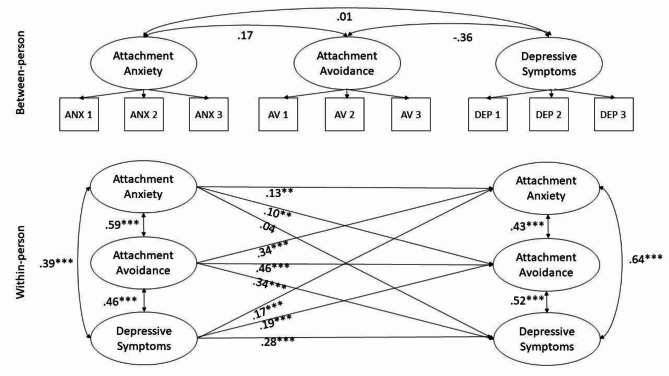
- In the RI-CLPM, improvements in attachment avoidance preceded improvements in depressive symptoms within subjects over time.
- The relationship was bidirectional: improvements in depressive symptoms also preceded later improvements in both attachment anxiety and avoidance.
- At the within-person level, elevated attachment insecurity was associated with greater depressive symptoms; at the between-person level, no significant associations were found.
- Model fit improved after freeing means over time: the final model had χ2(24) = 179.12, CFI = 0.988, RMSEA = 0.037, SRMR = 0.027.
## Methods
- Design: Observational outcomes study using repeated measures from a residential psychiatric system that had adopted ABFT as a core family therapy modality; analyses used a random-intercept cross-lagged panel model (RI-CLPM).
- Sample/data: 4,786 adolescents admitted to a multistate U.S. residential psychiatric treatment system; analyses excluded 399 adolescents with missing length of stay. Data were collected from 2020 to 2022 at intake, week 3, and week 5.
- Measures/analysis: Attachment anxiety and avoidance were measured with the ECR-RS; depressive symptoms with the PHQ-9. Missing data were handled with full-information maximum likelihood and length of stay was included as a time-invariant control.
## Limitations
- The paper states that conclusions about ABFT mechanisms in multimodal residential care are limited without a control group; changes could reflect other treatments, time away from home, or regression to the mean.
- The sample was predominantly White and Non-Hispanic and mostly had a primary diagnosis of a mood disorder, so the authors say findings may not generalize well to other racial groups or diagnoses.
- ABFT was implemented before the outcomes monitoring program, so the study cannot compare outcomes with and without ABFT.
- Evident from the text: the residential program included multiple concurrent treatments (e.g., medication, ACT, DBT-informed techniques, experiential therapies), so the specific contribution of ABFT cannot be isolated.
Model-written summary. Check it against the paper before relying on it.
Integrity signals
Registry
Cites
Statistics
Figures
Verification
Claims the paper makes
4 Valid · 1 Not valid · 5 Not checked · 26 Own results and interpretations
The cited sources support only part of this claim — read each source’s verdict below.
In the paper
“Studies have consistently shown that negative family processes can cause or exacerbate mental health problems in youth [11, 12].”
§ Evaluating attachment-based family therapy in residential treatment in the United States: does adolescents’ increased attachment security to caregivers lead to decreases in depressive symptoms? > Introduction
What the sources say
- Partly supportedcites [11] Spruit A, Goos L, Weenink N, Rodenburg R, Niemeyer H, Stams GJ, Colonnesi C. The relation between attachment and depression in children and adolescents: a Multilevel Meta-Analysis. Clin Child Fam Psychol Rev. 2020;23:54–69. 31392452 PMC7000490 sourceExperimental — accuracy not yet measured
The “Depression in Youth” section lists parental conflict and insecure attachment among risk factors for youth depression. But the “Implications for Research and Clinical Practice” section says the meta-analysis found an association and did not test whether attachment insecurity is a causal risk factor. The claim overstates that evidence as causation and extends it from depression to mental health problems generally; page numbers were not available in our copy. (LLM, conf=0.90)
- Not checked — no full text of the sourcecites [12] Sutton TE. Review of attachment theory: familial predictors, continuity and change, and Intrapersonal and Relational outcomes. Marriage Fam Rev. 2019;55:1–22. source
boostedstates a cause- Asserted: passes — The authors put it forward as true.
- Checkable: passes — It can be checked against evidence.
- Load-bearing: passes — The paper’s conclusions depend on it.
- Based: passes — The paper gives a reason why it holds.
- Partly supported
The cited sources support only part of this claim — read each source’s verdict below.
In the paper
“This model has gained empirical support for the treatment of adolescents and young adults struggling with depression and suicidality mostly in outpatient studies [25].”
§ Evaluating attachment-based family therapy in residential treatment in the United States: does adolescents’ increased attachment security to caregivers lead to decreases in depressive symptoms? > Introduction
What the sources say
- Partly supportedcites [25] Diamond G, Diamond GM, Levy S. Attachment-based family therapy: theory, clinical model, outcomes, and process research. J Affect Disord. 2021;294:286–95. 34304083 PMC8489519 sourceExperimental — accuracy not yet measured
The Clinical Trials Research and Fully Powered Randomized Controlled Trial sections report evidence for ABFT in adolescents with depression or suicidal ideation, and the Conclusion describes effective outpatient therapy. The paper also discusses ABFT with young adults, but that study concerns unresolved anger toward parents; it does not establish support for treating depression or suicidality in young adults. No page numbers were available in our copy. (LLM, conf=0.87)
plain- Asserted: passes — The authors put it forward as true.
- Checkable: passes — It can be checked against evidence.
- Load-bearing: passes — The paper’s conclusions depend on it.
- Based: passes — The paper gives a reason why it holds.
- Partly supported
The sources with a verdict support this claim; the rest weren’t checked yet, have no full text we could read, or their verdicts aren’t rated yet.
In the paper
“Both of these insecure attachment strategies are frequently associated with depression [11, 49].”
§ Evaluating attachment-based family therapy in residential treatment in the United States: does adolescents’ increased attachment security to caregivers lead to decreases in depressive symptoms? > Introduction > Proposed mechanisms of change in ABFT
What the sources say
- Supportedcites [11] Spruit A, Goos L, Weenink N, Rodenburg R, Niemeyer H, Stams GJ, Colonnesi C. The relation between attachment and depression in children and adolescents: a Multilevel Meta-Analysis. Clin Child Fam Psychol Rev. 2020;23:54–69. 31392452 PMC7000490 source
The Attachment Variables section reports that insecure-avoidant and insecure-ambivalent attachment were each significantly and positively associated with depression in children and adolescents. The paper calls the second pattern “ambivalent,” rather than “anxiety”; its evidence is specific to youth. (LLM, conf=0.88)
- Not checked — no full text of the sourcecites [49] Madigan S, Brumariu LE, Villani V, Atkinson L, Lyons-Ruth K. Representational and questionnaire measures of attachment: a meta-analysis of relations to child internalizing and externalizing problems. Psychol Bull. 2016;142:367–99. 26619212 source
plainstates an association- Asserted: passes — The authors put it forward as true.
- Checkable: passes — It can be checked against evidence.
- Load-bearing: passes — The paper’s conclusions depend on it.
- Based: passes — The paper gives a reason why it holds.
- Supported
The paper states this without a source or data behind it here, so there is nothing to check it against. The quote shows it is in the paper.
In the paper
“Thus, improvement in perceived attachment was associated with a reduction in depressive symptoms.”
§ Evaluating attachment-based family therapy in residential treatment in the United States: does adolescents’ increased attachment security to caregivers lead to decreases in depressive symptoms? > Abstract > Results
states an association- Asserted: passes — The authors put it forward as true.
- Checkable: passes — It can be checked against evidence.
- Load-bearing: passes — The paper’s conclusions depend on it.
- Based: unclear — It is unclear why the paper says it holds.
A result the paper reports from its own data — it cites no other source for it, so there is none to check. The quote shows it is in the paper.
In the paper
“Improvements in attachment avoidance preceded improvements in depressive symptoms within subjects, over time.”
- Also stated in: § Discussion This study aimed to test one of the key theoretical tenets of ABFT; namely, that improving adolescents’ perceived attachment to caregivers should lead to reduction in depressive symptoms. This study was unique in testing these changes in the context of an RTC setting. Across three time points in a random intercept cross-lagged panel model, the results generally supported our hypotheses. Attachment insecurity and depressive symptoms improved over 5 weeks of treatment and, within the same adolescents over time, improvements in attachment avoidance preceded improvements in depressive symptoms. At the same time, improvements in depressive symptoms preceded improvements in both dimensions of attachment (anxiety and avoidance). After accounting for these cross-lagged associations, cross-sectional associations remained within adolescents. That is, at times when adolescents had elevated attachment insecurity (after accounting for individual differences) they were also likely to report greater depressive symptoms. However, no between-person associations were significant. This means that, after accounting for within-person associations over time, those with a higher mean level of attachment insecurity did not also have a higher mean level of depressive symptoms. Taken together, change in attachment avoidance appears to be a plausible mechanism for some, but not all, of the change in depressive symptoms. The relationship between changes in attachment insecurity and depressive symptoms is bidirectional. These findings offer some support for the theoretical mechanisms of ABFT, as well as attachment-informed, family-focused residential treatment programs. Little research has examined how change in attachment and depressive symptoms influence each other over time. Some evidence suggests, however, that improvements in attachment may be related to decreases in depression for adolescents and adults in treatment [50–52]. Based on the results of the present study, it is worth considering why only reductions in attachment avoidance, and not attachment anxiety, predicted subsequent improvements in depressive symptoms. While the literature on attachment dimensions as outcome moderators or mediators is limited and somewhat mixed, child and adult patients with attachment anxiety tend to benefit less from psychotherapy across a wide range of treatment modalities [61]. This might be explained by these patients’ approach-avoidance orientation [62]. Specifically, patients with attachment anxiety present with a mix of bids for comfort and support from important others along with withdrawal and anger because they believe their efforts will fail. In the context of family treatments for youth, it may be more challenging to coach parents to interact with these adolescents in a way that can revise their internal working models, that is, help them begin to see their caregiver as capable of providing comfort. In contrast, for youth with attachment avoidance, helping parents learn and employ more steady, attachment-promoting behaviors is often obtained in ABFT [63]. Indeed, over the course of the treatment period, reductions in attachment anxiety scores were also less than those for attachment avoidance. Further research should examine these changes in more depth in order to understand what therapeutic, contextual, or individual factors influence unique changes in attachment anxiety and avoidance. · plain
“within the same adolescents over time, improvements in attachment avoidance preceded improvements in depressive symptoms.”
§ Evaluating attachment-based family therapy in residential treatment in the United States: does adolescents’ increased attachment security to caregivers lead to decreases in depressive symptoms? > Abstract > Results
plainstates a cause- Asserted: passes — The authors put it forward as true.
- Checkable: passes — It can be checked against evidence.
- Load-bearing: passes — The paper’s conclusions depend on it.
- Based: passes — The paper gives a reason why it holds.
- Also stated in: § Discussion This study aimed to test one of the key theoretical tenets of ABFT; namely, that improving adolescents’ perceived attachment to caregivers should lead to reduction in depressive symptoms. This study was unique in testing these changes in the context of an RTC setting. Across three time points in a random intercept cross-lagged panel model, the results generally supported our hypotheses. Attachment insecurity and depressive symptoms improved over 5 weeks of treatment and, within the same adolescents over time, improvements in attachment avoidance preceded improvements in depressive symptoms. At the same time, improvements in depressive symptoms preceded improvements in both dimensions of attachment (anxiety and avoidance). After accounting for these cross-lagged associations, cross-sectional associations remained within adolescents. That is, at times when adolescents had elevated attachment insecurity (after accounting for individual differences) they were also likely to report greater depressive symptoms. However, no between-person associations were significant. This means that, after accounting for within-person associations over time, those with a higher mean level of attachment insecurity did not also have a higher mean level of depressive symptoms. Taken together, change in attachment avoidance appears to be a plausible mechanism for some, but not all, of the change in depressive symptoms. The relationship between changes in attachment insecurity and depressive symptoms is bidirectional. These findings offer some support for the theoretical mechanisms of ABFT, as well as attachment-informed, family-focused residential treatment programs. Little research has examined how change in attachment and depressive symptoms influence each other over time. Some evidence suggests, however, that improvements in attachment may be related to decreases in depression for adolescents and adults in treatment [50–52]. Based on the results of the present study, it is worth considering why only reductions in attachment avoidance, and not attachment anxiety, predicted subsequent improvements in depressive symptoms. While the literature on attachment dimensions as outcome moderators or mediators is limited and somewhat mixed, child and adult patients with attachment anxiety tend to benefit less from psychotherapy across a wide range of treatment modalities [61]. This might be explained by these patients’ approach-avoidance orientation [62]. Specifically, patients with attachment anxiety present with a mix of bids for comfort and support from important others along with withdrawal and anger because they believe their efforts will fail. In the context of family treatments for youth, it may be more challenging to coach parents to interact with these adolescents in a way that can revise their internal working models, that is, help them begin to see their caregiver as capable of providing comfort. In contrast, for youth with attachment avoidance, helping parents learn and employ more steady, attachment-promoting behaviors is often obtained in ABFT [63]. Indeed, over the course of the treatment period, reductions in attachment anxiety scores were also less than those for attachment avoidance. Further research should examine these changes in more depth in order to understand what therapeutic, contextual, or individual factors influence unique changes in attachment anxiety and avoidance. · plain
14 more claims
Create a free account to see all 36 claims and every source verdict.
- Probably not a substantial claim. 11
- It may state two separate claims as one. 13
Statistics recomputed
Every reported test result, recomputed from its test statistic and degrees of freedom. A result shows as not adding up only once an independent check has confirmed it.
- Consistentχ²(28) = 726.63reported p < .001 · recomputed p < .001
“χ2(28) = 726.63, p < .001”
- Consistentχ²(24) = 179.12reported p < .001 · recomputed p < .001
“χ2(24) = 179.12, p < .001”
Self-check
Percentages, sums and reported differences re-computed from the paper’s own numbers.
Self-check results appear here once an independent check has confirmed them.
Citations
Cites
The PHQ-9: Validity of a brief depression severity measure
Kroenke, K., Spitzer, R. L., & Williams, J. B. W. (2001) · Journal of General Internal Medicine · doi:10.1046/j.1525-1497.2001.016009606.x · Cited by 44,910
Attachment and Loss. Vol. 1. Attachment
Rever, G. W. (1972) · Psychosomatic Medicine · doi:10.1097/00006842-197211000-00011 · Cited by 8,446
The American Psychological Association
Langfeld, H. S. (1919) · Science · doi:10.1126/science.49.1254.51 · Cited by 7,475
A critique of the cross-lagged panel model
Hamaker, E. L., Kuiper, R. M., & Grasman, R. P. P. P. (2015) · Psychological Methods · doi:10.1037/a0038889 · Cited by 4,005 · cited 2×
“Therefore, we used a random-intercept, cross-lagged panel model (RI-CLPM) [54] to examine these relationships over time.”
(1998) · Cited by 3,968
Fraley, R. C., Heffernan, M. E., Vicary, A. M., & Brumbaugh, C. C. (2011) · Psychological Assessment · doi:10.1037/a0022898 · Cited by 1,198 · cited 3×
“Fourth, the RTCs implemented a well-known and psychometrically sound attachment insecurity measure [56] into the program evaluation assessment battery.”
InfluentialApproach and Avoidance Social Motives and Goals
Gable, S. L. (2006) · Journal of Personality · doi:10.1111/j.1467-6494.2005.00373.x · Cited by 501 · cited 1×
“This might be explained by these patients’ approach-avoidance orientation [62].”
A unified framework of longitudinal models to examine reciprocal relations.
Usami, S., Murayama, K., & Hamaker, E. L. (2019) · Psychological Methods · doi:10.1037/met0000210 · Cited by 437 · cited 1×
“…the between-person components represent how much an individual ado-lescent’s trajectory is above or below the mean trajectory (while sharing the same underlying trend of improvement), and the within-person components as increases and decreases relevant to that adolescent’s trajectory [60].”
Madigan, S., Brumariu, L. E., Villani, V., Atkinson, L., & Lyons-Ruth, K. (2016) · Psychological Bulletin · doi:10.1037/bul0000029 · Cited by 397 · cited 1×
“Both of these insecure attachment strategies are frequently associated with depression [11, 49].”
Tyrer, P., Mulder, R., Kim, Y.-R., & Crawford, M. J. (2019) · Annual Review of Clinical Psychology · doi:10.1146/annurev-clinpsy-050718-095736 · Cited by 369 · cited 1×
“…the program is located in the United States and uses the Diagnostic and Statistical Manual-5 rather than the International Classification of Diseases-11, and the more categorical framework of the former appears to lead to lower rates of diagnosing personality disorders in adolescence [66, 67].”
Health Outcomes of Parents of Children with Chronic Illness: A Systematic Review and Meta-Analysis
Cohn, L. N., Pechlivanoglou, P., Lee, Y., Mahant, S., Orkin, J., Marson, A., & Cohen, E. (2020) · The Journal of Pediatrics · doi:10.1016/j.jpeds.2019.10.068 · Cited by 349 · cited 1×
“In addition, even the highest functioning families can be destabilized when raising a child with mental health challenges and thus could benefit from additional support [14].”
Titov, N., Dear, B. F., McMillan, D., Anderson, T., Zou, J., & Sunderland, M. (2011) · Cognitive Behaviour Therapy · doi:10.1080/16506073.2010.550059 · Cited by 342 · cited 1×
“The PHQ-9 is brief, with strong sensitivity and specificity [59].”
Chris Fraley, R., Niedenthal, P. M., Marks, M., Brumbaugh, C., & Vicary, A. (2006) · Journal of Personality · doi:10.1111/j.1467-6494.2006.00406.x · Cited by 332 · cited 1×
“Because the relationship with the attachment figure was unknown for most of the sample, and scores were highly correlated across figures, attachment scores were averaged across both figures to create overall indices of anxiety and avoidance (as recommended for this measure) [57].”
Parent–child attachment and children’s experience and regulation of emotion: A meta-analytic review.
Cooke, J. E., Kochendorfer, L. B., Stuart-Parrigon, K. L., Koehn, A. J., & Kerns, K. A. (2019) · Emotion · doi:10.1037/emo0000504 · Cited by 293
Spruit, A., Goos, L., Weenink, N., Rodenburg, R., Niemeyer, H., Stams, G. J., & Colonnesi, C. (2020) · Clinical Child and Family Psychology Review · doi:10.1007/s10567-019-00299-9 · Cited by 280 · cited 3×
“Both of these insecure attachment strategies are frequently associated with depression [11, 49].”
Knorth, E. J., Harder, A. T., Zandberg, T., & Kendrick, A. J. (2008) · Children and Youth Services Review · doi:10.1016/j.childyouth.2007.09.001 · Cited by 274 · cited 1×
“Family-centered care proposes that treating the entire family, not just the adolescent, may improve program outcomes and stability upon returning home [18–20].”
Attachment-based family therapy for depressed adolescents.
Diamond, G. S., Diamond, G. M., & Levy, S. A. (2014) · American Psychological Association eBooks · doi:10.1037/14296-000 · Cited by 246 · cited 1×
“Other studies have demonstrated ABFT can reduce depression and suicide ideation for LGBQ [34, 35] and trans-identified [36, 37] youth.”
Self-citationAttachment as a Core Feature of Resilience: A Systematic Review and Meta-Analysis
Darling Rasmussen, P., Storebø, O. J., Løkkeholt, T., Voss, L. G., Shmueli-Goetz, Y., Bojesen, A. B., Simonsen, E., & Bilenberg, N. (2019) · Psychological Reports · doi:10.1177/0033294118785577 · Cited by 167 · cited 1×
“At the same time, positive and secure family relationships can protect against mental health distress [13].”
Diamond, G. S., Wintersteen, M. B., Brown, G. K., Diamond, G. M., Gallop, R., Shelef, K., & Levy, S. (2010) · Journal of the American Academy of Child & Adolescent Psychiatry · doi:10.1016/j.jaac.2009.11.002 · Cited by 152 · cited 1×
“Several studies have demonstrated the effectiveness of ABFT for adolescents and young adults at risk for suicide [26–28].”
Self-citationDiamond, G. S., Kobak, R. R., Krauthamer Ewing, E. S., Levy, S. A., Herres, J. L., Russon, J. M., & Gallop, R. J. (2019) · Journal of the American Academy of Child & Adolescent Psychiatry · doi:10.1016/j.jaac.2018.10.006 · Cited by 147
Self-citationAssociation between Family Functionality and Depression: A Systematic Review and Meta-Analysis
Guerrero-Muñoz, D., Salazar, D., Constain, V., Perez, A., Pineda-Cañar, C. A., & García‐Perdomo, H. A. (2020) · Korean Journal of Family Medicine · doi:10.4082/kjfm.19.0166 · Cited by 140 · cited 1×
“This is consistent with a large body of research linking family functioning to depressive symptoms [68].”
Siqueland, L., Rynn, M., & Diamond, G. S. (2005) · Journal of Anxiety Disorders · doi:10.1016/j.janxdis.2004.04.006 · Cited by 134 · cited 1×
“Preliminary research also suggests ABFT may be effective for the treatment of youth struggling with eating disorders [29, 30] and anxiety [31, 32] as well as for younger children (ages 8 to 12) with a range of internalizing and externalizing distress [33].”
Self-citationAttachment and psychopathology: a dynamic model of the insecure cycle
Kobak, R., & Bosmans, G. (2019) · Current Opinion in Psychology · doi:10.1016/j.copsyc.2018.02.018 · Cited by 117 · cited 2×
“While biological and temperamental vulnerabilities are relevant, the family environment may either buffer against psychopathology or exacerbate it [44].”
Bloom, J. M., Woodward, E. N., Susmaras, T., & Pantalone, D. W. (2012) · Psychiatric Services · doi:10.1176/appi.ps.201100311 · Cited by 103 · cited 1×
“Therefore, many outcome studies of specific treatment modalities delivered in residential care deduce modality effectiveness from general, pre-post patient data and do not account for the impact of multiple treatments or the possible role of regression to the mean [65].”
An attachment-based intervention for parents of adolescents at risk: mechanisms of change
Moretti, M. M., Obsuth, I., Craig, S. G., & Bartolo, T. (2015) · Attachment & Human Development · doi:10.1080/14616734.2015.1006383 · Cited by 98
Attachment-based family therapy: Theory, clinical model, outcomes, and process research
Diamond, G., Diamond, G. M., & Levy, S. (2021) · Journal of Affective Disorders · doi:10.1016/j.jad.2021.07.005 · Cited by 91 · cited 4×
“One candidate for family therapy in an RTC is Attach-ment-Based Family Therapy (ABFT) [24, 25].”
InfluentialSelf-citationSutton, T. E. (2019) · Marriage & Family Review · doi:10.1080/01494929.2018.1458001 · Cited by 87 · cited 1×
“Studies have consistently shown that negative family processes can cause or exacerbate mental health problems in youth [11, 12].”
Family processes: risk, protective and treatment factors for youth at risk for suicide.
Diamond, G., Kodish, T., Ewing, E. S. K., Hunt, Q. A., & Russon, J. M. (2022) · Aggression and Violent Behavior · doi:10.1016/j.avb.2021.101586 · Cited by 70 · cited 1×
“Other studies have demonstrated ABFT can reduce depression and suicide ideation for LGBQ [34, 35] and trans-identified [36, 37] youth.”
Family Functioning and Residential Treatment Outcomes
Sunseri, P. A. (2004) · Residential Treatment For Children & Youth · doi:10.1300/j007v22n01_03 · Cited by 69 · cited 1×
“Several studies suggest that family involvement in RTC treatment leads to better treatment response, completion, and transition home [6, 10, 15–17].”
Feasibility of attachment based family therapy for depressed clinic-referred Norwegian adolescents
Israel, P., & Diamond, G. S. (2013) · Clinical Child Psychology and Psychiatry · doi:10.1177/1359104512455811 · Cited by 61 · cited 1×
“ABFT has been implemented in clinical settings including hospital-based psychiatric departments [39], child welfare systems [40], eating disorder programs [30, 41], LGBTQ + specialized services [37], and crisis units [42].”
Self-citationAttachment and psychotherapy: Implications from empirical research.
Levy, K. N., & Johnson, B. N. (2019) · Canadian Psychology / Psychologie canadienne · doi:10.1037/cap0000162 · Cited by 57 · cited 3×
“While the literature on attachment dimensions as outcome moderators or mediators is limited and somewhat mixed, child and adult patients with attachment anxiety tend to benefit less from psychotherapy across a wide range of treat-ment modalities [61].”
Parental Involvement in Residential Care: Distance, Frequency of Contact, and Youth Outcomes
Huefner, J. C., Pick, R., Smith, G. L., Stevens, A. L., & Mason, W. A. (2014) · Journal of Child and Family Studies · doi:10.1007/s10826-014-9953-0 · Cited by 56 · cited 1×
“Several studies suggest that family involvement in RTC treatment leads to better treatment response, completion, and transition home [6, 10, 15–17].”
Tasca, G., Balfour, L., Ritchie, K., & Bissada, H. (2007) · Psychotherapy: Theory, Research, Practice, Training · doi:10.1037/0033-3204.44.4.423 · Cited by 54 · cited 2×
“In both adolescent and adult studies, improvements in attachment may be related to decreases in depression [50–52].”
An Outcomes Perspective of the Role of Residential Treatment in the System of Care
Lyons, J. S., Woltman, H., Martinovich, Z., & Hancock, B. (2009) · Residential Treatment For Children & Youth · doi:10.1080/08865710902872960 · Cited by 51 · cited 1×
“These adolescent patients usually present as the most troubled in the mental health system, who have not benefited from less restrictive treatment settings or have struggles too difficult to address while living in a home environment [2].”
Adult Attachment Anxiety: Using Group Therapy to Promote Change: Attachment Anxiety in Group Therapy
Marmarosh, C. L., & Tasca, G. A. (2013) · Journal of Clinical Psychology · doi:10.1002/jclp.22044 · Cited by 50 · cited 2×
“In both adolescent and adult studies, improvements in attachment may be related to decreases in depression [50–52].”
Borderline personality disorder in adolescents: the He-who-must-not-be-named of psychiatry
Larrivée, M.-P. (2013) · Dialogues in Clinical Neuroscience · doi:10.31887/dcns.2013.15.2/mplarrivee · Cited by 50 · cited 1×
“…the program is located in the United States and uses the Diagnostic and Statistical Manual-5 rather than the International Classification of Diseases-11, and the more categorical framework of the former appears to lead to lower rates of diagnosing personality disorders in adolescence [66, 67].”
Parental Involvement as a Factor in the Readmission to a Residential Treatment Center
Lakin, B. L., Brambila, A. D., & Sigda, K. B. (2004) · Residential Treatment For Children & Youth · doi:10.1300/j007v22n02_03 · Cited by 48
Blau, G. M., Caldwell, B., Fisher, S. K., Kuppinger, A. D., Levison-Johnson, J., & Lieberman, R. (2010) · PubMed · Cited by 47
Ecological Factors in Successful Residential Treatment
Lewis, W. W. (1982) · Behavioral Disorders · doi:10.1177/019874298200700304 · Cited by 38
Russon, J., Smithee, L. C., Simpson, S., Levy, S. A., & Diamond, G. S. (2021) · Family Process · doi:10.1111/famp.12677 · Cited by 37
Self-citationDiamond, G. M., Boruchovitz‐Zamir, R., Nir‐Gotlieb, O., Gat, I., Bar‐Kalifa, E., Fitoussi, P., & Katz, S. (2022) · Family Process · doi:10.1111/famp.12770 · Cited by 36 · cited 1×
“In addition, ABFT has increased parental acceptance, decreased rejection, and improved adolescents’ attachment avoidance amongst sexual and gender minority young adults with non-accepting parents [38].”
Self-citationMiddle childhood attachment‐based family therapy: Theory and model description
Vlierberghe, L. V., Diamond, G. S., & Bosmans, G. (2023) · Family Process · doi:10.1111/famp.12887 · Cited by 35 · cited 1×
“Preliminary research also suggests ABFT may be effective for the treatment of youth struggling with eating disorders [29, 30] and anxiety [31, 32] as well as for younger children (ages 8 to 12) with a range of internalizing and externalizing distress [33].”
Self-citationSunseri, P. A. (2019) · Residential Treatment for Children & Youth · doi:10.1080/0886571x.2019.1589405 · Cited by 32 · cited 1×
“Family-centered care proposes that treating the entire family, not just the adolescent, may improve program outcomes and stability upon returning home [18–20].”
Rose, R. A., & Lanier, P. (2017) · International Journal of Environmental Research and Public Health · doi:10.3390/ijerph14101141 · Cited by 30 · cited 1×
“The cost of these programs have been estimated to be between $23,000 and $55,000 a treatment episode [3] and many youth, with unsuccessful discharge statuses, require repeated residential placements [4].”
A Review of Family Therapy in Residential Settings
Merritts, A. N. (2016) · Contemporary Family Therapy · doi:10.1007/s10591-016-9378-6 · Cited by 25 · cited 1×
“These potential confounds present some of the biggest challenges for outcomes research in this treatment setting, where the implementation of a con-trol group might not be clinically feasible or ethical [64].”
Family‐centred practice and family outcomes in residential youth care: A systematic review
Tang, E., de Haan, A. D., Kuiper, C. H. Z., & Harder, A. T. (2024) · Child & Family Social Work · doi:10.1111/cfs.13120 · Cited by 24 · cited 2×
“Addressing these challenges could improve outcomes in residential care and facilitate adolescents’ transition back home [5–7].”
Borderline personality disorder in adolescents: the He-who-must-not-be-named of psychiatry.
Larrivée, M.-P. (2013) · Europe PMC (PubMed Central) · Cited by 23
Lanier, P., Jensen, T., Bryant, K., Chung, G., Rose, R., Smith, Q., & Lackmann, L. (2020) · Children and Youth Services Review · doi:10.1016/j.childyouth.2020.104951 · Cited by 20 · cited 3×
“Several studies suggest that family involvement in RTC treatment leads to better treatment response, completion, and transition home [6, 10, 15–17].”
Redefining Residential: Becoming Family-Driven
American Association of Children’s (2009) · Residential Treatment for Children & Youth · doi:10.1080/08865710903256239 · Cited by 18 · cited 2×
“Numerous international policy statements and white papers have called for more family-centered care in these residential settings [8–10].”
Herbell, K., McNamara, P., Cresswell, C., Price, M., Sweeney, M., & Bellonci, C. (2023) · Residential Treatment for Children & Youth · doi:10.1080/0886571x.2023.2217530 · Cited by 18 · cited 1×
“In one recent review, Herbell and authors [23] questioned whether RTC programs used empirically supported family models and which family processes were targeted during treatment.”
Russon, J., Abbott, C. H., Jin, B., Rivers, A. S., Winston‐Lindeboom, P., Kobak, R., & Diamond, G. S. (2023) · Suicide and Life-Threatening Behavior · doi:10.1111/sltb.12995 · Cited by 16 · cited 1×
“Other studies have demonstrated ABFT can reduce depression and suicide ideation for LGBQ [34, 35] and trans-identified [36, 37] youth.”
Self-citationWagner, I., Diamond, G. S., Levy, S., Russon, J., & Litster, R. (2016) · Australian and New Zealand Journal of Family Therapy · doi:10.1002/anzf.1152 · Cited by 15 · cited 2×
“Preliminary research also suggests ABFT may be effective for the treatment of youth struggling with eating disorders [29, 30] and anxiety [31, 32] as well as for younger children (ages 8 to 12) with a range of internalizing and externalizing distress [33].”
Self-citationDifferences in Treatment Approaches by Residential Treatment Facilities
Herbell, K., & Ault, S. (2021) · Residential Treatment for Children & Youth · doi:10.1080/0886571x.2021.1910613 · Cited by 15 · cited 1×
“Drawing on data from over 500 facilities, the 2018 National Mental Health Services Survey [22] found that family therapy was one of the least used modalities compared to individual, group and cognitive behavioral therapy (CBT).”
Herres, J. L., James, K. M., Bounoua, N., Ewing, E. S. K., Kobak, R., & Diamond, G. S. (2021) · Psychotherapy · doi:10.1037/pst0000391 · Cited by 15
Self-citationPredicting Repeated Child and Adolescent Residential Treatment Placements
Izmirian, S. C., Milette-Winfree, M., Jackson, D. S., & Mueller, C. W. (2018) · Residential Treatment for Children & Youth · doi:10.1080/0886571x.2018.1558162 · Cited by 13 · cited 1×
“The cost of these programs have been estimated to be between $23,000 and $55,000 a treatment episode [3] and many youth, with unsuccessful discharge statuses, require repeated residential placements [4].”
van der Spek, N., Dekker, W., Peen, J., Santens, T., Cuijpers, P., Bosmans, G., & Dekker, J. (2024) · Crisis · doi:10.1027/0227-5910/a000916 · Cited by 13 · cited 1×
“Several studies have demonstrated the effectiveness of ABFT for adolescents and young adults at risk for suicide [26–28].”
Santens, T., Hannes, K., Levy, S., Diamond, G., & Bosmans, G. (2020) · Family Process · doi:10.1111/famp.12504 · Cited by 12 · cited 1×
“ABFT has been implemented in clinical settings including hospital-based psychiatric departments [39], child welfare systems [40], eating disorder programs [30, 41], LGBTQ + specialized services [37], and crisis units [42].”
Self-citationRedefining Residential: Family-Driven Care in Residential Treatment—Family Members Speak
American Association of Children’s (2009) · Residential Treatment for Children & Youth · doi:10.1080/08865710903459221 · Cited by 11
Herres, J., Krauthamer Ewing, E. S., Levy, S., Creed, T. A., & Diamond, G. S. (2023) · Frontiers in Psychiatry · doi:10.3389/fpsyt.2023.1096291 · Cited by 11 · cited 1×
“Preliminary research also suggests ABFT may be effective for the treatment of youth struggling with eating disorders [29, 30] and anxiety [31, 32] as well as for younger children (ages 8 to 12) with a range of internalizing and externalizing distress [33].”
Self-citationManasse, S. M., Russon, J., Lampe, E. W., King, A., Abber, S. R., Trainor, C. M., Gillikin, L. M., Levy, S. A., & Diamond, G. S. (2023) · Clinical Child Psychology and Psychiatry · doi:10.1177/13591045231187433 · Cited by 8 · cited 1×
“Preliminary research also suggests ABFT may be effective for the treatment of youth struggling with eating disorders [29, 30] and anxiety [31, 32] as well as for younger children (ages 8 to 12) with a range of internalizing and externalizing distress [33].”
Self-citationWinston-Lindeboom, P., Rivers, A. S., Roeske, M., & Diamond, G. (2025) · The Family Journal · doi:10.1177/10664807241280107 · Cited by 6
Self-citation(2013) · doi:10.1037/e333512004-001 · Cited by 5
Research works printed but not linked: 4
- Becvar RJ, Becvar DS, Reif LV. Systems theory and family therapy: a primer, fourth edition. 4th ed. Rowan & Littlefield; 2023.
- Diamond GS, Diamond GM, Levy S. Attachment-based family therapy for depressed adolescents. American Psychological Association; 2013. · DOI · Paper page
- Gornall A, Gronow S, Lu S, James K, Muscara F, Anderson V, Prakash C. A pilot randomized controlled trial of interventions to promote outpatient engagement following self-harm and suicidal acts in adolescent inpatients. Biomed J Sci Tech Res. 2022;44:35737–45.
- Bakermans–Kranenburg MJ, Oosterman M. Attachment–based interventions to promote secure attachment in children. Attach. Fundam. Quest. New York, NY, US: The Guilford Press; 2021. pp. 299–306.
Cited by
Güngör, S. (2026) · Frontiers in Psychology · doi:10.3389/fpsyg.2026.1780192 · Cited by 6
Becoming Herself: Using Lady Bird in Cinema Therapy with Adolescents
Rajaei, A., & El-Ammouri, L. (2026) · The Family Journal · doi:10.1177/10664807261415872 · Cited by 1
“These dynamics resemble attachment ruptures addressed in ABFT (Diamond et al., 2024).”
InfluentialCastro, E., Magalhães, E., & del Valle, J. F. (2026) · Residential Treatment for Children & Youth · doi:10.1080/0886571x.2026.2653863 · Cited by 1
Kozlov, M. Y. (2026) · Social Sciences and Childhood · doi:10.17759/ssc.2026070104 · Cited by 1
Stanek, C. J., Sherman, J. P., & Herbell, K. (2026) · Child Abuse & Neglect · doi:10.1016/j.chiabu.2026.108205
Metadata
- Authors
- Diamond, G., Rivers, A. S., Winston-Lindeboom, P., Russon, J., & Roeske, M.
- Affiliations
- University of Pennsylvania (US)
- Texas Woman's University (US)
- Virginia Tech (US)
- Newport Hospital (US)
- Corresponding author
- Rivers, Alannah Shelby
- Venue
- Child and Adolescent Psychiatry and Mental Health
- Published
- 2024-11-13
- Volume
- 18
- Issue
- 1
- Pages
- 147-147
- ISSN
- 1753-2000 (ISSN-L)
- PMC
- PMC11562347
- OpenAlex
- W4404311449
- Semantic Scholar
- 25d308e554ad826e22220c69d3e5601369bd8a9b
- Cited by
- 5
- References
- 64
- Citations by year
- 2026: 5
- FWCI
- 2.50
- Type
- journal article
- Language
- en
- Open access
- gold
- doi.org
- Licence
- cc-by
- creativecommons.org/licenses/by/4.0 (tdm)
- creativecommons.org/licenses/by/4.0 (vor)
- Locations
- Child and Adolescent Psychiatry and Mental Health (publishedVersion, cc-by)
- PubMed Central (publishedVersion, cc-by)
- PubMed (publishedVersion)
- VTechWorks (Virginia Tech) (submittedVersion, cc-by)
- DOAJ (DOAJ: Directory of Open Access Journals) (submittedVersion)
- Topics
- Social Sciences › Psychology › Clinical Psychology › Psychotherapy Techniques and Applications
- Social Sciences › Psychology › Social Psychology › Attachment and Relationship Dynamics
- Social Sciences › Psychology › Clinical Psychology › Counseling, Therapy, and Family Dynamics
- Keywords
- attachment-based family therapy, adolescents, insecure attachment, attachment avoidance, depressive symptoms, attachment anxiety, family therapy, treatment effectiveness
About these checks
Registry, retraction, Cites and statistics results are computed, not judged, with one exception: a printed reference that no index lists is read once by a model before it counts as a citation error. Claims are extracted by a model and kept only when their quote appears verbatim in the text; each cited source is then checked, with a model’s help, for whether it says what the claim relies on. Those verdicts can be wrong — read the claim’s quote and the cited source before relying on one.
The claim verdicts this report counts are experimental: their accuracy is not yet measured.
A language model drew the claims from the paper on 2026-10-11, under version 3 of the claim definition (model deepseek-v4.1-flash, prompt extract-v3).
A second model labelled each claim on 2026-10-11 (model jev-1.13-20260917, definition revision gold-guideline-v0.2).
Cited sources are checked with a language model’s help (gpt-6-sol).
Statistics and arithmetic are recomputed, not judged.
Confidence bands are shown only for fields calibrated on our annotated test set. None is calibrated yet, so no band is shown.
What counts as a claim ›How we measure confidence ›How we check this ›
Are you an author, or do you see a problem with this page? Request a review
Data sources
Bibliographic data: Semantic Scholar, OpenAlex, Crossref.
Contains information from the Semantic Scholar Academic Graph Datasets, made available under the ODC Attribution License (ODC-BY 1.0).
Semantic Scholar’s data is described in: Kinney, R., et al. (2023). The Semantic Scholar Open Data Platform. arXiv:2301.10140.
