

Cancer-associated adipocytes: key players in breast cancer progression
Open accessThe DOI matches its Crossref record; 150 of the 151 references it cites were found in a registry or an index.
Abstract
Adipocytes are one of the primary stromal cells in many tissues, and they are considered to play an active role in the tumor microenvironment. Cancer-associated adipocytes (CAAs) are not only found adjacent to cancer cells, but also communicate with cancer cells through releasing various factors that can mediate local and systemic effects. The adipocyte-cancer cell crosstalk leads to phenotypical and functional changes of both cell types, which can further enhance tumor progression. Indeed, obesity, which is associated with an increase in adipose mass and an alteration of adipose tissue, is becoming pandemic in some countries and it is now considered to be an independent risk factor for cancer progression. In this review, we focus on the potential mechanisms involved with special attention to the adipocyte-cancer cell circle in breast cancer. We envisage that besides having a direct impact on tumor cells, CAAs systemically preconditions the tumor microenvironment by favoring anti-tumor immunity. A better understanding of cancer-associated adipocytes and the key molecular events in the adipocyte-cancer cell crosstalk will provide insights into tumor biology and permit the optimization of therapeutic strategies.
Overview
The claims and statistics of this paper haven’t been checked yet.
Free: it reads the open-access text and checks the first 5 claims that cite a source we can check. Create a free account to check every claim.
Integrity signals
Registry
Cites
Statistics
Figures
Verification
Claims the paper makes
The claims and statistics of this paper haven’t been checked yet.
Free: it reads the open-access text and checks the first 5 claims that cite a source we can check. Create a free account to check every claim.
Claims other papers make about this one
Each is checked against this paper’s own text: does it say what the citing paper says it does?
The cited source says what the claim attributes to it.
In the citing paper
“All these factors can modify the behavior and stimulate the tumorigenic potential of breast cancer cells.”
From 3D In Vitro Model (R)evolution: Unveiling Tumor–Stroma Interactions (2021) · cites this paper as [50]
The cited source says what the claim attributes to it.
In the citing paper
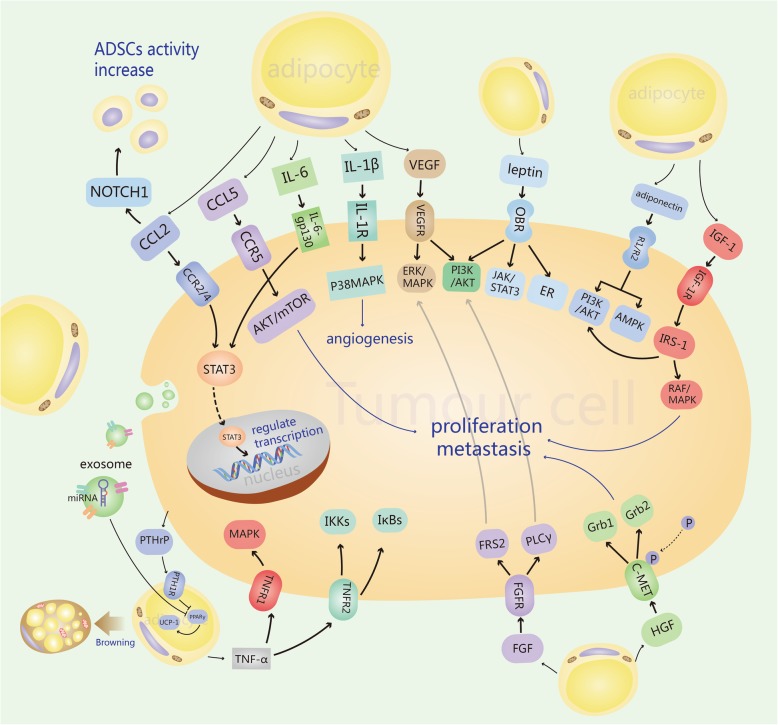
“In breast cancer, CAAs secrete chemokines CCL2 and CCL5, in fl ammatory factors such as IL-1 β and IL-6, VEGF, tumor necrosis factor (TNFα ), and adipokines such as leptin [50].”
From 3D In Vitro Model (R)evolution: Unveiling Tumor–Stroma Interactions (2021) · cites this paper as [50]
Self-check
Percentages, sums and reported differences re-computed from the paper’s own numbers.
The self-check needs the paper’s full text.
Citations
Cites
4 retracted
Akiyama, M., Hideshima, T., Hayashi, T., Tai, Y., Mitsiades, C. S., Mitsiades, N., Chauhan, D., Richardson, P. G. G., Munshi, N. C., & Anderson, K. C. (2003) · PubMed · Cited by 212
RetractedZhang, H., Zhu, L., Bai, M., Liu, Y., Zhan, Y., Deng, T., Yang, H., Sun, W., Wang, X., Zhu, K., et al. (2019) · International Journal of Cancer · doi:10.1002/ijc.31977 · Cited by 210
Self-citationRetractedWu, Q., Li, J., Li, Z., Sun, S., Zhu, S., Wang, L., Wu, J., Yuan, J., Zhang, Y., Sun, S., et al. (2019) · Journal of Experimental & Clinical Cancer Research · doi:10.1186/s13046-019-1210-3 · Cited by 137
Self-citationRetractedWu, Q., Sun, S., Li, Z., Yang, Q., Li, B., Zhu, S., Wang, L., Wu, J., Yuan, J., Yang, C., et al. (2018) · Molecular Cancer · doi:10.1186/s12943-018-0899-5 · Cited by 102
Self-citationRetractedUnderstanding the Warburg Effect: The Metabolic Requirements of Cell Proliferation
Vander Heiden, M. G., Cantley, L. C., & Thompson, C. B. (2009) · Science · doi:10.1126/science.1160809 · Cited by 16,197
Warburg, O. (1956) · Science · doi:10.1126/science.123.3191.309 · Cited by 13,425
The biology of VEGF and its receptors
Ferrara, N., Gerber, H.-P., & LeCouter, J. (2003) · Nature Medicine · doi:10.1038/nm0603-669 · Cited by 9,591
Long non-coding RNA HOTAIR reprograms chromatin state to promote cancer metastasis
Gupta, R. A., Shah, N., Wang, K. C., Kim, J., Horlings, H. M., Wong, D. J., Tsai, M.-C., Hung, T., Argani, P., Rinn, J. L., et al. (2010) · Nature · doi:10.1038/nature08975 · Cited by 5,218
Regulation of cancer cell metabolism
Cairns, R. A., Harris, I. S., & Mak, T. W. (2011) · Nature Reviews Cancer · doi:10.1038/nrc2981 · Cited by 4,744
Infliximab for Induction and Maintenance Therapy for Ulcerative Colitis
Rutgeerts, P., Sandborn, W. J., Feagan, B. G., Reinisch, W., Olson, A., Johanns, J., Travers, S., Rachmilewitz, D., Hanauer, S. B., Lichtenstein, G. R., et al. (2005) · New England Journal of Medicine · doi:10.1056/nejmoa050516 · Cited by 3,902
Cited by
Items 501–504 of 504
Chen, Y., & Tang, D. (2026) · International Journal of Cancer · doi:10.1002/ijc.70681
Peritumoral adipose tissue: A bidirectional regulator of cancer
Li, Y., Liu, S., Li, Z.-J., Yun-wei, D., & Ju, H. (2026) · Cell Metabolism · doi:10.1016/j.cmet.2026.09.022
Self-citationIn Vitro and In Vivo Drug Screening for Breast Cancer Using 3d Engineered Tissues
MIRI, F., Altememy, D., Keshavarzian, F., NAZEMI, S., MIRHAJ, Y., Gharibshahian, M., Alizadeh, A., & Saffarieh, E. (2026) · International Journal of Applied Pharmaceutics · doi:10.22159/ijap.2026v18i6.56164
Wise, J., Currie, M. J., Morrin, H. R., Major, G. S., Woodfield, T. B. F., Lim, K. S., & Phillips, E. (2026) · Advanced Healthcare Materials · doi:10.1002/adhm.71962
Metadata
- Authors
- Wu, Q., Li, B., Li, Z., Li, J., Sun, S., & Sun, S.
- Affiliations
- Université Paris-Sud (FR)
- Renmin Hospital of Wuhan University (CN)
- Corresponding author
- Sun, Si
- Sun, Shengrong
- Venue
- Journal of Hematology & Oncology
- Published
- 2019-09-10
- Volume
- 12
- Issue
- 1
- Pages
- 95-95
- ISSN
- 1756-8722 (ISSN-L)
- PMC
- PMC6734503
- OpenAlex
- W2972584423
- Semantic Scholar
- 894bc532f56c3ff5c11ff42c221956d25ebcc79d
- Cited by
- 462
- References
- 150
- Citations by year
- 2026: 44 · 2025: 59 · 2024: 82 · 2023: 82 · 2022: 70 · 2021: 71 · 2020: 52
- FWCI
- 4.63
- Type
- journal article
- Language
- en
- Open access
- gold
- doi.org
- Licence
- cc-by
- creativecommons.org/licenses/by/4.0/ (tdm)
- creativecommons.org/licenses/by/4.0/ (vor)
- Locations
- Journal of Hematology & Oncology (publishedVersion, cc-by)
- PubMed Central (publishedVersion, cc-by)
- PubMed (publishedVersion)
- DOAJ (DOAJ: Directory of Open Access Journals) (submittedVersion)
- Funders
- National Natural Science Foundation of China (81471781)
- National Key Scientific Instrument and Equipment Development Projects of China (2012YQ160203)
- Topics
- Life Sciences › Biochemistry, Genetics and Molecular Biology › Cancer Research › Cancer, Lipids, and Metabolism
- Health Sciences › Medicine › Endocrinology, Diabetes and Metabolism › Adipokines, Inflammation, and Metabolic Diseases
- Health Sciences › Medicine › Physiology (medical) › Adipose Tissue and Metabolism
- Keywords
- cancer-associated adipocytes, breast cancer progression, tumor microenvironment, obesity, adipose tissue, antitumor immunity, tumor stroma
- MeSH terms
- Breast Neoplasms, Female, Gene Expression Regulation, Humans, Cytokines, Adipocytes, Disease Progression, Tumor Microenvironment
About these checks
Registry, retraction, Cites and statistics results are computed, not judged, with one exception: a printed reference that no index lists is read once by a model before it counts as a citation error. Claims are extracted by a model and kept only when their quote appears verbatim in the text; each cited source is then checked, with a model’s help, for whether it says what the claim relies on. Those verdicts can be wrong — read the claim’s quote and the cited source before relying on one.
Statistics and arithmetic are recomputed, not judged.
Confidence bands are shown only for fields calibrated on our annotated test set. None is calibrated yet, so no band is shown.
What counts as a claim ›How we measure confidence ›How we check this ›
Are you an author, or do you see a problem with this page? Request a review
Data sources
Bibliographic data: Semantic Scholar, OpenAlex, Crossref.
Contains information from the Semantic Scholar Academic Graph Datasets, made available under the ODC Attribution License (ODC-BY 1.0).
Semantic Scholar’s data is described in: Kinney, R., et al. (2023). The Semantic Scholar Open Data Platform. arXiv:2301.10140.
