

Inhibition of SALL4 reduces tumorigenicity involving epithelial-mesenchymal transition via Wnt/β-catenin pathway in esophageal squamous cell carcinoma
Open accessThe DOI matches its Crossref record; 48 of the 49 references it cites were found in a registry or an index.
Abstract
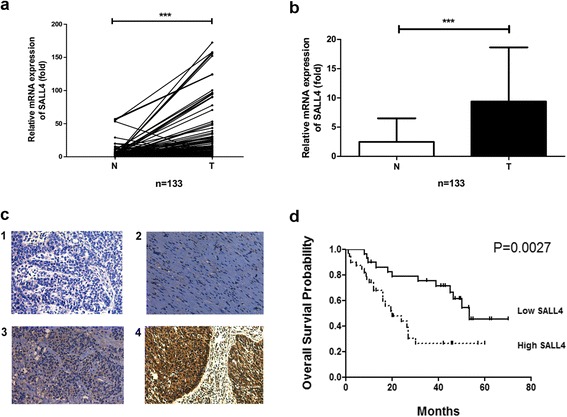
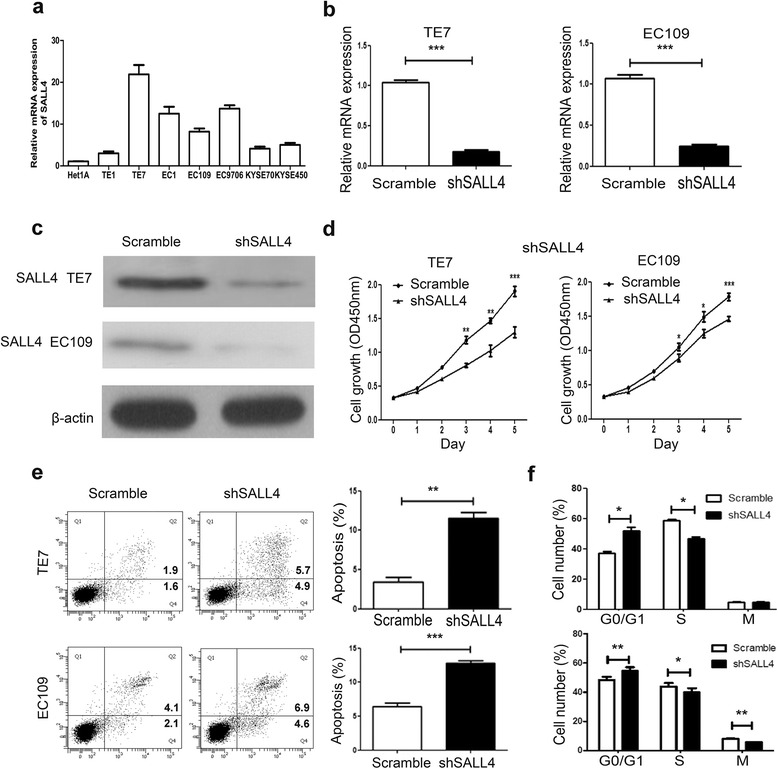
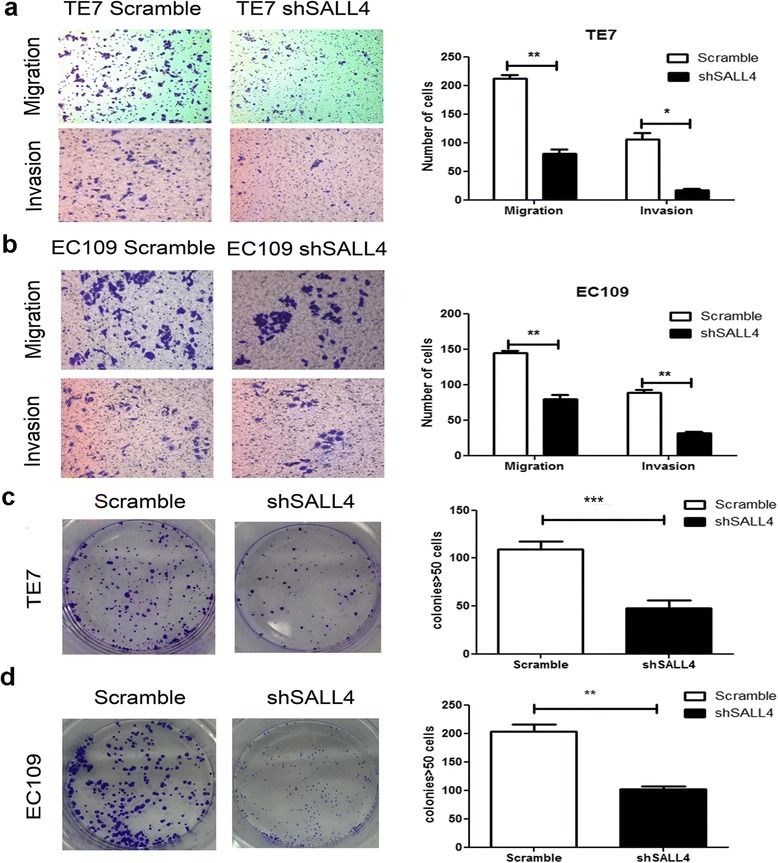
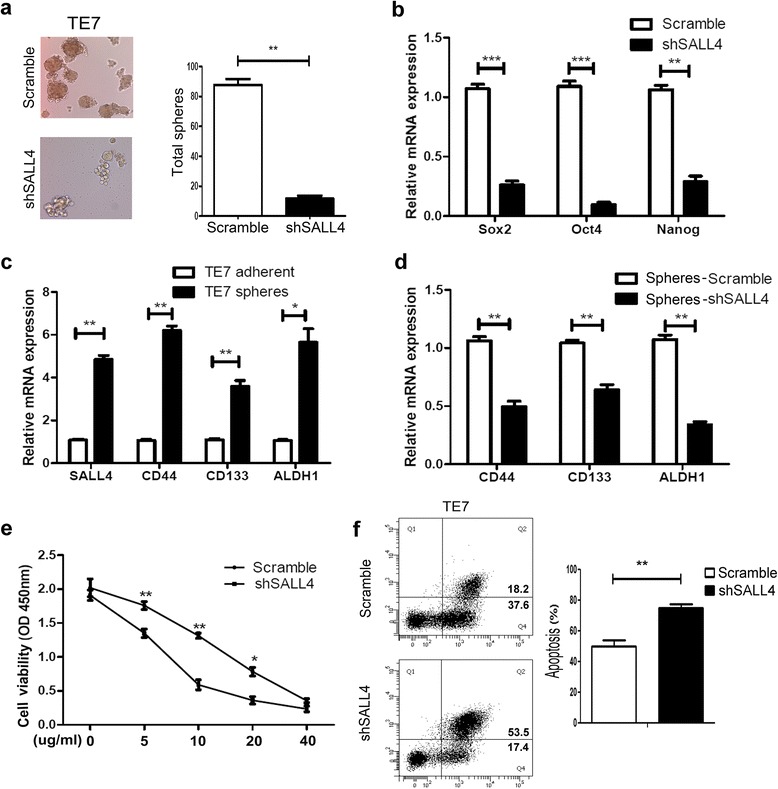
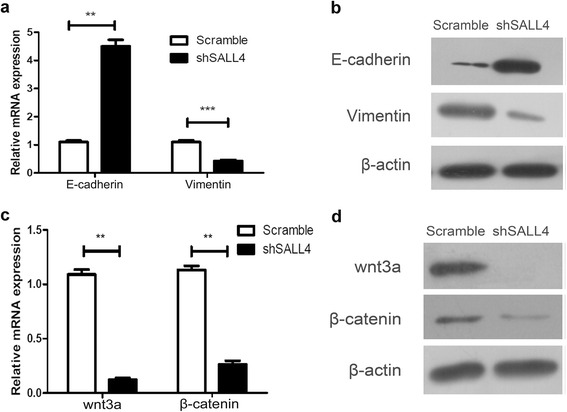
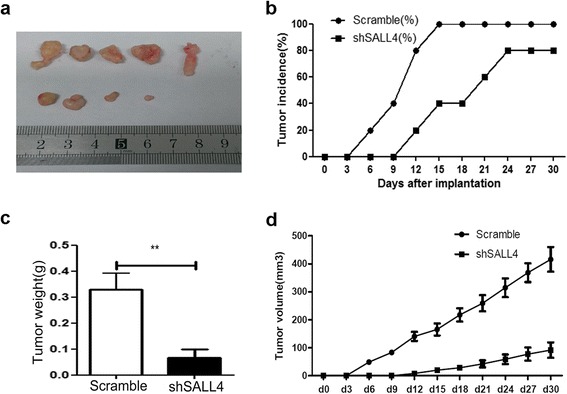
BACKGROUND: Growing evidence suggests that SALL4 plays a vital role in tumor progression and metastasis. However, the molecular mechanism of SALL4 promoting esophageal squamous cell carcinoma (ESCC) remains to be elucidated. METHODS: The gene and protein expression profiles- were examined by using quantitative real-time PCR, immunohistochemistry and western blotting. Small hairpin RNA was used to evaluate the role of SALL4 both in cell lines and in animal models. Cell proliferation, apoptosis and invasion were assessed by CCK8, flow cytometry and transwell-matrigel assays. Sphere formation assay was used for cancer stem cell derivation and characterization. RESULTS: Our study showed that the transcription factor SALL4 was overexpressed in a majority of human ESCC tissues and closely correlated with a poor outcome. We established the lentiviral system using short hairpin RNA to knockdown SALL4 in TE7 and EC109 cells. Silencing of SALL4 inhibited the cell proliferation, induced apoptosis and the G1 phase arrest in cell cycle, decreased the ability of migration/invasion, clonogenicity and stemness in vitro. Besides, down-regulation of SALL4 enhanced the ESCC cells' sensitivity to cisplatin. Xenograft tumor models showed that silencing of SALL4 decreased the ability to form tumors in vivo. Furthermore, our study demonstrated that SALL4 played a vital role in modulating the stemness of ESCC cells via Wnt/β-catenin signaling pathway and in epithelial-mesenchymal transition. CONCLUSIONS: Our results revealed that SALL4 might serve as a functional marker for ESCC cancer stem cell, a crucial marker for prognosis and an attractive candidate for target therapy of ESCC.
Overview
The claims and statistics of this paper haven’t been checked yet.
Free: it reads the open-access text and checks the first 5 claims that cite a source we can check. Create a free account to check every claim.
Integrity signals
Registry
Cites
Statistics
Figures
Verification
Claims the paper makes
The claims and statistics of this paper haven’t been checked yet.
Free: it reads the open-access text and checks the first 5 claims that cite a source we can check. Create a free account to check every claim.
Claims other papers make about this one
Each is checked against this paper’s own text: does it say what the citing paper says it does?
The source backs part of the claim, not all of it — or backs it for a different population, condition or comparison.
In the citing paper
“These data suggest that in melanoma—similar to other cancer types—Sall4 is essential for tumor growth, while its depletion or downregulation leads to increased micrometastases formation”
From Epigenetic control of melanoma cell invasiveness by the stem cell factor SALL4 (2021) · cites this paper as [37]
Experimental — accuracy not yet measured
Self-check
Percentages, sums and reported differences re-computed from the paper’s own numbers.
The self-check needs the paper’s full text.
Citations
Cites
Jemal, A., Bray, F., Center, M. M., Ferlay, J., Ward, E., & Forman, D. (2011) · CA: A Cancer Journal for Clinicians · doi:10.3322/caac.20107 · Cited by 54,679
Global Cancer Statistics, 2002
Parkin, D. M., Bray, F., Ferlay, J., & Pisani, P. (2005) · CA: A Cancer Journal for Clinicians · doi:10.3322/canjclin.55.2.74 · Cited by 18,196
Cancer statistics in China, 2015
Chen, W., Zheng, R., Baade, P. D., Zhang, S., Zeng, H., Bray, F., Jemal, A., Yu, X. Q., & He, J. (2016) · CA: A Cancer Journal for Clinicians · doi:10.3322/caac.21338 · Cited by 17,038
Self-citationJemal, A., Siegel, R., Xu, J., & Ward, E. (2010) · CA: A Cancer Journal for Clinicians · doi:10.3322/caac.20073 · Cited by 12,596
Epithelial-Mesenchymal Transitions in Development and Disease
Thiery, J. P., Acloque, H., Huang, R. Y. J., & Nieto, M. A. (2009) · Cell · doi:10.1016/j.cell.2009.11.007 · Cited by 9,931 · cited 1×
“EMT plays crucial roles during embryonic development, tumor metastasis and invasion and is one of the major molecular mechanisms through which invasion and metastasis are promoted during the oncogenic process [33, 34].”
BackgroundStem cells, cancer, and cancer stem cells
Reya, T., Morrison, S. J., Clarke, M. F., & Weissman, I. L. (2001) · Nature · doi:10.1038/35102167 · Cited by 9,738 · cited 1×
“Accumulating evidence suggests that many solid tumors contain a small subset of tumor cells known as CSCs [26], which display stem cell characteristics, including selfrenewal and differentiation into a heterogeneous tumor cell population consisting of progenitor cells and more differentiated cancer cells [27, 28].”
BackgroundTrastuzumab-Induced Hepatotoxicity: A Case Report
Vucicevic, D., Carey, E. J., & Karlin, N. J. (2013) · Breast Care · doi:10.1159/000346844 · Cited by 4,415
Brocken, P., van der Heijden, H. F. M., Dekhuijzen, P. N. R., Peters-Bax, L., & de Geus-Oei, L.-F. (2014) · Respiration · doi:10.1159/000347096 · Cited by 4,002
Wnt signalling in stem cells and cancer
Reya, T., & Clevers, H. (2005) · Nature · doi:10.1038/nature03319 · Cited by 3,666 · cited 1×
“Activation of Wnt/β-catenin signaling pathway has been implicated in stem cell self-renewal, maintenance and differentiation [38, 39].”
BackgroundClarke, M. F., Dick, J. E., Dirks, P. B., Eaves, C. J., Jamieson, C. H. M., Jones, D. L., Visvader, J., Weissman, I. L., & Wahl, G. M. (2006) · Cancer Research · doi:10.1158/0008-5472.can-06-3126 · Cited by 3,051 · cited 12×
“Accumulating evidence suggests that many solid tumors contain a small subset of tumor cells known as CSCs [26], which display stem cell characteristics, including selfrenewal and differentiation into a heterogeneous tumor cell population consisting of progenitor cells and more differentiated cancer cells [27, 28].”
BackgroundInfluential
Cited by
Liu, J., Xue, N., Guo, Y., Niu, K., Gao, L., Zhang, S., Gu, H., Wang, X., Zhao, D., & Fan, R. (2019) · Aging · doi:10.18632/aging.102580 · Cited by 163
“Wnt3 is also reported to be associated with the tumorigenicity and poor prognosis of ESCC [22, 23].”
BackgroundSALL4 activates TGF-β/SMAD signaling pathway to induce EMT and promote gastric cancer metastasis
Zhang, X., Zhang, P., Shao, M., Zang, X., Zhang, J., Mao, F., Qian, H., & Xu, W. (2018) · Cancer Management and Research · doi:10.2147/cmar.s177373 · Cited by 83
“He et al demonstrated that the inhibition of SALL4 reduces tumorigenicity involving EMT via Wnt/βcatenin pathway in esophageal squamous cell carcinoma.(21) Liu et al suggested that SALL4 acts as an EMT and drug resistance inducer through the regulation of c-Myc in endometrial cancer.”
BackgroundIntratumor microbiome in cancer progression: current developments, challenges and future trends
Liu, J., & Zhang, Y. (2022) · Biomarker Research · doi:10.1186/s40364-022-00381-5 · Cited by 80
Self-citationCancer stem cells with increased metastatic potential as a therapeutic target for esophageal cancer
Wang, D., Plukker, J. T. M., & Coppes, R. P. (2017) · Seminars in Cancer Biology · doi:10.1016/j.semcancer.2017.03.010 · Cited by 86
Self-citationLin, J., Lin, W., Ye, Y., Wang, L., Chen, X., Zang, S., & Huang, A. (2017) · Journal of Experimental & Clinical Cancer Research · doi:10.1186/s13046-017-0603-4 · Cited by 73
“EMT is able to endow tumor cells with stem cell-like phenotype to increase the ability of migration/invasion [35, 36] and Wnt/β-catenin signaling was reporeted to have a close association with EMT [37].”
BackgroundSelf-citationRetractedTargeting the CXCR4/CXCL12 axis in treating epithelial ovarian cancer
Mao, T. L., Fan, K.-F., & Liu, C.-L. (2017) · Gene Therapy · doi:10.1038/gt.2017.69 · Cited by 77
Wang, X., Liu, S., Cao, L., Zhāng, T., Yue, D., Wang, L., Ping, Y., He, Q., Zhang, C., Wang, M., et al. (2017) · Oncotarget · doi:10.18632/oncotarget.21246 · Cited by 72
“The method is in agreement with those reported in previous studies [43].”
ResultSelf-citationLiu, P., Liu, W., Chang, J.-M., Chen, Y., Liu, Y., Kuo, H., Hsieh, C., Ding, Y.-S., Chen, W., & Chong, I. (2017) · PLoS ONE · doi:10.1371/journal.pone.0180844 · Cited by 69
Gao, Y., Yi, J., Zhang, K., Bai, F., Feng, B., Wang, R., Chu, X., Chen, L., & Song, H. (2017) · Journal of Experimental & Clinical Cancer Research · doi:10.1186/s13046-017-0622-1 · Cited by 72
Wang, C., Zhou, M., Zhu, P., Ju, C., Sheng, J., Du, D., Wan, J., Yin, H., Xing, Y., Li, H., et al. (2022) · Journal of Experimental & Clinical Cancer Research · doi:10.1186/s13046-022-02550-8 · Cited by 59
“The final immunoreactivity score of IGF2BP2 was calculated as previously described [19].”
MethodSelf-citationmiR-103/miR-195/miR-15b Regulate SALL4 and Inhibit Proliferation and Migration in Glioma
Chen, L., Zhang, N.-N., Ren, X.-Q., He, J., & Li, Y. (2018) · Molecules · doi:10.3390/molecules23112938 · Cited by 60
“The inhibition of SALL4 reduces tumorigenicity involving epithelial-mesenchymal transition via the Wnt/β-catenin pathway in esophageal squamous cell carcinoma [31].”
BackgroundSelf-citationQi, B., Wang, Y., Chen, Z., Li, X., Qi, Y., Yang, Y., Cui, G., Guo, H., Li, W., & Zhao, S. (2017) · World Journal of Gastroenterology · doi:10.3748/wjg.v23.i45.7965 · Cited by 53
Chen, M., Li, L., & Zheng, P. (2019) · Cancer Science · doi:10.1111/cas.14140 · Cited by 52
Tissue-guided LASSO for prediction of clinical drug response using preclinical samples
Huang, E. W., Bhope, A., Lim, J., Sinha, S., & Emad, A. (2020) · PLoS Computational Biology · doi:10.1371/journal.pcbi.1007607 · Cited by 52
Li, H., Yang, H., Wen, D., Luo, Y., Liang, C., Pan, D., Ma, W., Chen, G., He, Y., & Chen, J. (2017) · Hormone and Metabolic Research · doi:10.1055/s-0043-103346 · Cited by 47
SALL 4 induces radioresistance in nasopharyngeal carcinoma via the ATM /Chk2/p53 pathway
Nie, X., Guo, E., Wu, C., Liu, D., Sun, W., Zhang, L., Long, G., Mei, Q., Wu, K., Xiong, H., et al. (2019) · Cancer Medicine · doi:10.1002/cam4.2056 · Cited by 45
Tang, Y., Wu, L., Zhao, M., Zhao, G., Mao, S., Wang, L., Liu, S., & Wang, X. (2019) · Biochemistry and Cell Biology · doi:10.1139/bcb-2019-0065 · Cited by 48
“EMT was suppressed after 327 SNHG4 silencing proved by decreased expression of SALL4, Twist, vimentin, MMP2 328 and MMP9 as well as up-regulated E-cadherin expression (He et al. 2016).”
BackgroundSelf-citationHe, J., Zhou, M., Li, X., Gu, S., Cao, Y., Xing, T., Chen, W., Chu, C., Gu, F., Zhou, J., et al. (2020) · Oncogene · doi:10.1038/s41388-020-1181-z · Cited by 44
“The procedures for testing cell viability with CCK-8, colony formation, cell cycle distributions with flow cytometry, transwell migration, and invasion assays were performed with standard protocols as previously described [20, 41].”
MethodSelf-citationOncofetal gene SALL4 and prognosis in cancer: A systematic review with meta-analysis
Nicolè, L., Sanavia, T., Veronese, N., Cappellesso, R., Luchini, C., Dabrilli, P., & Fassina, A. (2017) · Oncotarget · doi:10.18632/oncotarget.14952 · Cited by 39
Li, P., Chen, X., Qin, G., Yue, D., Zhang, Z., Yü, P., Wang, D., Zhao, X., Song, M., Zhao, Q., et al. (2018) · Cancer Immunology Research · doi:10.1158/2326-6066.cir-17-0415 · Cited by 43
“RNA extraction and qRT-PCR Detailed experiments were performed as described previously (21).”
BackgroundMethodSelf-citationHe, J., Jin, Y., Zhou, M., Li, X., Chen, W., Wang, Y., Gu, S., Cao, Y., Chu, C., Liu, X., et al. (2017) · Cancer Science · doi:10.1111/cas.13478 · Cited by 41
“was calculated as previously described.(14) In brief, the expression of SLC35F2 was scored according to the percentage of positive-stained tumor cells and the intensity of staining.”
MethodSelf-citationZhou, C., Fan, N., Liu, F., Fang, N., Plum, P. S., Thieme, R., Gockel, I., Gromnitza, S., Hillmer, A. M., Chon, S., et al. (2020) · Cells · doi:10.3390/cells9061481 · Cited by 40
“Other read-outs for cancer stemness associated genes such as BMI-1 [61], Nanog [58–60], Sox2 [53–57], Oct-4 [54,62,65,66], SALL4 [55,73], GLI-1 [70–72], Ep-CAM [67–69], and Podoplanin (PDPN) [74–77] are involved in regulating CSC populations, leading to enhanced proliferation, invasiveness, therapy resistance, and met…”
BackgroundYue, D., Liu, S., Zhang, T., Wang, Y., Qin, G., Chen, X., Zhang, H., Wang, D., Huang, L., Wang, F., et al. (2021) · Cancer Biology and Medicine · doi:10.20892/j.issn.2095-3941.2020.0290 · Cited by 40
“Detailed evaluation of immunohistochemical staining experiments was performed as described previously 12 .”
Self-citationSALL Proteins; Common and Antagonistic Roles in Cancer
Álvarez, C., Quiroz, A., Benítez-Riquelme, D., Riffo, E., Castro, A. F., & Pincheira, R. (2021) · Cancers · doi:10.3390/cancers13246292 · Cited by 37
“Esophageal SALL4 High Undescribed SALL4 silencing in ESCC cells is associated with suppressing cell migration, invasion, viability, and drug resistance in vivo SALL4 knockdown reduces epithelial-mesenchymal transition by targeting the Wnt/β-catenin signaling pathway Oncogene [42, 126]”
BackgroundEpigenetic control of melanoma cell invasiveness by the stem cell factor SALL4
Diener, J., Baggiolini, A., Pernebrink, M., Dalcher, D., Lerra, L., Cheng, P. F., Varum, S., Häusel, J., Stierli, S., Treier, M., et al. (2021) · Nature Communications · doi:10.1038/s41467-021-25326-8 · Cited by 34
SALL4 promotes tumor progression in breast cancer by targeting EMT
Chen, T., Tsang, J. Y. S., Su, X., Li, P., Sun, W., Wong, I. L. K., Choy, K., Yang, Q., Tse, G. M. K., Chan, T. H., et al. (2020) · Molecular Carcinogenesis · doi:10.1002/mc.23250 · Cited by 32
Simon, A. G., Lyu, S. I., Laible, M., Wöll, S., Türeci, Ö., Şahin, U., Alakus, H., Fahrig, L., Zander, T., Buettner, R., et al. (2023) · Journal of Translational Medicine · doi:10.1186/s12967-023-04433-8 · Cited by 34
Yang, Y., Wang, X., Liu, Y., Hu, Y., Li, Z., Li, Z., Bu, Z., Wu, X., Zhang, L., & Ji, J. (2021) · Frontiers in Cell and Developmental Biology · doi:10.3389/fcell.2021.600344 · Cited by 27
“Although SALL4 has been reported as a prognosis-related biomarker for many cancers, such as liver cancer, esophageal cancer, germ cell cancer, and breast cancer (Cao et al., 2009a; Liu T.-C. et al., 2014; Yue et al., 2015; He et al., 2016), the correlation between SALL4 expression and GC prognosis has not been clarifi…”
BackgroundZhao, X., Liu, S., Chen, X., Zhao, J., Li, F., Zhao, Q., Xie, T., Huang, L., Zhang, Z., Qi, Y., et al. (2020) · Cancer Biology and Medicine · doi:10.20892/j.issn.2095-3941.2020.0182 · Cited by 30
Self-citationSun, J., Tang, Q., Gao, Y., Zhang, W., Zhao, Z., Yang, F., Hu, X., Zhang, D., Wang, Y., Zhang, H., et al. (2020) · Journal of Experimental & Clinical Cancer Research · doi:10.1186/s13046-020-01609-8 · Cited by 27
Self-citationZhang, G.-J., Zhao, J., Jiang, M.-L., & Zhang, L.-C. (2018) · Biochemical and Biophysical Research Communications · doi:10.1016/j.bbrc.2018.01.045 · Cited by 23
cPLA2α reversibly regulates different subsets of cancer stem cells transformation in cervical cancer
He, Y., Xiao, M., Fu, H., Chen, L., Qi, L., Liu, D., Guo, P., Chen, L., Luo, Y., Xiao, H., et al. (2020) · Stem Cells · doi:10.1002/stem.3157 · Cited by 24
Chang, S., Sun, G., Zhang, D., Li, Q., Wan, Y., Zhou, X., Lu, Q., Han, X., Chen, X., Xing, T., et al. (2020) · Cell Death and Disease · doi:10.1038/s41419-020-02789-z · Cited by 21
Self-citationStarska, K. (2024) · Cells · doi:10.3390/cells13151270 · Cited by 22
“Another interesting in vitro study by He et al. [138] found that Gremlin-1 overexpression markedly promoted the proliferation and invasion of human oesophageal squamous cell carcinoma in ECa109 and TE-1 cell lines and xenograft tumour models.”
BackgroundZhang, J., Zhang, D., & Sun, L. (2016) · Oncology Research Featuring Preclinical and Clinical Cancer Therapeutics · doi:10.3727/096504016x693164 · Cited by 21
Cancer stem cells in esophageal squamous cell carcinoma
Sun, G., Yang, Y., Liu, J., Gao, Z., Xu, T., Chai, J., Xu, J., Fan, Z., Xiao, T., Jia, Q., et al. (2022) · Pathology - Research and Practice · doi:10.1016/j.prp.2022.154043 · Cited by 22
Xu, Y., Wu, G., Zhang, J., Li, J., Ruan, N., Zhang, J., Zhang, Z., Chen, Y., Zhang, Q., & Xia, Q. (2020) · BioMed Research International · doi:10.1155/2020/8409239 · Cited by 20
“For example, in esophageal squamous cell carcinoma, silencing SALL4 has been shown to inhibit EMT by inhibiting the activation of the Wnt/β-catenin pathway, thereby inhibiting the survival, migration, invasion, and drug resistance of cancer cells in vitro, as well as the tumorigenic ability in vivo [42].”
BackgroundSelf-citationEffect of SALL4 on the Proliferation, Invasion and Apoptosis of Breast Cancer Cells
Liu, C., Yao, F., Mao, X., Li, W., & Chen, H. (2020) · Technology in Cancer Research & Treatment · doi:10.1177/1533033820980074 · Cited by 19
“tumor cells.(30) In agreement with these findings, our results indicated that knockdown of SALL4 impeded the migratory and invasive abilities of breast cancer cells.”
ResultThe role of high‐mobility group protein box 1 in lung cancer
Wu, X., Chen, Y., Gong, C., & Pei, D. (2018) · Journal of Cellular Biochemistry · doi:10.1002/jcb.26837 · Cited by 19
“As reported that HMGB1 could induce epithelial-mesenchymal transition through RAGE and the PI3 K/AKT/GSK3β/β-catenin signaling pathway.(88) Furthermore, HMGB1 interacts with RAGE and then induce tumor proliferation, invasion, and expression of matrix metallo proteinases (MMPs) by activating p44/p42, p38, and SAP/JNK M…”
BackgroundThe new advance of SALL4 in cancer: Function, regulation, and implication
Abouelnazar, F. A., Zhang, X., Wang, M., Zhang, J., Yu, D. B., Zang, X., Zhang, J., Li, Y., Xu, J., Yang, Q., et al. (2023) · Journal of Clinical Laboratory Analysis · doi:10.1002/jcla.24927 · Cited by 20
Knockdown of SALL4 Inhibits Proliferation, Migration, and Invasion in Osteosarcoma Cells
Zhang, D., Jiang, F., Wang, X., & Li, G. (2017) · Oncology Research Featuring Preclinical and Clinical Cancer Therapeutics · doi:10.3727/096504016x14772402056137 · Cited by 17
Role of SALL4 in HER2+ Breast Cancer Progression: Regulating PI3K/AKT Pathway
Pattanayak, B., Lameirinhas, A., Torres‐Ruiz, S., Burgués, O., Rovira, A., Martínez, M. T., Tapia, M., Zazo, S., Albanell, J., Rojo, F., et al. (2022) · International Journal of Molecular Sciences · doi:10.3390/ijms232113292 · Cited by 16
“Beforehand, it has been studied that SALL4 is involved in the EMT process in several types of cancer, including BC [38], gastric cancer [39], endometrial cancer [40], colorectal cancer [41] and esophageal squamous cell carcinoma [28].”
BackgroundRen, L., Deng, H. X., Jiang, Y., & Liu, C. (2023) · Digestive Diseases and Sciences · doi:10.1007/s10620-022-07790-4 · Cited by 15
Mahmoudian, R. A., & Forghanifard, M. M. (2020) · Molecular Biology Reports · doi:10.1007/s11033-020-05423-5 · Cited by 15
Changing shape and shaping change: Inducing the inner ear
Ladher, R. K. (2016) · Seminars in Cell and Developmental Biology · doi:10.1016/j.semcdb.2016.10.006 · Cited by 18
Sharbatoghli, M., Shamshiripour, P., Fattahi, F., Kalantari, E., Shams, Z. H., Panahi, M., Totonchi, M., Asadi-Lari, Z., Madjd, Z., & Zanjani, L. S. (2022) · Journal of Ovarian Research · doi:10.1186/s13048-021-00921-x · Cited by 16
Cancer stem cell biomarkers and related signalling pathways
Wang, Z., Li, R. Q., Yang, G., & Wang, Y. (2023) · Journal of drug targeting · doi:10.1080/1061186x.2023.2295222 · Cited by 15
“…[89], oesophageal squamous cell carcinoma [90] β-catenin [90], nf-κb [91], Vegf [92], Hif [92] Sall4 HCC [94], oesophageal squamous cell carcinoma [95], nSClC [96], melanoma [97] Wnt/β-catenin [95], egfr [96], Vegfr [97], PTen [97] EpCAM the epithelial cell Adhesion Molecule (epcAM) gene…”
BackgroundMethodInfluentialZhou, J., Peng, S., Fan, H., Li, J., Li, Z., Wang, G., Zeng, L., Guo, Z., Lai, Y., & Huang, H. W. (2023) · Cancer Medicine · doi:10.1002/cam4.5998 · Cited by 14
Vienot, A., Monnien, F., Truntzer, C., Mougey, V., Bouard, A., Pallandre, J., Molimard, C., Loyon, R., Asgarov, K., Avérous, G., et al. (2023) · Molecular Oncology · doi:10.1002/1878-0261.13370 · Cited by 12
Pluripotency Stemness and Cancer: More Questions than Answers
Hatina, J., Kripnerová, M., Houdek, Z., Pešta, M., & Tichánek, F. (2021) · Advances in experimental medicine and biology · doi:10.1007/5584_2021_663 · Cited by 12
Zheng, X., Wang, X., He, Y., & Ge, H. (2022) · Frontiers in Molecular Biosciences · doi:10.3389/fmolb.2022.844618 · Cited by 16
“Previous studies have shown that HMGB1 can promote tumor growth and metastasis through the TAK1-NF-κB or RAGE/JNK/NF-κB pathways (van Beijnum et al., 2013; He et al., 2016; Nguyen et al., 2016; Nguyen et al., 2017; Wu et al., 2018).”
BackgroundSun, J., Zhao, Z., Zhang, W., Tang, Q., Yang, F., Hu, X., Liu, C., Song, B., Zhang, B., & Wang, H. (2020) · Medical Science Monitor · doi:10.12659/msm.920851 · Cited by 12
“In endometrial cancer and esophageal squamous cell carcinoma, similar effects have been observed both in vitro and in vivo [26,27].”
BackgroundSelf-citationThe Research Advances of Exosomes in Esophageal Cancer
Lin, M., Zhou, C., He, S., Yu, H., Guo, T., Ye, J., Feng, X., & Bian, X. (2019) · Biomarkers in Medicine · doi:10.2217/bmm-2018-0314 · Cited by 11
Expression and clinical value of SALL4 in renal cell carcinomas
Che, J., Wu, P., Wang, G., Yao, X., Zheng, J., & Guo, C. (2020) · Molecular Medicine Reports · doi:10.3892/mmr.2020.11170 · Cited by 10
“Other studies have also confirmed a critical role of Sall4 in cell survival and tumorigenicity by knocking down Sall4 (39).”
SALL4 in gastrointestinal tract cancers: upstream and downstream regulatory mechanisms
Wang, T., Jin, Y., Wang, M., Chen, B., Sun, J., Zhang, J., Yang, H., Deng, X., Cao, X., Wang, L., et al. (2024) · Molecular Medicine · doi:10.1186/s10020-024-00812-z · Cited by 9
“SALL4 is overexpressed in ESCC tissues (He et al. 2016; Zargari et al. 2020; Yang et al. 2007; Forghani-fard et al. 2014), which indicates its involvement in ESCC progression and reveals the underlying function of SALL4 as a predictor in the early diagnosis and therapy of ESCC (Fig.”
BackgroundInfluentialSelf-citationWang, J., Huang, J., Ma, Q., & Liu, G. (2019) · Cancer Management and Research · doi:10.2147/cmar.s199968 · Cited by 9
“10 And Sall4 promotes intrahepatic cholangiocarcinoma cell proliferation through Wnt/ β -catenin signaling and enhancing epithelial – mesenchymal transition (EMT) process.”
The critical role of circular RNAs in drug resistance in gastrointestinal cancers
Tehrani, S. S., Esmaeili, F., Shirzad, M., Goodarzi, G., Yousefi, T., Maniati, M., Taheri‐Anganeh, M., & Anushiravani, A. (2023) · Medical Oncology · doi:10.1007/s12032-023-01980-4 · Cited by 8
Di, C., Sun, J. Y., Zhang, H., Zhou, P., & Kong, J. (2018) · PubMed Central · Cited by 9
Potential markers of cancer stem-like cells in ESCC: a review of the current knowledge
Wang, L., Liu, H., Liu, Y., Guo, S., Yan, Z., Chen, G., Wu, Q., Xu, S., Zhou, Q., Liu, L., et al. (2024) · Frontiers in Oncology · doi:10.3389/fonc.2023.1324819 · Cited by 8
Self-citationMa, C., & Luo, H. (2022) · Clinics and Research in Hepatology and Gastroenterology · doi:10.1016/j.clinre.2022.102033 · Cited by 8
Zhao, H., Wu, L., Wu, J., Yu, H., Zhou, J., Luan, B., & Xu, C. (2018) · Reproductive Sciences · doi:10.1177/1933719117715130 · Cited by 8
Misawa, K., Misawa, Y., Mima, M., Yamada, S., Imai, A., Mochizuki, D., Nakagawa, T., Kurokawa, T., Endo, S., Kawasaki, H., et al. (2020) · Cellular Oncology · doi:10.1007/s13402-020-00509-5 · Cited by 7
Liu, J., Shao, J., Zhang, C., Qin, G., Liu, J., Li, M., Wu, P., Zhao, X., & Zhang, Y. (2021) · European Journal of Immunology · doi:10.1002/eji.202149441 · Cited by 6
Self-citationSaberi, S., Esmaeili, M., Tashakoripour, M., Hosseini, M. E., Baharvand, H., & Mohammadi, M. (2021) · Microbial Pathogenesis · doi:10.1016/j.micpath.2021.105353 · Cited by 6
Xue, J., Zhang, L., Hou, H.-J., Li, Y., Liang, W., & Yang, K. (2018) · PubMed Central · doi:10.22038/ijbms.2018.29141.7039 · Cited by 7
“Moreover, consistent with the findings of a previous study (33), H2O2 could facilitate the abilities of migration and invasion of Eca109 cells in our study, which indicated the possibility that H2O2 could activate the Wnt/β-catenin signaling pathway and promote the epithelial-mesenchymal transition (EMT) (46), thereby…”
ResultLi, X., Song, H., Kong, F., Guo, Y., Chen, Y., Zhang, L., Gao, D., Zhao, X., & Zhang, H. (2018) · Oncology Letters · doi:10.3892/ol.2018.9753 · Cited by 5
“The Annexin V‑fluorescein isothiocyanate (FITC)/PI apoptosis detection kit was purchased from Nanjing Biobox Biotech (Nanjing, China).”
InfluentialLow expression of PRDM5 predicts poor prognosis of esophageal squamous cell carcinoma
Guo, J., Yang, Q., Wei, S., Shao, J., Zhao, T., Guo, L., Liu, J., Chen, J., & Wang, G. (2022) · BMC Cancer · doi:10.1186/s12885-022-09787-8 · Cited by 5
SALL4 stemness agent expression in oral squamous cell cancer and its clinical significance
Ouban, A. (2021) · Biotechnology & Biotechnological Equipment · doi:10.1080/13102818.2021.1914165 · Cited by 4
Hakim, S. A., Atti, R. M. A. E., Faheim, R. M., & Gabal, H. H. A. (2021) · Analytical Cellular Pathology · doi:10.1155/2021/3198555 · Cited by 4
“A final immunoreactivity score was obtained for each case by multiplying the percentage of stained cells score by the intensity score (0–9) [5, 12, 13].”
MethodLi, Y., Liu, L., Hu, R., Sun, Q., Wen, X.-B., Luo, R., & Yan, S. (2021) · International Journal of Clinical Oncology · doi:10.1007/s10147-021-01976-y · Cited by 3
Wang, Q., Liu, L., Li, D., Gao, L., & Zhang, M. (2022) · Pathology International · doi:10.1111/pin.13285 · Cited by 3
“What's more, repressing SALL4 reduces oncogenesis involving EMT in esophageal squamous cell carcinoma.(29) Herein, we found that SALL4 mRNA and SALL4 protein were highly expressed in human LC tissues and cells.”
BackgroundWu, Y., Zhou, M., Wan, Y., Wei, K., Ma, S., Cheng, L., Lin, T., He, L., He, Y., & Zhou, F. (2026) · Frontiers in Microbiology · doi:10.3389/fmicb.2025.1695187 · Cited by 3
Self-citationOuban, A. (2021) · All Life · doi:10.1080/26895293.2021.1972349 · Cited by 1
Liu, Y., Zhu, X., Zhang, W., Bian, T., Wu, Z., Zhang, J., Qiu, H., Hu, Y., Feng, J., & Shi, J. (2022) · Oncology Reports · doi:10.3892/or.2022.8291 · Cited by 1
“Activation of the Wnt/β‐catenin signaling pathway is common in many malignant tumors and is involved in the carcinogenesis consisting of ESCC proliferation and migration processes (34).”
BackgroundSun, G., Li, Y., Wang, Z., Xu, X., Xiang, Y., Teng, F., Zhao, L., Liu, J., Liu, Z., Xiang, C., et al. (2025) · Bioorganic Chemistry · doi:10.1016/j.bioorg.2025.108687 · Cited by 2
Potential application of human SALL4 on oral squamous cell carcinoma
Matos, L. L., & da Silva, J. B. (2022) · Annals of Translational Medicine · doi:10.21037/atm-22-3982 · Cited by 1
“OSCC is the sixth most common cancer globally, and recent studies have correlated the presence of cancer stem cells, one of the causes for the occurrence of this neoplasm (21,22).”
InfluentialClinical Application of Stem Cell Biology in Esophageal Cancer
Okumura, T., Kojima, H., Yamaguchi, T., & Shimada, Y. (2017) · Current human cell research and applications · doi:10.1007/978-981-10-6469-2_3
Forghanifard, M. M., & Salehi, S. (2022) · Egyptian Journal of Medical Human Genetics · doi:10.1186/s43042-022-00333-6
“significantly limited cellular migration and invasion in colorectal [43] gastric, and esophageal malignancies [44, 48].”
BackgroundDiscovering Multi-omic Biomarkers for Prostate Cancer Severity Using Machine LearningPreprint
Zhou, J., & Rhrissorrakrai, K. (2024) · arXiv (Cornell University) · doi:10.48550/arxiv.2410.22387
“…, KMT2C , EZH2 , SFRP4 , and TP53 had some of the highest importance values for predicting Gleason scores, and these genes have all been identified as potential biomarkers of prostate cancer prognosis and severity [23, 53, 69, 68, 37, 32, 26, 42, 27, 36, 58, 41, 29, 14, 28, 13, 61, 71, 74, 21].”
BackgroundWang, C., Zhou, M., Zhu, P., Ju, C., Sheng, J., Du, D., Wan, J., Yin, H., Xing, Y., Li, H., et al. (2023) · Figshare · doi:10.6084/m9.figshare.22613695
Self-citationGuo, J., Yang, Q., Wei, S., Shao, J., Zhao, T., Guo, L., Liu, J., Chen, J., & Gaoren, W. (2022) · Figshare · doi:10.6084/m9.figshare.20267482
Chen, W., Chen, C., Hu, Z., Li, F., Peng, Y., & Zhang, M. (2026) · Molecular and Cellular Biochemistry · doi:10.1007/s11010-026-05526-w
Lu, X., Gu, Y., Wei, Y., Wang, H., & Ou, W. (2026) · Biochimica et Biophysica Acta (BBA) - Molecular Cell Research · doi:10.1016/j.bbamcr.2026.120179
Chen, X., Wang, J., Zhao, D., Li, S., Li, M., & Wang, L. J. (2026) · Discover Oncology · doi:10.1007/s12672-026-05538-4
“Previous studies have indicated that persistent activation of Wnt/β-catenin signaling is associated with the development of EMT in ESCC [15], and MISP expression in pancreatic cancer can also regulate the activation of the Wnt/β-catenin signaling pathway [21].”
Self-citationHao, Y., Zhao, L., Sun, Y., Peng, F., Xu, T., Deng, W., & Xia, Q. (2026) · Genetics Research · doi:10.1155/genr/1270981
Metadata
- Authors
- He, J., Zhou, M., Chen, X., Yue, D., Yang, L., Qin, G., Zhang, Z., Gao, Q., Wang, D., Zhang, C., Huang, L., Wang, L., Zhang, B., Yu, J., & Zhang, Y.
- Affiliations
- First Affiliated Hospital of Zhengzhou University (CN)
- Northwestern University (US)
- University of Cincinnati (US)
- Zhengzhou University (CN)
- Corresponding author
- Zhang, Yi
- ORCID
- Venue
- Journal of Experimental & Clinical Cancer Research
- Published
- 2016-06-21
- Volume
- 35
- Issue
- 1
- Pages
- 98-98
- ISSN
- 0392-9078 (ISSN-L)
- 1756-9966
- PMC
- PMC4915037
- OpenAlex
- W2471237755
- Cited by
- 85
- References
- 49
- Citations by year
- 2026: 5 · 2025: 1 · 2024: 3 · 2023: 8 · 2022: 13 · 2021: 12 · 2020: 14 · 2019: 6 · 2018: 8 · 2017: 13 · 2016: 2
- FWCI
- 5.21
- Type
- journal article
- Language
- en
- Open access
- gold
- doi.org
- Licence
- cc-by
- Locations
- Journal of Experimental & Clinical Cancer Research (publishedVersion, cc-by)
- PubMed Central (publishedVersion, cc-by)
- PubMed (publishedVersion)
- Funders
- the Basic and Advanced Technology Research Foundation from Science and Technology Department of Henan Province (No.112300410153)
- Research Grant from the Ministry of Public Health (No.201501004)
- Topics
- Health Sciences › Medicine › Oncology › Cancer Cells and Metastasis
- Health Sciences › Medicine › Surgery › Esophageal Cancer Research and Treatment
- Life Sciences › Biochemistry, Genetics and Molecular Biology › Molecular Biology › Wnt/β-catenin signaling in development and cancer
- Keywords
- SALL4, esophageal squamous cell carcinoma, epithelial-mesenchymal transition, Wnt/β-catenin signaling, cancer stem cells, cancer stemness, cell proliferation, apoptosis, cell migration and invasion, cisplatin sensitivity, prognostic factors, therapeutic target
- MeSH terms
- Esophageal Squamous Cell Carcinoma, Animals, Carcinoma, Squamous Cell, Cell Movement, Esophageal Neoplasms, Female, Humans, Male, Neoplasm Transplantation, Prognosis, Transcription Factors, Up-Regulation, Gene Expression Regulation, Neoplastic, Apoptosis, Cell Line, Tumor, Cell Proliferation, Mice, Gene Knockdown Techniques, Epithelial-Mesenchymal Transition, Cell Cycle Checkpoints, Wnt Signaling Pathway
About these checks
Registry, retraction, Cites and statistics results are computed, not judged, with one exception: a printed reference that no index lists is read once by a model before it counts as a citation error. Claims are extracted by a model and kept only when their quote appears verbatim in the text; each cited source is then checked, with a model’s help, for whether it says what the claim relies on. Those verdicts can be wrong — read the claim’s quote and the cited source before relying on one.
Statistics and arithmetic are recomputed, not judged.
Confidence bands are shown only for fields calibrated on our annotated test set. None is calibrated yet, so no band is shown.
What counts as a claim ›How we measure confidence ›How we check this ›
Are you an author, or do you see a problem with this page? Request a review
Data sources
Bibliographic data: Semantic Scholar, OpenAlex, Crossref.
Contains information from the Semantic Scholar Academic Graph Datasets, made available under the ODC Attribution License (ODC-BY 1.0).
Semantic Scholar’s data is described in: Kinney, R., et al. (2023). The Semantic Scholar Open Data Platform. arXiv:2301.10140.
