

Sleep habits and pattern in 1-14 years old children and relationship with video devices use and evening and night child activities
Open accessThe DOI matches its Crossref record; 33 of the 33 references it cites were found in a registry or an index.
Abstract
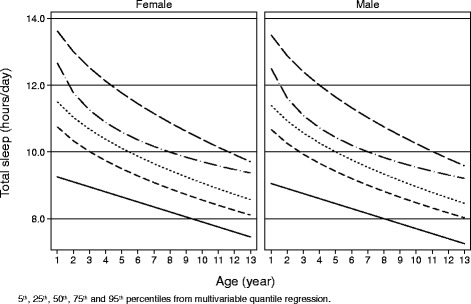
BACKGROUND: Sleep in childhood and adolescence is crucial for mental and physical health; however several researches reported an increasing trend towards a sleep deprivation in this age. Due to the lack of recent epidemiological studies in Italy, the aim of our study was to depict sleep habits and patterns in Italian children aged 1-14 years and to evaluate their relationships with video devices use (TV, tablet, smartphone, PC) and evening/night child activities. METHODS: A structured interview was conducted during 2015 by 72 Family Pediatricians in 2030 healthy children aged 1-14 years by a cross-sectional survey named "Ci piace sognare". Total sleep duration was calculated, 2015 National Sleep Foundation Recommendations were used as reference. Optimal sleepers were defined children sleeping in own bed all night without awakenings. Multivariable median regression was performed to identify predictors of sleep duration and multivariable logistic regression for predictors of optimal sleep. RESULTS: Total sleep duration and numbers of awakenings decreased with age. Only 66.9% of children had sleep duration in agreement with Recommendations (50% in 10-14 years group). Before sleeping 63.5% of children used video devices (39.6% at 1-3 years), 39.1% read, 27.5% drank and 19.5% ate. Bottle users at bedtime were 30.8% at 1-3 years, 16.6% at 3-5 years and 4.9% at 5-7 years. Overall, 23.4% of children changed sleeping place during the night, 22.4% referred sleeping problems in the first year of life. Video devices use was negative predictor of sleep duration (-0.25 h [95%CI:-0.35,-0.14], p < 0.001). Optimal sleep was inversely related with bedroom TV (OR 0.63 [0.50,0.79], p < 0.001), with sleeping disorders in the first year (OR 0.62 [0.48,0.80], p < 0.001)), with bottle use (OR 0.64 [0.44,0.94], p < 0.05) and posivively related with high mother's education level (OR 1.44 [1.11,1.88], p < 0.01). CONCLUSIONS: About one third of 1 to 14 year Italian children sleep less than recommended, one half in teenage. Modifiable risk factors for sleep abnormalities such as video devices use, bedroom TV and bottle use should be target of preventive strategies for a correct sleep. Pediatricians should give priority to the identification of sleep disorders early in life.
Overview
The claims and statistics of this paper haven’t been checked yet.
Free: it reads the open-access text and checks the first 5 claims that cite a source we can check. Create a free account to check every claim.
Integrity signals
Registry
Cites
Statistics
Figures
Verification
Claims the paper makes
The claims and statistics of this paper haven’t been checked yet.
Free: it reads the open-access text and checks the first 5 claims that cite a source we can check. Create a free account to check every claim.
Claims other papers make about this one
Each is checked against this paper’s own text: does it say what the citing paper says it does?
The source backs part of the claim, not all of it — or backs it for a different population, condition or comparison.
In the citing paper
“Brambilla et al find that 25% of 1- to 3-year-olds and nearly 75% of children and teens have devices in the bedroom and/or use them prior to bedtime.220”
From Digital Ecosystems, Children, and Adolescents: Technical Report (2026) · cites this paper as [220]
Experimental — accuracy not yet measuredThe source backs part of the claim, not all of it — or backs it for a different population, condition or comparison.
In the citing paper
“Although several studies have reported that many adolescents use MTSDs frequently [2, 3, 5, 6], and commonly at night or before sleeping [19, 20], little is known about adolescents’ daily routines of using these devices, which can be affected by different types of day (e.g. weekdays versus weekend, school days versus holidays) or settings (e.g. home versus school).”
From “From the moment I wake up I will use it…every day, very hour”: a qualitative study on the patterns of adolescents’ mobile touch screen device use from adolescent and parent perspectives (2019) · cites this paper as [19]
Experimental — accuracy not yet measured
Self-check
Percentages, sums and reported differences re-computed from the paper’s own numbers.
The self-check needs the paper’s full text.
Citations
Cites
(1990) · Choice Reviews Online · doi:10.5860/choice.27-3338 · Cited by 35,305
Hosmer, D. W., Lemeshow, S., & Sturdivant, R. X. (2013) · Wiley Series in Probability and Statistics · doi:10.1002/9781118548387 · Cited by 13,861
Koenker, R. (2005) · Cambridge University Press eBooks · doi:10.1017/cbo9780511754098 · Cited by 4,551
National Sleep Foundation's sleep time duration recommendations: methodology and results summary.
Hirshkowitz, M., Whiton, K., Albert, S. M., Alessi, C., Bruni, O., DonCarlos, L., Hazen, N., Herman, J., Katz, E. S., Kheirandish-Gozal, L., et al. (2015) · Sleep Health · doi:10.1016/j.sleh.2014.12.010 · Cited by 4,404 · cited 1×
“Adequacy of total sleep duration was assessed by comparison with age-specific recommendations [15].”
MethodSelf-citationAnthropometric Standardization Reference Manual
Lohman, T. J., Roache, A. F., & Martorell, R. (1992) · Medicine & Science in Sports & Exercise · doi:10.1249/00005768-199208000-00020 · Cited by 2,764 · cited 1×
“Child data Pediatricians measured child weight and height (length up to 2 years of age) in the same day in which the interview was administered, using standard anthropometric procedures [16].”
MethodSleep Health: Can We Define It? Does It Matter?
Buysse, D. J. (2014) · Sleep · doi:10.5665/sleep.3298 · Cited by 2,536
Owens, J. A., Spirito, A., & McGuinn, M. (2000) · Sleep · doi:10.1093/sleep/23.8.1d · Cited by 2,535 · cited 1×
“Structured interview The structured interview was elaborated by the Working Group (by adapting other existing and validated questionnaires) [13, 14] and contains questions on:”
MethodMeta-Analysis of Short Sleep Duration and Obesity in Children and Adults
Cappuccio, F. P., Taggart, F. M., Kandala, N.-B., Currie, A., Peile, E., Stranges, S., & Miller, M. A. (2008) · Sleep · doi:10.1093/sleep/31.5.619 · Cited by 2,076
BRUNI, O., OTTAVIANO, S., GUIDETTI, V., ROMOLI, M., INNOCENZI, M., CORTESI, F., & GIANNOTTI, F. (1996) · Journal of Sleep Research · doi:10.1111/j.1365-2869.1996.00251.x · Cited by 1,380 · cited 1×
“Structured interview The structured interview was elaborated by the Working Group (by adapting other existing and validated questionnaires) [13, 14] and contains questions on:”
MethodSelf-citationElectronic media use and sleep in school-aged children and adolescents: A review
Cain, N., & Gradisar, M. (2010) · Sleep Medicine · doi:10.1016/j.sleep.2010.02.006 · Cited by 1,376 · cited 2×
“TV viewing may directly displace bedtime or increase child emotional arousal and light exposure, all these mechanisms affecting sleep onset and duration [12].”
BackgroundChildren and Adolescents and Digital Media
Reid Chassiakos, Y. (., Radesky, J., Christakis, D., Moreno, M. A., Cross, C., COUNCIL ON COMMUNICATIONS AND MEDIA, Hill, D., Ameenuddin, N., Hutchinson, J., Levine, A., et al. (2016) · Pediatrics · doi:10.1542/peds.2016-2593 · Cited by 1,340 · cited 3×
“Pediatrics.”
BackgroundInfluentialSleep Duration From Infancy to Adolescence: Reference Values and Generational Trends
Iglowstein, I., Jenni, O. G., Molinari, L., & Largo, R. H. (2003) · Pediatrics · doi:10.1542/peds.111.2.302 · Cited by 1,315 · cited 1×
“At the same time some studies have reported a reduction of sleep duration in pediatric ages [5, 6], thus suggesting to pediatricians the need for increasing their attention on this topic.”
BackgroundRoyston, P., & Sauerbrei, W. (2008) · Wiley Series in Probability and Statistics · doi:10.1002/9780470770771 · Cited by 712
In search of lost sleep: secular trends in the sleep time of school-aged children and adolescents
Matricciani, L., Olds, T., & Petkov, J. (2012) · Sleep Medicine Reviews · doi:10.1016/j.smrv.2011.03.005 · Cited by 698 · cited 1×
“At the same time some studies have reported a reduction of sleep duration in pediatric ages [5, 6], thus suggesting to pediatricians the need for increasing their attention on this topic.”
BackgroundRoyston, P. J., & Sauerbrei, W. (2008) · Cited by 601
Sleep and sleep ecology in the first 3 years: a web-based study
SADEH, A., MINDELL, J. A., LUEDTKE, K., & WIEGAND, B. (2009) · Journal of Sleep Research · doi:10.1111/j.1365-2869.2008.00699.x · Cited by 510 · cited 1×
“A prolunged bottle use seems to be related to an alteration of sleep pattern, at least for children under 3 years of age, as found by other studies [31].”
ResultSleep in children with autistic spectrum disorder
Cortesi, F., Giannotti, F., Ivanenko, A., & Johnson, K. (2010) · Sleep Medicine · doi:10.1016/j.sleep.2010.01.010 · Cited by 355
Media Use and Child Sleep: The Impact of Content, Timing, and Environment
Garrison, M. M., Liekweg, K., & Christakis, D. A. (2011) · Pediatrics · doi:10.1542/peds.2010-3304 · Cited by 236 · cited 2×
“In particular, a relationship between inadequate sleep and TV viewing and/or TV in the bedroom has been found by cross-sectional studies [8, 9].”
BackgroundResultLongitudinal analysis of sleep in relation to BMI and body fat in children: the FLAME study
Carter, P. J., Taylor, B. J., Williams, S. M., & Taylor, R. W. (2011) · BMJ · doi:10.1136/bmj.d2712 · Cited by 226 · cited 1×
“Of note, we did not found any relationship between sleep duration and child BMI, in contrast with the prevalent literature on this topic [26, 27], but in accordance with others [28].”
ResultTelevision viewing, bedroom television, and sleep duration from infancy to mid-childhood
Cespedes, E. M., Gillman, M. W., Kleinman, K., Rifas-Shiman, S. L., Redline, S., & Taveras, E. M. (2014) · Pediatrics · doi:10.1542/peds.2013-3998 · Cited by 219
Childhood Sleep Duration and Associated Demographic Characteristics in an English Cohort
Blair, P. S., Humphreys, J. S., Gringras, P., Taheri, S., Scott, N., Emond, A., Henderson, J., & Fleming, P. J. (2012) · Sleep · doi:10.5665/sleep.1694 · Cited by 207
Technology Use and Sleep Quality in Preadolescence and Adolescence
Bruni, O., Sette, S., Fontanesi, L., Baiocco, R., Laghi, F., & Baumgartner, E. (2015) · Journal of Clinical Sleep Medicine · doi:10.5664/jcsm.5282 · Cited by 207 · cited 1×
“Literature reports a relationship between light exposure from video devices at bedtime and melatonin suppression, suggesting a possible explaination for the linking between video use and sleep duration [12, 23, 24].”
BackgroundSelf-citationLongitudinal Study of Sleep Behavior in Normal Infants during the First Year of Life
Bruni, O., Baumgartner, E., Sette, S., Ancona, M., Caso, G., Cosimo, M. E. D., Mannini, A., Ometto, M., Pasquini, A., Ulliana, A., et al. (2014) · Journal of Clinical Sleep Medicine · doi:10.5664/jcsm.4114 · Cited by 164 · cited 1×
“An early history of sleep problems affecting further sleep continuity suggests the importance of establishing a correct sleep pattern very soon after birth, taking into account that a relative stability of sleep characteristics has been described starting from 6 month of age [29].”
BackgroundSelf-citationNuutinen, T., Ray, C., & Roos, E. (2013) · BMC Public Health · doi:10.1186/1471-2458-13-684 · Cited by 144 · cited 2×
“Also more recent longitudinal studies showed a negative impact of daily TV viewing and use of other video devices (tablet, smartphone, PC) on sleep duration [10, 11].”
BackgroundResultSleep characteristics and cardiovascular risk in children and adolescents: an enumerative review
Matthews, K. A., & Pantesco, E. J. M. (2016) · Sleep Medicine · doi:10.1016/j.sleep.2015.06.004 · Cited by 136
Sleep quality and cognitive performance in 8-year-old children
Paavonen, E. J., Räikkönen, K., Pesonen, A., Lahti, J. M. T., Komsi, N., Heinonen, K., Järvenpää, A., Strandberg, T. E., Kajantie, E., & Porkka‐Heiskanen, T. (2010) · Sleep Medicine · doi:10.1016/j.sleep.2009.09.009 · Cited by 125
Calamaro, C., Yang, K., Ratcliffe, S. J., & Chasens, E. R. (2011) · Journal of Pediatric Health Care · doi:10.1016/j.pedhc.2010.12.002 · Cited by 109 · cited 1×
“In particular, a relationship between inadequate sleep and TV viewing and/or TV in the bedroom has been found by cross-sectional studies [8, 9].”
BackgroundImpact of television on the quality of sleep in preschool children
Brockmann, P. E., Diaz, B., Damiani, F., Villarroel, L., Núñez, F., & Bruni, O. (2016) · Sleep Medicine · doi:10.1016/j.sleep.2015.06.005 · Cited by 104
Self-citationKlingenberg, L., Christensen, L. B., Hjorth, M. F., Zangenberg, S., Chaput, J. ‐., Sjödin, A., Mølgaard, C., & Michaelsen, K. F. (2013) · Pediatric Obesity · doi:10.1111/j.2047-6310.2012.00109.x · Cited by 53 · cited 1×
“Of note, we did not found any relationship between sleep duration and child BMI, in contrast with the prevalent literature on this topic [26, 27], but in accordance with others [28].”
ResultBonuck, K. A., Huang, V., & Fletcher, J. (2010) · Maternal & Child Nutrition · doi:10.1111/j.1740-8709.2009.00186.x · Cited by 45 · cited 1×
“Pediatricians usually suggest bottle use weaning at or around 12 months of age, but this recommendation is greatly ignored [30].”
BackgroundInteractive vs passive screen time and nighttime sleep duration among school-aged children
Yland, J., Guan, S., Emanuele, E., & Hale, L. (2015) · Sleep Health · doi:10.1016/j.sleh.2015.06.007 · Cited by 42 · cited 1×
“We found that the use of a video device close to bedtime in childhood was related to a short sleep independently of the presence of bedroom TV, and this fact might be explained by the increasing use of mobile devices [25].”
BackgroundBaird, J., Hill, C. M., Harvey, N. C., Crozier, S., Robinson, S. M., Godfrey, K. M., Cooper, C., Inskip, H., & The SWS Study Group (2016) · Journal of Sleep Research · doi:10.1111/jsr.12389 · Cited by 32 · cited 1×
“Of note, we did not found any relationship between sleep duration and child BMI, in contrast with the prevalent literature on this topic [26, 27], but in accordance with others [28].”
ResultDong, S., Song, Y., Jiang, Y., Sun, W., Wang, Y., & Jiang, F. (2015) · PubMed · Cited by 16
Cited by
Lissak, G. (2018) · Environmental Research · doi:10.1016/j.envres.2018.01.015 · Cited by 1,024
Daily energy expenditure through the human life course
Pontzer, H., Yamada, Y., Sagayama, H., Ainslie, P. N., Andersen, L. F., Anderson, L. J., Arab, L., Baddou, I., Bedu-Addo, K., Blaak, E. E., et al. (2021) · Science · doi:10.1126/science.abe5017 · Cited by 583
Pediatric sleep health: It matters, and so does how we define it
Meltzer, L. J., Williamson, A. A., & Mindell, J. A. (2021) · Sleep Medicine Reviews · doi:10.1016/j.smrv.2021.101425 · Cited by 337
Rhodes, R. E., Guerrero, M. D., Vanderloo, L. M., Barbeau, K., Birken, C. S., Chaput, J.-P., Faulkner, G., Janssen, I., Madigan, S., Mâsse, L. C., et al. (2020) · International Journal of Behavioral Nutrition and Physical Activity · doi:10.1186/s12966-020-00973-0 · Cited by 334
Yildiz Durak, H. (2019) · The Social Science Journal · doi:10.1016/j.soscij.2018.09.003 · Cited by 249
Metadata
- Authors
- on behalf of the “Ci piace sognare” Study Group, Brambilla, P., Giussani, M., Pasinato, A., Venturelli, L., Privitera, F., Miraglia del Giudice, E., Sollai, S., Picca, M., Di Mauro, G., Bruni, O., & Chiappini, E.
- Affiliations
- University of Campania "Luigi Vanvitelli" (IT)
- Meyer Children's Hospital (IT)
- Corresponding author
- Brambilla, Paolo
- Venue
- Italian Journal of Pediatrics
- Published
- 2017-01-13
- Volume
- 43
- Issue
- 1
- Pages
- 7-7
- ISSN
- 1720-8424 (ISSN-L)
- 1824-7288
- PMC
- PMC5347825
- OpenAlex
- W2574848177
- Cited by
- 77
- References
- 32
- Citations by year
- 2026: 5 · 2025: 6 · 2024: 8 · 2023: 4 · 2022: 14 · 2021: 17 · 2020: 4 · 2019: 9 · 2018: 5 · 2017: 5
- FWCI
- 8.19
- Type
- journal article
- Language
- en
- Open access
- gold
- doi.org
- Licence
- cc-by
- Locations
- The Italian Journal of Pediatrics/Italian journal of pediatrics (publishedVersion, cc-by)
- PubMed Central (publishedVersion, cc-by)
- PubMed (publishedVersion)
- Florence Research (University of Florence) (submittedVersion, cc-by)
- IRIS UNIMORE (University of Modena and Reggio Emilia) (submittedVersion, cc-by)
- Archivio Istituzionale della Ricerca - Università degli Studi della Campania "Luigi Vanvitelli" (submittedVersion)
- IRIS Research product catalog (Sapienza University of Rome) (submittedVersion)
- Topics
- Social Sciences › Psychology › Experimental and Cognitive Psychology › Sleep and related disorders
- Social Sciences › Education › Child Development and Digital Technology
- Life Sciences › Neuroscience › Endocrine and Autonomic Systems › Circadian rhythm and melatonin
- Keywords
- sleep duration, screen time, sleep deprivation, bottle feeding, nocturnal awakenings, sleep environment, maternal education, Italian children
- MeSH terms
- Sleep Hygiene, Adolescent, Child, Child Behavior, Child, Preschool, Cross-Sectional Studies, Female, Habits, Health Promotion, Humans, Infant, Italy, Male, Parents, Surveys and Questionnaires, Risk Factors, Sleep Wake Disorders, Television, Body Mass Index, Prevalence, Video Games
About these checks
Registry, retraction, Cites and statistics results are computed, not judged, with one exception: a printed reference that no index lists is read once by a model before it counts as a citation error. Claims are extracted by a model and kept only when their quote appears verbatim in the text; each cited source is then checked, with a model’s help, for whether it says what the claim relies on. Those verdicts can be wrong — read the claim’s quote and the cited source before relying on one.
Statistics and arithmetic are recomputed, not judged.
Confidence bands are shown only for fields calibrated on our annotated test set. None is calibrated yet, so no band is shown.
What counts as a claim ›How we measure confidence ›How we check this ›
Are you an author, or do you see a problem with this page? Request a review
Data sources
Bibliographic data: Semantic Scholar, OpenAlex, Crossref.
Contains information from the Semantic Scholar Academic Graph Datasets, made available under the ODC Attribution License (ODC-BY 1.0).
Semantic Scholar’s data is described in: Kinney, R., et al. (2023). The Semantic Scholar Open Data Platform. arXiv:2301.10140.
