

Diabetes-specific enteral nutrition formula in hyperglycemic, mechanically ventilated, critically ill patients: a prospective, open-label, blind-randomized, multicenter study
Open accessThe DOI matches its Crossref record; 42 of the 43 references it cites were found in a registry or an index.
Abstract
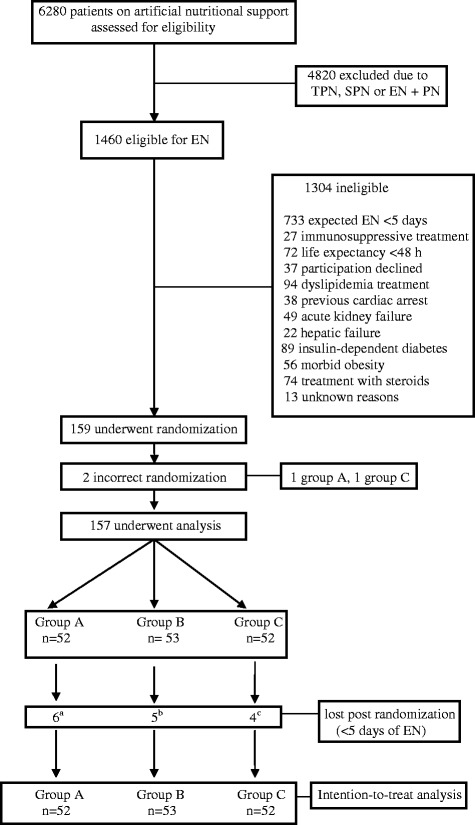
Introduction: Although standard enteral nutrition is universally accepted, the use of disease-specific formulas for hyperglycemic patients is still controversial. This study examines whether a high-protein diabetes-specific formula reduces insulin needs, improves glycemic control and reduces ICU-acquired infection in critically ill, hyperglycemic patients on mechanical ventilation (MV). Methods: This was a prospective, open-label, randomized (web-based, blinded) study conducted at nine Spanish ICUs. The patient groups established according to the high-protein formula received were: group A, new-generation diabetes-specific formula; group B, standard control formula; group C, control diabetes-specific formula. Inclusion criteria were: expected enteral nutrition ≥5 days, MV, baseline glucose >126 mg/dL on admission or >200 mg/dL in the first 48 h. Exclusion criteria were: APACHE II ≤10, insulin-dependent diabetes, renal or hepatic failure, treatment with corticosteroids, immunosuppressants or lipid-lowering drugs and body mass index ≥40 kg/m 2. The targeted glucose level was 110–150 mg/dL. Glycemic variability was calculated as the standard deviation, glycemic lability index and coefficient of variation. Acquired infections were recorded using published consensus criteria for critically ill patients. Data analysis was on an intention-to-treat basis. Results: Over a 2-year period, 157 patients were consecutively enrolled (A 52, B 53 and C 52). Compared with the standard control formula, the new formula gave rise to lower insulin requirement (19.1 ± 13.1 vs. 23.7 ± 40.1 IU/day, p <0.05), plasma glucose (138.6 ± 39.1 vs. 146.1 ± 49.9 mg/dL, p <0.01) and capillary blood glucose (146.1 ± 45.8 vs. 155.3 ± 63.6 mg/dL, p <0.001). Compared with the control diabetes-specific formula, only capillary glucose levels were significantly reduced (146.1 ± 45.8 vs. 150.1 ± 41.9, p <0.01). Both specific formulas reduced capillary glucose on ICU day 1 (p <0.01), glucose variability in the first week (p <0.05), and incidences of ventilator-associated tracheobronchitis (p <0.01) or pneumonia (p <0.05) compared with the standard formula. No effects of the nutrition formula were produced on hospital stay or mortality. Conclusions: In these high-risk ICU patients, both diabetes-specific formulas lowered insulin requirements, improved glycemic control and reduced the risk of acquired infections relative to the standard formula. Compared with the control-specific formula, the new-generation formula also improved capillary glycemia. Trial registration: Clinicaltrials.gov NCT1233726.
Overview
The claims and statistics of this paper haven’t been checked yet.
Free: it reads the open-access text and checks the first 5 claims that cite a source we can check. Create a free account to check every claim.
Integrity signals
Registry
Cites
Statistics
Figures
Verification
Claims the paper makes
The claims and statistics of this paper haven’t been checked yet.
Free: it reads the open-access text and checks the first 5 claims that cite a source we can check. Create a free account to check every claim.
Claims other papers make about this one
Each is checked against this paper’s own text: does it say what the citing paper says it does?
The source backs part of the claim, not all of it — or backs it for a different population, condition or comparison.
In the citing paper
“The use of diabetic-specific enteral formula in ICU patients suffering from Type 2 Diabetes Mellitus seems to improve the glucose profile (190,191) and may have clinical and economic impact (192).”
From ESPEN guideline on clinical nutrition in the intensive care unit. (2019) · cites this paper as [191]
Experimental — accuracy not yet measuredThe source backs part of the claim, not all of it — or backs it for a different population, condition or comparison.
In the citing paper
“The use of diabetic-specific enteral formula in ICU patients suffering from Type 2 Diabetes Mellitus decrease the requirement for insulin [70,71]”
From ESPEN practical and partially revised guideline: Clinical nutrition in the intensive care unit (2023) · cites this paper as [71]
Experimental — accuracy not yet measuredThe check wasn’t confident either way, so it gives no verdict — never disputed.
In the citing paper
“CGM in the hospital is not currently approved by regulatory agencies, with ongoing validation studies.1395”
From American Association of Clinical Endocrinology Clinical Practice Guideline: Developing a Diabetes Mellitus Comprehensive Care Plan-2022 Update. (2022) · cites this paper as [1395]
Experimental — accuracy not yet measured
Self-check
Percentages, sums and reported differences re-computed from the paper’s own numbers.
The self-check needs the paper’s full text.
Citations
Cites
Intensive insulin therapy in critically ill patients.
Van den Berghe, G., Wouters, P., Weekers, F., Verwaest, C., Bruyninckx, F., Schetz, M., Vlasselaers, D., Ferdinande, P., Lauwers, P., & Bouillon, R. (2001) · New England Journal of Medicine · doi:10.1056/nejmoa011300 · Cited by 9,977
Horan, T. C., Andrus, M., & Dudeck, M. A. (2008) · American Journal of Infection Control · doi:10.1016/j.ajic.2008.03.002 · Cited by 6,626 · cited 1×
“ICU-acquired infections were defined according to criteria for critically ill patients emerging from consensus conferences [37, 38].”
MethodIntensive versus Conventional Glucose Control in Critically Ill Patients
(2009) · New England Journal of Medicine · doi:10.1056/nejmoa0810625 · Cited by 5,119
Standards of medical care in diabetes—2013
American Diabetes Association (2013) · Diabetes Care · doi:10.2337/dc13-s011 · Cited by 4,369
Intensive insulin therapy in the medical ICU
Van den Berghe, G., Wilmer, A., Hermans, G., Meersseman, W., Wouters, P. J., Milants, I., Van Wijngaerden, E., Bobbaers, H., & Bouillon, R. (2006) · New England Journal of Medicine · doi:10.1056/nejmoa052521 · Cited by 3,639
International Study of the Prevalence and Outcomes of Infection in Intensive Care Units
Vincent, J.-L. (2009) · JAMA · doi:10.1001/jama.2009.1754 · Cited by 3,618
Basevi, V., Di Mario, S., Morciano, C., Nonino, F., & Magrini, N. (2011) · Diabetes Care · doi:10.2337/dc11-0174 · Cited by 3,055
Krinsley, J. S. (2003) · Mayo Clinic Proceedings · doi:10.4065/78.12.1471 · Cited by 1,165 · cited 1×
“Introduction Critically ill patients show a stereotype metabolic response to injury that affects carbohydrate metabolism [1, 2], causing hyperglycemia, which is boosted by the actions of counterregulatory hormones [3, 4].”
BackgroundGriesdale, D. E. G., de Souza, R. J., van Dam, R. M., Heyland, D. K., Cook, D. J., Malhotra, A., Dhaliwal, R., Henderson, W. R., Chittock, D. R., Finfer, S., et al. (2009) · Canadian Medical Association Journal · doi:10.1503/cmaj.090206 · Cited by 1,096
Glucose Control and Mortality in Critically Ill Patients
Finney, S. J. (2003) · JAMA · doi:10.1001/jama.290.15.2041 · Cited by 1,055
Cited by
ESPEN guideline on clinical nutrition in the intensive care unit.
Singer, P., Blaser, A. R., Berger, M. M., Alhazzani, W., Calder, P. C., Casaer, M. P., Hiesmayr, M., Mayer, K., Montejo, J. C., Pichard, C., et al. (2019) · Clinical Nutrition · doi:10.1016/j.clnu.2018.08.037 · Cited by 2,904
“The use of diabeticspecific enteral formula in ICU patients suffering from Type 2 Diabetes Mellitus seems to improve the glucose profile [188,189] and may have clinical and economic impact [188].”
ESPEN practical and partially revised guideline: Clinical nutrition in the intensive care unit
Singer, P., Blaser, A. R., Berger, M. M., Calder, P. C., Casaer, M., Hiesmayr, M., Mayer, K., Montejo-Gonzalez, J. C., Pichard, C., Preiser, J.-C., et al. (2023) · Clinical Nutrition · doi:10.1016/j.clnu.2023.07.011 · Cited by 793
“formula in ICU patients suffering from Type 2 Diabetes Mellitus decrease the requirement for insulin [70,71] and.”
BackgroundBlonde, L., Umpierrez, G. E., Reddy, S. S., McGill, J. B., Berga, S. L., Bush, M., Chandrasekaran, S., DeFronzo, R. A., Einhorn, D., Galindo, R. J., et al. (2022) · Endocrine Practice · doi:10.1016/j.eprac.2022.08.002 · Cited by 507
Barazzoni, R., Deutz, N. E. P., Biolo, G., Bischoff, S., Boirie, Y., Cederholm, T., Cuerda, C., Delzenne, N., Leon Sanz, M., Ljungqvist, O., et al. (2017) · Clinical Nutrition · doi:10.1016/j.clnu.2016.09.010 · Cited by 112
“DSFs containing higher proportions of fat and modified carbohydrates have not been extensively assessed in ICU patients, but recent data suggest that the use of these formulas improves glycemic control, and, in at least one study, this was shown to provide clinical benefit [100].”
BackgroundHealth Outcomes and Quality of Life Indices of Children Receiving Blenderized Feeds via Enteral Tube
Hron, B. M., Fishman, E., Lurie, M., Clarke, T., Chin, Z., Hester, L., Burch, E., & Rosen, R. (2019) · The Journal of Pediatrics · doi:10.1016/j.jpeds.2019.04.023 · Cited by 117
Jiménez‐Sánchez, A., Martínez-Ortega, A. J., Remón-Ruiz, P., Piñar-Gutiérrez, A., Cunill, J. L. P., & García‐Luna, P. P. (2022) · Nutrients · doi:10.3390/nu14071440 · Cited by 83
“Mesejo (2015) [223] Open-label, parallel Yes ICU Glucerna Select (n = 53):60 (45–71) years; Diaba HP (n = 52): 57 (43–70) years; Isosource Protein Fiber (n = 52):58 (46–68) years Nasogastric tube 28 days Glucerna Select/Diaba HP 49.”
BackgroundVieira, R., Souto, S. B., Sánchez‐López, E., López-Machado, A., Severino, P. B., Jose, S., Santini, A., Silva, A. M., Fortuna, A. C., García, M. L., et al. (2019) · Journal of Clinical Medicine · doi:10.3390/jcm8091332 · Cited by 81
“This route opens a window in order to aid the development of enteral nutrition formulas, such as the recent study published by Mesejo and colleagues which developed a high-protein diabetes-specific formula that reduces insulin needs and improves glycemic control [75].”
BackgroundExpert consensus on the glycemic management of critically ill patients
Wu, Z., Liu, J., Zhang, D., Kang, K., Zuo, X., Xu, Q., Pan, A., Fang, W., Liu, F., Shang, Y., et al. (2022) · Journal of Intensive Medicine · doi:10.1016/j.jointm.2022.06.001 · Cited by 73
Ojo, O., Weldon, S. M., Thompson, T., Crockett, R., & Wang, X. (2019) · Nutrients · doi:10.3390/nu11081905 · Cited by 66
“[38] Spain 2 years Prospective, open-label, randomized study n = 157 Median (Q1–Q3) Per 100 mL, DSF had 100 kcal, 5.”
BackgroundSanz‐París, A., Hernández, J. Á., Ballesteros-Pomar, M. D., Romero, F. B., León-Sanz, M., Martín-Palmero, Á., Olmos, M. Á. M., & Olveira, G. (2017) · Nutrition · doi:10.1016/j.nut.2017.02.014 · Cited by 68
Sanz‐París, A., Matía-Martín, P., Martín-Palmero, Á., Gómez‐Candela, C., & Robles, M. C. (2020) · Clinical Nutrition · doi:10.1016/j.clnu.2020.02.036 · Cited by 55
Nutrition support for critically ill patients
Al‐Dorzi, H. M., & Arabi, Y. M. (2021) · Journal of Parenteral and Enteral Nutrition · doi:10.1002/jpen.2228 · Cited by 74
(Kristine) Koekkoek, W., Panteleon, V., & van Zanten, A. R. (2019) · Nutrition · doi:10.1016/j.nut.2018.07.013 · Cited by 49
Drincic, A. T., Knezevich, J. T., & Akkireddy, P. (2017) · Current Diabetes Reports · doi:10.1007/s11892-017-0882-3 · Cited by 47
The Japanese Critical Care Nutrition Guideline 2024
Nakamura, K., Yamamoto, R., Higashibeppu, N., Yoshida, M., Tatsumi, H., Shimizu, Y., Izumino, H., Oshima, T., Hatakeyama, J., Ouchi, A., et al. (2025) · Journal of Intensive Care · doi:10.1186/s40560-025-00785-z · Cited by 60
Enteral Formulas in Nutrition Support Practice: Is There a Better Choice for Your Patient?
Escuro, A. A., & Hummell, A. C. (2016) · Nutrition in Clinical Practice · doi:10.1177/0884533616668492 · Cited by 56
Tight glycemic control in acutely ill patients: low evidence of benefit, high evidence of harm!
Marik, P. E. (2016) · Intensive Care Medicine · doi:10.1007/s00134-016-4299-2 · Cited by 42
“Furthermore, a more physiologic approach to feeding critically ill patients [19], and the use of a “diabetes-specific” enteral formula [20], will likely reduce the incidence of severe stress hyperglycemia.”
BackgroundEnteral nutrition product formulations: A review of available products and indications for use
Church, A., & Zoeller, S. (2023) · Nutrition in Clinical Practice · doi:10.1002/ncp.10960 · Cited by 47
van Steen, S. C. J., Rijkenberg, S., Sechterberger, M. K., DeVries, J. H., & van der Voort, P. H. J. (2017) · Journal of Parenteral and Enteral Nutrition · doi:10.1002/jpen.1045 · Cited by 36
Doola, R., Greer, R. M., Hurford, R., Flatley, C. J., Forbes, J. M., Todd, A. S., Joyce, C., & Sturgess, D. J. (2018) · Clinical Nutrition · doi:10.1016/j.clnu.2018.08.001 · Cited by 37
Doola, R., Deane, A. M., Tolcher, D. M., Presneill, J., Barrett, H. L., Forbes, J. M., Todd, A. S., Okano, S., & Sturgess, D. J. (2019) · Clinical Nutrition ESPEN · doi:10.1016/j.clnesp.2019.02.013 · Cited by 38
Rice, T. W., Files, D. C., Morris, P. E., Bernard, A. C., Ziegler, T. R., Drover, J., Kress, J. P., Ham, K. R., Grathwohl, D., Huhmann, M. B., et al. (2018) · Journal of Parenteral and Enteral Nutrition · doi:10.1002/jpen.1447 · Cited by 32
Mechanick, J. I., Marchetti, A. E., Hegazi, R. A. F., & Hamdy, O. (2020) · Nutrients · doi:10.3390/nu12123616 · Cited by 38
“Among high-risk ICU patients, two different DSNFs outperformed a standard formula comparator across important clinical parameters [55].”
BackgroundGlycemic targets in critically ill adults: A mini-review
See, K. C. (2021) · World Journal of Diabetes · doi:10.4239/wjd.v12.i10.1719 · Cited by 28
Eckert, I. D. C., Kumbier, M. C. C., Silva, F. M., Franzosi, O. S., & de Almeida, J. C. (2021) · Clinical Nutrition · doi:10.1016/j.clnu.2021.04.030 · Cited by 28
Glycemic Management of Hospitalized Patients Receiving Nutrition Support
Polavarapu, P., Pachigolla, S., & Drincic, A. (2022) · Diabetes Spectrum · doi:10.2337/dsi22-0010 · Cited by 29
Huhmann, M. B., Yamamoto, S., Neutel, J. M., Cohen, S. S., & Ochoa, J. B. (2018) · Nutrition and Diabetes · doi:10.1038/s41387-018-0053-x · Cited by 27
Medical Foods: Science, Regulation, and Practical Aspects. Summary of a Workshop
Holmes, J. L., Biella, A., Morck, T. A., Rostorfer, J., & Schneeman, B. O. (2020) · Current Developments in Nutrition · doi:10.1093/cdn/nzaa172 · Cited by 24
“Diabetes-specific formulas are designed to improve glucose control (43, 44).”
BackgroundEnteral Nutrition Formulas: Current Evidence and Nutritional Composition
Cámara‐Martos, F., & Iturbide-Casas, M. (2019) · Elsevier eBooks · doi:10.1016/b978-0-12-816842-4.00013-7 · Cited by 20
Lu, Y., Zhang, Q., & Lou, J. (2021) · Scientific Reports · doi:10.1038/s41598-021-94697-1 · Cited by 21
Burslem, R., Radler, D. R., Parker, A., & Zelig, R. S. (2021) · Nutrition in Clinical Practice · doi:10.1002/ncp.10652 · Cited by 18
Update on nutritional assessment and therapy in critical care
Blaser, A. R., Rice, T. W., & Deane, A. M. (2020) · Current Opinion in Critical Care · doi:10.1097/mcc.0000000000000694 · Cited by 22
Boeykens, K. (2020) · Dimensions of Critical Care Nursing · doi:10.1097/dcc.0000000000000448 · Cited by 24
“This metabolic response makes the critically ill patient especially susceptible to infection and increases morbidity and mortality.(29) In 2001, a landmark study demonstrated morbidity and mortality benefits of intensive insulin therapy to maintain blood glucose at or below 110 mg/dL (between 80 and 110 mg/dL or 4.”
BackgroundLansink, M., Hofman, Z., Genovese, S., Rouws, C., & Ceriello, A. (2016) · Journal of Parenteral and Enteral Nutrition · doi:10.1177/0148607115625635 · Cited by 20
“Although we cannot extrapolate current results to critically ill patients, a recent study in critically ill patients indicated that a high-protein DSF might be beneficial for these patients by lowering insulin requirements, improving glycemic control, and reducing the risk of acquired infections compared with a standa…”
ResultViana, M. V., Viana, L. V., Tavares, A. L. J., & de Azevedo, M. J. (2017) · Annals of Nutrition and Metabolism · doi:10.1159/000481355 · Cited by 15
Precision Glycemic Control in the ICU*
Marik, P. E. (2016) · Critical Care Medicine · doi:10.1097/ccm.0000000000001683 · Cited by 16
Strategies to Maximize the Benefits of Evidence-Based Enteral Nutrition: A Narrative Review
Kano, K.-I., Yamamoto, R., Yoshida, M., Sato, T., Nishita, Y., Ito, J., Nagatomo, K., Ohbe, H., Takahashi, K., Kaku, M., et al. (2025) · Nutrients · doi:10.3390/nu17050845 · Cited by 16
Diabetes in COVID-19 patients: challenges and possible management strategies
Reshad, R. A. I., Riana, S. H., Chowdhury, M. A.-B., Moin, A. T., Miah, F., Sarkar, B., & Jewel, N. A. (2021) · Egyptian Journal of Bronchology · doi:10.1186/s43168-021-00099-2 · Cited by 15
“Moreover, mechanical ventilation may be needed for these patients in case of respiratory distress, but it may also increase the aerosolization of the virus [79].”
BackgroundVahabzadeh, D., Hasanloei, M. A. V., & Shariatpanahi, Z. V. (2018) · International Journal of Diabetes in Developing Countries · doi:10.1007/s13410-018-0660-z · Cited by 13
Liu, D., Fan, Y., Zhuang, Y., Hu, P. C., Gao, C., & Chen, Y. (2022) · Journal of Inflammation Research · doi:10.2147/jir.s383053 · Cited by 14
Shao, Y., Heng, W., Li, S., Xu, Y., & Hu, G. (2017) · Journal of Parenteral and Enteral Nutrition · doi:10.1002/jpen.1035 · Cited by 12
Doola, R., Todd, A. S., Forbes, J. M., Deane, A. M., Presneill, J., & Sturgess, D. J. (2018) · JMIR Research Protocols · doi:10.2196/resprot.9374 · Cited by 13
“Despite this, only a small number of studies have investigated the effect of manipulating nutritional formulae on blood glucose control in an intensive care unit (ICU) setting [6-8].”
BackgroundOhbe, H., Yoshida, M., Okada, K., Inoue, T., Yamada, K., Nakamura, K., Yamamoto, R., Nozaki, A., Higashibeppu, N., & Kotani, J. (2024) · Clinical Nutrition · doi:10.1016/j.clnu.2024.09.023 · Cited by 13
Milla, S. P., Plaza, B. L., Santamaría, B., de Arriba‐Sánchez, Á., Bermejo, L. M., & Gómez‐Candela, C. (2016) · Journal of Parenteral and Enteral Nutrition · doi:10.1177/0148607116676839 · Cited by 11
Chinese Guidelines for Medical Nutrition Therapy for Patients with Diabetes (2022 Edition).
(2024) · PubMed Central · doi:10.6133/apjcn.202406_33(2).0001 · Cited by 15
Mongkolsucharitkul, P., Pinsawas, B., Surawit, A., Pongkunakorn, T., Manosan, T., Ophakas, S., Suta, S., Pumeiam, S., & Mayurasakorn, K. (2024) · Nutrients · doi:10.3390/nu16030395 · Cited by 10
“Diabetes-specific nutrition formulas (DSNFs) that offer less total carbohydrate as well as a variation in the type of carbohydrate become essential nutritional support to help minimize the glycemic response, improve outcomes in acute and critical illness, and lower mortality [2,6,10,11].”
BackgroundHijaze, D., & Szalat, A. (2017) · Nutrition in Clinical Practice · doi:10.1177/0884533617692765 · Cited by 9
The syndromic triad of COVID-19, type 2 diabetes, and malnutrition
Mechanick, J. I., Christofides, E. A., Marchetti, A. E., Hoddy, K. K., Joachim, J., Hegazi, R. A. F., & Hamdy, O. (2023) · Frontiers in Nutrition · doi:10.3389/fnut.2023.1122203 · Cited by 10
Li, Q., & Wang, J. (2025) · Nutrients · doi:10.3390/nu17030450 · Cited by 8
Diretriz BRASPEN de Terapia Nutricional no Diabetes Mellitus
Campos, L. F., Borges, V. C., Barreto, P. A., González, M. C., Ceniccola, G. D., de Abreu, H. B., Alves, J. T. M., Segadilha, N. L. A. L., Kumbier, M. C. C., & Castro, M. G. (2020) · Braspen Journal · doi:10.37111/braspenj.diretrizdm2020 · Cited by 15
Lin, Y., Sun, Z., Wang, H., & Liu, M. (2018) · Open Medicine · doi:10.1515/med-2018-0082 · Cited by 8
Juan-Díaz, M., Mateu‐Campos, L., Sánchez-Miralles, Á., Quintana, M. E. M., & Mesejo-Arizmendi, A. (2020) · Medicina Intensiva (English Edition) · doi:10.1016/j.medine.2019.12.005 · Cited by 7
“published a randomized, prospective multicenter clinical trial involving 157 patients subjected to MV in which two diabetes-specific diets (including a new generation diet) were compared with a standard diet -- all diets being hyperproteic.(25) The diabetes-specific diets achieved better glycemic control, with a decre…”
BackgroundMethodNutrition priorities in obese critically ill patients
Al‐Dorzi, H. M., Stapleton, R. D., & Arabi, Y. M. (2021) · Current Opinion in Clinical Nutrition & Metabolic Care · doi:10.1097/mco.0000000000000803 · Cited by 11
Chaiyakul, S., Ketkham, N., Chaichana, C., Khumkhana, N., Deekum, W., Wongshaya, P., Suwanmalai, T., Hutchinson, C., & Pramyothin, P. (2023) · Frontiers in Endocrinology · doi:10.3389/fendo.2023.1141497 · Cited by 10
“The use of DSFs in this setting can reduce the risk of hyperglycemia and improve glucose variability (2).”
BackgroundBahramian, B., Sarabi‐Jamab, M., Talebi, S., Razavi, S. M. A., & Rezaie, M. (2022) · Nutrition in Clinical Practice · doi:10.1002/ncp.10893 · Cited by 12
Fructose use in clinical nutrition: metabolic effects and potential consequences
Moulin, S., Seematter, G., & Seyssel, K. (2017) · Current Opinion in Clinical Nutrition & Metabolic Care · doi:10.1097/mco.0000000000000376 · Cited by 6
Mithal, A., Sharma, J., Kulkarni, A. P., Sivakumar, M., Mehta, Y. B., Chakravarti, S., Joshi, A., Reddy, B. R., & Bathina, H. (2019) · Indian Journal of Critical Care Medicine · doi:10.5005/jp-journals-10071-23298 · Cited by 9
Juan-Díaz, M., Mateu‐Campos, L., Sánchez-Miralles, Á., Quintana, M. E. M., & Mesejo-Arizmendi, A. (2020) · Medicina Intensiva · doi:10.1016/j.medin.2019.12.012 · Cited by 6
Efficacy of Diabetes-Specific Formulas as Meal Replacements in Diabetic Patients: An Overview
Jáquez, A., Jj, S., Rodríguez, N. A., & Guzmán, E. E. (2020) · International Journal of Endocrinology and Metabolic Disorders · doi:10.16966/2380-548x.168 · Cited by 6
“At the end of 3 months both groups obtained lower HDL cholesterol values, but only the MR group had lower LDL and total cholesterol values [31].”
BackgroundNutritional therapy in critically ill patients with diabetes
Doola, R., & Preiser, J. (2021) · Current Opinion in Clinical Nutrition & Metabolic Care · doi:10.1097/mco.0000000000000807 · Cited by 7
Effect of Home Enteral Nutrition on Diabetes and Its Management
Vallumsetla, N., Epp, L., Hurt, R. T., & Mundi, M. S. (2018) · Nutrition in Clinical Practice · doi:10.1002/ncp.10104 · Cited by 6
Dietary management of blood glucose in medical critically ill patients with overweight/obesity
Srinath, R., & Mechanick, J. I. (2020) · Current Opinion in Clinical Nutrition & Metabolic Care · doi:10.1097/mco.0000000000000636 · Cited by 5
Significant Published Articles for Pharmacy Nutrition Support Practice in 2014 and 2015
Dickerson, R. N., Kumpf, V. J., Blackmer, A. B., Bingham, A. L., Tucker, A. M., Ybarra, J. V., Kraft, M. D., & Canada, T. W. (2016) · Hospital Pharmacy · doi:10.1310/hpj5107-539 · Cited by 6
Пасечник, И. Н., Sirota, A. E., Talyzin, P. A., & Новикова, Т. В. (2023) · Russian Journal of Anesthesiology and Reanimatology · doi:10.17116/anaesthesiology202303159 · Cited by 4
Arbeloa, C. S., de la Gándara, A. M., Cinto, C. L., Lasierra, J. L. F., & Vácaro, J. A. M. (2020) · Medicina Intensiva · doi:10.1016/j.medin.2019.12.013 · Cited by 7
Use of Oral Nutritional Supplements for Patients with Diabetes
Kang, M. R. (2017) · Journal of Korean Diabetes · doi:10.4093/jkd.2017.18.3.181 · Cited by 4
“당뇨병 환자에게 당뇨병 환자용 ONS와 일반 환자용 ONS를 영양 중재한 결과 당질 함량이 적고 MUFA 함량이 많은 당뇨병 환자용 ONS가 식후 혈당[16,24,26-31]과 당”
Nienow, M. K., Foley, S., Nowak, K. L., Braunschweig, C. A., & Peterson, S. J. (2021) · Clinical Nutrition ESPEN · doi:10.1016/j.clnesp.2021.09.732 · Cited by 4
Arbeloa, C. S., de la Gándara, A. M., Cinto, C. L., Lasierra, J. L. F., & Vácaro, J. A. M. (2020) · Medicina Intensiva (English Edition) · doi:10.1016/j.medine.2019.12.008 · Cited by 8
Nutrition in the critically ill patient
Koekkoek, W. A. C. (2023) · Utrecht University Repository (Utrecht University) · doi:10.33540/1675 · Cited by 3
Noronha, J. C., Mechanick, J. I., Barazzoni, R., Tarazona‐Santabalbina, F. J., Dimosthenopoulos, C., Raben, A., Kendall, C. W. C., Chiavaroli, L., & Sievenpiper, J. L. (2025) · Clinical Nutrition ESPEN · doi:10.1016/j.clnesp.2025.08.027 · Cited by 3
de Luis, D. A., Rodas, L. V., Reyes, L. M., Medina, J. A., Palmero, Á. M., Candela, C. G., Bonmatí, E. M., Guzmán, G., Camprubí-Robles, M., & Fernández, L. R. (2022) · Clinical Nutrition Open Science · doi:10.1016/j.nutos.2022.06.007 · Cited by 2
Tañada, M. R. P. K., & Tanchee-Ngo, M. J. (2021) · Philippine Journal of Internal Medicine · doi:10.65564/pjim.fb7f106bfe · Cited by 2
Macronutrients and fatty acids of enteral diets: A comparison between labels and analytical findings
Führ, A. L., Stafussa, A. P., Valdez, A. S. B., Lourenço, E. C., Toci, A. T., Boroski, M., & Madrona, G. S. (2021) · Journal of Food Composition and Analysis · doi:10.1016/j.jfca.2021.104273 · Cited by 5
Intensivmedizinische Aspekte des Blutzuckerstoffwechsels
Dischinger, U., Mikulasch, J., & Weismann, D. (2022) · Intensivmedizin up2date · doi:10.1055/a-1579-7458 · Cited by 2
Wang, M., Gu, X., Yu, J., Zhang, Y., & Chen, S. (2021) · Europe PMC (PubMed Central) · Cited by 2
El‐Raheem, G. O. H. A., Abdallah, M. M. A., & Noma, M. (2022) · PLoS ONE · doi:10.1371/journal.pone.0267655 · Cited by 5
“Our findings raised concerns about the nutritional status of the patients and the methods used as discussed in the literature [8,9,39].”
MethodRahimpour, F., Nejati, M., Farsaei, S., Moghaddas, A., & Feizi, A. (2024) · The Egyptian Journal of Internal Medicine · doi:10.1186/s43162-024-00361-1 · Cited by 3
Doola, R., Chapple, L. S., Deane, A., Griffin, A., Harward, M., Leditschke, I. A., Ridley, E. J., Sturgess, D. J., Walsham, J., & Krüger, P. (2025) · Clinical Nutrition ESPEN · doi:10.1016/j.clnesp.2025.05.029 · Cited by 1
Blood Glucose Control in Critical Care
Mårtensson, J., Egi, M., & Bellomo, R. (2019) · Elsevier eBooks · doi:10.1016/b978-0-323-44942-7.00079-0 · Cited by 3
González, J. C. M. (2021) · Nutrición Hospitalaria · doi:10.20960/nh.03546 · Cited by 2
“En un estudio multicéntrico y prospectivo pudimos comprobar que los pacientes que habían recibido este tipo de dieta presentaron menos requerimientos de insulina, menor variabilidad glucémica y menos complicaciones infecciosas en comparación con el grupo de control (21).”
BackgroundBetter methodology and research index are needed
Lu, M., Kang, Y., & Guo, J. (2017) · Journal of Critical Care · doi:10.1016/j.jcrc.2017.06.013
Management of Diabetes and/or Hyperglycemia during Enteral and Parenteral Nutrition
Gosmanov, A. R., & Gosmanov, N. R. (2018) · Wiley eBooks · doi:10.1002/9781119374800.ch36
Nutrition Therapy in Type 2 Diabetic Burn Patient
Ramadhania, D. A., Wardhana, A., Sinaga, W., Wulandari, Y., Daya, M., & Octovia, L. I. (2021) · Jurnal Plastik Rekonstruksi · doi:10.14228/jprjournal.v8i1.314
Golin, A., de Jesus, S. R., Alves, B. P., Schott, M., Marques, A. R., dos Santos, L. D., Fleck, J. M. C., da Rocha, J. B. T., & Colpo, E. (2022) · Endocrinología Diabetes y Nutrición · doi:10.1016/j.endinu.2022.03.007 · Cited by 1
姜, 惠. (2023) · Advances in Clinical Medicine · doi:10.12677/acm.2023.1351055
Hiperglicemia em pacientes críticos em uso de terapia nutricional enteral
Botesini, G. D. G., Kümpel, D. A., Zanchim, M. C., & Alves, A. L. S. (2022) · Revista Brasileira de Ciências do Envelhecimento Humano · doi:10.5335/rbceh.v19i1.10538 · Cited by 3
Golin, A., de Jesus, S. R., Alves, B. P., Schott, M., Marques, A. R., dos Santos, L. D., Fleck, J. M. C., da Rocha, J. B. T., & Colpo, E. (2023) · Endocrinología Diabetes y Nutrición (English ed ) · doi:10.1016/j.endien.2023.05.013
Spuntarelli, V., Taranto, A., Beumo, B. N., Tartarone, E., Bentivegna, E., Luciani, M., Morsa, A., Bonfini, R., & Martelletti, P. (2024) · SN Comprehensive Clinical Medicine · doi:10.1007/s42399-024-01673-7
“Regarding glycemic fluctuations [13, 14], however, numerous studies had already emphasized the importance of proper glycemic control during hospitalization to avoid the onset of complications.”
Adams, D., Conaway, B., Farrar, J. E., Byerly, S. E., Filiberto, D. M., & Dickerson, R. N. (2025) · Nutrients · doi:10.3390/nu17172880 · Cited by 1
“…control for critically ill hyperglycemic patients is to provide a more restricted carbohydrate intake by the use of enteral formulas lower in carbohydrate content than standard formulas as glycemic control is difficult to achieve with higher-carbohydrate-containing enteral formulas [32,33].”
Ekin, S., Gülen, D., Ceylan, İ., Özyaprak, B., Kılınç, K., & Öztürk, A. (2026) · Nutrients · doi:10.3390/nu18101615
“Previous studies have reported inconsistent associations of disease severity, steroid exposure, vasopressor requirement, and nutritional load with glycemic variability [11,19,25].”
InfluentialTaiwanese consensus statement on the use of diabetes‐specific formula: Scientific evidence
Ch, C., Peng, H.-Y., Lee, C., Wang, C., Ko, Y., Chen, W., Hsu, P.-H., Huang, C., Yang, Y., Yeh, K.-M., et al. (2026) · Journal of Diabetes Investigation · doi:10.1111/jdi.70329
“DSFs are characterized by their unique nutritional pro fi le, which includes slow-digesting carbohydrates (low-GI), high-quality fats (e.g., MUFAs), protein, dietary fi ber, and essential vitamins and minerals.”
InfluentialHospitalized Patient with Diabetes
Swift, C. S. (2026) · American Diabetes Association eBooks · doi:10.2337/9781580408493-ch12
Boucle fermée et dénutrition : questions clés pour la pratique clinique
Blervaque, J., Carnino, E., & Betry, C. (2026) · Médecine des Maladies Métaboliques · doi:10.1016/j.mmm.2026.06.007
Hamdy, O., Bannuru, R. R., Christofides, E. A., Glenn, A. J., SAYED, N. A. E., Fazioli, K., Lau, K. H. K., Noble, M., Shields, T., Umpierrez, G. E., et al. (2026) · BMJ Open Diabetes Research & Care · doi:10.1136/bmjdrc-2026-006281
Metadata
- Authors
- Mesejo, A., Montejo-González, J. C., Vaquerizo-Alonso, C., Lobo-Tamer, G., Zabarte-Martinez, M., Herrero-Meseguer, J. I., Acosta-Escribano, J., Blesa-Malpica, A., & Martinez-Lozano, F.
- Affiliations
- Hospital Clínico Universitario de Valencia (ES)
- Donostiako Unibertsitate Ospitalea (ES)
- Bellvitge University Hospital (ES)
- Hospital Clínico San Carlos (ES)
- Corresponding author
- Mesejo, Alfonso
- Venue
- Critical Care
- Published
- 2015-12
- Volume
- 19
- Issue
- 1
- Pages
- 390-390
- ISSN
- 1364-8535 (ISSN-L)
- PMC
- PMC4638090
- OpenAlex
- W2114294375
- Cited by
- 94
- References
- 43
- Citations by year
- 2026: 5 · 2025: 6 · 2024: 5 · 2023: 8 · 2022: 11 · 2021: 14 · 2020: 12 · 2019: 7 · 2018: 10 · 2017: 9 · 2016: 7
- FWCI
- 7.52
- Type
- journal article
- Language
- en
- Open access
- gold
- doi.org
- Licence
- cc-by
- creativecommons.org/licenses/by/4.0 (tdm)
- creativecommons.org/licenses/by/4.0 (vor)
- Locations
- Critical Care (publishedVersion, cc-by)
- Europe PMC (PubMed Central) (publishedVersion, cc-by)
- PubMed Central (publishedVersion, cc-by)
- PubMed (publishedVersion)
- Dipòsit Digital de la Universitat de Barcelona (Universitat de Barcelona) (publishedVersion, cc-by)
- LA Referencia (Red Federada de Repositorios Institucionales de Publicaciones Científicas) (submittedVersion, other-oa)
- RECERCAT (Consorci de Serveis Universitaris de Catalunya) (submittedVersion, cc-by)
- RISalud Institutional Health Repository of Andalucía (submittedVersion, other-oa)
- Topics
- Health Sciences › Medicine › Endocrinology, Diabetes and Metabolism › Hyperglycemia and glycemic control in critically ill and hospitalized patients
- Health Sciences › Nursing › Nutrition and Dietetics › Clinical Nutrition and Gastroenterology
- Health Sciences › Medicine › Critical Care and Intensive Care Medicine › Intensive Care Unit Cognitive Disorders
- Keywords
- hyperglycemia, mechanical ventilation, critically ill patients, high-protein formula, insulin requirement, glycemic control, intensive care unit infections, ICU-acquired pneumonia, enteral nutrition, glycemic variability, sepsis, septic shock, multiple organ failure
- MeSH terms
- Adult, Aged, Blood Glucose, Diabetes Mellitus, Enteral Nutrition, Female, Humans, Hyperglycemia, Insulin, Intensive Care Units, Male, Middle Aged, Nutritional Status, Prospective Studies, Critical Illness, Glycemic Index
About these checks
Registry, retraction, Cites and statistics results are computed, not judged, with one exception: a printed reference that no index lists is read once by a model before it counts as a citation error. Claims are extracted by a model and kept only when their quote appears verbatim in the text; each cited source is then checked, with a model’s help, for whether it says what the claim relies on. Those verdicts can be wrong — read the claim’s quote and the cited source before relying on one.
Statistics and arithmetic are recomputed, not judged.
Confidence bands are shown only for fields calibrated on our annotated test set. None is calibrated yet, so no band is shown.
What counts as a claim ›How we measure confidence ›How we check this ›
Are you an author, or do you see a problem with this page? Request a review
Data sources
Bibliographic data: Semantic Scholar, OpenAlex, Crossref.
Contains information from the Semantic Scholar Academic Graph Datasets, made available under the ODC Attribution License (ODC-BY 1.0).
Semantic Scholar’s data is described in: Kinney, R., et al. (2023). The Semantic Scholar Open Data Platform. arXiv:2301.10140.
