

Diabetes-specific enteral nutrition formula in hyperglycemic, mechanically ventilated, critically ill patients: a prospective, open-label, blind-randomized, multicenter study
Open accessThe DOI matches its Crossref record; 42 of the 43 references it cites were found in a registry or an index.
Abstract
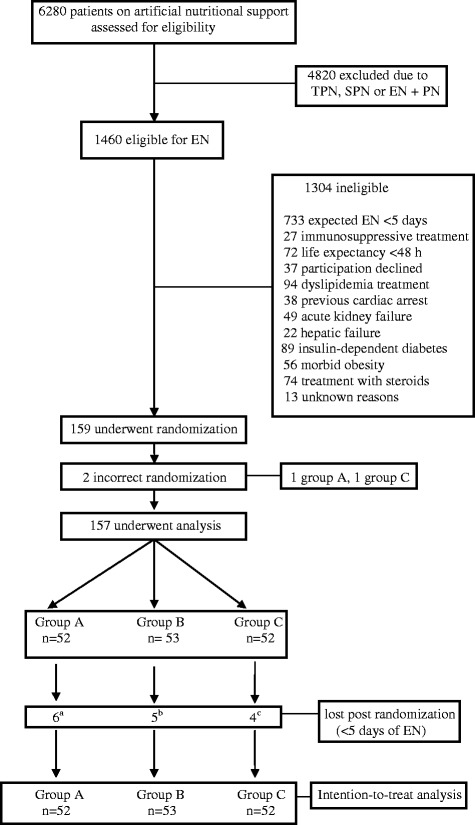
Introduction: Although standard enteral nutrition is universally accepted, the use of disease-specific formulas for hyperglycemic patients is still controversial. This study examines whether a high-protein diabetes-specific formula reduces insulin needs, improves glycemic control and reduces ICU-acquired infection in critically ill, hyperglycemic patients on mechanical ventilation (MV). Methods: This was a prospective, open-label, randomized (web-based, blinded) study conducted at nine Spanish ICUs. The patient groups established according to the high-protein formula received were: group A, new-generation diabetes-specific formula; group B, standard control formula; group C, control diabetes-specific formula. Inclusion criteria were: expected enteral nutrition ≥5 days, MV, baseline glucose >126 mg/dL on admission or >200 mg/dL in the first 48 h. Exclusion criteria were: APACHE II ≤10, insulin-dependent diabetes, renal or hepatic failure, treatment with corticosteroids, immunosuppressants or lipid-lowering drugs and body mass index ≥40 kg/m 2. The targeted glucose level was 110–150 mg/dL. Glycemic variability was calculated as the standard deviation, glycemic lability index and coefficient of variation. Acquired infections were recorded using published consensus criteria for critically ill patients. Data analysis was on an intention-to-treat basis. Results: Over a 2-year period, 157 patients were consecutively enrolled (A 52, B 53 and C 52). Compared with the standard control formula, the new formula gave rise to lower insulin requirement (19.1 ± 13.1 vs. 23.7 ± 40.1 IU/day, p <0.05), plasma glucose (138.6 ± 39.1 vs. 146.1 ± 49.9 mg/dL, p <0.01) and capillary blood glucose (146.1 ± 45.8 vs. 155.3 ± 63.6 mg/dL, p <0.001). Compared with the control diabetes-specific formula, only capillary glucose levels were significantly reduced (146.1 ± 45.8 vs. 150.1 ± 41.9, p <0.01). Both specific formulas reduced capillary glucose on ICU day 1 (p <0.01), glucose variability in the first week (p <0.05), and incidences of ventilator-associated tracheobronchitis (p <0.01) or pneumonia (p <0.05) compared with the standard formula. No effects of the nutrition formula were produced on hospital stay or mortality. Conclusions: In these high-risk ICU patients, both diabetes-specific formulas lowered insulin requirements, improved glycemic control and reduced the risk of acquired infections relative to the standard formula. Compared with the control-specific formula, the new-generation formula also improved capillary glycemia. Trial registration: Clinicaltrials.gov NCT1233726.
Overview
The claims and statistics of this paper haven’t been checked yet.
Free: it reads the open-access text and checks the first 5 claims that cite a source we can check. Create a free account to check every claim.
Integrity signals
Registry
Cites
Statistics
Figures
Verification
Claims the paper makes
The claims and statistics of this paper haven’t been checked yet.
Free: it reads the open-access text and checks the first 5 claims that cite a source we can check. Create a free account to check every claim.
Claims other papers make about this one
Each is checked against this paper’s own text: does it say what the citing paper says it does?
The source backs part of the claim, not all of it — or backs it for a different population, condition or comparison.
In the citing paper
“The use of diabetic-specific enteral formula in ICU patients suffering from Type 2 Diabetes Mellitus seems to improve the glucose profile (190,191) and may have clinical and economic impact (192).”
From ESPEN guideline on clinical nutrition in the intensive care unit. (2019) · cites this paper as [191]
Experimental — accuracy not yet measuredThe source backs part of the claim, not all of it — or backs it for a different population, condition or comparison.
In the citing paper
“The use of diabetic-specific enteral formula in ICU patients suffering from Type 2 Diabetes Mellitus decrease the requirement for insulin [70,71]”
From ESPEN practical and partially revised guideline: Clinical nutrition in the intensive care unit (2023) · cites this paper as [71]
Experimental — accuracy not yet measuredThe check wasn’t confident either way, so it gives no verdict — never disputed.
In the citing paper
“CGM in the hospital is not currently approved by regulatory agencies, with ongoing validation studies.1395”
From American Association of Clinical Endocrinology Clinical Practice Guideline: Developing a Diabetes Mellitus Comprehensive Care Plan-2022 Update. (2022) · cites this paper as [1395]
Experimental — accuracy not yet measured
Self-check
Percentages, sums and reported differences re-computed from the paper’s own numbers.
The self-check needs the paper’s full text.
Citations
Cites
Intensive insulin therapy in critically ill patients.
Van den Berghe, G., Wouters, P., Weekers, F., Verwaest, C., Bruyninckx, F., Schetz, M., Vlasselaers, D., Ferdinande, P., Lauwers, P., & Bouillon, R. (2001) · New England Journal of Medicine · doi:10.1056/nejmoa011300 · Cited by 9,977
Horan, T. C., Andrus, M., & Dudeck, M. A. (2008) · American Journal of Infection Control · doi:10.1016/j.ajic.2008.03.002 · Cited by 6,626 · cited 1×
“ICU-acquired infections were defined according to criteria for critically ill patients emerging from consensus conferences [37, 38].”
MethodIntensive versus Conventional Glucose Control in Critically Ill Patients
(2009) · New England Journal of Medicine · doi:10.1056/nejmoa0810625 · Cited by 5,119
Standards of medical care in diabetes—2013
American Diabetes Association (2013) · Diabetes Care · doi:10.2337/dc13-s011 · Cited by 4,369
Intensive insulin therapy in the medical ICU
Van den Berghe, G., Wilmer, A., Hermans, G., Meersseman, W., Wouters, P. J., Milants, I., Van Wijngaerden, E., Bobbaers, H., & Bouillon, R. (2006) · New England Journal of Medicine · doi:10.1056/nejmoa052521 · Cited by 3,639
International Study of the Prevalence and Outcomes of Infection in Intensive Care Units
Vincent, J.-L. (2009) · JAMA · doi:10.1001/jama.2009.1754 · Cited by 3,618
Basevi, V., Di Mario, S., Morciano, C., Nonino, F., & Magrini, N. (2011) · Diabetes Care · doi:10.2337/dc11-0174 · Cited by 3,055
Krinsley, J. S. (2003) · Mayo Clinic Proceedings · doi:10.4065/78.12.1471 · Cited by 1,165 · cited 1×
“Introduction Critically ill patients show a stereotype metabolic response to injury that affects carbohydrate metabolism [1, 2], causing hyperglycemia, which is boosted by the actions of counterregulatory hormones [3, 4].”
BackgroundGriesdale, D. E. G., de Souza, R. J., van Dam, R. M., Heyland, D. K., Cook, D. J., Malhotra, A., Dhaliwal, R., Henderson, W. R., Chittock, D. R., Finfer, S., et al. (2009) · Canadian Medical Association Journal · doi:10.1503/cmaj.090206 · Cited by 1,096
Glucose Control and Mortality in Critically Ill Patients
Finney, S. J. (2003) · JAMA · doi:10.1001/jama.290.15.2041 · Cited by 1,055
Variability of Blood Glucose Concentration and Short-term Mortality in Critically Ill Patients
Egi, M., Bellomo, R., Stachowski, E., French, C. J., & Hart, G. (2006) · Anesthesiology · doi:10.1097/00000542-200608000-00006 · Cited by 854 · cited 2×
“[8] observed a greater GV in patients who died than in survivors.”
BackgroundMethodCalandra, T., & Cohen, J. (2005) · Critical Care Medicine · doi:10.1097/01.ccm.0000168253.91200.83 · Cited by 839 · cited 1×
“ICU-acquired infections were defined according to criteria for critically ill patients emerging from consensus conferences [37, 38].”
MethodAlterations in carbohydrate metabolism during stress: A review of the literature
Mizock, B. A. (1995) · The American Journal of Medicine · doi:10.1016/s0002-9343(99)80083-7 · Cited by 531 · cited 1×
“Introduction Critically ill patients show a stereotype metabolic response to injury that affects carbohydrate metabolism [1, 2], causing hyperglycemia, which is boosted by the actions of counterregulatory hormones [3, 4].”
BackgroundMontejo, J. C. (1999) · Critical Care Medicine · doi:10.1097/00003246-199908000-00006 · Cited by 449
Glucose variability is associated with intensive care unit mortality*
Hermanides, J., Vriesendorp, T. M., Bosman, R. J., Zandstra, D. F., Hoekstra, J. B., & DeVries, J. H. (2010) · Critical Care Medicine · doi:10.1097/ccm.0b013e3181cc4be9 · Cited by 437 · cited 1×
“[9], in 5728 critical patients, found a significant relationship between GV, measured as mean absolute glucose, and the likelihood of ICU death.”
BackgroundKrinsley, J. S., Egi, M., Kiss, A., Devendra, A. N., Schuetz, P., Maurer, P. M., Schultz, M. J., van Hooijdonk, R. T., Kiyoshi, M., Mackenzie, I. M., et al. (2013) · Critical Care · doi:10.1186/cc12547 · Cited by 369
Gastric residual volume during enteral nutrition in ICU patients: the REGANE study
Montejo, J. C., Miñambres, E., Bordejé, L., Mesejo, A., Acosta, J., Heras, A., Ferré, M., Fernandez-Ortega, F., Vaquerizo, C. I., & Manzanedo, R. (2010) · Intensive Care Medicine · doi:10.1007/s00134-010-1856-y · Cited by 368 · cited 1×
“The following gastrointestinal complications were defined according to criteria published by our group [35, 36]: a) Abdominal distention: tympany and/or absence of bowel sounds; b) high GRV: recovered gastric volume equal to or greater than 500 mL; c) vomiting: enteral formula ejected through the mouth; d) diet regurg…”
MethodSelf-citationToward Understanding Tight Glycemic Control in the ICU
Marik, P. E., & Preiser, J.-C. (2010) · Chest · doi:10.1378/chest.09-1737 · Cited by 365
Ryan, E. A., Shandro, T., Green, K., Paty, B. W., Senior, P. A., Bigam, D., Shapiro, A. M. J., & Vantyghem, M.-C. (2004) · Diabetes · doi:10.2337/diabetes.53.4.955 · Cited by 343 · cited 1×
“The GLI was calculated using the Ryan equation [34] modified for critically ill patients and corrected for the number of blood extractions as follows:”
MethodPittas, A. G., Siegel, R. D., & Lau, J. (2004) · Archives of Internal Medicine · doi:10.1001/archinte.164.18.2005 · Cited by 306 · cited 1×
“However, to date no consensus has been reached on the optimal target glucose range [16–19].”
BackgroundThe Impact of Early Hypoglycemia and Blood Glucose Variability on Outcome in Critical Illness
Bagshaw, S. M., Bellomo, R., Jacka, M. J., Egi, M., Hart, G. K., George, C., & the ANZICS CORE Management Committee (2009) · Critical Care · doi:10.1186/cc7921 · Cited by 285 · cited 1×
“In an effort to avoid the detrimental consequences of hypoglycemia [13–15], many ICUs have elevated their targeted lower limits for glucose levels.”
BackgroundEnteral Nutritional Support and Use of Diabetes-Specific Formulas for Patients With Diabetes
Elia, M., Ceriello, A., Laube, H., Sinclair, A. J., Engfer, M., & Stratton, R. J. (2005) · Diabetes Care · doi:10.2337/diacare.28.9.2267 · Cited by 244 · cited 2×
“Hyperglycemia in the ICU patient can be treated with exogenous insulin [20, 21] and by the enteral administration of diabetes-specific formulas [22].”
BackgroundResultFinfer, S., Wernerman, J., Preiser, J.-C., Cass, T., Desaive, T., Hovorka, R., Joseph, J. I., Kosiborod, M., Krinsley, J., Mackenzie, I., et al. (2013) · Critical Care · doi:10.1186/cc12537 · Cited by 208
Benefits and Risks of Tight Glucose Control in Critically Ill Adults: A Meta-analysis
Wiener, R. S., Wiener, D. C., & Larson, R. J. (2008) · JAMA · doi:10.1001/jama.300.8.933 · Cited by 200
A.S.P.E.N. Clinical Guidelines: Nutrition Support of Adult Patients With Hyperglycemia
McMahon, M. M., Nystrom, E., Braunschweig, C., Miles, J., Compher, C., & the American Society for Parenteral and Enteral Nutrition (A.S.P.E.N.) Board of Directors (2013) · Journal of Parenteral and Enteral Nutrition · doi:10.1177/0148607112452001 · Cited by 164
Intensive insulin therapy is associated with reduced infectious complications in burn patients
Hemmila, M. R., Taddonio, M. A., Arbabi, S., Maggio, P. M., & Wahl, W. L. (2008) · Surgery · doi:10.1016/j.surg.2008.07.001 · Cited by 144 · cited 1×
“A relationship between hyperglycemia and infection has been established in several populations of critically ill patients [39–41].”
BackgroundInternational recommendations for glucose control in adult non diabetic critically ill patients
Ichai, C., Preiser, J.-C., (SFAR), F. T. S. F. D.-R., & Société de Réanimation de langue Française (SRLF) and the Experts group (2010) · Critical Care · doi:10.1186/cc9258 · Cited by 127
Metabolic Mechanisms of Stress Hyperglycemia
Mechanick, J. I. (2006) · Journal of Parenteral and Enteral Nutrition · doi:10.1177/0148607106030002157 · Cited by 120 · cited 1×
“Introduction Critically ill patients show a stereotype metabolic response to injury that affects carbohydrate metabolism [1, 2], causing hyperglycemia, which is boosted by the actions of counterregulatory hormones [3, 4].”
BackgroundMesejo, A., Batlle, J. A., Ortega, C., Vila, J., Fernandez, M., Ferreres, J., Sanchís, J., & López, F. B. (2003) · Clinical Nutrition · doi:10.1016/s0261-5614(02)00234-0 · Cited by 118
Self-citationFreire, A. X., Bridges, L., Umpierrez, G. E., Kuhl, D. A., & Kitabchi, A. E. (2005) · CHEST Journal · doi:10.1378/chest.128.5.3109 · Cited by 116 · cited 1×
“This metabolic response makes the critically ill patient especially susceptible to infection and increases morbidity and mortality [5–7].”
BackgroundPohl, M., Mayr, P., Mertl-Rötzer, M., Lauster, F., Lerch, M., Eriksen, J., Haslbeck, M., & Rahlfs, V. W. (2005) · European Journal of Clinical Nutrition · doi:10.1038/sj.ejcn.1602232 · Cited by 97 · cited 2×
“However, consistent with our findings, numerous studies have shown that insulin requirements and plasma and capillary blood glucose levels can be reduced using a diabetes-specific EN formula as an adjuvant to insulin [22, 25, 27, 29, 30] (Table 4).”
ResultRelationship between perioperative glycemic control and postoperative infections
Hanazaki, K., Maeda, H., & Okabayashi, T. (2009) · World Journal of Gastroenterology · doi:10.3748/wjg.15.4122 · Cited by 91 · cited 1×
“A relationship between hyperglycemia and infection has been established in several populations of critically ill patients [39–41].”
BackgroundA Diabetes-Specific Enteral Formula Improves Glycemic Variability in Patients with Type 2 Diabetes
Alish, C. J., Garvey, W. T., Maki, K. C., Sacks, G. S., Hustead, D. S., Hegazi, R. A., & Mustad, V. A. (2010) · Diabetes Technology & Therapeutics · doi:10.1089/dia.2009.0185 · Cited by 77 · cited 2×
“[12] reported lower GV based on the mean amplitude of glycemic excursions (MAGE) in noncritically ill patients with diabetes who were administered a diabetes-specific formula than in those administered a Table 7 Other clinical outcomes”
BackgroundMethodGlycaemic variability, infections and mortality in a medical–surgical intensive care unit
Donati, A., Damiani, E., Domizi, R., Botticelli, L., Castagnani, R., Gabbanelli, V., Nataloni, S., Carsetti, A., Scorcella, C., Adrario, E., et al. (2014) · Critical Care and Resuscitation · doi:10.1016/s1441-2772(23)01437-0 · Cited by 69 · cited 1×
“[11] were the first to report close correlation between glycemic variability (GLI, SD, CV and MAGE) and acquired infections in diabetic and nondiabetic patients, with higher discriminative values observed for GLI and CV.”
BackgroundHyperglycaemia in critically ill patients: marker or mediator of mortality?
Corstjens, A. M., van der Horst, I. C. C., Zijlstra, J. G., Groeneveld, A. B. J., Zijlstra, F., Tulleken, J. E., & Ligtenberg, J. J. M. (2006) · Critical Care · doi:10.1186/cc4957 · Cited by 68
Bochicchio, G. V., Bochicchio, K. M., Joshi, M. G., Ilahi, O., & Scalea, T. M. (2010) · Annals of Surgery · doi:10.1097/sla.0b013e3181f4e499 · Cited by 67 · cited 1×
“A relationship between hyperglycemia and infection has been established in several populations of critically ill patients [39–41].”
BackgroundLeon-Sanz, M., Garcia-Luna, P. P., Planas, M., Sanz-Paris, A., Gomez-Candela, C., Casimiro, C., & the Abbott SPAI-97-004 Study Cooperative Group (2005) · Journal of Parenteral and Enteral Nutrition · doi:10.1177/014860710502900121 · Cited by 59 · cited 1×
“However, consistent with our findings, numerous studies have shown that insulin requirements and plasma and capillary blood glucose levels can be reduced using a diabetes-specific EN formula as an adjuvant to insulin [22, 25, 27, 29, 30] (Table 4).”
ResultVoss, A. C., Maki, K. C., Garvey, W. T., Hustead, D. S., Alish, C. J., Fix, B., & Mustad, V. A. (2008) · Nutrition · doi:10.1016/j.nut.2008.06.009 · Cited by 57 · cited 1×
“When used as short- to medium-term treatment, a standard highcarbohydrate/low-fat diet may compromise glycemic control [25, 26].”
Vaisman, N., Lansink, M., Rouws, C., van Laere, K. M., Segal, R., Niv, E., Bowling, T. E., Waitzberg, D. L., & Morley, J. E. (2009) · Clinical Nutrition · doi:10.1016/j.clnu.2009.05.004 · Cited by 54 · cited 1×
“However, consistent with our findings, numerous studies have shown that insulin requirements and plasma and capillary blood glucose levels can be reduced using a diabetes-specific EN formula as an adjuvant to insulin [22, 25, 27, 29, 30] (Table 4).”
ResultCrespillo, M. D. C., Olveira, G., de Adana, M. S. R., Rojo‐Martínez, G., Garcı́a-Alemán, J., Olvera, P., Soriguer, F., & Muñoz, A. J. J. (2003) · Clinical Nutrition · doi:10.1016/s0261-5614(03)00047-5 · Cited by 29 · cited 1×
“By modifying carbohydrate composition and adding monounsaturated fatty acids (MUFA) and fiber, studies have shown improved glycemic control compared with a standard diet [27–29].”
BackgroundValencia, E., Marín, A., & Hardy, G. (2009) · Current Opinion in Clinical Nutrition & Metabolic Care · doi:10.1097/mco.0b013e32832a2be6 · Cited by 17 · cited 1×
“Exclusion criteria were: contraindication for EN, expected EN <5 days, Acute Physiology and Chronic Health Evaluation II (APACHE II) score ≤10, insulindependent diabetes, acute or chronic kidney failure [32], liver failure (total bilirubin ≥3 mg/dL, Child-Pugh Mesejo et al.”
BackgroundAlonso, C. V., Carmona, T. G., & Díaz, M. J. (2011) · PubMed · doi:10.1590/s0212-16112011000800010 · Cited by 15 · cited 1×
“Hyperglycemia in the ICU patient can be treated with exogenous insulin [20, 21] and by the enteral administration of diabetes-specific formulas [22].”
Background
Cited by
ESPEN guideline on clinical nutrition in the intensive care unit.
Singer, P., Blaser, A. R., Berger, M. M., Alhazzani, W., Calder, P. C., Casaer, M. P., Hiesmayr, M., Mayer, K., Montejo, J. C., Pichard, C., et al. (2019) · Clinical Nutrition · doi:10.1016/j.clnu.2018.08.037 · Cited by 2,904
“The use of diabeticspecific enteral formula in ICU patients suffering from Type 2 Diabetes Mellitus seems to improve the glucose profile [188,189] and may have clinical and economic impact [188].”
ESPEN practical and partially revised guideline: Clinical nutrition in the intensive care unit
Singer, P., Blaser, A. R., Berger, M. M., Calder, P. C., Casaer, M., Hiesmayr, M., Mayer, K., Montejo-Gonzalez, J. C., Pichard, C., Preiser, J.-C., et al. (2023) · Clinical Nutrition · doi:10.1016/j.clnu.2023.07.011 · Cited by 793
“formula in ICU patients suffering from Type 2 Diabetes Mellitus decrease the requirement for insulin [70,71] and.”
BackgroundBlonde, L., Umpierrez, G. E., Reddy, S. S., McGill, J. B., Berga, S. L., Bush, M., Chandrasekaran, S., DeFronzo, R. A., Einhorn, D., Galindo, R. J., et al. (2022) · Endocrine Practice · doi:10.1016/j.eprac.2022.08.002 · Cited by 507
Barazzoni, R., Deutz, N. E. P., Biolo, G., Bischoff, S., Boirie, Y., Cederholm, T., Cuerda, C., Delzenne, N., Leon Sanz, M., Ljungqvist, O., et al. (2017) · Clinical Nutrition · doi:10.1016/j.clnu.2016.09.010 · Cited by 112
“DSFs containing higher proportions of fat and modified carbohydrates have not been extensively assessed in ICU patients, but recent data suggest that the use of these formulas improves glycemic control, and, in at least one study, this was shown to provide clinical benefit [100].”
BackgroundHealth Outcomes and Quality of Life Indices of Children Receiving Blenderized Feeds via Enteral Tube
Hron, B. M., Fishman, E., Lurie, M., Clarke, T., Chin, Z., Hester, L., Burch, E., & Rosen, R. (2019) · The Journal of Pediatrics · doi:10.1016/j.jpeds.2019.04.023 · Cited by 117
Metadata
- Authors
- Mesejo, A., Montejo-González, J. C., Vaquerizo-Alonso, C., Lobo-Tamer, G., Zabarte-Martinez, M., Herrero-Meseguer, J. I., Acosta-Escribano, J., Blesa-Malpica, A., & Martinez-Lozano, F.
- Affiliations
- Hospital Clínico Universitario de Valencia (ES)
- Donostiako Unibertsitate Ospitalea (ES)
- Bellvitge University Hospital (ES)
- Hospital Clínico San Carlos (ES)
- Corresponding author
- Mesejo, Alfonso
- Venue
- Critical Care
- Published
- 2015-12
- Volume
- 19
- Issue
- 1
- Pages
- 390-390
- ISSN
- 1364-8535 (ISSN-L)
- PMC
- PMC4638090
- OpenAlex
- W2114294375
- Cited by
- 94
- References
- 43
- Citations by year
- 2026: 5 · 2025: 6 · 2024: 5 · 2023: 8 · 2022: 11 · 2021: 14 · 2020: 12 · 2019: 7 · 2018: 10 · 2017: 9 · 2016: 7
- FWCI
- 7.52
- Type
- journal article
- Language
- en
- Open access
- gold
- doi.org
- Licence
- cc-by
- creativecommons.org/licenses/by/4.0 (tdm)
- creativecommons.org/licenses/by/4.0 (vor)
- Locations
- Critical Care (publishedVersion, cc-by)
- Europe PMC (PubMed Central) (publishedVersion, cc-by)
- PubMed Central (publishedVersion, cc-by)
- PubMed (publishedVersion)
- Dipòsit Digital de la Universitat de Barcelona (Universitat de Barcelona) (publishedVersion, cc-by)
- LA Referencia (Red Federada de Repositorios Institucionales de Publicaciones Científicas) (submittedVersion, other-oa)
- RECERCAT (Consorci de Serveis Universitaris de Catalunya) (submittedVersion, cc-by)
- RISalud Institutional Health Repository of Andalucía (submittedVersion, other-oa)
- Topics
- Health Sciences › Medicine › Endocrinology, Diabetes and Metabolism › Hyperglycemia and glycemic control in critically ill and hospitalized patients
- Health Sciences › Nursing › Nutrition and Dietetics › Clinical Nutrition and Gastroenterology
- Health Sciences › Medicine › Critical Care and Intensive Care Medicine › Intensive Care Unit Cognitive Disorders
- Keywords
- hyperglycemia, mechanical ventilation, critically ill patients, high-protein formula, insulin requirement, glycemic control, intensive care unit infections, ICU-acquired pneumonia, enteral nutrition, glycemic variability, sepsis, septic shock, multiple organ failure
- MeSH terms
- Adult, Aged, Blood Glucose, Diabetes Mellitus, Enteral Nutrition, Female, Humans, Hyperglycemia, Insulin, Intensive Care Units, Male, Middle Aged, Nutritional Status, Prospective Studies, Critical Illness, Glycemic Index
About these checks
Registry, retraction, Cites and statistics results are computed, not judged, with one exception: a printed reference that no index lists is read once by a model before it counts as a citation error. Claims are extracted by a model and kept only when their quote appears verbatim in the text; each cited source is then checked, with a model’s help, for whether it says what the claim relies on. Those verdicts can be wrong — read the claim’s quote and the cited source before relying on one.
Statistics and arithmetic are recomputed, not judged.
Confidence bands are shown only for fields calibrated on our annotated test set. None is calibrated yet, so no band is shown.
What counts as a claim ›How we measure confidence ›How we check this ›
Are you an author, or do you see a problem with this page? Request a review
Data sources
Bibliographic data: Semantic Scholar, OpenAlex, Crossref.
Contains information from the Semantic Scholar Academic Graph Datasets, made available under the ODC Attribution License (ODC-BY 1.0).
Semantic Scholar’s data is described in: Kinney, R., et al. (2023). The Semantic Scholar Open Data Platform. arXiv:2301.10140.
