

Tailoring nutrition therapy to illness and recovery
Open accessThe DOI matches its Crossref record; 47 of the 47 references it cites were found in a registry or an index.
Abstract
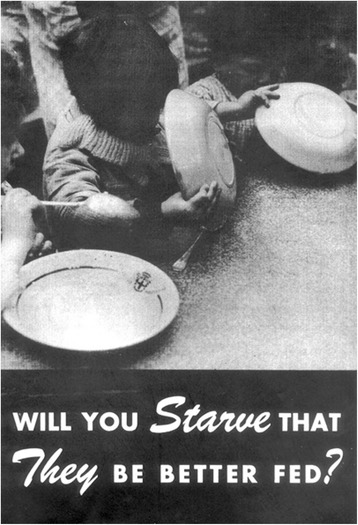
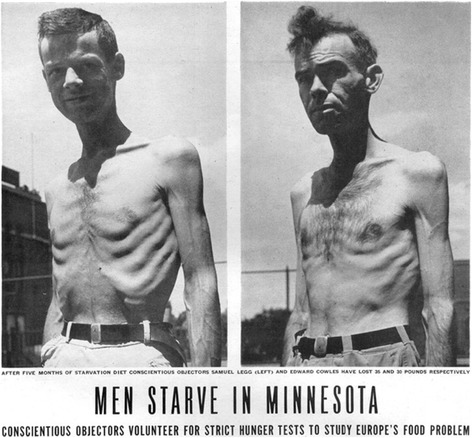
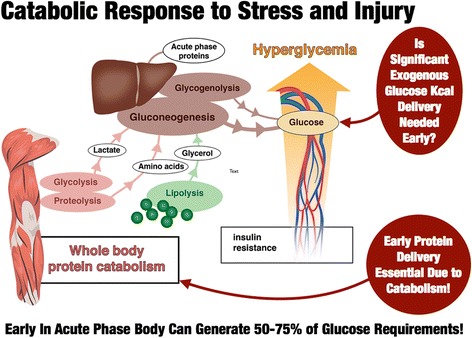
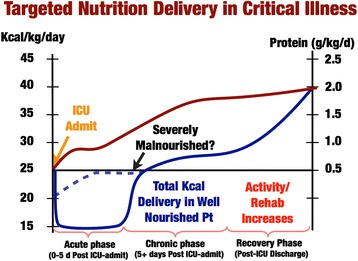
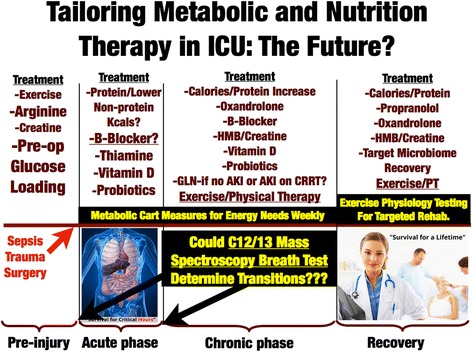
Without doubt, in medicine as in life, one size does not fit all. We do not administer the same drug or dose to every patient at all times, so why then would we live under the illusion that we should give the same nutrition at all times in the continuum of critical illness? We have long lived under the assumption that critical illness and trauma lead to a consistent early increase in metabolic/caloric need, the so-called "hypermetabolism" of critical illness. What if this is incorrect? Recent data indicate that early underfeeding of calories (trophic feeding) may have benefits and may require consideration in well-nourished patients. However, we must confront the reality that currently ICU nutrition delivery worldwide is actually leading to "starvation" of our patients and is likely a major contributor to poor long-term quality of life outcomes. To begin to ascertain the actual calorie and protein delivery required for optimal ICU recovery, an understanding of "starvation" and recovery from starvation and lean body mass (LBM) loss is needed. To begin to answer this question, we must look to the landmark Minnesota Starvation Study from 1945. This trial defines much of the world's knowledge about starvation, and most importantly what is required for recovery from starvation and massive LBM loss as occurs in the ICU. Recent and historic data indicate that critical illness is characterized by early massive catabolism, LBM loss, and escalating hypermetabolism that can persist for months or years. Early enteral nutrition during the acute phase should attempt to correct micronutrient/vitamin deficiencies, deliver adequate protein, and moderate nonprotein calories in well-nourished patients, as in the acute phase they are capable of generating significant endogenous energy. Post resuscitation, increasing protein (1.5-2.0 g/kg/day) and calories are needed to attenuate LBM loss and promote recovery. Malnutrition screening is essential and parenteral nutrition can be safely added following resuscitation when enteral nutrition is failing based on pre-illness malnutrition and LBM status. Following the ICU stay, significant protein/calorie delivery for months or years is required to facilitate functional and LBM recovery, with high-protein oral supplements being essential to achieve adequate nutrition.
Overview
The claims and statistics of this paper haven’t been checked yet.
Free: it reads the open-access text and checks the first 5 claims that cite a source we can check. Create a free account to check every claim.
Integrity signals
Registry
Cites
Statistics
Figures
Verification
Claims the paper makes
The claims and statistics of this paper haven’t been checked yet.
Free: it reads the open-access text and checks the first 5 claims that cite a source we can check. Create a free account to check every claim.
Claims other papers make about this one
Each is checked against this paper’s own text: does it say what the citing paper says it does?
The source backs part of the claim, not all of it — or backs it for a different population, condition or comparison.
In the citing paper
“It has been observed ( 5) that in daily practice the amount of protein provided to most ICU patients is less than the loss, and is related to technical difficulties and commercial product composition not adequately enriched with proteins in comparison to the calorie content (156).”
From ESPEN guideline on clinical nutrition in the intensive care unit. (2019) · cites this paper as [5]
Experimental — accuracy not yet measuredThe source backs part of the claim, not all of it — or backs it for a different population, condition or comparison.
In the citing paper
“Oral intake is frequently prescribed in the intensive care setting varying from 25 to 45% of the patients in the first four days, but does not reach the energy or protein requirements according to the Nutrition Day ICU survey ( 5).”
From ESPEN guideline on clinical nutrition in the intensive care unit. (2019) · cites this paper as [5]
Experimental — accuracy not yet measuredThe source backs part of the claim, not all of it — or backs it for a different population, condition or comparison.
In the citing paper
“Furthermore, the large heterogeneity of the ICU population potentially reduces the external validity of the recommendations”
From ESPEN guideline on clinical nutrition in the intensive care unit. (2019) · cites this paper as [5]
Experimental — accuracy not yet measuredThe source backs part of the claim, not all of it — or backs it for a different population, condition or comparison.
In the citing paper
“Furthermore, the large heterogeneity of the ICU population potentially reduces the external validity of the recommendations, which should be seen as a basis to support decisions made for each patient on an individual basis [6].”
From ESPEN practical and partially revised guideline: Clinical nutrition in the intensive care unit (2023) · cites this paper as [6]
Experimental — accuracy not yet measuredThe source backs part of the claim, not all of it — or backs it for a different population, condition or comparison.
In the citing paper
“Oral intake is frequently prescribed in the intensive care setting varying from 25 to 45% of the patients in the first four days, but does not reach the energy or protein requirements according to the Nutrition Day ICU survey [6].”
From ESPEN practical and partially revised guideline: Clinical nutrition in the intensive care unit (2023) · cites this paper as [6]
Experimental — accuracy not yet measured
1 more claim about this paper
Create a free account to see every claim other papers make about this one.
Self-check
Percentages, sums and reported differences re-computed from the paper’s own numbers.
The self-check needs the paper’s full text.
Citations
Cites
McClave, S. A., Taylor, B. E., Martindale, R. G., Warren, M. M., Johnson, D. R., Braunschweig, C., McCarthy, M. S., Davanos, E., Rice, T. W., Cresci, G. A., et al. (2016) · Journal of Parenteral and Enteral Nutrition · doi:10.1177/0148607115621863 · Cited by 3,982 · cited 4×
“2 g protein/kg/day) should be considered in patients requiring PN over the first week in the ICU [17].”
BackgroundMethodInfluentialThe Biology of Human Starvation: Volume I
KEYS, A., BROŽEK, J., HENSCHEL, A., MICKELSEN, O., & TAYLOR, H. L. (1950) · doi:10.5749/j.ctv9b2tqv · Cited by 2,039
Early versus late parenteral nutrition in critically ill adults
Casaer, M. P., Mesotten, D., Hermans, G., Wouters, P. J., Schetz, M., Meyfroidt, G., Van Cromphaut, S., Ingels, C., Meersseman, P., Muller, J., et al. (2011) · New England Journal of Medicine · doi:10.1056/nejmoa1102662 · Cited by 1,696 · cited 1×
“data have indicated that early hypocaloric feeding (so-called trophic feeding) may be superior [1, 2].”
BackgroundTaylor, B. E., McClave, S. A., Martindale, R. G., Warren, M. M., Johnson, D. R., Braunschweig, C., McCarthy, M. S., Davanos, E., Rice, T. W., Cresci, G. A., et al. (2016) · Critical Care Medicine · doi:10.1097/ccm.0000000000001525 · Cited by 1,476
Kaukonen, K.-M., Bailey, M., Suzuki, S., Pilcher, D., & Bellomo, R. (2014) · JAMA · doi:10.1001/jama.2014.2637 · Cited by 1,459
Alberda, C., Gramlich, L., Jones, N., Jeejeebhoy, K., Day, A. G., Dhaliwal, R., & Heyland, D. K. (2009) · Intensive Care Medicine · doi:10.1007/s00134-009-1567-4 · Cited by 975 · cited 2×
“6 g/kg/ day of protein for the first 2 weeks following ICU admission [16].”
BackgroundThe National Heart, L., Rice, T. W., Wheeler, A. P., Thompson, B. T., Steingrub, J., Hite, R. D., Moss, M., Morris, A., Dong, N., & Rock, P. (2012) · JAMA: The Journal of the American Medical Association · doi:10.1001/jama.2012.137 · Cited by 935
Disease-related malnutrition: an evidence-based approach to treatment
(2003) · CABI eBooks · doi:10.1079/9780851996486.0000 · Cited by 876
Heyland, D. K., Dhaliwal, R., Jiang, X., & Day, A. G. (2011) · Critical Care · doi:10.1186/cc10546 · Cited by 863 · cited 2×
“, patients with significant pre-ICU weight loss or NUTRIC Score (w/o IL-6) > 5) who are unlikely to have the metabolic reserve to generate the needed endogenous energy [17, 19].”
BackgroundHeidegger, C. P., Berger, M. M., Graf, S., Zingg, W., Darmon, P., Costanza, M. C., Thibault, R., & Pichard, C. (2013) · The Lancet · doi:10.1016/s0140-6736(12)61351-8 · Cited by 776
Research works printed but not linked: 2
- Keys A Brozek J Henschel A Mickelsen O Taylor HL Experimental Starvation in Man: A Report from the Laboratory of Physiological Hygiene, University of Minnesota 1945 Minneapolis University of Minnesota
- Keys A Brozek J Henschel A Mickelsen O Taylor HL Rehabilitation Following Experimental Starvation in Man: A Report from the Laboratory of Physiological Hygiene, University of Minnesota 1946 Minneapolis University of Minnesota
Cited by
ESPEN guideline on clinical nutrition in the intensive care unit.
Singer, P., Blaser, A. R., Berger, M. M., Alhazzani, W., Calder, P. C., Casaer, M. P., Hiesmayr, M., Mayer, K., Montejo, J. C., Pichard, C., et al. (2019) · Clinical Nutrition · doi:10.1016/j.clnu.2018.08.037 · Cited by 2,904
ESPEN practical and partially revised guideline: Clinical nutrition in the intensive care unit
Singer, P., Blaser, A. R., Berger, M. M., Calder, P. C., Casaer, M., Hiesmayr, M., Mayer, K., Montejo-Gonzalez, J. C., Pichard, C., Preiser, J.-C., et al. (2023) · Clinical Nutrition · doi:10.1016/j.clnu.2023.07.011 · Cited by 793
“Oral intake is frequently prescribed in the intensive care setting varying from 25 to 45% of the patients in the fi rst four days, but does not reach the energy or protein requirements according to the Nutrition Day ICU survey [6].”
BackgroundMethodvan Zanten, A. R. H., De Waele, E., & Wischmeyer, P. E. (2019) · Critical Care · doi:10.1186/s13054-019-2657-5 · Cited by 345
Self-citationThe malnourished surgery patient: a silent epidemic in perioperative outcomes?
Williams, D. G. A., Molinger, J., & Wischmeyer, P. E. (2019) · Current Opinion in Anaesthesiology · doi:10.1097/aco.0000000000000722 · Cited by 167
Self-citationNutrition therapy in critical illness: a review of the literature for clinicians
Lambell, K., Tatucu-Babet, O. A., Chapple, L. S., Gantner, D. C., & Ridley, E. J. (2020) · Critical Care · doi:10.1186/s13054-020-2739-4 · Cited by 171
Moonen, H. P. F. X., Beckers, K. J. H., & van Zanten, A. R. H. (2021) · Journal of Intensive Care · doi:10.1186/s40560-021-00524-0 · Cited by 147
Krok-Schoen, J. L., Archdeacon Price, A., Luo, M., Kelly, O. J., & Taylor, C. A. (2019) · The Journal of nutrition, health and aging · doi:10.1007/s12603-019-1174-1 · Cited by 113
Measuring and monitoring lean body mass in critical illness
Looijaard, W. G. P. M., Molinger, J., & Weijs, P. J. M. (2018) · Current Opinion in Critical Care · doi:10.1097/mcc.0000000000000511 · Cited by 110
Deane, A. M., Little, L., Bellomo, R., Chapman, M. J., Davies, A. R., Ferrie, S., Horowitz, M., Hurford, S., Lange, K., Litton, E., et al. (2020) · American Journal of Respiratory and Critical Care Medicine · doi:10.1164/rccm.201909-1810oc · Cited by 84
Malnutrition and its effects in severely injured trauma patients
Dijkink, S., Meier, K., Krijnen, P., Yeh, D. D., Velmahos, G. C., & Schipper, I. B. (2020) · European Journal of Trauma and Emergency Surgery · doi:10.1007/s00068-020-01304-5 · Cited by 84
Major, M. E., Dettling-Ihnenfeldt, D. S., Ramaekers, S. P. J., Engelbert, R., & van der Schaaf, M. (2021) · Critical Care · doi:10.1186/s13054-021-03709-z · Cited by 62
Enteral Nutrition Can Be Given to Patients on Vasopressors
Wischmeyer, P. E. (2020) · Critical Care Medicine · doi:10.1097/ccm.0000000000003965 · Cited by 53
“Finally, the gut’s fate, and we believe short and long-term outcomes from critical illness will ultimately depend on successful delivery of nutrients to ensure nutritional delivery to promote recovery (5).”
BackgroundSelf-citationNutrition support for critically ill patients
Al‐Dorzi, H. M., & Arabi, Y. M. (2021) · Journal of Parenteral and Enteral Nutrition · doi:10.1002/jpen.2228 · Cited by 74
Slingerland-Boot, R., van der Heijden, I., Schouten, N., Driessen, L., Meijer, S., Mensink, M., & van Zanten, A. R. H. (2022) · Clinical Nutrition · doi:10.1016/j.clnu.2022.07.031 · Cited by 50
The Japanese Critical Care Nutrition Guideline 2024
Nakamura, K., Yamamoto, R., Higashibeppu, N., Yoshida, M., Tatsumi, H., Shimizu, Y., Izumino, H., Oshima, T., Hatakeyama, J., Ouchi, A., et al. (2025) · Journal of Intensive Care · doi:10.1186/s40560-025-00785-z · Cited by 60
Meisami, A. H., Abbasi, M., Mosleh-Shirazi, S., Azari, A., Amani, A. M., Vaez, A., & Golchin, A. (2022) · European Journal of Pharmacology · doi:10.1016/j.ejphar.2022.175011 · Cited by 47
Hsu, C.-C., Sun, C.-Y., Tsai, C., Chen, M.-Y., Wang, S., Hsu, J., Yeh, C., & Yeh, T. (2021) · Journal of Multidisciplinary Healthcare · doi:10.2147/jmdh.s306350 · Cited by 58
Endogenous Glucose Production in Critical Illness
Al‐Yousif, N., Rawal, S., Jurczak, M. J., Mahmud, H., & Shah, F. A. (2021) · Nutrition in Clinical Practice · doi:10.1002/ncp.10646 · Cited by 41
Grillo-Ardila, C. F., Tibavizco-Palacios, D., Triana, L. C., Rugeles, S. J., Vallejo-Ortega, M. T., Calderón-Franco, C. H., & Ramírez-Mosquera, J. J. (2024) · Nutrients · doi:10.3390/nu16111560 · Cited by 35
“Medical nutrition therapy provides the opportunity to compensate and correct significant muscle wasting [6], oxidative stress, and immune response activation in sepsis or septic shock, counterbalancing the energy deficit [7].”
BackgroundHow much underfeeding can the critically ill adult patient tolerate?
Tatucu-Babet, O. A., & Ridley, E. J. (2022) · Journal of Intensive Medicine · doi:10.1016/j.jointm.2022.01.002 · Cited by 41
Nutritional support in the recovery phase of critically ill children
Joosten, K., Eveleens, R. D., & Verbruggen, S. C. A. T. (2018) · Current Opinion in Clinical Nutrition & Metabolic Care · doi:10.1097/mco.0000000000000549 · Cited by 39
Lambell, K., Goh, G. S., Tierney, A. C., Forsyth, A. K., Nanjayya, V. B., Nyulasi, I. B., & King, S. (2020) · Nutrition · doi:10.1016/j.nut.2020.111061 · Cited by 32
Wischmeyer, P. E., Molinger, J., & Haines, K. (2021) · Nutrition in Clinical Practice · doi:10.1002/ncp.10643 · Cited by 35
Self-citationParenteral nutrition in the ICU: Lessons learned over the past few years
Berger, M. M., & Pichard, C. (2018) · Nutrition · doi:10.1016/j.nut.2018.08.012 · Cited by 32
Lugli, A. K., de Watteville, A., Hollinger, A., Goetz, N., & Heidegger, C. P. (2019) · Journal of Clinical Medicine · doi:10.3390/jcm8091395 · Cited by 31
Ridley, E. J., Tierney, A. C., King, S., Ainslie, E., Udy, A. A., Scheinkestel, C. D., & Nyulasi, I. B. (2020) · Journal of Parenteral and Enteral Nutrition · doi:10.1002/jpen.1791 · Cited by 26
Nutritional Optimization of the Surgical Patient: A Narrative Review
Heutlinger, O., Acharya, N., Tedesco, A., Ramesh, A., Smith, B., Nguyen, N. T., & Wischmeyer, P. E. (2024) · Advances in Nutrition · doi:10.1016/j.advnut.2024.100351 · Cited by 33
Self-citationEarly Enteral Nutrition in Mechanically Ventilated Patients With COVID‐19 Infection
Farina, N., Nordbeck, S., Montgomery, M., Cordwin, L., Blair, F., Cherry‐Bukowiec, J. R., Kraft, M. D., Pleva, M. R., & Raymond, E. (2021) · Nutrition in Clinical Practice · doi:10.1002/ncp.10629 · Cited by 32
Nutritional Support for Critically Ill Patients (Review)
Пасечник, И. Н. (2020) · General Reanimatology · doi:10.15360/1813-9779-2020-4-40-59 · Cited by 24
Knudsen, A. W., Hansen, S. M., Thomsen, T., Knudsen, H., & Munk, T. (2024) · Australian Critical Care · doi:10.1016/j.aucc.2024.07.083 · Cited by 21
Enhanced Recovery in Surgical Intensive Care: A Review
Jovanović, G., Jakovljević, D. K., & Lukić-Šarkanović, M. (2018) · Frontiers in Medicine · doi:10.3389/fmed.2018.00256 · Cited by 24
Wendt, S., Schomburg, L., Manzanares, W., & Stoppe, C. (2019) · Nutrition in Clinical Practice · doi:10.1002/ncp.10326 · Cited by 18
Rapid decreases of key antioxidant molecules in critically ill patients: A personalized approach
Margaritelis, N. V., Paschalis, V., Theodorou, A. A., Vassiliou, V., Kyparos, A., & Nikolaidis, M. G. (2019) · Clinical Nutrition · doi:10.1016/j.clnu.2019.04.029 · Cited by 20
Yébenes, J. C., Campins, L., Zurbano, I. M. D. L., Bordejé, L., Lorencio, C., Carmona, T. G., Montejo, J. C., Bodí, M. A., Serra‐Prat, M., & Working Group on Nutrition and Metabolism of the Spanish Society of Critical Care (2019) · Nutrients · doi:10.3390/nu11081775 · Cited by 19
Nutritional support for the trauma and emergency general surgery patient: What you need to know
Hartwell, J. L., Evans, D. C., & Martin, M. J. (2024) · The Journal of Trauma: Injury, Infection, and Critical Care · doi:10.1097/ta.0000000000004283 · Cited by 18
Nutritional survey in critically ill children: a single center study in China
Li, J., Li, B., Qian, J., Zhang, J., Ren, H., Ning, B., & Wang, Y. (2020) · Translational Pediatrics · doi:10.21037/tp-19-173 · Cited by 19
Tedesco, A., Sharma, A. K., Acharya, N., Rublev, G. A., Hashmi, S. Z., Wu, H., Lee, Y.-P., Scolaro, J. A., & Bhatia, N. N. (2024) · JBJS Reviews · doi:10.2106/jbjs.rvw.23.00242 · Cited by 19
Deer, R., Hosein, E., Harvey, M., Nguyen, T. Q., Givan, A. H., Hamilton, M., Turner, K., Kretzmer, R., Rock, M., Swartz, M. C., et al. (2022) · Nutrients · doi:10.3390/nu14030642 · Cited by 20
How to interpret and apply the results of indirect calorimetry studies: A case-based tutorial
Berger, M. M., Waele, E. D., Gramlich, L. M., Jin, J., Pantet, O., Pichard, C., Roffe, A. J., Russell, L. A., Singer, P., & Wischmeyer, P. E. (2024) · Clinical Nutrition ESPEN · doi:10.1016/j.clnesp.2024.07.1055 · Cited by 15
Self-citationGonzalez‐Granda, A., Seethaler, B., Haap, M. M., Rießen, R., & Bischoff, S. C. (2021) · Clinical Nutrition ESPEN · doi:10.1016/j.clnesp.2021.04.002 · Cited by 15
Gonzalez‐Granda, A., Schollenberger, A. E., Thorsteinsson, R., Haap, M. M., & Bischoff, S. C. (2021) · Clinical Nutrition ESPEN · doi:10.1016/j.clnesp.2021.06.018 · Cited by 15
Hartwell, J. L., Peck, K. A., Ley, E. J., Brown, C. V. R., Moore, E. E., Sperry, J. L., Rizzo, A. G., Rosen, N. G., Brasel, K. J., Weinberg, J. A., et al. (2021) · The Journal of Trauma: Injury, Infection, and Critical Care · doi:10.1097/ta.0000000000003326 · Cited by 12
Nickels, M., Blythe, R. D., White, N. M., Ali, A., Aitken, L. M., Heyland, D. K., & McPhail, S. (2023) · Australian Critical Care · doi:10.1016/j.aucc.2022.12.015 · Cited by 13
Dudzik, J. M., Balk, E. K., & Deierlein, A. L. (2025) · Clinical Nutrition ESPEN · doi:10.1016/j.clnesp.2025.03.171 · Cited by 14
Trophic or full nutritional support?
Arabi, Y. M., & Al‐Dorzi, H. M. (2018) · Current Opinion in Critical Care · doi:10.1097/mcc.0000000000000508 · Cited by 13
Reddy, B. R., Nigam, A., Gogia, A., Bhatia, S., Tewary, K., Mallath, M. K., Sathe, P., Dabhi, A., Kar, A., Hazarika, B. G., et al. (2024) · Journal of the Association of Physicians of India · doi:10.59556/japi.72.0394 · Cited by 10
Critical care nutrition and COVID-19: a cause of malnutrition not to be underestimated
Eden, T., & McAuliffe, S. (2021) · BMJ Nutrition Prevention & Health · doi:10.1136/bmjnph-2021-000271 · Cited by 9
Predictive Energy Equations Inaccurately Estimate Metabolic Demands of Older Adult Trauma Patients
Haines, K., Walsh, J., Sytsma, T. M., Tiko-Okoye, C. S., Molinger, J., Howell, S., Agarwal, S., Vatsaas, C., Cox, C. E., Schmader, K. E., et al. (2024) · Journal of Surgical Research · doi:10.1016/j.jss.2024.07.098 · Cited by 8
Self-citationStuever, M., Kidner, R. F., Chae, F. E., & Evans, D. C. (2018) · Nutrition in Clinical Practice · doi:10.1002/ncp.10101 · Cited by 11
Diretriz BRASPEN de Terapia Nutricional no Diabetes Mellitus
Campos, L. F., Borges, V. C., Barreto, P. A., González, M. C., Ceniccola, G. D., de Abreu, H. B., Alves, J. T. M., Segadilha, N. L. A. L., Kumbier, M. C. C., & Castro, M. G. (2020) · Braspen Journal · doi:10.37111/braspenj.diretrizdm2020 · Cited by 15
Patursson, P., Møller, G., Thomsen, B. B., Olsen, E., Mortensen, J., Andorsdóttir, G., Mohr, M., & Andersen, J. R. (2022) · Nutrients · doi:10.3390/nu14132599 · Cited by 7
Waele, E. D., Leduc, S., Jonckheer, J., Demol, J., Geers, J., Verhelst, C., Meers, G., Rosseel, Z., Leemans, L., & Pen, J. J. (2025) · Clinical Nutrition ESPEN · doi:10.1016/j.clnesp.2025.06.053 · Cited by 9
Sadıç, A., Şahiner, Z., Eşme, M., Balcı, C., Doğu, B. B., Cankurtaran, M., & Halil, M. G. (2025) · Medicina · doi:10.3390/medicina61081354 · Cited by 11
Rachmah, Q., Nindya, T. S., Aji, A. S., Pattimah, S., Rachmah, N., Maulana, N. I., Agustin, A. M., & Astina, J. (2021) · Media Gizi Indonesia · doi:10.20473/mgi.v16i3.273-279 · Cited by 7
Evaluation of a Nasoenteral Feeding Tube With Balloon to Facilitate Placement
Gabriel, S. A., Ackermann, R., Gabriel, S., Ackermann, C., & Swadener-Culpepper, L. (2020) · Critical Care Nurse · doi:10.4037/ccn2020845 · Cited by 7
Burslem, R., & Parker, A. (2021) · Nutrition in Clinical Practice · doi:10.1002/ncp.10728 · Cited by 6
Cho, J., Shin, A., & Im, C. (2024) · Journal of Parenteral and Enteral Nutrition · doi:10.1002/jpen.2691 · Cited by 9
Tsou, Y., Wang, C., Chen, W.-S., Wu, H.-P., Liu, M., Lin, H.-C., Chang, J.-J., Tsai, M.-S., Chen, T., Cheng, C., et al. (2023) · Nutrients · doi:10.3390/nu15030649 · Cited by 6
ApSimon, M., Steel, C., Johnston, C., Winder, B., Cohen, S. S., Reichert, H., & Armstrong, D. (2024) · Clinical Nutrition ESPEN · doi:10.1016/j.clnesp.2024.03.002 · Cited by 6
Nutrition therapy for critically ill patients - Five key problems
Kreymann, K. G., & de Heer, G. (2025) · Clinical Nutrition · doi:10.1016/j.clnu.2025.01.004 · Cited by 7
What more can community nurses do to manage adult malnutrition
Holdoway, A., & Anderson, L. (2019) · British Journal of Community Nursing · doi:10.12968/bjcn.2019.24.sup7.s6 · Cited by 5
Post-intensive care syndrome: a state-of-the-art review
Lau, Y. H., Chong, S. H., Kayambu, G., Lim, W. S., Poh, P., Wong, S. R., & See, K. C. (2026) · Singapore Medical Journal · doi:10.4103/singaporemedj.smj-2025-099 · Cited by 8
Current concepts on feeding the critically ill patient: a narrative review
Adolph, M., van Zanten, A. R. H., Berger, M. M., Petros, S., Hiesmayr, M., Weimann, A., Martignoni, M. E., Feil, K., Hirschberger, S., Haller, V., et al. (2026) · Critical Care · doi:10.1186/s13054-026-06123-5 · Cited by 5
Does Ileus Represent the Forgotten End Organ Failure in Critical Illness?
Lawson, C. M., Jones, C., Herman, M., Kim, C., Mannino, E. A., Omer, E. M., & Venegas, C. (2024) · Current Gastroenterology Reports · doi:10.1007/s11894-023-00910-8 · Cited by 4
High vs low protein intake in chronic critical illness: A systematic review and meta-analysis
Castro, S., Tomé, A., Granja, C., Macedo, A., & Binnie, A. (2024) · Clinical Nutrition ESPEN · doi:10.1016/j.clnesp.2024.12.003 · Cited by 5
Viral agents in neuromuscular pathology
Singh, A. K., Sudhan, Y. G., Ramakrishna, R., & Durairajan, S. S. K. (2025) · International review of neurobiology · doi:10.1016/bs.irn.2025.04.007 · Cited by 4
Ferguson, C. E., Hayes, K., Tatucu-Babet, O. A., Lambell, K., Paul, E. M., Hodgson, C. L., & Ridley, E. J. (2024) · Australian Critical Care · doi:10.1016/j.aucc.2024.02.008 · Cited by 4
Lv, C., Zhou, L., Zhou, Y., Lew, C. C. H., Lee, Z., Hasan, M. S., Li, B., Liu, Y., Lin, J., Mao, W., et al. (2024) · Burns & Trauma · doi:10.1093/burnst/tkae027 · Cited by 4
Katsumata, Y., Yatabe, T., Kuroiwa, H., Iwata, H., Oda, S., & Kawano, T. (2024) · Annals of Nutrition and Metabolism · doi:10.1159/000540301 · Cited by 5
Beyond Conventional Therapies: Exploring Nutritional Interventions for Cervical Cancer Patients
Obeagu, E. I. (2023) · Cancer Research and Cellular Therapeutics · doi:10.31579/2640-1053/180 · Cited by 3
Reconsidering Nutritional Support in Critically Ill Patients
Korwin, A. S., & Honiden, S. (2019) · Seminars in Respiratory and Critical Care Medicine · doi:10.1055/s-0039-1697967 · Cited by 3
Raphaeli, O., Singer, P., Robinson, E., Statlender, L., & Kagan, I. (2024) · Nutrients · doi:10.3390/nu16193258 · Cited by 5
Huk-Wieliczuk, E. (2021) · Rozprawy Społeczne · doi:10.29316/rs/138861 · Cited by 3
Wang, K., Deng, Y.-X., Li, K.-W., Wang, X., Yang, C., & Ding, W.-W. (2022) · Chinese Journal of Traumatology · doi:10.1016/j.cjtee.2022.12.009 · Cited by 2
The accuracy of estimating equations for total resting energy expenditure in hospitalized patients
Pape, M. K. B., Hyldgaard, L., Stentoft, G. W., Valbirk, W. K., Toftgård, T. T., Andås, E. O. M., Køhler, M., Rasmussen, H. H., Mikkelsen, S. L., & Holst, M. (2025) · Clinical Nutrition ESPEN · doi:10.1016/j.clnesp.2025.02.009 · Cited by 4
Optimizing Nutrition Delivery in Critically Ill Patients on Vasopressors
Wischmeyer, P. E. (2026) · Surgical Clinics of North America · doi:10.1016/j.suc.2025.12.009 · Cited by 3
Self-citationBibliometric and Visual Analysis of Palliative Nutrition Research Based on Web of Science
Alkan, S., & Tokur, M. E. (2023) · European Journal of Therapeutics · doi:10.58600/eurjther1672 · Cited by 2
Parsons, M. (2024) · Nursing in Critical Care · doi:10.1111/nicc.13062 · Cited by 3
Nutritional management in critically ill patients with COVID-19: a retrospective multicentre study
Danel, J. K., Taborek, M., Nowotarska, A., Winiarska, K., Dylczyk-Sommer, A., Szczeklik, W., Białka, S., Czarnik, T., Sołek-Pastuszka, J., & Krzych, Ł. J. (2024) · Anaesthesiology Intensive Therapy · doi:10.5114/ait.2024.138559 · Cited by 3
Hyperactive browning and hypermetabolism: potentially dangerous element in critical illness
Huang, L., Zhu, L., Zhao, Z., & Jiang, S. (2024) · Frontiers in Endocrinology · doi:10.3389/fendo.2024.1484524 · Cited by 2
Winthrop, H. M., Beyer, M., Wischmeyer, P. E., Sung, A. D., Molinger, J., & Haines, K. (2025) · Clinical Nutrition ESPEN · doi:10.1016/j.clnesp.2025.02.019 · Cited by 2
Self-citationAbusudah, W. F., Singh, R. B., Fedačko, J., Fatima, G., Alexiou, A. T., Papadakis, M., Faheem, S. A., & Batiha, G. E. (2025) · Current Gastroenterology Reports · doi:10.1007/s11894-025-01018-x · Cited by 3
Nutritional support in the early stage of critical illness - focused on energy and protein intake
Kula, R., Kula, R., Charwátová, D., & Sušková, T. (2021) · Vnitřní lékařství · doi:10.36290/vnl.2021.016 · Cited by 2
Chapela, S. P., Martinez, P. I., Reberendo, M. J., Llobera, N. D., & Ernst, G. (2022) · Revista de la Facultad de Ciencias Médicas de Córdoba · doi:10.31053/1853.0605.v79.n3.36975 · Cited by 4
Pérez‐Sales, P. (2021) · Torture Journal · doi:10.7146/torture.v30i3.123318 · Cited by 5
van Zanten, A. R. H. (2022) · doi:10.18174/572227 · Cited by 2
The right nutrition plan in intensive care: does "one size" and "one outcome" fit all?
Bignami, E. G., & Vetrugno, L. (2020) · Minerva Anestesiologica · doi:10.23736/s0375-9393.20.14522-x · Cited by 1
Araújo, F., Posadas-Calleja, J. G., Raman, M., Tosh, M., Wischmeyer, P. E., Barreto, P. A., & Gillis, C. (2024) · Journal of Parenteral and Enteral Nutrition · doi:10.1002/jpen.2673 · Cited by 2
Self-citationThe energy requirement after ICU discharge and strategies to improve nutritional adequacy
Scarcella, M., D’Alessandro, L., Scarpellini, E., Abenavoli, L., Charitos, I. A., ROBERTIS, E. D., & Cotoia, A. (2025) · Clinical Nutrition Open Science · doi:10.1016/j.nutos.2025.07.004 · Cited by 1
Hypocaloric feeding in critically ill trauma patients: A scoping review of the literature
Preston, J. D., Wagner, V. E., Galloway, J. R., Ziegler, T. R., & Benjamin, E. (2025) · The Journal of Trauma: Injury, Infection, and Critical Care · doi:10.1097/ta.0000000000004704 · Cited by 2
Duran, H. T., & Kılınç, O. Ö. (2025) · Medicine · doi:10.1097/md.0000000000045645 · Cited by 1
Prevalence and causes for enteral nutrition interruptions in inpatients: A mixed-methods study
Chen, X., Gai, Y., Luo, Y., Liu, G., & Han, B. (2025) · International Journal of Nursing Studies Advances · doi:10.1016/j.ijnsa.2025.100472 · Cited by 1
Zhang, X., Xu, Q., Chenxi, Y., Wang, H., Zhizun, M., Hu, M., Cheng, C., Bian, Y., & Li, S. (2026) · Lipids in Health and Disease · doi:10.1186/s12944-026-02919-0 · Cited by 1
Comparison of Isocaloric and Hypercaloric Diet in Undernourished Patients
Barutçu, A., Barutçu, S., Doğan, A. E., Özdener, F., Tümgör, G., & Evliyaoğlu, N. (2022) · Journal of College of Physicians And Surgeons Pakistan · doi:10.29271/jcpsp.2022.01.61 · Cited by 1
Nutritional Practices in Critically Ill Patients – A Review
Shah, U. (2022) · Vidarbha Journal of Internal Medicine · doi:10.25259/vjim_17_2021 · Cited by 2
Monitoring of Muscle Mass in Critically Ill Patients
Umbrello, M., Formenti, P., Brogi, E., & Forfori, F. (2024) · Springer eBooks · doi:10.1007/978-3-031-66541-7_10 · Cited by 1
Sport en réanimation. Intérêt des traitements adjuvants
Laplace, C. (2018) · Le Praticien en Anesthésie Réanimation · doi:10.1016/j.pratan.2018.10.002 · Cited by 1
PERI-OPERATIVE REHABILITATION: ERAS OR PICS PREVENTION?
Губайдуллин, Р. Р., Gusakova, E. V., Черемисов, В. В., Rymarchuk, R. A., Kulakov, V. V., & Cherepanova, O. N. (2019) · Messenger of Anesthesiology and Resuscitation · doi:10.21292/2078-5658-2019-16-2-67-74 · Cited by 1
Enteral Nutrition With High-Dose Vasopressors
Powers, J. (2021) · Critical Care Nurse · doi:10.4037/ccn2021779 · Cited by 1
Методичні рекомендації ESPEN щодо клінічного харчування у відділенні інтенсивної терапії
Singer, P., Blaser, A. R., Berger, M. M., Alhazzani, W. A., Calder, P. C., Casaer, M. P., Hiesmayr, M., Mayer, K., Montejo, J. C., Pichard, C., et al. (2019) · Pain anesthesia and intensive care · doi:10.25284/2519-2078.2(87).2019.171009
Metadata
- Authors
- Wischmeyer, P. E.
- Affiliations
- Duke University (US)
- Corresponding author
- Wischmeyer, Paul E.
- ORCID
- Wischmeyer, Paul E.
- Venue
- Critical Care
- Published
- 2017-12
- Volume
- 21
- Issue
- S3
- Pages
- 316-316
- ISSN
- 1364-8535 (ISSN-L)
- PMC
- PMC5751603
- OpenAlex
- W2779720126
- Cited by
- 131
- References
- 47
- Citations by year
- 2026: 16 · 2025: 14 · 2024: 23 · 2023: 12 · 2022: 13 · 2021: 19 · 2020: 11 · 2019: 14 · 2018: 9
- FWCI
- 0.96
- Type
- journal article
- Language
- en
- Open access
- gold
- doi.org
- Licence
- cc-by
- Locations
- Critical Care (publishedVersion, cc-by)
- Europe PMC (PubMed Central) (publishedVersion, cc-by)
- PubMed Central (publishedVersion, cc-by)
- PubMed (publishedVersion)
- DOAJ (DOAJ: Directory of Open Access Journals) (submittedVersion, cc-by-sa)
- DukeSpace (Duke University) (submittedVersion, cc-by-nc-nd)
- Funders
- National Institutes of Health (NHLBI R34 HL109369)
- National Heart, Lung, and Blood Institute (R34HL109369)
- Topics
- Health Sciences › Nursing › Nutrition and Dietetics › Clinical Nutrition and Gastroenterology
- Health Sciences › Medicine › Surgery › Enhanced Recovery After Surgery
- Health Sciences › Medicine › Endocrinology, Diabetes and Metabolism › Hyperglycemia and glycemic control in critically ill and hospitalized patients
- Keywords
- critical illness nutrition, hypermetabolism, starvation, lean mass loss, catabolism, enteral nutrition, parenteral nutrition, protein delivery, malnutrition screening, long-term recovery, micronutrient deficiency
- MeSH terms
- Fatigue, Humans, Nutritional Status, Research Design, Warfare, Critical Illness, Nutritional Support, World War II, History, 20th Century, Muscle Strength, Precision Medicine
About these checks
Registry, retraction, Cites and statistics results are computed, not judged, with one exception: a printed reference that no index lists is read once by a model before it counts as a citation error. Claims are extracted by a model and kept only when their quote appears verbatim in the text; each cited source is then checked, with a model’s help, for whether it says what the claim relies on. Those verdicts can be wrong — read the claim’s quote and the cited source before relying on one.
Statistics and arithmetic are recomputed, not judged.
Confidence bands are shown only for fields calibrated on our annotated test set. None is calibrated yet, so no band is shown.
What counts as a claim ›How we measure confidence ›How we check this ›
Are you an author, or do you see a problem with this page? Request a review
Data sources
Bibliographic data: Semantic Scholar, OpenAlex, Crossref.
Contains information from the Semantic Scholar Academic Graph Datasets, made available under the ODC Attribution License (ODC-BY 1.0).
Semantic Scholar’s data is described in: Kinney, R., et al. (2023). The Semantic Scholar Open Data Platform. arXiv:2301.10140.
