

The hypoxic tumor microenvironment in vivo selects the cancer stem cell fate of breast cancer cells
Open accessThe DOI matches its Crossref record; 68 of the 68 references it cites were found in a registry or an index.
Abstract
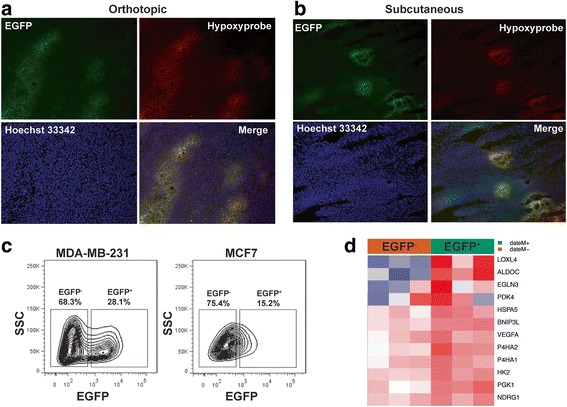
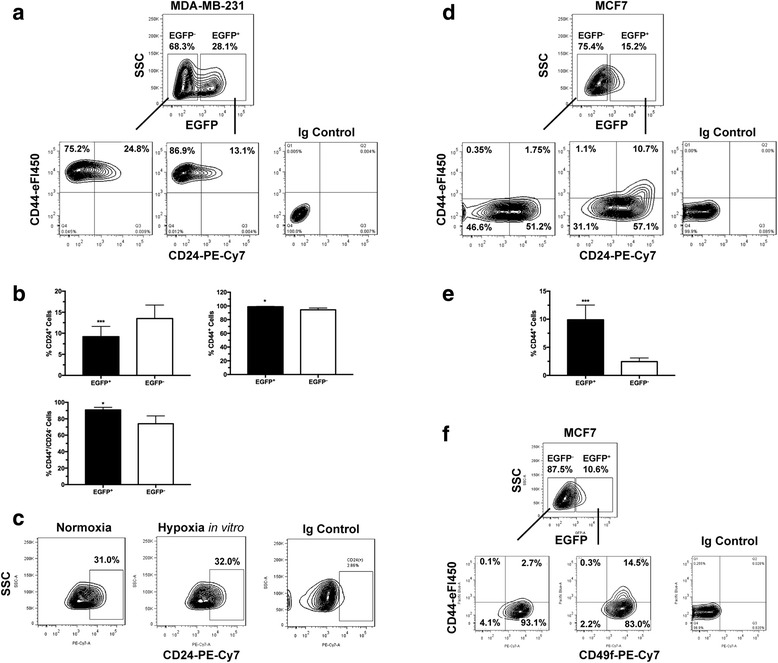
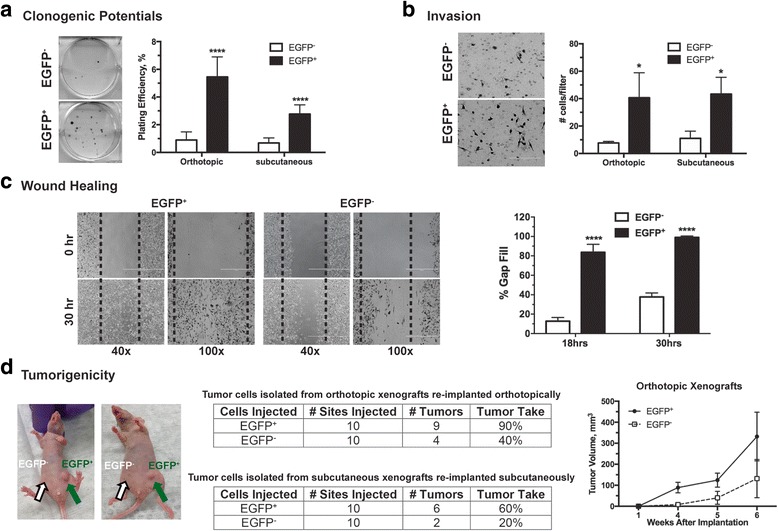
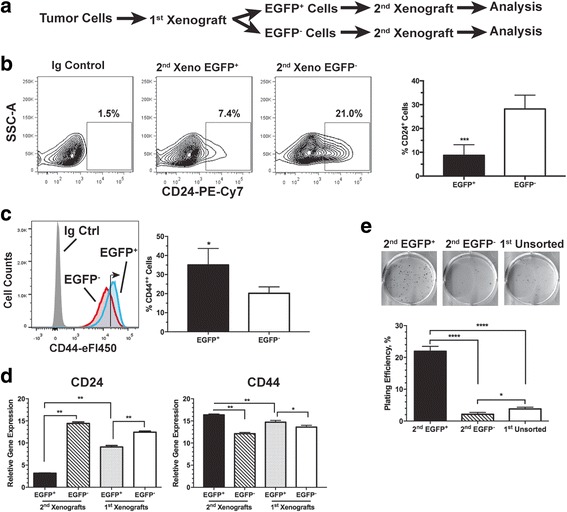
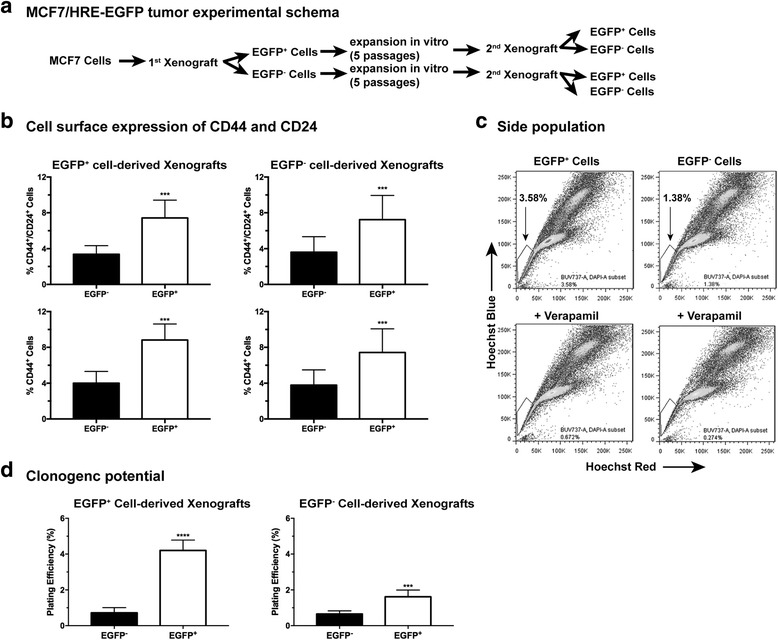
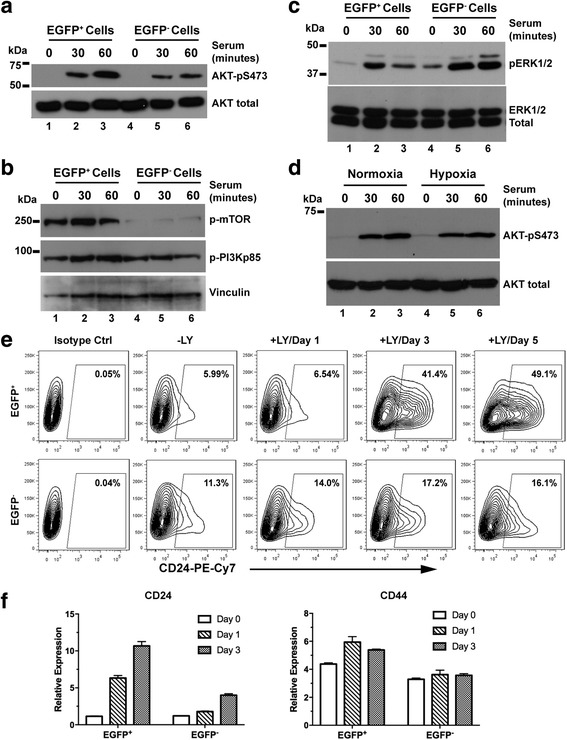
BACKGROUND: Tumor hypoxia is an independent prognostic factor associated with poor patient survival. Emerging evidence suggests that hypoxia can potentially maintain or enhance the stem cell phenotype of both normal stem cells and cancer cells. However, it remains to be determined whether cell fate is regulated in vivo by the hypoxic tumor microenvironment (TME). METHODS: We established a hypoxia-sensing xenograft model to identify hypoxic tumor cell in vivo primarily using human breast cancer cell lines MDA-MB-231 and MCF7. Hypoxic tumor cells were identified in situ by fluorescence of green fluorescence protein. They were further isolated from xenografts, purified and sorted by flow cytometry for detailed analysis of their stem cell characteristics. RESULTS: We have found that hypoxic tumor cells freshly isolated from xenografts contain increased subpopulations of tumor cells with cancer stem cell (CSC)-like characteristics. The CSC characteristics of the hypoxic tumor cells are further enhanced upon re-implantation in vivo, whereas secondary xenografts derived from the non-hypoxic tumor cells remain similar to the primary xenografts. Interestingly, the phenotypes exhibited by the hypoxic tumor cells are stable and remain distinctively different from those of the non-hypoxic tumor cells isolated from the same tumor mass even when they are maintained under the same ambient culture conditions. Mechanistically, the PI3K/AKT pathway is strongly potentiated in the hypoxic tumor cells and is required to maintain the CSC-like phenotype. Importantly, the differential cell fates between hypoxic and non-hypoxic tumor cells are only found in tumor cells isolated from the hypoxic TME in vivo and are not seen in tumor cells treated by hypoxia in vitro alone. CONCLUSIONS: These previously unknown observations suggest that the hypoxic TME may promote malignant progression and therapy resistance by coordinating induction, selection and/or preferential maintenance of the CSC-like phenotype in tumor cells.
Overview
The claims and statistics of this paper haven’t been checked yet.
Free: it reads the open-access text and checks the first 5 claims that cite a source we can check. Create a free account to check every claim.
Integrity signals
Registry
Cites
Statistics
Figures
Verification
Claims the paper makes
The claims and statistics of this paper haven’t been checked yet.
Free: it reads the open-access text and checks the first 5 claims that cite a source we can check. Create a free account to check every claim.
Claims other papers make about this one
Each is checked against this paper’s own text: does it say what the citing paper says it does?
The check wasn’t confident either way, so it gives no verdict — never disputed.
In the citing paper
“In addition, spheroids can also replicate cell–cell interactions,[ 45 ] growth kinetics,[ 46 ] and de novo ECM deposition of solid human tumors.[ 47 ]”
From 3D Biomimetic Models to Reconstitute Tumor Microenvironment In Vitro: Spheroids, Organoids, and Tumor‐on‐a‐Chip (2023) · cites this paper as [45]
Experimental — accuracy not yet measured
Self-check
Percentages, sums and reported differences re-computed from the paper’s own numbers.
The self-check needs the paper’s full text.
Citations
Cites
Stem cells, cancer, and cancer stem cells
Reya, T., Morrison, S. J., Clarke, M. F., & Weissman, I. L. (2001) · Nature · doi:10.1038/35102167 · Cited by 9,738
Cancer stem cells in solid tumours: accumulating evidence and unresolved questions
Visvader, J. E., & Lindeman, G. J. (2008) · Nature Reviews Cancer · doi:10.1038/nrc2499 · Cited by 3,429
Hypoxia in cancer: significance and impact on clinical outcome
Vaupel, P., & Mayer, A. (2007) · Cancer and Metastasis Reviews · doi:10.1007/s10555-007-9055-1 · Cited by 2,240
Evolution of the Cancer Stem Cell Model
Kreso, A., & Dick, J. E. (2014) · Cell Stem Cell · doi:10.1016/j.stem.2014.02.006 · Cited by 2,224
Höckel, M., Schlenger, K., Aral, B., Mitze, M., Schäffer, U., & Vaupel, P. W. (1996) · PubMed · Cited by 1,951
The Cancer Stem Cell Niche: How Essential Is the Niche in Regulating Stemness of Tumor Cells?
Plaks, V., Kong, N., & Werb, Z. (2015) · Cell Stem Cell · doi:10.1016/j.stem.2015.02.015 · Cited by 1,557
Oxygen in Stem Cell Biology: A Critical Component of the Stem Cell Niche
Mohyeldin, A., Garzón-Muvdi, T., & Quiñones-Hinojosa, A. (2010) · Cell Stem Cell · doi:10.1016/j.stem.2010.07.007 · Cited by 1,535
Hypoxia-inducible factors regulate tumorigenic capacity of glioma stem cells
Li, Z., Bao, S., Wu, Q., Wang, H., Eyler, C., Sathornsumetee, S., Shi, Q., Cao, Y., Lathia, J., McLendon, R. E., et al. (2009) · Cancer Cell · doi:10.1016/j.ccr.2009.03.018 · Cited by 1,354 · cited 1×
“protein levels are also found in the stemcell-like tumor cells in neuroblastomas [18, 19] or gliomas [20].”
Molecular Definition of Breast Tumor Heterogeneity
Shipitsin, M., Campbell, L. L., Argani, P., Weremowicz, S., Bloushtain-Qimron, N., Yao, J., Nikolskaya, T., Serebryiskaya, T., Beroukhim, R., Hu, M., et al. (2007) · Cancer Cell · doi:10.1016/j.ccr.2007.01.013 · Cited by 1,353
Yu, J. S. L., & Cui, W. (2016) · Development · doi:10.1242/dev.137075 · Cited by 1,135
Cited by
Items 101–135 of 135
Kai, K., Ishizuka, T., Matsumoto, J., Shimamawari, K., Mori, R., Fidya, Lkham-Erdene, B., Kubota, T., Ikenoue, M., Higuchi, K., et al. (2025) · ACTA HISTOCHEMICA ET CYTOCHEMICA · doi:10.1267/ahc.25-00002 · Cited by 2
Kołodziej, M., Czarny, J., Dyła, H., Rekawek, D., Zlotek, M., Wlodarz, A., Baranowicz, M., Kwiatkowska-Borowczyk, E. P., Milbrandt, O., Ramlau, R., et al. (2026) · International Journal of Molecular Sciences · doi:10.3390/ijms27031314 · Cited by 2
Cancer Stem Cells (CSCs) in Tumor Ecosystem
Saw, P. E., & Song, E. (2023) · Springer eBooks · doi:10.1007/978-981-99-1183-7_17 · Cited by 2
Lessons from the Embryo: an Unrejected Transplant and a Benign Tumor
Rezalotfi, A., Vrynas, A. V., Dehghanian, M., & Rezaei, N. (2020) · Stem Cell Reviews and Reports · doi:10.1007/s12015-020-10088-5 · Cited by 1
Cancer Stem Cells; More Cancer or Stem?
Karpenko, D. V. (2025) · Biocell · doi:10.32604/biocell.2025.062791 · Cited by 1
Sharma, N., Yadav, V., Sinha, S., Kumari, L., Sethi, A., Marcus, S., Singh, M., Kaur, S., Garg, N., Pathak, A., et al. (2026) · Molecular Aspects of Medicine · doi:10.1016/j.mam.2026.101486 · Cited by 1
Oxygen Delivery Microcapsules provide a Novel Strategy for the Treatment of Cancer
Sheng, J. (2021) · Current Trends in Biomedical Engineering & Biosciences · doi:10.19080/ctbeb.2021.20.556029 · Cited by 1
Mapping the Fate of Hypoxic Cells Using an Irreversible Fluorescent Switch
Weinstein, A. G., Gilkes, D. M., & Godet, I. (2024) · Methods in molecular biology · doi:10.1007/978-1-0716-3633-6_3 · Cited by 1
Cancer Stem Cell Plasticity – A Deadly DealPreprint
Archana, P. T., Kritika, S., Murali, R., Jolly, M. K., & Nair, R. (2019) · Preprints.org · doi:10.20944/preprints201912.0388.v1 · Cited by 1
Piecyk, M. (2023) · theses.fr (ABES) · doi:10.70675/719bdae4ze6aez4c21z8f31z59ac75ea38dd · Cited by 1
Günaydın, G., & Gedik, M. E. (2019) · Journal of Ankara University Faculty of Medicine · doi:10.4274/atfm.galenos.2019.40316
Induction and metastasis of cancer stem cells in pancreatic cancer
Nimmakayala, R. K. (2019) · DigitalCommons@UNMC
ELECTROSPUN NANOFIBER SCAFFOLDS AS A PLATFORM FOR BREAST CANCER RESEARCH
Que, C. (2020) · Digital Commons - Michigan Tech (Michigan Technological University) · doi:10.37099/mtu.dc.etdr/1000
Hanumantharao, S. N. (2020) · Digital Commons - Michigan Tech (Michigan Technological University) · doi:10.37099/mtu.dc.etdr/1088
Introduction to Tumor Microenvironment
Momtazmanesh, S., & Rezaei, N. (2023) · Springer eBooks · doi:10.1007/978-3-030-80962-1_82-1
Data from Hypoxia Promotes Breast Cancer Cell Growth by Activating a Glycogen Metabolic Program
Tang, K., Zhu, L., Chen, J., Wang, D., Zeng, L., Chen, C., Tang, L., Zhou, L., Wei, K., Zhou, Y., et al. (2023) · doi:10.1158/0008-5472.c.6513639
Drug Resistance Mechanism of Tri-ple-Negative Breast Cancer and Research Progress with DLG5
王, 旭. (2023) · Advances in Clinical Medicine · doi:10.12677/acm.2023.13112537
Introduction to Tumor Microenvironment
Momtazmanesh, S., & Rezaei, N. (2025) · Springer eBooks · doi:10.1007/978-3-032-00761-2_82
Development and Characterization of the Femur Window Chamber Model for Leukemia Research
Jin, J. (2021) · TSpace (University of Toronto)
Extracellular matrix proteins in hypoxia, 3D cancer spheroids as a model
Tamanna, I. (2022) · UTUPub (University of Turku)
Biological Considerations in Beam Selection for Particle Therapy Optimization
Ramesh, P. (2024) · eScholarship (California Digital Library)
Hahn, L. (2019) · ScholarWorks -A service of University of Vermont Libraries (University of Vermont)
Mechanical phenotyping of cancer stemness in colorectal cancer
Conti, S. (2023) · Dipòsit Digital de la Universitat de Barcelona (Universitat de Barcelona)
Čerepokaitė, K. (2026) · Lithuanian University of Health Sciences
Rôle de l'autophagie dans l'émergence des cellules souches cancéreuses : implication du métabolisme
El-Hout, M. (2019) · theses.fr (ABES) · doi:10.70675/881cf980z01caz4a56z8a81zdcebe1247536
Role of VDAC1 hypoxic form, VDAC1-∆C, in the expression of primary cilia and tumor progression
Fabbri, L. (2019) · theses.fr (ABES) · doi:10.70675/7a53239dzc652z4ea4z8b95z4a71961c83b4
Développement d’un système rapporteur de la plasticité des cellules cancéreuses du sein
Bidan, N. (2019) · theses.fr (ABES) · doi:10.70675/d709ae78ze281z45a7z9603z09cd3ad008c7
Rôle de la plasticité cellulaire radio-induite dans la radiorésistance des cancers du sein
Forissier, V. (2020) · theses.fr (ABES) · doi:10.70675/94b479dcz38e5z44c7z97b3z680c163e90a8
PRX5 as a Redox Regulator of STAT3 Signaling in Cancer Stem Cells
Choi, E.-H. (2026) · Biocell · doi:10.32604/biocell.2026.079386
The regulatory role of non-coding RNAs in taxane resistance of breast cancer
Sun, C., Lv, L., Xu, Q., Wu, S., Khan, F. A., Pandupuspitasari, N. S., Zhang, Y., & Huang, C. (2026) · Biochemical Pharmacology · doi:10.1016/j.bcp.2026.118371
Liu, H., Zhihao Wei, Yu Zhang, and, K. S., & Li, J. (2023) · doi:10.3389/fneur.2023.1188383.s005
Bhuyan, S., Pal, B., Pathak, L., Saikia, P. J., Mitra, S., Gayan, S., Mokhtari, R. B., Li, H., Ramana, C. V., Baishya, D., et al. (2022) · doi:10.3389/fimmu.2022.933329.s001
Metadata
- Authors
- Kim, H., Lin, Q., Glazer, P. M., & Yun, Z.
- Affiliations
- Yale University (US)
- Corresponding author
- Yun, Zhong
- Venue
- Breast Cancer Research
- Published
- 2018-03-06
- Volume
- 20
- Issue
- 1
- Pages
- 16-16
- ISSN
- 1465-5411 (ISSN-L)
- 1465-542X
- PMC
- PMC5840770
- OpenAlex
- W2789886906
- Semantic Scholar
- 91db641215d36ed7502c44e65dec787f8ecdfbc6
- Cited by
- 122
- References
- 68
- Citations by year
- 2026: 3 · 2025: 4 · 2024: 16 · 2023: 23 · 2022: 7 · 2021: 20 · 2020: 19 · 2019: 22 · 2018: 8
- FWCI
- 6.47
- Type
- journal article
- Language
- en
- Open access
- gold
- doi.org
- Licence
- cc-by
- creativecommons.org/licenses/by/4.0/ (tdm)
- creativecommons.org/licenses/by/4.0/ (vor)
- Locations
- Breast Cancer Research (publishedVersion, cc-by)
- Europe PMC (PubMed Central) (publishedVersion, cc-by)
- PubMed Central (publishedVersion, cc-by)
- PubMed (publishedVersion)
- DOAJ (DOAJ: Directory of Open Access Journals) (submittedVersion)
- Funders
- National Cancer Institute (R01 CA178254)
- CT Innovations (13-SCA-YALE-05)
- National Institutes of Health (R01 ES005775)
- Topics
- Health Sciences › Medicine › Oncology › Cancer Cells and Metastasis
- Life Sciences › Biochemistry, Genetics and Molecular Biology › Cancer Research › Cancer, Hypoxia, and Metabolism
- Life Sciences › Biochemistry, Genetics and Molecular Biology › Molecular Biology › Angiogenesis and VEGF in Cancer
- Keywords
- tumor hypoxia, hypoxic tumor microenvironment, cancer stem cells, breast cancer, PI3K/Akt signaling, xenograft models, treatment resistance, malignant progression
- MeSH terms
- Tumor Hypoxia, Animals, Breast Neoplasms, Cell Differentiation, Female, Humans, Neoplastic Stem Cells, Cell Lineage, Xenograft Model Antitumor Assays, Mice, Tumor Microenvironment, MCF-7 Cells
About these checks
Registry, retraction, Cites and statistics results are computed, not judged, with one exception: a printed reference that no index lists is read once by a model before it counts as a citation error. Claims are extracted by a model and kept only when their quote appears verbatim in the text; each cited source is then checked, with a model’s help, for whether it says what the claim relies on. Those verdicts can be wrong — read the claim’s quote and the cited source before relying on one.
Statistics and arithmetic are recomputed, not judged.
Confidence bands are shown only for fields calibrated on our annotated test set. None is calibrated yet, so no band is shown.
What counts as a claim ›How we measure confidence ›How we check this ›
Are you an author, or do you see a problem with this page? Request a review
Data sources
Bibliographic data: Semantic Scholar, OpenAlex, Crossref.
Contains information from the Semantic Scholar Academic Graph Datasets, made available under the ODC Attribution License (ODC-BY 1.0).
Semantic Scholar’s data is described in: Kinney, R., et al. (2023). The Semantic Scholar Open Data Platform. arXiv:2301.10140.
