

Temporal variability is a personalized feature of the human microbiome
Open accessThe DOI matches its Crossref record; 42 of the 42 references it cites were found in a registry or an index.
Abstract
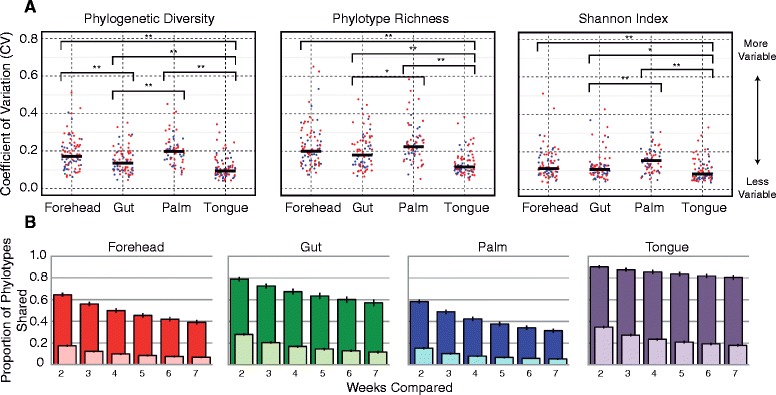
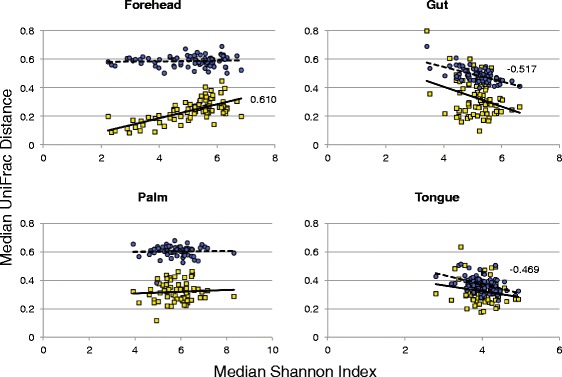
Background: It is now apparent that the complex microbial communities found on and in the human body vary across individuals. What has largely been missing from previous studies is an understanding of how these communities vary over time within individuals. To the extent to which it has been considered, it is often assumed that temporal variability is negligible for healthy adults. Here we address this gap in understanding by profiling the forehead, gut (fecal), palm, and tongue microbial communities in 85 adults, weekly over 3 months. Results: We found that skin (forehead and palm) varied most in the number of taxa present, whereas gut and tongue communities varied more in the relative abundances of taxa. Within each body habitat, there was a wide range of temporal variability across the study population, with some individuals harboring more variable communities than others. The best predictor of these differences in variability across individuals was microbial diversity; individuals with more diverse gut or tongue communities were more stable in composition than individuals with less diverse communities. Conclusions: Longitudinal sampling of a relatively large number of individuals allowed us to observe high levels of temporal variability in both diversity and community structure in all body habitats studied. These findings suggest that temporal dynamics may need to be considered when attempting to link changes in microbiome structure to changes in health status. Furthermore, our findings show that, not only is the composition of an individual’s microbiome highly personalized, but their degree of temporal variability is also a personalized feature.
Overview
The claims and statistics of this paper haven’t been checked yet.
Free: it reads the open-access text and checks the first 5 claims that cite a source we can check. Create a free account to check every claim.
Integrity signals
Registry
Cites
Statistics
Figures
Verification
Claims the paper makes
The claims and statistics of this paper haven’t been checked yet.
Free: it reads the open-access text and checks the first 5 claims that cite a source we can check. Create a free account to check every claim.
Claims other papers make about this one
Each is checked against this paper’s own text: does it say what the citing paper says it does?
The source backs part of the claim, not all of it — or backs it for a different population, condition or comparison.
In the citing paper
“Study of short-term longitudinal samplings from half the donors found that individuals are more similar to themselves over time compared with others (Costello et al., 2009; Flores et al., 2014; Mehta et al., 2018).”
From Gut microbiome stability and dynamics in healthy donors and patients with non-gastrointestinal cancers (2021) · cites this paper as Flores et al., 2014
Experimental — accuracy not yet measuredIn the citing paper
“while Bacteroidota was higher in donors with greater species stability over time (Fig. 6 D and Data S1, table 15; Flores et al., 2014).”
From Gut microbiome stability and dynamics in healthy donors and patients with non-gastrointestinal cancers (2021) · cites this paper as Flores et al., 2014
Self-check
Percentages, sums and reported differences re-computed from the paper’s own numbers.
The self-check needs the paper’s full text.
Citations
Cites
vegan: Community Ecology Package
Oksanen, J., Simpson, G. L., Blanchet, F. G., Kindt, R., Legendre, P., Minchin, P. R., O'Hara, R. B., Solymos, P., Stevens, M. H. H., Szoecs, E., et al. (2001) · CRAN: Contributed Packages · doi:10.32614/cran.package.vegan · Cited by 22,615
Search and clustering orders of magnitude faster than BLAST
Edgar, R. C. (2010) · Bioinformatics · doi:10.1093/bioinformatics/btq461 · Cited by 20,826
Non‐parametric multivariate analyses of changes in community structure
CLARKE, K. R. (1993) · Australian Journal of Ecology · doi:10.1111/j.1442-9993.1993.tb00438.x · Cited by 14,128 · cited 2×
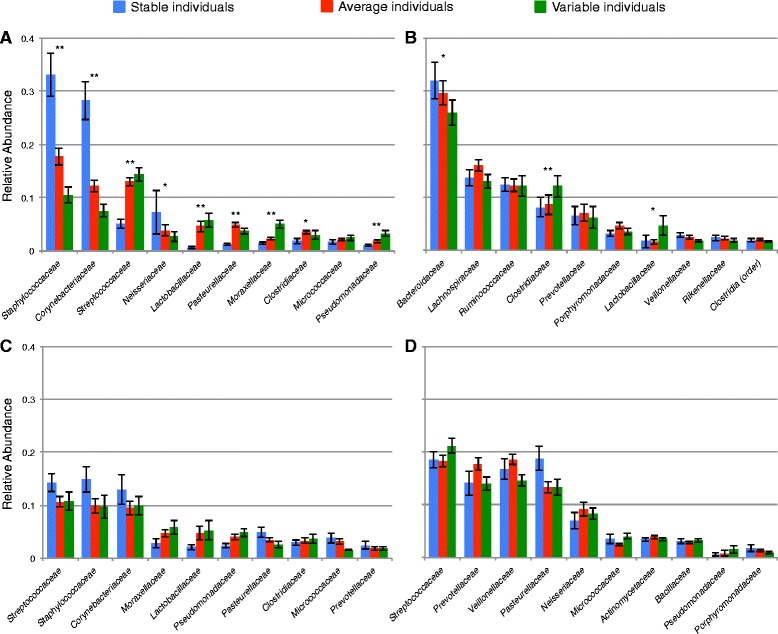
“To determine if certain taxa were more or less abundant in the different quartiles (that is, stability classes), we rank transformed the most abundant bacterial families (>1% across individuals) for each body habitat and tested for differences between the groups using the nonparametric Kruskal-Wallis analysis of varia…”
Structure, function and diversity of the healthy human microbiome
The Human Microbiome Project Consortium (2012) · Nature · doi:10.1038/nature11234 · Cited by 11,726 · cited 3×
“Previous studies that have characterized human associated microbial communities over time have been based on relatively few individuals [3,4], intermittent sampling intervals [2,5,6], single body habitats [4,7-10], or focused on disease states [11], leaving us with an incomplete picture of the range of normal variabil…”
Self-citationDiet rapidly and reproducibly alters the human gut microbiome
David, L. A., Maurice, C. F., Carmody, R. N., Gootenberg, D. B., Button, J. E., Wolfe, B. E., Ling, A. V., Devlin, A. S., Varma, Y., Fischbach, M. A., et al. (2014) · Nature · doi:10.1038/nature12820 · Cited by 10,100 · cited 1×
“Previous studies that have characterized human associated microbial communities over time have been based on relatively few individuals [3,4], intermittent sampling intervals [2,5,6], single body habitats [4,7-10], or focused on disease states [11], leaving us with an incomplete picture of the range of normal variabil…”
Ultra-high-throughput microbial community analysis on the Illumina HiSeq and MiSeq platforms
Caporaso, J. G., Lauber, C. L., Walters, W. A., Berg-Lyons, D., Huntley, J., Fierer, N., Owens, S. M., Betley, J., Fraser, L., Bauer, M., et al. (2012) · The ISME Journal · doi:10.1038/ismej.2012.8 · Cited by 8,839 · cited 3×
“DNA extraction and PCR amplification of the variable region 4 (V4) of the 16S rRNA gene using Illumina adapted universal primers 515 F/806R [12,30] was conducted using the direct PCR protocol as previously described [31].”
Self-citationHuman gut microbes associated with obesity
Ley, R. E., Turnbaugh, P. J., Klein, S., & Gordon, J. I. (2006) · Nature · doi:10.1038/4441022a · Cited by 8,785 · cited 1×
“A higher Firmicutes:Bacteriodetes ratio has been observed in guts of obese individuals [26,27], but we did not have enough diversity in body mass index (BMI) to formally test if temporal variability may also be associated with obesity.”
UniFrac: a New Phylogenetic Method for Comparing Microbial Communities
Lozupone, C., & Knight, R. (2005) · Applied and Environmental Microbiology · doi:10.1128/aem.71.12.8228-8235.2005 · Cited by 8,227 · cited 2×
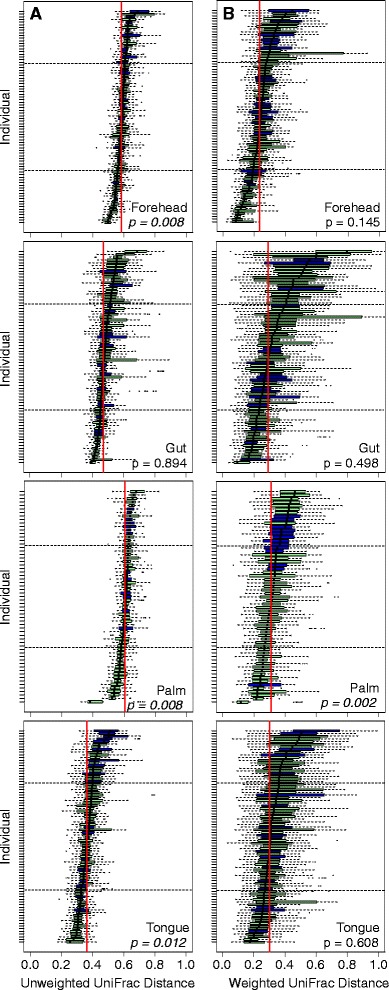
“A similar pattern was observed when we used median unweighted UniFrac values [16] (a phylogenetic metric of community membership) for each body habitat, where turnover was found to be greater for the skin than for the tongue and gut communities (Figure 2a and Additional file 5a).”
Self-citationMeasuring biological diversity
(2004) · Choice Reviews Online · doi:10.5860/choice.42-1547 · Cited by 6,621
Linking long-term dietary patterns with gut microbial enterotypes
Wu, G. D., Chen, J., Hoffmann, C., Bittinger, K., Chen, Y.-Y., Keilbaugh, S. A., Bewtra, M., Knights, D., Walters, W. A., Knight, R., et al. (2011) · Science · doi:10.1126/science.1208344 · Cited by 6,513 · cited 1×
“Previous studies that have characterized human associated microbial communities over time have been based on relatively few individuals [3,4], intermittent sampling intervals [2,5,6], single body habitats [4,7-10], or focused on disease states [11], leaving us with an incomplete picture of the range of normal variabil…”
Self-citation
Cited by
Items 301–400 of 461
Sammallahti, H., Rezasoltani, S., Pekkala, S., Kokkola, A., Aghdaei, H. A., Looha, M. A., Ghanbari, R., Zamani, F., Sadeghi, A., Sarhadi, V. K., et al. (2025) · Gut Pathogens · doi:10.1186/s13099-025-00698-0 · Cited by 10
“Typically, higher alpha diversity is associated with a healthy and stable microbiome due to increased microbial functional redundancy [59, 60], and lower alpha diversity has been linked to various medical conditions, including cancer [61–65].”
Tracking the functional meaning of the human oral-microbiome protein-protein interactions
Rosa, N. D. N., Campos, B., Esteves, A. C., Duarte, A. S., Correia, M. J., Silva, R. M., & Barros, M. (2020) · Advances in protein chemistry and structural biology · doi:10.1016/bs.apcsb.2019.11.014 · Cited by 9
Huang, L., Huang, H., Liang, X., Su, Q., Ye, L., Zhai, C., Huang, E., Pang, J., Zhong, X., Shi, M., et al. (2024) · Forensic Science International · doi:10.1016/j.forsciint.2024.112152 · Cited by 8
van den Munckhof, E. H. A., der Kolk, T. N., van der Wall, H. E. C., van Alewijk, D. C. J. G., van Doorn, M. B. A., Burggraaf, J., Buters, T. P., Becker, M., Feiss, G. L., Quint, W. G. V., et al. (2019) · Acta Dermato Venereologica · doi:10.2340/00015555-3373 · Cited by 8
The Human Gut Microbiota in all its States: From Disturbance to Resilience
Tap, J., Ruppé, É., & Derrien, M. (2021) · Elsevier eBooks · doi:10.1016/b978-0-12-819265-8.00039-5 · Cited by 9
Early-life and concurrent predictors of the healthy adolescent microbiome in a cohort study
Laue, H. E., Willis, A. D., Wang, F., MacDougall, M. C., Xu, Y. Y., Karagas, M. R., Madan, J. C., Fleisch, A. F., Lanphear, B. P., Cecil, K. M., et al. (2025) · Genome Medicine · doi:10.1186/s13073-025-01481-1 · Cited by 7
He, J., Lin, Z., Lin, X., Wang, C., Cao, M., Xia, R., & Hong, W. (2025) · Brain Behavior and Immunity · doi:10.1016/j.bbi.2025.106162 · Cited by 7
Bello, A. D., Scala, A., Gili, R., Falcicchia, R., Bassolino, A., Polidori, S., D’Auria, F., Tortora, G., Bossi, P., & Cassano, A. (2026) · Critical Reviews in Oncology/Hematology · doi:10.1016/j.critrevonc.2025.105108 · Cited by 7
Biogeographical Landscape of the Human Face Skin Microbiome Viewed in High Definition
Brandwein, M., Fuks, G., Israel, A., Hodak, E., Sabbah, F., Steinberg, D., Bentwich, Z., Shental, N., & Meshner, S. (2021) · Acta Dermato Venereologica · doi:10.2340/00015555-3929 · Cited by 7
Minnebo, Y., Paepe, K. D., Raes, J., & de Wiele, T. V. (2023) · FEMS Microbiology Ecology · doi:10.1093/femsec/fiad149 · Cited by 7
Rivera-Pérez, J. I., González, A. A., & Toranzos, G. A. (2017) · Microbiology Spectrum · doi:10.1128/microbiolspec.emf-0009-2016 · Cited by 8
“Microbial communities within holobionts are not stag-nant, and population shifts within these communities are common (30, 31).”
BackgroundSmith, C. J., Dethlefsen, L., Gardner, C. D., Nguyen, L. A. B., Feldman, M. W., Costello, E. K., Kolodny, O., & Relman, D. A. (2022) · mBio · doi:10.1128/mbio.01051-22 · Cited by 8
GePMI: A statistical model for personal intestinal microbiome identification
Wang, Z., Lou, H., Wang, Y., Shamir, R., Jiang, R., & Chen, T. (2018) · npj Biofilms and Microbiomes · doi:10.1038/s41522-018-0065-2 · Cited by 8
Identifying background microbiomes in an evidence recovery laboratory: A preliminary study
Neckovic, A., van Oorschot, R. A. H., Szkuta, B., & Durdle, A. (2021) · Science & Justice · doi:10.1016/j.scijus.2021.01.001 · Cited by 7
Shadoff, R., Panoyan, M. A., & Novroski, N. M. M. (2022) · Forensic Genomics · doi:10.1089/forensic.2022.0007 · Cited by 8
Clavel, T., Reitmeier, S., Hitch, T. C. A., Treichel, N. S., Fikas, N., Hausmann, B., Ramer‐Tait, A. E., Neuhaus, K., Berry, D., Haller, D., et al. (2020) · Research Square · doi:10.21203/rs.3.rs-117421/v1 · Cited by 8
Liu, K. Y. P., Huang, A., Pepin, C., Shen, Y., Tsang, P., & Poh, C. F.-Y. (2025) · Cancers · doi:10.3390/cancers18010145 · Cited by 7
“The oral cavity is also easily influenced by short-term behavioral and environmental factors; pre-collection protocols are therefore essential for minimizing variability [29,108,109].”
Yang, M., Schlatter, D., LeTourneau, M. K., Wen, S., Mavrodi, D. V., Mavrodi, O. V., Thomashow, L. S., Kandlati, E. N., Rajagopalan, K., Weller, D. M., et al. (2025) · Phytobiomes Journal · doi:10.1094/pbiomes-02-24-0028-r · Cited by 6
Overview on Multi-omics Research in Microbiome Analysis
Mathuria, A., Ali, N., Mani, I., & Singh, V. (2024) · Springer eBooks · doi:10.1007/978-981-97-1844-3_1 · Cited by 16
Explore variation of salivary bacteria across time and geolocations
Wang, S., Song, F., Song, M., Wei, X., Zhou, Y., Jiang, L., Wang, Z., Sun, C., Yao, H., Liang, W., et al. (2023) · International Journal of Legal Medicine · doi:10.1007/s00414-023-03045-7 · Cited by 6
“Nerveless, a previous study has observed greater changes in bacterial diversity over time on the skin surface than in the gut or oral cavity [24].”
Rolle des Mikrobioms bei chronischen Wunden
Daeschlein, G., Hinz, P., Kiefer, T., & Jünger, M. (2019) · Der Hautarzt · doi:10.1007/s00105-019-4425-5 · Cited by 6
Perspectives for Consideration in the Development of Microbial Cell Reference Materials
Allen‐Vercoe, E., Carmical, J. R., Forry, S. P., Gail, M. H., & Sinha, R. (2019) · Cancer Epidemiology Biomarkers & Prevention · doi:10.1158/1055-9965.epi-19-0557 · Cited by 7
BayesTime: Bayesian Functional Principal Components for Sparse Longitudinal DataPreprint
Jiang, L., Zhong, Y., Elrod, C., Natarajan, L., Knight, R. D., & Thompson, W. K. (2020) · arXiv (Cornell University) · doi:10.48550/arxiv.2012.00579 · Cited by 9
Self-citationZouiouich, S., Wan, Y., Vogtmann, E., Porras, C., Abnet, C. C., Shi, J., & Sinha, R. (2025) · Cancer Epidemiology Biomarkers & Prevention · doi:10.1158/1055-9965.epi-24-0839 · Cited by 5
Huang, L., Pu, Y.-T., Zhao, Y.-H., Sun, X.-Y., Zhu, Y., Lu, Y., Leng, H., Feng, J., Jin, L., & Sun, K. (2026) · npj Biofilms and Microbiomes · doi:10.1038/s41522-026-00930-y · Cited by 6
Markey, L., Pugliese, A., Tian, T., Roy, F., Lee, K., & Kumamoto, C. A. (2021) · mSphere · doi:10.1128/msphere.00982-20 · Cited by 6
Hobson, C. A., Vigué, L., Magnan, M., Chassaing, B., Naimi, S., Gachet, B., Claraz, P., Storme, T., Bonacorsi, S., Tenaillon, O., et al. (2022) · Frontiers in Cellular and Infection Microbiology · doi:10.3389/fcimb.2022.886447 · Cited by 5
Nouadi, B., Sbaoui, Y., Messal, M. E., Bennis, F., & Chegdani, F. (2020) · Bioinformatics and Biology Insights · doi:10.1177/1177932220906168 · Cited by 5
From Form to In-formation: A Spinozan Link between Deleuzian and Simondonian Ontologies
Sylvia, J. J. (2022) · Deleuze and Guattari Studies · doi:10.3366/dlgs.2022.0476 · Cited by 5
Wavelet clustering analysis as a tool for characterizing community structure in the human microbiome
Benincà, E., Pinto, S., Cazelles, B., Fuentes, S., Shetty, S. A., & Bogaards, J. A. (2023) · Scientific Reports · doi:10.1038/s41598-023-34713-8 · Cited by 8
“Unfortunately, only few of such datasets exists in human microbiome studies 26,30,50,51 .”
Liu, W., Chen, S., Yang, J., Chen, Y., Yang, Q., Lu, L., Li, J., Yang, T., Zhang, G., & Hu, J. (2025) · Microbial Pathogenesis · doi:10.1016/j.micpath.2025.107734 · Cited by 4
Cuthbertson, L., Hatfield, L. R., Gavillet, H., Hardman, M., Marsh, R., Rivett, D. W., & Gast, C. (2025) · Microbiome · doi:10.1186/s40168-025-02143-5 · Cited by 4
“CF lung microbiota have high interpatient variability and are highly personalized to the individual pwCF [9], expanding upon that spatial principle we found that temporal organization, as measured with STRs, is also a highly personalized feature of the CF lung micro-biome [17, 24].”
Lee, Y., Seo, J.-M., & Camillo, B. D. (2025) · Scientific Reports · doi:10.1038/s41598-025-24802-1 · Cited by 8
Verhaar, B. J. H., Bouwmeester, T. A., Galenkamp, H., van den Born, B. H., & Nieuwdorp, M. (2026) · npj Biofilms and Microbiomes · doi:10.1038/s41522-026-00952-6 · Cited by 7
Debiased high-dimensional regression calibration for errors-in-variables log-contrast models
Zhao, H., & Wang, T. (2024) · Biometrics · doi:10.1093/biomtc/ujae153 · Cited by 4
“In this section, we apply the proposed high-dimensional calibration method to a longitudinal microbiome study reported by Flores et al. (2014), which has also been studied for investigating the association between microbiome and traits (Shi et al., 2022).”
Impact of Data and Study Characteristics on Microbiome Volatility Estimates
Park, D. J., & Plantinga, A. (2023) · Genes · doi:10.3390/genes14010218 · Cited by 4
Forensic microbiology in built environments
Lax, S. M., & Gilbert, J. A. (2017) · Wiley eBooks · doi:10.1002/9781119062585.ch13 · Cited by 5
Influence of Vaginal Microbiota on Sexual and Reproductive Health: A Mini Review
Don, K. R., Padma, K. R., Chandana, B. V. S., Anjum, M. R., & Mohan, S. (2023) · Entomology and Applied Science Letters · doi:10.51847/pkk3odrur2 · Cited by 5
Microbiome Contributions to Health
Reynolds, T., Noorbakhsh, S., & Smith, R. N. (2023) · Surgical Infections · doi:10.1089/sur.2023.002 · Cited by 5
Park, Y. E., & Kim, J. H. (2023) · Kosin Medical Journal · doi:10.7180/kmj.23.115 · Cited by 5
Mild skin cleansers strengthen microbiome networks without affecting the skin microbiome
Cheviti, B., Cawley, A., Malviya, S., Murphy, B., Malhotra, G., Sivaram, T. K., Sethna, S., Ghatlia, N. D., Darling, K. A., Hawkins, S. S., et al. (2025) · British Journal of Dermatology · doi:10.1093/bjd/ljaf282 · Cited by 3
Decoding the gut microbiota-mitochondrial-inflammasome axis in cardiovascular disease
Chauhan, R., Lidoo, K., Jyoti, U., Singh, T. G., & Devi, S. (2025) · Molecular and Cellular Biochemistry · doi:10.1007/s11010-025-05451-4 · Cited by 3
Early-Life β-Lactam Exposure and the Developing Microbiome: Clinical Relevance and Controversies
Kundnani, N. R., Sharma, A., Levai, M. C., Marin-Bancila, L., Georgescu, D., Botaş, L., Chiriac, S. D., Valcovici, M. D., & Popa, M.-D. (2026) · Microorganisms · doi:10.3390/microorganisms14020440 · Cited by 4
“Early-life bacterial exchange can occur through contact with shared surfaces, household objects and the indoor air microbiome, reflecting the continuous microbe flow between humans and their surroundings [20].”
Fecal Microbiota Transplantation as Therapy for Inflammatory Bowel Disease
Schneider, A., & Maric, L. V. (2018) · Elsevier eBooks · doi:10.1016/b978-0-12-811388-2.00028-2 · Cited by 4
Pinoargote, G., & Ravishankar, S. (2018) · Journal of Probiotics & Health · doi:10.4172/2329-8901.1000191 · Cited by 4
A scoping review of longitudinal airway microbiota studies
Yin, T., Jeong, J. H., Hardcastle, T. F., Biswas, K., & Douglas, R. G. (2021) · Expert Review of Respiratory Medicine · doi:10.1080/17476348.2021.1924061 · Cited by 3
The interplay between anticancer challenges and the microbial communities from the gut
Hobson, C. A., Bonacorsi, S., Baruchel, A., Tenaillon, O., & Birgy, A. (2022) · European Journal of Clinical Microbiology & Infectious Diseases · doi:10.1007/s10096-022-04435-2 · Cited by 3
Alpha diversity metrics for noisy OTUsPreprint
Edgar, R. C., & Flyvbjerg, H. (2018) · bioRxiv (Cold Spring Harbor Laboratory) · doi:10.1101/434977 · Cited by 3
Schultz, A. A., Malecki, K. M. C., Holzhausen, E. A., Bajwa, P., Peppard, P. E., LeCaire, T. J., Eggers, S. I., Safdar, N., & Sethi, A. K. (2021) · medRxiv · doi:10.1101/2021.11.22.21266369 · Cited by 3
Moosavi, D., Curtis, K. R., Randolph, T. W., Kahsai, O. J., Ammar, H., Lim, U., Cheng, I. C., Wilkens, L. R., Marchand, L. L., Lampe, J. W., et al. (2025) · Cancer Epidemiology Biomarkers & Prevention · doi:10.1158/1055-9965.epi-24-1770 · Cited by 3
Skin microbiome and inflammatory dermatoses: A focused review
Wilkhoo, H. S., Islam, A. W., Hussain, S., Kadam, S., Rao, Z. K., & Singh, B. (2025) · Cosmoderma · doi:10.25259/csdm_99_2025 · Cited by 3
Gut Microbiome and Its Role in Enteric Infections with Microbial Pathogens
Galleher, C., van Megesen, K., Resnicow, A., Manning, J., Recalde, L., Hurtado, K., & Garcia, W. J. (2020) · Springer eBooks · doi:10.1007/978-3-030-47384-6_9 · Cited by 4
Kozhakhmetova, S., Bekbayeva, A., Zholdybayeva, E. V., Krivoruchko, T., Dashevskaya, N., Mukhanbetzhanova, Z., Vinogradova, E. B., Kushugulova, A. R., & Kozhakhmetov, S. (2024) · Current Research in Microbial Sciences · doi:10.1016/j.crmicr.2024.100294 · Cited by 2
“For instance, Flores et al. (2014) revealed that individual variability in microbiome-associated changes might surpass the significance of group treatment effects, emphasizing the need for more detailed analysis at the individual subject level (Flores et al., 2014).”
Clustering of the structures by using “snakes-&-dragons” approach, or correlation matrix as a signal
Andreev, V. P., Liu, G., Zee, J., Henn, L. L., Flores, G. E., & Merion, R. M. (2019) · PLoS ONE · doi:10.1371/journal.pone.0223267 · Cited by 2
Self-citationChávez-Elizalde, B. P., Barrera-Vázquez, O. S., & Carrillo-Vega, M. F. (2020) · Springer eBooks · doi:10.1007/978-3-030-40955-5_9 · Cited by 2
Gut microbiota: its development and relation to certain diseases
Sepová, H. K., Dudík, B., & Bilková, A. (2017) · Česká a slovenská farmacie · doi:10.36290/csf.2017.038 · Cited by 3
Oral Microbes: A Hidden Yet Powerful Evidence for Futuristic Forensic Investigation
Patel, B. C., & Soni, M. G. (2020) · Springer eBooks · doi:10.1007/978-981-15-6655-4_25 · Cited by 2
Omics for Forensic and Post-Mortem Microbiology
Fernández-Rodríguez, A., Gónzález‐Candelas, F., & Arora, N. (2021) · Springer eBooks · doi:10.1007/978-3-030-62155-1_12 · Cited by 2
Self-supervised Metric Learning in Multi-View Data: A Downstream Task Perspective
Wang, S. (2022) · Journal of the American Statistical Association · doi:10.1080/01621459.2022.2057317 · Cited by 6
Wang, H., Zhou, C., Shu-ping, G., & Sun, Y. W. (2023) · Frontiers in Microbiology · doi:10.3389/fmicb.2022.1050352 · Cited by 2
Czyz, S., Quan, J., Yang, K., Alhusayen, R. O., & Hardin, J. (2025) · Dermatology and Therapy · doi:10.1007/s13555-025-01619-4 · Cited by 1
“This may reflect broader trends in skin microbiome research where intra-individual variation tends to be less than inter-individual differences, partially due to environmental influences such as household and diet [65–67].”
Sub-community-level network analysis reveals distinct microbial dynamics in a lake littoral sediment
Tardy, V., Lyautey, É., & Frossard, V. (2025) · BMC Microbiology · doi:10.1186/s12866-025-04512-4 · Cited by 1
“Advances in high-throughput sequencing technologies have greatly facilitated time series studies across diverse environments, including aquatic [2–4] and terrestrial [5, 6] ecosystems as well as human the gut [7].”
Responses of skin and salivary microbiome to different environmental exposures
Yao, H., Sun, C., Jiang, L., Zhou, Y., Wang, X., Zhang, Z., Liu, B., Yang, Y., Wang, C., Zhou, C., et al. (2026) · International Journal of Legal Medicine · doi:10.1007/s00414-025-03710-z · Cited by 1
Tractenberg, R. E., Groah, S. L., Newcomb, E., Khemmani, M., Joyce, C., Wolfe, A. J., & Riegner, C. R. (2026) · PLoS ONE · doi:10.1371/journal.pone.0356391 · Cited by 1
“The use of single samples per individual amplifies these issues, preventing assessment of whether observed “differences” are stable, cyclical, or stochastic fluctuations within an individual’s normal range [14,15].”
Rojas, C. A., Smith, R., Oliver, R., Jospin, G., Corral, I., & Ganz, H. H. (2026) · Animal Microbiome · doi:10.1186/s42523-026-00546-9 · Cited by 1
“Previous studies conducted in humans reveal that individuals showcase high levels of temporal variability in both microbiome diversity and community structure across different body sites, including in oral, fecal, and skin microbiomes over short temporal scales (3 months) [9].”
Gut microbiome in sepsis: from dysbiotic biomarker to precision and palliative decision-making
Wang, L.-M., Chen, C., Danzheng, J., & Zhao, J. (2026) · Frontiers in Medicine · doi:10.3389/fmed.2026.1811304 · Cited by 2
Ni, Z., Xie, J., Zhang, Z., Zhang, K., Ding, J., Chang, M., Su, Y., Zhang, Y., Yao, M., Wang, C., et al. (2026) · iMeta · doi:10.1002/imt2.70148 · Cited by 2
Paulino, L. C. (2017) · Springer eBooks · doi:10.1007/978-3-319-59997-7_5 · Cited by 2
Biotransformation of toxic xenobiotics by human gut microbiota
Srivastava, A. K., Kumar, D., Singh, D. R., & Singh, R. K. (2022) · Elsevier eBooks · doi:10.1016/b978-0-323-90560-2.00013-3 · Cited by 1
Persistence of location-specific microbial signatures on boats during voyages
Schaerer, L. G., Ghannam, R. B., Olson, A., Camp, A. V., & Techtmann, S. M. (2023) · Marine Pollution Bulletin · doi:10.1016/j.marpolbul.2023.115884 · Cited by 1
Procedures for sampling of small and larger samples of microbiome
Adetunji, J. B., Michael, O. S., Adetunji, C. O., Ajayi, O. O., & Ogundolie, F. A. (2024) · Elsevier eBooks · doi:10.1016/b978-0-323-91190-0.00003-5 · Cited by 1
Park, J., Lemons, A. R., Croston, T. L., Roseman, J., Green, B. J., & Cox‐Ganser, J. M. (2025) · Building and Environment · doi:10.1016/j.buildenv.2025.112657 · Cited by 2
Khadka, S., Bowman, J. P., Gautam, S., Goldberg, L. R., King, A. E., Crocombe, L., & Bettiol, S. S. (2025) · Clinical and Experimental Dental Research · doi:10.1002/cre2.70212 · Cited by 1
“First, individual people have dynamic and different oral community structures (Flores et al. 2014; Nearing et al. 2020) that make it hard to overcome the variations inherent in a small cohort study.”
Characterization of Intestinal Microbiota in Healthy Adults and the Effect of Perturbations
Jalanka, J. (2014) · Helda - University of Helsinki Institutional Repository · Cited by 3
Casavant, E., Dethlefsen, L., Sankaran, K., Sprockett, D. D., Holmes, S., Relman, D. A., & Elias, J. E. (2019) · bioRxiv (Cold Spring Harbor Laboratory) · doi:10.1101/551143 · Cited by 1
Khafipour, A. (2017) · Mspace (University of Manitoba) · Cited by 3
Jenkins, T. P. (2019) · Apollo (University of Cambridge) · doi:10.17863/cam.44738 · Cited by 1
Commentary: Loss of Function Dysbiosis Associated with Antibiotics and High Fat, High Sugar Diet
Miller, A. W. (2019) · Journal of Infectiology · doi:10.29245/2689-9981/2019/3.1141 · Cited by 1
Impact of changing environments on the gut microbiome of a migratory songbirdPreprint
Skeen, H. R., Cooper, N. W., Hackett, S., Bates, J. M., & Marra, P. P. (2020) · Authorea · doi:10.22541/au.160253801.17639387/v1 · Cited by 1
High-resolution temporal profiling of the gut microbiome through the whole life of micePreprint
Takayasu, L., Watanabe, E., Umeyama, T., Kurokawa, R., Maskawa, R., Basu, S., Ogata, Y., Kiguchi, Y., Masuoka, H., Umezaki, M., et al. (2022) · bioRxiv (Cold Spring Harbor Laboratory) · doi:10.1101/2022.11.07.515511 · Cited by 2
Lee, C. Y. (2023) · Deep Blue (University of Michigan) · doi:10.7302/22267 · Cited by 2
Evolutionary Histories and Environments Shape Ugandan and Global Oral MicrobiomesPreprint
Ademola‐Popoola, I. J., Grogen, K. E., Abdul‐Aziz, M. A., Christine, K. T., Tang, K., Blekhman, R., Barreiro, L. B., Perry, G. H., & Weyrich, L. S. (2026) · bioRxiv (Cold Spring Harbor Laboratory) · doi:10.64898/2026.05.20.726600 · Cited by 1
“…Contreras, Noya-Alarcon, et al., 2015), several communities within Nepal (Ryu et al., 2024), and ‘industrialized’ people living within from the United States of America, Europe, and Australia (Flores et al., 2014; McDonald, Hyde, Debelius, Morton, Gunderson, et al., 2018; Ryu et al., 2024).”
InfluentialMehta, R. S. (2016) · Digital Access to Scholarship at Harvard (DASH) (Harvard University)
The development of a microbiome reference that spans thousands of individuals
McDonald, D. T. (2015) · CU Scholar (University of Colorado Boulder)
Insights into microbial ecosystems using a new computational approach
Do, T. (2016) · Oral Diseases · doi:10.1111/odi.12591
Microbiota profiling in gastrointestinal health and disease
Tedjo (2018) · Research Publications (Maastricht University) · doi:10.26481/dis.20180301dt
Urologic Applications of the Microbiota in Multiple Sclerosis
May, D. N., & Togami, J. M. (2018) · Current Bladder Dysfunction Reports · doi:10.1007/s11884-018-0461-8
Bacteriophage in host associated microbial communities examined with continuous culture systems
Dills, M. (2018) · Montana State University ScholarWorks (Montana State University)
Frankel‐Bricker, J. (2019) · ScholarWorks (Boise State University) · doi:10.18122/td/1522/boisestate
Development and dynamics of the normal gut microbiota
Olsson, L. M. (2020) · Gothenburg University Publications Electronic Archive (Gothenburg University)
Nutritional programming effects of probiotic lactobacilli on bone health in CD-1 Elite mice
Stinson, S. E. (2018) · TSpace (University of Toronto) · Cited by 1
APPLICATIONS OF MACHINE LEARNING IN MICROBIAL FORENSICS
Ghannam, R. B. (2021) · Digital Commons - Michigan Tech (Michigan Technological University) · doi:10.37099/mtu.dc.etdr/1196
Fernández, G., & Dary, L. (2021)
Hu, H. (2021) · Faculty Opinions – Post-Publication Peer Review of the Biomedical Literature · doi:10.3410/f.740019293.793585138
Jakubovics, N. S. (2019) · Elsevier eBooks · doi:10.1016/b978-0-12-801238-3.99216-x
Rivera-Pérez, J. I., González, A. A., & Toranzos, G. A. (2018) · ASM Press eBooks · doi:10.1128/9781555818852.ch3
Respiratory microbiome dysbiosis and temporal dynamics in individuals with asthma.Preprint
Megremis, S., Yap, C. F., Tapinos, A., Kritikou, M., Wardzyńska, A., Busby, J., Rovina, N., Chałubiński, M., Xepapadaki, P. V., Muldoon, M. R., et al. (2022) · Research Square · doi:10.21203/rs.3.rs-1580980/v1
Metadata
- Authors
- Flores, G. E., Caporaso, J. G., Henley, J. B., Rideout, J. R., Domogala, D., Chase, J., Leff, J. W., Vázquez-Baeza, Y., Gonzalez, A., Knight, R., Dunn, R. R., & Fierer, N.
- Affiliations
- California State University, Northridge (US)
- Northern Arizona University (US)
- Cooperative Institute for Research in Environmental Sciences (US)
- Howard Hughes Medical Institute (US)
- North Carolina State University (US)
- Corresponding author
- Flores, Gilberto E
- Fierer, Noah
- ORCID
- Venue
- Genome Biology
- Published
- 2014-12-03
- Volume
- 15
- Issue
- 12
- Pages
- 531-531
- ISSN
- 1465-6906 (ISSN-L)
- 1474-760X
- PMC
- PMC4252997
- OpenAlex
- W2167123129
- Semantic Scholar
- 40dc97fcb625a91529213aea54269160b0385fee
- Cited by
- 446
- References
- 42
- Citations by year
- 2026: 23 · 2025: 36 · 2024: 34 · 2023: 31 · 2022: 45 · 2021: 51 · 2020: 51 · 2019: 50 · 2018: 37 · 2017: 41 · 2016: 36 · 2015: 10 · 2014: 1
- FWCI
- 12.02
- Type
- journal article
- Language
- en
- Open access
- gold
- doi.org
- Licence
- cc-by
- creativecommons.org/licenses/by/4.0 (tdm)
- creativecommons.org/licenses/by/4.0 (vor)
- Locations
- Genome biology (publishedVersion, cc-by)
- Europe PMC (PubMed Central) (publishedVersion, cc-by)
- PubMed Central (publishedVersion, cc-by)
- PubMed (publishedVersion)
- eScholarship (California Digital Library) (submittedVersion)
- Funders
- Howard Hughes Medical Institute
- North Carolina State University
- Amazon Web Services
- National Institutes of Health
- Topics
- Life Sciences › Biochemistry, Genetics and Molecular Biology › Molecular Biology › Gut microbiota and health
- Physical Sciences › Environmental Science › Ecology › Microbial Community Ecology and Physiology
- Health Sciences › Dentistry › Periodontics › Oral microbiology and periodontitis research
- Keywords
- human microbiome, temporal variation, microbiome stability, interindividual variability, skin microbiome, gut microbiota, tongue microbiome, microbial diversity, community composition
- MeSH terms
- Adult, Bacteria, Feces, Female, Forehead, Hand, Humans, Longitudinal Studies, Male, Middle Aged, Phylogeny, Tongue, Genome, Bacterial, Genomics, Young Adult, Microbiota, Healthy Volunteers
About these checks
Registry, retraction, Cites and statistics results are computed, not judged, with one exception: a printed reference that no index lists is read once by a model before it counts as a citation error. Claims are extracted by a model and kept only when their quote appears verbatim in the text; each cited source is then checked, with a model’s help, for whether it says what the claim relies on. Those verdicts can be wrong — read the claim’s quote and the cited source before relying on one.
Statistics and arithmetic are recomputed, not judged.
Confidence bands are shown only for fields calibrated on our annotated test set. None is calibrated yet, so no band is shown.
What counts as a claim ›How we measure confidence ›How we check this ›
Are you an author, or do you see a problem with this page? Request a review
Data sources
Bibliographic data: Semantic Scholar, OpenAlex, Crossref.
Contains information from the Semantic Scholar Academic Graph Datasets, made available under the ODC Attribution License (ODC-BY 1.0).
Semantic Scholar’s data is described in: Kinney, R., et al. (2023). The Semantic Scholar Open Data Platform. arXiv:2301.10140.
