

Temporal variability is a personalized feature of the human microbiome
Open accessThe DOI matches its Crossref record; 42 of the 42 references it cites were found in a registry or an index.
Abstract
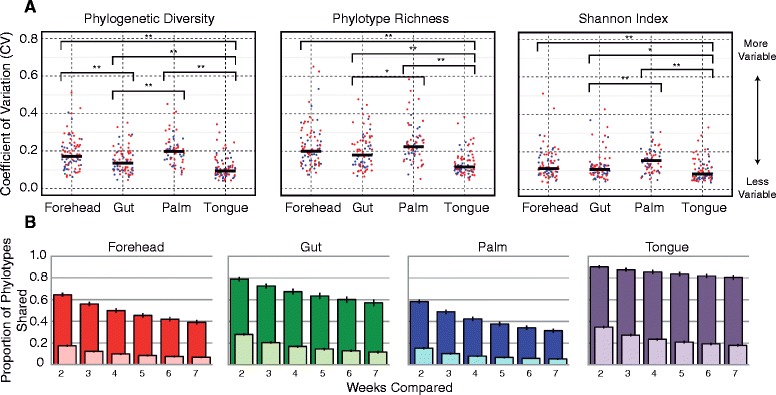
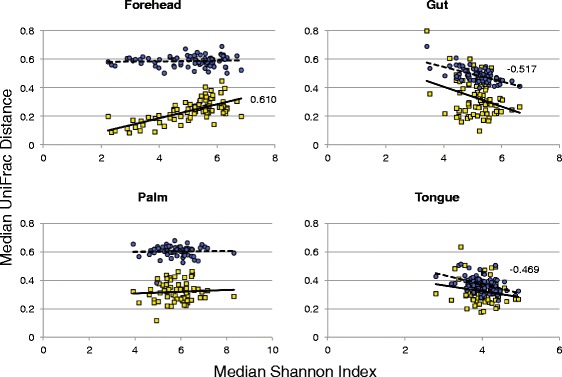
Background: It is now apparent that the complex microbial communities found on and in the human body vary across individuals. What has largely been missing from previous studies is an understanding of how these communities vary over time within individuals. To the extent to which it has been considered, it is often assumed that temporal variability is negligible for healthy adults. Here we address this gap in understanding by profiling the forehead, gut (fecal), palm, and tongue microbial communities in 85 adults, weekly over 3 months. Results: We found that skin (forehead and palm) varied most in the number of taxa present, whereas gut and tongue communities varied more in the relative abundances of taxa. Within each body habitat, there was a wide range of temporal variability across the study population, with some individuals harboring more variable communities than others. The best predictor of these differences in variability across individuals was microbial diversity; individuals with more diverse gut or tongue communities were more stable in composition than individuals with less diverse communities. Conclusions: Longitudinal sampling of a relatively large number of individuals allowed us to observe high levels of temporal variability in both diversity and community structure in all body habitats studied. These findings suggest that temporal dynamics may need to be considered when attempting to link changes in microbiome structure to changes in health status. Furthermore, our findings show that, not only is the composition of an individual’s microbiome highly personalized, but their degree of temporal variability is also a personalized feature.
Overview
The claims and statistics of this paper haven’t been checked yet.
Free: it reads the open-access text and checks the first 5 claims that cite a source we can check. Create a free account to check every claim.
Integrity signals
Registry
Cites
Statistics
Figures
Verification
Claims the paper makes
The claims and statistics of this paper haven’t been checked yet.
Free: it reads the open-access text and checks the first 5 claims that cite a source we can check. Create a free account to check every claim.
Claims other papers make about this one
Each is checked against this paper’s own text: does it say what the citing paper says it does?
The source backs part of the claim, not all of it — or backs it for a different population, condition or comparison.
In the citing paper
“Study of short-term longitudinal samplings from half the donors found that individuals are more similar to themselves over time compared with others (Costello et al., 2009; Flores et al., 2014; Mehta et al., 2018).”
From Gut microbiome stability and dynamics in healthy donors and patients with non-gastrointestinal cancers (2021) · cites this paper as Flores et al., 2014
Experimental — accuracy not yet measuredIn the citing paper
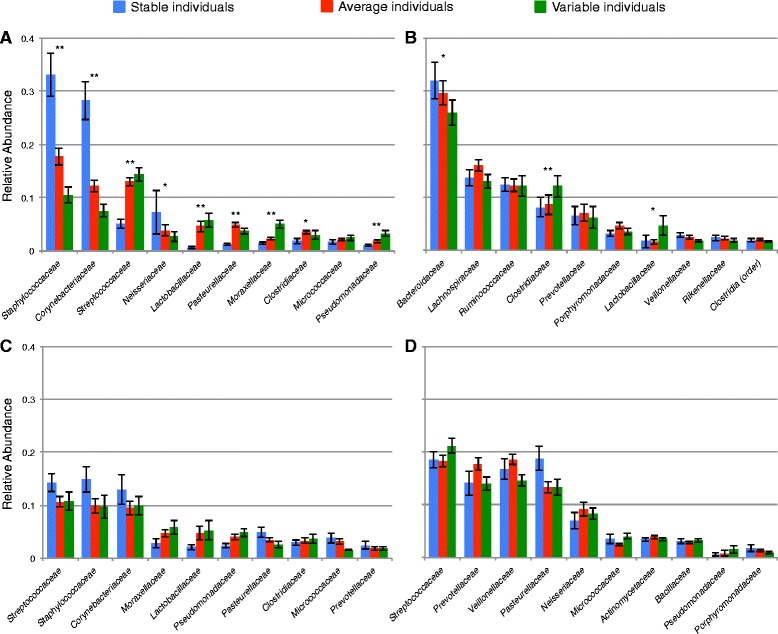
“while Bacteroidota was higher in donors with greater species stability over time (Fig. 6 D and Data S1, table 15; Flores et al., 2014).”
From Gut microbiome stability and dynamics in healthy donors and patients with non-gastrointestinal cancers (2021) · cites this paper as Flores et al., 2014
Self-check
Percentages, sums and reported differences re-computed from the paper’s own numbers.
The self-check needs the paper’s full text.
Citations
Cites
vegan: Community Ecology Package
Oksanen, J., Simpson, G. L., Blanchet, F. G., Kindt, R., Legendre, P., Minchin, P. R., O'Hara, R. B., Solymos, P., Stevens, M. H. H., Szoecs, E., et al. (2001) · CRAN: Contributed Packages · doi:10.32614/cran.package.vegan · Cited by 22,615
Search and clustering orders of magnitude faster than BLAST
Edgar, R. C. (2010) · Bioinformatics · doi:10.1093/bioinformatics/btq461 · Cited by 20,826
Non‐parametric multivariate analyses of changes in community structure
CLARKE, K. R. (1993) · Australian Journal of Ecology · doi:10.1111/j.1442-9993.1993.tb00438.x · Cited by 14,128 · cited 2×
“To determine if certain taxa were more or less abundant in the different quartiles (that is, stability classes), we rank transformed the most abundant bacterial families (>1% across individuals) for each body habitat and tested for differences between the groups using the nonparametric Kruskal-Wallis analysis of varia…”
Structure, function and diversity of the healthy human microbiome
The Human Microbiome Project Consortium (2012) · Nature · doi:10.1038/nature11234 · Cited by 11,726 · cited 3×
“Previous studies that have characterized human associated microbial communities over time have been based on relatively few individuals [3,4], intermittent sampling intervals [2,5,6], single body habitats [4,7-10], or focused on disease states [11], leaving us with an incomplete picture of the range of normal variabil…”
Self-citationDiet rapidly and reproducibly alters the human gut microbiome
David, L. A., Maurice, C. F., Carmody, R. N., Gootenberg, D. B., Button, J. E., Wolfe, B. E., Ling, A. V., Devlin, A. S., Varma, Y., Fischbach, M. A., et al. (2014) · Nature · doi:10.1038/nature12820 · Cited by 10,100 · cited 1×
“Previous studies that have characterized human associated microbial communities over time have been based on relatively few individuals [3,4], intermittent sampling intervals [2,5,6], single body habitats [4,7-10], or focused on disease states [11], leaving us with an incomplete picture of the range of normal variabil…”
Ultra-high-throughput microbial community analysis on the Illumina HiSeq and MiSeq platforms
Caporaso, J. G., Lauber, C. L., Walters, W. A., Berg-Lyons, D., Huntley, J., Fierer, N., Owens, S. M., Betley, J., Fraser, L., Bauer, M., et al. (2012) · The ISME Journal · doi:10.1038/ismej.2012.8 · Cited by 8,839 · cited 3×
“DNA extraction and PCR amplification of the variable region 4 (V4) of the 16S rRNA gene using Illumina adapted universal primers 515 F/806R [12,30] was conducted using the direct PCR protocol as previously described [31].”
Self-citationHuman gut microbes associated with obesity
Ley, R. E., Turnbaugh, P. J., Klein, S., & Gordon, J. I. (2006) · Nature · doi:10.1038/4441022a · Cited by 8,785 · cited 1×
“A higher Firmicutes:Bacteriodetes ratio has been observed in guts of obese individuals [26,27], but we did not have enough diversity in body mass index (BMI) to formally test if temporal variability may also be associated with obesity.”
UniFrac: a New Phylogenetic Method for Comparing Microbial Communities
Lozupone, C., & Knight, R. (2005) · Applied and Environmental Microbiology · doi:10.1128/aem.71.12.8228-8235.2005 · Cited by 8,227 · cited 2×
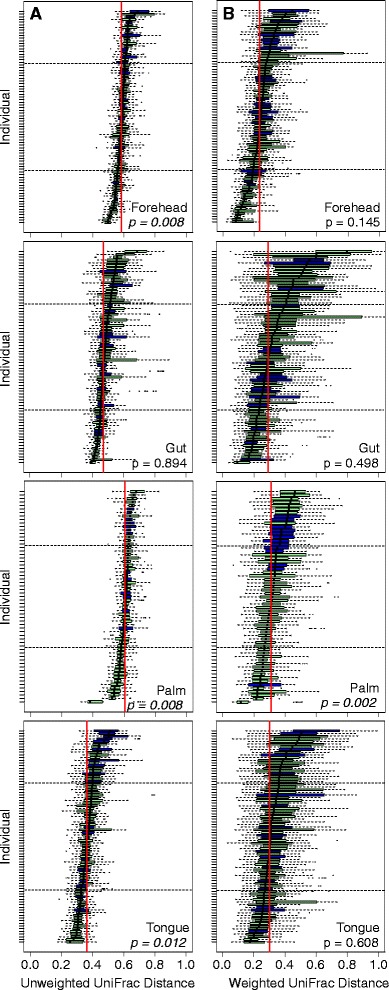
“A similar pattern was observed when we used median unweighted UniFrac values [16] (a phylogenetic metric of community membership) for each body habitat, where turnover was found to be greater for the skin than for the tongue and gut communities (Figure 2a and Additional file 5a).”
Self-citationMeasuring biological diversity
(2004) · Choice Reviews Online · doi:10.5860/choice.42-1547 · Cited by 6,621
Linking long-term dietary patterns with gut microbial enterotypes
Wu, G. D., Chen, J., Hoffmann, C., Bittinger, K., Chen, Y.-Y., Keilbaugh, S. A., Bewtra, M., Knights, D., Walters, W. A., Knight, R., et al. (2011) · Science · doi:10.1126/science.1208344 · Cited by 6,513 · cited 1×
“Previous studies that have characterized human associated microbial communities over time have been based on relatively few individuals [3,4], intermittent sampling intervals [2,5,6], single body habitats [4,7-10], or focused on disease states [11], leaving us with an incomplete picture of the range of normal variabil…”
Self-citationTurnbaugh, P. J., Ley, R. E., Hamady, M., Fraser-Liggett, C. M., Knight, R., & Gordon, J. I. (2007) · Nature · doi:10.1038/nature06244 · Cited by 6,091 · cited 1×
“Background The increasing recognition that commensal and mutualistic microorganisms are necessary for many aspects of normal human physiology has altered the traditional pathogendominated view of human-bacterial interactions [1,2].”
Self-citationMcDonald, D., Price, M. N., Goodrich, J., Nawrocki, E. P., DeSantis, T. Z., Probst, A., Andersen, G. L., Knight, R., & Hugenholtz, P. (2012) · The ISME Journal · doi:10.1038/ismej.2011.139 · Cited by 5,064 · cited 1×
“Sequences that passed quality filtering were clustered into phylotypes (Operational Taxonomic Units, OTUs) at 97% sequence identity using a uclust-based [33] closed-reference protocol against the 12_10 revision of the Greengenes database [34], where reads that did not match a sequence in the reference set at least 97%…”
Self-citationRichness of human gut microbiome correlates with metabolic markers
Le Chatelier, E., Nielsen, T., Qin, J., Prifti, E., Hildebrand, F., Falony, G., Almeida, M., Arumugam, M., Batto, J.-M., Kennedy, S., et al. (2013) · Nature · doi:10.1038/nature12506 · Cited by 4,662
Measuring Biological Diversity
REID, J. R. W. (2005) · Austral Ecology · doi:10.1111/j.1442-9993.2005.01502.x · Cited by 4,442
Quality-filtering vastly improves diversity estimates from Illumina amplicon sequencing
Bokulich, N. A., Subramanian, S., Faith, J. J., Gevers, D., Gordon, J. I., Knight, R., Mills, D. A., & Caporaso, J. G. (2013) · Nature Methods · doi:10.1038/nmeth.2276 · Cited by 4,401 · cited 1×
“Raw fastq data were demultiplexed and quality filtered as described previously [32].”
Self-citationVaginal microbiome of reproductive-age women
Ravel, J., Gajer, P., Abdo, Z., Schneider, G. M., Koenig, S. S. K., McCulle, S. L., Karlebach, S., Gorle, R., Russell, J., Tacket, C. O., et al. (2011) · Proceedings of the National Academy of Sciences · doi:10.1073/pnas.1002611107 · Cited by 4,254 · cited 1×
“Using median UniFrac values for each individual as our metric of temporal variability in community membership (unweighted) and structure (weighted), we found that individuals differed dramatically not only in the composition of their microbial communities (Additional file 6), as has been observed previously [2,5,17,18…”
Bacterial Community Variation in Human Body Habitats Across Space and Time
Costello, E. K., Lauber, C. L., Hamady, M., Fierer, N., Gordon, J. I., & Knight, R. (2009) · Science · doi:10.1126/science.1177486 · Cited by 3,231 · cited 4×
“Previous studies that have characterized human associated microbial communities over time have been based on relatively few individuals [3,4], intermittent sampling intervals [2,5,6], single body habitats [4,7-10], or focused on disease states [11], leaving us with an incomplete picture of the range of normal variabil…”
InfluentialSelf-citationTopographical and Temporal Diversity of the Human Skin Microbiome
Grice, E. A., Kong, H. H., Conlan, S., Deming, C. B., Davis, J., Young, A. C., Program, N. C. S., Bouffard, G. G., Blakesley, R. W., Murray, P. R., et al. (2009) · Science · doi:10.1126/science.1171700 · Cited by 2,953 · cited 1×
“Previous studies that have characterized human associated microbial communities over time have been based on relatively few individuals [3,4], intermittent sampling intervals [2,5,6], single body habitats [4,7-10], or focused on disease states [11], leaving us with an incomplete picture of the range of normal variabil…”
Dethlefsen, L., & Relman, D. A. (2011) · Proceedings of the National Academy of Sciences · doi:10.1073/pnas.1000087107 · Cited by 2,421 · cited 3×
“Previous studies that have characterized human associated microbial communities over time have been based on relatively few individuals [3,4], intermittent sampling intervals [2,5,6], single body habitats [4,7-10], or focused on disease states [11], leaving us with an incomplete picture of the range of normal variabil…”
Dethlefsen, L., Huse, S., Sogin, M. L., & Relman, D. A. (2008) · PLoS Biology · doi:10.1371/journal.pbio.0060280 · Cited by 2,361 · cited 1×
“Based on previous work [4,20], we expected that antibiotic usage would lead to profound shifts in the structure of an individual’s microbiome.”
Statistical computing: An introduction to data analysis using s-plus
(2003) · Computers & Mathematics with Applications · doi:10.1016/s0898-1221(03)80131-1 · Cited by 1,919
Model Based Inference in the Life Sciences: A Primer on Evidence
Anderson, D. R. (2008) · Springer eBooks · doi:10.1007/978-0-387-74075-1 · Cited by 1,841 · cited 1×
“Model simplification approaches have been criticized [39], but in the absence of strong a priori information on the drivers of variability of bacterial assemblages, this approach is a useful first step [40].”
Kong, H. H., Oh, J., Deming, C., Conlan, S., Grice, E. A., Beatson, M. A., Nomicos, E., Polley, E. C., Komarow, H. D., Program, N. C. S., et al. (2012) · Genome Research · doi:10.1101/gr.131029.111 · Cited by 1,808 · cited 1×
“Previous studies that have characterized human associated microbial communities over time have been based on relatively few individuals [3,4], intermittent sampling intervals [2,5,6], single body habitats [4,7-10], or focused on disease states [11], leaving us with an incomplete picture of the range of normal variabil…”
THE ECOLOGICAL CONSEQUENCES OF CHANGES IN BIODIVERSITY: A SEARCH FOR GENERAL PRINCIPLES101
Tilman, D. (1999) · Ecology · doi:10.1890/0012-9658(1999)080[1455:tecoci]2.0.co;2 · Cited by 1,746 · cited 1×
“invasions (that is, the portfolio effect) [22].”
Temporal Dynamics of the Human Vaginal Microbiota
Gajer, P., Brotman, R. M., Bai, G., Sakamoto, J., Schütte, U. M. E., Zhong, X., Koenig, S. S. K., Fu, L., Ma, Z. (., Zhou, X., et al. (2012) · Science Translational Medicine · doi:10.1126/scitranslmed.3003605 · Cited by 1,558 · cited 3×
“Previous studies that have characterized human associated microbial communities over time have been based on relatively few individuals [3,4], intermittent sampling intervals [2,5,6], single body habitats [4,7-10], or focused on disease states [11], leaving us with an incomplete picture of the range of normal variabil…”
Why do we still use stepwise modelling in ecology and behaviour?
WHITTINGHAM, M. J., STEPHENS, P. A., BRADBURY, R. B., & FRECKLETON, R. P. (2006) · Journal of Animal Ecology · doi:10.1111/j.1365-2656.2006.01141.x · Cited by 1,520 · cited 1×
“Model simplification approaches have been criticized [39], but in the absence of strong a priori information on the drivers of variability of bacterial assemblages, this approach is a useful first step [40].”
Examining the global distribution of dominant archaeal populations in soil
Bates, S. T., Berg-Lyons, D., Caporaso, J. G., Walters, W. A., Knight, R., & Fierer, N. (2011) · The ISME Journal · doi:10.1038/ismej.2010.171 · Cited by 1,322 · cited 2×
“DNA extraction and PCR amplification of the variable region 4 (V4) of the 16S rRNA gene using Illumina adapted universal primers 515 F/806R [12,30] was conducted using the direct PCR protocol as previously described [31].”
Self-citationGut Microbiomes of Malawian Twin Pairs Discordant for Kwashiorkor
Smith, M. I., Yatsunenko, T., Manary, M. J., Trehan, I., Mkakosya, R., Cheng, J., Kau, A. L., Rich, S. S., Concannon, P., Mychaleckyj, J. C., et al. (2013) · Science · doi:10.1126/science.1229000 · Cited by 1,173 · cited 1×
“It is now well established that there is considerable inter-individual variability in the composition of the human microbiome [5,18], leading to the concept of a ‘personal microbiome’ , and we are beginning to establish causal relationships between composition of the microbiome and disease [28].”
Self-citationMoving pictures of the human microbiome
Caporaso, J. G., Lauber, C. L., Costello, E. K., Berg-Lyons, D., Gonzalez, A., Stombaugh, J., Knights, D., Gajer, P., Ravel, J., Fierer, N., et al. (2011) · Genome Biology · doi:10.1186/gb-2011-12-5-r50 · Cited by 1,138 · cited 3×
“Previous studies that have characterized human associated microbial communities over time have been based on relatively few individuals [3,4], intermittent sampling intervals [2,5,6], single body habitats [4,7-10], or focused on disease states [11], leaving us with an incomplete picture of the range of normal variabil…”
Self-citationXenobiotics shape the physiology and gene expression of the active human gut microbiome
Maurice, C. F., Haiser, H. J., & Turnbaugh, P. J. (2013) · Cell · doi:10.1016/j.cell.2012.10.052 · Cited by 811 · cited 1×
“Our observation that antibiotic use was not associated with increased temporal variability in microbial communities across the study population could be due to the fact that we did not control for the timing of sampling relative to antibiotic use, dosage, or type of antibiotics used by the individuals sampled here, or…”
Statistical Computing: An Introduction to Data Analysis Using S-PLUS
Kushler, R. (2003) · Technometrics · doi:10.1198/tech.2003.s173 · Cited by 744 · cited 1×
“05) in a stepwise fashion [38], to explore the relative contributions of the various terms included in the start model.”
Forensic identification using skin bacterial communities
Fierer, N., Lauber, C. L., Zhou, N., McDonald, D., Costello, E. K., & Knight, R. (2010) · Proceedings of the National Academy of Sciences · doi:10.1073/pnas.1000162107 · Cited by 609 · cited 2×
“Using median UniFrac values for each individual as our metric of temporal variability in community membership (unweighted) and structure (weighted), we found that individuals differed dramatically not only in the composition of their microbial communities (Additional file 6), as has been observed previously [2,5,17,18…”
Self-citationDifferences in gut microbiota composition between obese and lean children: a cross-sectional study
Bervoets, L., Van Hoorenbeeck, K., Kortleven, I., Van Noten, C., Hens, N., Vael, C., Goossens, H., Desager, K. N., & Vankerckhoven, V. (2013) · Gut Pathogens · doi:10.1186/1757-4749-5-10 · Cited by 448
A meta-analysis of changes in bacterial and archaeal communities with time
Shade, A., Gregory Caporaso, J., Handelsman, J., Knight, R., & Fierer, N. (2013) · The ISME Journal · doi:10.1038/ismej.2013.54 · Cited by 399 · cited 1×
“Results and discussion To quantify the amount of temporal variability in diversity of each body habitat, we calculated the coefficient of variation (CV = standard deviation/mean) for three alpha diversity metrics (phylogenetic diversity, phylotype richness, and Shannon index [13]) for each individual [14].”
Self-citationEspejo, M. R. (2003) · Computational Statistics & Data Analysis · doi:10.5555/770729.770747 · Cited by 381
A comparison of the species–time relationship across ecosystems and taxonomic groups
P. White, E., B. Adler, P., K. Lauenroth, W., A. Gill, R., Greenberg, D., M. Kaufman, D., Rassweiler, A., A. Rusak, J., D. Smith, M., R. Steinbeck, J., et al. (2006) · Oikos · doi:10.1111/j.0030-1299.2006.14223.x · Cited by 220 · cited 1×
“Furthermore, relatively few individuals exhibited a significant timedecay relationship [19]; in general, samples collected closer together in time did not harbor more similar communities than those collected further apart in time (Additional file 10).”
Zarate, G., & Nader-Macias, M. E. (2006) · Letters in Applied Microbiology · doi:10.1111/j.1472-765x.2006.01934.x · Cited by 161 · cited 1×
“The trade-off between Staphylococcaceae and Lactobacillaceae is intriguing because several Lactobacillaceae species inhibit attachment of Staphylococcaceae to epithelial cells [24,25].”
Prince, T., McBain, A. J., & O’Neill, C. A. (2012) · Applied and Environmental Microbiology · doi:10.1128/aem.00595-12 · Cited by 142 · cited 1×
“The trade-off between Staphylococcaceae and Lactobacillaceae is intriguing because several Lactobacillaceae species inhibit attachment of Staphylococcaceae to epithelial cells [24,25].”
Fukami, T. (2004) · Population Ecology · doi:10.1007/s10144-004-0182-z · Cited by 126 · cited 2×
“Skin surfaces also hosted the most diverse communities we surveyed (Additional file 4), as theory would predict for open, exposed environments that have a larger species pool of potential colonizers [15].”
A Direct PCR Approach to Accelerate Analyses of Human-Associated Microbial Communities
Flores, G. E., Henley, J. B., & Fierer, N. (2012) · PLoS ONE · doi:10.1371/journal.pone.0044563 · Cited by 84 · cited 2×
“DNA extraction, PCR amplification, and sequencing DNA extraction and PCR amplification of the variable region 4 (V4) of the 16S rRNA gene using Illumina adapted universal primers 515 F/806R [12,30] was conducted using the direct PCR protocol as previously described [31].”
Self-citationSupervised classification of microbiota mitigates mislabeling errors
Knights, D., Kuczynski, J., Koren, O., Ley, R. E., Field, D., Knight, R., DeSantis, T. Z., & Kelley, S. T. (2011) · The ISME Journal · doi:10.1038/ismej.2010.148 · Cited by 56 · cited 2×
“Potentially mislabeled samples were detected using the random forest classification approach described previously [35].”
Self-citationThe temporal dynamics of bacterial communities across human anterior nares
Camarinha‐Silva, A., Jáuregui, R., Pieper, D. H., & Wos‐Oxley, M. L. (2012) · Environmental Microbiology Reports · doi:10.1111/j.1758-2229.2011.00313.x · Cited by 54
Cited by
Current understanding of the human microbiome
Gilbert, J. A., Blaser, M. J., Caporaso, J. G., Jansson, J. K., Lynch, S. V., & Knight, R. (2018) · Nature Medicine · doi:10.1038/nm.4517 · Cited by 2,609
Self-citationLloyd-Price, J., Abu-Ali, G., & Huttenhower, C. (2016) · Genome Medicine · doi:10.1186/s13073-016-0307-y · Cited by 1,891
Strains, functions and dynamics in the expanded Human Microbiome Project
Lloyd-Price, J., Mahurkar, A., Rahnavard, G., Crabtree, J., Orvis, J., Hall, A. B., Brady, A., Creasy, H. H., McCracken, C., Giglio, M. G., et al. (2017) · Nature · doi:10.1038/nature23889 · Cited by 1,267
Self-citationThe microbiome in early life: Implications for health outcomes
Tamburini, S., Shen, N., Wu, H. C., & Clemente, J. C. (2016) · Nature Medicine · doi:10.1038/nm.4142 · Cited by 1,213
Dynamics of the human gut microbiome in inflammatory bowel disease
Halfvarson, J., Brislawn, C. J., Lamendella, R., Vázquez-Baeza, Y., Walters, W. A., Bramer, L. M., D'Amato, M., Bonfiglio, F., McDonald, D., Gonzalez, A., et al. (2017) · Nature Microbiology · doi:10.1038/nmicrobiol.2017.4 · Cited by 1,204
Self-citation
Metadata
- Authors
- Flores, G. E., Caporaso, J. G., Henley, J. B., Rideout, J. R., Domogala, D., Chase, J., Leff, J. W., Vázquez-Baeza, Y., Gonzalez, A., Knight, R., Dunn, R. R., & Fierer, N.
- Affiliations
- California State University, Northridge (US)
- Northern Arizona University (US)
- Cooperative Institute for Research in Environmental Sciences (US)
- Howard Hughes Medical Institute (US)
- North Carolina State University (US)
- Corresponding author
- Flores, Gilberto E
- Fierer, Noah
- ORCID
- Venue
- Genome Biology
- Published
- 2014-12-03
- Volume
- 15
- Issue
- 12
- Pages
- 531-531
- ISSN
- 1465-6906 (ISSN-L)
- 1474-760X
- PMC
- PMC4252997
- OpenAlex
- W2167123129
- Cited by
- 446
- References
- 42
- Citations by year
- 2026: 23 · 2025: 36 · 2024: 34 · 2023: 31 · 2022: 45 · 2021: 51 · 2020: 51 · 2019: 50 · 2018: 37 · 2017: 41 · 2016: 36 · 2015: 10 · 2014: 1
- FWCI
- 12.02
- Type
- journal article
- Language
- en
- Open access
- gold
- doi.org
- Licence
- cc-by
- creativecommons.org/licenses/by/4.0 (tdm)
- creativecommons.org/licenses/by/4.0 (vor)
- Locations
- Genome biology (publishedVersion, cc-by)
- Europe PMC (PubMed Central) (publishedVersion, cc-by)
- PubMed Central (publishedVersion, cc-by)
- PubMed (publishedVersion)
- eScholarship (California Digital Library) (submittedVersion)
- Funders
- Howard Hughes Medical Institute
- North Carolina State University
- Amazon Web Services
- National Institutes of Health
- Topics
- Life Sciences › Biochemistry, Genetics and Molecular Biology › Molecular Biology › Gut microbiota and health
- Physical Sciences › Environmental Science › Ecology › Microbial Community Ecology and Physiology
- Health Sciences › Dentistry › Periodontics › Oral microbiology and periodontitis research
- Keywords
- human microbiome, temporal variation, microbiome stability, interindividual variability, skin microbiome, gut microbiota, tongue microbiome, microbial diversity, community composition
- MeSH terms
- Adult, Bacteria, Feces, Female, Forehead, Hand, Humans, Longitudinal Studies, Male, Middle Aged, Phylogeny, Tongue, Genome, Bacterial, Genomics, Young Adult, Microbiota, Healthy Volunteers
About these checks
Registry, retraction, Cites and statistics results are computed, not judged, with one exception: a printed reference that no index lists is read once by a model before it counts as a citation error. Claims are extracted by a model and kept only when their quote appears verbatim in the text; each cited source is then checked, with a model’s help, for whether it says what the claim relies on. Those verdicts can be wrong — read the claim’s quote and the cited source before relying on one.
Statistics and arithmetic are recomputed, not judged.
Confidence bands are shown only for fields calibrated on our annotated test set. None is calibrated yet, so no band is shown.
What counts as a claim ›How we measure confidence ›How we check this ›
Are you an author, or do you see a problem with this page? Request a review
Data sources
Bibliographic data: Semantic Scholar, OpenAlex, Crossref.
Contains information from the Semantic Scholar Academic Graph Datasets, made available under the ODC Attribution License (ODC-BY 1.0).
Semantic Scholar’s data is described in: Kinney, R., et al. (2023). The Semantic Scholar Open Data Platform. arXiv:2301.10140.
