

Temporal variability is a personalized feature of the human microbiome
Open accessThe DOI matches its Crossref record; 42 of the 42 references it cites were found in a registry or an index.
Abstract
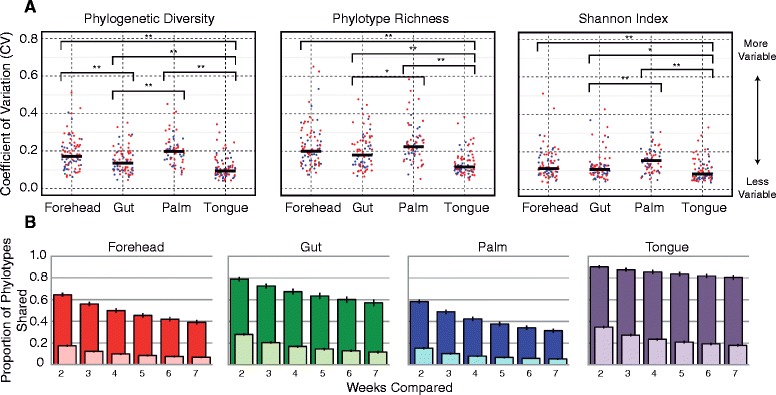
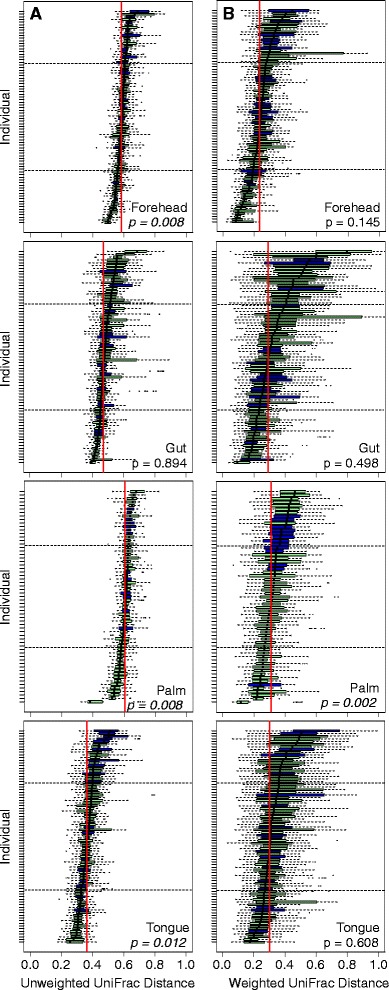
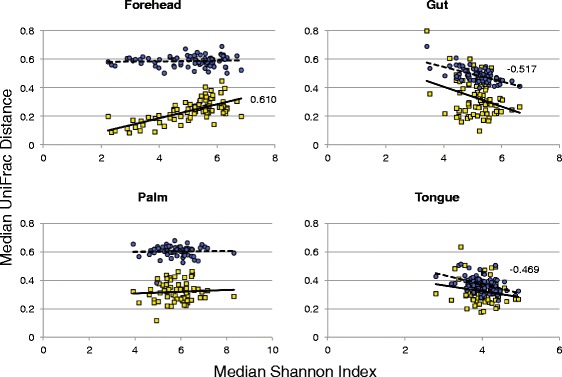
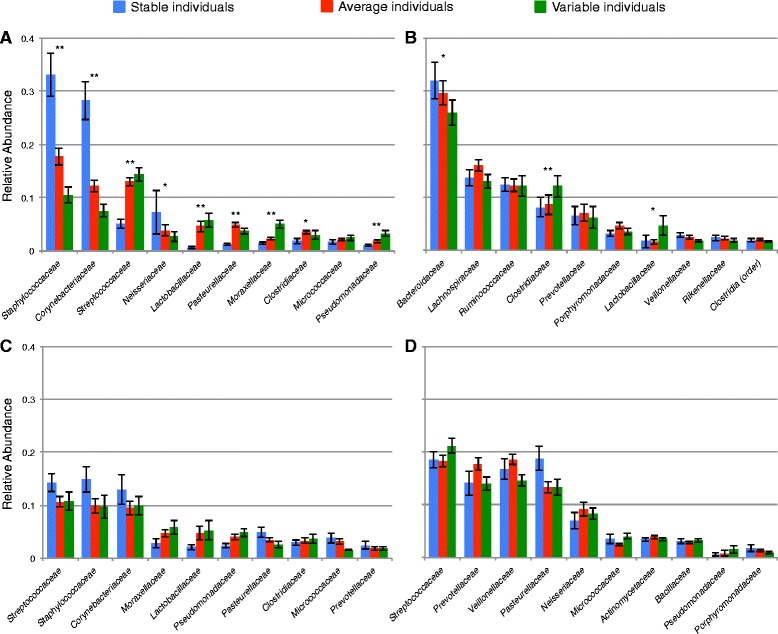
Background: It is now apparent that the complex microbial communities found on and in the human body vary across individuals. What has largely been missing from previous studies is an understanding of how these communities vary over time within individuals. To the extent to which it has been considered, it is often assumed that temporal variability is negligible for healthy adults. Here we address this gap in understanding by profiling the forehead, gut (fecal), palm, and tongue microbial communities in 85 adults, weekly over 3 months. Results: We found that skin (forehead and palm) varied most in the number of taxa present, whereas gut and tongue communities varied more in the relative abundances of taxa. Within each body habitat, there was a wide range of temporal variability across the study population, with some individuals harboring more variable communities than others. The best predictor of these differences in variability across individuals was microbial diversity; individuals with more diverse gut or tongue communities were more stable in composition than individuals with less diverse communities. Conclusions: Longitudinal sampling of a relatively large number of individuals allowed us to observe high levels of temporal variability in both diversity and community structure in all body habitats studied. These findings suggest that temporal dynamics may need to be considered when attempting to link changes in microbiome structure to changes in health status. Furthermore, our findings show that, not only is the composition of an individual’s microbiome highly personalized, but their degree of temporal variability is also a personalized feature.
Overview
The claims and statistics of this paper haven’t been checked yet.
Free: it reads the open-access text and checks the first 5 claims that cite a source we can check. Create a free account to check every claim.
Integrity signals
Registry
Cites
Statistics
Figures
Verification
Claims the paper makes
The claims and statistics of this paper haven’t been checked yet.
Free: it reads the open-access text and checks the first 5 claims that cite a source we can check. Create a free account to check every claim.
Claims other papers make about this one
Each is checked against this paper’s own text: does it say what the citing paper says it does?
The source backs part of the claim, not all of it — or backs it for a different population, condition or comparison.
In the citing paper
“Study of short-term longitudinal samplings from half the donors found that individuals are more similar to themselves over time compared with others (Costello et al., 2009; Flores et al., 2014; Mehta et al., 2018).”
From Gut microbiome stability and dynamics in healthy donors and patients with non-gastrointestinal cancers (2021) · cites this paper as Flores et al., 2014
Experimental — accuracy not yet measuredIn the citing paper
“while Bacteroidota was higher in donors with greater species stability over time (Fig. 6 D and Data S1, table 15; Flores et al., 2014).”
From Gut microbiome stability and dynamics in healthy donors and patients with non-gastrointestinal cancers (2021) · cites this paper as Flores et al., 2014
Self-check
Percentages, sums and reported differences re-computed from the paper’s own numbers.
The self-check needs the paper’s full text.
Citations
Cites
vegan: Community Ecology Package
Oksanen, J., Simpson, G. L., Blanchet, F. G., Kindt, R., Legendre, P., Minchin, P. R., O'Hara, R. B., Solymos, P., Stevens, M. H. H., Szoecs, E., et al. (2001) · CRAN: Contributed Packages · doi:10.32614/cran.package.vegan · Cited by 22,615
Search and clustering orders of magnitude faster than BLAST
Edgar, R. C. (2010) · Bioinformatics · doi:10.1093/bioinformatics/btq461 · Cited by 20,826
Non‐parametric multivariate analyses of changes in community structure
CLARKE, K. R. (1993) · Australian Journal of Ecology · doi:10.1111/j.1442-9993.1993.tb00438.x · Cited by 14,128 · cited 2×
“To determine if certain taxa were more or less abundant in the different quartiles (that is, stability classes), we rank transformed the most abundant bacterial families (>1% across individuals) for each body habitat and tested for differences between the groups using the nonparametric Kruskal-Wallis analysis of varia…”
Structure, function and diversity of the healthy human microbiome
The Human Microbiome Project Consortium (2012) · Nature · doi:10.1038/nature11234 · Cited by 11,726 · cited 3×
“Previous studies that have characterized human associated microbial communities over time have been based on relatively few individuals [3,4], intermittent sampling intervals [2,5,6], single body habitats [4,7-10], or focused on disease states [11], leaving us with an incomplete picture of the range of normal variabil…”
Self-citationDiet rapidly and reproducibly alters the human gut microbiome
David, L. A., Maurice, C. F., Carmody, R. N., Gootenberg, D. B., Button, J. E., Wolfe, B. E., Ling, A. V., Devlin, A. S., Varma, Y., Fischbach, M. A., et al. (2014) · Nature · doi:10.1038/nature12820 · Cited by 10,100 · cited 1×
“Previous studies that have characterized human associated microbial communities over time have been based on relatively few individuals [3,4], intermittent sampling intervals [2,5,6], single body habitats [4,7-10], or focused on disease states [11], leaving us with an incomplete picture of the range of normal variabil…”
Ultra-high-throughput microbial community analysis on the Illumina HiSeq and MiSeq platforms
Caporaso, J. G., Lauber, C. L., Walters, W. A., Berg-Lyons, D., Huntley, J., Fierer, N., Owens, S. M., Betley, J., Fraser, L., Bauer, M., et al. (2012) · The ISME Journal · doi:10.1038/ismej.2012.8 · Cited by 8,839 · cited 3×
“DNA extraction and PCR amplification of the variable region 4 (V4) of the 16S rRNA gene using Illumina adapted universal primers 515 F/806R [12,30] was conducted using the direct PCR protocol as previously described [31].”
Self-citationHuman gut microbes associated with obesity
Ley, R. E., Turnbaugh, P. J., Klein, S., & Gordon, J. I. (2006) · Nature · doi:10.1038/4441022a · Cited by 8,785 · cited 1×
“A higher Firmicutes:Bacteriodetes ratio has been observed in guts of obese individuals [26,27], but we did not have enough diversity in body mass index (BMI) to formally test if temporal variability may also be associated with obesity.”
UniFrac: a New Phylogenetic Method for Comparing Microbial Communities
Lozupone, C., & Knight, R. (2005) · Applied and Environmental Microbiology · doi:10.1128/aem.71.12.8228-8235.2005 · Cited by 8,227 · cited 2×
“A similar pattern was observed when we used median unweighted UniFrac values [16] (a phylogenetic metric of community membership) for each body habitat, where turnover was found to be greater for the skin than for the tongue and gut communities (Figure 2a and Additional file 5a).”
Self-citationMeasuring biological diversity
(2004) · Choice Reviews Online · doi:10.5860/choice.42-1547 · Cited by 6,621
Linking long-term dietary patterns with gut microbial enterotypes
Wu, G. D., Chen, J., Hoffmann, C., Bittinger, K., Chen, Y.-Y., Keilbaugh, S. A., Bewtra, M., Knights, D., Walters, W. A., Knight, R., et al. (2011) · Science · doi:10.1126/science.1208344 · Cited by 6,513 · cited 1×
“Previous studies that have characterized human associated microbial communities over time have been based on relatively few individuals [3,4], intermittent sampling intervals [2,5,6], single body habitats [4,7-10], or focused on disease states [11], leaving us with an incomplete picture of the range of normal variabil…”
Self-citation
Cited by
Current understanding of the human microbiome
Gilbert, J. A., Blaser, M. J., Caporaso, J. G., Jansson, J. K., Lynch, S. V., & Knight, R. (2018) · Nature Medicine · doi:10.1038/nm.4517 · Cited by 2,609
Self-citationLloyd-Price, J., Abu-Ali, G., & Huttenhower, C. (2016) · Genome Medicine · doi:10.1186/s13073-016-0307-y · Cited by 1,891
Strains, functions and dynamics in the expanded Human Microbiome Project
Lloyd-Price, J., Mahurkar, A., Rahnavard, G., Crabtree, J., Orvis, J., Hall, A. B., Brady, A., Creasy, H. H., McCracken, C., Giglio, M. G., et al. (2017) · Nature · doi:10.1038/nature23889 · Cited by 1,267
Self-citationThe microbiome in early life: Implications for health outcomes
Tamburini, S., Shen, N., Wu, H. C., & Clemente, J. C. (2016) · Nature Medicine · doi:10.1038/nm.4142 · Cited by 1,213
Dynamics of the human gut microbiome in inflammatory bowel disease
Halfvarson, J., Brislawn, C. J., Lamendella, R., Vázquez-Baeza, Y., Walters, W. A., Bramer, L. M., D'Amato, M., Bonfiglio, F., McDonald, D., Gonzalez, A., et al. (2017) · Nature Microbiology · doi:10.1038/nmicrobiol.2017.4 · Cited by 1,204
Self-citationTemporal Stability of the Human Skin Microbiome
Oh, J., Byrd, A. L., Park, M., Kong, H. H., & Segre, J. A. (2016) · Cell · doi:10.1016/j.cell.2016.04.008 · Cited by 1,036
“This suggested that while skin microbial communities overall exhibit site-specific trends in stability, stability itself may be largely an individual trait that has been observed previously in skin, gut, and vaginal communities (Flores et al., 2014; Gajer et al., 2012).”
American Gut: an Open Platform for Citizen-Science Microbiome Research
McDonalda, D., Hyde, E., Debelius, J. W., Morton, J. T., Gonzalez, A., Ackermann, G., Aksenov, A. A., Behsaz, B., Brennan, C., Chen, Y., et al. (2018) · doi:10.1101/277970 · Cited by 878
“128 Using a survey modified from (7, 8), participants reported general health status, disease 129 history, and lifestyle data (table S2, supplemental text).”
Self-citationSartor, R. B., & Wu, G. D. (2017) · Gastroenterology · doi:10.1053/j.gastro.2016.10.012 · Cited by 808
Human Gut Microbiome: Function Matters
Heintz-Buschart, A., & Wilmes, P. (2018) · Trends in Microbiology · doi:10.1016/j.tim.2017.11.002 · Cited by 740
Daily sampling reveals personalized diet-microbiome associations in humans
Johnson, A. J., Vangay, P., Al-Ghalith, G. A., Hillmann, B. M., Ward, T. L., Shields-Cutler, R. R., Kim, A. D., Shmagel, A. K., Syed, A. N., Walter, J., et al. (2019) · Cell Host & Microbe · doi:10.1016/j.chom.2019.05.005 · Cited by 742
Microbiome-wide association studies link dynamic microbial consortia to disease
Gilbert, J. A., Quinn, R. A., Debelius, J., Xu, Z. Z., Morton, J., Garg, N., Jansson, J. K., Dorrestein, P. C., & Knight, R. (2016) · Nature · doi:10.1038/nature18850 · Cited by 718
Self-citationThe Madness of Microbiome: Attempting To Find Consensus “Best Practice” for 16S Microbiome Studies
Pollock, J., Glendinning, L., Wisedchanwet, T., & Watson, M. (2018) · Applied and Environmental Microbiology · doi:10.1128/aem.02627-17 · Cited by 575
“the magnitude of inter-individual variation is very much dependant on sampling site (5), this 55 can have implications for experimental design, specifically when considering the number of 56”
BackgroundMitra, A., MacIntyre, D. A., Marchesi, J. R., Lee, Y. S., Bennett, P. R., & Kyrgiou, M. (2016) · Microbiome · doi:10.1186/s40168-016-0203-0 · Cited by 484
Species–function relationships shape ecological properties of the human gut microbiome
Vieira-Silva, S., Falony, G., Darzi, Y., Lima-Mendez, G., Garcia Yunta, R., Okuda, S., Vandeputte, D., Valles-Colomer, M., Hildebrand, F., Chaffron, S., et al. (2016) · Nature Microbiology · doi:10.1038/nmicrobiol.2016.88 · Cited by 483
Asnicar, F., Manara, S., Zolfo, M., Truong, D. T., Scholz, M., Armanini, F., Ferretti, P., Gorfer, V., Pedrotti, A., Tett, A., et al. (2017) · mSystems · doi:10.1128/msystems.00164-16 · Cited by 445
The human microbiome in evolution
Davenport, E. R., Sanders, J. G., Song, S. J., Amato, K. R., Clark, A. G., & Knight, R. (2017) · BMC Biology · doi:10.1186/s12915-017-0454-7 · Cited by 393
Self-citationThe dormant blood microbiome in chronic, inflammatory diseases
Potgieter, M., Bester, J., Kell, D. B., & Pretorius, E. (2015) · FEMS Microbiology Reviews · doi:10.1093/femsre/fuv013 · Cited by 383
Deciphering functional redundancy in the human microbiome
Tian, L., Wang, X.-W., Wu, A.-K., Fan, Y., Friedman, J., Dahlin, A., Waldor, M. K., Weinstock, G. M., Weiss, S. T., & Liu, Y.-Y. (2020) · Nature Communications · doi:10.1038/s41467-020-19940-1 · Cited by 380
d'Enfert, C., Kaune, A.-K., Alaban, L.-R., Chakraborty, S., Cole, N., Delavy, M., Kosmala, D., Marsaux, B., Fróis-Martins, R., Morelli, M., et al. (2021) · FEMS Microbiology Reviews · doi:10.1093/femsre/fuaa060 · Cited by 347
Gut microbiota in Parkinson's disease: Temporal stability and relations to disease progression
Aho, V. T. E., Pereira, P. A. B., Voutilainen, S., Paulin, L., Pekkonen, E., Auvinen, P., & Scheperjans, F. (2019) · eBioMedicine · doi:10.1016/j.ebiom.2019.05.064 · Cited by 361
Understanding the impact of antibiotic perturbation on the human microbiome
Schwartz, D. J., Langdon, A. E., & Dantas, G. (2020) · Genome Medicine · doi:10.1186/s13073-020-00782-x · Cited by 322
q2-longitudinal: Longitudinal and Paired-Sample Analyses of Microbiome Data
Bokulich, N. A., Dillon, M. R., Zhang, Y., Rideout, J. R., Bolyen, E., Li, H., Albert, P. S., & Caporaso, J. G. (2018) · mSystems · doi:10.1128/msystems.00219-18 · Cited by 319
Self-citationTemporal Stability in Chronic Wound Microbiota Is Associated With Poor Healing
Loesche, M., Gardner, S. E., Kalan, L., Horwinski, J., Zheng, Q., Hodkinson, B. P., Tyldsley, A. S., Franciscus, C. L., Hillis, S. L., Mehta, S., et al. (2017) · Journal of Investigative Dermatology · doi:10.1016/j.jid.2016.08.009 · Cited by 310
“Microbial communities exhibit a wide range of stabilities across the human body (Ding and Schloss, 2014; Flores et al., 2014); however, what these differing stabilities mean for the”
Di Paola, M., Sani, C., Clemente, A. M., Iossa, A., Perissi, E., Castronovo, G., Tanturli, M., Rivero, D., Cozzolino, F., Cavalieri, D., et al. (2017) · Scientific Reports · doi:10.1038/s41598-017-09842-6 · Cited by 304
Dzidic, M., Collado, M. C., Abrahamsson, T., Artacho, A., Stensson, M., Jenmalm, M. C., & Mira, A. (2018) · The ISME Journal · doi:10.1038/s41396-018-0204-z · Cited by 279
Stability of the human faecal microbiome in a cohort of adult men
Mehta, R. S., Abu-Ali, G. S., Drew, D. A., Lloyd-Price, J., Subramanian, A., Lochhead, P., Joshi, A. D., Ivey, K. L., Khalili, H., Brown, G. T., et al. (2018) · Nature Microbiology · doi:10.1038/s41564-017-0096-0 · Cited by 273
Universality of human microbial dynamics
Bashan, A., Gibson, T. E., Friedman, J., Carey, V. J., Weiss, S. T., Hohmann, E. L., & Liu, Y.-Y. (2016) · Nature · doi:10.1038/nature18301 · Cited by 270
“We used the four dissimilarity measures (rJSD, BC, YC and nSC) to calculate the DOC (using robust LOWESS)of gut microbiome samples from two studies: the HMP and SMP.”
InfluentialBeckmann, J. S., & Lew, D. (2016) · Genome Medicine · doi:10.1186/s13073-016-0388-7 · Cited by 258
“…our inherited genome is, but for a few exceptions, relatively static throughout life, our micro-biome is considerably more dynamic (for example, [64 – 66]) — its landscape changes and fluctuates in response to a number of intrinsic and external factors (such as disease, antibiotic therapy or…”
BackgroundShetty, S. A., Hugenholtz, F., Lahti, L., Smidt, H., & de Vos, W. M. (2017) · FEMS Microbiology Reviews · doi:10.1093/femsre/fuw045 · Cited by 255
The impact of skin care products on skin chemistry and microbiome dynamics
Bouslimani, A., da Silva, R., Kosciolek, T., Janssen, S., Callewaert, C., Amir, A., Dorrestein, K., Melnik, A. V., Zaramela, L. S., Kim, J.-N., et al. (2019) · BMC Biology · doi:10.1186/s12915-019-0660-6 · Cited by 234
Self-citationFungal-Bacterial Interactions in Health and Disease
Krüger, W., Vielreicher, S., Kapitan, M., Jacobsen, I., & Niemiec, M. (2019) · Pathogens · doi:10.3390/pathogens8020070 · Cited by 227
“On the contrary, other studies found that the oral bacteriome was variable and relative abundances could shift within periods as short as one day [126–128].”
Performing Skin Microbiome Research: A Method to the Madness
Kong, H. H., Andersson, B., Clavel, T., Common, J. E., Jackson, S. A., Olson, N. D., Segre, J. A., & Traidl-Hoffmann, C. (2017) · Journal of Investigative Dermatology · doi:10.1016/j.jid.2016.10.033 · Cited by 227
Hall, M. W., Singh, N., Ng, K. F., Lam, D. K., Goldberg, M. B., Tenenbaum, H. C., Neufeld, J. D., G. Beiko, R., & Senadheera, D. B. (2017) · npj Biofilms and Microbiomes · doi:10.1038/s41522-016-0011-0 · Cited by 226
On the Use of Diversity Measures in Longitudinal Sequencing Studies of Microbial Communities
Wagner, B. D., Grunwald, G. K., Zerbe, G. O., Mikulich-Gilbertson, S. K., Robertson, C. E., Zemanick, E. T., & Harris, J. K. (2018) · Frontiers in Microbiology · doi:10.3389/fmicb.2018.01037 · Cited by 195
Microbiomes of Site-Specific Dental Plaques from Children with Different Caries Status
Richards, V. P., Alvarez, A. J., Luce, A. R., Bedenbaugh, M., Mitchell, M. L., Burne, R. A., & Nascimento, M. M. (2017) · Infection and Immunity · doi:10.1128/iai.00106-17 · Cited by 201
Reproducible protocols for metagenomic analysis of human faecal phageomes
Shkoporov, A. N., Ryan, F. J., Draper, L. A., Forde, A., Stockdale, S. R., Daly, K. M., McDonnell, S. A., Nolan, J. A., Sutton, T. D. S., Dalmasso, M., et al. (2018) · Microbiome · doi:10.1186/s40168-018-0446-z · Cited by 200
“between individuals, but with a large degree of resilience and stability over time [5, 6].”
New Insights into the Intrinsic and Extrinsic Factors That Shape the Human Skin Microbiome
Dimitriu, P. A., Iker, B., Malik, K., Leung, H., Mohn, W. W., & Hillebrand, G. G. (2019) · mBio · doi:10.1128/mbio.00839-19 · Cited by 186
Dynamics of the normal gut microbiota: A longitudinal one-year population study in Sweden
Olsson, L. M., Boulund, F., Nilsson, S., Khan, M. T., Gummesson, A., Fagerberg, L., Engstrand, L., Perkins, R., Uhlén, M., Bergström, G., et al. (2022) · Cell Host & Microbe · doi:10.1016/j.chom.2022.03.002 · Cited by 194
Skin Microbiome in Atopic Dermatitis
Edslev, S., Agner, T., & Andersen, P. (2020) · Acta Dermato Venereologica · doi:10.2340/00015555-3514 · Cited by 173
Reitmeier, S., Hitch, T. C. A., Treichel, N., Fikas, N., Hausmann, B., Ramer-Tait, A. E., Neuhaus, K., Berry, D., Haller, D., Lagkouvardos, I., et al. (2021) · ISME Communications · doi:10.1038/s43705-021-00033-z · Cited by 174
Microbial Contribution to the Human Metabolome: Implications for Health and Disease
Van Treuren, W., & Dodd, D. (2020) · Annual Review of Pathology: Mechanisms of Disease · doi:10.1146/annurev-pathol-020117-043559 · Cited by 181
Signaling in Host-Associated Microbial Communities
Fischbach, M. A., & Segre, J. A. (2016) · Cell · doi:10.1016/j.cell.2016.02.037 · Cited by 172
Review of human hand microbiome research
Edmonds-Wilson, S. L., Nurinova, N. I., Zapka, C. A., Fierer, N., & Wilson, M. (2015) · Journal of Dermatological Science · doi:10.1016/j.jdermsci.2015.07.006 · Cited by 159
Self-citationZhou, X., Shen, X., Johnson, J. S., Spakowicz, D. J., Agnello, M., Zhou, W., Avina, M., Honkala, A., Chleilat, F., Chen, S. J., et al. (2024) · Cell Host & Microbe · doi:10.1016/j.chom.2024.02.012 · Cited by 167
Perez Perez, G. I., Gao, Z., Jourdain, R., Ramirez, J., Gany, F., Clavaud, C., Demaude, J., Breton, L., & Blaser, M. J. (2016) · PLOS ONE · doi:10.1371/journal.pone.0151990 · Cited by 165
Host microbiota can facilitate pathogen infection
Stevens, E. J., Bates, K. A., & King, K. C. (2021) · PLOS Pathogens · doi:10.1371/journal.ppat.1009514 · Cited by 161
Human Skin, Oral, and Gut Microbiomes Predict Chronological Age
Huang, S., Haiminen, N., Carrieri, A.-P., Hu, R., Jiang, L., Parida, L., Russell, B., Allaband, C., Zarrinpar, A., Vázquez-Baeza, Y., et al. (2020) · mSystems · doi:10.1128/msystems.00630-19 · Cited by 167
Self-citationTemporal patterns of rarity provide a more complete view of microbial diversity
Shade, A., & Gilbert, J. A. (2015) · Trends in Microbiology · doi:10.1016/j.tim.2015.01.007 · Cited by 161
Linear and nonlinear correlation estimators unveil undescribed taxa interactions in microbiome data
Huang, L., Eggesbø, M. Å., & Peddada, S. (2022) · Nature Communications · doi:10.1038/s41467-022-32243-x · Cited by 197
Auchtung, J. M., Robinson, C. D., & Britton, R. A. (2015) · Microbiome · doi:10.1186/s40168-015-0106-5 · Cited by 155
“had also reported success with a direct amplification approach for higher-throughput analysis of 16S rRNA gene content from microbial samples [38].”
BackgroundLeung, M. H. Y., Wilkins, D., & Lee, P. K. H. (2015) · Scientific Reports · doi:10.1038/srep11845 · Cited by 156
Modelling microbiome recovery after antibiotics using a stability landscape framework
Shaw, L. P., Bassam, H., Barnes, C. P., Walker, A. S., Klein, N., & Balloux, F. (2019) · The ISME Journal · doi:10.1038/s41396-019-0392-1 · Cited by 160
Longitudinal gut microbiome changes in immune checkpoint blockade-treated advanced melanoma
Björk, J. R., Bolte, L. A., Maltez Thomas, A., Lee, K. A., Rossi, N., Wind, T. T., Smit, L. M., Armanini, F., Asnicar, F., Blanco-Miguez, A., et al. (2024) · Nature Medicine · doi:10.1038/s41591-024-02803-3 · Cited by 156
Mukherjee, S., Mitra, R., Maitra, A., Gupta, S., Kumaran, S., Chakrabortty, A., & Majumder, P. P. (2016) · Scientific Reports · doi:10.1038/srep36062 · Cited by 153
Crosstalk between Vaginal Microbiome and Female Health: A review
Gupta, S., Kakkar, V., & Bhushan, I. (2019) · Microbial Pathogenesis · doi:10.1016/j.micpath.2019.103696 · Cited by 168
Wang, Z., Singh, R., Miller, B. E., Tal‐Singer, R., Horn, S. V., Tomsho, L., Mackay, A. J., Allinson, J. P., Webb, A. J., Brookes, A. J., et al. (2017) · Thorax · doi:10.1136/thoraxjnl-2017-210741 · Cited by 158
Skin microbiome modulation induced by probiotic solutions
Paetzold, B., Willis, J. R., Pereira de Lima, J., Knödlseder, N., Brüggemann, H., Quist, S. R., Gabaldón, T., & Güell, M. (2019) · Microbiome · doi:10.1186/s40168-019-0709-3 · Cited by 128
The Skin and Intestinal Microbiota and Their Specific Innate Immune Systems
Coates, M., Lee, M. J., Norton, D., & MacLeod, A. S. (2019) · Frontiers in Immunology · doi:10.3389/fimmu.2019.02950 · Cited by 131
Fecal Microbiota Analysis: An Overview of Sample Collection Methods and Sequencing Strategies
Thomas, V., Clark, J., & Doré, J. (2015) · Future Microbiology · doi:10.2217/fmb.15.87 · Cited by 123
Ceja-Navarro, J. A., Wang, Y., Ning, D., Arellano, A., Ramanculova, L., Yuan, M., Byer, A., Craven, K. D., Saha, M. C., Brodie, E., et al. (2021) · Microbiome · doi:10.1186/s40168-021-01042-9 · Cited by 147
Integrating the microbiome as a resource in the forensics toolkit
Clarke, T. H., Gomez, A. M., Singh, H., Nelson, K. E., & Brinkac, L. M. (2017) · Forensic Science International Genetics · doi:10.1016/j.fsigen.2017.06.008 · Cited by 151
Suskind, D. L., Lee, D. Y., Kim, Y., Wahbeh, G. T., Singh, N., Braly, K., Nuding, M. E., Nicora, C., Purvine, S. O., Lipton, M. S. W., et al. (2020) · Nutrients · doi:10.3390/nu12123749 · Cited by 141
Rethinking gut microbiome residency and the Enterobacteriaceae in healthy human adults
Martinson, J. N. V., Pinkham, N. V., Peters, G. W., Cho, H., Heng, J., Rauch, M., Broadaway, S. C., & Walk, S. T. (2019) · The ISME Journal · doi:10.1038/s41396-019-0435-7 · Cited by 148
“, 3 months) [8], use of alternative sequencing”
BackgroundTurroni, S., Rampelli, S., Biagi, E., Consolandi, C., Severgnini, M., Peano, C., Quercia, S., Soverini, M., Carbonero, F. G., Bianconi, G., et al. (2017) · Microbiome · doi:10.1186/s40168-017-0256-8 · Cited by 130
Sarker, S. A., Berger, B., Deng, Y., Kieser, S., Foata, F., Moine, D., Descombes, P., Sultana, S., Huq, S., Bardhan, P. K., et al. (2017) · Environmental Microbiology · doi:10.1111/1462-2920.13574 · Cited by 125
Carini, P., Delgado‐Baquerizo, M., Hinckley, E. S., Holland-Moritz, H. E., Brewer, T. E., Rue, G., Vanderburgh, C., McKnight, D. M., & Fierer, N. (2020) · mBio · doi:10.1128/mbio.02776-19 · Cited by 146
“The microbial communities found in the human gut (1), leaf litter (2), marine (3), and freshwater (4) habitats can exhibit a high degree of temporal variation.”
Self-citationGruninger, R. J., Ribeiro, G. O., Cameron, A., & McAllister, T. A. (2019) · animal · doi:10.1017/s1751731119000752 · Cited by 145
Sex-Specific Effects of Organophosphate Diazinon on the Gut Microbiome and Its Metabolic Functions
Gao, B., Bian, X., Mahbub, R., & Lu, K. (2017) · Environmental Health Perspectives · doi:10.1289/ehp202 · Cited by 125
“It is noteworthy that the composition and temporal variability of the human microbiome is actually highly personalized (Flores et al. 2014).”
Grice, E. A. (2015) · Genome Research · doi:10.1101/gr.191320.115 · Cited by 122
“In light of temporal variability being a personalized feature of the humanmicrobiome and the observation that the skinmicrobiome varies themost over time compared with other body habitats (Flores et al. 2014), the ideal clinical study design would incorporate longitudinal sampling to”
BackgroundRichness and ecosystem development across faecal snapshots of the gut microbiota
Falony, G., Vieira‐Silva, S., & Raes, J. (2018) · Nature Microbiology · doi:10.1038/s41564-018-0143-5 · Cited by 132
Shoskes, D. A., Wang, H., Polackwich, A. S., Tucky, B. H., Altemus, J. B., & Eng, C. (2016) · The Journal of Urology · doi:10.1016/j.juro.2016.02.2959 · Cited by 132
Characterization of oral and gut microbiome temporal variability in hospitalized cancer patients
Galloway-Peña, J. R., Smith, D. P., Sahasrabhojane, P., Wadsworth, W. D., Fellman, B. M., Ajami, N. J., Shpall, E. J., Daver, N., Guindani, M., Petrosino, J. F., et al. (2017) · Genome Medicine · doi:10.1186/s13073-017-0409-1 · Cited by 112
Tsunoda, S. M., Gonzales, C., Jarmusch, A. K., Momper, J. D., & JOSEPH, D. R. (2021) · Clinical Pharmacokinetics · doi:10.1007/s40262-021-01032-y · Cited by 129
Weinstein, S. B., Martínez‐Mota, R., Stapleton, T. E., Klure, D. M., Greenhalgh, R., Orr, T. J., Dale, C., Kohl, K. D., & Dearing, M. D. (2021) · Proceedings of the National Academy of Sciences · doi:10.1073/pnas.2108787118 · Cited by 121
The oral cavity microbiota: between health, oral disease, and cancers of the aerodigestive tract
Bars, P. L., Matamoros, S., Montassier, E., Vacon, F. L., Potel, G., Soueidan, A., Jordana, F., & de la Cochetière, M.-F. (2017) · Canadian Journal of Microbiology · doi:10.1139/cjm-2016-0603 · Cited by 121
Zaura, E., Pappalardo, V. Y., Buijs, M. J., Volgenant, C. M. C., & Brandt, B. W. (2020) · Periodontology 2000 · doi:10.1111/prd.12359 · Cited by 129
Gut microbiome of treatment-naïve MS patients of different ethnicities early in disease course
Ventura, R. E., Iizumi, T., Battaglia, T., Liu, M., Perez-Perez, G. I., Herbert, J., & Blaser, M. J. (2019) · Scientific Reports · doi:10.1038/s41598-019-52894-z · Cited by 105
Effects of ursodeoxycholic acid on the gut microbiome and colorectal adenoma development
Pearson, T., Caporaso, J. G., Yellowhair, M., Bokulich, N. A., Padi, M., Roe, D. J., Wertheim, B. C., Linhart, M., Martinez, J. A., Bilagody, C., et al. (2019) · Cancer Medicine · doi:10.1002/cam4.1965 · Cited by 105
Self-citationMicrobiome-based body fluid identification of samples exposed to indoor conditions
Dobay, A., Haas, C., Fucile, G., Downey, N., Morrison, H. G., Kratzer, A., & Arora, N. (2019) · Forensic Science International Genetics · doi:10.1016/j.fsigen.2019.02.010 · Cited by 108
Ng, Q. X., Lim, Y. L., Yaow, C. Y. L., Ng, W., Thumboo, J., & Liew, T. M. (2023) · Nutrients · doi:10.3390/nu15061351 · Cited by 110
Bringing the Dynamic Microbiome to Life with Animations
Vázquez‐Baeza, Y., Gonzalez, A., Smarr, L. L., McDonald, D. T., Morton, J. T., Navas-Molina, J. A., & Knight, R. D. (2017) · Cell Host & Microbe · doi:10.1016/j.chom.2016.12.009 · Cited by 110
Self-citationJones, J. C., Reinke, S. N., Alishum, A., Palmer, D. J., & Christophersen, C. T. (2021) · Scientific Reports · doi:10.1038/s41598-021-93031-z · Cited by 104
Individuality, Stability, and Variability of the Plaque Microbiome
Utter, D. R., Mark Welch, J. L., & Borisy, G. G. (2016) · Frontiers in Microbiology · doi:10.3389/fmicb.2016.00564 · Cited by 93
Interactions Between Food and Gut Microbiota: Impact on Human Health
Wu, Y., Wan, J., Choe, U., Pham, Q., Schoene, N. W., He, Q., Li, B., Yu, L. L., & Wang, T. T. Y. (2019) · Annual Review of Food Science and Technology · doi:10.1146/annurev-food-032818-121303 · Cited by 103
Kirmiz, N., Galindo, K., Cross, K. L., Luna, E., Rhoades, N., Podar, M., & Flores, G. E. (2020) · Applied and Environmental Microbiology · doi:10.1128/aem.02117-19 · Cited by 94
Self-citationMicrobial burden and viral exacerbations in a longitudinal multicenter COPD cohort
Bouquet, J., Tabor, D. E., Silver, J. S., Nair, V., Tovchigrechko, A., Griffin, M. P., Esser, M. T., Sellman, B. R., & Jin, H. (2020) · Respiratory Research · doi:10.1186/s12931-020-01340-0 · Cited by 105
Nguyen, T. T., Kosciolek, T., Daly, R. E., Vázquez-Baeza, Y., Swafford, A., Knight, R., & Jeste, D. V. (2021) · Brain, Behavior, and Immunity · doi:10.1016/j.bbi.2020.10.003 · Cited by 83
Self-citationMining, analyzing, and integrating viral signals from metagenomic data
Zheng, T., Li, J., Ni, Y., Kang, K., Misiakou, M.-A., Imamovic, L., Chow, B., Rode, A. A., Bytzer, P. M., Sommer, M. O. A., et al. (2019) · Microbiome · doi:10.1186/s40168-019-0657-y · Cited by 96
An association between chronic widespread pain and the gut microbiome
Freidin, M. B., Stalteri, M. A., Wells, P. M., Lachance, G., Baleanu, A.-F., Bowyer, R. C. E., Kurilshikov, A., Zhernakova, A., Steves, C. J., & Williams, F. M. K. (2020) · Rheumatology · doi:10.1093/rheumatology/keaa847 · Cited by 98
Kozik, A. J., Nakatsu, C. H., Chun, H., & Jones‐Hall, Y. (2019) · PLoS ONE · doi:10.1371/journal.pone.0225079 · Cited by 90
Skin fungal community and its correlation with bacterial community of urban Chinese individuals
Leung, M. H. Y., Chan, K. C. K., & Lee, P. K. H. (2016) · Microbiome · doi:10.1186/s40168-016-0192-z · Cited by 90
Fragile skin microbiomes in megacities are assembled by a predominantly niche-based process
Kim, H.-J., Kim, H., Kim, J. J., Myeong, N. R., Kim, T., Park, T., Kim, E., Choi, J.-Y., Lee, J., An, S., et al. (2018) · Science Advances · doi:10.1126/sciadv.1701581 · Cited by 83
Forensic Analysis of Human Microbiome in Skin and Body Fluids Based on Geographic Location
Cho, H., & Eom, Y. (2021) · Frontiers in Cellular and Infection Microbiology · doi:10.3389/fcimb.2021.695191 · Cited by 91
Layeghifard, M., Li, H., Wang, P. W., Donaldson, S. L., Coburn, B. A., Clark, S. T., Caballero, J. D., Zhang, Y., Tullis, D. E., Yau, Y. C. W., et al. (2019) · npj Biofilms and Microbiomes · doi:10.1038/s41522-018-0077-y · Cited by 94
Indoor microplastics and bacteria in the atmospheric fallout in urban homes
Cui, J., Chen, C., Gan, Q., Wang, T. A., Li, W., Zeng, W., Xu, X., Chen, G., Wang, L., Lu, Z., et al. (2022) · The Science of The Total Environment · doi:10.1016/j.scitotenv.2022.158233 · Cited by 91
Kolmeder, C. A., Salojärvi, J., Ritari, J., de Been, M., Raes, J., Falony, G., Vieira-Silva, S., Kekkonen, R. A., Corthals, G. L., Palva, A., et al. (2016) · PLOS ONE · doi:10.1371/journal.pone.0153294 · Cited by 85
“The type and amount of microbes contributing to these actions differ substantially between individuals which means that the phylogenetic composition can be considered as kind of a subjective fingerprint [5,6].”
Murray, I. A., Nichols, R. G., Zhang, L., Patterson, A. D., & Perdew, G. H. (2016) · Scientific Reports · doi:10.1038/srep33969 · Cited by 97
“…individual microbial species and their metabolic activity are in a constant state of flux, being highly sensitive to perturbation by environmental stimuli, including fluctuation in diet 1–4 , xenobiotics 5 , antibiotics 6 , stress 7 and exposure to extrinsic commensal and/or pathogenic bacteria 8 .”
Coordinated change at the colony level in fruit bat fur microbiomes through time
Kolodny, O., Weinberg, M., Reshef, L., Harten, L. M., Hefetz, A., Gophna, U., Feldman, M. W., & Yovel, Y. (2018) · Nature Ecology & Evolution · doi:10.1038/s41559-018-0731-z · Cited by 84
Alshehri, D., Saadah, O. I., Mosli, M. H., Edris, S., Al-Hindi, R. R., & Bahieldin, A. (2021) · Biomolecules and Biomedicine · doi:10.17305/bjbms.2020.5016 · Cited by 107
Martellacci, L., Quaranta, G., Patini, R., Isola, G., Gallenzi, P., & Masucci, L. (2019) · Materials · doi:10.3390/ma12183010 · Cited by 80
Metadata
- Authors
- Flores, G. E., Caporaso, J. G., Henley, J. B., Rideout, J. R., Domogala, D., Chase, J., Leff, J. W., Vázquez-Baeza, Y., Gonzalez, A., Knight, R., Dunn, R. R., & Fierer, N.
- Affiliations
- California State University, Northridge (US)
- Northern Arizona University (US)
- Cooperative Institute for Research in Environmental Sciences (US)
- Howard Hughes Medical Institute (US)
- North Carolina State University (US)
- Corresponding author
- Flores, Gilberto E
- Fierer, Noah
- ORCID
- Venue
- Genome Biology
- Published
- 2014-12-03
- Volume
- 15
- Issue
- 12
- Pages
- 531-531
- ISSN
- 1465-6906 (ISSN-L)
- 1474-760X
- PMC
- PMC4252997
- OpenAlex
- W2167123129
- Semantic Scholar
- 40dc97fcb625a91529213aea54269160b0385fee
- Cited by
- 446
- References
- 42
- Citations by year
- 2026: 23 · 2025: 36 · 2024: 34 · 2023: 31 · 2022: 45 · 2021: 51 · 2020: 51 · 2019: 50 · 2018: 37 · 2017: 41 · 2016: 36 · 2015: 10 · 2014: 1
- FWCI
- 12.02
- Type
- journal article
- Language
- en
- Open access
- gold
- doi.org
- Licence
- cc-by
- creativecommons.org/licenses/by/4.0 (tdm)
- creativecommons.org/licenses/by/4.0 (vor)
- Locations
- Genome biology (publishedVersion, cc-by)
- Europe PMC (PubMed Central) (publishedVersion, cc-by)
- PubMed Central (publishedVersion, cc-by)
- PubMed (publishedVersion)
- eScholarship (California Digital Library) (submittedVersion)
- Funders
- Howard Hughes Medical Institute
- North Carolina State University
- Amazon Web Services
- National Institutes of Health
- Topics
- Life Sciences › Biochemistry, Genetics and Molecular Biology › Molecular Biology › Gut microbiota and health
- Physical Sciences › Environmental Science › Ecology › Microbial Community Ecology and Physiology
- Health Sciences › Dentistry › Periodontics › Oral microbiology and periodontitis research
- Keywords
- human microbiome, temporal variation, microbiome stability, interindividual variability, skin microbiome, gut microbiota, tongue microbiome, microbial diversity, community composition
- MeSH terms
- Adult, Bacteria, Feces, Female, Forehead, Hand, Humans, Longitudinal Studies, Male, Middle Aged, Phylogeny, Tongue, Genome, Bacterial, Genomics, Young Adult, Microbiota, Healthy Volunteers
About these checks
Registry, retraction, Cites and statistics results are computed, not judged, with one exception: a printed reference that no index lists is read once by a model before it counts as a citation error. Claims are extracted by a model and kept only when their quote appears verbatim in the text; each cited source is then checked, with a model’s help, for whether it says what the claim relies on. Those verdicts can be wrong — read the claim’s quote and the cited source before relying on one.
Statistics and arithmetic are recomputed, not judged.
Confidence bands are shown only for fields calibrated on our annotated test set. None is calibrated yet, so no band is shown.
What counts as a claim ›How we measure confidence ›How we check this ›
Are you an author, or do you see a problem with this page? Request a review
Data sources
Bibliographic data: Semantic Scholar, OpenAlex, Crossref.
Contains information from the Semantic Scholar Academic Graph Datasets, made available under the ODC Attribution License (ODC-BY 1.0).
Semantic Scholar’s data is described in: Kinney, R., et al. (2023). The Semantic Scholar Open Data Platform. arXiv:2301.10140.
