

The DOI matches its Crossref record; 73 of the 73 references it cites were found in a registry or an index.
Feature selection and dimension reduction for single-cell RNA-Seq based on a multinomial model
Open accessPublished version of a preprint
Abstract
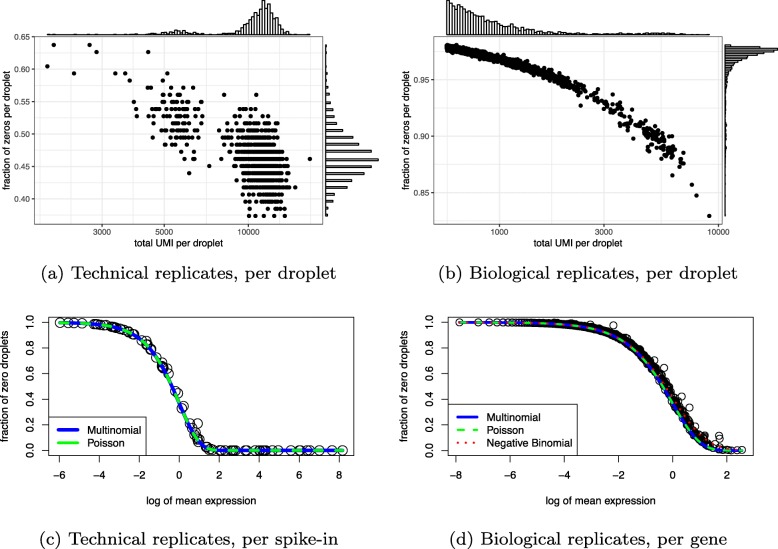
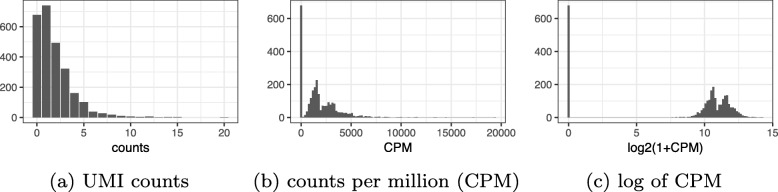
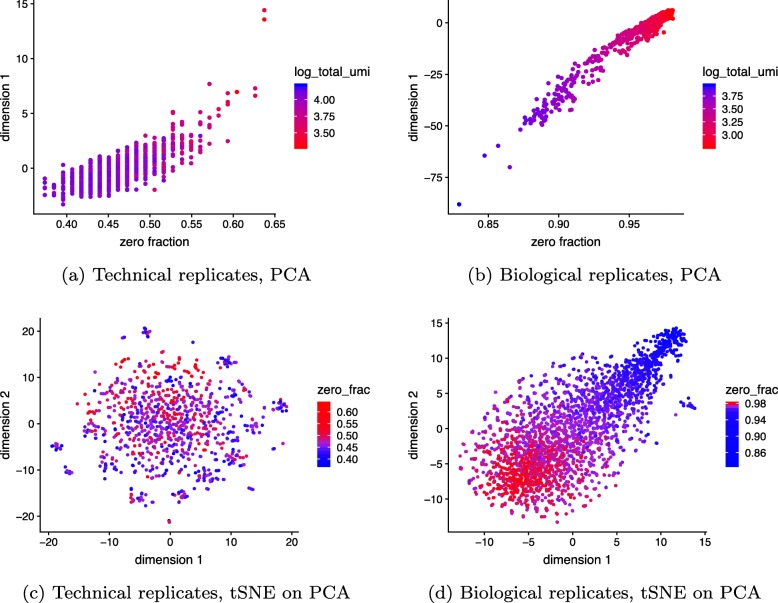
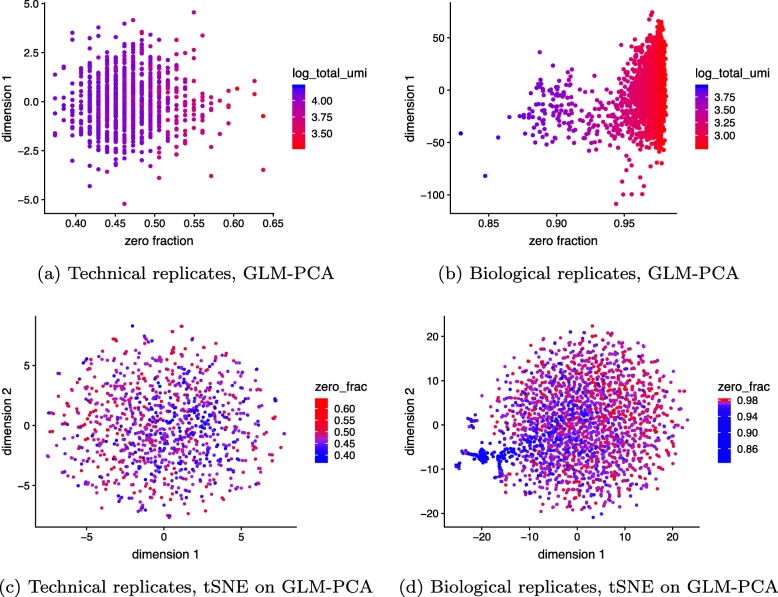
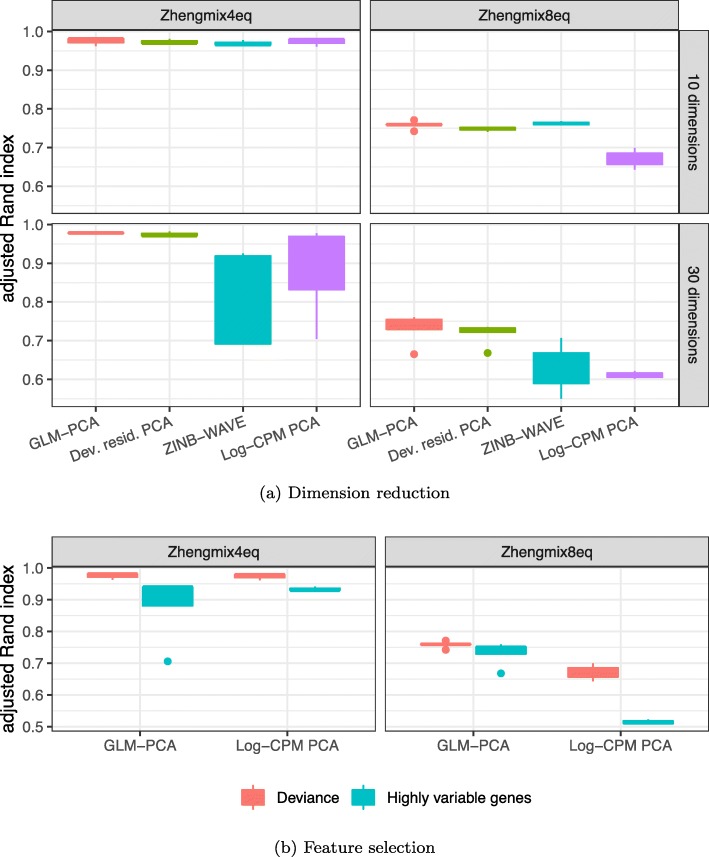
Single-cell RNA-Seq (scRNA-Seq) profiles gene expression of individual cells. Recent scRNA-Seq datasets have incorporated unique molecular identifiers (UMIs). Using negative controls, we show UMI counts follow multinomial sampling with no zero inflation. Current normalization procedures such as log of counts per million and feature selection by highly variable genes produce false variability in dimension reduction. We propose simple multinomial methods, including generalized principal component analysis (GLM-PCA) for non-normal distributions, and feature selection using deviance. These methods outperform the current practice in a downstream clustering assessment using ground truth datasets.
Overview
The claims and statistics of this paper haven’t been checked yet.
Run the check — free, no account needed. It reads the open-access text and checks the sources it cites.
Integrity signals
Registry
Cites
Statistics
Figures
Verification
Claims the paper makes
The claims and statistics of this paper haven’t been checked yet.
Run the check — free, no account needed. It reads the open-access text and checks the sources it cites.
Claims other papers make about this one
Each is checked against this paper’s own text: does it say what the citing paper says it does?
In the citing paper
“Deviance identifies highly informative genes by fitting a gene-wise model that assumes constant expression across all cells and quantifying which genes violate this assumption47.”
From Best practices for single-cell analysis across modalities (2023) · cites this paper as [47]
Self-check
Percentages, sums and reported differences re-computed from the paper’s own numbers.
The self-check needs the paper’s full text.
Citations
Cites
Algorithm AS 136: A K-Means Clustering Algorithm
Hartigan, J. A., & Wong, M. A. (1979) · Applied Statistics · doi:10.2307/2346830 · Cited by 14,523
Integrating single-cell transcriptomic data across different conditions, technologies, and species
Butler, A., Hoffman, P., Smibert, P., Papalexi, E., & Satija, R. (2018) · Nature Biotechnology · doi:10.1038/nbt.4096 · Cited by 13,174
Analysis of a complex of statistical variables into principal components.
Hotelling, H. (1933) · Journal of Educational Psychology · doi:10.1037/h0071325 · Cited by 9,691
Advances in Neural Information Processing Systems 14
(2002) · The MIT Press eBooks · doi:10.7551/mitpress/1120.001.0001 · Cited by 9,187
Hubert, L., & Arabie, P. (1985) · Journal of Classification · doi:10.1007/bf01908075 · Cited by 8,219
Massively parallel digital transcriptional profiling of single cells
Zheng, G. X. Y., Terry, J. M., Belgrader, P., Ryvkin, P., Bent, Z. W., Wilson, R., Ziraldo, S. B., Wheeler, T. D., McDermott, G. P., Zhu, J., et al. (2017) · Nature Communications · doi:10.1038/ncomms14049 · Cited by 7,353
Trapnell, C., Cacchiarelli, D., Grimsby, J., Pokharel, P., Li, S., Morse, M., Lennon, N. J., Livak, K. J., Mikkelsen, T. S., & Rinn, J. L. (2014) · Nature Biotechnology · doi:10.1038/nbt.2859 · Cited by 7,314
Highly parallel genome-wide expression profiling of individual cells using nanoliter droplets.
Macosko, E. Z., Basu, A., Satija, R., Nemesh, J., Shekhar, K., Goldman, M., Tirosh, I., Bialas, A. R., Kamitaki, N., Martersteck, E. M., et al. (2015) · Cell · doi:10.1016/j.cell.2015.05.002 · Cited by 7,110
UMAP: Uniform Manifold Approximation and Projection for Dimension Reduction
McInnes, L., Healy, J., & Melville, J. (2018) · arXiv · doi:10.48550/arxiv.1802.03426 · Cited by 7,101
Hafemeister, C., & Satija, R. (2019) · Genome Biology · doi:10.1186/s13059-019-1874-1 · Cited by 4,479 · cited 1×
“Recently, Pearson residuals based on a negative binomial null model have also been independently proposed as the sctransform method [60].”
Method
Cited by
Sorted by citations
Hafemeister, C., & Satija, R. (2019) · Genome Biology · doi:10.1186/s13059-019-1874-1 · Cited by 4,479
“For example, Townes et al. [29] introduced GLM-PCA, a generalization of PCA for data exhibiting non-normal error distributions such as the negative binomial, that takes count data directly as input instead of relying on intermediate residuals.”
MethodEleven grand challenges in single-cell data science
Lähnemann, D., Köster, J., Szczurek, E., McCarthy, D. J., Hicks, S. C., Robinson, M. D., Vallejos, C. A., Campbell, K. R., Beerenwinkel, N., Mahfouz, A., et al. (2020) · Genome Biology · doi:10.1186/s13059-020-1926-6 · Cited by 1,327
Self-citationRobust decomposition of cell type mixtures in spatial transcriptomics
Cable, D. M., Murray, E., Zou, L. S., Goeva, A., Macosko, E. Z., Chen, F., & Irizarry, R. A. (2022) · Nature Biotechnology · doi:10.1038/s41587-021-00830-w · Cited by 1,487
Self-citationBest practices for single-cell analysis across modalities
Heumos, L., Schaar, A. C., Lance, C., Litinetskaya, A., Drost, F., Zappia, L., Lücken, M. D., Strobl, D. C., Henao, J., Curion, F., et al. (2023) · Nature Reviews Genetics · doi:10.1038/s41576-023-00586-w · Cited by 1,051
“Deviance identifies highly informative genes by fitting a gene-wise model that assumes constant expression across all cells and quantifying which genes violate this assumption 47 .”
BackgroundThe art of using t-SNE for single-cell transcriptomics
Kobak, D., & Berens, P. (2019) · Nature Communications · doi:10.1038/s41467-019-13056-x · Cited by 1,161
Metadata
- Authors
- Townes, F. W., Hicks, S. C., Aryee, M. J., & Irizarry, R. A.
- Affiliations
- Harvard University (US)
- Johns Hopkins University (US)
- Venue
- Genome Biology
- Published
- 2019-12
- Volume
- 20
- Issue
- 1
- Pages
- 295-295
- ISSN
- 1465-6906 (ISSN-L)
- 1474-760X
- PMC
- PMC6927135
- OpenAlex
- W2998065416
- Cited by
- 471
- References
- 68
- Citations by year
- 2026: 49 · 2025: 56 · 2024: 78 · 2023: 76 · 2022: 70 · 2021: 80 · 2020: 48 · 2019: 14
- FWCI
- 17.71
- Type
- journal article
- Language
- en
- Update notices
- correction (2020-07-22)
- Open access
- gold
- doi.org
- Licence
- Locations
- Genome biology (publishedVersion, cc-by)
- bioRxiv (Cold Spring Harbor Laboratory) (acceptedVersion, cc-by-nc-nd)
- PubMed Central (publishedVersion, cc-by)
- PubMed (publishedVersion)
- DOAJ (DOAJ: Directory of Open Access Journals) (submittedVersion)
- Funders
- National Institutes of Health
- National Human Genome Research Institute (R00HG009007, R01HG005220, P41HG004059)
- National Cancer Institute (T32CA009337)
- National Institute of General Medical Sciences (R01GM083084)
- Topics
- Life Sciences › Biochemistry, Genetics and Molecular Biology › Molecular Biology › Single-cell and spatial transcriptomics
- Life Sciences › Biochemistry, Genetics and Molecular Biology › Molecular Biology › Gene expression and cancer classification
- Life Sciences › Biochemistry, Genetics and Molecular Biology › Molecular Biology › Genomics and Phylogenetic Studies
- Keywords
- single-cell RNA sequencing, feature selection, dimensionality reduction, multinomial model, unique molecular identifiers, highly variable genes, generalized principal component analysis, cell clustering
- MeSH terms
- Models, Statistical, Sequence Analysis, RNA, Single-Cell Analysis
About these checks
Registry, retraction, Cites and statistics results are computed, not judged, with one exception: a printed reference that no index lists is read once by a model before it counts as a citation error. Claims are extracted by a model and kept only when their quote appears verbatim in the text; each cited source is then checked, with a model’s help, for whether it says what the claim relies on. Those verdicts can be wrong — read the claim’s quote and the cited source before relying on one.
Statistics and arithmetic are recomputed, not judged.
Confidence bands are shown only for fields calibrated on our annotated test set. None is calibrated yet, so no band is shown.
What counts as a claim ›How we measure confidence ›How we check this ›
Are you an author, or do you see a problem with this page? Request a review
