

Accuracy, robustness and scalability of dimensionality reduction methods for single-cell RNA-seq analysis
Open accessPublished version of a preprint
The DOI matches its Crossref record; 91 of the 91 references it cites were found in a registry or an index.
Abstract
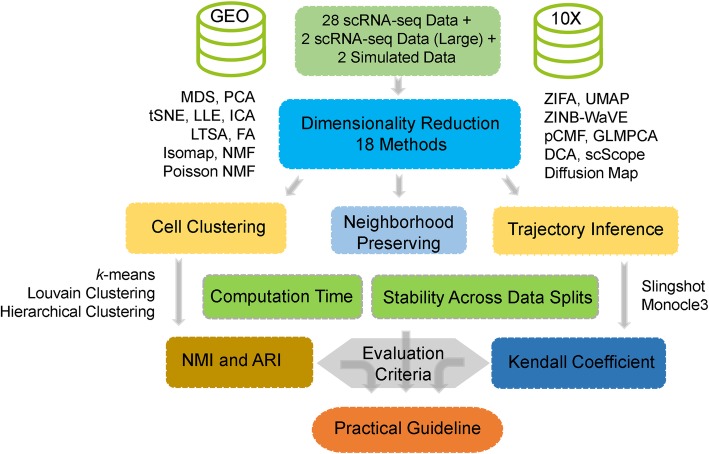
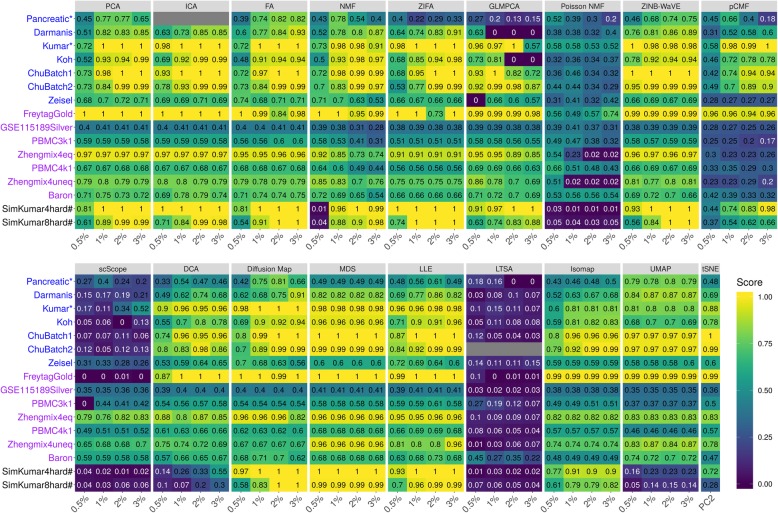
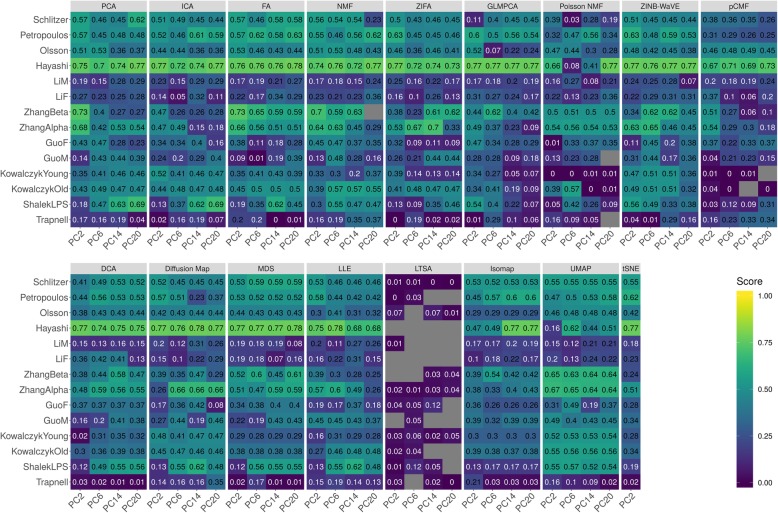
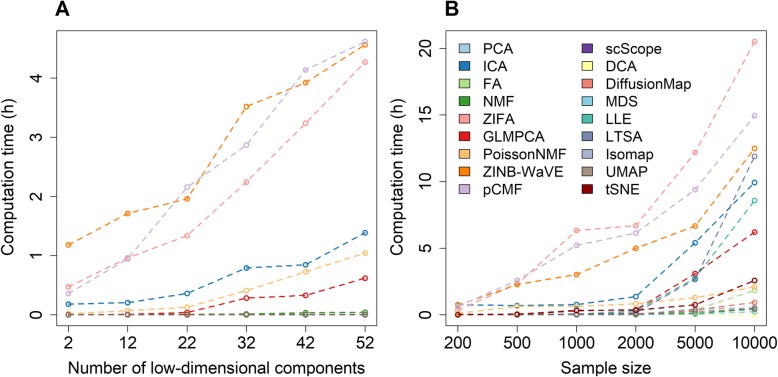
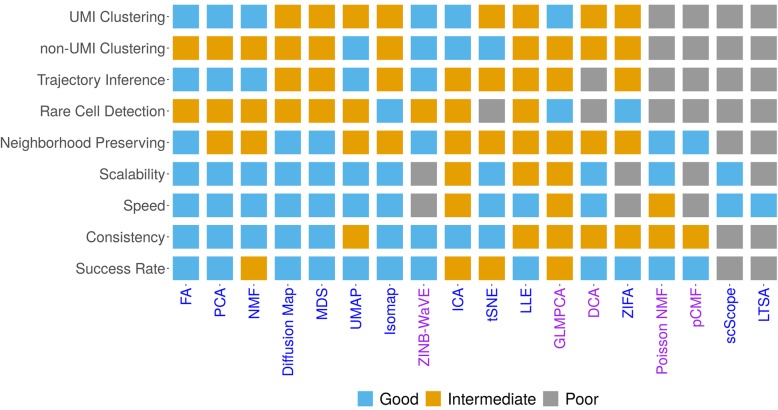
BACKGROUND: Dimensionality reduction is an indispensable analytic component for many areas of single-cell RNA sequencing (scRNA-seq) data analysis. Proper dimensionality reduction can allow for effective noise removal and facilitate many downstream analyses that include cell clustering and lineage reconstruction. Unfortunately, despite the critical importance of dimensionality reduction in scRNA-seq analysis and the vast number of dimensionality reduction methods developed for scRNA-seq studies, few comprehensive comparison studies have been performed to evaluate the effectiveness of different dimensionality reduction methods in scRNA-seq. RESULTS: We aim to fill this critical knowledge gap by providing a comparative evaluation of a variety of commonly used dimensionality reduction methods for scRNA-seq studies. Specifically, we compare 18 different dimensionality reduction methods on 30 publicly available scRNA-seq datasets that cover a range of sequencing techniques and sample sizes. We evaluate the performance of different dimensionality reduction methods for neighborhood preserving in terms of their ability to recover features of the original expression matrix, and for cell clustering and lineage reconstruction in terms of their accuracy and robustness. We also evaluate the computational scalability of different dimensionality reduction methods by recording their computational cost. CONCLUSIONS: Based on the comprehensive evaluation results, we provide important guidelines for choosing dimensionality reduction methods for scRNA-seq data analysis. We also provide all analysis scripts used in the present study at www.xzlab.org/reproduce.html.
Overview
The claims and statistics of this paper haven’t been checked yet.
Free: it reads the open-access text and checks the first 5 claims that cite a source we can check. Create a free account to check every claim.
Integrity signals
Registry
Cites
Statistics
Figures
Verification
Claims the paper makes
The claims and statistics of this paper haven’t been checked yet.
Free: it reads the open-access text and checks the first 5 claims that cite a source we can check. Create a free account to check every claim.
Claims other papers make about this one
Each is checked against this paper’s own text: does it say what the citing paper says it does?
In the citing paper
“Dimensionality reduction removes noise and simplifies subsequent analysis (Sun et al., 2019).”
From Single-Cell Sequencing of Brain Cell Transcriptomes and Epigenomes (2021) · cites this paper as Sun et al., 2019
Self-check
Percentages, sums and reported differences re-computed from the paper’s own numbers.
The self-check needs the paper’s full text.
Citations
Cites
(2008) · Journal of Machine Learning Research · Cited by 33,051
Fast unfolding of communities in large networks
Blondel, V. D., Guillaume, J.-L., Lambiotte, R., & Lefebvre, E. (2008) · Journal of Statistical Mechanics: Theory and Experiment · doi:10.1088/1742-5468/2008/10/p10008 · Cited by 21,424
Nonlinear Dimensionality Reduction by Locally Linear Embedding
Roweis, S. T., & Saul, L. K. (2000) · Science · doi:10.1126/science.290.5500.2323 · Cited by 14,965
Jolliffe, I. (2005) · Encyclopedia of Statistics in Behavioral Science · doi:10.1002/0470013192.bsa501 · Cited by 14,310
Learning the parts of objects by non-negative matrix factorization
Lee, D. D., & Seung, H. S. (1999) · Nature · doi:10.1038/44565 · Cited by 13,868
A Global Geometric Framework for Nonlinear Dimensionality Reduction
Tenenbaum, J. B., Silva, V. D., & Langford, J. C. (2000) · Science · doi:10.1126/science.290.5500.2319 · Cited by 13,585
Robust enumeration of cell subsets from tissue expression profiles
Newman, A. M., Liu, C. L., Green, M. R., Gentles, A. J., Feng, W., Xu, Y., Hoang, C. D., Diehn, M., & Alizadeh, A. A. (2015) · Nature Methods · doi:10.1038/nmeth.3337 · Cited by 13,224
Integrating single-cell transcriptomic data across different conditions, technologies, and species
Butler, A., Hoffman, P., Smibert, P., Papalexi, E., & Satija, R. (2018) · Nature Biotechnology · doi:10.1038/nbt.4096 · Cited by 13,174
Hubert, L., & Arabie, P. (1985) · Journal of Classification · doi:10.1007/bf01908075 · Cited by 8,219
Massively parallel digital transcriptional profiling of single cells
Zheng, G. X. Y., Terry, J. M., Belgrader, P., Ryvkin, P., Bent, Z. W., Wilson, R., Ziraldo, S. B., Wheeler, T. D., McDermott, G. P., Zhu, J., et al. (2017) · Nature Communications · doi:10.1038/ncomms14049 · Cited by 7,353
Self-citation
Research works printed but not linked: 1
- Sun S, Zhu J, Ma Y, Zhou X: Accuracy, robustness and scalability of dimensionality reduction methods for single-cell RNA-seq analysis. Anal Code Github Repository 2019. https://github.com/xzhoulab/DRComparison. Accessed 13 Oct 2019. PMC6902413 31823809
Cited by
Items 101–200 of 228
scVGATAE: A Variational Graph Attentional Autoencoder Model for Clustering Single-Cell RNA-seq Data
Liu, L., Wu, X., Yu, J. Q., Zhang, Y., Niu, K., & Yu, A. (2024) · Biology · doi:10.3390/biology13090713 · Cited by 6
Data-driven assessment of dimension reduction quality for single-cell omics data
Dong, X., & Bacher, R. L. (2022) · Patterns · doi:10.1016/j.patter.2022.100465 · Cited by 5
“or heuristic guidelines based on benchmarking studies.(6,7) However, choosing an optimal DR method for a given dataset”
BackgroundWu, H., Zhou, H., Zhou, B., & Wang, M. (2023) · Briefings in Functional Genomics · doi:10.1093/bfgp/elad004 · Cited by 8
Fang, C., Selega, A., & Campbell, K. R. (2024) · Genome biology · doi:10.1186/s13059-024-03304-9 · Cited by 7
“For example, numerous papers have performed comprehensive evaluations of multiple stages of the scRNA-seq workflow, including clustering [4], pseudotemporal ordering [5, 6], dimensionality reduction [7], dataset integration [8], data imputation [9], and gene selection [10].”
BackgroundNormalization of Single-Cell RNA-Seq Data
Risso, D. (2021) · Methods in molecular biology · doi:10.1007/978-1-0716-1307-8_17 · Cited by 5
Xia, L., Lee, C., & Li, J. J. (2023) · bioRxiv (Cold Spring Harbor Laboratory) · doi:10.1101/2023.04.21.537839 · Cited by 5
Mapping Cell Identity from scRNA-seq: A primer on computational methods
Traversa, D., & Chiara, M. (2025) · Computational and Structural Biotechnology Journal · doi:10.1016/j.csbj.2025.03.051 · Cited by 5
“…analysis (PCA), are applied to the highly variable genes to summarise their pattern of expression in a discrete number of Principal Components (see [17] for a comprehensive overview of dimensionality reduction techniques used in scRNA-seq) and obtain a simplified representation of gene expression…”
scRL: Utilizing Reinforcement Learning to Evaluate Fate Decisions in Single-Cell Data
Fu, Z., Chen, C., Wang, S., Wang, J., & Chen, S. (2025) · Biology · doi:10.3390/biology14060679 · Cited by 7
“Visualization techniques—including PCA (principal component analysis), t-SNE (t-distributed Stochastic Neighbour Embedding) and UMAP (Uniform Manifold Approximation and Projection)— facilitate exploratory analysis and often serve as the basis for trajectory inference [8–10].”
Xie, Q., Zhang, L., Yang, J., Yang, M., Li, Q., & Chen, Q. (2025) · International Journal of Women s Health · doi:10.2147/ijwh.s554069 · Cited by 4
“18 We applied UMAP to generate a two-dimensional representation using the first 40 principal components.”
Reduced multidimensional scaling
Paradis, E. (2021) · Computational Statistics · doi:10.1007/s00180-021-01116-0 · Cited by 6
Multimodal Dimension Reduction and Subtype Classification of Head and Neck Squamous Cell Tumors
Bard, J., Nowak, N. J., Buck, M. J., & Sinha, S. (2022) · Frontiers in Oncology · doi:10.3389/fonc.2022.892207 · Cited by 4
“Indeed, there has been a growing interest in application of dimension reduction and visualization strategies to ef fi ciently and accurately model many large-scale data types (30).”
BackgroundRégnier, P., Marques, C., & Saadoun, D. (2023) · Bioinformatics Advances · doi:10.1093/bioadv/vbad177 · Cited by 5
“We chose to implement UMAP because of its versatility and its superiority on a lot of different data types, including bulk transcriptomics (Yang et al. 2021) and single-cell RNA-Seq (Sun et al. 2019).”
MethodWalsh, E. S., Ghashghaei, H. T., & Peng, X. (2021) · IEEE International Conference on Bioinformatics and Biomedicine (BIBM) · doi:10.1109/bibm52615.2021.9669819 · Cited by 3
scGPS: Determining Cell States and Global Fate Potential of Subpopulations
Thompson, M., Matsumoto, M., Ma, T., Senabouth, A., Palpant, N. J., Powell, J. E., & Nguyen, Q. H. (2021) · Frontiers in Genetics · doi:10.3389/fgene.2021.666771 · Cited by 3
Zhang, L., Yang, M., Zhang, Q., Zhang, Y., Li, Q., & Chen, Q. (2025) · International Journal of Women s Health · doi:10.2147/ijwh.s530666 · Cited by 4
“13 Subsequently, we created a two-dimensional representation of the data using UMAP with the first 40 principal components (PCs).”
Mu, X., Huang, Z., Li, K., Zhang, H., Wang, X., Fan, Y., Zhang, K., & Zhou, F. (2025) · Knowledge-Based Systems · doi:10.1016/j.knosys.2025.114690 · Cited by 3
Jones, D., Delplace, F., Khafif, M., Zaffuto, M., Xiong, T. C., Barbacci, A., & Raffaele, S. (2025) · Genome biology · doi:10.1186/s13059-025-03906-x · Cited by 3
“NMF is less commonly used than PCA in single cell analysis, but several studies have shown that it can recover populations of biologically informative cells more effectively than standard PCA analyses [85, 86].”
Yang, X., Wang, X., & Yang, J. (2025) · Archives of Dermatological Research · doi:10.1007/s00403-025-03894-9 · Cited by 5
“The RunUMAP function is then used to embed the multidi - mensional data into a two-dimensional space [ 12 ].”
Statistical Modeling of High Dimensional Counts
Love, M. I. (2021) · Methods in molecular biology · doi:10.1007/978-1-0716-1307-8_7 · Cited by 3
SAREV : A review on statistical analytics of single‐cell RNA sequencing data
Ellis, D. D., Wu, D., & Datta, S. (2021) · Wiley Interdisciplinary Reviews Computational Statistics · doi:10.1002/wics.1558 · Cited by 4
“…neighbor embedding (t-SNE), independent component analysis (ICA), locality-sensitive hashing (LSH), Uniform Manifold Approximation and Projection for Dimension Reduction (UMAP), nonnegative matrix factorization (NMF), and zero-inflated NB (ZINB)-WaVE (Sinha et al., 2018; Sun et al., 2019).”
Essential procedures of single-cell RNA sequencing in multiple myeloma and its translational value
Du, J., Gu, X.-R., Yu, X., Cao, Y.-J., & Hou, J. (2023) · Blood Science · doi:10.1097/bs9.0000000000000172 · Cited by 3
“90 The most commonly employed linear transformation strategies involves principal component analysis (PCA), which identifies axes (or PC) that capture the greatest amount of variation in high-dimensional space.”
MethodMetric multidimensional scaling for large single-cell datasets using neural networks
Canzar, S., Do, V. H., Jelić, S., Laue, S., Matijević, D., & Prusina, T. (2024) · Algorithms for Molecular Biology · doi:10.1186/s13015-024-00265-3 · Cited by 7
Zhang, L., Yang, M., Zhang, Y., Lan, J., & Chen, Q. (2025) · Scientific Reports · doi:10.1038/s41598-025-02723-3 · Cited by 5
“Normalized expression data were used to identify highly variable genes, which were then subjected to principal component analysis (PCA) to reduce dimensionality 30 .”
Deep generative autoencoder for low-dimensional embeding extraction from single-cell RNAseq data
Sun, S., Liu, Y., & Shang, X. (2019) · IEEE International Conference on Bioinformatics and Biomedicine (BIBM) · doi:10.1109/bibm47256.2019.8983289 · Cited by 4
“On the six publicly available data sets, the NMI and ARI performance evaluations show their powerful performance compared to the seven existing DR methods.”
BackgroundInfluentialSelf-citationWang, Y., Xu, Y., Zang, Z.-L., Wu, L.-R., & Li, Z. (2022) · International Journal of Molecular Sciences · doi:10.3390/ijms23147775 · Cited by 3
“Others include locally linear embedding (LLE) [9,10], diffusion map [11], scvis [12], variational autoencoder (VAE) [13,14], scalable deep-learning-based approach (scScope) [15], local tangent space alignment (LTSA) [16,17], isometric mapping (ISOMAP) [17–19], Grand-Prix [20] and deep count autoencoder network (DCA) […”
BackgroundMethodRetractedCellar: Interactive single cell data annotation toolPreprint
Hasanaj, E., Wang, J., Sarathi, A., Ding, J., & Bar-joseph, Z. (2021) · bioRxiv · doi:10.1101/2021.03.19.436162 · Cited by 2
Visualizing single-cell data with the neighbor embedding spectrumPreprint
Damrich, S., Klockow, M. V., Berens, P., Hamprecht, F. A., & Kobak, D. (2024) · bioRxiv (Cold Spring Harbor Laboratory) · doi:10.1101/2024.04.26.590867 · Cited by 5
“…al., 2021; Huang et al., 2022; Wang et al., 2023a; Lause et al., 2024), while UMAP and ForceAtlas2 can perform better in global metrics such as correlation between pairwise distances (Huang et al., 2022; Sun et al., 2019), in particular for developmental data with pronounced continuous structure.”
BackgroundTopoMetry systematically learns and evaluates the latent geometry of single-cell data
Sidarta-Oliveira, D., Domingos, A. I., & Velloso, L. A. (2026) · eLife · doi:10.1101/2022.03.14.484134 · Cited by 5
Hernández, A. G. M., Martinez-Aguilar, V., Chavez-Gonzalez, T. M., Ávila, J. C. M., Becerril, J. V. F., Morales-Hernandez, L. A., & Cruz-Albarrán, I. A. (2023) · Diagnostics · doi:10.3390/diagnostics13162644 · Cited by 2
“In addition, runtime, memory, sensitivity, and scalability analyses were performed [34,35].”
MethodMulti-Task 3D Model for Lung Nodule Feature Extraction and Classification Using CNN and Transformer
Jiang, H., Wang, J., Yao, H., & Wang, J. (2025) · International Conference on Electronic Engineering and Information Systems (EEISS) · doi:10.1109/eeiss65394.2025.11085964 · Cited by 2
“The accuracy of MT-TCNet in the primary task of malignancy classification is 92.61%, which is 1.76 percentage points higher than the best comparison approach, sGBM [16].”
InfluentialscPI: A Scalable Framework for Probabilistic Inference in Single-Cell RNA-Sequencing Data Analysis
Ming, J., Zhao, J., & Yang, C. (2022) · Statistics in Biosciences · doi:10.1007/s12561-022-09335-9 · Cited by 2
“However, it may not be realistic and rational to find a model which is perfect for all scRNA-seq datasets and different types of scRNA-seq analysis such as cell clustering and lineage reconstruction [16].”
BackgroundWang, Z., Wang, C., Song, C., Li, L., & Du, X. (2024) · IEEE Journal of Emerging and Selected Topics in Industrial Electronics · doi:10.1109/jestie.2024.3352495 · Cited by 3
“[16]studieddatadimensionality reductionmethodsinthefieldofsingle-cellsequencing,compared the accuracy and robustness of 18 commonly used data dimensionality reduction methods in cell sequencing, and provided meaningful guidance for data dimensionality reduction.”
MethodGenetic Optimization in Uncovering Biologically Meaningful Gene Biomarkers for Glioblastoma Subtypes
Paplomatas, P., Douroumi, I.-E., Vlamos, P., & Vrahatis, A. G. (2024) · BioMedInformatics · doi:10.3390/biomedinformatics4010045 · Cited by 2
A scalable approach to topic modelling in single-cell data by approximate pseudobulk projection
Subedi, S., Sumida, T. S., & Park, Y. (2024) · Life Science Alliance · doi:10.26508/lsa.202402713 · Cited by 2
“The complexity of an exact PCA algorithm (singular value decomposition) scales linearly with the number of genes/features and quadratically with the number of cells (Tsuyuzaki et al, 2020), designing a scalable latent data modelling is crucially important (Sun et al, 2019).”
Mo, Y., Liu, J., & Zhang, L. (2024) · Briefings in Bioinformatics · doi:10.1093/bib/bbaf052 · Cited by 3
“Dimensionality reduction is crucial for scRNA-seq data to extract informative features, as the data is usually noisy and sparse [44, 45].”
K-Volume Clustering Algorithms for scRNA-Seq Data Analysis
Chen, Y., & Li, F. (2025) · Biology · doi:10.3390/biology14030283 · Cited by 2
“Our future research will focus on extending this framework by incorporating advanced high-dimensional data processing techniques, such as dimensionality reduction methods and deep learning-based feature extraction, to further enhance clustering performance [35,36].”
Pollock: fishing for cell states
Storrs, E. P., Zhou, D. C., Wendl, M. C., Wyczalkowski, M. A., Karpova, A., Wang, L.-B., Li, Y., Southard-Smith, A. N., Jayasinghe, R. G., Yao, L., et al. (2022) · Bioinformatics Advances · doi:10.1093/bioadv/vbac028 · Cited by 2
Pre-processing, Dimension Reduction, and Clustering for Single-Cell RNA-seq Data
Hu, J., Wang, Y., Zhou, X., & Chen, M. (2022) · Springer handbooks of computational statistics · doi:10.1007/978-3-662-65902-1_2 · Cited by 2
Self-citationSCM Enables Improved Single-Cell Clustering by Scoring Consensus Matrices
Yu, Y., & Liu, J. (2023) · Mathematics · doi:10.3390/math11173785 · Cited by 2
Wu, J., Wang, L., Xi, S., Ma, C., Zou, F., Fang, G., Liu, F., Wang, X., & Qu, L. (2024) · Aging · doi:10.18632/aging.205755 · Cited by 4
“The “RunPCA” function was used for clustering and uniform manifold approximation and projection, a manifold learning technique for dimension reduction [15, 16].”
MethodBlumenberg, L. M., & Ruggles, K. V. (2020) · bioRxiv (Cold Spring Harbor Laboratory) · doi:10.1101/2020.01.13.905323 · Cited by 3
Metric Multidimensional Scaling for Large Single-Cell Data Sets using Neural NetworksPreprint
Canzar, S., Do, V. H., Jelić, S., Laue, S., Matijević, D., & Prusina, T. (2021) · bioRxiv (Cold Spring Harbor Laboratory) · doi:10.1101/2021.06.24.449725 · Cited by 2
Pan, X., Saunders, R. A., Replogle, J. M., Weissman, J. S., & Zhuang, X. (2026) · bioRxiv (Cold Spring Harbor Laboratory) · doi:10.64898/2026.05.16.725005 · Cited by 5
Gikera, R., Mwaura, J., Muuro, E., & Mambo, S. M. (2023) · Journal on artificial intelligence · doi:10.32604/jai.2023.043229 · Cited by 2
Inferring Tree-Shaped Single-Cell Trajectories with Totem
Sousa, A. G. G., Smolander, J., Junttila, S., & Elo, L. L. (2024) · Methods in molecular biology · doi:10.1007/978-1-0716-3886-6_9 · Cited by 1
Principal Component Analysis Balancing Prediction and Approximation Accuracy for Spatial Data
Cheng, S., Blanco, M. N., Larson, T. V., Sheppard, L. A., Szpiro, A. A., & Shojaie, A. (2025) · Journal of Computational and Graphical Statistics · doi:10.1080/10618600.2025.2518185 · Cited by 3
“…measurements (Rao et al. 2021), dimension reduction is commonly performed before the main analytic tasks on genomic data to extract biologically meaningful signals as well as to facilitate computation; see Sun et al. (2019), Zhao et al. (2021), and Shang and Zhou (2022) for related examples.”
Evaluating discrepancies in dimensionality reduction for time-series single-cell RNA-sequencing data
Hackenberg, M., Guitart, L. C., Backofen, R., & Binder, H. (2025) · Briefings in Bioinformatics · doi:10.1093/bib/bbaf287 · Cited by 3
Sketching T cell atlases in the single‐cell era: challenges and recommendations
Bojović, I., Sousa, A. G. G., Junttila, S., & Elo, L. L. (2025) · Immunology and Cell Biology · doi:10.1111/imcb.70040 · Cited by 1
Zhao, Y., Samir, J., Keoshkerian, E., Li, H., An, H., Bull, R. A., Luciani, F., & Lloyd, A. R. (2025) · The Journal of Immunology · doi:10.1093/jimmun/vkaf299 · Cited by 1
Zhang, L., Zhang, Q., Yang, M., Xu, M., Li, Q., & Chen, Q. (2026) · Discover Oncology · doi:10.1007/s12672-026-04414-5 · Cited by 1
“These genes were used for Principal Component Analysis (PCA) [18].”
A Review of Dimensionality Reduction Methods on Single-Cell RNA-Seq (scRNA-Seq) Data
Joshi, R., & Sarmah, R. (2026) · Lecture notes in networks and systems · doi:10.1007/978-981-95-2878-3_10 · Cited by 1
Pérez-Villavicencio, J., Martínez-Rojas, V. A., Rubio, C., Serrano‐García, N., Galván, E. J., & Parra, H. R. (2026) · Epilepsy Research · doi:10.1016/j.eplepsyres.2026.107792 · Cited by 1
Fan, Y., Ning, J., Wang, L., Yang, S., & Sun, S. (2026) · Genomics · doi:10.1016/j.ygeno.2026.111243 · Cited by 1
Self-citationMAPLE: Self-Supervised Learning-Enhanced Nonlinear Dimensionality Reduction for Visual Analysis
Huang, Z., Fujiwara, T., Chatzimparmpas, A., Duchemin, W., & Kerren, A. (2026) · IEEE Transactions on Visualization and Computer Graphics · doi:10.1109/tvcg.2026.3694000 · Cited by 3
“While UMAP is widely used in single-cell studies, it has also been criticized for generating overly confident continuous trajectories that may not exist [15], [69], [85].”
An Effective Hybrid Deep Learning Model for Eukaryotic Promoter Identification
Wang, Y., Peng, Q., Xu, M., Han, T., Sun, Z., & Wang, X. (2020) · IEEE International Conference on Bioinformatics and Biomedicine (BIBM) · doi:10.1109/bibm49941.2020.9313461 · Cited by 1
“To see the effectiveness of center loss intuitively, we reduce dimensions [44] and visualize the sequence features [45] extracted by PromoterClCce and PromoterCce respectively.”
MethodStandardization of Single-Cell RNA-Sequencing Analysis Workflow to Study Drosophila Ovary
Chatterjee, D., & Deng, W. (2023) · Methods in molecular biology · doi:10.1007/978-1-0716-3259-8_9 · Cited by 1
Impact of Normalization Techniques in Microarray Data Analysis
Thant, L. M., & Phyu, S. (2023) · IEEE Conference on Computer Applications (ICCA) · doi:10.1109/icca51723.2023.10181723 · Cited by 1
“Even if the previous recommendations are still valuable for processing of data, those are depending on facts of data processing (such as. [5]), it is not calculate how the selections of tools are impact on the analyzed study [6] or it is not implements all data processing aspects, such as doublet…”
BackgroundComparative Analysis of Surrogate Models for High-Dimensional Expensive Problems
Huang, X., Li, F., & Liu, Y. (2023) · International Conference on Data-driven Optimization of Complex Systems (DOCS) · doi:10.1109/docs60977.2023.10294531 · Cited by 1
“To address the challenges posed by High-Dimensional Expensive Problems, techniques such as dimensionality reduction [1] and surrogate models.”
MethodSingle-Cell RNA-Seq Data Clustering: Highlighting Computational Challenges and Considerations
Nossier, M., Moussa, S. M., & Badr, N. L. (2023) · IEEE International Conference on Bioinformatics and Biomedicine (BIBM) · doi:10.1109/bibm58861.2023.10385639 · Cited by 2
Meijer, I., Terpstra, M. M., Cámara, Ó., Marquering, H. A., Terreros, N. A., & de Groot, J. R. (2025) · Diagnostics · doi:10.3390/diagnostics15101269 · Cited by 3
“We selected PCA over other dimensionality reduction techniques because of its interpretability and stability [24,25].”
Inferring cellular heterogeneity of associations from single cell genomics
Levy, M., Frishberg, A., & Gat‐Viks, I. (2020) · Bioinformatics · doi:10.1093/bioinformatics/btaa151 · Cited by 1
Cell type specific transcriptomic characterization of myelin abnormalities
Sun, T. (2022) · eDiss (Georg-August-Universität Göttingen) · doi:10.53846/goediss-9413 · Cited by 1
cellstruct: Metrics scores to quantify the biological preservation between two embeddingsPreprint
Loh, J. W., & Ouyang, J. F. (2023) · bioRxiv (Cold Spring Harbor Laboratory) · doi:10.1101/2023.11.13.566337 · Cited by 1
TopOMetry systematically learns and evaluates the latent dimensions of single-cell atlasesPreprint
Sidarta-Oliveira, D., Domingos, A. I., & Velloso, L. A. (2024) · eLife · doi:10.7554/elife.100361.1 · Cited by 1
Single Cell RNA Sequencing and Data Analysis
Goswami, M., Kitchlu, A., Behera, B. P., Thalathoti, L. S., Kurimindla, P., Balagannavar, G. C., & Acharya, K. K. (2024) · Elsevier eBooks · doi:10.1016/b978-0-323-95502-7.00209-8 · Cited by 3
DANCE 2.0: Transforming single-cell analysis from black box to transparent workflowPreprint
Ding, J., Zhijin, X. I. N. G., Wang, Y., Liu, R., Liu, S., Huang, Z., Tang, W., Xie, Y., Zou, J., Qiu, X., et al. (2025) · bioRxiv (Cold Spring Harbor Laboratory) · doi:10.1101/2025.07.17.665427 · Cited by 2
Inferring cellular trajectories from scRNA-seq using Pseudocell TracerPreprint
Reiman, D. J., Xu, H., Sonin, A., Chen, D., Singh, H., & Khan, A. A. (2020) · bioRxiv (Cold Spring Harbor Laboratory) · doi:10.1101/2020.06.26.173179
“In the first step, dimensionality reduction techniques (Sun et al., 2019), such as PCA (Street et al., 2018), ICA (Trapnell et al., 2014), and UMAP (Wolf et al., 2019), are used to project and visualize single cells based on their gene expression profiles in low dimensional space (Figure 1A, left).”
MethodOmicPioneer-sc: an integrated, interactive visualization environment for single-cell sequencing dataPreprint
Weinstein, J. N., Rohrdanz, M. A., Stucky, M., Melott, J. M., Ma, J., Mohanty, V., Manyam, G. C., Wakefield, C., Chen, K., Navin, N. E., et al. (2020) · bioRxiv (Cold Spring Harbor Laboratory) · doi:10.1101/2020.10.31.363580
Lin, K., Lei, J., & Roeder, K. (2021) · Journal of the American Statistical Association · doi:10.1080/01621459.2021.1892701
“As mentioned above, benchmarking papers such as Sun et al. (2019) and Hou et al. (2020) best demonstrate this, where they report the accuracy of the embedding itself, but also of the down-stream clustering, differential expression, or trajectory analysis across various datasets.”
BackgroundMethodWong, T., & Barahona, M. (2021) · bioRxiv (Cold Spring Harbor Laboratory) · doi:10.1101/2021.07.08.451664
Baraban, A., Clark, B. S., Slosberg, J., Fertig, E. J., Goff, L. A., & Stein-O’Brien, G. (2021) · bioRxiv (Cold Spring Harbor Laboratory) · doi:10.1101/2021.08.25.457650 · Cited by 1
Recent Dimensionality Reduction Techniques for High-Dimensional COVID-19 Data
Dallas, I. L., Vrahatis, A. G., Tasoulis, S. K., & Plagianakos, V. P. (2022) · Lecture notes in computer science · doi:10.1007/978-3-031-20837-9_18
Tracking The Sensitivity of The Learning Models Toward Exact and Near Duplicates
Gabr, M. I., Helmy, Y., & Elzanfaly, D. S. (2022) · International Journal of Advanced Computer Science and Applications · doi:10.14569/ijacsa.2022.0131240
“As stated in the literature [49]–[51], reducing the dimensions of the dataset improves the clustering results, however this is not the scope of this paper but showing the effect of near duplicates on the performance of the clustering models within different ratios.”
BackgroundAdditional file 3 of scRNASequest: an ecosystem of scRNA-seq analysis, visualization, and publishing
Li, K., Sun, Y. H., Ouyang, Z., Negi, S., Gao, Z., Zhu, J. F., Wang, W., Chen, Y., Piya, S., Hu, W., et al. (2023) · Figshare · doi:10.6084/m9.figshare.22735494
Self-citationAdditional file 1 of scRNASequest: an ecosystem of scRNA-seq analysis, visualization, and publishing
Li, K., Sun, Y. H., Ouyang, Z., Negi, S., Gao, Z., Zhu, J. F., Wang, W., Chen, Y., Piya, S., Hu, W., et al. (2023) · Figshare · doi:10.6084/m9.figshare.22735488
Self-citationAdditional file 2 of scRNASequest: an ecosystem of scRNA-seq analysis, visualization, and publishing
Li, K., Sun, Y. H., Ouyang, Z., Negi, S., Gao, Z., Zhu, J., Wang, W., Chen, Y., Piya, S., Hu, W., et al. (2023) · Figshare · doi:10.6084/m9.figshare.22735491
Self-citationCI-VAE for Single-Cell: Leveraging Generative-AI to Enhance Disease Understanding
Nabian, M., Eftekhari, Z., & Wong, C. W. (2024) · Lecture notes in computer science · doi:10.1007/978-3-031-66538-7_36
Dimensionality Reduction and Clustering
Raza, K. (2024) · SpringerBriefs in applied sciences and technology · doi:10.1007/978-981-97-6703-8_3
TopoMetry systematically learns and evaluates the latent geometry of single-cell dataPreprint
Sidarta-Oliveira, D., Domingos, A. I., & Velloso, L. A. (2024) · eLife · doi:10.7554/elife.100361
Zhang, J., Chakravarthy, M., & Singh, R. (2024) · bioRxiv (Cold Spring Harbor Laboratory) · doi:10.1101/2024.10.27.620531
“It is widely used in many single-cell studies and shows a good dimen-554 sionality reduction performance [62–64].”
Bersenev, D., & Zhang, E. R. (2024) · bioRxiv (Cold Spring Harbor Laboratory) · doi:10.1101/2024.12.19.629541 · Cited by 1
Jiang, J., Li, D., Cui, D., Wan, Y., Zhou, P., Cui, X., & Yu, H. (2025) · Biochemical Genetics · doi:10.1007/s10528-025-11099-y
“Dimensionality reduction (Sun et al. 2019) and cell proportions (Germain et al. 2020) were visualized using the Unified Popular Approximation and Projection (UMAP) method.”
Sun, L., Yang, Q., Zhang, J., Guo, W., & Lin, L. (2025) · bioRxiv (Cold Spring Harbor Laboratory) · doi:10.1101/2025.05.14.654052
DeepAtlas: a tool for effective manifold learningPreprint
Hughes, S., Hamilton, T., Kolokotrones, T., & Deeds, E. J. (2025) · bioRxiv (Cold Spring Harbor Laboratory) · doi:10.1101/2025.08.26.672474
“This and other studies (39–42) all suggest that current manifold learning techniques struggle to successfully embed or otherwise represent the actual structure of scRNA-seq data.”
Liu, P., Chen, C., Liu, H., Gu, J., Chen, X., Su, Y., Cheng, Z., Lv, X., & Chen, C. (2025) · Engineering Applications of Artificial Intelligence · doi:10.1016/j.engappai.2025.112313
Zhang, Z., Chen, J., Wu, H., Li, K. Y., Adams, P. D., Itkin‐Ansari, P., & Yip, K. Y.-L. (2025) · bioRxiv (Cold Spring Harbor Laboratory) · doi:10.1101/2025.10.01.679835
Jevans, B., Cooper, F., Peruzza, L., Perin, S., Li, S., McAteer, T., Coppi, P. D., Andrews, P. W., Tsakiridis, A., & McCann, C. J. (2025) · bioRxiv (Cold Spring Harbor Laboratory) · doi:10.1101/2025.10.16.679985
Sample-level modeling of single-cell data at scale with tinydenseRPreprint
Milanez‐Almeida, P., Schildknecht, D., Linder, M., Brachmann, S. M., Weiss, A., Adler, F., Lenticchia, S. C., Meistertzheim, M., Wild, S. A., Cuttat, R., et al. (2025) · bioRxiv (Cold Spring Harbor Laboratory) · doi:10.1101/2025.11.26.690752
BioRSP: Angular Scanning for Directional Gene Expression Enrichment in Single-Cell Embeddings
Yao, Z., & Chen, J. Y. (2025) · ACM International Conference on Bioinformatics, Computational Biology, and Health Informatics (ACM-BCB) · doi:10.1145/3765612.3767793
Sun, T., Song, D., Li, W. V., & Li, J. J. (2021) · Figshare · doi:10.6084/m9.figshare.14677034
Quah, F. X., & Hemberg, M. (2024) · Figshare · doi:10.6084/m9.figshare.26553044
Raimundo, F., Prompsy, P., Vert, J., & Vallot, C. (2024) · Figshare · doi:10.6084/m9.figshare.26598461
Fang, C., Selega, A., & Campbell, K. R. (2024) · Figshare · doi:10.6084/m9.figshare.26735316
Li, Z., & Zhou, X. (2022) · Figshare · doi:10.6084/m9.figshare.20438589
Self-citation
Metadata
- Authors
- Sun, S., Zhu, J., Ma, Y., & Zhou, X.
- Affiliations
- Northwestern Polytechnical University (CN)
- University of Michigan (US)
- Corresponding author
- Zhou, Xiang
- Venue
- Genome biology
- Published
- 2019-12
- Volume
- 20
- Issue
- 1
- Pages
- 269-269
- ISSN
- 1465-6906 (ISSN-L)
- 1474-760X
- PMC
- PMC6902413
- OpenAlex
- W2996274328
- Semantic Scholar
- 8649d8535160554b6004563b832bce1914304fcd
- Cited by
- 225
- References
- 90
- Citations by year
- 2026: 20 · 2025: 27 · 2024: 37 · 2023: 34 · 2022: 36 · 2021: 51 · 2020: 18 · 2019: 2
- FWCI
- 8.85
- Type
- journal article
- Language
- en
- Open access
- gold
- doi.org
- Licence
- cc-by
- creativecommons.org/licenses/by/4.0/ (tdm)
- creativecommons.org/licenses/by/4.0/ (vor, 9 d)
- Locations
- Genome biology (publishedVersion, cc-by)
- bioRxiv (Cold Spring Harbor Laboratory) (acceptedVersion, cc-by)
- PubMed Central (publishedVersion, cc-by)
- PubMed (publishedVersion)
- Deep Blue (University of Michigan) (submittedVersion)
- DOAJ (DOAJ: Directory of Open Access Journals) (submittedVersion, cc-by-sa)
- Funders
- the National Institutes of Health (R01HG009124, R01GM126553, R01HD088558, U01HL137182)
- the National Science Foundation (DMS1712933)
- the Chan Zuckerberg Initiative DAF (2018-181314)
- the National Natural Science Foundation of China (61902319)
- the Natural Science Foundation of Shaanxi Province (2019JQ127)
- Topics
- Life Sciences › Biochemistry, Genetics and Molecular Biology › Molecular Biology › Single-cell and spatial transcriptomics
- Life Sciences › Biochemistry, Genetics and Molecular Biology › Molecular Biology › Gene expression and cancer classification
- Life Sciences › Biochemistry, Genetics and Molecular Biology › Molecular Biology › Genomics and Phylogenetic Studies
- Keywords
- dimensionality reduction, single-cell RNA sequencing, method comparison, neighborhood preservation, cell clustering, lineage reconstruction, computational scalability, robustness, noise reduction, reproducibility
- MeSH terms
- Cluster Analysis, Sequence Analysis, RNA, Single-Cell Analysis, Dimensional Measurement Accuracy
About these checks
Registry, retraction, Cites and statistics results are computed, not judged, with one exception: a printed reference that no index lists is read once by a model before it counts as a citation error. Claims are extracted by a model and kept only when their quote appears verbatim in the text; each cited source is then checked, with a model’s help, for whether it says what the claim relies on. Those verdicts can be wrong — read the claim’s quote and the cited source before relying on one.
Statistics and arithmetic are recomputed, not judged.
Confidence bands are shown only for fields calibrated on our annotated test set. None is calibrated yet, so no band is shown.
What counts as a claim ›How we measure confidence ›How we check this ›
Are you an author, or do you see a problem with this page? Request a review
Data sources
Bibliographic data: Semantic Scholar, OpenAlex, Crossref.
Contains information from the Semantic Scholar Academic Graph Datasets, made available under the ODC Attribution License (ODC-BY 1.0).
Semantic Scholar’s data is described in: Kinney, R., et al. (2023). The Semantic Scholar Open Data Platform. arXiv:2301.10140.
