

Accuracy, robustness and scalability of dimensionality reduction methods for single-cell RNA-seq analysis
Open accessPublished version of a preprint
The DOI matches its Crossref record; 91 of the 91 references it cites were found in a registry or an index.
Abstract
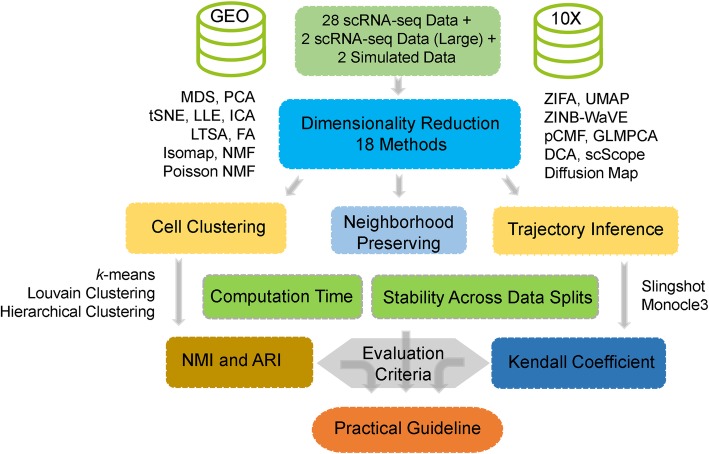
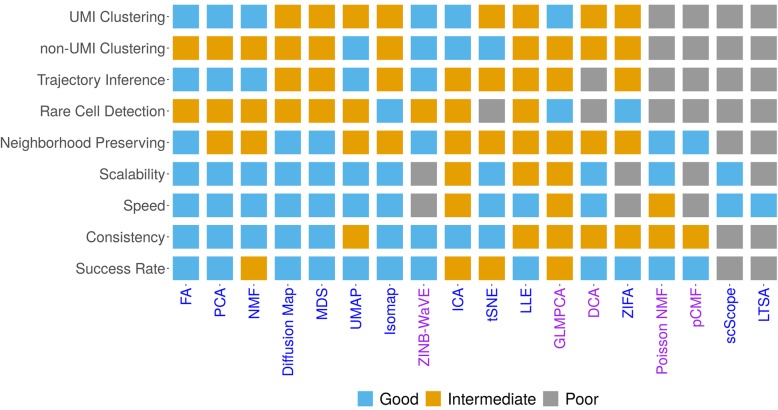
BACKGROUND: Dimensionality reduction is an indispensable analytic component for many areas of single-cell RNA sequencing (scRNA-seq) data analysis. Proper dimensionality reduction can allow for effective noise removal and facilitate many downstream analyses that include cell clustering and lineage reconstruction. Unfortunately, despite the critical importance of dimensionality reduction in scRNA-seq analysis and the vast number of dimensionality reduction methods developed for scRNA-seq studies, few comprehensive comparison studies have been performed to evaluate the effectiveness of different dimensionality reduction methods in scRNA-seq. RESULTS: We aim to fill this critical knowledge gap by providing a comparative evaluation of a variety of commonly used dimensionality reduction methods for scRNA-seq studies. Specifically, we compare 18 different dimensionality reduction methods on 30 publicly available scRNA-seq datasets that cover a range of sequencing techniques and sample sizes. We evaluate the performance of different dimensionality reduction methods for neighborhood preserving in terms of their ability to recover features of the original expression matrix, and for cell clustering and lineage reconstruction in terms of their accuracy and robustness. We also evaluate the computational scalability of different dimensionality reduction methods by recording their computational cost. CONCLUSIONS: Based on the comprehensive evaluation results, we provide important guidelines for choosing dimensionality reduction methods for scRNA-seq data analysis. We also provide all analysis scripts used in the present study at www.xzlab.org/reproduce.html.
Overview
The claims and statistics of this paper haven’t been checked yet.
Free: it reads the open-access text and checks the first 5 claims that cite a source we can check. Create a free account to check every claim.
Integrity signals
Registry
Cites
Statistics
Figures
Verification
Claims the paper makes
The claims and statistics of this paper haven’t been checked yet.
Free: it reads the open-access text and checks the first 5 claims that cite a source we can check. Create a free account to check every claim.
Claims other papers make about this one
Each is checked against this paper’s own text: does it say what the citing paper says it does?
In the citing paper
“Dimensionality reduction removes noise and simplifies subsequent analysis (Sun et al., 2019).”
From Single-Cell Sequencing of Brain Cell Transcriptomes and Epigenomes (2021) · cites this paper as Sun et al., 2019
Self-check
Percentages, sums and reported differences re-computed from the paper’s own numbers.
The self-check needs the paper’s full text.
Citations
Cites
(2008) · Journal of Machine Learning Research · Cited by 33,051
Fast unfolding of communities in large networks
Blondel, V. D., Guillaume, J.-L., Lambiotte, R., & Lefebvre, E. (2008) · Journal of Statistical Mechanics: Theory and Experiment · doi:10.1088/1742-5468/2008/10/p10008 · Cited by 21,424
Nonlinear Dimensionality Reduction by Locally Linear Embedding
Roweis, S. T., & Saul, L. K. (2000) · Science · doi:10.1126/science.290.5500.2323 · Cited by 14,965
Jolliffe, I. (2005) · Encyclopedia of Statistics in Behavioral Science · doi:10.1002/0470013192.bsa501 · Cited by 14,310
Learning the parts of objects by non-negative matrix factorization
Lee, D. D., & Seung, H. S. (1999) · Nature · doi:10.1038/44565 · Cited by 13,868
A Global Geometric Framework for Nonlinear Dimensionality Reduction
Tenenbaum, J. B., Silva, V. D., & Langford, J. C. (2000) · Science · doi:10.1126/science.290.5500.2319 · Cited by 13,585
Robust enumeration of cell subsets from tissue expression profiles
Newman, A. M., Liu, C. L., Green, M. R., Gentles, A. J., Feng, W., Xu, Y., Hoang, C. D., Diehn, M., & Alizadeh, A. A. (2015) · Nature Methods · doi:10.1038/nmeth.3337 · Cited by 13,224
Integrating single-cell transcriptomic data across different conditions, technologies, and species
Butler, A., Hoffman, P., Smibert, P., Papalexi, E., & Satija, R. (2018) · Nature Biotechnology · doi:10.1038/nbt.4096 · Cited by 13,174
Hubert, L., & Arabie, P. (1985) · Journal of Classification · doi:10.1007/bf01908075 · Cited by 8,219
Massively parallel digital transcriptional profiling of single cells
Zheng, G. X. Y., Terry, J. M., Belgrader, P., Ryvkin, P., Bent, Z. W., Wilson, R., Ziraldo, S. B., Wheeler, T. D., McDermott, G. P., Zhu, J., et al. (2017) · Nature Communications · doi:10.1038/ncomms14049 · Cited by 7,353
Self-citation
Research works printed but not linked: 1
- Sun S, Zhu J, Ma Y, Zhou X: Accuracy, robustness and scalability of dimensionality reduction methods for single-cell RNA-seq analysis. Anal Code Github Repository 2019. https://github.com/xzhoulab/DRComparison. Accessed 13 Oct 2019. PMC6902413 31823809
Cited by
Eleven grand challenges in single-cell data science
Lähnemann, D., Köster, J., Szczurek, E., McCarthy, D. J., Hicks, S. C., Robinson, M. D., Vallejos, C. A., Campbell, K. R., Beerenwinkel, N., Mahfouz, A., et al. (2020) · Genome Biology · doi:10.1186/s13059-020-1926-6 · Cited by 1,327
Tutorial: guidelines for the computational analysis of single-cell RNA sequencing data
Andrews, T. S., Kiselev, V. Y., McCarthy, D., & Hemberg, M. (2021) · Nature Protocols · doi:10.1038/s41596-020-00409-w · Cited by 306
Alignment and integration of spatial transcriptomics data
Zeira, R., Land, M., Strzalkowski, A., & Raphael, B. J. (2022) · Nature Methods · doi:10.1038/s41592-022-01459-6 · Cited by 298
Spatially aware dimension reduction for spatial transcriptomics
Shang, L., & Zhou, X. (2022) · Nature Communications · doi:10.1038/s41467-022-34879-1 · Cited by 254
“However, SpatialPCA can be potentially paired with any clustering algorithm 16 or trajectory inference algorithm 18 developed in the scRNA-seq literature to take advantage of their bene fi ts. Importantly, because SpatialPCA builds upon a data-generative model that automaticallyinfersthe spatial…”
BackgroundMethodSelf-citationSingle-Cell Sequencing of Brain Cell Transcriptomes and Epigenomes
Armand, E. J., Li, J., Xie, F., Luo, C., & Mukamel, E. A. (2021) · Neuron · doi:10.1016/j.neuron.2020.12.010 · Cited by 241
“Dimensionality reduction removes noise and simplifies subsequent analysis (Sun et al., 2019) .”
BackgroundSarkar, A., & Stephens, M. (2021) · Nature Genetics · doi:10.1038/s41588-021-00873-4 · Cited by 224
Single-cell analyses of aging, inflammation and senescence
Uyar, B., Palmer, D., Kowald, A., Murua Escobar, H., Barrantes, I., Möller, S., Akalin, A., & Fuellen, G. (2020) · Ageing Research Reviews · doi:10.1016/j.arr.2020.101156 · Cited by 200
“…expression analysis to determine cluster-specific markers (Soneson and Robinson, 2018), cell type annotation (Abdelaal et al., 2019), dimension reduction (Sun et al., 2019), visualization, and downstream analyses, e.g., based on biological network data (Gawel et al., 2019; Mohammadi et al., 2019).”
Yang, Y., Sun, H., Zhang, Y., Zhang, T., Gong, J., Wei, Y., Duan, Y.-G., Shu, M., Yang, Y., Wu, D., et al. (2021) · Cell Reports · doi:10.1016/j.celrep.2021.109442 · Cited by 197
Li, Z., & Zhou, X. (2022) · Genome Biology · doi:10.1186/s13059-022-02734-7 · Cited by 176
“the gene expression information into a low-dimensional manifold [64].”
BackgroundMethodSelf-citationGene signature extraction and cell identity recognition at the single-cell level with Cell-ID
Cortal, A., Martignetti, L., Six, E., & Rausell, A. (2021) · Nature Biotechnology · doi:10.1038/s41587-021-00896-6 · Cited by 160
“We then assessed the ability of Cell-ID to recognize rare cells from the same cell type across independent scRNA-seq datasets from different tissues of origin and, thus, within diverse cell composition contexts (Supplementary Note 5).”
BackgroundMethodResultInfluentialGermain, P.-L., Sonrel, A., & Robinson, M. D. (2020) · Genome Biology · doi:10.1186/s13059-020-02136-7 · Cited by 147
“• Similarly to previous reports [11], we recommend the irlba-based PCA using weighting 366 of the components, as implemented in Seurat.”
BackgroundMethodInfluentialA mixture-of-experts deep generative model for integrated analysis of single-cell multiomics data
Minoura, K., Abe, K., Nam, H., Nishikawa, H., & Shimamura, T. (2021) · Cell Reports Methods · doi:10.1016/j.crmeth.2021.100071 · Cited by 146
“To compare how well latent variables inferred by scMM and totalVI preserved structures in the original transcriptome and surface protein space, we calculated the Jaccard index (JI) (Sun et al., 2019).”
MethodDeep learning applications in single-cell genomics and transcriptomics data analysis
Erfanian, N., Heydari, A. A., Feriz, A. M., Iañez, P., Derakhshani, A., Ghasemigol, M., Farahpour, M., Razavi, S. M., Nasseri, S., Safarpour, H., et al. (2023) · Biomedicine & Pharmacotherapy · doi:10.1016/j.biopha.2023.115077 · Cited by 140
Tools for the analysis of high-dimensional single-cell RNA sequencing data
Wu, Y., & Zhang, K. (2020) · Nature Reviews Nephrology · doi:10.1038/s41581-020-0262-0 · Cited by 141
“In fact, a benchmarking study found that dimensionality reduction methods that work well for clustering often do not work as well for visualization 55 .”
BackgroundReview of single-cell RNA-seq data clustering for cell-type identification and characterization
Zhang, S., Li, X., Lin, J., Lin, Q., & Wong, K. (2023) · RNA · doi:10.1261/rna.078965.121 · Cited by 131
“In a recent study, Sun et al. (2019) compared 18 different dimensionality reduction methods based on PCA, t-SNE, and UMAP, and evaluated the computational scalability.”
MethodstPlus: a reference-based method for the accurate enhancement of spatial transcriptomics
Shengquan, C., Boheng, Z., Xiaoyang, C., Xuegong, Z., & Rui, J. (2021) · Bioinformatics · doi:10.1093/bioinformatics/btab298 · Cited by 113
Sun, T., Song, D., Li, W. V., & Li, J. J. (2021) · Genome Biology · doi:10.1186/s13059-021-02367-2 · Cited by 109
“For example, many algorithms have been developed for missing gene expression imputation [36, 37], dimensionality reduction [38–40], cell clustering [41–44], rare cell type detection [45–47], differentially expressed gene identification [48–52], and trajectory inference [53–57].”
BackgroundContext-aware deconvolution of cell–cell communication with Tensor-cell2cell
Armingol, E., Baghdassarian, H. M., Martino, C., Perez-Lopez, A., Aamodt, C., Knight, R., & Lewis, N. E. (2022) · Nature Communications · doi:10.1038/s41467-022-31369-2 · Cited by 111
Interpretation of omics data analyses
Yamada, R., Okada, D., Wang, J., Basak, T., & Koyama, S. (2020) · Journal of Human Genetics · doi:10.1038/s10038-020-0763-5 · Cited by 120
Data analysis guidelines for single-cell RNA-seq in biomedical studies and clinical applications
Su, M., Pan, T., Chen, Q.-Z., Zhou, W., Gong, Y., Xu, G., Yan, H.-Y., Li, S., Shi, Q.-Z., Zhang, Y., et al. (2022) · Military Medical Research · doi:10.1186/s40779-022-00434-8 · Cited by 145
“With 1000–5000 HVGs selected, the dimensionality of the expression data is still high, thus obstructing manual inspection of the dataset, such as visualization, clustering and cell type annotations [116].”
MethodLiu, W., Liao, X., Yang, Y., Lin, H., Yeong, J. P.-S., Zhou, X., Shi, X., & Liu, J. (2022) · Nucleic Acids Research · doi:10.1093/nar/gkac219 · Cited by 109
“PCA is a well-recognized approach that is routinely used in many software packages used for both scRNA-seq and spatial transcriptomics analyses (17,23) and has many desirable features such as simplicity, computational efficiency, and relative accuracy.”
Self-citationCell type annotation of single-cell chromatin accessibility data via supervised Bayesian embedding
Chen, X., Chen, S., Song, S., Gao, Z., Hou, L., Zhang, X., Lv, H., & Jiang, R. (2022) · Nature Machine Intelligence · doi:10.1038/s42256-021-00432-w · Cited by 98
“…methods, including multilayer perceptron (MLP) 19 , ACTINN 20 , SuperCT 6 and four machine learning methods incorporated with or without dimen-sion reduction to 10 by principal component analysis (PCA), one of the most widely used dimension reduction methods for single-cell data 21 (Methods).”
MethodShen, R., Liu, L., Wu, Z., Zhang, Y., Yuan, Z., Guo, J., Yang, F., Zhang, C., Chen, B., Feng, W., et al. (2022) · Nature Communications · doi:10.1038/s41467-022-35288-0 · Cited by 100
Benchmarking algorithms for pathway activity transformation of single-cell RNA-seq data
Zhang, Y., Ma, Y., Huang, Y., Zhang, Y., Jiang, Q., Zhou, M., & Su, J. (2020) · Computational and Structural Biotechnology Journal · doi:10.1016/j.csbj.2020.10.007 · Cited by 79
“To evaluate ability of these tools on meaningfully extracting transcriptional heterogeneity, we assessed that the cell-typespecific obtained from PAS should be retained in dimensional reductional space and could assign cells into cell populations through unsupervised clustering or supervised classification [20,24,26,3…”
MethodSelf-citationArtificial neural network-based shelf life prediction approach in the food storage process: A review
Shi, C., Zhao, Z., Jia, Z., Hou, M., Yang, X., Ying, X., & Ji, Z. (2023) · Critical Reviews in Food Science and Nutrition · doi:10.1080/10408398.2023.2245899 · Cited by 95
“This method converts the original high-dimensional noisy expression matrix into a low-dimensional subspace containing valuable signals, from which all the relevant sample information can be extracted (Sun et al. 2019).”
Tzec-Interián, J. A., González‐Padilla, D., & Góngora‐Castillo, E. (2025) · Quantitative Biology · doi:10.1002/qub2.78 · Cited by 100
“Examples of these include SCNN [131], SCVIS [191], and VASC, etc [192, 193].”
Xia, L., Lee, C., & Li, J. J. (2024) · Nature Communications · doi:10.1038/s41467-024-45891-y · Cited by 86
Accurate feature selection improves single-cell RNA-seq cell clustering
Su, K., Yu, T., & Wu, H. (2021) · Briefings in Bioinformatics · doi:10.1093/bib/bbab034 · Cited by 77
“Despite some efforts that have been made to systematically compare and evaluate methods for data normalization [19, 20], dimension reduction [21] and cell”
MethodSingle‐Cell Sequencing Methodologies: From Transcriptome to Multi‐Dimensional Measurement
Chen, Y., Song, J. T., Ruan, Q., Zeng, X., Wu, L., Cai, L., Wang, X., & Yang, C. J. (2021) · Small Methods · doi:10.1002/smtd.202100111 · Cited by 66
Leveraging Single-Cell Approaches in Cancer Precision Medicine
Nath, A., & Bild, A. (2021) · Trends in cancer · doi:10.1016/j.trecan.2021.01.007 · Cited by 72
Tetef, S., Govind, N., & Seidler, G. T. (2021) · Physical Chemistry Chemical Physics · doi:10.1039/d1cp02903g · Cited by 56
siVAE: interpretable deep generative models for single-cell transcriptomes
Choi, Y., Li, R., & Quon, G. (2023) · Genome biology · doi:10.1186/s13059-023-02850-y · Cited by 58
“Individual embedding dimensions capture distinct groups of correlated input features and are often also correlated with biological factors such as case-control status [9], gender [10], and others [11].”
BackgroundComparative analysis of dimension reduction methods for cytometry by time-of-flight data
Wang, K., Yang, Y., Wu, F., Song, B., Wang, X., & Wang, T. (2023) · Nature Communications · doi:10.1038/s41467-023-37478-w · Cited by 53
Generative modeling of single-cell gene expression for dose-dependent chemical perturbations
Kana, O., Nault, R., Filipovic, D., Marri, D., Zacharewski, T., & Bhattacharya, S. (2023) · Patterns · doi:10.1016/j.patter.2023.100817 · Cited by 44
“30 Lower-dimensional representations of single-cell data are at the heart of many single-cell gene expression analysis methods such as trajectory inference.”
MethodThe shaky foundations of simulating single-cell RNA sequencing data
Crowell, H. L., Leonardo, S. X. M., Soneson, C., & Robinson, M. D. (2023) · Genome biology · doi:10.1186/s13059-023-02904-1 · Cited by 66
“Benchmark tasks included batch effects [13, 14], clustering [28, 31, 35], doublet detection [22], differential expression [9–11, 30], dimensionality reduction [29, 32], imputation [25, 34], isoform quantification [36], marker selection [24, 27], normalization [26], pipelines [21, 23], cell type assignment [33], and tr…”
MethodZhang, Z., & Wei, X. (2023) · Seminars in Cancer Biology · doi:10.1016/j.semcancer.2023.02.005 · Cited by 43
Li, L., Zou, J., Pei, S., Huang, W., Zhang, Y., Zhao, Z., Ding, Y., & Xiao, C. (2024) · Heliyon · doi:10.1016/j.heliyon.2024.e37726 · Cited by 41
Moehlin, J., Mollet, B., Colombo, B. M., & Mendoza-Parra, M. A. (2021) · Cell Systems · doi:10.1016/j.cels.2021.04.008 · Cited by 39
Heterogeneity of germinal center B cells: New insights from single‐cell studies
Attaf, N., Baaklini, S., Binet, L., & Milpied, P. (2021) · European Journal of Immunology · doi:10.1002/eji.202149235 · Cited by 38
Tuning parameters of dimensionality reduction methods for single-cell RNA-seq analysis
Raimundo, F., Vallot, C., & Vert, J. (2020) · Genome biology · doi:10.1186/s13059-020-02128-7 · Cited by 35
An efficient scRNA-seq dropout imputation method using graph attention network
Xu, C., Cai, L., & Gao, J. (2021) · BMC Bioinformatics · doi:10.1186/s12859-021-04493-x · Cited by 35
“In the downstream analysis of scRNA-seq data, the dimensional reduction and unsu - pervised clustering are always be used to infer cell development trajectories and identify rare cell clusters [14, 15].”
MethodSingle-cell and long-read sequencing to enhance modelling of splicing and cell-fate determination
Wu, S., & Schmitz, U. (2023) · Computational and Structural Biotechnology Journal · doi:10.1016/j.csbj.2023.03.023 · Cited by 31
Loers, J. U., & Vermeirssen, V. (2024) · Briefings in Bioinformatics · doi:10.1093/bib/bbae382 · Cited by 45
“…principal component analysis, matrix factorization, and latent semantic indexing, and nonlinear methods such as autoencoders, aim to consolidate information from the high-dimensional space into fewer dimensions while preserving as much biological information as possible from the original data [33].”
BackgroundMethodA parameter-free deep embedded clustering method for single-cell RNA-seq data
Zeng, Y., Wei, Z., Zhong, F., Pan, Z., Lu, Y., & Yang, Y. (2022) · Briefings in Bioinformatics · doi:10.1093/bib/bbac172 · Cited by 29
Carbonetto, P. S., Luo, K., Sarkar, A., Hung, A., Tayeb, K., Pott, S., & Stephens, M. (2023) · Genome biology · doi:10.1186/s13059-023-03067-9 · Cited by 30
“Clustering [4–7] and dimensionality reduction techniques such as such as PCA [8–10], t -SNE [11] or UMAP [12] are commonly used for this aim.”
A survey of dimension reduction and classification methods for RNA-Seq data on malaria vector
Arowolo, M. O., Adebiyi, M. O., Aremu, C., & Adebiyi, A. A. (2021) · Journal Of Big Data · doi:10.1186/s40537-021-00441-x · Cited by 34
“In 2019, Shiquan, Jiaqiang, Ying and Xiang [58] worked on robustness, accuracy and scalability of dimensionality reduction approaches for RNA-Seq analysis, they provided a relative evaluation using dimensionality reduction approaches for RNA-Seq trainings.”
BackgroundInfluentialSingle-Cell Analysis of the Transcriptome and Epigenome
Mazan-Mamczarz, K., Ha, J., De, S., & Sen, P. (2022) · Methods in molecular biology · doi:10.1007/978-1-0716-1831-8_3 · Cited by 29
Single-cell and spatial transcriptomics: Bridging current technologies with long-read sequencing
Yuan, C. U., Quah, F. X., & Hemberg, M. (2024) · Molecular Aspects of Medicine · doi:10.1016/j.mam.2024.101255 · Cited by 32
Feng, M., Swevers, L., & Sun, J. (2022) · Frontiers in Immunology · doi:10.3389/fimmu.2022.852702 · Cited by 38
“Between B. mori and D. melanogaster When looking at the graphical presentation of the different hemocyte clusters in Bombyx, the clusters that represent oenocytoids and granulocytes remain associated while plasmatocytes and spherulocytes are clearly separated (Figure 1; UMAP plot).”
MethodInfluentialSC3s: efficient scaling of single cell consensus clustering to millions of cells
Quah, F. X., & Hemberg, M. (2022) · BMC Bioinformatics · doi:10.1186/s12859-022-05085-z · Cited by 21
“More generally, as it can be shown that no single clustering algorithm will feature all desired statistical properties and perform well for all datasets, the field would benefit from additional methodologies [6].”
Hsu, L. L., & Culhane, A. C. (2023) · Scientific Reports · doi:10.1038/s41598-022-26434-1 · Cited by 32
Sun, Y., Kong, L., Huang, J., Deng, H., Bian, X., Li, X., Cui, F., Dou, L., Cao, C., Zou, Q., et al. (2024) · Briefings in Functional Genomics · doi:10.1093/bfgp/elae023 · Cited by 35
A successful hybrid deep learning model aiming at promoter identification
Wang, Y., Peng, Q., Xu, M., Wang, X., Li, H., Han, T., Sun, Z., & Wang, X. R. (2022) · BMC Bioinformatics · doi:10.1186/s12859-022-04735-6 · Cited by 26
“We lower the dimensions by PCA (principal component analysis) and TSNE (t-distributed stochastic neighbor embedding) methods [31] and show the features of the sequences extracted via PSFNcce and the PSFN to check the validity of the centre loss intuitively.”
MethodKoch, F. C., Sutton, G. J., Voineagu, I., & Vafaee, F. (2021) · Briefings in Bioinformatics · doi:10.1093/bib/bbab304 · Cited by 20
An introduction to representation learning for single-cell data analysis
Gunawan, I., Vafaee, F., Meijering, E. H. W., & Lock, J. G. (2023) · Cell Reports Methods · doi:10.1016/j.crmeth.2023.100547 · Cited by 29
“In many circumstances, such as multi-method benchmarking, researchers rely on default hyperparameter values.(45,87) Here, we briefly describe the generalized hyperparameter optimizationprocessandnotehowdifferent challengesare minimized or exacerbated by different representation learning methods, potentially influencin…”
BackgroundMethodWang, Y., Chen, X., Zheng, Z., Huang, L., Xie, W., Wang, F., Zhang, Z., & Wong, K. (2024) · iScience · doi:10.1016/j.isci.2024.109352 · Cited by 33
Khosroabadi, Z., Azaryar, S., Dianat‐Moghadam, H., Amoozgar, Z., & Sharifi, M. (2025) · Molecular Medicine · doi:10.1186/s10020-025-01085-w · Cited by 19
Single-Cell RNA Sequencing Data Clustering by Low-Rank Subspace Ensemble Framework
Wang, C., Gao, Y.-L., Liu, J., Kong, X.-Z., & Zheng, C.-H. (2020) · IEEE Transactions on Computational Biology and Bioinformatics · doi:10.1109/tcbb.2020.3029187 · Cited by 17
“Data dimensionality reduction can effectively remove redundant features and mine potential structural information [50].”
BackgroundBuilt on sand: the shaky foundations of simulating single-cell RNA sequencing dataPreprint
Crowell, H. L., Leonardo, S. X. M., Soneson, C., & Robinson, M. D. (2021) · bioRxiv (Cold Spring Harbor Laboratory) · doi:10.1101/2021.11.15.468676 · Cited by 16
Shiga, M., Seno, S., Onizuka, M., & Matsuda, H. (2021) · PeerJ · doi:10.7717/peerj.12087 · Cited by 16
Yifan, C., Fan, Y., & Pu, J. (2020) · Journal of Molecular and Cellular Cardiology · doi:10.1016/j.yjmcc.2020.03.005 · Cited by 16
DrivAER: Identification of driving transcriptional programs in single-cell RNA sequencing data
Simon, L. M., Yan, F., & Zhao, Z. (2020) · GigaScience · doi:10.1093/gigascience/giaa122 · Cited by 14
“Dri-vAER builds upon our Deep Count Autoencoder (DCA) method [9], which has been shown to achieve high scalability for large scRNA-seq data [24].”
Predicting the prevalence of lung cancer using feature transformation techniques
Munawar, Z., Ahmad, F. B., Alanazi, S., Nisar, K. S., Khalid, M., Anwar, M., & Murtaza, K. (2022) · Egyptian Informatics Journal · doi:10.1016/j.eij.2022.08.002 · Cited by 21
Single-Cell RNA Sequencing Procedures and Data Analysis
Wolfien, M., David, R., & Galow, A.-M. (2021) · Exon Publications eBooks · doi:10.36255/exonpublications.bioinformatics.2021.ch2 · Cited by 21
“compared 18 different dimensionality reduction methods on 30 publicly available scRNA-seq datasets (57).”
MethodForecasting cellular states: from descriptive to predictive biology via single-cell multiomics
Stein-O’Brien, G., Ainslie, M. C., & Fertig, E. J. (2021) · Current Opinion in Systems Biology · doi:10.1016/j.coisb.2021.03.008 · Cited by 15
“Robust to increased noise of single cell measurements and variable normalization procedures, latent space and dimension reduction methods were some of the first algorithms adopted for single cell analysis (see [39,40] for method comparisons).”
MethodKatebi, A., Ramirez, D., & Lu, M. (2021) · Computational and Systems Oncology · doi:10.1002/cso2.1021 · Cited by 16
“Third, having preprocessed the data, one can perform certain downstream analyses such as (1) visualizing the transcriptomic landscape via dimensional reduction [97] (principal component analysis [PCA] [98], t-stochastic neighbor embedding [t-SNE] [99], uniformmanifold approximation and projection [UMAP]) [100]; (2) id…”
MethodA benchmark of computational pipelines for single-cell histone modification data
Raimundo, F., Prompsy, P., Vert, J., & Vallot, C. (2023) · Genome biology · doi:10.1186/s13059-023-02981-2 · Cited by 16
An active learning approach for clustering single-cell RNA-seq data
Lin, X., Liu, H., Wei, Z., Roy, S. B., & Gao, N. (2021) · Laboratory Investigation · doi:10.1038/s41374-021-00639-w · Cited by 15
Gakii, C., Mireji, P., & Rimiru, R. (2022) · Algorithms · doi:10.3390/a15010021 · Cited by 12
“Metrics such as accuracy, sensitivity, specificity, recall, robustness, computational scalability and computational cost are then used to evaluate the performance of the classifiers [20].”
MethodLi, Z., Tang, C., Zheng, X., Li, Z., Zhang, W., & Cao, L. (2022) · Neurocomputing · doi:10.1016/j.neucom.2022.06.046 · Cited by 14
Impact of Data Preprocessing on Integrative Matrix Factorization of Single Cell Data
Hsu, L. L., & Culhane, A. C. (2020) · Frontiers in Oncology · doi:10.3389/fonc.2020.00973 · Cited by 21
“…factorization (34–36), and probabilistic count matrix factorization [pCMF, (37)], as well as methods designed to model zero-inflated sparse data, including ZIFA and ZINB-WaVE (38, 39) did not outperform PCA across the full range of analyses and evaluations performed in the study Sun et al. (30).”
MethodInfluentialData-driven comparison of multiple high-dimensional single-cell expression profiles
Okada, D., Cheng, J. H., Zheng, C., & Yamada, R. (2021) · Journal of Human Genetics · doi:10.1038/s10038-021-00989-9 · Cited by 16
Lin, K., Lei, J., & Roeder, K. (2021) · Journal of the American Statistical Association · doi:10.1080/01621459.2021.1886106 · Cited by 19
LineageVAE: reconstructing historical cell states and transcriptomes toward unobserved progenitors
Majima, K., Kojima, Y., Minoura, K., Abe, K., Hirose, H., & Shimamura, T. (2024) · Bioinformatics · doi:10.1093/bioinformatics/btae520 · Cited by 13
Scoping Review: Methods and Applications of Spatial Transcriptomics in Tumor Research
Maciejewski, K., & Czerwińska, P. (2024) · Cancers · doi:10.3390/cancers16173100 · Cited by 17
“Whichever approach a researcher chooses, it is crucial to be aware of the selected method’s pitfalls and the potential need for algorithm optimization for specific datasets [125].”
BackgroundApplication of single-cell transcriptomics to kinetoplastid research
Briggs, E. M., Warren, F., Matthews, K. R., McCulloch, R., & Otto, T. D. (2021) · Parasitology · doi:10.1017/s003118202100041x · Cited by 13
“Different clustering approaches have been applied to scRNA-seq data (Duò et al., 2018; Sun et al., 2019) and the choice of method will likely vary between experiments.”
InfluentialDimensionality Reduction of Single-Cell RNA-Seq Data
Linderman, G. C. (2021) · Methods in molecular biology · doi:10.1007/978-1-0716-1307-8_18 · Cited by 16
Zandavi, S. M., Koch, F. C., Vijayan, A., Zanini, F., Valdés‐Mora, F., Gallego‐Ortega, D., & Vafaee, F. (2022) · Nucleic Acids Research · doi:10.1093/nar/gkac436 · Cited by 12
“DR methods have varied performance in separating biological clusters as per our recent comprehensive benchmarking (14) and often perform poorly in facilitating the detection of rare cell populations (15).”
MethodHypercluster: a flexible tool for parallelized unsupervised clustering optimization
Blumenberg, L. M., & Ruggles, K. V. (2020) · BMC Bioinformatics · doi:10.1186/s12859-020-03774-1 · Cited by 12
Spatially Resolved Immunometabolism to Understand Infectious Disease Progression
Tans, R., Dey, S., Dey, N. S., Calder, G. M., O’Toole, P. J., Kaye, P. M., & Heeren, R. M. A. (2021) · Frontiers in Microbiology · doi:10.3389/fmicb.2021.709728 · Cited by 12
Reiman, D. J., Vijay, G. K. M., Xu, H., Sonin, A., Chen, D., Salomonis, N., Singh, H., & Khan, A. A. (2021) · PLoS Computational Biology · doi:10.1371/journal.pcbi.1008094 · Cited by 10
scMLC: an accurate and robust multiplex community detection method for single-cell multi-omics data
Chen, Y., Zheng, R., Liu, J., & Li, M. (2024) · Briefings in Bioinformatics · doi:10.1093/bib/bbae101 · Cited by 10
Explainable t-SNE for single-cell RNA-seq data analysisPreprint
Han, H., Zhang, T., Li, C., Benton, M. L., Wang, J., & Li, J. (2022) · bioRxiv (Cold Spring Harbor Laboratory) · doi:10.1101/2022.01.12.476084 · Cited by 13
Dimensionality reduction methods for extracting functional networks from large‐scale CRISPR screens
Hassan, A. Z., Ward, H. N., Rahman, M., Billmann, M., Lee, Y., & Myers, C. L. (2023) · Molecular Systems Biology · doi:10.15252/msb.202311657 · Cited by 8
“…into a low-dimensional one, and although they are typically applied under the assumption that low-dimensional signal is desirable (Way & Greene, 2017; Ding et al , 2018; Lopez et al , 2018; Lotfollahi et al , 2019; Sun et al , 2019), we flip that assumption in order to normalize DepMap data.”
BackgroundscINRB: single-cell gene expression imputation with network regularization and bulk RNA-seq data
Kang, Y., Zhang, H., & Guan, J. (2024) · Briefings in Bioinformatics · doi:10.1093/bib/bbae148 · Cited by 9
“The Kendall rank correlation coefficient denotes the consistency degree of the orderings of cells between the inferred trajectory and the true trajectory [47].”
BackgroundWhat Single Cell RNA Sequencing Has Taught Us about Chronic Obstructive Pulmonary Disease
Sin, D. D. (2024) · Tuberculosis & respiratory diseases · doi:10.4046/trd.2024.0001 · Cited by 13
“…commonly used method is a principal component analysis followed by a uniform manifold approximation and projection mapping for data visualization, though other algorithms are also available including non-negative matrix factorization, and partial least squares and multi-dimensional scaling 24 .”
MethodHubness reduction improves clustering and trajectory inference in single-cell transcriptomic data
Amblard, E., Bac, J., Chervov, A., Soumelis, V., & Zinovyev, A. Y. (2021) · Bioinformatics · doi:10.1093/bioinformatics/btab795 · Cited by 13
Li, T., Qian, K., Wang, X., Li, W. V., & Li, H. (2024) · NAR Genomics and Bioinformatics · doi:10.1093/nargab/lqae004 · Cited by 10
“However, analyzing high-dimensional and sparse single-cell gene expression data is not a trivial task ( 2 ,3 ).”
BackgroundDrake, R. S., Villanueva, M. A., Vilme, M., Russo, D. D., Navia, A. W., Love, J. C., & Shalek, A. K. (2022) · Methods in molecular biology · doi:10.1007/978-1-0716-2756-3_3 · Cited by 9
scRNASequest: an ecosystem of scRNA-seq analysis, visualization, and publishing
Li, K., Sun, Y. H., Ouyang, Z., Negi, S., Gao, Z., Zhu, J., Wang, W., Chen, Y., Piya, S., Hu, W., et al. (2023) · BMC Genomics · doi:10.1186/s12864-023-09332-2 · Cited by 9
“Next, to achieve a basic understanding of the main trends and patterns in the dataset, some processing steps, including dimensionality reduction, feature selection, and clustering, are implemented [21, 23–26].”
MethodSelf-citationRNFLT2Vec: Artifact-corrected representation learning for retinal nerve fiber layer thickness maps
Shi, M. Y., Tian, Y., Luo, Y., Elze, T., & Wang, M. (2024) · Medical Image Analysis · doi:10.1016/j.media.2024.103110 · Cited by 11
Bica, C., Zănoagă, O., Pop, L., Ciocan, C. A., Ráduly, L., Nutu, A. M., Berindan‐Neagoe, I., & Bender, A. (2026) · Frontiers in Immunology · doi:10.3389/fimmu.2025.1693784 · Cited by 10
Nonnegative spatial factorizationPreprint
Townes, F. W., & Engelhardt, B. E. (2021) · arXiv (Cornell University) · doi:10.48550/arxiv.2110.06122 · Cited by 11
Accelerated dimensionality reduction of single-cell RNA sequencing data with fastglmpca
Weine, E., Carbonetto, P. S., & Stephens, M. (2024) · Bioinformatics · doi:10.1093/bioinformatics/btae494 · Cited by 8
“Almost every analysis of single-cell RNA sequencing (scRNA-seq) data involves some kind of dimensionality reduction to help summarize and denoise the data (Stuart et al. 2019, Sun et al. 2019, Amezquita et al. 2020, Tsuyuzaki et al. 2020, Linderman 2021).”
MethodKang, P., Ko, Y. J., Youm, S., Chun, Y., Davis, S., & Connaughton, D. P. (2025) · International Journal of Sports Marketing and Sponsorship · doi:10.1108/ijsms-07-2024-0170 · Cited by 8
Wilson, S. B., Vanslambrouck, J. M., Murphy, A., Neavin, D. R., Powell, J. E., Howden, S. E., & Little, M. H. (2026) · iScience · doi:10.1016/j.isci.2026.115752 · Cited by 7
“49 Cells are then grouped using clustering algorithms based on these lower dimensions prior to visualization, often after further dimensional reduction.”
Agostinis, F., Romualdi, C., Sales, G., & Risso, D. (2022) · Bioinformatics · doi:10.1093/bioinformatics/btac149 · Cited by 7
Lee, H., & Han, B. (2022) · The American Journal of Human Genetics · doi:10.1016/j.ajhg.2022.09.008 · Cited by 6
Atitey, K., Motsinger‐Reif, A. A., & Anchang, B. (2023) · Briefings in Bioinformatics · doi:10.1093/bib/bbad455 · Cited by 9
Interpretable deep generative models for genomicsPreprint
Choi, Y., Li, R., & Quon, G. (2021) · bioRxiv (Cold Spring Harbor Laboratory) · doi:10.1101/2021.09.15.460498 · Cited by 6
Metadata
- Authors
- Sun, S., Zhu, J., Ma, Y., & Zhou, X.
- Affiliations
- Northwestern Polytechnical University (CN)
- University of Michigan (US)
- Corresponding author
- Zhou, Xiang
- Venue
- Genome biology
- Published
- 2019-12
- Volume
- 20
- Issue
- 1
- Pages
- 269-269
- ISSN
- 1465-6906 (ISSN-L)
- 1474-760X
- PMC
- PMC6902413
- OpenAlex
- W2996274328
- Semantic Scholar
- 8649d8535160554b6004563b832bce1914304fcd
- Cited by
- 225
- References
- 90
- Citations by year
- 2026: 20 · 2025: 27 · 2024: 37 · 2023: 34 · 2022: 36 · 2021: 51 · 2020: 18 · 2019: 2
- FWCI
- 8.85
- Type
- journal article
- Language
- en
- Open access
- gold
- doi.org
- Licence
- cc-by
- creativecommons.org/licenses/by/4.0/ (tdm)
- creativecommons.org/licenses/by/4.0/ (vor, 9 d)
- Locations
- Genome biology (publishedVersion, cc-by)
- bioRxiv (Cold Spring Harbor Laboratory) (acceptedVersion, cc-by)
- PubMed Central (publishedVersion, cc-by)
- PubMed (publishedVersion)
- Deep Blue (University of Michigan) (submittedVersion)
- DOAJ (DOAJ: Directory of Open Access Journals) (submittedVersion, cc-by-sa)
- Funders
- the National Institutes of Health (R01HG009124, R01GM126553, R01HD088558, U01HL137182)
- the National Science Foundation (DMS1712933)
- the Chan Zuckerberg Initiative DAF (2018-181314)
- the National Natural Science Foundation of China (61902319)
- the Natural Science Foundation of Shaanxi Province (2019JQ127)
- Topics
- Life Sciences › Biochemistry, Genetics and Molecular Biology › Molecular Biology › Single-cell and spatial transcriptomics
- Life Sciences › Biochemistry, Genetics and Molecular Biology › Molecular Biology › Gene expression and cancer classification
- Life Sciences › Biochemistry, Genetics and Molecular Biology › Molecular Biology › Genomics and Phylogenetic Studies
- Keywords
- dimensionality reduction, single-cell RNA sequencing, method comparison, neighborhood preservation, cell clustering, lineage reconstruction, computational scalability, robustness, noise reduction, reproducibility
- MeSH terms
- Cluster Analysis, Sequence Analysis, RNA, Single-Cell Analysis, Dimensional Measurement Accuracy
About these checks
Registry, retraction, Cites and statistics results are computed, not judged, with one exception: a printed reference that no index lists is read once by a model before it counts as a citation error. Claims are extracted by a model and kept only when their quote appears verbatim in the text; each cited source is then checked, with a model’s help, for whether it says what the claim relies on. Those verdicts can be wrong — read the claim’s quote and the cited source before relying on one.
Statistics and arithmetic are recomputed, not judged.
Confidence bands are shown only for fields calibrated on our annotated test set. None is calibrated yet, so no band is shown.
What counts as a claim ›How we measure confidence ›How we check this ›
Are you an author, or do you see a problem with this page? Request a review
Data sources
Bibliographic data: Semantic Scholar, OpenAlex, Crossref.
Contains information from the Semantic Scholar Academic Graph Datasets, made available under the ODC Attribution License (ODC-BY 1.0).
Semantic Scholar’s data is described in: Kinney, R., et al. (2023). The Semantic Scholar Open Data Platform. arXiv:2301.10140.
