

Accuracy, robustness and scalability of dimensionality reduction methods for single-cell RNA-seq analysis
Open accessPublished version of a preprint
The DOI matches its Crossref record; 91 of the 91 references it cites were found in a registry or an index.
Abstract
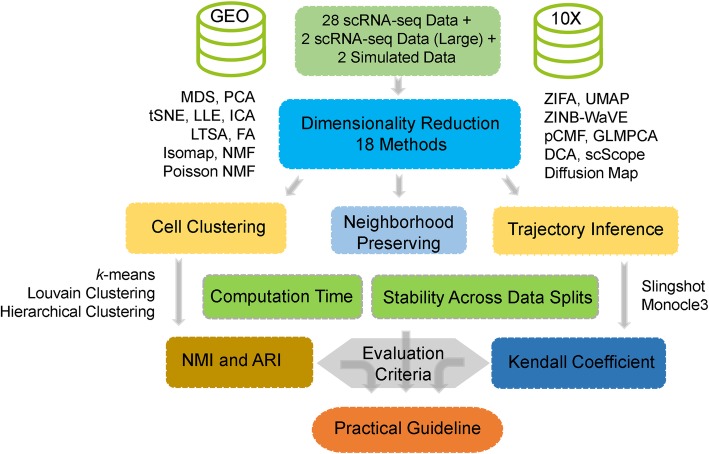
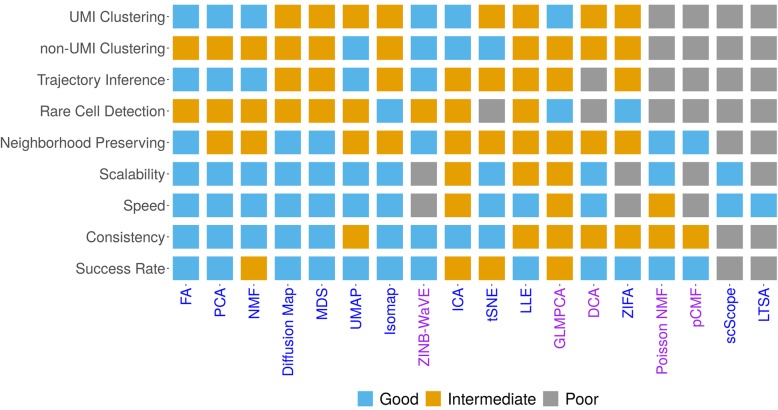
BACKGROUND: Dimensionality reduction is an indispensable analytic component for many areas of single-cell RNA sequencing (scRNA-seq) data analysis. Proper dimensionality reduction can allow for effective noise removal and facilitate many downstream analyses that include cell clustering and lineage reconstruction. Unfortunately, despite the critical importance of dimensionality reduction in scRNA-seq analysis and the vast number of dimensionality reduction methods developed for scRNA-seq studies, few comprehensive comparison studies have been performed to evaluate the effectiveness of different dimensionality reduction methods in scRNA-seq. RESULTS: We aim to fill this critical knowledge gap by providing a comparative evaluation of a variety of commonly used dimensionality reduction methods for scRNA-seq studies. Specifically, we compare 18 different dimensionality reduction methods on 30 publicly available scRNA-seq datasets that cover a range of sequencing techniques and sample sizes. We evaluate the performance of different dimensionality reduction methods for neighborhood preserving in terms of their ability to recover features of the original expression matrix, and for cell clustering and lineage reconstruction in terms of their accuracy and robustness. We also evaluate the computational scalability of different dimensionality reduction methods by recording their computational cost. CONCLUSIONS: Based on the comprehensive evaluation results, we provide important guidelines for choosing dimensionality reduction methods for scRNA-seq data analysis. We also provide all analysis scripts used in the present study at www.xzlab.org/reproduce.html.
Overview
The claims and statistics of this paper haven’t been checked yet.
Free: it reads the open-access text and checks the first 5 claims that cite a source we can check. Create a free account to check every claim.
Integrity signals
Registry
Cites
Statistics
Figures
Verification
Claims the paper makes
The claims and statistics of this paper haven’t been checked yet.
Free: it reads the open-access text and checks the first 5 claims that cite a source we can check. Create a free account to check every claim.
Claims other papers make about this one
Each is checked against this paper’s own text: does it say what the citing paper says it does?
In the citing paper
“Dimensionality reduction removes noise and simplifies subsequent analysis (Sun et al., 2019).”
From Single-Cell Sequencing of Brain Cell Transcriptomes and Epigenomes (2021) · cites this paper as Sun et al., 2019
Self-check
Percentages, sums and reported differences re-computed from the paper’s own numbers.
The self-check needs the paper’s full text.
Citations
Cites
(2008) · Journal of Machine Learning Research · Cited by 33,051
Fast unfolding of communities in large networks
Blondel, V. D., Guillaume, J.-L., Lambiotte, R., & Lefebvre, E. (2008) · Journal of Statistical Mechanics: Theory and Experiment · doi:10.1088/1742-5468/2008/10/p10008 · Cited by 21,424
Nonlinear Dimensionality Reduction by Locally Linear Embedding
Roweis, S. T., & Saul, L. K. (2000) · Science · doi:10.1126/science.290.5500.2323 · Cited by 14,965
Jolliffe, I. (2005) · Encyclopedia of Statistics in Behavioral Science · doi:10.1002/0470013192.bsa501 · Cited by 14,310
Learning the parts of objects by non-negative matrix factorization
Lee, D. D., & Seung, H. S. (1999) · Nature · doi:10.1038/44565 · Cited by 13,868
A Global Geometric Framework for Nonlinear Dimensionality Reduction
Tenenbaum, J. B., Silva, V. D., & Langford, J. C. (2000) · Science · doi:10.1126/science.290.5500.2319 · Cited by 13,585
Robust enumeration of cell subsets from tissue expression profiles
Newman, A. M., Liu, C. L., Green, M. R., Gentles, A. J., Feng, W., Xu, Y., Hoang, C. D., Diehn, M., & Alizadeh, A. A. (2015) · Nature Methods · doi:10.1038/nmeth.3337 · Cited by 13,224
Integrating single-cell transcriptomic data across different conditions, technologies, and species
Butler, A., Hoffman, P., Smibert, P., Papalexi, E., & Satija, R. (2018) · Nature Biotechnology · doi:10.1038/nbt.4096 · Cited by 13,174
Hubert, L., & Arabie, P. (1985) · Journal of Classification · doi:10.1007/bf01908075 · Cited by 8,219
Massively parallel digital transcriptional profiling of single cells
Zheng, G. X. Y., Terry, J. M., Belgrader, P., Ryvkin, P., Bent, Z. W., Wilson, R., Ziraldo, S. B., Wheeler, T. D., McDermott, G. P., Zhu, J., et al. (2017) · Nature Communications · doi:10.1038/ncomms14049 · Cited by 7,353
Self-citationTrapnell, C., Cacchiarelli, D., Grimsby, J., Pokharel, P., Li, S., Morse, M., Lennon, N. J., Livak, K. J., Mikkelsen, T. S., & Rinn, J. L. (2014) · Nature Biotechnology · doi:10.1038/nbt.2859 · Cited by 7,314
Dimensionality reduction for visualizing single-cell data using UMAP
Becht, E., McInnes, L., Healy, J., Dutertre, C.-A., Kwok, I. W. H., Ng, L. G., Ginhoux, F., & Newell, E. W. (2019) · Nature Biotechnology · doi:10.1038/nbt.4314 · Cited by 5,358
A review of feature selection techniques in bioinformatics
Saeys, Y., Inza, I., & Larrañaga, P. (2007) · Bioinformatics · doi:10.1093/bioinformatics/btm344 · Cited by 5,244
Reversed graph embedding resolves complex single-cell trajectories
Qiu, X., Mao, Q., Tang, Y., Wang, L., Chawla, R., Pliner, H. A., & Trapnell, C. (2017) · Nature Methods · doi:10.1038/nmeth.4402 · Cited by 5,070
Single-cell RNA-seq highlights intratumoral heterogeneity in primary glioblastoma
Patel, A. P., Tirosh, I., Trombetta, J. J., Shalek, A. K., Gillespie, S. M., Wakimoto, H., Cahill, D. P., Nahed, B. V., Curry, W. T., Martuza, R. L., et al. (2014) · Science · doi:10.1126/science.1254257 · Cited by 5,063
The single-cell transcriptional landscape of mammalian organogenesis
Cao, J., Spielmann, M., Qiu, X., Huang, X., Ibrahim, D. M., Hill, A. J., Zhang, F., Mundlos, S., Christiansen, L., Steemers, F. J., et al. (2019) · Nature · doi:10.1038/s41586-019-0969-x · Cited by 4,490
Full-length RNA-seq from single cells using Smart-seq2
Picelli, S., Faridani, O. R., Björklund, Å. K., Winberg, G., Sagasser, S., & Sandberg, R. (2014) · Nature Protocols · doi:10.1038/nprot.2014.006 · Cited by 4,137 · cited 4×
“These data sets cover a wide variety of sequencing techniques that include Smart-Seq2 (8 data sets), 10X Genomics (6 data sets), Smart-Seq (5 data sets), inDrop (1 data set), RamDA-seq (1 data set), sci-RNA-seq3 (1 data set), SMARTer (5 data sets), and others (3 data sets).”
BackgroundInfluentialmRNA-Seq whole-transcriptome analysis of a single cell
Tang, F., Barbacioru, C., Wang, Y., Nordman, E., Lee, C., Xu, N., Wang, X., Bodeau, J., Tuch, B. B., Siddiqui, A., et al. (2009) · Nature Methods · doi:10.1038/nmeth.1315 · Cited by 3,969
Droplet barcoding for single-cell transcriptomics applied to embryonic stem cells
Klein, A. M., Mazutis, L., Akartuna, I., Tallapragada, N., Veres, A., Li, V., Peshkin, L., Weitz, D. A., & Kirschner, M. W. (2015) · Cell · doi:10.1016/j.cell.2015.04.044 · Cited by 3,356
Slingshot: cell lineage and pseudotime inference for single-cell transcriptomics
Street, K., Risso, D., Fletcher, R. B., Das, D., Ngai, J., Yosef, N., Purdom, E., & Dudoit, S. (2018) · BMC Genomics · doi:10.1186/s12864-018-4772-0 · Cited by 3,159
Comparing community structure identification
Danon, L., Díaz-Guilera, A., Duch, J., & Arenas, A. (2005) · Journal of Statistical Mechanics: Theory and Experiment · doi:10.1088/1742-5468/2005/09/p09008 · Cited by 2,872
Regev, A., Teichmann, S. A., Lander, E. S., Amit, I., Benoist, C., Birney, E., Bodenmiller, B., Campbell, P., Carninci, P., Clatworthy, M., et al. (2017) · eLife · doi:10.7554/elife.27041 · Cited by 2,232
Accelerating t-SNE using tree-based algorithms
van der Maaten, L. (2014) · doi:10.5555/2627435.2697068 · Cited by 2,226
Single-cell mRNA quantification and differential analysis with Census
Qiu, X., Hill, A., Packer, J., Lin, D., Ma, Y.-A., & Trapnell, C. (2017) · Nature Methods · doi:10.1038/nmeth.4150 · Cited by 1,918
Self-citationCoifman, R. R., Lafon, S., Lee, A. B., Maggioni, M., Nadler, B., Warner, F., & Zucker, S. W. (2005) · Proceedings of the National Academy of Sciences · doi:10.1073/pnas.0500334102 · Cited by 1,675
A comparison of single-cell trajectory inference methods
Saelens, W., Cannoodt, R., Todorov, H., & Saeys, Y. (2019) · Nature Biotechnology · doi:10.1038/s41587-019-0071-9 · Cited by 1,670
Global characterization of T cells in non-small-cell lung cancer by single-cell sequencing
Guo, X., Zhang, Y., Zheng, L., Zheng, C., Song, J., Zhang, Q., Kang, B., Liu, Z., Jin, L., Xing, R., et al. (2018) · Nature Medicine · doi:10.1038/s41591-018-0045-3 · Cited by 1,651 · cited 1×
“[53], which consists of 12,346 single cells collected through a non-UMI based sequencing technique.”
MethodFull-length mRNA-Seq from single-cell levels of RNA and individual circulating tumor cells
Ramsköld, D., Luo, S., Wang, Y.-C., Li, R., Deng, Q., Faridani, O. R., Daniels, G. A., Khrebtukova, I., Loring, J. F., Laurent, L. C., et al. (2012) · Nature Biotechnology · doi:10.1038/nbt.2282 · Cited by 1,609
Multi-Omics Factor Analysis—a framework for unsupervised integration of multi-omics data sets
Argelaguet, R., Velten, B., Arnol, D., Dietrich, S., Zenz, T., Marioni, J. C., Buettner, F., Huber, W., & Stegle, O. (2018) · Molecular Systems Biology · doi:10.15252/msb.20178124 · Cited by 1,510
SC3: consensus clustering of single-cell RNA-seq data
Kiselev, V. Y., Kirschner, K., Schaub, M. T., Andrews, T., Yiu, A., Chandra, T., Natarajan, K. N., Reik, W., Barahona, M., Green, A. R., et al. (2017) · Nature Methods · doi:10.1038/nmeth.4236 · Cited by 1,500
Comparative Analysis of Single-Cell RNA Sequencing Methods
Ziegenhain, C., Vieth, B., Parekh, S., Reinius, B., Guillaumet-Adkins, A., Smets, M., Leonhardt, H., Heyn, H., Hellmann, I., & Enard, W. (2017) · Molecular Cell · doi:10.1016/j.molcel.2017.01.023 · Cited by 1,494
Principal Manifolds and Nonlinear Dimensionality Reduction via Tangent Space Alignment
Zhang, Z., & Zha, H. (2004) · SIAM Journal on Scientific Computing · doi:10.1137/s1064827502419154 · Cited by 1,479
Integrative single-cell analysis
Stuart, T., & Satija, R. (2019) · Nature Reviews Genetics · doi:10.1038/s41576-019-0093-7 · Cited by 1,460
Regev, A., Teichmann, S. A., Lander, E. S., Amit, I., Benoist, C. O., Birney, E., Bodenmiller, B., & Campbell, P. J. (2017) · Zurich Open Repository and Archive (University of Zurich) · doi:10.5167/uzh-162597 · Cited by 1,399
Computational and analytical challenges in single-cell transcriptomics
Stegle, O., Teichmann, S. A., & Marioni, J. C. (2015) · Nature Reviews Genetics · doi:10.1038/nrg3833 · Cited by 1,170
Challenges in unsupervised clustering of single-cell RNA-seq data
Kiselev, V. Y., Andrews, T. S., & Hemberg, M. (2019) · Nature Reviews Genetics · doi:10.1038/s41576-018-0088-9 · Cited by 1,160
Buettner, F., Natarajan, K. N., Casale, F. P., Proserpio, V., Scialdone, A., Theis, F. J., Teichmann, S. A., Marioni, J. C., & Stegle, O. (2015) · Nature Biotechnology · doi:10.1038/nbt.3102 · Cited by 1,136
Single-cell RNA-seq denoising using a deep count autoencoder
Eraslan, G., Simon, L. M., Mircea, M., Mueller, N. S., & Theis, F. J. (2019) · Nature Communications · doi:10.1038/s41467-018-07931-2 · Cited by 1,084
Li, H., Courtois, E. T., Sengupta, D., Tan, Y., Chen, K. H., Goh, J. J. L., Kong, S. L., Chua, C., Hon, L. K., Tan, W. S., et al. (2017) · Nature Genetics · doi:10.1038/ng.3818 · Cited by 1,080
(2002) · Springer Series in Statistics · doi:10.1007/b98835 · Cited by 919
Single-Cell RNA-Seq with Waterfall Reveals Molecular Cascades underlying Adult Neurogenesis
Shin, J., Berg, D. A., Zhu, Y., Shin, J. Y., Song, J., Bonaguidi, M. A., Enikolopov, G., Nauen, D. W., Christian, K. M., Ming, G.-L., et al. (2015) · Cell Stem Cell · doi:10.1016/j.stem.2015.07.013 · Cited by 784
Bias, robustness and scalability in single-cell differential expression analysis
Soneson, C., & Robinson, M. D. (2018) · Nature Methods · doi:10.1038/nmeth.4612 · Cited by 770
A general and flexible method for signal extraction from single-cell RNA-seq data
Risso, D., Perraudeau, F., Gribkova, S., Dudoit, S., & Vert, J.-P. (2018) · Nature Communications · doi:10.1038/s41467-017-02554-5 · Cited by 718
Classification of low quality cells from single-cell RNA-seq data
Ilicic, T., Kim, J. K., Kolodziejczyk, A. A., Bagger, F. O., McCarthy, D. J., Marioni, J. C., & Teichmann, S. A. (2016) · Genome Biology · doi:10.1186/s13059-016-0888-1 · Cited by 693
TSCAN: Pseudo-time reconstruction and evaluation in single-cell RNA-seq analysis
Ji, Z., & Ji, H. (2016) · Nucleic Acids Research · doi:10.1093/nar/gkw430 · Cited by 641
destiny : diffusion maps for large-scale single-cell data in R
Angerer, P., Haghverdi, L., Büttner, M., Theis, F. J., Marr, C., & Buettner, F. (2016) · Bioinformatics · doi:10.1093/bioinformatics/btv715 · Cited by 640
The Human Cell Atlas: from vision to reality
Rozenblatt-Rosen, O., Stubbington, M. J. T., Regev, A., & Teichmann, S. A. (2017) · Nature · doi:10.1038/550451a · Cited by 638
ZIFA: Dimensionality reduction for zero-inflated single-cell gene expression analysis
Pierson, E., & Yau, C. (2015) · Genome Biology · doi:10.1186/s13059-015-0805-z · Cited by 577
Wishbone identifies bifurcating developmental trajectories from single-cell data
Setty, M., Tadmor, M. D., Reich-Zeliger, S., Angel, O., Salame, T. M., Kathail, P., Choi, K., Bendall, S., Friedman, N., & Pe'er, D. (2016) · Nature Biotechnology · doi:10.1038/nbt.3569 · Cited by 558
Independent Component Analysis: A Tutorial Introduction
(2007) · Technometrics · doi:10.1198/004017007000000191 · Cited by 551
CIDR: Ultrafast and accurate clustering through imputation for single-cell RNA-seq data
Lin, P., Troup, M., & Ho, J. W. K. (2017) · Genome Biology · doi:10.1186/s13059-017-1188-0 · Cited by 537
Fast interpolation-based t-SNE for improved visualization of single-cell RNA-seq data
Linderman, G. C., Rachh, M., Hoskins, J. G., Steinerberger, S., & Kluger, Y. (2019) · Nature Methods · doi:10.1038/s41592-018-0308-4 · Cited by 534
Analysis of Multivariate Social Science Data
Bartholomew, D. J., Steele, F., Steele, F., & Moustaki, I. (2008) · Chapman & Hall/CRC eBooks · doi:10.1201/b15114 · Cited by 520
The curse(s) of dimensionality
Altman, N., & Krzywinski, M. (2018) · Nature Methods · doi:10.1038/s41592-018-0019-x · Cited by 475
Automated identification of stratifying signatures in cellular subpopulations
Bruggner, R. V., Bodenmiller, B., Dill, D. L., Tibshirani, R. J., & Nolan, G. P. (2014) · Proceedings of the National Academy of Sciences · doi:10.1073/pnas.1408792111 · Cited by 473
Feature selection and dimension reduction for single-cell RNA-Seq based on a multinomial model
Townes, F. W., Hicks, S. C., Aryee, M. J., & Irizarry, R. A. (2019) · Genome Biology · doi:10.1186/s13059-019-1861-6 · Cited by 471
Comparison of clustering methods for high‐dimensional single‐cell flow and mass cytometry data
Weber, L. M., & Robinson, M. D. (2016) · Cytometry Part A · doi:10.1002/cyto.a.23030 · Cited by 378 · cited 2×
“We then applied different DR methods to each data and used F-measure to measure the performance of rare-cell type detection following [49, 50] (details in Methods and Materials).”
MethodLinear Dimensionality Reduction: Survey, Insights, and Generalizations
Cunningham, J. P., & Ghahramani, Z. (2014) · arXiv (Cornell University) · doi:10.48550/arxiv.1406.0873 · Cited by 357
Interpretable dimensionality reduction of single cell transcriptome data with deep generative models
Ding, J., Condon, A., & Shah, S. P. (2018) · Nature Communications · doi:10.1038/s41467-018-04368-5 · Cited by 337
Exploring the single-cell RNA-seq analysis landscape with the scRNA-tools database
Zappia, L., Phipson, B., & Oshlack, A. (2018) · PLOS Computational Biology · doi:10.1371/journal.pcbi.1006245 · Cited by 317
GiniClust: detecting rare cell types from single-cell gene expression data with Gini index
Jiang, L., Chen, H., Pinello, L., & Yuan, G.-C. (2016) · Genome Biology · doi:10.1186/s13059-016-1010-4 · Cited by 300 · cited 1×
“Identifying rare cell populations can be of significant interest in certain applications and performance of rare cell type identification may not always be in line with general clustering performance [62, 63].”
BackgroundA systematic performance evaluation of clustering methods for single-cell RNA-seq data
Duò, A., Robinson, M. D., & Soneson, C. (2018) · F1000Research · doi:10.12688/f1000research.15666.2 · Cited by 296
Hayashi, T., Ozaki, H., Sasagawa, Y., Umeda, M., Danno, H., & Nikaido, I. (2018) · Nature Communications · doi:10.1038/s41467-018-02866-0 · Cited by 290
M3Drop: dropout-based feature selection for scRNASeq
Andrews, T. S., & Hemberg, M. (2019) · Bioinformatics · doi:10.1093/bioinformatics/bty1044 · Cited by 288
CHETAH: a selective, hierarchical cell type identification method for single-cell RNA sequencing
de Kanter, J. K., Lijnzaad, P., Candelli, T., Margaritis, T., & Holstege, F. C. P. (2019) · Nucleic Acids Research · doi:10.1093/nar/gkz543 · Cited by 285 · cited 2×
“The hierarchical clustering is a key ingredient of commonly applied scRNA-seq clustering methods such as CIDR [17] and CHETAH [81].”
MethodReview of the Development of Multidimensional Scaling Methods
Mead, A. (1992) · The Statistician · doi:10.2307/2348634 · Cited by 270
Wang, D., & Gu, J. (2018) · Genomics, Proteomics & Bioinformatics · doi:10.1016/j.gpb.2018.08.003 · Cited by 215
Evaluation of tools for highly variable gene discovery from single-cell RNA-seq data
Yip, S. H., Sham, P. C., & Wang, J. (2019) · Briefings in Bioinformatics · doi:10.1093/bib/bby011 · Cited by 196 · cited 1×
“The feature section methods rely on different criteria to select important genes and are also commonly used in the preprocessing step of scRNAseq data analysis [61].”
MethodSLICER: inferring branched, nonlinear cellular trajectories from single cell RNA-seq data
Welch, J. D., Hartemink, A. J., & Prins, J. F. (2016) · Genome Biology · doi:10.1186/s13059-016-0975-3 · Cited by 160
Deng, Y., Bao, F., Dai, Q., Wu, L. F., & Altschuler, S. J. (2019) · Nature Methods · doi:10.1038/s41592-019-0353-7 · Cited by 160
Efficient Algorithms for t-distributed Stochastic Neighborhood Embedding
Linderman, G. C., Rachh, M., Hoskins, J. G., Steinerberger, S., & Kluger, Y. (2017) · arXiv (Cornell University) · doi:10.48550/arxiv.1712.09005 · Cited by 145
dropClust: efficient clustering of ultra-large scRNA-seq data
Sinha, D., Kumar, A., Kumar, H., Bandyopadhyay, S., & Sengupta, D. (2018) · Nucleic Acids Research · doi:10.1093/nar/gky007 · Cited by 143
From tissues to cell types and back: single-cell gene expression analysis of tissue architecture
Chen, X., Teichmann, S. A., & Meyer, K. B. (2018) · Annual Review of Biomedical Data Science · doi:10.1146/annurev-biodatasci-080917-013452 · Cited by 112
A Critical Survey of Deconvolution Methods for Separating Cell Types in Complex Tissues
Mohammadi, S., Zuckerman, N. S., Goldsmith, A. J., & Grama, A. (2016) · Proceedings of the IEEE · doi:10.1109/jproc.2016.2607121 · Cited by 94
A systematic performance evaluation of clustering methods for single-cell RNA-seq data
Duò, A., Robinson, M. D., & Soneson, C. (2018) · F1000Research · doi:10.12688/f1000research.15666.1 · Cited by 93
Semisoft clustering of single-cell data
Zhu, L., Lei, J., Klei, L., Devlin, B., & Roeder, K. (2018) · Proceedings of the National Academy of Sciences · doi:10.1073/pnas.1817715116 · Cited by 85
Wegmann, R., Neri, M., Schuierer, S., Bilican, B., Hartkopf, H., Nigsch, F., Mapa, F., Waldt, A., Cuttat, R., Salick, M. R., et al. (2019) · Genome Biology · doi:10.1186/s13059-019-1739-7 · Cited by 79
Moana: A robust and scalable cell type classification framework for single-cell RNA-Seq data
Wagner, F., & Yanai, I. (2018) · bioRxiv (Cold Spring Harbor Laboratory) · doi:10.1101/456129 · Cited by 68 · cited 1×
“In addition, cell classification in scRNA-seq also relies on a low-dimensional structure inferred from original scRNA-seq through dimensionality reduction [74, 75].”
MethodDhaka: variational autoencoder for unmasking tumor heterogeneity from single cell genomic data
Rashid, S., Shah, S., Bar-Joseph, Z., & Pandya, R. (2021) · Bioinformatics · doi:10.1093/bioinformatics/btz095 · Cited by 58
The contribution of cell cycle to heterogeneity in single-cell RNA-seq data
McDavid, A., Finak, G., & Gottardo, R. (2016) · Nature Biotechnology · doi:10.1038/nbt.3498 · Cited by 57
Feature Selection and Dimension Reduction for Single Cell RNA-Seq based on a Multinomial ModelPreprint
Townes, F. W., Hicks, S. C., Aryee, M. J., et al. (2019) · bioRxiv (Cold Spring Harbor Laboratory) · doi:10.1101/574574 · Cited by 57
SMARTer single cell total RNA sequencing
Verboom, K., Everaert, C., Bolduc, N., Livak, K. J., Yigit, N., Rombaut, D., Anckaert, J., Lee, S., Venø, M. T., Kjems, J., et al. (2019) · Nucleic Acids Research · doi:10.1093/nar/gkz535 · Cited by 57
Cooley, S. M., Hamilton, T., Aragones, S. D., Ray, J. C. J., & Deeds, E. J. (2019) · bioRxiv (Cold Spring Harbor Laboratory) · doi:10.1101/689851 · Cited by 52
ascend : R package for analysis of single-cell RNA-seq data
Senabouth, A., Lukowski, S. W., Hernandez, J. A., Andersen, S. B., Mei, X., Nguyen, Q. H., & Powell, J. E. (2019) · GigaScience · doi:10.1093/gigascience/giz087 · Cited by 49 · cited 1×
“Multidimensional scaling (MDS) is used in ascend [22].”
MethodQuantile normalization of single-cell RNA-seq read counts without unique molecular identifiers
Townes, F. W., & Irizarry, R. A. (2020) · Genome biology · doi:10.1186/s13059-020-02078-0 · Cited by 45
From the Human Cell Atlas to dynamic immune maps in human disease
Adlung, L., & Amit, I. (2018) · Nature reviews. Immunology · doi:10.1038/s41577-018-0050-2 · Cited by 40
Chen, M., & Zhou, X. (2017) · Scientific Reports · doi:10.1038/s41598-017-13665-w · Cited by 37
Self-citationProbabilistic count matrix factorization for single cell expression data analysis
Durif, G., Modolo, L., Mold, J. E., Lambert‐Lacroix, S., & Picard, F. (2019) · Bioinformatics · doi:10.1093/bioinformatics/btz177 · Cited by 33
Bayesian deep learning for single-cell analysis
Way, G. P., & Greene, C. S. (2018) · Nature Methods · doi:10.1038/s41592-018-0230-9 · Cited by 29
Quantile normalization of single-cell RNA-seq read counts without unique molecular identifiersPreprint
Townes, F. W., & Irizarry, R. A. (2019) · bioRxiv (Cold Spring Harbor Laboratory) · doi:10.1101/817031 · Cited by 4
Swaminathan, M. S. (2002) · Nature Biotechnology · doi:10.1038/nbt0602-547a · Cited by 1
Research works printed but not linked: 1
- Sun S, Zhu J, Ma Y, Zhou X: Accuracy, robustness and scalability of dimensionality reduction methods for single-cell RNA-seq analysis. Anal Code Github Repository 2019. https://github.com/xzhoulab/DRComparison. Accessed 13 Oct 2019. PMC6902413 31823809
Cited by
Eleven grand challenges in single-cell data science
Lähnemann, D., Köster, J., Szczurek, E., McCarthy, D. J., Hicks, S. C., Robinson, M. D., Vallejos, C. A., Campbell, K. R., Beerenwinkel, N., Mahfouz, A., et al. (2020) · Genome Biology · doi:10.1186/s13059-020-1926-6 · Cited by 1,327
Tutorial: guidelines for the computational analysis of single-cell RNA sequencing data
Andrews, T. S., Kiselev, V. Y., McCarthy, D., & Hemberg, M. (2021) · Nature Protocols · doi:10.1038/s41596-020-00409-w · Cited by 306
Alignment and integration of spatial transcriptomics data
Zeira, R., Land, M., Strzalkowski, A., & Raphael, B. J. (2022) · Nature Methods · doi:10.1038/s41592-022-01459-6 · Cited by 298
Spatially aware dimension reduction for spatial transcriptomics
Shang, L., & Zhou, X. (2022) · Nature Communications · doi:10.1038/s41467-022-34879-1 · Cited by 254
“However, SpatialPCA can be potentially paired with any clustering algorithm 16 or trajectory inference algorithm 18 developed in the scRNA-seq literature to take advantage of their bene fi ts. Importantly, because SpatialPCA builds upon a data-generative model that automaticallyinfersthe spatial…”
BackgroundMethodSelf-citationSingle-Cell Sequencing of Brain Cell Transcriptomes and Epigenomes
Armand, E. J., Li, J., Xie, F., Luo, C., & Mukamel, E. A. (2021) · Neuron · doi:10.1016/j.neuron.2020.12.010 · Cited by 241
“Dimensionality reduction removes noise and simplifies subsequent analysis (Sun et al., 2019) .”
Background
Metadata
- Authors
- Sun, S., Zhu, J., Ma, Y., & Zhou, X.
- Affiliations
- Northwestern Polytechnical University (CN)
- University of Michigan (US)
- Corresponding author
- Zhou, Xiang
- Venue
- Genome biology
- Published
- 2019-12
- Volume
- 20
- Issue
- 1
- Pages
- 269-269
- ISSN
- 1465-6906 (ISSN-L)
- 1474-760X
- PMC
- PMC6902413
- OpenAlex
- W2996274328
- Cited by
- 225
- References
- 90
- Citations by year
- 2026: 20 · 2025: 27 · 2024: 37 · 2023: 34 · 2022: 36 · 2021: 51 · 2020: 18 · 2019: 2
- FWCI
- 8.85
- Type
- journal article
- Language
- en
- Open access
- gold
- doi.org
- Licence
- cc-by
- creativecommons.org/licenses/by/4.0/ (tdm)
- creativecommons.org/licenses/by/4.0/ (vor, 9 d)
- Locations
- Genome biology (publishedVersion, cc-by)
- bioRxiv (Cold Spring Harbor Laboratory) (acceptedVersion, cc-by)
- PubMed Central (publishedVersion, cc-by)
- PubMed (publishedVersion)
- Deep Blue (University of Michigan) (submittedVersion)
- DOAJ (DOAJ: Directory of Open Access Journals) (submittedVersion, cc-by-sa)
- Funders
- the National Institutes of Health (R01HG009124, R01GM126553, R01HD088558, U01HL137182)
- the National Science Foundation (DMS1712933)
- the Chan Zuckerberg Initiative DAF (2018-181314)
- the National Natural Science Foundation of China (61902319)
- the Natural Science Foundation of Shaanxi Province (2019JQ127)
- Topics
- Life Sciences › Biochemistry, Genetics and Molecular Biology › Molecular Biology › Single-cell and spatial transcriptomics
- Life Sciences › Biochemistry, Genetics and Molecular Biology › Molecular Biology › Gene expression and cancer classification
- Life Sciences › Biochemistry, Genetics and Molecular Biology › Molecular Biology › Genomics and Phylogenetic Studies
- Keywords
- dimensionality reduction, single-cell RNA sequencing, method comparison, neighborhood preservation, cell clustering, lineage reconstruction, computational scalability, robustness, noise reduction, reproducibility
- MeSH terms
- Cluster Analysis, Sequence Analysis, RNA, Single-Cell Analysis, Dimensional Measurement Accuracy
About these checks
Registry, retraction, Cites and statistics results are computed, not judged, with one exception: a printed reference that no index lists is read once by a model before it counts as a citation error. Claims are extracted by a model and kept only when their quote appears verbatim in the text; each cited source is then checked, with a model’s help, for whether it says what the claim relies on. Those verdicts can be wrong — read the claim’s quote and the cited source before relying on one.
Statistics and arithmetic are recomputed, not judged.
Confidence bands are shown only for fields calibrated on our annotated test set. None is calibrated yet, so no band is shown.
What counts as a claim ›How we measure confidence ›How we check this ›
Are you an author, or do you see a problem with this page? Request a review
Data sources
Bibliographic data: Semantic Scholar, OpenAlex, Crossref.
Contains information from the Semantic Scholar Academic Graph Datasets, made available under the ODC Attribution License (ODC-BY 1.0).
Semantic Scholar’s data is described in: Kinney, R., et al. (2023). The Semantic Scholar Open Data Platform. arXiv:2301.10140.
