

The DOI matches its Crossref record; 75 of the 81 references it cites were found in a registry or an index; 14 of the 58 sources its claims cite were checked for support.
Acceptance and Commitment Therapy preceded by an experimental Attention Bias Modification procedure in recurrent depression: study protocol for a randomized controlled trial
Open accessAbstract
Background: This project studies the effect of group-based Acceptance and Commitment Therapy (ACT) following Attention Bias Modification (ABM) on residual symptoms in recurrent depression. ACT is a cognitive-behavioral intervention combining acceptance and mindfulness processes with commitment and behavior-change processes. ACT enjoys modest empirical support in treating depression and has also shown promising results in secondary prevention of depression. The experimental cognitive bias modification (ABM) procedure has been shown to reduce surrogate markers of depression vulnerability in patients in remission from depression. The aim of the current project is to investigate if the effect of group-based ACT on reducing residual depressive symptoms can be enhanced by preceding it with ABM. Also, assessment of the relationship between conceptually relevant therapeutic processes and outcome will be investigated. Methods/design: An invitation to participate in this project was extended to 120 individuals within a larger sample who had just completed a separate randomized, multisite, clinical trial (referred to hereafter as Phase 1) in which they received either ABM (n = 60) or a control condition without bias modification (n = 60). This larger Phase-1 sample consisted of 220 persons with a history of at least two episodes of major depression who were currently in remission or not fulfilling the criteria of major depression. After its inclusion, Phase-1 participants from the Sørlandet site (n = 120) were also recruited for this study in which they received an 8-week group-based ACT intervention. Measures will be taken immediately after Phase 1, 1 month, 2 months, 6 months, and 1 year after the conclusion of Phase 1. Discussion: This study sequentially combines acceptable, nondrug interventions from neuropsychology and cognitive-behavioral psychology in treating residual symptoms in depression. The results will provide information about the effectiveness of treatment and on mechanisms and processes of change that may be valuable in understanding and further developing ABM and ACT, combined and alone. © 2018 The Author(s).
Overview
CoChat Summary
TL;DR
This is a study protocol for a randomized controlled trial testing whether 8-week group-based Acceptance and Commitment Therapy (ACT) after Attention Bias Modification (ABM) reduces residual symptoms in recurrent depression better than ACT after a control condition. The paper reports the planned design, sample, outcomes, and analyses, but not trial results.
Key findings
- The trial is designed to compare group-based ACT after ABM versus ACT after a control condition in people with recurrent depression in remission or not currently meeting criteria for major depression.
- The planned sample is 220 participants in Phase 1, with 120 from the Sørlandet site invited into the ACT phase; half of these (60) are expected to have received ABM and half control.
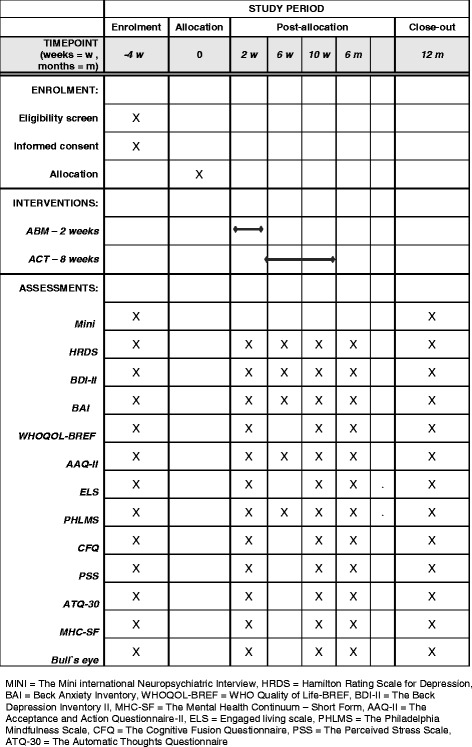
- ABM is delivered twice daily for 14 days, for 28 sessions total, and the ACT phase is an 8-week group intervention.
- The primary outcome is change in residual depressive symptoms measured with both self-report and clinician-rating scales at six assessment points; secondary outcomes include recurrence of major depressive episodes at 12 months, anxiety, quality of life, flourishing, and early morning cortisol response.
Methods
- Protocol for a randomized controlled trial built as a two-phase design: Phase 1 randomization to ABM or no-bias-modification control, followed by ACT for the Sørlandet participants.
- Participants: history of major depression, currently in remission; age 18–65; exclusions include neurological illness, bipolar disorder, psychosis, drug addiction, and ADHD/ADD.
- Primary analysis planned as intention-to-treat using mixed models; potential confounders checked with t tests and included as covariates, with multiple regressions for moderators and mediation.
Limitations
- The paper is a protocol, so no outcome data or effectiveness results are reported yet.
- The authors note that there are no relevant studies to guide expectations for the sequential combination of ABM and ACT versus ACT alone; this is a stated evidence gap.
- Evident limitation: because ACT is only given to the Sørlandet subgroup (n = 120), the study design is not described as a fully balanced trial across the full Phase-1 sample; this is inferred from the text.
Model-written summary. Check it against the paper before relying on it.
Integrity signals
Registry
Cites
Statistics
Figures




Verification
Claims the paper makes
11 Valid · 0 Not valid · 29 Not checked · 12 Own results and interpretations
The cited sources support only part of this claim — read each source’s verdict below.
In the paper
“Unfortunately, some projects have been limited by small sample sizes and poor trial methodology [20–23].”
§ Acceptance and Commitment Therapy preceded by an experimental Attention Bias Modification procedure in recurrent depression: study protocol for a randomized controlled trial > Background > Attention Bias Modification
What the sources say
- Partly supportedcites [20] Grafton B, MacLeod C, Rudaizky D, Holmes EA, Salemink E, Fox E, Notebaert L. Confusing procedures with process when appraising the impact of cognitive bias modification on emotional vulnerability. Br J Psychiatry. 2017;211(5):266–71. sourceExperimental — accuracy not yet measured
In “Implications and future directions” (page not provided), the paper says some attention-bias modification procedures were delivered through less rigorous approaches, particularly in uncontrolled home environments. It does not identify small sample sizes as a limitation, so that part of the claim is unsupported by our copy. (LLM, conf=0.84)
- Not checked — no full text of the sourcecites [21] Jones EB, Sharpe L. Cognitive bias modification: a review of meta-analyses. J Affect Disord. 2017;223:175–83. source
- Supportedcites [22] Cristea IA, Kok RN, Cuijpers P. Efficacy of cognitive bias modification interventions in anxiety and depression: meta-analysis. Br J Psychiatry. 2015;206(1):7–16. source
The Implications section describes early cognitive bias modification studies as pilot, low-powered studies and says well-powered, methodologically appropriate trials were lacking. The Quality of the included studies section reports that 33 of 49 trials met fewer than three of five quality criteria. The paper includes attention bias modification among the interventions it reviews; page numbers were not available in our copy. (LLM, conf=0.88)
- Not checked — no full text of the sourcecites [23] Hallion LS, Ruscio AM. A meta-analysis of the effect of cognitive bias modification on anxiety and depression. Psychol Bull. 2011;137(6):940–58. source
plain- Asserted: passes — The authors put it forward as true.
- Checkable: passes — It can be checked against evidence.
- Load-bearing: unclear — It is unclear whether the paper’s conclusions depend on it.
- Based: passes — The paper gives a reason why it holds.
- Partly supported
Every source the paper cites for this claim was checked and supports it.
In the paper
“Preventive strategies that identify and ameliorate these factors ostensibly could reduce risk of subsequent episodes [6].”
§ Acceptance and Commitment Therapy preceded by an experimental Attention Bias Modification procedure in recurrent depression: study protocol for a randomized controlled trial > Background
What the sources say
- Supportedcites [6] Bhagwagar Z, Cowen PJ. ‘It's not over when it's over’: persistent neurobiological abnormalities in recovered depressed patients. Psychol Med. 2008;38(03):307–13. source
The Introduction says that understanding vulnerability factors might improve identification of people at high risk of recurrence and lead to new prevention methods. The Discussion (p. 309) likewise proposes using neurobiological markers to guide early interventions that might have a preventive role. This supports the citing sentence’s qualified claim that such strategies could reduce subsequent episodes. (LLM, conf=0.91)
hedgedstates a possible cause- Asserted: passes — The authors put it forward as true.
- Checkable: passes — It can be checked against evidence.
- Load-bearing: passes — The paper’s conclusions depend on it.
- Based: passes — The paper gives a reason why it holds.
- Supported
Every source the paper cites for this claim was checked and supports it.
In the paper
“Correlational and experimental evidence indicates that experiential avoidance, as the converse of acceptance, contributes to the development and maintenance of different psychological and behavioral problems [32].”
§ Acceptance and Commitment Therapy preceded by an experimental Attention Bias Modification procedure in recurrent depression: study protocol for a randomized controlled trial > Background > Acceptance and Commitment Therapy Acceptance and Commitment Therapy (ACT) is a modern cognitive-behavior therapy that combines acceptance and mindfulness processes, with commitment and behavior-change processes. ACT is a transdiagnostic model that focuses on pathogenic processes that are hypothesized to be common in different forms of human suffering [26]. The main goal in ACT is to foster psychological flexibility, which is defined as “the ability to contact the present moment more fully as a conscious human being and to change, or persist in, behavior when doing so serves valued ends” ([27], p. 7). Psychological flexibility has shown to be associated with higher life satisfaction, emotional well-being, job performance, and job satisfaction [28–31]. Because ACT focuses on promoting psychological flexibility, rather than removing psychopathology, ACT is hypothesized to be well suited for the prevention of psychological disorders [32]. Psychological flexibility, in turn, is strengthened through the six core processes of (1) acceptance, (2) defusion, (3) self as context, (4) committed action, (5) values, and (6) contact with the present moment [32]. Of these six process, acceptance has received the most attention. Correlational and experimental evidence indicates that experiential avoidance, as the converse of acceptance, contributes to the development and maintenance of different psychological and behavioral problems [32]. A basic tenet of ACT is that by nurturing and developing a more accepting and psychologically flexible stance makes it possible to remain in contact with the uncomfortable experiences, while remaining focused on what one wants life to be about both now, and in the future. Another process contributing to psychological flexibility that ACT addresses, that would appear to be of greater relevance for the rationale of this study, is that of present-moment awareness. To somewhat varying degrees and via differing means, ACT protocols seek to strengthen mindfulness in a manner consistent with that of Jon Kabat-Zinn [33] as “paying attention in a particular way: on purpose, in the present moment, nonjudgmentally” (p. 4). Depressed clients are encouraged to “just notice” with an accepting attitude thoughts, emotions, and bodily sensations that might otherwise be responded to in a ruminative and experientially avoidant manner.
What the sources say
- Supportedcites [32] Biglan A, Hayes SC, Pistorello J. Acceptance and commitment: implications for prevention science. Prev Sci. 2008;9(3):139–52. source
The “Empirical Evidence Regarding Experiential Avoidance” section explicitly says that correlational and experimental evidence indicates EA contributes to diverse psychological and behavioral difficulties. Its longitudinal findings and the “Diathesis-Stress Model of Experiential Avoidance” section further describe EA as a risk factor that can amplify distress over time. Page numbers are unavailable in our copy. (LLM, conf=0.93)
hedgedstates a cause- Asserted: passes — The authors put it forward as true.
- Checkable: passes — It can be checked against evidence.
- Load-bearing: passes — The paper’s conclusions depend on it.
- Based: passes — The paper gives a reason why it holds.
- Supported
The sources with a verdict support this claim; the rest weren’t checked yet, have no full text we could read, or their verdicts aren’t rated yet.
In the paper
“While overall findings have been mixed, studies that have found measurable positive changes in emotional biases with ABM, have also reported associated changes in clinical symptoms [13, 24, 25].”
§ Acceptance and Commitment Therapy preceded by an experimental Attention Bias Modification procedure in recurrent depression: study protocol for a randomized controlled trial > Background > Attention Bias Modification
What the sources say
- Supportedcites [13] Browning M, Holmes EA, Charles M, Cowen PJ, Harmer CJ. Using attentional bias modification as a cognitive vaccine against depression. Biol Psychiatry. 2012;72(7):572–9. source
The Results report that positive face-based ABM increased positive attentional bias and reduced residual depressive symptoms compared with placebo. This supports the claim that a study finding a measurable bias change also reported a symptom change. The paper did not find a significant correlation between the two changes within participants, so it does not establish that stronger bias changes predicted stronger symptom improvements. (LLM, conf=0.88)
- Supportedcites [24] Li H, Wei D, Browning M, Du X, Zhang Q, Qiu J. Attentional bias modification (ABM) training induces spontaneous brain activity changes in young women with subthreshold depression: a randomized controlled trial. Psychol Med. 2016;46(5):909–20. source
In ‘The effect of ABM on attentional bias’ (page unavailable), the ABM group showed increased attention toward positive stimuli. ‘The effect of ABM on Symptom Changes’ reports significant reductions in depressive and anxiety symptoms in that group. The Discussion notes that the attentional-bias difference between ABM and active control was not significant, so the finding should not be read as a demonstrated between-group bias effect. (LLM, conf=0.88)
- Not checked — no full text of the sourcecites [25] Wells TT, Beevers CG. Biased attention and dysphoria: manipulating selective attention reduces subsequent depressive symptoms. Cognit Emot. 2010;24(4):719–28. source
plainstates an association- Asserted: passes — The authors put it forward as true.
- Checkable: passes — It can be checked against evidence.
- Load-bearing: passes — The paper’s conclusions depend on it.
- Based: passes — The paper gives a reason why it holds.
- Supported
Every source the paper cites for this claim was checked and supports it.
In the paper
“Statistical power analysis using G*Power [43] indicates that with an α-level at 0.05 and, a β-level at 0.10, the total sample size in a design like this should be 206 to detect differences in the main and interaction effects of a moderate to medium effect size, f = 0.25, with a one-two-way analysis of variance (ANOVA).”
§ Acceptance and Commitment Therapy preceded by an experimental Attention Bias Modification procedure in recurrent depression: study protocol for a randomized controlled trial > Methods/design > Sample size and power
What the sources say
- Supportedcites [43] Faul F, Erdfelder E, Lang A-G, Buchner A. G*power 3: a flexible statistical power analysis program for the social, behavioral, and biomedical sciences. Behav Res Methods. 2007;39:175–91. source
The citation immediately follows “G*Power,” identifying the program used for the citing authors’ calculation rather than attributing their sample-size result to Faul et al. The source’s “Program Handling” and “Tests for Means (Univariate Case)” sections describe a priori sample-size calculations and ANOVA main-effect and interaction tests using effect size f; the latter identifies f = 0.25 as medium. Page numbers are not available in our copy. (LLM, conf=0.88)
hedged- Asserted: passes — The authors put it forward as true.
- Checkable: passes — It can be checked against evidence.
- Load-bearing: passes — The paper’s conclusions depend on it.
- Based: passes — The paper gives a reason why it holds.
- Supported
17 more claims · 1 with their cited sources checked
Create a free account to see all 52 claims and every source verdict.
- Probably not a substantial claim. 24
- It may state two separate claims as one. 13
Citations
Cites
Baron, R. M., & Kenny, D. A. (1986) · Journal of Personality and Social Psychology · doi:10.1037/0022-3514.51.6.1173 · Cited by 91,532 · cited 1×
“Multiple regressions will be considered to explore potential moderators, and how acceptance, values, engaged living, mindfulness, cognitive fusion, psychological stress and automatic thoughts mediate outcome [71].”
Faul, F., Erdfelder, E., Lang, A.-G., & Buchner, A. (2007) · Behavior Research Methods · doi:10.3758/bf03193146 · Cited by 65,971 · cited 2×
“Statistical power analysis using G*Power [43] indicates that with an α-level at 0.”
InfluentialHamilton, M. (1960) · Journal of Neurology, Neurosurgery & Psychiatry · doi:10.1136/jnnp.23.1.56 · Cited by 32,817 · cited 2×
“The Hamilton Rating Scale for Depression (HRDS) [46, 47] is a widely used semi-structured clinical inter-view measuring the severity of depressive symptomatology covering a range of affective, behavioral and biological symptoms.”
An inventory for measuring clinical anxiety: Psychometric properties.
Beck, A. T., Epstein, N., Brown, G., & Steer, R. A. (1988) · Journal of Consulting and Clinical Psychology · doi:10.1037/0022-006x.56.6.893 · Cited by 14,407 · cited 3×
“The BAI has been found to have high internal consistency and has shown good convergent and divergent validity [50, 51] Changes in quality of life Quality in life is measured by the WHO Quality of Life-BREF (WHOQOL-BREF) [52, 53], which is a 26-item version of the WHOQOL-100 assessment.”
Depression and quality of life in older persons: A review
Sivertsen, H., Bjørkløf, G. H., Engedal, K., Selbæk, G., & Helvik, A.-S. (2015) · Dementia and Geriatric Cognitive Disorders · doi:10.1159/000437299 · Cited by 14,152
Development of a Rating Scale for Primary Depressive Illness
HAMILTON, M. (1967) · British Journal of Social and Clinical Psychology · doi:10.1111/j.2044-8260.1967.tb00530.x · Cited by 8,410 · cited 2×
“The Hamilton Rating Scale for Depression (HRDS) [46, 47] is a widely used semi-structured clinical inter-view measuring the severity of depressive symptomatology covering a range of affective, behavioral and biological symptoms.”
Development of the World Health Organization WHOQOL-BREF Quality of Life Assessment
THE WHOQOL GROUP (1998) · Psychological Medicine · doi:10.1017/s0033291798006667 · Cited by 7,933 · cited 2×
“The BAI has been found to have high internal consistency and has shown good convergent and divergent validity [50, 51] Changes in quality of life Quality in life is measured by the WHO Quality of Life-BREF (WHOQOL-BREF) [52, 53], which is a 26-item version of the WHOQOL-100 assessment.”
Beck, A. T., Steer, R. A., & Brown, G. (2011) · PsycTESTS Dataset · doi:10.1037/t00742-000 · Cited by 7,535
Acceptance and commitment therapy: model, processes and outcomes
Hayes, S. C., Luoma, J. B., Bond, F. W., Masuda, A., & Lillis, J. (2006) · Behaviour Research and Therapy · doi:10.1016/j.brat.2005.06.006 · Cited by 6,587 · cited 1×
“The main goal in ACT is to foster psychological flexibility, which is defined as “the ability to contact the present moment more fully as a conscious human being and to change, or persist in, behavior when doing so serves valued ends” ([27], p.”
Skevington, S. M., Lotfy, M., & O'Connell, K. A. (2004) · Quality of Life Research · doi:10.1023/b:qure.0000018486.91360.00 · Cited by 4,686 · cited 3×
“The BAI has been found to have high internal consistency and has shown good convergent and divergent validity [50, 51] Changes in quality of life Quality in life is measured by the WHO Quality of Life-BREF (WHOQOL-BREF) [52, 53], which is a 26-item version of the WHOQOL-100 assessment.”
Research works printed but not linked: 2
- National Institute for Health and Clinical Excellence: Treatment and management of depression in adults, including adults with a chronic physical health problem: National Clinical Practice Guideline number 23 (update). 2009.
- Plumb J, Hayes S, Hildebrandt M, Martin L. Values and valued action as key processes in clinical intervention. In: Symposium ‘engaging in life: values and valued action as catalysts for change’(JC plumb, chair) meeting of the Association for Behavior Analysis, San Diego, May: 2007; 2007.
Cited by
Østergaard, T., Lundgren, T., Zettle, R. D., Landrø, N. I., & Haaland, V. Ø. (2020) · Frontiers in Psychology · doi:10.3389/fpsyg.2020.00528 · Cited by 45
Østergaard, T., Lundgren, T., Rosendahl, I. K., Zettle, R. D., Jonassen, R., Harmer, C. J., Stiles, T. C., Landrø, N. I., & Haaland, V. Ø. (2019) · Frontiers in Psychology · doi:10.3389/fpsyg.2019.01995 · Cited by 15
Self-citationEl Morr, C. (2019) · International Journal of Extreme Automation and Connectivity in Healthcare · doi:10.4018/ijeach.2019010102 · Cited by 10
Corman, M., Aubret, D., Ghazal, J., Berthon, M., Chaussé, P., Lohou, C., & Dambrun, M. (2019) · Journal of Behavior Therapy and Experimental Psychiatry · doi:10.1016/j.jbtep.2019.101525 · Cited by 9
Easton, K., Kellett, S., Cooper, M., Millings, A., Varela, J., & Parry, G. D. (2021) · JMIR Mental Health · doi:10.2196/20213 · Cited by 3
Metadata
- Authors
- Østergaard, T., Lundgren, T., Zettle, R., Jonassen, R., Harmer, C. J., Stiles, T. C., Landrø, N. I., & Haaland, V. Ø.
- Affiliations
- University of Oslo (NO)
- Karolinska Institutet (SE)
- Wichita State University (US)
- University of Oxford (GB)
- Norwegian University of Science and Technology (NO)
- Corresponding author
- Østergaard, Tom
- ORCID
- Venue
- Trials
- Published
- 2018-03-27
- Volume
- 19
- Issue
- 1
- Pages
- 203-203
- ISSN
- 1745-6215 (ISSN-L)
- PMC
- PMC5870819
- OpenAlex
- W2795491928
- Cited by
- 10
- References
- 81
- Citations by year
- 2026: 1 · 2023: 1 · 2021: 2 · 2020: 3 · 2019: 2 · 2018: 1
- FWCI
- 2.34
- Type
- journal article
- Language
- en
- Open access
- gold
- doi.org
- Licence
- cc-by
- creativecommons.org/licenses/by/4.0/ (tdm)
- Locations
- Trials (publishedVersion, cc-by)
- PubMed Central (publishedVersion, cc-by)
- PubMed (publishedVersion)
- DOAJ (DOAJ: Directory of Open Access Journals) (submittedVersion, cc-by-sa)
- NORA - Norwegian Open Research Archives (submittedVersion, cc-by)
- Holmes Museum Of Anthropology (Wichita State University) (submittedVersion)
- Funders
- Helse Sør-Øst RHF (2015056)
- Topics
- Social Sciences › Psychology › Clinical Psychology › Mindfulness and Compassion Interventions
- Social Sciences › Psychology › Experimental and Cognitive Psychology › Anxiety, Depression, Psychometrics, Treatment, Cognitive Processes
- Social Sciences › Psychology › Clinical Psychology › Psychotherapy Techniques and Applications
- Keywords
- acceptance and commitment therapy, attentional bias modification, recurrent depression, residual depressive symptoms, cognitive bias modification, depression remission, mechanisms of change
- MeSH terms
- Attentional Bias, Adolescent, Adult, Aged, Depression, Female, Humans, Male, Middle Aged, Norway, Psychotherapy, Group, Recurrence, Remission Induction, Time Factors, Multicenter Studies as Topic, Randomized Controlled Trials as Topic, Treatment Outcome, Young Adult, Acceptance and Commitment Therapy
About these checks
Registry, retraction, Cites and statistics results are computed, not judged, with one exception: a printed reference that no index lists is read once by a model before it counts as a citation error. Claims are extracted by a model and kept only when their quote appears verbatim in the text; each cited source is then checked, with a model’s help, for whether it says what the claim relies on. Those verdicts can be wrong — read the claim’s quote and the cited source before relying on one.
The claim verdicts this report counts are experimental: their accuracy is not yet measured.
A language model drew the claims from the paper on 2026-10-11, under version 3 of the claim definition (model deepseek-v4.1-flash, prompt extract-v3).
A second model labelled each claim on 2026-10-11 (model jev-1.13-20260917, definition revision gold-guideline-v0.2).
Cited sources are checked with a language model’s help (gpt-6-sol).
Statistics and arithmetic are recomputed, not judged.
Confidence bands are shown only for fields calibrated on our annotated test set. None is calibrated yet, so no band is shown.
What counts as a claim ›How we measure confidence ›How we check this ›
Are you an author, or do you see a problem with this page? Request a review
How to cite
Cite CoChat for the checks on this page, and the paper for its own findings.
- This page
- CoChat. (2026). Citation check: Acceptance and Commitment Therapy preceded by an experimental Attention Bias Modification procedure in recurrent depression: study protocol for a randomized controlled trial. https://app.cochat.ai/papers/10.1186/s13063-018-2515-9
- The paper
- Østergaard, T., Lundgren, T., Zettle, R., Jonassen, R., Harmer, C. J., Stiles, T. C., Landrø, N. I., & Haaland, V. Ø. (2018). Acceptance and Commitment Therapy preceded by an experimental Attention Bias Modification procedure in recurrent depression: study protocol for a randomized controlled trial. Trials. https://doi.org/10.1186/s13063-018-2515-9
Data sources
Bibliographic data: Semantic Scholar, OpenAlex, Crossref.
Contains information from the Semantic Scholar Academic Graph Datasets, made available under the ODC Attribution License (ODC-BY 1.0).
Semantic Scholar’s data is described in: Kinney, R., et al. (2023). The Semantic Scholar Open Data Platform. arXiv:2301.10140.
