

Functional implications of microbial and viral gut metagenome changes in early stage L-DOPA-naive Parkinson's disease patients
Open accessThe DOI matches its Crossref record; 88 of the 89 references it cites were found in a registry or an index.
Abstract
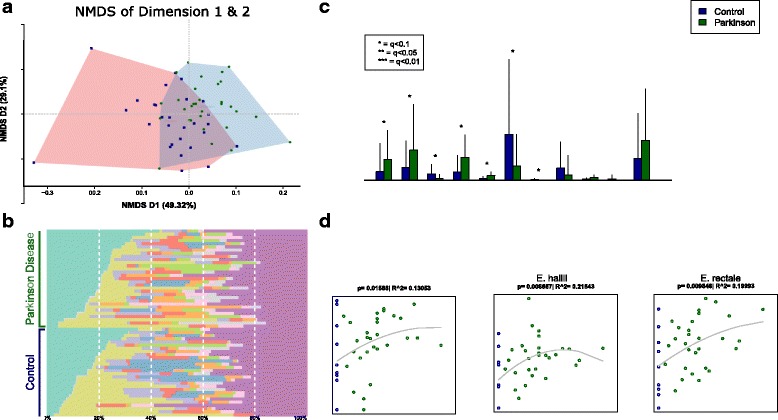
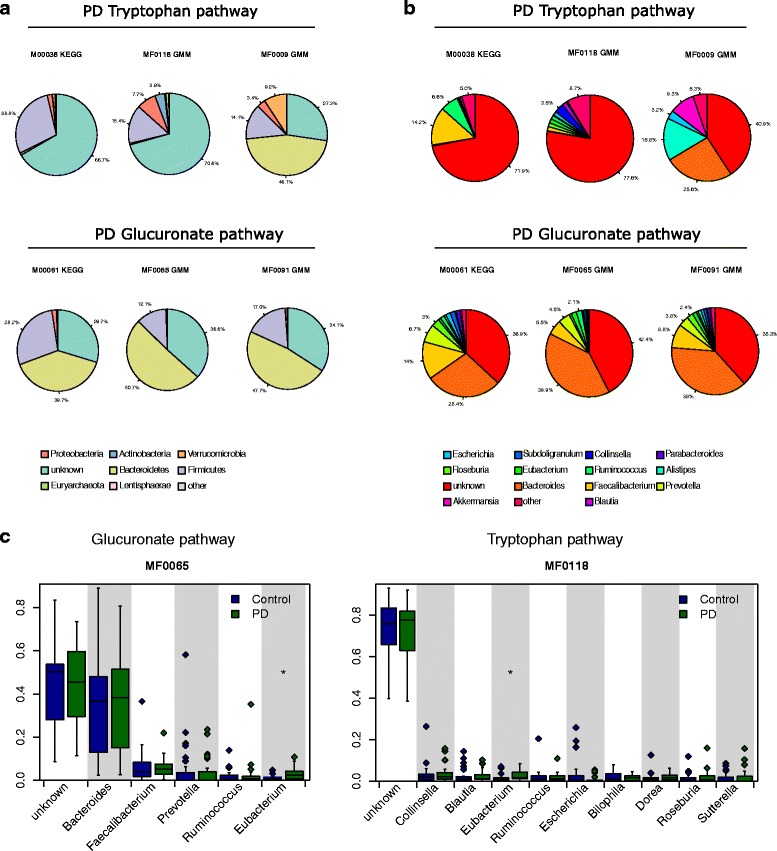
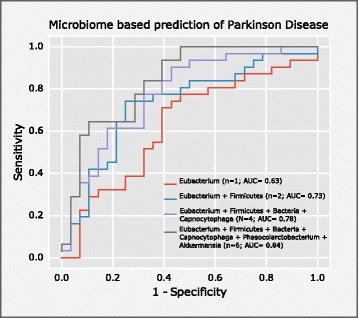
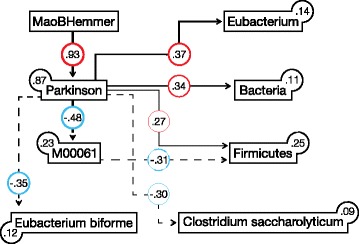
BACKGROUND: Parkinson's disease (PD) presently is conceptualized as a protein aggregation disease in which pathology involves both the enteric and the central nervous system, possibly spreading from one to another via the vagus nerves. As gastrointestinal dysfunction often precedes or parallels motor symptoms, the enteric system with its vast diversity of microorganisms may be involved in PD pathogenesis. Alterations in the enteric microbial taxonomic level of L-DOPA-naïve PD patients might also serve as a biomarker. METHODS: We performed metagenomic shotgun analyses and compared the fecal microbiomes of 31 early stage, L-DOPA-naïve PD patients to 28 age-matched controls. RESULTS: We found increased Verrucomicrobiaceae (Akkermansia muciniphila) and unclassified Firmicutes, whereas Prevotellaceae (Prevotella copri) and Erysipelotrichaceae (Eubacterium biforme) were markedly lowered in PD samples. The observed differences could reliably separate PD from control with a ROC-AUC of 0.84. Functional analyses of the metagenomes revealed differences in microbiota metabolism in PD involving the ẞ-glucuronate and tryptophan metabolism. While the abundances of prophages and plasmids did not differ between PD and controls, total virus abundance was decreased in PD participants. Based on our analyses, the intake of either a MAO inhibitor, amantadine, or a dopamine agonist (which in summary relates to 90% of PD patients) had no overall influence on taxa abundance or microbial functions. CONCLUSIONS: Our data revealed differences of colonic microbiota and of microbiota metabolism between PD patients and controls at an unprecedented detail not achievable through 16S sequencing. The findings point to a yet unappreciated aspect of PD, possibly involving the intestinal barrier function and immune function in PD patients. The influence of the parkinsonian medication should be further investigated in the future in larger cohorts.
Overview
The claims and statistics of this paper haven’t been checked yet.
Free: it reads the open-access text and checks the first 5 claims that cite a source we can check. Create a free account to check every claim.
Integrity signals
Registry
Cites
Statistics
Figures
Verification
Claims the paper makes
The claims and statistics of this paper haven’t been checked yet.
Free: it reads the open-access text and checks the first 5 claims that cite a source we can check. Create a free account to check every claim.
Self-check
Percentages, sums and reported differences re-computed from the paper’s own numbers.
The self-check needs the paper’s full text.
Citations
Cites
Controlling the False Discovery Rate: A Practical and Powerful Approach to Multiple Testing
Benjamini, Y., & Hochberg, Y. (1995) · Journal of the Royal Statistical Society Series B: Statistical Methodology · doi:10.1111/j.2517-6161.1995.tb02031.x · Cited by 109,482 · cited 1×
“PERMANOVA post hoc P values were corrected for multiple testing using the Benjamini–Hochberg false discovery rate (q-value) [36].”
MethodScikit-learn: Machine Learning in Python
Pedregosa, F., Varoquaux, G., Gramfort, A., Michel, V., Thirion, B., Grisel, O., Blondel, M., Müller, A., Nothman, J., Louppe, G., et al. (2012) · arXiv · doi:10.48550/arxiv.1201.0490 · Cited by 71,016
Fast and sensitive protein alignment using DIAMOND
Buchfink, B., Xie, C., & Huson, D. H. (2015) · Nature Methods · doi:10.1038/nmeth.3176 · Cited by 14,201 · cited 1×
“MOCAT2 quality filtered reads were mapped against the ACLAME [30] database using Diamond [31] in sensitive mode, after format conversion from fastq to fasta using sdm [32].”
MethodA new method for non-parametric multivariate analysis of variance
Anderson, M. J. (2001) · Austral Ecology · doi:10.1111/j.1442-9993.2001.01070.pp.x · Cited by 13,828 · cited 1×
“Intergroup differences for the microbiota were calculated using a PERMANOVA test as implemented in vegan [35].”
MethodHughes, A. J., Daniel, S. E., Kilford, L., & Lees, A. J. (1992) · Journal of Neurology, Neurosurgery & Psychiatry · doi:10.1136/jnnp.55.3.181 · Cited by 10,378
Diet rapidly and reproducibly alters the human gut microbiome
David, L. A., Maurice, C. F., Carmody, R. N., Gootenberg, D. B., Button, J. E., Wolfe, B. E., Ling, A. V., Devlin, A. S., Varma, Y., Fischbach, M. A., et al. (2014) · Nature · doi:10.1038/nature12820 · Cited by 10,100 · cited 1×
“In particular, Prevotella enrichment has been linked to non-Western and/or fiberrich diets [56, 57].”
BackgroundHuman gut microbiome viewed across age and geography
Yatsunenko, T., Rey, F. E., Manary, M. J., Trehan, I., Dominguez-Bello, M. G., Contreras, M., Magris, M., Hidalgo, G., Baldassano, R. N., Anokhin, A. P., et al. (2012) · Nature · doi:10.1038/nature11053 · Cited by 7,815 · cited 1×
“The Prevotella enterotype is the least prevalent in human individuals [53] and is related to dietary/fiber intake [54, 55].”
BackgroundEnterotypes of the human gut microbiome
MetaHIT Consortium (additional members), Arumugam, M., Raes, J., Pelletier, E., Le Paslier, D., Yamada, T., Mende, D. R., Fernandes, G. R., Tap, J., Bruls, T., et al. (2011) · Nature · doi:10.1038/nature09944 · Cited by 7,548 · cited 1×
“The Prevotella enterotype is the least prevalent in human individuals [53] and is related to dietary/fiber intake [54, 55].”
BackgroundSelf-citationLinking long-term dietary patterns with gut microbial enterotypes
Wu, G. D., Chen, J., Hoffmann, C., Bittinger, K., Chen, Y.-Y., Keilbaugh, S. A., Bewtra, M., Knights, D., Walters, W. A., Knight, R., et al. (2011) · Science · doi:10.1126/science.1208344 · Cited by 6,513
De Filippo, C., Cavalieri, D., Di Paola, M., Ramazzotti, M., Poullet, J. B., Massart, S., Collini, S., Pieraccini, G., & Lionetti, P. (2010) · Proceedings of the National Academy of Sciences · doi:10.1073/pnas.1005963107 · Cited by 5,579 · cited 1×
“In particular, Prevotella enrichment has been linked to non-Western and/or fiberrich diets [56, 57].”
Background
Cited by
Items 501–600 of 755
Gonçalves, A. R., Ranganathan, H., Valdes, C., Zhu, H., Zhang, B., Kok, C. R., Martí, J. M., Mulakken, N., Thissen, J. B., Jaing, C. J., et al. (2026) · Frontiers in Microbiology · doi:10.3389/fmicb.2025.1695501 · Cited by 4
Gut Microbes in Parkinson's Disease
Markidi, A., Elford, J. D., Berkers, C. R., Kraneveld, A. D., & Perez‐Pardo, P. (2024) · Elsevier eBooks · doi:10.1016/b978-0-323-99971-7.00002-3 · Cited by 4
Interplay of alpha-synuclein pathology and gut microbiome in Parkinson’s disease
Srivastava, A., Kataria, A., Yadav, D. K., Han, I., & Choi, E. H. (2022) · Elsevier eBooks · doi:10.1016/b978-0-323-91313-3.00003-9 · Cited by 4
Microbiota-Gut-Brain Axis in Neurological Disorders
Sundaram, S., Ponnambath, D. K., & Nair, S. S. (2022) · Springer eBooks · doi:10.1007/978-981-16-7672-7_7 · Cited by 4
Ansari, S., Purohit, K. J., Shelke, A. B., Shah, M., Nkhoma, I. A., Navale, A. M., & Wakchaure, R. S. (2026) · Antonie van Leeuwenhoek · doi:10.1007/s10482-026-02296-9 · Cited by 4
Zhou, Z., Yu, T., Wang, Z., Xu, F., Liu, W., Ai, H., Zhang, T., Ding, K., Chen, Q., Yan, Y., et al. (2025) · Phytomedicine · doi:10.1016/j.phymed.2025.157557 · Cited by 4
Chen, H., Bai, J., Ta, X., Yu, J., & Wang, C. (2026) · Journal of Future Foods · doi:10.1016/j.jfutfo.2026.01.008 · Cited by 4
Synthesis and Metabolism of Gut Dopamine
Liu, C., Feng, X., Liu, S., Zhang, X., & Zhu, J. (2021) · Springer eBooks · doi:10.1007/978-981-33-6586-5_2 · Cited by 4
Diagnostic potential of gut microbiota in Parkinson’s disease
Петров, В. А., Alifirova, V. M., Saltykova, I. V., Zhukova, I. A., Жукова, Н. Г., Dorofeeva, Y. B., Ikkert, O. P., Titova, M. A., Mironova, Y. S., Сазонов, А. Э., et al. (2020) · Bulletin of Siberian Medicine · doi:10.20538/1682-0363-2019-4-92-101 · Cited by 4
Liu, S., Tian, M., Ma, M., Qiu, Y., Tang, J., Hou, J. G., Lu, Q., Tian, C., Ye, G., Wang, L., et al. (2025) · Animals · doi:10.3390/ani15020221 · Cited by 4
Bell, J., Raidal, S. L., Cuming, R. S., Trope, G. D., & Hughes, K. (2024) · Journal of Veterinary Internal Medicine · doi:10.1111/jvim.17185 · Cited by 4
Lam, J. S. T. (2019) · cIRcle (University of British Columbia) · doi:10.14288/1.0383233 · Cited by 4
Examination of shared gut microbiome signatures in aging and Parkinson’s disease
Tng, T. J. W., Vanan, S., Tan, E.-K., Zeng, L., Goh, W. W. B., Wong, H. S., & Lim, K. (2026) · Frontiers in Aging Neuroscience · doi:10.3389/fnagi.2026.1745455 · Cited by 3
Ahmadi, S., Sedaghat, F. R., Mohammadzadeh-Asl, Y., Khabbaz, A., Hosseinzadeh, N., Poortahmasebi, V., Hasani, R., Hosseini, S., Yazdchi, M., Mehdizadehfar, E., et al. (2026) · Antonie van Leeuwenhoek · doi:10.1007/s10482-026-02304-y · Cited by 3
An, K., Qu, Y., Li, J., Wang, D., Mao, Z., & Xue, Z. (2025) · Nutritional Neuroscience · doi:10.1080/1028415x.2025.2558119 · Cited by 3
Improved Key Microbial Biomarker Discovery Using Ensemble Statistical Methods
Pirovano, W., Gangopadhyay, Y., Baak, M. L., de Leeuw, C., Bongoni, R., & Klaassens, E. S. (2025) · Advanced Gut & Microbiome Research · doi:10.1155/agm3/9676659 · Cited by 3
The Role of the human microbiome in neurodegenerative diseases: A Perspective
Mukherjea, N., Khandelwal, A., Saluja, R., & Kalra, N. (2025) · Current Genetics · doi:10.1007/s00294-025-01319-8 · Cited by 3
Peterson, C. T., Iablokov, S. N., Rodionov, D. A., & Peterson, S. N. (2023) · Microorganisms · doi:10.3390/microorganisms11081979 · Cited by 3
Ji, S., He, Q., Su, M., Wu, S., Liu, Y., Chen, J., Du, L., Li, D., Zhou, X., You, Y., et al. (2025) · medRxiv · doi:10.1101/2025.03.25.25324621 · Cited by 3
Intestinal dysbiosis leads to the reduction in neurochemical production in Parkinson’s disease (PD)
Kumar, R., & Kumar, R. (2025) · International review of neurobiology · doi:10.1016/bs.irn.2025.03.004 · Cited by 3
Dietary fibre responses in microbiota reveal opportunity for disease-specific prebiotic approaches
Chen, T., Cantu-Jungles, T. M., Zhang, B., Yao, T., Lamothe, L. M., Shaikh, M. W., Engen, P. A., Green, S. J., Keshavarzian, A., & Hamaker, B. R. (2025) · Beneficial Microbes · doi:10.1163/18762891-bja00067 · Cited by 3
Das, S., Patel, M., Khandelwal, S., Rawat, R., Shukla, S., Kumari, A., Singh, K., & Kumar, A. (2025) · Journal of Neurochemistry · doi:10.1111/jnc.70278 · Cited by 3
Role of the Gut Microbiome and Bacterial Amyloids in the Development of Synucleinopathies
Trubitsina, N. P., Matiiv, A. B., Rogoza, T. M., Zudilova, A. A., Bezgina, M. D., Zhouravleva, G. A., & Bondarev, S. A. (2024) · Biochemistry (Moscow) · doi:10.1134/s0006297924030118 · Cited by 3
Role of gut virome and mycobiome in neurological disorders
Chaudhary, A. (2025) · Elsevier eBooks · doi:10.1016/b978-0-443-21680-0.00017-1 · Cited by 3
Campanale, A., Mir, H.-D., Dumais, E., Inserra, A., Flamand, N., Chakravarty, M. M., Gantois, I., Siddiqui, N., Sonenberg, N., Gobbi, G., et al. (2025) · Progress in Neuro-Psychopharmacology and Biological Psychiatry · doi:10.1016/j.pnpbp.2025.111575 · Cited by 3
Die Rolle des Darmmikrobioms beim idiopathischen Parkinson-Syndrom
Unger, M. M., Becker, A., Keller, A., Schäfer, K., Schwiertz, A., & Oertel, W. H. (2020) · Der Nervenarzt · doi:10.1007/s00115-020-01011-x · Cited by 3
Zhang, M. R., Gan, X., Fang, Y., Song, X., Li, Q., & Huang, B. (2024) · Brain Research · doi:10.1016/j.brainres.2024.149032 · Cited by 3
Yang, L., Xu, Y., & Wang, X. (2026) · Frontiers in Microbiology · doi:10.3389/fmicb.2025.1723549 · Cited by 3
Wren, J. F., Wilson, S. M., Kang, Y., Oba, P. M., Menton, J. F., Vinay, E., Millette, M., Kelly, M. R., & Swanson, K. S. (2025) · Pets · doi:10.3390/pets2030030 · Cited by 3
Zhao, T., Guo, L., Liu, Y., Zhang, J., Fan, X., Ao, M., Niu, Y., Li, D., He, J., Sun, D., et al. (2026) · npj Parkinson s Disease · doi:10.1038/s41531-026-01392-x · Cited by 3
Zhang, S., Chen, W., Ma, C., Luo, Y., Dong, L., Hu, X., Chen, F., & Li, D. (2024) · Food Science and Human Wellness · doi:10.26599/fshw.2024.9250215 · Cited by 2
Gracia, L., Hughes, E. R., Middleton, D. R., Mueller, K. D., Portillo, J., Sharma, A., Davey, L., Panzetta, M. E., Chanin, R. B., Bhatt, A. S., et al. (2026) · mBio · doi:10.1128/mbio.01048-26 · Cited by 2
Elford, J. D., Heesbeen, E. J., van der Plaats, N. A., Garssen, J., Kraneveld, A. D., Groenink, L., & Perez‐Pardo, P. (2026) · npj Parkinson's Disease · doi:10.1038/s41531-025-01236-0 · Cited by 2
Mora-Ortiz, M., García-Fernández, H., Pérez‐Martínez, P., & Camargo, A. (2024) · Open Research Europe · doi:10.12688/openreseurope.18568.1 · Cited by 2
Roseburia intestinalis Offers Vagus-Dependent Neuroprotection Against Parkinson’s Disease
Li, M., Wu, J., Xiang, J., Yang, Z., Wang, B., Li, P., Zheng, M., Li, Y., Shao, X., & He, L. (2026) · Molecular Neurobiology · doi:10.1007/s12035-026-05707-0 · Cited by 2
A generic approach to infer community-level fitness of microbial genes
Wang, T., Weiss, A., & You, L. (2024) · Proceedings of the National Academy of Sciences · doi:10.1073/pnas.2318380121 · Cited by 2
Azimzadeh, M., & Azimzadeh, M. (2026) · Behavioural Brain Research · doi:10.1016/j.bbr.2026.116404 · Cited by 2
Dynamics of the canine gut microbiota of a military dog birth cohort
An, J.-U., Mun, S.-H., Kim, W.-H., Seong, J. K., Park, K., & Cho, S. (2025) · Frontiers in Microbiology · doi:10.3389/fmicb.2025.1481567 · Cited by 2
Neurodegenerative Diseases and the Gut Microbiota
Cabré, S., O’Riordan, K. J., & Cryan, J. F. (2022) · Progress in inflammation research · doi:10.1007/978-3-030-91051-8_11 · Cited by 2
Gou, Y., Liu, X., Zhu, W., Yuan, Y., Wang, Y., & Xie, Q. (2026) · Frontiers in Neuroscience · doi:10.3389/fnins.2026.1808839 · Cited by 2
Maladie de Parkinson, nutrition et micronutrition
Coudron, O. (2020) · Actualités Pharmaceutiques · doi:10.1016/j.actpha.2020.03.011 · Cited by 2
Liu, J., Wang, L., Su, L., Chen, J., & Su, R. (2025) · Frontiers in Microbiology · doi:10.3389/fmicb.2025.1654418 · Cited by 3
Sex Differences and Gut Microbiota Changes in Parkinson’s Disease
Lee, J., & Shin, C. M. (2022) · Springer eBooks · doi:10.1007/978-981-19-0120-1_24 · Cited by 2
Psychobiotics and Elderly Health
DÜDÜKÇÜ, N., & Öğüt, S. (2022) · Psikiyatride Guncel Yaklasimlar - Current Approaches in Psychiatry · doi:10.18863/pgy.1033628 · Cited by 2
Analysis of the Relativity between Post-Stroke Depression and Gut Microbiome
赵, 欢. (2023) · Advances in Clinical Medicine · doi:10.12677/acm.2023.1371488 · Cited by 2
Chou, H. L. (2019) · eScholarship (California Digital Library) · Cited by 2
Qian, Y., Xu, S., He, X., Lai, Y., Zhang, Y., Mo, C., Ai, P., Yang, X., & Xiao, Q. (2026) · npj Parkinson's Disease · doi:10.1038/s41531-026-01299-7 · Cited by 2
Nishiwaki, H., Hamaguchi, T., Ito, M., Ishida, T., Maeda, T., Kashihara, K., Tsuboi, Y., Ueyama, J., Shimamura, T., Mori, H., et al. (2020) · bioRxiv (Cold Spring Harbor Laboratory) · doi:10.1101/2020.08.07.242453 · Cited by 2
Beisembayeva, M., Shayakhmetova, Y., Сабитовна, М. Ш., Li, I., Yakupov, E. Z., Kaiyrzhanov, R. B., & Grigolashvili, M. A. (2025) · International Journal of Clinical Practice · doi:10.1155/ijcp/5511146 · Cited by 2
Akkermansia muciniphila Selectively Reshapes Small Intestinal Cell Populations
Edens-Valentine, R., Engevik, K. A., Engevik, M. A., & Engevik, A. C. (2026) · Journal of Histochemistry & Cytochemistry · doi:10.1369/00221554261417734 · Cited by 2
Ju, Y., Lin, S., Hu, S., Jin, X., Xiao, L., Zhang, T., Zhang, Y., Zhang, L., Ma, X., Zhu, F., et al. (2026) · Gut Microbes · doi:10.1080/19490976.2026.2630563 · Cited by 2
Das, A., Das, R., Das, A., & Aich, P. (2026) · Experimental Neurology · doi:10.1016/j.expneurol.2026.115701 · Cited by 2
Lai, Y., Liu, Y., Chen, J., Cao, Y. Q., Zhang, X., Li, L., Zhou, P., Sun, P., & Zhou, J. (2025) · Brain and Behavior · doi:10.1002/brb3.70693 · Cited by 2
Carnelian: alignment-free functional binning and abundance estimation of metagenomic readsPreprint
Nazeen, S., & Berger, B. (2018) · bioRxiv (Cold Spring Harbor Laboratory) · doi:10.1101/375121 · Cited by 2
Ensemble test for microbiome data
Bu, D., Yan, J., Yang, W., Zhang, X., & Li, Q. (2026) · Microbiome · doi:10.1186/s40168-026-02367-z · Cited by 2
Godswill, E. E., Abiodun, O. F., Ogboji, C. M., Janet, O. O., O, A. B., Kaura, S., Olunwa, A. C., & Obidike, G. (2024) · International Neuropsychiatric Disease Journal · doi:10.9734/indj/2024/v21i3433 · Cited by 2
An Overview of Small Intestinal Bacterial Overgrowth and Gut Microbiota in Patients with Rosacea
Maden, S. (2026) · Dermato · doi:10.3390/dermato6010009 · Cited by 2
Interpreting Microbiome Relative Abundance Data Using Symbolic RegressionPreprint
Haldar, S., Stein‐Thoeringer, C. K., & Borisov, V. (2024) · arXiv (Cornell University) · doi:10.48550/arxiv.2410.16109 · Cited by 2
Lindström, F., & Oleandersson, R. (2024) · Uppsala University Publications (Uppsala University) · Cited by 2
Nápoles-Medina, A. Y., Aguilar-Uscanga, B. R., Nápoles-Medina, B. G., Brand-Rubalcava, P. A., Tejeda-Martínez, A. R., & Flores-Soto, M. E. (2025) · Neurology Perspectives · doi:10.1016/j.neurop.2025.100206 · Cited by 1
Peptidomics: A New Dimension in Microbiome Research
Hilpert, K. (2026) · Protein and Peptide Letters · doi:10.2174/0109298665436241260327111926 · Cited by 1
Microbiota as a regulator of brain vulnerability across lifespan and disease contexts
Santerre, M., Shcherbik, N., & Sawaya, B. E. (2026) · Journal of Neuroinflammation · doi:10.1186/s12974-026-03824-0 · Cited by 1
Han, Y., Lu, J., Bu, X., Hu, L., Niu, C., Qiao, J., Wu, H., & Caiyin, Q. (2026) · Microorganisms · doi:10.3390/microorganisms14040820 · Cited by 1
Lakshmanan, A. P., Murugesan, S., & Bangarusamy, D. K. (2022) · Springer eBooks · doi:10.1007/978-981-16-6226-3_4 · Cited by 1
The Gut Microbiome in Neurodegenerative Disorders
Euers, L. A., & Quigley, E. M. M. (2020) · Oxford University Press eBooks · doi:10.1093/oxfordhb/9780190931544.013.11 · Cited by 1
Gut Dysbiosis and Neurological Disorders—An Eclectic Perspective
Bostancıklıoğlu, M., & Demir, T. (2021) · Elsevier eBooks · doi:10.1016/b978-0-12-819265-8.00041-3 · Cited by 1
Muralidhara, M. (2023) · Elsevier eBooks · doi:10.1016/b978-0-443-19084-1.00015-6 · Cited by 1
Franyer, L., Adrian, G. M., Oscar, B. A.-N., González, J., & Pinzón, A. M. (2025) · Bacteria · doi:10.3390/bacteria4040059 · Cited by 1
Przerwa, J. (2025) · International Journal of Innovative Technologies in Social Science · doi:10.31435/ijitss.4(48).2025.4431 · Cited by 1
Venugopal, G., Jacob, A. A., Varghese, J. E., & Mattethra, G. C. (2026) · Comprehensive physiology · doi:10.1002/cph4.70278 · Cited by 1
The Role of the Gut in Parkinsons Disease
Worku, D. A., & Matt, R. (2019) · European Journal of Experimental Biology · doi:10.36648/2248-9215.9.2.83 · Cited by 1
Neuropsychological Assessments and Neurodegenerative Disorders
Tchienga, I., & Heavens, B. (2025) · IntechOpen eBooks · doi:10.5772/intechopen.1012409 · Cited by 1
Depression in Parkinson’s Disease: A Trajectory Linking Gut Microbiota and Neuroinflammation
Kujur, P. P., Sahu, M. R., & Mondal, A. C. (2024) · Integrated science · doi:10.1007/978-3-031-72079-6_13 · Cited by 1
Arbab, S., Ullah, H., Han, Y., Zhou, J., & Li, K. (2026) · Ageing Research Reviews · doi:10.1016/j.arr.2026.103263 · Cited by 1
Zhou, Y., & Jiang, T. (2026) · Frontiers in Neuroscience · doi:10.3389/fnins.2026.1854892 · Cited by 1
Modulation of host proteostasis by Prevotella corporis via induction of the heat shock response
Tibi, M. F., Argote, Y. M., Walker, A. C., Pandey, S., Puente, C. P., Ellward, G. L., Safwat, A., Rincón-Limas, D. E., & Czyż, D. M. (2026) · Cell Stress and Chaperones · doi:10.1016/j.cstres.2026.100150 · Cited by 1
Nalbantoğlu, Ö. U. (2021) · Entropy · doi:10.3390/e23020187 · Cited by 1
Gamal, N. K., Fakhry, R., Hatem, Y., Rashed, E., Marzouk, R., Bukr, A. K. M., Safwat, K., Mamdouh, M., Abdelfatah, A., Atallah, A., et al. (2026) · Inflammopharmacology · doi:10.1007/s10787-026-02292-5 · Cited by 1
Neto, D. P. A., Bosque, B. P., de Godoy, J. V. P., Rodrigues, P. V., Meneses, D. D., Tostes, K., Tonoli, C. C. C., González-Billault, C. E., & Fonseca, M. D. C. (2021) · Research Square · doi:10.21203/rs.3.rs-696660/v1 · Cited by 1
Microbiome Association of Polypharmacy in Geriatric Population
Pazhani, G. P., Veerapandian, M., Malayandi, R., & Ramamurthy, T. (2022) · Springer eBooks · doi:10.1007/978-981-16-7672-7_9 · Cited by 1
Gut Microbiota Changes and Parkinson’s Disease: What Do We Know, Which Avenues Ahead
Hirayama, M., & Ohno, K. (2023) · Healthy ageing and longevity · doi:10.1007/978-3-031-14023-5_13 · Cited by 1
Bicknell, B. T., Liebert, A. D., McLachlan, C. S., & Kiat, H. (2026) · Journal of Clinical Medicine · doi:10.3390/jcm15010368 · Cited by 1
Verespejova, A. I., Grendár, M., Kertys, M., Hunarova, N., Chien, L. S., Grofik, M., Škorvanová, M., Šofránko, J., Žideková, N., Kurča, E., et al. (2026) · Biomolecules · doi:10.3390/biom16060875 · Cited by 1
An Adaptive Network Model of the Role of the Gut-Brain Axis in Parkinson’s Disease
Goetzinger, C., Toniolo, K., & Treur, J. (2021) · Frontiers in artificial intelligence and applications · doi:10.3233/faia210292 · Cited by 1
田, 格. (2024) · Advances in Clinical Medicine · doi:10.12677/acm.2024.142347 · Cited by 1
Xia, Y.-M., Zhang, M.-X., Ma, X., Tan, L., Li, T., Wu, J., Li, M., Zhao, W., Qiao, C.-M., Jia, X.-B., et al. (2025) · Brain Sciences · doi:10.3390/brainsci15050433 · Cited by 1
Gastrointestinal Disturbances in Parkinson’s Disease Including the Management of Sialorrhea
Jost, W. H., & Klingelhoefer, L. (2022) · Cambridge University Press eBooks · doi:10.1017/9781009039291.014 · Cited by 1
Diet and the microbiome in Parkinson's disease
Metcalfe‐Roach, A. (2025) · cIRcle (University of British Columbia) · doi:10.14288/1.0444180 · Cited by 1
Wang, J., Guo, H., Qi, W., & Qiao, Z. (2025) · Journal of Microbiology and Biotechnology · doi:10.4014/jmb.2504.04011 · Cited by 1
Zhao, Q., Zuo, S., Liu, S., Wang, J., Tang, J., Zou, X., Leng, Y., Li, X., Zhou, M., Tian, J., et al. (2026) · BMC Microbiology · doi:10.1186/s12866-026-05168-4 · Cited by 1
Chadaideh, K. S., Eappen, K. E., Moore, B. E., & Carmody, R. N. (2021) · bioRxiv (Cold Spring Harbor Laboratory) · doi:10.1101/2021.11.07.466338 · Cited by 1
Jin, H., Meng, L., Yuluğ, B., Altay, Ö., Li, X., Çankaya, Ş., Hanoğlu, L., Ji, B., Coşkun, E., İdil, E., et al. (2026) · Neurobiology of Disease · doi:10.1016/j.nbd.2026.107424 · Cited by 1
Saini, O., kaur, A., Haneef, M., & Kosey, S. (2026) · Current Neurovascular Research · doi:10.2174/0115672026468149260326045511 · Cited by 1
Tong, R., An, L., Liang, Z., Wang, Y., Lyu, X., 荣恒漠, An, Y., Gao, R., Liu, X., Tong, Z., et al. (2026) · Microorganisms · doi:10.3390/microorganisms14081673 · Cited by 1
Effects of the probiotic formulation SLAB51 in in vivo and in vitro Parkinson’s disease models
Castelli, V. (2020) · Archivio Istituzionale della Ricerca - Università degli Studi dell Aquila · Cited by 1
Guardia-Escote, L. (2019) · Rovira & Virgili repository · Cited by 1
El‐Salhy, M., Skarvatun, T., Hoff, D. A. L., Lunding, J. A., Steinsvik, E. K., Gilja, O. H., & Hatlebakk, J. G. (2026) · Journal of Neurogastroenterology and Motility · doi:10.5056/jnm26028 · Cited by 1
de Castro, T. B. (2020) · LA Referencia (Red Federada de Repositorios Institucionales de Publicaciones Científicas) · Cited by 1
Deciphering the role of microbially-derived metabolites on the microbiota-gut-brain axis
Spichak, S. (2021) · Arrow@dit (Dublin Institute of Technology) · Cited by 1
Hirayama, M., Maeda, T., Kashihara, K., Tsuboi, Y., Ito, M., Nishiwaki, H., Ohno, K., & Ueyama, J. (2025) · Journal of Neural Transmission · doi:10.1007/s00702-025-03052-5 · Cited by 1
Metadata
- Authors
- Bedarf, J. R., Hildebrand, F., Coelho, L. P., Sunagawa, S., Bahram, M., Goeser, F., Bork, P., & Wüllner, U.
- Affiliations
- University of Bonn (DE)
- European Molecular Biology Laboratory (DE)
- ETH Zurich (CH)
- Uppsala University (SE)
- Corresponding author
- Wüllner, U.
- Venue
- Genome Medicine
- Published
- 2017-04-28
- Volume
- 9
- Issue
- 1
- Pages
- 39-39
- ISSN
- 1756-994X (ISSN-L)
- PMC
- PMC5408370
- OpenAlex
- W2608965099
- Cited by
- 642
- References
- 89
- Citations by year
- 2026: 54 · 2025: 71 · 2024: 69 · 2023: 74 · 2022: 90 · 2021: 97 · 2020: 70 · 2019: 61 · 2018: 46 · 2017: 10
- FWCI
- 20.78
- Type
- journal article
- Language
- en
- Update notices
- correction (2017-06-29)
- Open access
- gold
- doi.org
- Licence
- cc-by
- Locations
- Genome Medicine (publishedVersion, cc-by)
- Europe PMC (PubMed Central) (publishedVersion, cc-by)
- PubMed Central (publishedVersion, cc-by)
- PubMed (publishedVersion)
- MDC Repository (Max-Delbrueck-Center for Molecular Medicine) (acceptedVersion)
- Uppsala University Publications (Uppsala University) (submittedVersion, other-oa)
- DOAJ (DOAJ: Directory of Open Access Journals) (submittedVersion, cc-by-sa)
- DZNE Pub (submittedVersion, cc-by)
- Repository for Publications and Research Data (ETH Zurich) (submittedVersion, cc-by)
- ETH Zürich Research Collection (cc-by)
- Funders
- PD Fonds Germany gGmbH
- European Union’s Horizon 2020 research and innovation program, (no. 600375)
- partly funded by grants of the German Center for Infection Research (DZIF)
- Helmut Horten Foundation
- Helge Ax:son Johnsons Stiftelse and PUT1317
- European Research Council (ERC) Microbios (ERC-AdG-669830)
- EU/EFPIA Innovative Medicines Initiative Joint Undertaking Aetionomy (grant number 115568)
- partly supported by the European Molecular Biology Laboratory (EMBL)
- Topics
- Life Sciences › Biochemistry, Genetics and Molecular Biology › Molecular Biology › Gut microbiota and health
- Health Sciences › Medicine › Clinical Neurology › Parkinson's Disease Mechanisms and Treatments
- Health Sciences › Medicine › Gastroenterology › Gastrointestinal motility and disorders
- Keywords
- Parkinson's disease, gut microbiota, gut metagenome, Akkermansia muciniphila, Verrucomicrobiaceae, Prevotella copri, tryptophan metabolism, virome, prophages, plasmids, gut-brain axis, vagus nerve, biomarkers, monoamine oxidase inhibitors, amantadine, dopamine agonists, intestinal barrier function
- MeSH terms
- Gastrointestinal Microbiome, Aged, Bacteria, Humans, Levodopa, Male, Middle Aged, Parkinson Disease, Viruses, Sequence Analysis, DNA, Metagenome
About these checks
Registry, retraction, Cites and statistics results are computed, not judged, with one exception: a printed reference that no index lists is read once by a model before it counts as a citation error. Claims are extracted by a model and kept only when their quote appears verbatim in the text; each cited source is then checked, with a model’s help, for whether it says what the claim relies on. Those verdicts can be wrong — read the claim’s quote and the cited source before relying on one.
Statistics and arithmetic are recomputed, not judged.
Confidence bands are shown only for fields calibrated on our annotated test set. None is calibrated yet, so no band is shown.
What counts as a claim ›How we measure confidence ›How we check this ›
Are you an author, or do you see a problem with this page? Request a review
Data sources
Bibliographic data: Semantic Scholar, OpenAlex, Crossref.
Contains information from the Semantic Scholar Academic Graph Datasets, made available under the ODC Attribution License (ODC-BY 1.0).
Semantic Scholar’s data is described in: Kinney, R., et al. (2023). The Semantic Scholar Open Data Platform. arXiv:2301.10140.
