

Effects of 12-weeks resistance training and vitamin E supplementation on aminotransferases, CTRP-2, and CTRP-9 levels in males with nonalcoholic fatty liver disease: a double-blind, randomized trial
Open accessThe DOI matches its Crossref record; 64 of the 65 references it cites were found in a registry or an index, and 1 are not checked yet.
Abstract
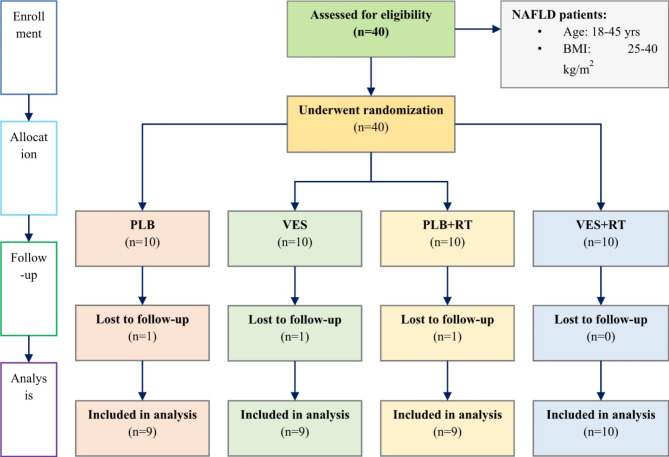
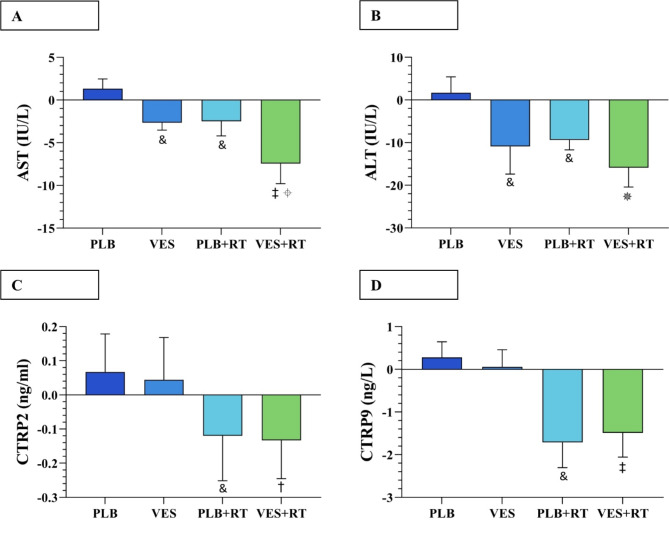
BACKGROUND: Nonalcoholic fatty liver disease (NAFLD) involves excessive liver fat accumulation and is closely linked to oxidative stress, which contributes to liver inflammation and damage. This study aimed to evaluate how interventions such as resistance training (RT) and vitamin E supplementation (VES) can modulate markers of NAFLD and key proteins regulating glucose and lipid metabolism, such as C1Q/TNF-related proteins (CTRPs). METHODS: Forty participants with NAFLD (mean age: 32.4 ± 8.2 years) were randomly assigned to one of four groups for 12 weeks: placebo (PLB), VES, PLB + RT, and VES + RT. VES was administered at 800 IU/day in a double-blind manner. The RT regimen included eight exercises at 60-80% of one-repetition maximum (1RM), with three sets of 8-12 repetitions, performed three times per week. Pre- and post-intervention assessments included body composition, aspartate aminotransferase (AST), alanine aminotransferase (ALT), lipid profile, glycemic control, CTRP-2, CTRP-9, and 1RM evaluations. RESULTS: Following the interventions, there was a significant improvement in body composition, lipid profile, glycemic control, and 1RM indices in the exercise groups compared to non-exercise groups (p < 0.05). AST and ALT levels decreased in all groups (p < 0.05) compared to the PLB group. There was also a significant difference between the VES + RT group and both the VES and PLB + RT groups (p < 0.05). CTRP-2 and CTRP-9 levels decreased in the exercise groups compared to non-exercise groups (p < 0.05), and their changes showed a marked correlation with body composition, lipid profile, and glycemic control indices (p < 0.05). CONCLUSIONS: This study highlights the benefits of RT on various health parameters among NAFLD patients. While adding VES to RT resulted in greater decreases in aminotransferases, it did not provide further improvements in other variables. Additionally, enhancements in body composition, lipid profile, and glycemic control indices were possibly associated with decreased levels of CTRPs. TRIAL REGISTRATION: Registered retrospectively in the Iranian Registry of Clinical Trials (IRCT20220601055056N1) on December 21, 2023. Access at https://irct.behdasht.gov.ir/trial/69231 .
Overview
The claims and statistics of this paper haven’t been checked yet.
Free: it reads the open-access text and checks the first 5 claims that cite a source we can check. Create a free account to check every claim.
Integrity signals
Registry
Cites
Statistics
Figures
Verification
Claims the paper makes
The claims and statistics of this paper haven’t been checked yet.
Free: it reads the open-access text and checks the first 5 claims that cite a source we can check. Create a free account to check every claim.
Claims other papers make about this one
Each is checked against this paper’s own text: does it say what the citing paper says it does?
The source backs part of the claim, not all of it — or backs it for a different population, condition or comparison.
In the citing paper
“Resistance exercise showed significant reduction in ALT levels compared with control groups (WMD = − 15.40 IU/L, 95%CI − 28.60 to − 2.20, P < 0.001)”
From Effects of Mediterranean diet, exercise, and their combination on body composition and liver outcomes in metabolic dysfunction-associated steatotic liver disease: a systematic review and meta-analysis of randomized controlled trials (2025) · cites this paper as [83]
Experimental — accuracy not yet measured
Self-check
Percentages, sums and reported differences re-computed from the paper’s own numbers.
The self-check needs the paper’s full text.
Citations
Cites
Global burden of NAFLD and NASH: trends, predictions, risk factors and prevention
Younossi, Z., Anstee, Q. M., Marietti, M., Hardy, T., Henry, L., Eslam, M., George, J., & Bugianesi, E. (2018) · Nature Reviews Gastroenterology & Hepatology · doi:10.1038/nrgastro.2017.109 · Cited by 5,249 · cited 1×
“The global prevalence of NAFLD has increased in tandem with the increase in metabolic syndrome (MetS), obesity, and diabetes, affecting approximately one-quarter of the global population [8].”
BackgroundProgression Models in Resistance Training for Healthy Adults
(2009) · Medicine & Science in Sports & Exercise · doi:10.1249/mss.0b013e3181915670 · Cited by 4,332
Pioglitazone, Vitamin E, or Placebo for Nonalcoholic Steatohepatitis
Sanyal, A. J., Chalasani, N., Kowdley, K. V., McCullough, A., Diehl, A. M., Bass, N. M., Neuschwander-Tetri, B. A., Lavine, J. E., Tonascia, J., Unalp, A., et al. (2010) · New England Journal of Medicine · doi:10.1056/nejmoa0907929 · Cited by 3,327 · cited 2×
“Sanyal et al. (2010) reported significant improvements in steatosis, inflammation, and the resolution of NASH symptoms following 96 weeks of vitamin E supplementation (VES; 800 IU/day) in nondiabetic, non-cirrhotic NAFLD patients [23].”
BackgroundXu, A., Wang, Y., Keshaw, H., Xu, L. Y., Lam, K. S. L., & Cooper, G. J. S. (2003) · Journal of Clinical Investigation · doi:10.1172/jci200317797 · Cited by 1,298
Xu, A., Wang, Y., Keshaw, H., Xu, L. Y., Lam, K. S. L., & Cooper, G. J. S. (2003) · Journal of Clinical Investigation · doi:10.1172/jci17797 · Cited by 1,296
The Role of Insulin Resistance in Nonalcoholic Fatty Liver Disease
Utzschneider, K. M., & Kahn, S. E. (2006) · The Journal of Clinical Endocrinology & Metabolism · doi:10.1210/jc.2006-0587 · Cited by 856
Resistance Training is Medicine: Effects of Strength Training on Health
Westcott, W. L. (2012) · Current Sports Medicine Reports · doi:10.1249/jsr.0b013e31825dabb8 · Cited by 778 · cited 3×
“Therefore, RT’s ability to boost energy expenditure during recovery and muscle regeneration [41] likely improved body composition in the RT groups.”
BackgroundInfluentialRandomization and allocation concealment: a practical guide for researchers
Doig, G. S., & Simpson, F. (2005) · Journal of Critical Care · doi:10.1016/j.jcrc.2005.04.005 · Cited by 656
Molecular pathways of nonalcoholic fatty liver disease development and progression
Bessone, F., Razori, M. V., & Roma, M. G. (2019) · Cellular and Molecular Life Sciences · doi:10.1007/s00018-018-2947-0 · Cited by 610
New Insight into Adiponectin Role in Obesity and Obesity-Related Diseases
Nigro, E., Scudiero, O., Monaco, M. L., Palmieri, A., Mazzarella, G., Costagliola, C., Bianco, A., & Daniele, A. (2014) · BioMed Research International · doi:10.1155/2014/658913 · Cited by 603
Adaptations to Endurance and Strength Training
Hughes, D. C., Ellefsen, S., & Baar, K. (2018) · Cold Spring Harbor Perspectives in Medicine · doi:10.1101/cshperspect.a029769 · Cited by 548
Hallsworth, K., Fattakhova, G., Hollingsworth, K. G., Thoma, C., Moore, S., Taylor, R., Day, C. P., & Trenell, M. I. (2011) · Gut · doi:10.1136/gut.2011.242073 · Cited by 529
Aerobic vs. resistance exercise in non-alcoholic fatty liver disease: a systematic review
Hashida, R., Kawaguchi, T., Bekki, M., Omoto, M., Matsuse, H., Nago, T., Takano, Y., Ueno, T., Koga, H., George, J., et al. (2017) · Journal of Hepatology · doi:10.1016/j.jhep.2016.08.023 · Cited by 509 · cited 1×
“Both aerobic (AT) and resistance training (RT) have been shown to reduce hepatic steatosis in NAFLD patients [18].”
BackgroundGuo, X., Yin, X., Liu, Z., & Wang, J. (2022) · International Journal of Molecular Sciences · doi:10.3390/ijms232415489 · Cited by 412
Farzanegi, P., Dana, A., Ebrahimpoor, Z., Asadi, M., & Azarbayjani, M. A. (2019) · European Journal of Sport Science · doi:10.1080/17461391.2019.1571114 · Cited by 379
Wong, G. W., Krawczyk, S. A., Kitidis-Mitrokostas, C., Revett, T., Gimeno, R., & Lodish, H. F. (2008) · Biochemical Journal · doi:10.1042/bj20081240 · Cited by 371 · cited 2×
“In obese mice, increased expression of CTRP-2 suggests a compensatory mechanism [12].”
BackgroundBacchi, E., Negri, C., Targher, G., Faccioli, N., Lanza, M., Zoppini, G., Zanolin, E., Schena, F., Bonora, E., & Moghetti, P. (2013) · Hepatology · doi:10.1002/hep.26393 · Cited by 350 · cited 1×
“Bac-chi et al. also observed a significant decrease in TG levels after four months of RT in individuals with Type 2 Diabetes (T2D) and NAFLD [48].”
BackgroundCurrent treatment paradigms and emerging therapies for NAFLD/NASH
Raza, S. (2021) · Frontiers in Bioscience · doi:10.2741/4892 · Cited by 310
Current treatment of non‐alcoholic fatty liver disease
Paternostro, R., & Trauner, M. (2022) · Journal of Internal Medicine · doi:10.1111/joim.13531 · Cited by 305
Liver fat imaging—a clinical overview of ultrasound, CT, and MR imaging
Zhang, Y. N., Fowler, K. J., Hamilton, G., Cui, J. Y., Sy, E. Z., Balanay, M., Hooker, J. C., Szeverenyi, N., & Sirlin, C. B. (2018) · The British Journal of Radiology · doi:10.1259/bjr.20170959 · Cited by 304
Wong, G. W., Krawczyk, S. A., Kitidis‐Mitrokostas, C., Ge, G., Spooner, E., Hug, C., Gimeno, R., & Lodish, H. F. (2009) · The FASEB Journal · doi:10.1096/fj.08-114991 · Cited by 279
Lopez, P., Taaffe, D. R., Galvão, D. A., Newton, R. U., Nonemacher, E. R., Wendt, V. M., Bassanesi, R. N., Turella, D. J. P., & Rech, A. (2022) · Obesity Reviews · doi:10.1111/obr.13428 · Cited by 210 · cited 1×
“RT programs can significantly reduce BFP in individuals who are overweight or obese, regardless of age or sex [40].”
BackgroundKim, S. H., Cho, Y. K., Kim, Y.-J., Jung, C. H., Lee, W. J., Park, J.-Y., Huh, J. H., Kang, J. G., Lee, S. J., & Ihm, S.-H. (2022) · Cardiovascular Diabetology · doi:10.1186/s12933-022-01522-8 · Cited by 190
Resistance Training Improves Glycaemic Control in Obese Type 2 Diabetic Men
(2003) · International Journal of Sports Medicine · doi:10.1055/s-2003-41173 · Cited by 174
The Role of Vitamin E in the Treatment of NAFLD
Perumpail, B. J., Li, A. A., John, N., Sallam, S., Shah, N. D., Kwong, W., Cholankeril, G. T., Kim, D., & Ahmed, A. (2018) · Diseases · doi:10.3390/diseases6040086 · Cited by 168
Effect of resistance training on non-alcoholic fatty-liver disease a randomized-clinical trial
Zelber-Sagi, S. (2014) · World Journal of Gastroenterology · doi:10.3748/wjg.v20.i15.4382 · Cited by 152
Vitamin E as a Treatment for Nonalcoholic Fatty Liver Disease: Reality or Myth?
Hadi, H., Vettor, R., & Rossato, M. (2018) · Antioxidants · doi:10.3390/antiox7010012 · Cited by 150
Avila, J. J., Gutierres, J. A., Sheehy, M. E., Lofgren, I. E., & Delmonico, M. J. (2010) · European Journal of Applied Physiology · doi:10.1007/s00421-010-1387-9 · Cited by 128 · cited 1×
“The RT protocol significantly increased the 1RM in the exercise groups consistent with previous findings [44].”
ResultShamsoddini, A., Sobhani, V., Ghamar Chehreh, M. E., Alavian, S. M., & Zaree, A. (2015) · Hepatitis Monthly · doi:10.5812/hepatmon.31434 · Cited by 126 · cited 1×
“Similarly, Shamsoddini et al. observed significant reductions in AST and ALT among males with NAFLD after eight weeks of RT [58].”
BackgroundRole of Ultrasound Methods for the Assessment of NAFLD
Petzold, G. (2022) · Journal of Clinical Medicine · doi:10.3390/jcm11154581 · Cited by 124
Wei, Z., Lei, X., Petersen, P. S., Aja, S., & Wong, G. W. (2014) · American Journal of Physiology-Endocrinology and Metabolism · doi:10.1152/ajpendo.00593.2013 · Cited by 110
Wood, T. M., Maddalozzo, G. F., & Harter, R. A. (2002) · Measurement in Physical Education and Exercise Science · doi:10.1207/s15327841mpee0602_1 · Cited by 100
Conceição, M., Bonganha, Vechin, Berton, LixandrÃo, Damas Nogueira, F. R., Souza, Chacon-mikahil, & Libardi (2013) · Clinical Interventions in Aging · doi:10.2147/cia.s44245 · Cited by 93
Physical activity as a treatment of non-alcoholic fatty liver disease: A systematic review
Whitsett, M. (2015) · World Journal of Hepatology · doi:10.4254/wjh.v7.i16.2041 · Cited by 82
Adipose Tissue Lipolysis Is Upregulated in Lean and Obese Men During Acute Resistance Exercise
Chatzinikolaou, A., Fatouros, I., Petridou, A., Jamurtas, A., Avloniti, A., Douroudos, I., Mastorakos, G., Lazaropoulou, C., Papassotiriou, I., Tournis, S., et al. (2008) · Diabetes Care · doi:10.2337/dc08-0072 · Cited by 80 · cited 1×
“RT, in particular, offers metabolic benefits with lower energy expenditure, making it feasible for individuals with lower cardiorespiratory fitness levels who may not tolerate AT [19, 20].”
BackgroundYakaryilmaz, F., Guliter, S., Savas, B., Erdem, O., Ersoy, R., Erden, E., Akyol, G., Bozkaya, H., & Ozenirler, S. (2007) · Internal Medicine Journal · doi:10.1111/j.1445-5994.2006.01295.x · Cited by 75
Asbaghi, O., Nazarian, B., Yousefi, M., Anjom-Shoae, J., Rasekhi, H., & Sadeghi, O. (2023) · Nutrition Journal · doi:10.1186/s12937-023-00840-1 · Cited by 68
Moro, T., Marcolin, G., Bianco, A., Bolzetta, F., Berton, L., Sergi, G., & Paoli, A. (2020) · International Journal of Environmental Research and Public Health · doi:10.3390/ijerph17114093 · Cited by 67
Charatcharoenwitthaya, P., Kuljiratitikal, K., Aksornchanya, O., Chaiyasoot, K., Bandidniyamanon, W., & Charatcharoenwitthaya, N. (2021) · Clinical and Translational Gastroenterology · doi:10.14309/ctg.0000000000000316 · Cited by 64
Mansour‐Ghanaei, R., Mansour‐Ghanaei, F., Naghipour, M., & Joukar, F. (2019) · Journal of Family Medicine and Primary Care · doi:10.4103/jfmpc.jfmpc_243_18 · Cited by 58
Venojärvi, M., Korkmaz, A., Wasenius, N., Manderoos, S., Heinonen, O. J., Lindholm, H. J., Aunola, S., Eriksson, J. G., & Atalay, M. (2013) · Food and Chemical Toxicology · doi:10.1016/j.fct.2013.04.015 · Cited by 56
CTRP2 Overexpression Improves Insulin and Lipid Tolerance in Diet-Induced Obese Mice
Peterson, J. M., Seldin, M. M., Tan, S. Y., & Wong, G. W. (2014) · PLoS ONE · doi:10.1371/journal.pone.0088535 · Cited by 52
Mohammadi, S., Monazzami, A., & alavimilani, S. (2023) · BMC Sports Science Medicine and Rehabilitation · doi:10.1186/s13102-023-00653-z · Cited by 51
Self-citationZuo, A., Zhao, X., Li, T., Li, J., Lei, S., Chen, J., Xu, D., Song, C., Liu, T., Li, C., et al. (2020) · Journal of Cellular and Molecular Medicine · doi:10.1111/jcmm.14982 · Cited by 45
Clifford, T., Jeffries, O., Stevenson, E. J., & Davies, K. A. B. (2020) · Critical Reviews in Food Science and Nutrition · doi:10.1080/10408398.2019.1703642 · Cited by 42
Ismaiel, A., Ciobanu, O. S., Ismaiel, M., Leucuta, D., Popa, S., David, L., Ensar, D., Srouji, N. A., & Dumitrascu, D. L. (2022) · Biomedicines · doi:10.3390/biomedicines10092101 · Cited by 42
Hasegawa, N., Fujie, S. J., Horii, N., Uchida, M., Kurihara, T., Sanada, K., Hamaoka, T., & Iemitsu, M. (2017) · American Journal of Physiology-Regulatory, Integrative and Comparative Physiology · doi:10.1152/ajpregu.00212.2017 · Cited by 39
Liu, J., Zhou, L., An, Y., Wang, Y., & Wang, G. (2022) · Frontiers in Nutrition · doi:10.3389/fnut.2022.954219 · Cited by 36
Jerobin, J., Ramanjaneya, M., Bettahi, I., Parammal, R., Siveen, K. S., Alkasem, M., Aye, M., Sathyapalan, T., Skarulis, M. C., Atkin, S. L., et al. (2021) · Lipids in Health and Disease · doi:10.1186/s12944-021-01463-3 · Cited by 32
Jang, S. (2011) · World Journal of Gastroenterology · doi:10.3748/wjg.v17.i28.3335 · Cited by 31
Mirzaalian, Y., Nourian, M., Gholamalizadeh, M., Doaei, S., Hatami, M., Hassanzadeh, A., Askari, G., & Farahi, R. (2019) · Archives of Medical Science - Atherosclerotic Diseases · doi:10.5114/amsad.2019.84411 · Cited by 30
Preliminary reliability of the five item physical activity questionnaire
Cho, M.-H. (2016) · Journal of Physical Therapy Science · doi:10.1589/jpts.28.3393 · Cited by 27
Ganjooei, N. A., Jamialahmadi, T., Nematy, M., Jangjoo, A., Goshayeshi, L., Khadem‐Rezaiyan, M., Reiner, Ž., Alidadi, M., Markin, A. M., & Sahebkar, A. (2021) · Frontiers in Cardiovascular Medicine · doi:10.3389/fcvm.2021.682352 · Cited by 26
Emami, M. R., Jamshidi, S., Zarezadeh, M., Khorshidi, M., Olang, B., Hezaveh, Z. S., Sohouli, M. H., & Aryaeian, N. (2021) · Clinical Nutrition · doi:10.1016/j.clnu.2021.02.002 · Cited by 25
Effects of a single bout of high-intensity interval exercise on C1q/TNF-related proteins
Kon, M., Ebi, Y., & Nakagaki, K. (2018) · Applied Physiology, Nutrition, and Metabolism · doi:10.1139/apnm-2018-0355 · Cited by 23
Betik, A. C., Aguila, J., McConell, G. K., McAinch, A. J., & Mathai, M. L. (2016) · PLoS ONE · doi:10.1371/journal.pone.0152562 · Cited by 17
Self-citationAstinchap, A., Monazzami, A., Fereidoonfara, K., Rahimi, Z., & Rahimi, M. (2021) · Hepatitis Monthly · doi:10.5812/hepatmon.116513 · Cited by 15 · cited 1×
“1 [26–29], with a significance level set at 0.05 and a statistical power of 80%.”
BackgroundInfluentialSelf-citationC1q/Tumor Necrosis Factor-Related Protein 9: Basics and Therapeutic Potentials
Guan, H., Wang, Y., Li, X., Xiang, A., Guo, F., Fan, J., & Yu, Q. (2022) · Frontiers in Physiology · doi:10.3389/fphys.2022.816218 · Cited by 15
Monazzami, A., Momenpur, R., Alipour, E., Yari, K., & Payandeh, M. (2021) · International Journal of Cancer Management · doi:10.5812/ijcm.109039 · Cited by 13
Self-citationSalehi, Z., Salehi, K., Moeini, M., Kargarfard, M., & Sadeghi, M. (2017) · Iranian Journal of Nursing and Midwifery Research · doi:10.4103/ijnmr.ijnmr_385_14 · Cited by 12
Hendarto, A., Alhadar, A. K., & Sjarif, D. R. (2019) · Acta medica Indonesiana · Cited by 12
Serum C1q/TNF-Related Protein-2 (CTRP2) Levels are Associated with Coronary Artery Disease
Ilbeigi, D., Khoshfetrat, M., Afrisham, R., Rahimi, B., & Gorgani‐Firuzjaee, S. (2020) · Archives of Medical Research · doi:10.1016/j.arcmed.2020.01.009 · Cited by 11
Monazzami, A., Rajabi, H., Ghrakhanlou, R., Yari, K., & Rahimi, Z. (2017) · Cellular and Molecular Biology · doi:10.14715/cmb/2017.63.5.3 · Cited by 8
Self-citationEmerging roles of C1Q tumor necrosis factor-related proteins in metabolic diseases
Ramanjaneya, M., Jerobin, J., Bettahi, I., Siveen, K. S., & Abou‐Samra, A. (2021) · Translational Medicine Communications · doi:10.1186/s41231-021-00083-4 · Cited by 8
Responses of complement C1q/tumor necrosis factor-related proteins to acute aerobic exercise
Kon, M., & Tanimura, Y. (2022) · Cytokine · doi:10.1016/j.cyto.2022.156083 · Cited by 6
Research works printed but not linked: 3
- Medicine ACoS. ACSM’s health-related physical fitness assessment manual. Lippincott Williams & Wilkins; 2013.
- Eslami L, Isazadehfar K, Karami M, Rahmani-Nia F, Nakhostinroohi B. The effect of 12 weeks regular physical activity and vitamin E in the treatment of non-alcoholic steatohepatitis: a pilot study. Govaresh. 2015;20:57–65.
- Sadeghi R, keshavarz s, Kargarfard M, banaii j. The effects of Aerobic, Resistance, and combined Exercise on Adiponectin and CTRP-9 levels in patients with type 2 diabetes Mellitus. J Appl Health Stud Sport Physiol. 2022;9(2):173–87.
Cited by
Arita, V. A., Cabezas, M. C., Hernández Vargas, J. A., Trujillo-Cáceres, S. J., Mendez Pernicone, N., Bridge, L. A., Raeisi-Dehkordi, H., Dietvorst, C. A. W., Dekker, R., Uriza-Pinzón, J. P., et al. (2025) · BMC Medicine · doi:10.1186/s12916-025-04320-7 · Cited by 43
Shahiddoust, F., & Monazzami, A. (2025) · BMC Sports Science Medicine and Rehabilitation · doi:10.1186/s13102-025-01123-4 · Cited by 10
Self-citationChen, Y., Qiao, X., Zou, X., Xu, K., Gu, Z., Chen, G., & Dai, J. (2026) · Frontiers in Physiology · doi:10.3389/fphys.2025.1679094 · Cited by 7
Karimi, M., Abidi, M., Aghaei, A., Kazemian, P., Banadak, N. R., Bahman, A. D., Moghadam, O. F., Amin, M. A., Khorgoo, R. K., Sharifara, F., et al. (2026) · Lipids · doi:10.1002/lipd.70042 · Cited by 3
Xiong, C. (2026) · Frontiers in Nutrition · doi:10.3389/fnut.2026.1806863 · Cited by 1
Metadata
- Authors
- Varmazyar, I., Monazzami, A. A., Moradi, M., & McAinch, A. J.
- Affiliations
- Razi University (IR)
- Kermanshah University of Medical Sciences (IR)
- Victoria University (AU)
- ORCID
- McAinch, Andrew J
- Venue
- BMC Sports Science, Medicine and Rehabilitation
- Published
- 2024-09-04
- Volume
- 16
- Issue
- 1
- Pages
- 185-185
- ISSN
- 2052-1847 (ISSN-L)
- PMC
- PMC11373101
- OpenAlex
- W4402232774
- Cited by
- 7
- References
- 64
- Citations by year
- 2026: 4 · 2025: 3
- FWCI
- 2.14
- Type
- journal article
- Language
- en
- Open access
- gold
- doi.org
- Licence
- cc-by-nc-nd
- creativecommons.org/licenses/by-nc-nd/4.0 (tdm)
- creativecommons.org/licenses/by-nc-nd/4.0 (vor)
- Locations
- BMC Sports Science Medicine and Rehabilitation (publishedVersion, cc-by-nc-nd)
- PubMed Central (publishedVersion, cc-by-nc-nd)
- PubMed (publishedVersion)
- Victoria University Research Repository (Victoria University) (submittedVersion, cc-by-nc-nd)
- DOAJ (DOAJ: Directory of Open Access Journals) (submittedVersion, cc-by-sa)
- Topics
- Health Sciences › Medicine › Hepatology › Liver Disease Diagnosis and Treatment
- Health Sciences › Medicine › Physiology (medical) › Exercise and Physiological Responses
- Health Sciences › Medicine › Public Health, Environmental and Occupational Health › Physical Activity and Health
- Keywords
- non-alcoholic fatty liver disease, resistance training, vitamin E supplementation, transaminases, alanine aminotransferase, aspartate aminotransferase, oxidative stress, body composition, lipid profile, glycemic control, one-repetition maximum, physical activity
About these checks
Registry, retraction, Cites and statistics results are computed, not judged, with one exception: a printed reference that no index lists is read once by a model before it counts as a citation error. Claims are extracted by a model and kept only when their quote appears verbatim in the text; each cited source is then checked, with a model’s help, for whether it says what the claim relies on. Those verdicts can be wrong — read the claim’s quote and the cited source before relying on one.
Statistics and arithmetic are recomputed, not judged.
Confidence bands are shown only for fields calibrated on our annotated test set. None is calibrated yet, so no band is shown.
What counts as a claim ›How we measure confidence ›How we check this ›
Are you an author, or do you see a problem with this page? Request a review
Data sources
Bibliographic data: Semantic Scholar, OpenAlex, Crossref.
Contains information from the Semantic Scholar Academic Graph Datasets, made available under the ODC Attribution License (ODC-BY 1.0).
Semantic Scholar’s data is described in: Kinney, R., et al. (2023). The Semantic Scholar Open Data Platform. arXiv:2301.10140.
