

Facebook use and its effects on the life of health science students in a private medical college of Nepal
Open accessThe DOI matches its Crossref record; 30 of the 30 references it cites were found in a registry or an index.
Abstract
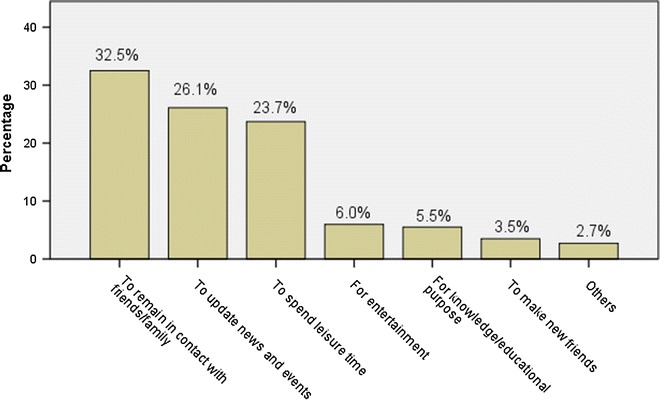
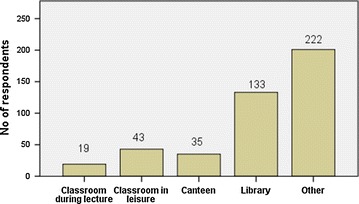
BACKGROUND: Facebook, a popular social networking site, has been used by people of different ages and professions for various purposes. Its use in the field of medical education is increasing dramatically. At the same time, the pros and cons of facebook use among the health science students has attracted the attention of educators. The data regarding its use and the effect on the life of Nepalese health science students has not yet been documented. Therefore, this study is carried out to evaluate the effect of facebook use on social interactions, behaviour, academics, and the health of students in a medical college of Nepal. RESULTS: A cross-sectional descriptive study conducted among medical, dental, nursing and allied health science students using self-administered questionnaire. The study showed that 98.2 % of participants were facebook users. Among 452 respondents, 224 and 228 were male and female respectively, with a mean age of 20.2 ± 1.2 years. The main reason for using facebook was to remain in contact with family and friend (32 %), while its use for the academic purpose was only 5 %. However, 80.8 % of students acknowledged ease in acquiring academic materials from others, through facebook. One-fourth of the students acknowledged that they are using facebook late at night on a regular basis, while surprisingly 4.2 % of the students admitted accessing facebook during the classroom lectures. Almost two-third of the users, further admitted that facebook has had a negative impact on their studies. Burning eyes (21 %), disturbed sleep (19 %), and headache (16 %) were the most common adverse health effects reported by the facebook users. Many students (71.4 %) tried and most of them (68.7 %) succeeded, in reducing time spent on facebook, to allow for increased time devoted to their studies. CONCLUSION: The widespread use of facebook among the health science students, was found to have both positive and negative effects on their academics, social life, and health.
Overview
The claims and statistics of this paper haven’t been checked yet.
Free: it reads the open-access text and checks the first 5 claims that cite a source we can check. Create a free account to check every claim.
Integrity signals
Registry
Cites
Statistics
Figures
Verification
Claims the paper makes
The claims and statistics of this paper haven’t been checked yet.
Free: it reads the open-access text and checks the first 5 claims that cite a source we can check. Create a free account to check every claim.
Self-check
Percentages, sums and reported differences re-computed from the paper’s own numbers.
The self-check needs the paper’s full text.
Citations
Cites
Ellison, N. B., Steinfield, C., & Lampe, C. (2007) · Journal of Computer-Mediated Communication · doi:10.1111/j.1083-6101.2007.00367.x · Cited by 9,939 · cited 1×
“Most of the students spent time on facebook on average, less than 1–2 h daily, which was consistent with the findings reported by others [18, 19].”
Result(2006) · BiblioBoard Library Catalog (Open Research Library) · Cited by 3,173
College students' social networking experiences on Facebook
Pempek, T. A., Yermolayeva, Y. A., & Calvert, S. L. (2009) · Journal of Applied Developmental Psychology · doi:10.1016/j.appdev.2008.12.010 · Cited by 2,081 · cited 1×
“Similar to the previous studies [2, 6, 22], a small number of students reported that relevant academic information was accessible through the facebook.”
ResultOnline Social Networking and Addiction—A Review of the Psychological Literature
Kuss, D. J., & Griffiths, M. D. (2011) · International Journal of Environmental Research and Public Health · doi:10.3390/ijerph8093528 · Cited by 2,038 · cited 1×
“It may also be associated with relationship problems, personal loneliness, and depression [23, 24].”
BackgroundDevelopment of a Facebook Addiction Scale
Andreassen, C. S., Torsheim, T., Brunborg, G. S., & Pallesen, S. (2012) · Psychological Reports · doi:10.2466/02.09.18.pr0.110.2.501-517 · Cited by 1,884 · cited 1×
“As these are some of the key components in determining the facebook addiction according to ‘Bergen Facebook Addiction Scale (BFAS)’ [26], this supports the theory that these participants possibly have some degree of facebook addiction.”
BackgroundRaacke, J., & Bonds-Raacke, J. (2008) · CyberPsychology & Behavior · doi:10.1089/cpb.2007.0056 · Cited by 1,577
Confronting the challenges of participatory cultures (media education for the 21st century)
Jenkins, H., Purushotma, R., Weigel, M., Clinton, K., & Robison, A. J. (2009) · Cited by 1,563
Internet Addiction: A New Clinical Phenomenon and Its Consequences
Young, K. S. (2004) · American Behavioral Scientist · doi:10.1177/0002764204270278 · Cited by 1,088
Kim, K., Ryu, E., Chon, M.-Y., Yeun, E.-J., Choi, S.-Y., Seo, J.-S., & Nam, B.-W. (2006) · International Journal of Nursing Studies · doi:10.1016/j.ijnurstu.2005.02.005 · Cited by 790 · cited 1×
“These effects include changes in self-esteem [8], sleep disorders, and high percentage of depression among students [9].”
BackgroundThe uses and abuses of Facebook: A review of Facebook addiction
Ryan, T., Chester, A., Reece, J., & Xenos, S. (2014) · Journal of Behavioral Addictions · doi:10.1556/jba.3.2014.016 · Cited by 714 · cited 1×
“While one-fourth of users in this study were found to be accessing facebook during leisure time, when accessed regularly, there is potential risk for developing addictive behaviours, through the development of poor self-discipline and task avoidance [16].”
BackgroundStudents’ and teachers’ use of Facebook
Hew, K. F. (2011) · Computers in Human Behavior · doi:10.1016/j.chb.2010.11.020 · Cited by 680
The relationship between Facebook and the well-being of undergraduate college students
Kalpidou, M., Costin, D., & Morris, J. (2011) · Cyberpsychology, Behavior, and Social Networking · doi:10.1089/cyber.2010.0061 · Cited by 619 · cited 1×
“Most of the students spent time on facebook on average, less than 1–2 h daily, which was consistent with the findings reported by others [18, 19].”
ResultThe risk factors of Internet addiction—A survey of university freshmen
Tsai, H. F., Cheng, S. H., Yeh, T. L., Shih, C.-C., Chen, K. C., Yang, Y. C., & Yang, Y. K. (2009) · Psychiatry Research · doi:10.1016/j.psychres.2008.01.015 · Cited by 368 · cited 1×
“However, these students were unaware of such adverse effects [10].”
BackgroundThe functions of internet use and their social and psychological consequences
Weiser, E. B. (2001) · CyberPsychology & Behavior · doi:10.1089/109493101753376678 · Cited by 343 · cited 1×
“It may also be associated with relationship problems, personal loneliness, and depression [23, 24].”
BackgroundMedical students’ use of Facebook to support learning: Insights from four case studies
Gray, K., Annabell, L., & Kennedy, G. (2010) · Medical Teacher · doi:10.3109/0142159x.2010.497826 · Cited by 226
Facebook Addiction: Concerns, Criticism, and Recommendations—A Response to Andreassen and Colleagues
Griffiths, M. D. (2012) · Psychological Reports · doi:10.2466/01.07.18.pr0.110.2.518-520 · Cited by 224 · cited 1×
“Particularly, the excessive use of online social media may contribute to misuse, dependence, and addictive behaviours [7].”
BackgroundSleep and Academic Performance in Undergraduates: A Multi-measure, Multi-predictor Approach
Gomes, A. A., Tavares, J., & de Azevedo, M. H. P. (2011) · Chronobiology International · doi:10.3109/07420528.2011.606518 · Cited by 211 · cited 1×
“stated that both quantity and quality of sleep might strongly influence mood [29] and subjective well-being, which in turn could impact the academic performance [21, 30] of the students who use facebook late at night and do not allow for sufficient sleep.”
BackgroundCalidad del sueño en estudiantes universitarios: importancia de la higiene del sueño
Sierra, J. C., Jiménez-Navarro, C., & Ortiz, J. D. M. (2002) · Salud Mental · Cited by 190
Sensor systems for use in reinforced concrete structures
McCarter, W. J., & Vennesland, Ø. (2004) · Construction and Building Materials · doi:10.1016/j.conbuildmat.2004.03.008 · Cited by 182
Use of Facebook in academic health sciences libraries
Hendrix, D., Chiarella, D. T., Hasman, L., Murphy, S. C., & Zafron, M. L. (2009) · Journal of the Medical Library Association JMLA · doi:10.3163/1536-5050.97.1.008 · Cited by 173
Assessment of medical students’ attitudes on social media use in medicine: a cross-sectional study
Avcı, K., Çelikden, S. G., Eren, S., & Aydenizöz, D. (2015) · BMC Medical Education · doi:10.1186/s12909-015-0300-y · Cited by 132 · cited 1×
“This was found to be similar in comparison, to studies conducted in different countries [12–14] on the same subject.”
ResultWhite, J., Kirwan, P., Lai, K., Walton, J., & Ross, S. (2013) · BMJ Open · doi:10.1136/bmjopen-2013-003013 · Cited by 93
(SNTL #1) Costs and Benefits of Facebook for Undergraduate Students
Gafni, R., & Deri, M. (2012) · Interdisciplinary Journal of Information Knowledge and Management · doi:10.28945/1577 · Cited by 74
Effect of Facebook on the life of Medical University students
Farooqi, H., Patel, H., Aslam, H., Ansari, I., Khan, M., Iqbal, N., Rasheed, H., Jabbar, Q., Khan, S., Khalid, B., et al. (2013) · International Archives of Medicine · doi:10.1186/1755-7682-6-40 · Cited by 58
Costs and Benefits of Facebook for Undergraduate Students
Gafni, R., & Deri, M. (2012) · Interdisciplinary Journal of Information Knowledge and Management · Cited by 42
Adverse Health Effects and Unhealthy Behaviors among Medical Students Using Facebook
Al‐Dubai, S. A. R., Ganasegeran, K., Alshagga, M. A., Yadav, H., & Arokiasamy, J. T. (2013) · The Scientific World JOURNAL · doi:10.1155/2013/465161 · Cited by 36
Facebook addiction among health university students in Bengaluru
Ramesh Masthi, N., Sonakshi, S., & Cadabam, S. (2015) · International Journal of Health & Allied Sciences · doi:10.4103/2278-344x.149234 · Cited by 31
Fovet, F. (2009) · IEEE Frontiers in Education Conference (FIE) · doi:10.1109/fie.2009.5350786 · Cited by 28
[Excessive Internet use and Internet addiction: emerging public health issues.].
Coniglio, M. A., Muni, V., Giammanco, G., & Pignato, S. (2007) · PubMed · Cited by 19
Social network utilization (Facebook) & e-Professionalism among medical students
Jawaid, M., Khan, M. H., & Bhutto, S. N. (2014) · Pakistan Journal of Medical Sciences · doi:10.12669/pjms.311.5643 · Cited by 11
Research works printed but not linked: 2
- Sharifah SZS Siti ZO Jusang B Mohd NO Facebook addiction among female university students Revista de Administratie Publica si Politici Sociale 2011 2 7 95 109
- Sierra JC Martin-Ortiz JD Navarro C Calidad del suen˜o en estudiantesuniversitarios: importancia de la higienedelsuen˜o Salud Mental 2002 25 6 35 43
Cited by
Gupta, M., & Sharma, A. (2021) · World Journal of Clinical Cases · doi:10.12998/wjcc.v9.i19.4881 · Cited by 316
Azizi, S. M., Soroush, A., & Khatony, A. (2019) · BMC Psychology · doi:10.1186/s40359-019-0305-0 · Cited by 306
“The overuse of social networks has positive and negative academic, social, and health consequences for the students [35].”
BackgroundSocial media in undergraduate medical education: A systematic review
Guckian, J., Utukuri, M., Asif, A., Burton, O. E., Adeyoju, J., Oumeziane, A., Chu, T. S. M., & Rees, E. L. (2021) · Medical Education · doi:10.1111/medu.14567 · Cited by 190
Problematic internet use among students in South-East Asia: Current state of evidence
Balhara, Y. S., Mahapatra, A., Sharma, P., & Bhargava, R. (2018) · Indian Journal of Public Health · doi:10.4103/ijph.ijph_288_17 · Cited by 115
Lahiry, S., Choudhury, S., Chatterjee, S., & Hazra, A. (2019) · Journal of Education and Health Promotion · doi:10.4103/jehp.jehp_365_18 · Cited by 57
Metadata
- Authors
- Jha, R. K., Shah, D. K., Basnet, S., Paudel, K. R., Sah, P., Sah, A. K., & Adhikari, K.
- Affiliations
- Chitwan Medical College (NP)
- Corresponding author
- Jha, Rajesh Kumar
- ORCID
- Venue
- BMC Research Notes
- Published
- 2016-08-02
- Volume
- 9
- Issue
- 1
- Pages
- 378-378
- ISSN
- 1756-0500 (ISSN-L)
- PMC
- PMC4970301
- OpenAlex
- W2504890637
- Cited by
- 68
- References
- 30
- Citations by year
- 2026: 2 · 2025: 10 · 2024: 8 · 2023: 10 · 2022: 7 · 2021: 9 · 2020: 7 · 2019: 8 · 2018: 4 · 2017: 3
- FWCI
- 14.26
- Type
- journal article
- Language
- en
- Open access
- gold
- doi.org
- Licence
- cc-by
- Locations
- BMC Research Notes (publishedVersion, cc-by)
- PubMed Central (publishedVersion, cc-by)
- PubMed (publishedVersion)
- Topics
- Social Sciences › Sociology and Political Science › Impact of Technology on Adolescents
- Social Sciences › Health › Social Media in Health Education
- Social Sciences › Business, Management and Accounting › Organizational Behavior and Human Resource Management › Cyberloafing and Workplace Behavior
- Keywords
- Facebook use, social networking sites, health sciences students, medical students, dental students, nursing students, academic performance, social interaction, sleep disorders, visual fatigue, headache, screen time, time management
- MeSH terms
- Cross-Sectional Studies, Education, Medical, Female, Headache, Humans, Sleep Initiation and Maintenance Disorders, Male, Nepal, Quality of Life, Students, Universities, Young Adult, Eye Pain, Social Networking, Social Media
About these checks
Registry, retraction, Cites and statistics results are computed, not judged, with one exception: a printed reference that no index lists is read once by a model before it counts as a citation error. Claims are extracted by a model and kept only when their quote appears verbatim in the text; each cited source is then checked, with a model’s help, for whether it says what the claim relies on. Those verdicts can be wrong — read the claim’s quote and the cited source before relying on one.
Statistics and arithmetic are recomputed, not judged.
Confidence bands are shown only for fields calibrated on our annotated test set. None is calibrated yet, so no band is shown.
What counts as a claim ›How we measure confidence ›How we check this ›
Are you an author, or do you see a problem with this page? Request a review
Data sources
Bibliographic data: Semantic Scholar, OpenAlex, Crossref.
Contains information from the Semantic Scholar Academic Graph Datasets, made available under the ODC Attribution License (ODC-BY 1.0).
Semantic Scholar’s data is described in: Kinney, R., et al. (2023). The Semantic Scholar Open Data Platform. arXiv:2301.10140.
