

Insights on associations between the frequency of use of diverse social media products and social networks use disorder tendencies from a German-speaking sample
Open accessThe DOI matches its Crossref record; 37 of the 37 references it cites were found in a registry or an index.
Abstract
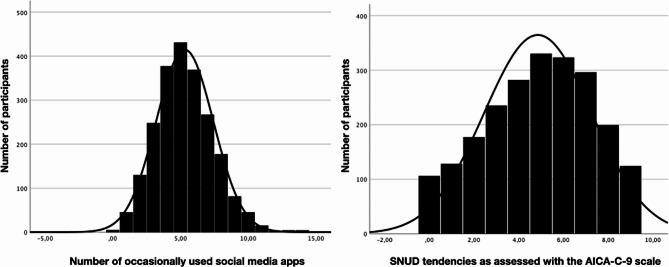
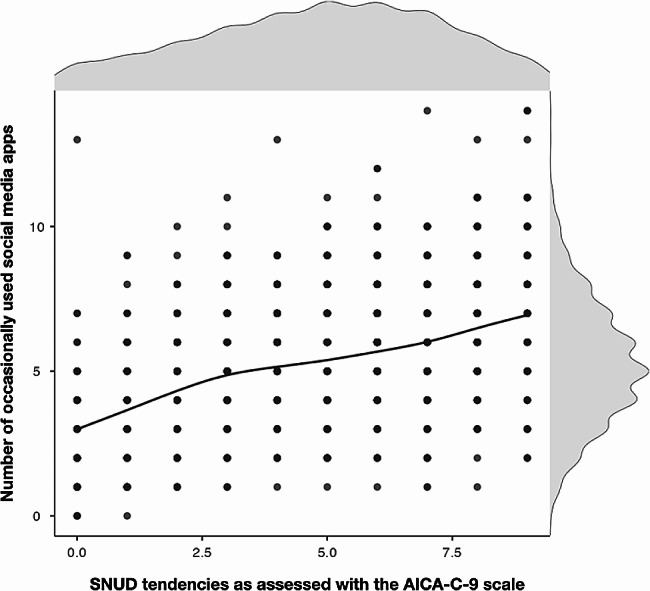
Objective: In the present work we investigate how individual differences in at least occasionally using distinct social media platforms is linked to social networks use disorder (SNUD) tendencies. A final sample of n = 2200 participants filled in the AICA-C-9 measure to get insights into individual differences in overuse of social media and participants also indicated which platforms they used at least once a month. Results: The analysis revealed a robust positive association between number of at least occasionally used social media apps and SNUD tendencies ( r = .44, p < .001). Further, platforms differed in terms of their “addictive potential”, if one takes associations between frequency of distinct platforms use and SNUD tendencies as a proxy for this (and of course the actual descriptive statistics of the SNUD scale for the (non-)frequent user groups of the different platforms). In this regard, at least occasionally using some platforms (here Tumblr, Twitter and TikTok) was associated with highest SNUD tendencies. Moreover, largest differences in terms of effect sizes between the occasional and non-occasional user groups regarding SNUD scores could be observed for Instagram, WhatsApp, and TikTok. The present work bases on data from a larger project investigating associations between SNUD and tobacco use disorder.
Overview
The claims and statistics of this paper haven’t been checked yet.
Free: it reads the open-access text and checks the first 5 claims that cite a source we can check. Create a free account to check every claim.
Integrity signals
Registry
Cites
Statistics
Figures
Verification
Claims the paper makes
The claims and statistics of this paper haven’t been checked yet.
Free: it reads the open-access text and checks the first 5 claims that cite a source we can check. Create a free account to check every claim.
Claims other papers make about this one
Each is checked against this paper’s own text: does it say what the citing paper says it does?
The source backs part of the claim, not all of it — or backs it for a different population, condition or comparison.
In the citing paper
“Inhibitory control, reflecting suppression of automatic responses, is central to executive functioning and highly relevant to PSMU, as affected individuals have been shown to struggle to resist notifications and impulsive platform engagement (Montag et al., 2024).”
From Problematic social media use and cognitive performance in young adults: Associations with selective attention and inhibitory control (2026) · cites this paper as Montag et al., 2024
Experimental — accuracy not yet measuredThe check wasn’t confident either way, so it gives no verdict — never disputed.
In the citing paper
“Current evidence suggests that selective attention and inhibitory control are especially affected in individuals with PSMU (Cheng et al., 2021; Montag et al., 2024).”
From Problematic social media use and cognitive performance in young adults: Associations with selective attention and inhibitory control (2026) · cites this paper as Montag et al., 2024
Experimental — accuracy not yet measured
Self-check
Percentages, sums and reported differences re-computed from the paper’s own numbers.
The self-check needs the paper’s full text.
Citations
Cites
Social Media: Defining, Developing, and Divining
Carr, C. T., & Hayes, R. A. (2015) · Atlantic Journal of Communication · doi:10.1080/15456870.2015.972282 · Cited by 1,295 · cited 1×
“As one can see both social media and messenger platforms are mentioned in the above list, because messengers such as WhatsApp have social media features such as online status and according to a visible social media definition messengers would belong under the umbrella term social media [27].”
BackgroundThe social media disorder scale
van den Eijnden, R. J. J. M., Lemmens, J. S., & Valkenburg, P. M. (2016) · Computers in Human Behavior · doi:10.1016/j.chb.2016.03.038 · Cited by 948 · cited 2×
“In this context, they assess disordered social media use by asking people about the severity of symptoms which have been inspired by addiction research [12].”
BackgroundCheng, C., Lau, Y.-C., Chan, L., & Luk, J. W. (2021) · Addictive Behaviors · doi:10.1016/j.addbeh.2021.106845 · Cited by 571 · cited 3×
“M = 33.37 (SD = 12.53) and it is also known that younger age goes along with higher SNUD tendencies [7], what we also observed in the present work.”
BackgroundResultInfluentialSocial media: A contextual framework to guide research and practice.
McFarland, L. A., & Ployhart, R. E. (2015) · Journal of Applied Psychology · doi:10.1037/a0039244 · Cited by 414 · cited 1×
“According to current estimates nearly five billion people are using a social media service worldwide [1] representing a communication tool differing in context from classic face-to-face or digital communication from such as via e-mail [2] or videoconferences [3].”
BackgroundSocial Media Elements, Ecologies, and Effects
Bayer, J. B., Triệu, P., & Ellison, N. B. (2020) · Annual Review of Psychology · doi:10.1146/annurev-psych-010419-050944 · Cited by 410 · cited 1×
“Studying several social media platforms in a single work might help to overcome biases in findings from studies focusing on single prominent large networks such as Facebook [23].”
BackgroundBrand, M., Rumpf, H.-J., Demetrovics, Z., MÜller, A., Stark, R., King, D. L., Goudriaan, A. E., Mann, K., Trotzke, P., Fineberg, N. A., et al. (2020) · Journal of Behavioral Addictions · doi:10.1556/2006.2020.00035 · Cited by 398 · cited 1×
“Although this debate is not settled [8], one could take the position that an industry actively aiming at prolonging online time represents one of the causes of excessive social media use [9, 10].”
BackgroundSelf-citationMontag, C., Lachmann, B., Herrlich, M., & Zweig, K. (2019) · International Journal of Environmental Research and Public Health · doi:10.3390/ijerph16142612 · Cited by 387 · cited 1×
“…may be more attractive or associated with a different addictive potential than others, future studies will need to examine the role played by certain design features, familiarity, algorithms and their speed of adaptation, as well as the content itself of the different platforms [22, 34, 35].”
BackgroundSelf-citationRozgonjuk, D., Sindermann, C., Elhai, J. D., & Montag, C. (2020) · Addictive Behaviors · doi:10.1016/j.addbeh.2020.106487 · Cited by 315 · cited 1×
“This said, recent research suggests that some platforms might elicit more disordered use tendencies than others [20], and might have a stronger impact on daily-life adversities [21].”
BackgroundSelf-citationPontes, H. M., Schivinski, B., Sindermann, C., Li, M., Becker, B., Zhou, M., & Montag, C. (2021) · International Journal of Mental Health and Addiction · doi:10.1007/s11469-019-00088-z · Cited by 302 · cited 1×
“…Diagnostic and Statistical Manual of Mental Disorders in its 5th revision (DSM-5; [16, 17]) or diagnostic requirements of Gaming Disorder in the 11th revision of the International Classification of Diseases (ICD-11; World Health Organization) 1 ; see also [18] have been adapted for this purpose.”
BackgroundSelf-citationInternet Gaming Disorder in the DSM-5
Petry, N. M., Rehbein, F., Ko, C.-H., & O’Brien, C. P. (2015) · Current Psychiatry Reports · doi:10.1007/s11920-015-0610-0 · Cited by 269 · cited 1×
“…often, diagnostic criteria of Internet Gaming Disorder in the Diagnostic and Statistical Manual of Mental Disorders in its 5th revision (DSM-5; [16, 17]) or diagnostic requirements of Gaming Disorder in the 11th revision of the International Classification of Diseases (ICD-11; World Health…”
BackgroundBillieux, J., Flayelle, M., Rumpf, H.-J., & Stein, D. J. (2019) · Current Addiction Reports · doi:10.1007/s40429-019-00259-x · Cited by 242 · cited 1×
“In addition, everyday use of digital media or devices should not be overpathologized as, for example, lined out in relation to gaming disorder [14].”
BackgroundSelf-citationZarouali, B., Dobber, T., De Pauw, G., & de Vreese, C. (2022) · Communication Research · doi:10.1177/0093650220961965 · Cited by 219
A taxonomy of technology design features that promote potentially addictive online behaviours
Flayelle, M., Brevers, D., King, D. L., Maurage, P., Perales, J. C., & Billieux, J. (2023) · Nature Reviews Psychology · doi:10.1038/s44159-023-00153-4 · Cited by 195 · cited 1×
“…may be more attractive or associated with a different addictive potential than others, future studies will need to examine the role played by certain design features, familiarity, algorithms and their speed of adaptation, as well as the content itself of the different platforms [22, 34, 35].”
BackgroundProblematic social media use in childhood and adolescence
Montag, C., Demetrovics, Z., Elhai, J. D., Grant, D., Koning, I., Rumpf, H.-J., M. Spada, M., Throuvala, M., & van den Eijnden, R. (2024) · Addictive Behaviors · doi:10.1016/j.addbeh.2024.107980 · Cited by 173 · cited 1×
“Although social media addiction or social networks use disorder (SNUD) does not represent an official diagnosis now, scientists around the world often use an addiction framework to study overuse of social media [11].”
BackgroundSelf-citationWell-being and social media: A systematic review of Bergen addiction scales
Duradoni, M., Innocenti, F., & Guazzini, A. (2020) · Future Internet · doi:10.3390/fi12020024 · Cited by 141
Smith, T., & Short, A. (2022) · Addictive Behaviors · doi:10.1016/j.addbeh.2022.107259 · Cited by 121 · cited 1×
““ [33].”
Fournier, L., Schimmenti, A., Musetti, A., Boursier, V., Flayelle, M., Cataldo, I., Starcevic, V., & Billieux, J. (2023) · Addictive Behaviors · doi:10.1016/j.addbeh.2023.107694 · Cited by 112 · cited 1×
“Please note that recent research demonstrated that only a few of such addiction symptoms are associated with psychopathological ten-dencies [13].”
BackgroundReliabilität und Validität der Skala zum Computerspielverhalten (CSV-S)
Wölfling, K., Müller, K. W., & Beutel, M. (2011) · PPmP - Psychotherapie · Psychosomatik · Medizinische Psychologie · doi:10.1055/s-0030-1263145 · Cited by 102 · cited 1×
“Individual differences in SNUD tendencies were assessed via the AICA-C-9 questionnaire (the original AICA-S scale with English wording can be found here [28]; please note that in this original paper the wording gaming was used, and in the present work the focus was on social networks).”
MethodBuilding and breaking social media habits
Bayer, J. B., Anderson, I. A., & Tokunaga, R. S. (2022) · Current Opinion in Psychology · doi:10.1016/j.copsyc.2022.101303 · Cited by 98 · cited 1×
“In this context it should be mentioned that different platforms in the beginning of usage might elicit different habit formation giving way to addictive tendencies towards distinct social media platforms [32].”
BackgroundRozgonjuk, D., Sindermann, C., Elhai, J. D., & Montag, C. (2021) · Cyberpsychology, Behavior, and Social Networking · doi:10.1089/cyber.2020.0156 · Cited by 86 · cited 2×
“This said, recent research suggests that some platforms might elicit more disordered use tendencies than others [20], and might have a stronger impact on daily-life adversities [21].”
BackgroundSelf-citationHow Can Social Networks Design Trigger Fear of Missing Out?
Alutaybi, A., Arden-Close, E., McAlaney, J., Stefanidis, A., Phalp, K., & Ali, R. (2019) · 2019 IEEE International Conference on Systems, Man and Cybernetics (SMC) · doi:10.1109/smc.2019.8914672 · Cited by 69 · cited 1×
“On the other hand, using more platforms could also elicit a stronger pull towards social media in general, which can also lead to mechanisms that lead to continuous consumption, such as FoMO, being further reinforced across the various platforms [22, 30, 31].”
BackgroundMontag, C., Rozgonjuk, D., Riedl, R., & Sindermann, C. (2022) · Journal of Affective Disorders Reports · doi:10.1016/j.jadr.2022.100409 · Cited by 64 · cited 1×
“According to current estimates nearly five billion people are using a social media service worldwide [1] representing a communication tool differing in context from classic face-to-face or digital communication from such as via e-mail [2] or videoconferences [3].”
BackgroundSelf-citationAddiction Research Unit: Affective and cognitive mechanisms of specific Internet‐use disorders
Brand, M., Müller, A., Stark, R., Steins‐Loeber, S., Klucken, T., Montag, C., Diers, M., Wolf, O. T., Rumpf, H., Wölfling, K., et al. (2021) · Addiction Biology · doi:10.1111/adb.13087 · Cited by 60 · cited 1×
“The detailed methods and agenda of the overarching project(s) have been presented in recent works [25, 26].”
MethodSelf-citationMarengo, D., Sindermann, C., Elhai, J. D., & Montag, C. (2020) · Frontiers in Psychology · doi:10.3389/fpsyg.2020.00936 · Cited by 59 · cited 1×
“Furthermore different platforms attract different user groups [36], which could also explain differences in SNUD tendencies towards certain social media applications.”
BackgroundSelf-citationMontag, C., & Elhai, J. D. (2023) · Current Addiction Reports · doi:10.1007/s40429-023-00494-3 · Cited by 52 · cited 1×
“Although this debate is not settled [8], one could take the position that an industry actively aiming at prolonging online time represents one of the causes of excessive social media use [9, 10].”
BackgroundSelf-citationMontag, C., Schivinski, B., & Pontes, H. M. (2021) · Addictive Behaviors Reports · doi:10.1016/j.abrep.2021.100391 · Cited by 45 · cited 1×
“Most often, diagnostic criteria of Internet Gaming Disorder in the Diagnostic and Statistical Manual of Mental Disorders in its 5th revision (DSM-5; [16, 17]) or diagnostic requirements of Gaming Disorder in the 11th revision of the International Classification of Diseases (ICD-11; World Health…”
BackgroundSelf-citationMontag, C., & Rumpf, H.-J. (2021) · Current Addiction Reports · doi:10.1007/s40429-021-00376-6 · Cited by 44 · cited 1×
“Frequency of use and the total number of social media apps used could serve as early signs in digital phenotyping or mobile sensing [37].”
BackgroundSelf-citationRe-start social media, but how?
Dhawan, S., Hegelich, S., Sindermann, C., & Montag, C. (2022) · Telematics and Informatics Reports · doi:10.1016/j.teler.2022.100017 · Cited by 40 · cited 1×
“Most of the current operating social media platforms run with a data business model, hence users do not pay with a monetary fee to use the service, but instead with their attention to ads and with their data [5].”
BackgroundSelf-citationSindermann, C., Montag, C., & Elhai, J. D. (2022) · Technology Mind and Behavior · doi:10.1037/tmb0000096 · Cited by 36
Self-citationSindermann, C., Yang, H., Liu, T., Elhai, J. D., & Montag, C. (2021) · Journal of Technology in Behavioral Science · doi:10.1007/s41347-020-00179-y · Cited by 31 · cited 1×
“On the other hand, using more platforms could also elicit a stronger pull towards social media in general, which can also lead to mechanisms that lead to continuous consumption, such as FoMO, being further reinforced across the various platforms [22, 30, 31].”
BackgroundSelf-citationSocial media companies or their users—which party needs to change to reduce online time?
Montag, C., Thrul, J., & van Rooij, A. J. (2022) · Addiction · doi:10.1111/add.15946 · Cited by 20 · cited 1×
“Although this debate is not settled [8], one could take the position that an industry actively aiming at prolonging online time represents one of the causes of excessive social media use [9, 10].”
BackgroundSelf-citationBunker, C. J., & Kwan, V. S. Y. (2023) · Computers in Human Behavior · doi:10.1016/j.chb.2023.108025 · Cited by 20 · cited 1×
“Differences of context in social media platforms and offline lives might also result in differences in the perception of one’s own person [4].”
BackgroundBrand, M., & Potenza, M. N. (2021) · SUCHT - Zeitschrift für Wissenschaft und Praxis / Journal of Addiction Research and Practice · doi:10.1024/0939-5911/a000721 · Cited by 18 · cited 1×
“To better distinguish between everyday behavior and pathology, theoretical underpinnings [15] and nosological criteria are of high importance.”
BackgroundBischof, A., Brandt, D. M., Schlossarek, S., Vens, M., Rozgonjuk, D., Wernicke, J., Kannen, C., Wölfling, K., Dreier, M., Salbach, H., et al. (2022) · BMJ Open · doi:10.1136/bmjopen-2022-061453 · Cited by 16 · cited 1×
“Early detection is a prerequisite for intervention approaches in terms of indicative prevention as stand-alone measure or within a comprehensive stepped-care approach [38].”
BackgroundSelf-citationKlinische Validierung von diagnostischen Merkmalen der Internetsucht
Müller, K., Beutel, M., & Wölfling, K. (2017) · Suchttherapie · doi:10.1055/s-0037-1604540 · Cited by 4 · cited 1×
“The shortened AICA-C-9 questionnaire consists of twelve items (one presented in an adaptive way), which can be used to assess nine symptom criteria of SNUD developed against the Internet Gaming Disorder framework in DSM-5 [29].”
MethodSchmidt, L. D., Wegmann, E., Bischof, A., Klein, L., Zhou, C., Rozgonjuk, D., Kannen, C., Borgwardt, S., Brand, M., Montag, C., et al. (2022) · SUCHT - Zeitschrift für Wissenschaft und Praxis / Journal of Addiction Research and Practice · doi:10.1024/0939-5911/a000782 · Cited by 3 · cited 1×
“The detailed methods and agenda of the overarching project(s) have been presented in recent works [25, 26].”
MethodSelf-citationAssociations between smoking status and social networks use disorder tendencies
Montag, C., Wegmann, E., Schmidt, L. D., Klein, L., Rozgonjuk, D., & Rumpf, H. (2023) · Emerging Trends in Drugs Addictions and Health · doi:10.1016/j.etdah.2023.100054 · Cited by 3
Self-citation
Cited by
Angelini, F., Koning, I. M., Gini, G., Marino, C., & van den Eijnden, R. J. J. M. (2025) · Computers in Human Behavior · doi:10.1016/j.chb.2025.108880 · Cited by 6
Digital Phenotyping for Problematic Technology Use: A Systematic Literature Review and Taxonomy
Schroeder, G. L., Francisco, R., & Barbosa, J. L. V. (2026) · Current Addiction Reports · doi:10.1007/s40429-026-00759-7 · Cited by 3
“Most excluded studies relied solely on self-report measures without employing digital phenotyping techniques or were conceptual, qualitative, or instrument-development studies without empirical evaluation [43, 58, 62–64, 66, 67, 71, 72, 86, 87, 90, 92 ].”
Elhai, J. D., Gazit, T., Casale, S., & Montag, C. (2026) · International Journal of Mental Health and Addiction · doi:10.1007/s11469-026-01680-w · Cited by 1
Self-citationSisí, C., Pallesen, S., & Fernández-Martín, M. P. (2026) · Journal of Behavioral Addictions · doi:10.1556/2006.2025.00576
“Current evidence suggests that selective attention and inhibitory control are especially affected in individuals with PSMU (Cheng et al., 2021; Montag et al., 2024).”
Öner, K., Teke, G., & Özkan, B. (2026) · Archives of Psychiatric Nursing · doi:10.1016/j.apnu.2025.152045 · Cited by 1
Metadata
- Authors
- Montag, C., Wegmann, E., Schmidt, L. D., Klein, L., Rozgonjuk, D., & Rumpf, H.-J.
- Affiliations
- Universität Ulm (DE)
- University of Duisburg-Essen (DE)
- University of Lübeck (DE)
- Corresponding author
- Montag, Christian
- ORCID
- Venue
- BMC Research Notes
- Published
- 2024-07-05
- Volume
- 17
- Issue
- 1
- Pages
- 189-189
- ISSN
- 1756-0500 (ISSN-L)
- PMC
- PMC11227173
- OpenAlex
- W4400348718
- Cited by
- 10
- References
- 37
- Citations by year
- 2026: 9 · 2025: 1
- FWCI
- 7.17
- Type
- journal article
- Language
- en
- Open access
- gold
- doi.org
- Licence
- cc-by
- creativecommons.org/licenses/by/4.0 (tdm)
- creativecommons.org/licenses/by/4.0 (vor)
- Locations
- BMC Research Notes (publishedVersion, cc-by)
- PubMed Central (publishedVersion, cc-by)
- PubMed (publishedVersion)
- PUBLISSO (German National Library of Medicine) (submittedVersion, cc-by)
- Universitätsbibliographie, Universität Duisburg-Essen (submittedVersion)
- DOAJ (DOAJ: Directory of Open Access Journals) (submittedVersion)
- Funders
- Universität Ulm
- Topics
- Social Sciences › Sociology and Political Science › Impact of Technology on Adolescents
- Social Sciences › Psychology › Clinical Psychology › Gambling Behavior and Treatments
- Social Sciences › Psychology › Clinical Psychology › Sexuality, Behavior, and Technology
- Keywords
- excessive social media use, Instagram, WhatsApp, TikTok, Tumblr, Twitter, individual differences, tobacco use disorder
- MeSH terms
- Adolescent, Adult, Female, Germany, Humans, Male, Middle Aged, Behavior, Addictive, Young Adult, Social Networking, Social Media
About these checks
Registry, retraction, Cites and statistics results are computed, not judged, with one exception: a printed reference that no index lists is read once by a model before it counts as a citation error. Claims are extracted by a model and kept only when their quote appears verbatim in the text; each cited source is then checked, with a model’s help, for whether it says what the claim relies on. Those verdicts can be wrong — read the claim’s quote and the cited source before relying on one.
Statistics and arithmetic are recomputed, not judged.
Confidence bands are shown only for fields calibrated on our annotated test set. None is calibrated yet, so no band is shown.
What counts as a claim ›How we measure confidence ›How we check this ›
Are you an author, or do you see a problem with this page? Request a review
Data sources
Bibliographic data: Semantic Scholar, OpenAlex, Crossref.
Contains information from the Semantic Scholar Academic Graph Datasets, made available under the ODC Attribution License (ODC-BY 1.0).
Semantic Scholar’s data is described in: Kinney, R., et al. (2023). The Semantic Scholar Open Data Platform. arXiv:2301.10140.
