

The DOI matches its Crossref record; 40 of the 40 references it cites were found in a registry or an index.
The pre-synaptic vesicle protein synaptotagmin is a novel biomarker for Alzheimer’s disease
Open accessAbstract
BACKGROUND: Synaptic degeneration is a central pathogenic event in Alzheimer's disease that occurs early during the course of disease and correlates with cognitive symptoms. The pre-synaptic vesicle protein synaptotagmin-1 appears to be essential for the maintenance of an intact synaptic transmission and cognitive function. Synaptotagmin-1 in cerebrospinal fluid is a candidate Alzheimer biomarker for synaptic dysfunction that also may correlate with cognitive decline. METHODS: In this study, a novel mass spectrometry-based assay for measurement of cerebrospinal fluid synaptotagmin-1 was developed, and was evaluated in two independent sample sets of patients and controls. Sample set I included cerebrospinal fluid samples from patients with dementia due to Alzheimer's disease (N = 17, age 52-86 years), patients with mild cognitive impairment due to Alzheimer's disease (N = 5, age 62-88 years), and controls (N = 17, age 41-82 years). Sample set II included cerebrospinal fluid samples from patients with dementia due to Alzheimer's disease (N = 24, age 52-84 years), patients with mild cognitive impairment due to Alzheimer's disease (N = 18, age 58-83 years), and controls (N = 36, age 43-80 years). RESULTS: The reproducibility of the novel method showed coefficients of variation of the measured synaptotagmin-1 peptide 215-223 (VPYSELGGK) and peptide 238-245 (HDIIGEFK) of 14 % or below. In both investigated sample sets, the CSF levels of synaptotagmin-1 were significantly increased in patients with dementia due to Alzheimer's disease (P ≤ 0.0001) and in patients with mild cognitive impairment due to Alzheimer's disease (P < 0.001). In addition, in sample set I the synaptotagmin-1 level was significantly higher in patients with mild cognitive impairment due to Alzheimer's disease compared with patients with dementia due to Alzheimer's disease (P ≤ 0.05). CONCLUSIONS: Cerebrospinal fluid synaptotagmin-1 is a promising biomarker to monitor synaptic dysfunction and degeneration in Alzheimer's disease that may be useful for clinical diagnosis, to monitor effect on synaptic integrity by novel drug candidates, and to explore pathophysiology directly in patients with Alzheimer's disease.
Overview
The claims and statistics of this paper haven’t been checked yet.
Run the check — free, no account needed. It reads the open-access text and checks the sources it cites.
Integrity signals
Registry
Cites
Statistics
Figures
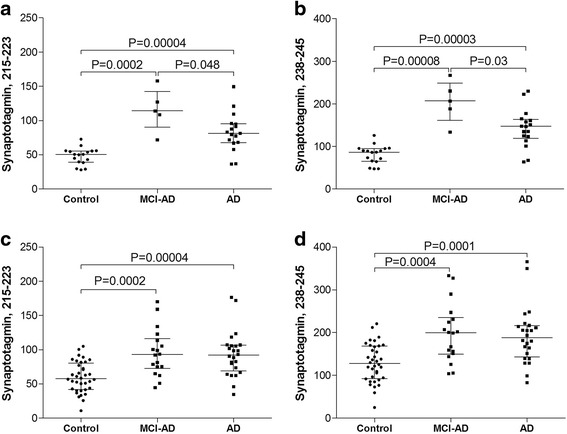
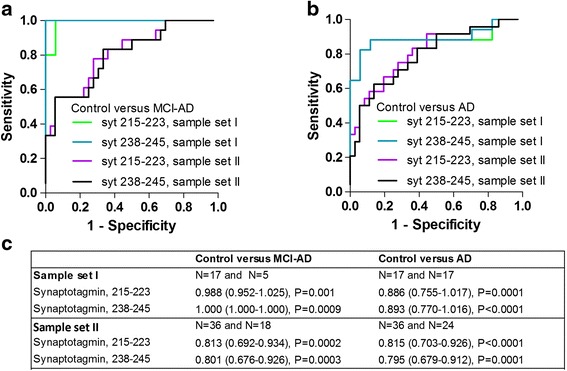
Verification
Claims the paper makes
The claims and statistics of this paper haven’t been checked yet.
Run the check — free, no account needed. It reads the open-access text and checks the sources it cites.
Claims other papers make about this one
Each is checked against this paper’s own text: does it say what the citing paper says it does?
In the citing paper
“Neurogranin (a key regulator of the calcium-binding protein calmodulin), synaptogamin (a calcium sensor protein), and SNAP-25 (a component of the SNARE [soluble N-ethylmaleimide sensitive factor attachment protein receptor] complex) are the strongest candidates for in vivo tracking synaptic homeostasis (131–133).”
From The β-Secretase BACE1 in Alzheimer’s Disease (2021) · cites this paper as [131]
Self-check
Percentages, sums and reported differences re-computed from the paper’s own numbers.
The self-check needs the paper’s full text.
Citations
Cites
McKhann, G. M., Knopman, D. S., Chertkow, H., Hyman, B. T., Jack, C. R., Kawas, C. H., Klunk, W. E., Koroshetz, W. J., Manly, J. J., Mayeux, R., et al. (2011) · Alzheimer's & Dementia · doi:10.1016/j.jalz.2011.03.005 · Cited by 18,657
The Amyloid Hypothesis of Alzheimer’s Disease: Progress and Problems on the Road to Therapeutics
Hardy, J., & Selkoe, D. J. (2002) · Science · doi:10.1126/science.1072994 · Cited by 13,864
Amyloid oligomers exacerbate tau pathology in a mouse model of tauopathy
Selenica, M.-L. B., Brownlow, M., Jimenez, J. P., Lee, D. C., Pena, G., Dickey, C. A., Gordon, M. N., & Morgan, D. (2013) · Neurodegenerative Diseases · doi:10.1159/000337230 · Cited by 10,359
Albert, M. S., DeKosky, S. T., Dickson, D., Dubois, B., Feldman, H. H., Fox, N. C., Gamst, A., Holtzman, D. M., Jagust, W. J., Petersen, R. C., et al. (2011) · Alzheimer's & Dementia · doi:10.1016/j.jalz.2011.03.008 · Cited by 10,152 · cited 1×
“For each patient, diagnosis was made considering CSF results and according to validated clinical diagnostic criteria for dementia due to Alzheimer’s disease [28], MCI due to Alzheimer’s disease [29, 30], subjective cognitive impairment [31], and psychiatric disorder (DSM-IV).”
Sperling, R. A., Aisen, P. S., Beckett, L. A., Bennett, D. A., Craft, S., Fagan, A. M., Iwatsubo, T., Jack, C. R., Kaye, J., Montine, T. J., et al. (2011) · Alzheimer's & Dementia · doi:10.1016/j.jalz.2011.03.003 · Cited by 7,155
Alzheimer's Disease Is a Synaptic Failure
Selkoe, D. J. (2002) · Science · doi:10.1126/science.1074069 · Cited by 4,420
Terry, R. D., Masliah, E., Salmon, D. P., Butters, N., DeTeresa, R., Hill, R., Hansen, L. A., & Katzman, R. (1991) · Annals of Neurology · doi:10.1002/ana.410300410 · Cited by 4,397
Advancing research diagnostic criteria for Alzheimer's disease: the IWG-2 criteria
Dubois, B., Feldman, H. H., Jacova, C., Hampel, H., Molinuevo, J. L., Blennow, K., DeKosky, S. T., Gauthier, S., Selkoe, D., Bateman, R., et al. (2014) · The Lancet Neurology · doi:10.1016/s1474-4422(14)70090-0 · Cited by 3,321
Self-citationBlennow, K., de Leon, M. J., & Zetterberg, H. (2006) · The Lancet · doi:10.1016/s0140-6736(06)69113-7 · Cited by 3,134
Self-citationAlbert, M., DeKosky, S. T., Dickson, D. W., Dubois, B., Feldman, H., Fox, N. C., Gamst, A. C., Holtzman, D. M., Jagust, W. J., Petersen, R. C., et al. (2013) · FOCUS The Journal of Lifelong Learning in Psychiatry · doi:10.1176/appi.focus.11.1.96 · Cited by 2,639
Synapse loss in frontal cortex biopsies in Alzheimer's disease: Correlation with cognitive severity
DeKosky, S. T., & Scheff, S. W. (1990) · Annals of Neurology · doi:10.1002/ana.410270502 · Cited by 2,376
Olsson, B., Lautner, R., Andreasson, U., Öhrfelt, A., Portelius, E., Bjerke, M., Hölttä, M., Rosén, C., Olsson, C., Strobel, G., et al. (2016) · The Lancet Neurology · doi:10.1016/s1474-4422(16)00070-3 · Cited by 2,049
Self-citationCerebrospinal fluid and plasma biomarkers in Alzheimer disease
Blennow, K., Hampel, H., Weiner, M., & Zetterberg, H. (2010) · Nature Reviews Neurology · doi:10.1038/nrneurol.2010.4 · Cited by 1,863
Self-citationPrevalence of Cerebral Amyloid Pathology in Persons Without Dementia: A Meta-analysis
Jansen, W. J., Ossenkoppele, R., Knol, D. L., Tijms, B. M., Scheltens, P., Verhey, F. R. J., Visser, P. J., Aalten, P., Aarsland, D., Alcolea, D., et al. (2015) · JAMA · doi:10.1001/jama.2015.4668 · Cited by 1,610
Self-citationSynaptotagmin I: A major Ca2+ sensor for transmitter release at a central synapse
Geppert, M., Goda, Y., Hammer, R. E., Li, C., Rosahl, T. W., Stevens, C. F., & Südhof, T. C. (1994) · Cell · doi:10.1016/0092-8674(94)90556-8 · Cited by 1,483
Molecular machines governing exocytosis of synaptic vesicles
Jahn, R., & Fasshauer, D. (2012) · Nature · doi:10.1038/nature11320 · Cited by 1,004
Tapiola, T., Alafuzoff, I., Herukka, S.-K., Parkkinen, L., Hartikainen, P., Soininen, H., & Pirttilä, T. (2009) · Archives of Neurology · doi:10.1001/archneurol.2008.596 · Cited by 896
Altered expression of synaptic proteins occurs early during progression of Alzheimer's disease
Masliah, E., Mallory, M., Alford, M., DeTeresa, R., Hansen, L. A., McKeel, D. W., & Morris, J. C. (2001) · Neurology · doi:10.1212/wnl.56.1.127 · Cited by 720
Davies, C. A., Mann, D. M. A., Sumpter, P. Q., & Yates, P. O. (1987) · Journal of the Neurological Sciences · doi:10.1016/0022-510x(87)90057-8 · Cited by 628
Buerger, K., Ewers, M., Pirttila, T., Zinkowski, R., Alafuzoff, I., Teipel, S. J., DeBernardis, J., Kerkman, D., McCulloch, C., Soininen, H., et al. (2006) · Brain · doi:10.1093/brain/awl269 · Cited by 586
Südhof, T. (2002) · Journal of Biological Chemistry · doi:10.1074/jbc.r100052200 · Cited by 503
Synaptotagmins: C2-domain proteins that regulate membrane traffic.
Südhof, T., & Rizo, J. (1996) · Neuron · doi:10.1016/s0896-6273(00)80171-3 · Cited by 450
The Alzheimer's Association external quality control program for cerebrospinal fluid biomarkers
Mattsson, N., Andréasson, U., Persson, S., Arai, H., Batish, S. D., Bernardini, S., Bocchio‐Chiavetto, L., Blankenstein, M. A., Carrillo, M. C., Chalbot, S., et al. (2011) · Alzheimer s & Dementia · doi:10.1016/j.jalz.2011.05.2243 · Cited by 411
Self-citationSynaptic pathology in Alzheimer's disease: a review of ultrastructural studies
Scheff, S. (2003) · Neurobiology of Aging · doi:10.1016/j.neurobiolaging.2003.08.002 · Cited by 391
Kvartsberg, H., Duits, F. H., Ingelsson, M., Andreasen, N., Öhrfelt, A., Andersson, K., Brinkmalm, G., Lannfelt, L., Minthon, L., Hansson, O., et al. (2014) · Alzheimer s & Dementia · doi:10.1016/j.jalz.2014.10.009 · Cited by 348
Self-citationBrinkmalm, A., Brinkmalm, G., Honer, W. G., Frölich, L., Hausner, L., Minthon, L., Hansson, O., Wallin, A., Zetterberg, H., Blennow, K., et al. (2014) · Molecular Neurodegeneration · doi:10.1186/1750-1326-9-53 · Cited by 293
Self-citationBlennow, K., Bogdanović, N., Alafuzoff, I. I., Ekman, R., & Davidsson, P. (1996) · Journal of Neural Transmission · doi:10.1007/bf01273157 · Cited by 207
Self-citationFunctional properties of multiple synaptotagmins in brain.
Ullrich, B., Li, C., Zhang, J. Z., McMahon, H., Anderson, R. G. W., Geppert, M., & Südhof, T. (1994) · Neuron · doi:10.1016/0896-6273(94)90415-4 · Cited by 199
Mechanism of phospholipid binding by the C2A-domain of synaptotagmin I.
Zhang, X., Rizo, J., & Südhof, T. (1998) · Biochemistry · doi:10.1021/bi9807512 · Cited by 190
Neurochemical Dissection of Synaptic Pathology in Alzheimer's Disease
Davidsson, P., & Blennow, K. (1998) · International Psychogeriatrics · doi:10.1017/s1041610298005110 · Cited by 179
Self-citationGourmaud, S., Paquet, C., Dumurgier, J., Pace, C., Bouras, C., Gray, F., Laplanche, J., MEURS, E. F., Mouton‐Liger, F., & Hugon, J. (2015) · Journal of Psychiatry and Neuroscience · doi:10.1503/jpn.140062 · Cited by 95
Self-citationIdentification of a human synaptotagmin-1 mutation that perturbs synaptic vesicle cycling
Baker, K., Gordon, S. L., Grozeva, D., van Kogelenberg, M., Roberts, N. Y., Pike, M. G., Blair, E. M., Hurles, M. E., Chong, W. K., Baldeweg, T., et al. (2015) · Journal of Clinical Investigation · doi:10.1172/jci79765 · Cited by 94
Bacaj, T., Wu, D., Burré, J., Malenka, R. C., Liu, X., & Südhof, T. C. (2015) · PLoS Biology · doi:10.1371/journal.pbio.1002267 · Cited by 88
Synaptotagmin, a synaptic vesicle protein, is present in human cerebrospinal fluid
Davidsson, P., Jahn, R., Bergquist, J., Ekman, R., & Blennow, K. (1996) · Molecular and Chemical Neuropathology · doi:10.1007/bf02815094 · Cited by 88
Self-citationRufener, E., Frazier, A. A., Wieser, C. M., Hinderliter, A., & Cafiso, D. S. (2005) · Biochemistry · doi:10.1021/bi048370d · Cited by 79
Lynch, K. L., Gerona, R. R. L., Larsen, E. C., Marcia, R., Mitchell, J. C., & Martin, T. (2007) · Molecular Biology of the Cell · doi:10.1091/mbc.e07-04-0368 · Cited by 79
Mouton‐Liger, F., Paquet, C., Dumurgier, J., Lapalus, P., Gray, F., Laplanche, J., & Hugon, J. (2012) · Biological Psychiatry · doi:10.1016/j.biopsych.2011.11.031 · Cited by 67
Self-citationMouton‐Liger, F., Wallon, D., Troussière, A., Yatimi, R., Dumurgier, J., Magnin, É., Sayette, V. D. L., Duron, E., Philippi, N., Beaufils, É., et al. (2013) · Journal of Neurology · doi:10.1007/s00415-013-7160-3 · Cited by 67
Self-citationMasliah, E., Honer, W. G., Mallory, M. E., Voigt, M., Kushner, P. D., Hansen, L. A., & Terry, R. D. (1994) · Acta Neuropathologica · doi:10.1007/bf00296182 · Cited by 56
Yoo, B. C., Cairns, N. J., Fountoulakis, M., & Lübec, G. (2001) · Dementia and Geriatric Cognitive Disorders · doi:10.1159/000051261 · Cited by 54
Cited by
Sorted by citations
Biomarkers for Alzheimer's disease: current status and prospects for the future
Blennow, K., & Zetterberg, H. (2018) · Journal of Internal Medicine · doi:10.1111/joim.12816 · Cited by 1,000
Self-citationThe β-Secretase BACE1 in Alzheimer’s Disease
Hampel, H., Vassar, R., De Strooper, B., Hardy, J., Willem, M., Singh, N., Zhou, J., Yan, R., Vanmechelen, E., De Vos, A., et al. (2021) · Biological Psychiatry · doi:10.1016/j.biopsych.2020.02.001 · Cited by 694
Current state of Alzheimer’s fluid biomarkers
Molinuevo, J. L., Ayton, S., Batrla, R., Bednar, M. M., Bittner, T., Cummings, J., Fagan, A. M., Hampel, H., Mielke, M. M., Mikulskis, A., et al. (2018) · Acta Neuropathologica · doi:10.1007/s00401-018-1932-x · Cited by 518
Self-citationBlood neuro‐exosomal synaptic proteins predict Alzheimer's disease at the asymptomatic stage
Jia, L., Zhu, M., Kong, C., Pang, Y., Zhang, H., Qiu, Q., Wei, C., Tang, Y., Wang, Q., Li, Y., et al. (2020) · Alzheimer s & Dementia · doi:10.1002/alz.12166 · Cited by 247
The synapse in traumatic brain injury
Jamjoom, A. A. B., Rhodes, J. K. J., Andrews, P., & Grant, S. G. N. (2020) · Brain · doi:10.1093/brain/awaa321 · Cited by 257
Metadata
- Authors
- Öhrfelt, A., Brinkmalm, A., Dumurgier, J., Brinkmalm, G., Hansson, O., Zetterberg, H., Bouaziz-Amar, E., Hugon, J., Paquet, C., & Blennow, K.
- Affiliations
- Sahlgrenska University Hospital (SE)
- Inserm (FR)
- Lund University (SE)
- Corresponding author
- Öhrfelt, Annika
- ORCID
- Venue
- Alzheimer's Research & Therapy
- Published
- 2016-10-03
- Volume
- 8
- Issue
- 1
- Pages
- 41-41
- ISSN
- 1758-9193 (ISSN-L)
- PMC
- PMC5048479
- OpenAlex
- W2529693680
- Cited by
- 184
- References
- 40
- Citations by year
- 2026: 6 · 2025: 17 · 2024: 35 · 2023: 18 · 2022: 31 · 2021: 22 · 2020: 26 · 2019: 14 · 2018: 13 · 2017: 2
- FWCI
- 7.78
- Type
- journal article
- Language
- en
- Open access
- gold
- doi.org
- Locations
- Alzheimer s Research & Therapy (publishedVersion, cc-by)
- PubMed Central (publishedVersion, cc-by)
- PubMed (publishedVersion)
- UCL Discovery (University College London) (submittedVersion)
- Lund University Publications (Lund University) (submittedVersion)
- Funders
- Swedish Brain Power
- Swedish research council
- Swedish Alzheimer foundation
- European research council
- ALF
- The Knut and Wallenberg foundation
- Demensfonden
- Eivind och Elsa K:son Sylvans stiftelse
- the Wolfson foundation
- Märtha och Gustaf Ågrens stiftelse
- Gun och Bertil Stohnes Stiftelse
- Stiftelsen gamla tjänarinnor
- Magnus Bergvalls Stiftelse
- Svenska Läkaresällskapet
- Åhlén-stiftelsen
- BMBF BIOMARK-APD
- Topics
- Life Sciences › Neuroscience › Cellular and Molecular Neuroscience › Alzheimer's disease research and treatments
- Health Sciences › Medicine › Psychiatry and Mental health › Dementia and Cognitive Impairment Research
- Life Sciences › Neuroscience › Neurology › Neuroinflammation and Neurodegeneration Mechanisms
- Keywords
- synaptotagmin-1, Alzheimer's disease, cerebrospinal fluid biomarkers, synaptic dysfunction, synaptic degeneration, mild cognitive impairment, dementia, cognitive decline, drug monitoring, neurodegeneration biomarkers, tau protein, neuroinflammation, neurofibrillary tangles, neurodegeneration
- MeSH terms
- Adult, Aged, Aged, 80 and over, Alzheimer Disease, Cognition Disorders, Dementia, Female, Humans, Male, Middle Aged, Peptide Fragments, Peptides, Psychiatric Status Rating Scales, ROC Curve, Mass Spectrometry, Amyloid beta-Peptides, tau Proteins, Immunoprecipitation, Synaptotagmin I
About these checks
Registry, retraction, Cites and statistics results are computed, not judged, with one exception: a printed reference that no index lists is read once by a model before it counts as a citation error. Claims are extracted by a model and kept only when their quote appears verbatim in the text; each cited source is then checked, with a model’s help, for whether it says what the claim relies on. Those verdicts can be wrong — read the claim’s quote and the cited source before relying on one.
Statistics and arithmetic are recomputed, not judged.
Confidence bands are shown only for fields calibrated on our annotated test set. None is calibrated yet, so no band is shown.
What counts as a claim ›How we measure confidence ›How we check this ›
Are you an author, or do you see a problem with this page? Request a review
