

The dynamics of biomarkers across the clinical spectrum of Alzheimer's disease
Open accessThe DOI matches its Crossref record; 81 of the 82 references it cites were found in a registry or an index.
Abstract
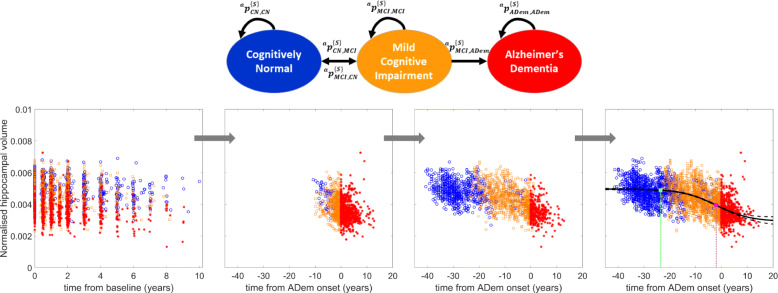
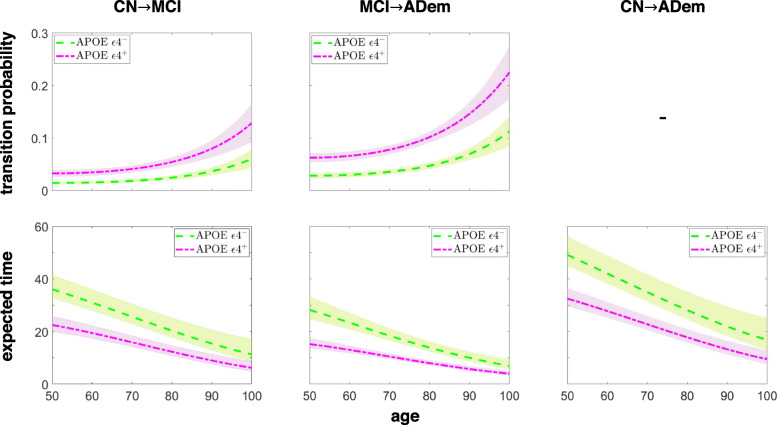
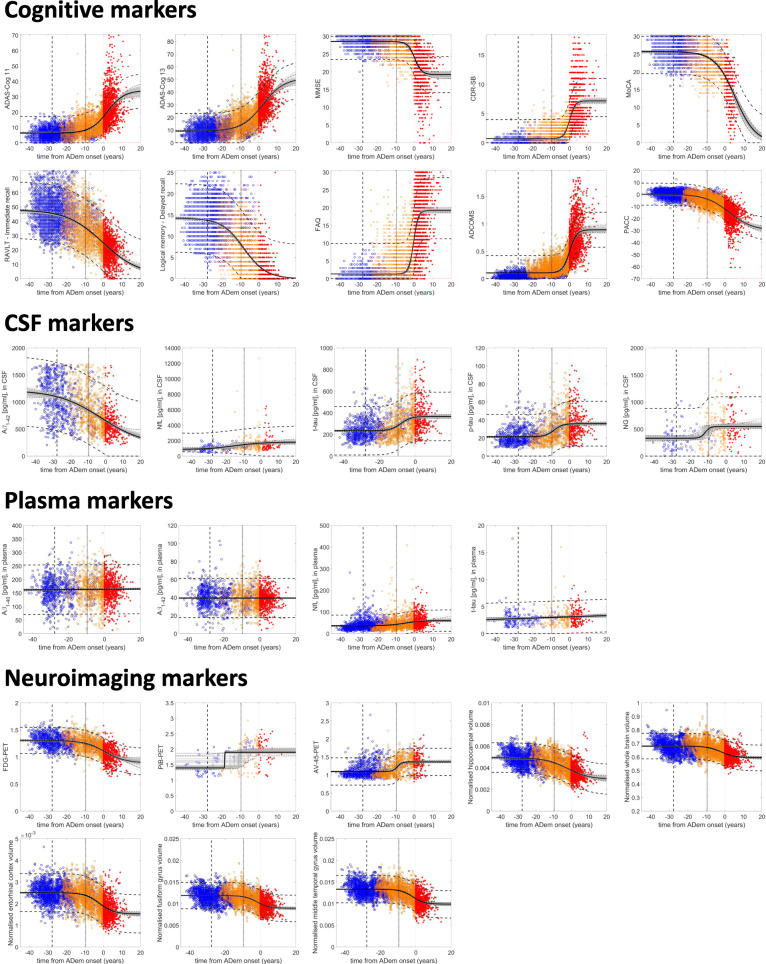
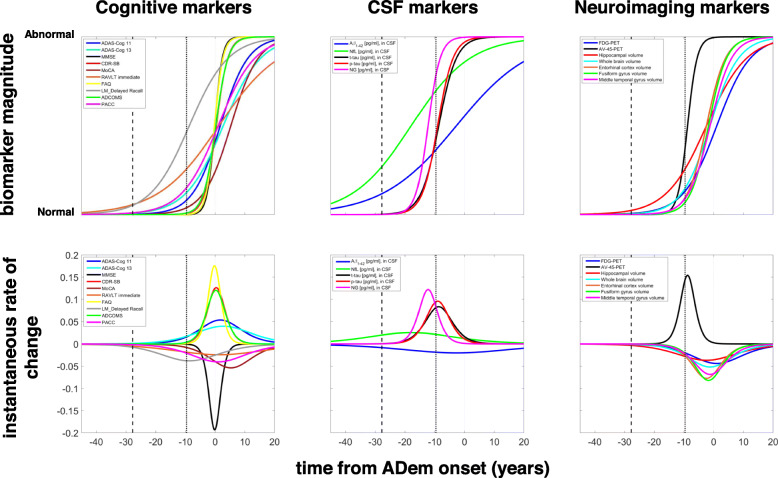
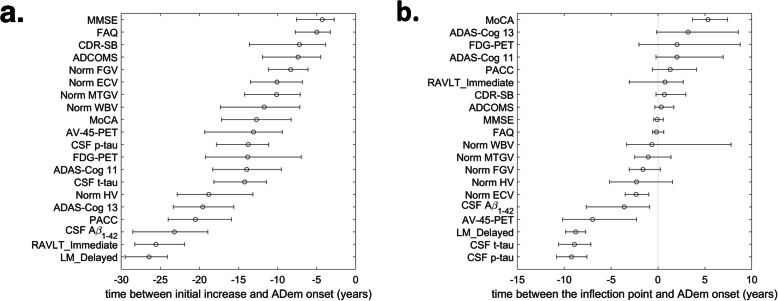
Background: Quantifying changes in the levels of biological and cognitive markers prior to the clinical presentation of Alzheimer’s disease (AD) will provide a template for understanding the underlying aetiology of the clinical syndrome and, concomitantly, for improving early diagnosis, clinical trial recruitment and treatment assessment. This study aims to characterise continuous changes of such markers and determine their rate of change and temporal order throughout the AD continuum. Methods: The methodology is founded on the development of stochastic models to estimate the expected time to reach different clinical disease states, for different risk groups, and synchronise short-term individual biomarker data onto a disease progression timeline. Twenty-seven markers are considered, including a range of cognitive scores, cerebrospinal (CSF) and plasma fluid proteins, and brain structural and molecular imaging measures. Data from 2014 participants in the Alzheimer’s Disease Neuroimaging Initiative database is utilised. Results: The model suggests that detectable memory dysfunction could occur up to three decades prior to the onset of dementia due to AD (ADem). This is closely followed by changes in amyloid-β CSF levels and the first cognitive decline, as assessed by sensitive measures. Hippocampal atrophy could be observed as early as the initial amyloid-β accumulation. Brain hypometabolism starts later, about 14 years before onset, along with changes in the levels of total and phosphorylated tau proteins. Loss of functional abilities occurs rapidly around ADem onset. Neurofilament light is the only protein with notable early changes in plasma levels. The rate of change varies, with CSF, memory, amyloid PET and brain structural measures exhibiting the highest rate before the onset of ADem, followed by a decline. The probability of progressing to a more severe clinical state increases almost exponentially with age. In accordance with previous studies, the presence of apolipoprotein E4 alleles and amyloid-β accumulation can be associated with an increased risk of developing the disease, but their influence depends on age and clinical state. Conclusions: Despite the limited longitudinal data at the individual level and the high variability observed in such data, the study elucidates the link between the long asynchronous pathophysiological processes and the preclinical and clinical stages of AD.
Overview
The claims and statistics of this paper haven’t been checked yet.
Free: it reads the open-access text and checks the first 5 claims that cite a source we can check. Create a free account to check every claim.
Integrity signals
Registry
Cites
Statistics
Figures
Verification
Claims the paper makes
The claims and statistics of this paper haven’t been checked yet.
Free: it reads the open-access text and checks the first 5 claims that cite a source we can check. Create a free account to check every claim.
Claims other papers make about this one
Each is checked against this paper’s own text: does it say what the citing paper says it does?
The cited source says what the claim attributes to it.
In the citing paper
“The long preclinical phase of some dementias over more than a decade is characterised by progressive neuropathological changes, such as amyloid or tau accumulation before Alzheimer's dementia (AD) , which initially have few cognitive effects, that may increase over many years.(25)”
From Dementia prevention, intervention, and care: 2024 report of the Lancet standing Commission (2024) · cites this paper as [25]
Self-check
Percentages, sums and reported differences re-computed from the paper’s own numbers.
The self-check needs the paper’s full text.
Citations
Cites
Folstein, M. F., Folstein, S. E., & McHugh, P. R. (1975) · Journal of Psychiatric Research · doi:10.1016/0022-3956(75)90026-6 · Cited by 88,282 · cited 1×
“…the least severe and the last the most severe [27]) and the ADAS-Cog 13 (0 to 85) [28]; the Mini-Mental State Examination (MMSE) test (30 to 0) [29] which is an indicator of mental status; the Clinical Dementia Rating Scale-Sum of Boxes (CDR-SB) (0 to 18) [30, 31]; the Montreal Cognitive…”
McKhann, G., Drachman, D., Folstein, M., Katzman, R., Price, D., & Stadlan, E. M. (1984) · Neurology · doi:10.1212/wnl.34.7.939 · Cited by 27,915 · cited 2×
“Three commonly accepted clinical states are considered: the cognitively normal state (CN), the mild cognitive impairment state (MCI) and the ADem state [16, 18].”
The Montreal Cognitive Assessment, MoCA: a brief screening tool for mild cognitive impairment
Nasreddine, Z. S., Phillips, N. A., Bédirian, V., Charbonneau, S., Whitehead, V., Collin, I., Cummings, J. L., & Chertkow, H. (2005) · Journal of the American Geriatrics Society · doi:10.1111/j.1532-5415.2005.53221.x · Cited by 25,553 · cited 1×
“…of mental status; the Clinical Dementia Rating Scale-Sum of Boxes (CDR-SB) (0 to 18) [30, 31]; the Montreal Cognitive Assessment (MoCA) (30 to 0) [32]; and the Functional Activities Questionnaire (FAQ), concerned with performing daily tasks necessary for independent living (0 to 30, with higher…”
Kok, J. S., Berg, I. J., & Scherder, E. J. A. (2013) · Dementia and Geriatric Cognitive Disorders Extra · doi:10.1159/000353441 · Cited by 20,589
Older Adults' Reasons for Using Technology while Aging in Place
Peek, S. T. M., Luijkx, K. G., Rijnaard, M. D., Nieboer, M. E., van der Voort, C. S., Aarts, S., van Hoof, J., Vrijhoef, H. J. M., & Wouters, E. J. M. (2016) · Gerontology · doi:10.1159/000430949 · Cited by 19,690
Sensitivity and False Alarm Rate of a Fall Sensor in Long-Term Fall Detection in the Elderly
Kangas, M., Korpelainen, R., Vikman, I., Nyberg, L., & Jämsä, T. (2015) · Gerontology · doi:10.1159/000362720 · Cited by 18,909
McKhann, G. M., Knopman, D. S., Chertkow, H., Hyman, B. T., Jack, C. R., Kawas, C. H., Klunk, W. E., Koroshetz, W. J., Manly, J. J., Mayeux, R., et al. (2011) · Alzheimer's & Dementia · doi:10.1016/j.jalz.2011.03.005 · Cited by 18,657
NIA‐AA Research Framework: Toward a biological definition of Alzheimer's disease
Jack, C. R., Bennett, D. A., Blennow, K., Carrillo, M. C., Dunn, B., Haeberlein, S. B., Holtzman, D. M., Jagust, W., Jessen, F., Karlawish, J., et al. (2018) · Alzheimer's & Dementia · doi:10.1016/j.jalz.2018.02.018 · Cited by 10,537 · cited 5×
“In this study, we aim to describe the pathophysiological changes that may be observed during the clinical progression from cognitively healthy stages to Alzheimer ’ s clinical syndrome [16] and provide further insights into their temporal relation.”
InfluentialAlbert, M. S., DeKosky, S. T., Dickson, D., Dubois, B., Feldman, H. H., Fox, N. C., Gamst, A., Holtzman, D. M., Jagust, W. J., Petersen, R. C., et al. (2011) · Alzheimer's & Dementia · doi:10.1016/j.jalz.2011.03.008 · Cited by 10,152
A New Clinical Scale for the Staging of Dementia
Hughes, C. P., Berg, L., Danziger, W., Coben, L. A., & Martin, R. L. (1982) · British Journal of Psychiatry · doi:10.1192/bjp.140.6.566 · Cited by 7,056 · cited 1×
“…Examination (MMSE) test (30 to 0) [29] which is an indicator of mental status; the Clinical Dementia Rating Scale-Sum of Boxes (CDR-SB) (0 to 18) [30, 31]; the Montreal Cognitive Assessment (MoCA) (30 to 0) [32]; and the Functional Activities Questionnaire (FAQ), concerned with performing daily…”
Hypothetical model of dynamic biomarkers of the Alzheimer's pathological cascade
Jack, C. R., Knopman, D. S., Jagust, W. J., Shaw, L. M., Aisen, P. S., Weiner, M. W., Petersen, R. C., & Trojanowski, J. Q. (2010) · The Lancet Neurology · doi:10.1016/s1474-4422(09)70299-6 · Cited by 4,806 · cited 5×
“The results support and contribute to the current understanding of the quantitative characteristics of the clinical progression of AD based on multiple clinical and biological measures [2, 26].”
InfluentialImaging brain amyloid in Alzheimer's disease with Pittsburgh Compound‐B
Klunk, W. E., Engler, H., Nordberg, A., Wang, Y., Blomqvist, G., Holt, D. P., Bergström, M., Savitcheva, I., Huang, G., Estrada, S., et al. (2004) · Annals of Neurology · doi:10.1002/ana.20009 · Cited by 4,496 · cited 1×
“…positron emission tomography (PET) which is used to visualise changes in the cerebral glucose metabolism [44], and standardised uptake value ratio (SUVr) for Pittsburgh compound B (PiB)-PET [45] and florbetapir (F18-AV-45) PET [46], which both allow in vivo assessment of cerebral amyloid load.”
A new rating scale for Alzheimer's disease
(1984) · American Journal of Psychiatry · doi:10.1176/ajp.141.11.1356 · Cited by 4,175 · cited 1×
“…as AD and dementia indicators: the ADAS-Cog 11 (ranged from 0 to 70, with the first number being the least severe and the last the most severe [27]) and the ADAS-Cog 13 (0 to 85) [28]; the Mini-Mental State Examination (MMSE) test (30 to 0) [29] which is an indicator of mental status; the…”
Clinical and biomarker changes in dominantly inherited Alzheimer's disease
Bateman, R. J., Xiong, C., Benzinger, T. L. S., Fagan, A. M., Goate, A., Fox, N. C., Marcus, D. S., Cairns, N. J., Xie, X., Blazey, T. M., et al. (2012) · New England Journal of Medicine · doi:10.1056/nejmoa1202753 · Cited by 3,814 · cited 3×
“The timespan and sequence of biomarker changes are also in general agreement with observations in autosomal dominant AD [6, 57].”
Apolipoprotein E and Alzheimer disease: risk, mechanisms and therapy
Liu, C.-C., Kanekiyo, T., Xu, H., & Bu, G. (2013) · Nature Reviews Neurology · doi:10.1038/nrneurol.2012.263 · Cited by 3,459 · cited 1×
“Two established major risk factors for sporadic Alzheimer ’ s are taken into account: the presence of the apolipoprotein E ɛ 4 genotype (APOE ɛ 4) [19] and age.”
Advancing research diagnostic criteria for Alzheimer's disease: the IWG-2 criteria
Dubois, B., Feldman, H. H., Jacova, C., Hampel, H., Molinuevo, J. L., Blennow, K., DeKosky, S. T., Gauthier, S., Selkoe, D., Bateman, R., et al. (2014) · The Lancet Neurology · doi:10.1016/s1474-4422(14)70090-0 · Cited by 3,321
L’examen Clinique en Psychologie
Rubé, P. (1959) · American Journal of Psychotherapy · doi:10.1176/appi.psychotherapy.1959.13.4.989 · Cited by 3,302
Alzheimer's Disease Neuroimaging Initiative (ADNI): Clinical characterization
Petersen, R. C., Aisen, P. S., Beckett, L. A., Donohue, M. C., Gamst, A. C., Harvey, D. J., Jack, C. R., Jagust, W. J., Shaw, L. M., Toga, A. W., et al. (2010) · Neurology · doi:10.1212/wnl.0b013e3181cb3e25 · Cited by 3,060 · cited 1×
“Previous work has mainly focused on the description of the dynamics within different clinical states [4, 5].”
Measurement of Functional Activities in Older Adults in the Community
Pfeffer, R. I., Kurosaki, T. T., Harrah, C. H., Chance, J. M., & Filos, S. (1982) · Journal of Gerontology · doi:10.1093/geronj/37.3.323 · Cited by 2,972
Albert, M. S., DeKosky, S. T., Dickson, D., Dubois, B., Feldman, H. H., Fox, N. C., Gamst, A., Holtzman, D. M., Jagust, W. J., Petersen, R. C., et al. (2013) · Focus · doi:10.1176/appi.focus.11.1.96 · Cited by 2,621
Villemagne, V. L., Burnham, S., Bourgeat, P., Brown, B., Ellis, K. A., Salvado, O., Szoeke, C., Macaulay, S. L., Martins, R., Maruff, P., et al. (2013) · The Lancet Neurology · doi:10.1016/s1474-4422(13)70044-9 · Cited by 2,279 · cited 7×
“The value of episodic memory tests, and associations of changes in the performance in delayed recall tasks and the clinical progression to ADem, has also been observed and discussed in previous studies [2, 9, 10, 62 – 65].”
InfluentialJack, C. R., Albert, M. S., Knopman, D. S., McKhann, G. M., Sperling, R. A., Carrillo, M. C., Thies, B., & Phelps, C. H. (2011) · Alzheimer's & Dementia · doi:10.1016/j.jalz.2011.03.004 · Cited by 2,042 · cited 1×
“Alzheimer ’ s disease (AD) is a neurodegenerative disorder with long preclinical and prodromal stages [1, 2], where pathophysiological changes, and potentially irreversible brain damage, occur many years prior to clinical manifestation.”
CSF markers for incipient Alzheimer's disease
Blennow, K., & Hampel, H. (2003) · The Lancet Neurology · doi:10.1016/s1474-4422(03)00530-1 · Cited by 1,291 · cited 2×
“The 42-amino acid form of amyloid β protein, A β 1 – 42 , which indicates brain amyloid pathology [39]; the neuro-filament light (NfL), a biomarker of neuroaxonal injury or neurodegeneration [40]; the total tau (t-tau) and phosphorylated tau (p-tau) proteins [39], which can be considered as…”
Use of Florbetapir-PET for Imaging β-Amyloid Pathology
Clark, C. M. (2011) · JAMA · doi:10.1001/jama.2010.2008 · Cited by 1,117
Association of plasma neurofilament light with neurodegeneration in patients with Alzheimer disease
Mattsson, N., Andreasson, U., Zetterberg, H., Blennow, K., & Initiative, F. T. A. D. N. (2017) · JAMA Neurology · doi:10.1001/jamaneurol.2016.6117 · Cited by 1,070
Amyloid imaging results from the Australian Imaging, Biomarkers and Lifestyle (AIBL) study of aging
Rowe, C. C., Ellis, K. A., Rimajova, M., Bourgeat, P., Pike, K. E., Jones, G., Fripp, J., Tochon-Danguy, H., Morandeau, L., O'Keefe, G., et al. (2010) · Neurobiology of Aging · doi:10.1016/j.neurobiolaging.2010.04.007 · Cited by 986 · cited 1×
“…some biomarkers could also be partly attributed to neurobiological changes occurring in non-Alzheimer ’ s ageing population, due for example to ageing or the presence of other pathological processes and neurodegenerative or cardiovascular diseases, that can be present in all clinical stages [73].”
Jack, C. R., Lowe, V. J., Senjem, M. L., Weigand, S. D., Kemp, B. J., Shiung, M. M., Knopman, D. S., Boeve, B. F., Klunk, W. E., Mathis, C. A., et al. (2008) · Brain · doi:10.1093/brain/awm336 · Cited by 958 · cited 1×
“…the following thresholds have been considered as amyloid-positive individuals: CSF A β 1 – 42 = 880 pg/mL [47] or/and global PET florbetapir SUVr = 1.11, normalised to the whole cerebellum [48], or/and PiB-PET SUVr (standardised in the region relative to cerebellar grey matter) = 1.5 [2, 49, 50].”
InfluentialDominantly Inherited Alzheimer Network, Preische, O., Schultz, S. A., Apel, A., Kuhle, J., Kaeser, S. A., Barro, C., Gräber, S., Kuder-Buletta, E., LaFougere, C., et al. (2019) · Nature Medicine · doi:10.1038/s41591-018-0304-3 · Cited by 927 · cited 1×
“…a promising marker that can indicate pathological changes at early stages in disease development, and therefore, although not specific for AD, it could potentially be considered as a biomarker for the screening of related neurodegeneration and disease prognosis, monitoring and assessment [68 – 71].”
Meng, X., & D’Arcy, C. (2012) · PLoS ONE · doi:10.1371/journal.pone.0038268 · Cited by 876 · cited 1×
“However, there are divergent views amongst researchers on the actual impact of education on the development of AD and the rate of progression [20, 55, 56].”
The Preclinical Alzheimer Cognitive Composite: Measuring Amyloid-Related Decline
Donohue, M. C., Sperling, R. A., Salmon, D. P., Rentz, D. M., Raman, R., Thomas, R. G., Weiner, M., & Aisen, P. S. (2014) · JAMA Neurology · doi:10.1001/jamaneurol.2014.803 · Cited by 860 · cited 1×
“The first is the Preclinical Alzheimer Cognitive Composite [36] (PACC, the modified version of [37] to include the Trail Making Test B), which has been designed to serve as the primary outcome measure for trials conducted at the asymptomatic phase of the disease (lower scores indicate more severe…”
APOE predicts amyloid‐beta but not tau Alzheimer pathology in cognitively normal aging
Morris, J. C., Roe, C. M., Xiong, C., Fagan, A. M., Goate, A. M., Holtzman, D. M., & Mintun, M. A. (2010) · Annals of Neurology · doi:10.1002/ana.21843 · Cited by 830 · cited 1×
“…presence of an APOE ε 4 allele and lower levels of education increase the likelihood and rate of developing symptoms of ADem, but the presence of APOE ε 4 was shown to be the dominant factor (it is worth noting that studies have shown that APOE ε 4 is linked to CSF A β 1 – 42 accumulation [8, 53]).”
Hansson, O., Seibyl, J., Stomrud, E., Zetterberg, H., Trojanowski, J. Q., Bittner, T., Lifke, V., Corradini, V., Eichenlaub, U., Batrla, R., et al. (2018) · Alzheimer's & Dementia · doi:10.1016/j.jalz.2018.01.010 · Cited by 808 · cited 1×
“…individuals that have ever crossed one of the following thresholds have been considered as amyloid-positive individuals: CSF A β 1 – 42 = 880 pg/mL [47] or/and global PET florbetapir SUVr = 1.11, normalised to the whole cerebellum [48], or/and PiB-PET SUVr (standardised in the region relative to…”
InfluentialProdromal Alzheimer's disease: successive emergence of the clinical symptoms
Amieva, H., Le Goff, M., Millet, X., Orgogozo, J. M., Pérès, K., Barberger‐Gateau, P., Jacqmin‐Gadda, H., & Dartigues, J. F. (2008) · Annals of Neurology · doi:10.1002/ana.21509 · Cited by 737
Amyloid deposition, hypometabolism, and longitudinal cognitive decline
Landau, S. M., Mintun, M. A., Joshi, A. D., Koeppe, R. A., Petersen, R. C., Aisen, P. S., Weiner, M. W., Jagust, W. J., & Initiative, F. T. A. D. N. (2012) · Annals of Neurology · doi:10.1002/ana.23650 · Cited by 727
Mattsson, N., Cullen, N. C., Andreasson, U., Zetterberg, H., & Blennow, K. (2019) · JAMA Neurology · doi:10.1001/jamaneurol.2019.0765 · Cited by 726 · cited 1×
“…a promising marker that can indicate pathological changes at early stages in disease development, and therefore, although not specific for AD, it could potentially be considered as a biomarker for the screening of related neurodegeneration and disease prognosis, monitoring and assessment [68 – 71].”
Mohs, R. C., Knopman, D., Petersen, R. C., Ferris, S. H., Ernesto, C., Grundman, M., Sano, M., Bieliauskas, L., Geldmacher, D., Clark, C., et al. (1997) · Alzheimer Disease & Associated Disorders · doi:10.1097/00002093-199700112-00003 · Cited by 692 · cited 1×
“…the ADAS-Cog 11 (ranged from 0 to 70, with the first number being the least severe and the last the most severe [27]) and the ADAS-Cog 13 (0 to 85) [28]; the Mini-Mental State Examination (MMSE) test (30 to 0) [29] which is an indicator of mental status; the Clinical Dementia Rating Scale-Sum of…”
Buchhave, P. (2012) · Archives of General Psychiatry · doi:10.1001/archgenpsychiatry.2011.155 · Cited by 664 · cited 2×
“This, perhaps, suggests that the appropriateness of each marker for disease diagnosis and monitoring and use in clinical trials should be based on the disease stage [8, 72].”
FDG-PET improves accuracy in distinguishing frontotemporal dementia and Alzheimer's disease
Foster, N. L., Heidebrink, J. L., Clark, C. M., Jagust, W. J., Arnold, S. E., Barbas, N. R., DeCarli, C. S., Scott Turner, R., Koeppe, R. A., Higdon, R., et al. (2007) · Brain · doi:10.1093/brain/awm177 · Cited by 608 · cited 1×
“…considered 18 F-fluorodeoxyglucose (FDG) positron emission tomography (PET) which is used to visualise changes in the cerebral glucose metabolism [44], and standardised uptake value ratio (SUVr) for Pittsburgh compound B (PiB)-PET [45] and florbetapir (F18-AV-45) PET [46], which both allow in…”
Relationship Between Education and Dementia: An Updated Systematic Review
Sharp, E. S., & Gatz, M. (2011) · Alzheimer Disease & Associated Disorders · doi:10.1097/wad.0b013e318211c83c · Cited by 591 · cited 2×
“We also extend the model to consider the effect of educational attainment [20].”
On the path to 2025: understanding the Alzheimer’s disease continuum
Aisen, P. S., Cummings, J., Jack, C. R., Morris, J. C., Sperling, R., Frölich, L., Jones, R. W., Dowsett, S. A., Matthews, B. R., Raskin, J., et al. (2017) · Alzheimer's Research & Therapy · doi:10.1186/s13195-017-0283-5 · Cited by 556 · cited 1×
“…of collecting frequent biomarker data over a long period of time, research over the last two decades has improved our understanding of the natural history of AD and demonstrated the importance of considering the disease as a multifaceted process moving along a biological and clinical continuum [3].”
The Alzheimer's Disease Neuroimaging Initiative positron emission tomography core
Jagust, W. J., Bandy, D., Chen, K., Foster, N. L., Landau, S. M., Mathis, C. A., Price, J. C., Reiman, E. M., Skovronsky, D., Koeppe, R. A., et al. (2010) · Alzheimer's & Dementia · doi:10.1016/j.jalz.2010.03.003 · Cited by 533
Symptom onset in autosomal dominant Alzheimer disease: A systematic review and meta-analysis
Ryman, D. C., Acosta-Baena, N., Aisen, P. S., Bird, T., Danek, A., Fox, N. C., Goate, A., Frommelt, P., Ghetti, B., Langbaum, J. B. S., et al. (2014) · Neurology · doi:10.1212/wnl.0000000000000596 · Cited by 502 · cited 1×
“Estimates in these studies have also been produced based on the mean age at onset of all other individuals with the same autosomal dominant AD mutation type [7].”
Zetterberg, H., Skillbäck, T., Mattsson, N., Trojanowski, J. Q., Portelius, E., Shaw, L. M., Weiner, M. W., Blennow, K., & Initiative, F. T. A. D. N. (2016) · JAMA Neurology · doi:10.1001/jamaneurol.2015.3037 · Cited by 487 · cited 2×
“…A β 1 – 42 , which indicates brain amyloid pathology [39]; the neuro-filament light (NfL), a biomarker of neuroaxonal injury or neurodegeneration [40]; the total tau (t-tau) and phosphorylated tau (p-tau) proteins [39], which can be considered as potential biomarkers of Alzheimer-type axonal…”
Mohs, R. C., Knopman, D. S., Petersen, R. C., Ferris, S. H., Ernesto, C., Grundman, M., Sano, M., Bieliauskas, L. A., Geldmacher, D., Clark, C., et al. (1997) · PubMed · Cited by 487
Subjective cognitive complaints and amyloid burden in cognitively normal older individuals
Amariglio, R. E., Becker, J. A., Carmasin, J., Wadsworth, L. P., Lorius, N., Sullivan, C., Maye, J. E., Gidicsin, C., Pepin, L. C., Sperling, R. A., et al. (2012) · Neuropsychologia · doi:10.1016/j.neuropsychologia.2012.08.011 · Cited by 472
Donohue, M. C., Sperling, R. A., Petersen, R., Sun, C.-K., Weiner, M. W., Aisen, P. S., & Initiative, F. T. A. D. N. (2017) · JAMA · doi:10.1001/jama.2017.6669 · Cited by 452 · cited 2×
“Differences, however, may be pronounced when comparing the trajectories during follow-up in the study between the groups of those that have and those that have not shown elevated levels of A β at baseline [37].”
Whitwell, J. L., Crum, W. R., Watt, H., & Fox, N. C. (2001) · American Journal of Neuroradiology · Cited by 440
Imaging cerebral atrophy: normal ageing to Alzheimer's disease
Fox, N. C., & Schott, J. M. (2004) · The Lancet · doi:10.1016/s0140-6736(04)15441-x · Cited by 436 · cited 1×
“brain regions have been considered: hippocampus, whole brain, entorhinal cortex, fusiform gyrus and middle temporal gyrus [42].”
Longitudinal Change in CSF Biomarkers in Autosomal-Dominant Alzheimer’s Disease
Fagan, A. M., Xiong, C., Jasielec, M. S., Bateman, R. J., Goate, A. M., Benzinger, T. L. S., Ghetti, B., Martins, R. N., Masters, C. L., Mayeux, R., et al. (2014) · Science Translational Medicine · doi:10.1126/scitranslmed.3007901 · Cited by 434 · cited 1×
“The timespan and sequence of biomarker changes are also in general agreement with observations in autosomal dominant AD [6, 57].”
Plasma tau levels in Alzheimer's disease
Zetterberg, H., Wilson, D., Andreasson, U., Minthon, L., Blennow, K., Randall, J., & Hansson, O. (2013) · Alzheimer's Research & Therapy · doi:10.1186/alzrt163 · Cited by 387 · cited 1×
“Elevated levels of plasma t-tau are observed at more severe clinical states [52].”
The Dynamics of Cortical and Hippocampal Atrophy in Alzheimer Disease
Sabuncu, M. R. (2011) · Archives of Neurology · doi:10.1001/archneurol.2011.167 · Cited by 339 · cited 1×
“Hence, such brain regions may be more sensitive biomarkers to changes than bigger brain regions [66].”
Plasma neurofilament light as a potential biomarker of neurodegeneration in Alzheimer’s disease
Lewczuk, P., Ermann, N., Andreasson, U., Schultheis, C., Podhorna, J., Spitzer, P., Maler, J. M., Kornhuber, J., Blennow, K., & Zetterberg, H. (2018) · Alzheimer's Research & Therapy · doi:10.1186/s13195-018-0404-9 · Cited by 305
Education and cognitive reserve in old age
Wilson, R. S., Yu, L., Lamar, M., Schneider, J. A., Boyle, P. A., & Bennett, D. A. (2019) · Neurology · doi:10.1212/wnl.0000000000007036 · Cited by 282 · cited 1×
“However, there are divergent views amongst researchers on the actual impact of education on the development of AD and the rate of progression [20, 55, 56].”
Jedynak, B. M., Lang, A., Liu, B., Katz, E., Zhang, Y., Wyman, B. T., Raunig, D., Jedynak, C. P., Caffo, B., & Prince, J. L. (2012) · NeuroImage · doi:10.1016/j.neuroimage.2012.07.059 · Cited by 243
Qiu, C., Bäckman, L., Winblad, B., Agüero-Torres, H., & Fratiglioni, L. (2001) · Archives of Neurology · doi:10.1001/archneur.58.12.2034 · Cited by 242 · cited 1×
“…between ADem onset and educational attainment, which could be partly attributed to resistance to cognitive decline due to cognitive reserve, literacy abilities, socioeconomic status, engagement in cognitively This association could also be partly due to a bias in detecting ADem symptoms [54].”
Neurogranin in cerebrospinal fluid as a marker of synaptic degeneration in Alzheimer's disease
Thorsell, A., Bjerke, M., Gobom, J., Brunhage, E., Vanmechelen, E., Andreasen, N., Hansson, O., Minthon, L., Zetterberg, H., & Blennow, K. (2010) · Brain Research · doi:10.1016/j.brainres.2010.09.073 · Cited by 204 · cited 1×
“…the total tau (t-tau) and phosphorylated tau (p-tau) proteins [39], which can be considered as potential biomarkers of Alzheimer-type axonal degeneration and neurofibrillary tangle formation, respectively; and neurogranin (Ng), which has also recently emerged as a potential synaptic biomarker [41].”
Estimating long‐term multivariate progression from short‐term data
Donohue, M. C., Jacqmin‐Gadda, H., Le Goff, M., Thomas, R. G., Raman, R., Gamst, A. C., Beckett, L. A., Jack, C. R., Weiner, M. W., Dartigues, J., et al. (2014) · Alzheimer's & Dementia · doi:10.1016/j.jalz.2013.10.003 · Cited by 197 · cited 3×
“The same method was then applied for only those individuals that have shown some evidence of substantial A β in their brain (amyloid-positive individuals), and so have an increased chance of being in the Alzheimer ’ s continuum [12, 16].”
Longitudinal Change of Biomarkers in Cognitive Decline
Lo, R. Y. (2011) · Archives of Neurology · doi:10.1001/archneurol.2011.123 · Cited by 189
Mild senile dementia of the alzheimer type: 2. Longitudinal assessment
Berg, L., Miller, J. P., Storandt, M., Duchek, J., Morris, J. C., Rubin, E. H., Burke, W. J., & Coben, L. A. (1988) · Annals of Neurology · doi:10.1002/ana.410230509 · Cited by 187 · cited 1×
“…(MMSE) test (30 to 0) [29] which is an indicator of mental status; the Clinical Dementia Rating Scale-Sum of Boxes (CDR-SB) (0 to 18) [30, 31]; the Montreal Cognitive Assessment (MoCA) (30 to 0) [32]; and the Functional Activities Questionnaire (FAQ), concerned with performing daily…”
Hirono, N., Mori, E., Ikejiri, Y., Imamura, T., Shimomura, T., Hashimoto, M., Yamashita, H., & Ikeda, M. (1997) · Brain and nerve · Cited by 169
ADCOMS: a composite clinical outcome for prodromal Alzheimer's disease trials
Wang, J., Logovinsky, V., Hendrix, S. B., Stanworth, S. H., Perdomo, C., Xu, L., Dhadda, S., Do, I., Rabe, M., Luthman, J., et al. (2016) · Journal of Neurology, Neurosurgery & Psychiatry · doi:10.1136/jnnp-2015-312383 · Cited by 160 · cited 1×
“The second is the AD Composite Score (ADCOMS) (0 to 1.97) [38], which has been developed to detect a related clinical decline in amnestic MCI due to AD, and prodromal and mild AD.”
InfluentialData-driven models of dominantly-inherited Alzheimer’s disease progression
(2018) · doi:10.1093/brain/awy050 · Cited by 145 · cited 4×
“Such late biomarkers may also be more useful in monitoring disease progression at severe disease stages [13].”
InfluentialJicha, G. A., & Carr, S. A. (2010) · Journal of Alzheimer's Disease · doi:10.3233/jad-2010-1237 · Cited by 102 · cited 1×
“The value of episodic memory tests, and associations of changes in the performance in delayed recall tasks and the clinical progression to ADem, has also been observed and discussed in previous studies [2, 9, 10, 62 – 65].”
Farrell, M. E., Kennedy, K. M., Rodrigue, K. M., Wig, G., Bischof, G. N., Rieck, J. R., Chen, X., Festini, S. B., Devous, M. D., & Park, D. C. (2017) · JAMA Neurology · doi:10.1001/jamaneurol.2017.0892 · Cited by 101
R2MLwiN: A Package to Run MLwiN from within R
Zhang, Z., Parker, R. M. A., Charlton, C. M. J., Leckie, G., & Browne, W. J. (2016) · Journal of Statistical Software · doi:10.18637/jss.v072.i10 · Cited by 93 · cited 1×
“The MCMC algorithms and goodness of fit statistics were implemented within the runMLwiN function from the R2MLwiN package in R [51].”
How early can we diagnose Alzheimer disease (and is it sufficient)?: The 2017 Wartenberg lecture
Petersen, R. C. (2018) · Neurology · doi:10.1212/wnl.0000000000006088 · Cited by 89 · cited 1×
“On the other hand, categorising individuals using clinical syndromic criteria is useful in clinical practice [17].”
Effects of beta-amyloid accumulation on neural function during encoding across the adult lifespan
Kennedy, K. M., Rodrigue, K. M., Devous, M. D., Hebrank, A. C., Bischof, G. N., & Park, D. C. (2012) · NeuroImage · doi:10.1016/j.neuroimage.2012.03.077 · Cited by 83 · cited 1×
“This may imply a link between memory deficits and elevated amyloid deposition, a view that is supported by previous reports [2, 58 – 61].”
Insel, P. S., Ossenkoppele, R., Gessert, D., Jagust, W., Landau, S., Hansson, O., Weiner, M. W., & Mattsson, N. (2017) · Frontiers in Neuroscience · doi:10.3389/fnins.2017.00281 · Cited by 77 · cited 1×
“The same methodology can also be applied to describe the sequence and magnitude of biomarker changes with respect to the time required to reach a specific biomarker value, e.g. a defined biomarker threshold/cut-off point [8, 74].”
Bayesian latent time joint mixed effect models for multicohort longitudinal data
Li, D., Iddi, S., Thompson, W. K., Donohue, M. C., & Initiative, F. T. A. D. N. (2019) · Statistical Methods in Medical Research · doi:10.1177/0962280217737566 · Cited by 75 · cited 1×
“…dynamics of biomarkers include the synchronisation of individual data based on a disease progression score, which can be a function of the individual ’ s age [9, 10], and the optimal alignment of individuals ’ biomarker trajectories with the estimated long-term population-level trajectory [11, 12].”
Quantifying the Pathophysiological Timeline of Alzheimer's Disease
Yang, E., Farnum, M., Lobanov, V., Schultz, T., Raghavan, N., Samtani, M. N., Novak, G., Narayan, V., DiBernardo, A., & Initiative1, A. T. A. D. N. (2011) · Journal of Alzheimer’s Disease · doi:10.3233/jad-2011-110551 · Cited by 68 · cited 1×
“Time-dependent changes of potential biomarkers have also been characterised on different scales of disease progression based on the individual bio-marker rate of change as estimated from the short-term longitudinal observations [2, 13 – 15].”
Bateman, R. J., Blennow, K., Doody, R., Hendrix, S., Lovestone, S., Salloway, S., Schindler, R., Weiner, M., Zetterberg, H., Aisen, P., et al. (2019) · The Journal of Prevention of Alzheimer's Disease · doi:10.14283/jpad.2019.21 · Cited by 63 · cited 1×
“However, the ease and low cost of measurements have created much interest in identifying reliable and sensitive peripheral blood-based markers that could serve as biomarkers of AD [67].”
Age‐dependent effects of APOE ε4 in preclinical Alzheimer's disease
Bonham, L. W., Geier, E. G., Fan, C. C., Leong, J. K., Besser, L., Kukull, W. A., Kornak, J., Andreassen, O. A., Schellenberg, G. D., Rosen, H. J., et al. (2016) · Annals of Clinical and Translational Neurology · doi:10.1002/acn3.333 · Cited by 59 · cited 1×
“While several studies have reported that APOE ε4-related risk for developing ADem may vary significantly with age [24, 25], in the sample dataset we considered it has been shown that this term is not significant (p > 0.”
Roe, C. M., Ances, B. M., Head, D. M., Babulal, G. M., Stout, S. H., Grant, E., Hassenstab, J. J., Xiong, C., Holtzman, D. M., Benzinger, T. L. S., et al. (2018) · Brain · doi:10.1093/brain/awy244 · Cited by 46 · cited 7×
“Considering the rate of change of potential markers instead of just a single absolute measure at a specific point in time may help identify the stage in disease progression [8].”
InfluentialPredicting time to dementia using a quantitative template of disease progression
Bilgel, M., Jedynak, B. M., & Initiative, A. D. N. (2019) · Alzheimer's & Dementia: Diagnosis, Assessment & Disease Monitoring · doi:10.1016/j.dadm.2019.01.005 · Cited by 46 · cited 2×
“The value of episodic memory tests, and associations of changes in the performance in delayed recall tasks and the clinical progression to ADem, has also been observed and discussed in previous studies [2, 9, 10, 62 – 65].”
Stomrud, E., Minthon, L., Zetterberg, H., Blennow, K., & Hansson, O. (2015) · Alzheimer's & Dementia: Diagnosis, Assessment & Disease Monitoring · doi:10.1016/j.dadm.2015.09.002 · Cited by 43 · cited 2×
“This contradicts previous studies in preclinical Alzheimer’s disease which suggested that Aβ1–42 reaches a plateau by the time of ADem onset [61, 72].”
Hadjichrysanthou, C., Ower, A. K., de Wolf, F., Anderson, R. M., & Initiative, F. T. A. D. N. (2018) · PLOS ONE · doi:10.1371/journal.pone.0190615 · Cited by 35 · cited 1×
“1 [21, 22].”
Self-citationAge stratification corrects bias in estimated hazard of APOE genotype for Alzheimer's disease
Liu, L., & Caselli, R. J. (2018) · Alzheimer's & Dementia: Translational Research & Clinical Interventions · doi:10.1016/j.trci.2018.09.006 · Cited by 29 · cited 1×
“While several studies have reported that APOE ε 4-related risk for developing ADem may vary significantly with age [24, 25], in the sample dataset we considered it has been shown that this term is not significant ( p > 0.7, checked at the 5% level of significance) and the model without the…”
InfluentialA simulation system for biomarker evolution in neurodegenerative disease
Young, A. L., Oxtoby, N. P., Ourselin, S., Schott, J. M., & Alexander, D. C. (2015) · Medical Image Analysis · doi:10.1016/j.media.2015.07.004 · Cited by 23
Hadjichrysanthou, C., Initiative, A. D. N., McRae‐McKee, K., Evans, S., de Wolf, F., & Anderson, R. M. (2018) · Journal of Alzheimer s Disease · doi:10.3233/jad-180101 · Cited by 13 · cited 2×
“1 [21, 22].”
Self-citationEvans, S., McRae‐McKee, K., Hadjichrysanthou, C., Wong, M. M., Ames, D. J., López, O. L., de Wolf, F., Anderson, R. M., Initiative, A. D. N., ageing, A. I. B. A. L. F. S. O., et al. (2019) · Alzheimer s & Dementia Translational Research & Clinical Interventions · doi:10.1016/j.trci.2019.04.005 · Cited by 13 · cited 1×
“Generalised linear mixed models (GLMMs) with a logit link function were developed and fitted, and then the probability of transitioning from state A to state B was estimated conditional on the covariates [23].”
Self-citationMustapić, M., Eitan, E., Mattson, M. P., Goetzl, E. J., & Kapogiannis, D. (2015) · Alzheimer s & Dementia · doi:10.1016/j.jalz.2015.07.202 · Cited by 3
Cited by
Dementia prevention, intervention, and care: 2024 report of the Lancet standing Commission
Livingston, G., Huntley, J., Liu, K. Y., Costafreda, S. G., Selbæk, G., Alladi, S., Ames, D., Banerjee, S., Burns, A., Brayne, C., et al. (2024) · The Lancet · doi:10.1016/s0140-6736(24)01296-0 · Cited by 3,860
The Amyloid-β Pathway in Alzheimer’s Disease
Hampel, H., Hardy, J., Blennow, K., Chen, C., Perry, G., Kim, S. H., Villemagne, V. L., Aisen, P., Vendruscolo, M., Iwatsubo, T., et al. (2021) · Molecular Psychiatry · doi:10.1038/s41380-021-01249-0 · Cited by 1,952
Gut microbiome composition may be an indicator of preclinical Alzheimer’s disease
Ferreiro, A. L., Choi, J., Ryou, J., Newcomer, E. P., Thompson, R., Bollinger, R. M., Hall-Moore, C., Ndao, I. M., Sax, L., Benzinger, T. L. S., et al. (2023) · Science Translational Medicine · doi:10.1126/scitranslmed.abo2984 · Cited by 356
Liss, J. L., Seleri Assunção, S., Cummings, J., Atri, A., Geldmacher, D. S., Candela, S. F., Devanand, D. P., Fillit, H. M., Susman, J., Mintzer, J., et al. (2021) · Journal of Internal Medicine · doi:10.1111/joim.13244 · Cited by 312
Veitch, D. P., Weiner, M. W., Aisen, P. S., Beckett, L. A., DeCarli, C., Green, R. C., Harvey, D., Jack, C. R., Jagust, W., Landau, S. M., et al. (2022) · Alzheimer's & Dementia · doi:10.1002/alz.12422 · Cited by 184
Metadata
- Authors
- Hadjichrysanthou, C., Evans, S., Bajaj, S., Siakallis, L. C., McRae-McKee, K., de Wolf, F., Anderson, R. M., & Initiative, T. A. D. N.
- Affiliations
- Imperial College London (GB)
- Public Health England (GB)
- National Hospital for Neurology and Neurosurgery (GB)
- Corresponding author
- Hadjichrysanthou, Christoforos
- ORCID
- Venue
- Alzheimer's Research & Therapy
- Published
- 2020-06-13
- Volume
- 12
- Issue
- 1
- Pages
- 74-74
- ISSN
- 1758-9193 (ISSN-L)
- PMC
- PMC7293779
- OpenAlex
- W3034479818
- Semantic Scholar
- 8731083a01854e04a1602934870bba798fb789df
- Cited by
- 86
- References
- 82
- Citations by year
- 2026: 7 · 2025: 16 · 2024: 12 · 2023: 19 · 2022: 18 · 2021: 13 · 2020: 1
- FWCI
- 9.30
- Type
- journal article
- Language
- en
- Open access
- gold
- doi.org
- Licence
- cc-by
- creativecommons.org/licenses/by/4.0 (tdm)
- creativecommons.org/licenses/by/4.0 (vor)
- Locations
- Alzheimer s Research & Therapy (publishedVersion, cc-by)
- PubMed Central (publishedVersion, cc-by)
- PubMed (publishedVersion)
- DOAJ (DOAJ: Directory of Open Access Journals) (submittedVersion, cc-by-sa)
- Spiral (Imperial College London) (submittedVersion, cc-by-nc-nd)
- Funders
- Medical Research Council (MRC) and Dementias Platform UK (MR/R015600/1)
- Topics
- Health Sciences › Medicine › Psychiatry and Mental health › Dementia and Cognitive Impairment Research
- Life Sciences › Neuroscience › Cellular and Molecular Neuroscience › Alzheimer's disease research and treatments
- Health Sciences › Medicine › Oncology › Cancer-related cognitive impairment studies
- Keywords
- Alzheimer's disease, biomarker dynamics, preclinical Alzheimer's disease, disease progression, stochastic modeling, amyloid-beta, tau protein, neurofilament light chain, hippocampal atrophy, brain hypometabolism, cerebrospinal fluid biomarkers, plasma biomarkers, APOE ε4, memory impairment, cognitive decline, early diagnosis
- MeSH terms
- Alzheimer Disease, Humans, Biomarkers, Amyloid beta-Peptides, tau Proteins, Neuroimaging, Cognitive Dysfunction
About these checks
Registry, retraction, Cites and statistics results are computed, not judged, with one exception: a printed reference that no index lists is read once by a model before it counts as a citation error. Claims are extracted by a model and kept only when their quote appears verbatim in the text; each cited source is then checked, with a model’s help, for whether it says what the claim relies on. Those verdicts can be wrong — read the claim’s quote and the cited source before relying on one.
Statistics and arithmetic are recomputed, not judged.
Confidence bands are shown only for fields calibrated on our annotated test set. None is calibrated yet, so no band is shown.
What counts as a claim ›How we measure confidence ›How we check this ›
Are you an author, or do you see a problem with this page? Request a review
Data sources
Bibliographic data: Semantic Scholar, OpenAlex, Crossref.
Contains information from the Semantic Scholar Academic Graph Datasets, made available under the ODC Attribution License (ODC-BY 1.0).
Semantic Scholar’s data is described in: Kinney, R., et al. (2023). The Semantic Scholar Open Data Platform. arXiv:2301.10140.
