

Mesenchymal stem cell-based Smad7 gene therapy for experimental liver cirrhosis
Open accessThe DOI matches its Crossref record; 34 of the 34 references it cites were found in a registry or an index.
Abstract
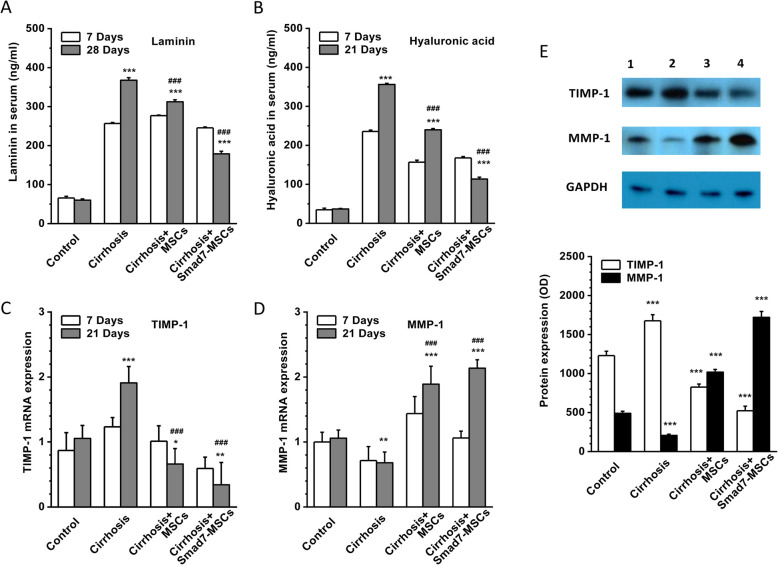
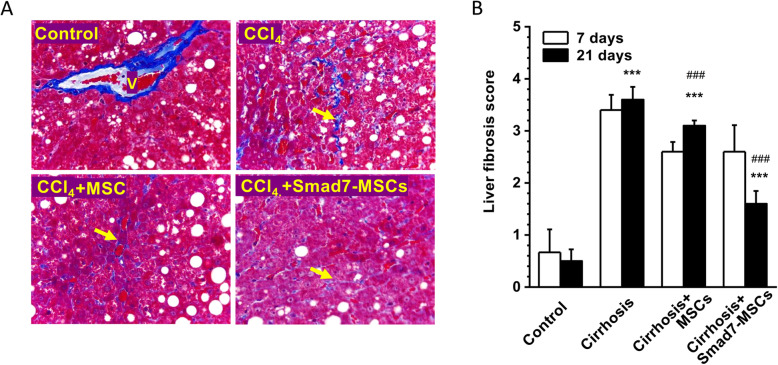
Background: Bone mesenchymal stem cells (MSCs) can promote liver regeneration and inhibit inflammation and hepatic fibrosis. MSCs also can serve as a vehicle for gene therapy. Smad7 is an essential negative regulatory gene in the TGF-β1/Smad signalling pathway. Activation of TGF-β1/Smad signalling accelerates liver inflammation and fibrosis; we therefore hypothesized that MSCs overexpressing the Smad7 gene might be a new cell therapy approach for treating liver fibrosis via the inhibition of TGF-β1/Smad signalling. Methods: MSCs were isolated from 6-week-old Wistar rats and transduced with the Smad7 gene using a lentivirus vector. Liver cirrhosis was induced by subcutaneous injection of carbon tetrachloride (CCl 4) for 8 weeks. The rats with established liver cirrhosis were treated with Smad7-MSCs by direct injection of cells into the main lobes of the liver. The expression of Smad7, Smad2/3 and fibrosis biomarkers or extracellular matrix proteins and histopathological change were assessed by quantitative PCR, ELISA and Western blotting and staining. Results: The mRNA and protein level of Smad7 in the recipient liver and serum were increased after treating with Smad-MSCs for 7 and 21 days (P < 0.001). The serum levels of collagen I and III and collagenase I and III were significantly (P < 0.001) reduced after the treatment with Smad7-MSCs. The mRNA levels of TGF-β1, TGFBR1, α-SMA, TIMP-1, laminin and hyaluronic acid were decreased (P < 0.001), while MMP-1 increased (P < 0.001). The liver fibrosis score and liver function were significantly alleviated after the cell therapy. Conclusions: The findings suggest that the MSC therapy with Smad7-MSCs is effective in the treatment of liver fibrosis in the CCl 4-induced liver cirrhosis model. Inhibition of TGF-β1 signalling pathway by enhancement of Smad-7 expression could be a feasible cell therapy approach to mitigate liver cirrhosis.
Overview
The claims and statistics of this paper haven’t been checked yet.
Free: it reads the open-access text and checks the first 5 claims that cite a source we can check. Create a free account to check every claim.
Integrity signals
Registry
Cites
Statistics
Figures
Verification
Claims the paper makes
The claims and statistics of this paper haven’t been checked yet.
Free: it reads the open-access text and checks the first 5 claims that cite a source we can check. Create a free account to check every claim.
Claims other papers make about this one
Each is checked against this paper’s own text: does it say what the citing paper says it does?
The source backs part of the claim, not all of it — or backs it for a different population, condition or comparison.
In the citing paper
“MSCs can increase the expression of MMP-1, -2, -9, -13, and -14 [190–192] and reduce the secretion of TIMP-1 and TIMP-2 [193, 194], rescuing deposited ECM and established fibrosis.”
From Mechanisms, efficacy, and future perspectives of cellular-based therapies for liver fibrosis/cirrhosis: focusing on mesenchymal stromal cells (2025) · cites this paper as [194]
Experimental — accuracy not yet measuredThe source backs part of the claim, not all of it — or backs it for a different population, condition or comparison.
In the citing paper
“MSCs overexpressing Smad7 reduced the serum levels of laminin, hyaluronic acid, and TIMP-1, while increasing the mRNA and protein levels of MMP-1 via inhibiting TGF-β1-Smad signaling pathway [194].”
From Mechanisms, efficacy, and future perspectives of cellular-based therapies for liver fibrosis/cirrhosis: focusing on mesenchymal stromal cells (2025) · cites this paper as [194]
Experimental — accuracy not yet measuredThe cited source says what the claim attributes to it.
In the citing paper
“A variety of genes have been overexpressed in MSCs, such as HGF, FGF, IGF1, HNF4α, phosphatase of regenerating liver-1 (PRL), IL-10, Smad7, CXCR2, MMP13, and ECM1 [178, 194, 253, 361–363].”
From Mechanisms, efficacy, and future perspectives of cellular-based therapies for liver fibrosis/cirrhosis: focusing on mesenchymal stromal cells (2025) · cites this paper as [194]
Self-check
Percentages, sums and reported differences re-computed from the paper’s own numbers.
The self-check needs the paper’s full text.
Citations
Cites
Dominici, M., Le Blanc, K., Mueller, I., Slaper-Cortenbach, I., Marini, F. C., Krause, D. S., Deans, R. J., Keating, A., Prockop, D. J., & Horwitz, E. M. (2006) · Cytotherapy · doi:10.1080/14653240600855905 · Cited by 17,766 · cited 1×
“The MSCs isolated from the bone marrow are characterized by physical, morphological, phenotypical and functional properties [30].”
BackgroundMassagué, J. (2012) · Nature Reviews Molecular Cell Biology · doi:10.1038/nrm3434 · Cited by 3,128
Sepanlou, S. G., Safiri, S., Bisignano, C., Ikuta, K. S., Merat, S., Saberifiroozi, M., Poustchi, H., Tsoi, D., Colombara, D. V., Abdoli, A., et al. (2020) · The Lancet Gastroenterology & Hepatology · doi:10.1016/s2468-1253(19)30349-8 · Cited by 1,714
Peister, A., Mellad, J. A., Larson, B. L., Hall, B. M., Gibson, L. F., & Prockop, D. J. (2004) · Blood · doi:10.1182/blood-2003-09-3070 · Cited by 994
Grading and staging systems for inflammation and fibrosis in chronic liver diseases
Goodman, Z. D. (2007) · Journal of Hepatology · doi:10.1016/j.jhep.2007.07.006 · Cited by 884
Contextual determinants of TGFβ action in development, immunity and cancer
David, C. J., & Massagué, J. (2018) · Nature Reviews Molecular Cell Biology · doi:10.1038/s41580-018-0007-0 · Cited by 851
Chronic Hepatitis B Infection: A Review
Tang, L. S. Y., Covert, E., Wilson, E., & Kottilil, S. (2018) · JAMA · doi:10.1001/jama.2018.3795 · Cited by 657
Chronic hepatitis B virus infection
Seto, W.-K., Lo, Y.-R., Pawlotsky, J.-M., & Yuen, M.-F. (2018) · The Lancet · doi:10.1016/s0140-6736(18)31865-8 · Cited by 555
TGF-β orchestrates fibrogenic and developmental EMTs via the RAS effector RREB1
Su, J., Morgani, S. M., David, C. J., Wang, Q., Er, E. E., Huang, Y.-H., Basnet, H., Zou, Y., Shu, W., Soni, R. K., et al. (2020) · Nature · doi:10.1038/s41586-019-1897-5 · Cited by 492 · cited 2×
“SMADs are transducer proteins and signal TGF-β1 activation to the downstream gene transcription [13, 15].”
BackgroundMesenchymal stem cells in fibrotic disease
El Agha, E., Kramann, R., Schneider, R. K., Li, X., Seeger, W., Humphreys, B. D., & Bellusci, S. (2017) · Cell stem cell · doi:10.1016/j.stem.2017.07.011 · Cited by 430
Cited by
Challenges and advances in clinical applications of mesenchymal stromal cells
Zhou, T., Yuan, Z., Weng, J., Pei, D., Du, X., He, C., & Lai, P. (2021) · Journal of Hematology & Oncology · doi:10.1186/s13045-021-01037-x · Cited by 712
Mesenchymal stromal cells in hepatic fibrosis/cirrhosis: from pathogenesis to treatment
Yang, X., Li, Q., Liu, W., Zong, C., Wei, L., Shi, Y., & Han, Z. (2023) · Cellular & Molecular Immunology · doi:10.1038/s41423-023-00983-5 · Cited by 120
Intestinal Fibrosis in Inflammatory Bowel Disease and the Prospects of Mesenchymal Stem Cell Therapy
Wang, Y., Huang, B., Jin, T., Ocansey, D. K. W., Jiang, J., & Mao, F. (2022) · Frontiers in Immunology · doi:10.3389/fimmu.2022.835005 · Cited by 126
“Some of the most classic cases of the application of MSCs include certain clinically intractable diseases such as spinal cord injury (148), autoimmune diseases (149), and liver diseases (150).”
BackgroundStem cells for treatment of liver fibrosis/cirrhosis: clinical progress and therapeutic potential
Liu, P., Mao, Y., Xie, Y., Wei, J., & Yao, J. (2022) · Stem Cell Research & Therapy · doi:10.1186/s13287-022-03041-5 · Cited by 82
Mesenchymal stromal cells: promising treatment for liver cirrhosis
Yao, L., Hu, X., Dai, K., Yuan, M., Liu, P., Zhang, Q., & Jiang, Y. (2022) · Stem Cell Research & Therapy · doi:10.1186/s13287-022-03001-z · Cited by 71
Cell mediated ECM-degradation as an emerging tool for anti-fibrotic strategy
Zhao, P., Sun, T., Lyu, C., Liang, K., & Du, Y. (2023) · Cell Regeneration · doi:10.1186/s13619-023-00172-9 · Cited by 48
Immunomodulatory role of mesenchymal stem cell therapy in liver fibrosis
Liu, P., Qian, Y., Liu, X., Zhu, X., Zhang, X., Lv, Y., & Xiang, J. (2023) · Frontiers in Immunology · doi:10.3389/fimmu.2022.1096402 · Cited by 37
“MSCs were able to significantly down-regulate the mRNA expression of TGF-b1 and TGFBR1 downstream molecule SMAD3 and increase the mRNA expression of SMAD7 (71).”
BackgroundInfluentialYadav, P., Singh, S. K., Rajput, S., Allawadhi, P., Khurana, A., Weiskirchen, R., & Navik, U. (2023) · Pharmacology & Therapeutics · doi:10.1016/j.pharmthera.2023.108563 · Cited by 40
Hu, G., Cui, Z., Chen, X., Sun, F., Li, T., Li, C., Zhang, L., Guo, X., Zhao, H., Xia, Y., et al. (2023) · Advanced Science · doi:10.1002/advs.202206439 · Cited by 28
Tang, Y., Wu, P., Li, L., Xu, W., & Jiang, J. (2022) · Frontiers in Immunology · doi:10.3389/fimmu.2022.880523 · Cited by 24
“incision Mitigates liver cirrhosis (45)”
MethodThe potential of flavonoids in hepatic fibrosis: A comprehensive review
Wenbo, Z., Jianwei, H., Hua, L., Tang, L., Guijuan, C., & Mengfei, T. (2024) · Phytomedicine · doi:10.1016/j.phymed.2024.155932 · Cited by 22
Application of mesenchymal stem cells in liver fibrosis and regeneration
Liu, Z., Ren, J., Qiu, C., Wang, Y., & Zhang, T. (2024) · Liver Research · doi:10.1016/j.livres.2024.11.004 · Cited by 20
Advance of Mesenchymal Stem Cells in Chronic End-Stage Liver Disease Control
Gao, Y., Yin, X., & Ren, X. (2022) · Stem Cells International · doi:10.1155/2022/1526217 · Cited by 22
Zhu, Y., Luo, M., Bai, X., Lou, Y., Nie, P., Jiang, S., Li, J., Li, B., & Luo, P. (2022) · Molecular and Cellular Biochemistry · doi:10.1007/s11010-022-04421-4 · Cited by 16
Cell therapy for end-stage liver disease: Current state and clinical challenge
Zhang, L., Deng, Y., Bai, X., Wei, X., Ren, Y., Chen, S., & Deng, H. (2024) · Chinese Medical Journal · doi:10.1097/cm9.0000000000003332 · Cited by 12
“[90] Moreover, our previous study confirmed the mechanism that MSC treatment ameliorates liver fibrosis by upregulating the expression of Caveolin1 and inhibiting the TGF-β /Smad signaling pathway in HSCs. [91] Apart from the TGF-β pathway, Qiao et al [92] proved that MSCs significantly inhibited…”
Huai, Q., Zhu, C., Zhang, X., Dai, H., Li, X., & Wang, H. (2024) · Hepatology Communications · doi:10.1097/hc9.0000000000000410 · Cited by 12
“[46] Genetically modified MSCs could produce trophic cytokines or other beneficial gene products to enhance their therapeutic effects on various liver diseases by engineering MSCs with viral or nonviral vectors in preclinical models.”
BackgroundNasiri, H., Manoochehrabadi, T., Eskandari, F., Majidi, J., & Gholipourmalekabadi, M. (2025) · Molecular Biology Reports · doi:10.1007/s11033-025-10570-8 · Cited by 14
Sani, F., Sani, M., Moayedfard, Z., Darayee, M., Tayebi, L., & Azarpira, N. (2023) · Stem Cell Research & Therapy · doi:10.1186/s13287-023-03364-x · Cited by 11
Chen, L., Zhang, N., Huang, Y., Zhang, Q., Fang, Y., Fu, J., Yuan, Y., Chen, L., Chen, X., Xu, Z., et al. (2023) · Stem Cell Reviews and Reports · doi:10.1007/s12015-023-10583-5 · Cited by 12
Wang, X., Wang, Y., Lu, W., Qu, J., Zhang, Y., & Ye, J. (2024) · Frontiers in Bioengineering and Biotechnology · doi:10.3389/fbioe.2024.1424253 · Cited by 13
“SAMD7 is an inhibitor of fi brosis and reduces hyaluronic acid levels (Su et al., 2020; Liu et al., 2022a).”
BackgroundAirway stenosis: classification, pathogenesis, and clinical management
Zhao, P., Jiang, Z., Li, X., Ainiwaer, M., Li, L., Wang, D., Fan, L., Chen, F., & Liu, J. (2025) · MedComm · doi:10.1002/mco2.70076 · Cited by 15
Sun, X., & Guo, S. (2022) · Cytotherapy · doi:10.1016/j.jcyt.2021.11.006 · Cited by 6
New perspectives in the treatment of liver cirrhosis: targeting macrophage regulatory mechanisms
Zheng, S., Li, S., Wang, Q., Zao, X., Li, X., Qi, W., Cheng, F., Yuexiao, G. E. N. G., Zhang, P., Shi, X., et al. (2025) · Journal of Translational Medicine · doi:10.1186/s12967-025-07239-y · Cited by 6
“For example, researchers have reported that BM-MSCs promote Ly6C hi to Ly6C lo macrophage polarization in the liver through the secretion of cytokines such as IL-4 and IL-10, thereby effectively attenuating liver fibrosis [60].”
Zhi, Y., Shu, M., Tang, P., Li, Y., Guo, M., Deng, J., Mo, H., Wu, M., Liu, B., Mai, Y.-Y., et al. (2025) · Stem Cells International · doi:10.1155/sci/6324980 · Cited by 4
“Several studies have reported that the upregulation of Smad7 is key to inhibiting TGF-β in the pathophysiology of fi brotic diseases and alleviating the progression of fi brosis [62, 63].”
Huang, Y., Cheng, R., Wang, G., Xu, Z., Liu, S., Wan, Y., Hou, X., & Wang, J. (2026) · Frontiers in Medicine · doi:10.3389/fmed.2025.1677021 · Cited by 5
“…these cellular regulatory mechanisms, MSCs actively remodel the fibrotic matrix by secreting matrix metalloproteinases (MMP-1, MMP-9) while downregulating tissue inhibitors of metalloproteinases (TIMPs), thus promoting the degradation of established collagen deposits (22, 23) (Figure 1B).”
Hwang, S., Eom, Y. W., Kang, S. H., Baik, S. K., & Kim, M. Y. (2024) · International Journal of Molecular Sciences · doi:10.3390/ijms25158509 · Cited by 3
Pan, X., Gao, T., & Wang, B. (2025) · Cell & Bioscience · doi:10.1186/s13578-025-01520-9 · Cited by 2
Lin, L., Xue, D., Chen, L.-M., Wei, Q.-Y., Chen, J.-H., Li, Y., Ye, X., & Huang, Z. (2024) · Molecular Biology · doi:10.1134/s002689332470033x · Cited by 2
“Mesenchymal stem cells overexpressing Smad7 alleviate carbon tetrachloride-induced cirrhosis [7].”
Hou, L., Zhao, J., Zou, Y., Zhang, Y., Xing, J., He, W., Zhou, S., & Zhang, B. (2025) · Chemical Engineering Journal · doi:10.1016/j.cej.2025.171801 · Cited by 1
Zhang, Q., Zheng, M., Siebert, H.-C., Wang, Q., Zhang, R., & Zhang, N. (2025) · Neural Regeneration Research · doi:10.4103/nrr.nrr-d-25-00062 · Cited by 3
“While MMPs degrade basal lamina proteins (compromising BBB/BSCB integrity) (Ying et al., 2020; Zhu et al., 2023), TIMPs maintain barrier function by inhibiting MMP activity (Su et al., 2020).”
InfluentialLi, Y., Zhang, X., Liu, G., 温军业, Zhang, H., Tang, T., Cai, Z., Ye, X., & Cai, J. (2025) · Experimental Cell Research · doi:10.1016/j.yexcr.2025.114750 · Cited by 1
Li, Y., Zhang, X., Liu, G., Wen, J., Zhang, H., Tang, T., Cai, Z., Ye, X., & Cai, J. (2024) · Research Square · doi:10.21203/rs.3.rs-4209570/v1
Mesenchymal stem cells and extracellular vesicles in liver regeneration
Karnawat, K., Puthiyattil, N., Parthasarathy, R., Sekar, J. A., Elangbam, P., Roy, N., Gupta, K., Balachander, G. M., & Pai, R. R. (2026) · Elsevier eBooks · doi:10.1016/b978-0-443-45056-3.00017-0
Metadata
- Authors
- Su, D.-N., Wu, S.-P., & Xu, S.-Z.
- Affiliations
- Jinan University (CN)
- University of Hull (GB)
- Corresponding author
- Xu, Shang-Zhong
- ORCID
- Xu, Shang-Zhong
- Venue
- Stem Cell Research & Therapy
- Published
- 2020-09-14
- Volume
- 11
- Issue
- 1
- Pages
- 395-395
- ISSN
- 1757-6512 (ISSN-L)
- PMC
- PMC7489041
- OpenAlex
- W3086480455
- Cited by
- 33
- References
- 34
- Citations by year
- 2026: 2 · 2025: 8 · 2024: 8 · 2023: 7 · 2022: 7 · 2021: 1
- FWCI
- 2.21
- Type
- journal article
- Language
- en
- Open access
- gold
- doi.org
- Licence
- cc-by
- creativecommons.org/licenses/by/4.0 (tdm)
- creativecommons.org/licenses/by/4.0 (vor)
- Locations
- Stem Cell Research & Therapy (publishedVersion, cc-by)
- PubMed Central (publishedVersion, cc-by)
- PubMed (publishedVersion)
- Repository@Hull (Worktribe) (University of Hull) (publishedVersion, other-oa)
- Repository@Hull (Worktribe) (University of Hull) (submittedVersion, cc-by)
- DOAJ (DOAJ: Directory of Open Access Journals) (submittedVersion, cc-by-sa)
- Funders
- Science and Technology Planning Project of Shenzhen Municipality (JCYJ 20140416122812003)
- Topics
- Health Sciences › Medicine › Hepatology › Liver physiology and pathology
- Life Sciences › Biochemistry, Genetics and Molecular Biology › Cell Biology › Mesenchymal stem cell research
- Life Sciences › Biochemistry, Genetics and Molecular Biology › Molecular Biology › TGF-β signaling in diseases
- Keywords
- mesenchymal stem cells, Smad7, liver cirrhosis, liver fibrosis, gene therapy, cell therapy, collagen deposition, extracellular matrix, rat model
- MeSH terms
- Animals, Liver, Liver Cirrhosis, Liver Cirrhosis, Experimental, Genetic Therapy, Rats, Sprague-Dawley, Rats, Wistar, Rats, Smad7 Protein, Transforming Growth Factor beta1, Mesenchymal Stem Cells
About these checks
Registry, retraction, Cites and statistics results are computed, not judged, with one exception: a printed reference that no index lists is read once by a model before it counts as a citation error. Claims are extracted by a model and kept only when their quote appears verbatim in the text; each cited source is then checked, with a model’s help, for whether it says what the claim relies on. Those verdicts can be wrong — read the claim’s quote and the cited source before relying on one.
Statistics and arithmetic are recomputed, not judged.
Confidence bands are shown only for fields calibrated on our annotated test set. None is calibrated yet, so no band is shown.
What counts as a claim ›How we measure confidence ›How we check this ›
Are you an author, or do you see a problem with this page? Request a review
Data sources
Bibliographic data: Semantic Scholar, OpenAlex, Crossref.
Contains information from the Semantic Scholar Academic Graph Datasets, made available under the ODC Attribution License (ODC-BY 1.0).
Semantic Scholar’s data is described in: Kinney, R., et al. (2023). The Semantic Scholar Open Data Platform. arXiv:2301.10140.
