

Automating data extraction in systematic reviews: a systematic review
Open accessThe DOI matches its Crossref record; 80 of the 80 references it cites were found in a registry or an index.
Abstract
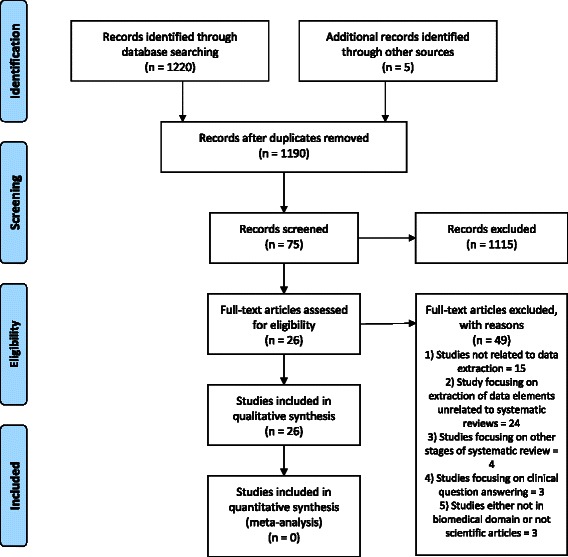
BACKGROUND: Automation of the parts of systematic review process, specifically the data extraction step, may be an important strategy to reduce the time necessary to complete a systematic review. However, the state of the science of automatically extracting data elements from full texts has not been well described. This paper performs a systematic review of published and unpublished methods to automate data extraction for systematic reviews. METHODS: We systematically searched PubMed, IEEEXplore, and ACM Digital Library to identify potentially relevant articles. We included reports that met the following criteria: 1) methods or results section described what entities were or need to be extracted, and 2) at least one entity was automatically extracted with evaluation results that were presented for that entity. We also reviewed the citations from included reports. RESULTS: Out of a total of 1190 unique citations that met our search criteria, we found 26 published reports describing automatic extraction of at least one of more than 52 potential data elements used in systematic reviews. For 25 (48 %) of the data elements used in systematic reviews, there were attempts from various researchers to extract information automatically from the publication text. Out of these, 14 (27 %) data elements were completely extracted, but the highest number of data elements extracted automatically by a single study was 7. Most of the data elements were extracted with F-scores (a mean of sensitivity and positive predictive value) of over 70 %. CONCLUSIONS: We found no unified information extraction framework tailored to the systematic review process, and published reports focused on a limited (1-7) number of data elements. Biomedical natural language processing techniques have not been fully utilized to fully or even partially automate the data extraction step of systematic reviews.
Overview
The claims and statistics of this paper haven’t been checked yet.
Free: it reads the open-access text and checks the first 5 claims that cite a source we can check. Create a free account to check every claim.
Integrity signals
Registry
Cites
Statistics
Figures
Verification
Claims the paper makes
The claims and statistics of this paper haven’t been checked yet.
Free: it reads the open-access text and checks the first 5 claims that cite a source we can check. Create a free account to check every claim.
Claims other papers make about this one
Each is checked against this paper’s own text: does it say what the citing paper says it does?
The source backs part of the claim, not all of it — or backs it for a different population, condition or comparison.
In the citing paper
“The time from the last search to publication takes commonly over 1 year for an SLR study”
From Automation of systematic literature reviews: A systematic literature review (2021) · cites this paper as [8]
Experimental — accuracy not yet measuredThe source backs part of the claim, not all of it — or backs it for a different population, condition or comparison.
In the citing paper
“However, almost all of this work has considered retrospective evaluation of ML/NLP methods applied to existing datasets, providing only indirect evidence of the utility of such methods for EBM.”
From Machine learning to help researchers evaluate biases in clinical trials: a prospective, randomized user study (2019) · cites this paper as [6]
Experimental — accuracy not yet measuredThe cited source says what the claim attributes to it.
In the citing paper
“The most efficient use and application of the machine-learning technologies would be in the areas allowing automation of specific SR processes, in particular those involving time-consuming and resource-intensive tasks such as language translation [15], study selection [11, 16–18], data extraction [19] and risk of bias assessment [20].”
From How to conduct systematic reviews more expeditiously? (2015) · cites this paper as [19]
The cited source says what the claim attributes to it.
In the citing paper
“for a primary study, it takes 2.5 - 6.5 years before it is incorporated in an SLR study [7,8].”
From Automation of systematic literature reviews: A systematic literature review (2021) · cites this paper as [8]
The cited source says what the claim attributes to it.
In the citing paper
“Additionally, 23% of all SLR studies are outdated within 2 years of publication, as reviewers failed to incorporate novel evidence on their subject of interest [8,9].”
From Automation of systematic literature reviews: A systematic literature review (2021) · cites this paper as [8]
1 more claim about this paper
Create a free account to see every claim other papers make about this one.
Self-check
Percentages, sums and reported differences re-computed from the paper’s own numbers.
The self-check needs the paper’s full text.
Citations
Cites
(2003) · Journal of Machine Learning Research · doi:10.5555/944919.944937 · Cited by 32,337
Text categorization with Support Vector Machines: Learning with many relevant features
Joachims, T. (1998) · Lecture Notes in Computer Science · doi:10.1007/bfb0026683 · Cited by 7,999
Whiting, P., Rutjes, A. W., Reitsma, J. B., Bossuyt, P. M., & Kleijnen, J. (2003) · BMC Medical Research Methodology · doi:10.1186/1471-2288-3-25 · Cited by 3,592
Towards complete and accurate reporting of studies of diagnostic accuracy: The STARD Initiative.
Bossuyt, P. M., Reitsma, J. B., Bruns, D. E., Gatsonis, C. A., Glasziou, P. P., Irwig, L. M., Lijmer, J. G., Moher, D., Rennie, D., de Vet, H. C. W., et al. (2003) · Annals of Internal Medicine · doi:10.7326/0003-4819-138-1-200301070-00010 · Cited by 3,219
Towards complete and accurate reporting of studies of diagnostic accuracy: the STARD initiative
Bossuyt, P. M., Reitsma, J. B., Bruns, D. E., Gatsonis, C. A., Glasziou, P. P., Irwig, L. M., Lijmer, J. G., Moher, D., Rennie, D., & de Vet, H. C. W. (2003) · BMJ · doi:10.1136/bmj.326.7379.41 · Cited by 3,215
Towards Complete and Accurate Reporting of Studies of Diagnostic Accuracy: The STARD Initiative
Bossuyt, P. M., Reitsma, J. B., Bruns, D. E., Gatsonis, C. A., Glasziou, P. P., Irwig, L. M., Lijmer, J. G., Moher, D., Rennie, D., & de Vet, H. C. W. (2003) · Radiology · doi:10.1148/radiol.2261021292 · Cited by 3,215
Improving the Quality of Reporting of Randomized Controlled Trials: The CONSORT Statement
Begg, C. (1996) · JAMA · doi:10.1001/jama.1996.03540080059030 · Cited by 3,127
The well-built clinical question: A key to evidence-based decisions
(1995) · ACP Journal Club · doi:10.7326/acpjc-1995-123-3-a12 · Cited by 2,931 · cited 2×
“…the Cochrane Handbook for Systematic Reviews [1], the CONsolidated Standards Of Reporting Trials (CONSORT) [9] statement, the Standards for Reporting of Diagnostic Accuracy (STARD) initiative [10], and PICO [11], PECODR [12], and PIBOSO [13] frameworks to obtain the data elements to be considered.”
MethodEddy, S. R. (1996) · Current Opinion in Structural Biology · doi:10.1016/s0959-440x(96)80056-x · Cited by 1,430
Clinical practice guidelines : directions for a new program
Field, M. J., & Lohr, K. N. (1990) · Cited by 1,415
Research works printed but not linked: 2
- Khan KS Ter Riet G Glanville J Sowden AJ Kleijnen J Undertaking systematic reviews of research on effectiveness: CRD’s guidance for carrying out or commissioning reviews, NHS Centre for Reviews and Dissemination 2001
- Woolf SH Manual for conducting systematic reviews, Agency for Health Care Policy and Research 1996
Cited by
Items 201–300 of 351
Modernizing evidence synthesis for evidence-based medicine
Saldanha, I. J., Adam, G. P., Schmid, C. H., Trikalinos, T. A., & Konnyu, K. J. (2023) · Elsevier eBooks · doi:10.1016/b978-0-323-91200-6.00006-1 · Cited by 4
Do Numbers Matter? Types and Prevalence of Numbers in Clinical Texts
Mahendra, R., Spina, D., Cavedon, L., & Verspoor, K. M. (2024) · Workshop on Biomedical Language Processing (BioNLP) · doi:10.18653/v1/2024.bionlp-1.32 · Cited by 4
“This limitation has made it impossible to compare model performances of different systems (Jonnalagadda et al., 2015).”
BackgroundLukmanjaya, W., Butler, T. G., Taflan, P., Simpson, P. L., Ginnivan, N., Buchan, I. E., Nenadić, G., & Karystianis, G. (2024) · JMIR Formative Research · doi:10.2196/60878 · Cited by 4
Lentschat, M., Buche, P., Dibie-Barthélemy, J., & Mathieu Roche, A. (2021) · International Journal of Intelligent Information and Database Systems · doi:10.1504/ijiids.2021.10042229 · Cited by 4
“Terminological variations of the vocabulary defining the entities can be extracted from list of terms present in documents via the analysis of morphological and syntax features (Jacquemin and Tzoukermann, 1999; Bourigault and Jacquemin, 1999).”
BackgroundMethodLegate, A. E., & Nimon, K. (2022) · F1000Research · doi:10.12688/f1000research.125198.1 · Cited by 4
“As in prior reviews, English language reports, published 2005 or later will be considered for inclusion (Jonnalagadda et al., 2015; O’Mara-Eves et al., 2015; Schmidt et al., 2020b, 2021).”
BackgroundResultInfluentialThe FAIR database: facilitating access to public health research literature
Zhao, Z., Thomas, J., Kell, G., Stansfield, C., Clowes, M., Graziosi, S., Brunton, J., Marshall, I. J., & Stevenson, M. (2024) · JAMIA Open · doi:10.1093/jamiaopen/ooae139 · Cited by 3
Palacio, L. X. N., López, A. K. R., Vásquez, B. N. F., Alarcón, S. A. Á., Jaramillo, J. E. B., Garcia, M. N. E., & González, R. E. E. (2025) · Cureus · doi:10.7759/cureus.99081 · Cited by 3
“The data was extracted using Excel 365 (Microsoft Corp., Redmond, WA, USA) [19].”
Jansen, T., Liebenow, L. W., Schaller, N.-J., Hattie, J., & Møller, J. (2026) · Educational Psychology Review · doi:10.1007/s10648-026-10136-5 · Cited by 4
Ridawanty, R., Pratidina, N. B., & Primarti, R. S. (2023) · DENTA · doi:10.30649/denta.v17i2.3 · Cited by 3
Branney, P., Marques, M. M., & Norris, E. (2024) · Journal of Health Psychology · doi:10.1177/13591053241229870 · Cited by 3
“Automated tools are being applied to speed up the process of evidence synthesis in the behavioural and health sciences (Marshall et al., 2020), such as automated data extraction (Jonnalagadda et al., 2015) and crowd-sourcing of article screening (NoelStorr et al., 2021).”
MethodD’Ambrosio, A., Grundmann, H., & Donker, T. (2022) · arXiv (Cornell University) · doi:10.48550/arxiv.2202.10033 · Cited by 3
“…of systematic reviews has made significant improvements in the last years (Ananiadou et al. 2009; O’Mara-Eves et al. 2015; Tsafnat et al. 2013; Jonnalagadda, Goyal, and Huffman 2015), and it is possible foreseeable that it will become the standard approach in the field (E. Beller et al. 2018),…”
BackgroundTod, D. (2019) · Springer eBooks · doi:10.1007/978-3-030-12263-8_7 · Cited by 3
Automatic extraction of quantitative data from ClinicalTrials.gov to conduct meta-analyses
Fanshawe, T. R., & Perera, R. (2019) · BMJ Evidence-Based Medicine · doi:10.1136/bmjebm-2019-111206 · Cited by 3
A Roadmap for Composing Automatic Literature Reviews: A Text Mining Approach
Júnior, E. M. D. S., & Dutra, M. L. (2021) · Lecture notes of the Institute for Computer Sciences, Social Informatics and Telecommunications Engineering · doi:10.1007/978-3-030-77417-2_17 · Cited by 3
Automated Text Mining and Ranked List Algorithms for Drug Discovery in Acute Myeloid Leukemia
Tran, D. (2019) · MacSphere (McMaster University) · doi:10.71548/22432 · Cited by 3
Chen, V. Z., Montano‐Campos, F., Zadrozny, W., & Canfield, E. (2021) · arXiv · doi:10.48550/arxiv.2106.16102 · Cited by 3
“So far, almost all the machine reading models for systematic reviews have been developed in biomedicine (Jonnalagadda, Goyal, & Huffman, 2015; Valenzuela-Escárcega et al., 2018).”
BackgroundGates, A., Gates, M., Sim, S., Elliott, S. A., Pillay, J., & Hartling, L. (2021) · doi:10.23970/ahrqepcmethodscreatingefficiencies · Cited by 3
Systematic Review using a Spiral approach with Machine LearningPreprint
Saeidmehr, A., Steel, P., & Samavati, F. F. (2023) · Research Square · doi:10.21203/rs.3.rs-2497596/v1 · Cited by 3
Efficient and Reliable Estimation of Named Entity Linking Quality: A Case Study on GutBrainIEPreprint
Martinelli, M., Marchesin, S., & Silvello, G. (2026) · arXiv (Cornell University) · doi:10.48550/arxiv.2601.06624 · Cited by 3
“…role in building reliable automatic IE systems that can support clinicians and researchers in processing large volumes of unstructured text, for instance when conducting biomedical literature reviews or extracting structured information from triage records and other clinical documents [4, 5, 6].”
A Scoping Review of Adopted Information Extraction Methods for RCTs.
Aletaha, A., Nemati-Anaraki, L., Keshtkar, A., Sedghi, S., Keramatfar, A., & Korolyova, A. (2023) · Medical Journal of The Islamic Republic of Iran · doi:10.47176/mjiri.37.95 · Cited by 2
“None of the existing reviews focus on the information extraction step to conduct an RCT and systematic review of trials (25, 63, 64).”
BackgroundMozgai, S., Kaurloto, C., Winn, J. G., Leeds, A., Beland, S., Sookiassian, A., & Hartholt, A. (2024) · CHI Conference Extended Abstracts on Human Factors in Computing Systems (CHI EA) · doi:10.1145/3613905.3637110 · Cited by 2
“A review of the literature of evidence synthesis techniques revealed that currently there is a body of research focused on automating the tedious aspects of literature reviews [3, 16, 30].”
BackgroundMechanical properties of the meninges: An expansive LLM-assisted systematic review
Chelstrom, B. P., Polak, M. P., Morgan, D. D., & Henak, C. R. (2025) · Materials Today Communications · doi:10.1016/j.mtcomm.2025.114034 · Cited by 2
Amissah, D. K., Boante, L. M., & Appati, J. K. (2025) · Operations Research Forum · doi:10.1007/s43069-025-00565-3 · Cited by 2
“These methodologies evaluate all available evidence, both published and unpublished, to provide a balanced perspective on current research [15, 16].”
Lifecycle-Based Analysis of Construction Dispute Causes: A Semi-Automated Systematic Review
Olaimat, A. R. A., & Pérez, M. F. M. (2026) · Buildings · doi:10.3390/buildings16050944 · Cited by 2
Echoes of Citations: Automated Extraction of Claims from Full Scientific Papers
Tan, N. Ö., Tandon, N., Tafjord, O., Witbrock, M., Clark, P. A., & GAHEGAN, M. N. (2026) · Proceedings of the AAAI Symposium Series · doi:10.1609/aaaiss.v8i1.42589 · Cited by 2
“…triplets to flag inconsistencies in biomedical abstracts; Wei (2023) Evidence-synthesis literature often extracts structured elements (e.g., PICO—Population, Intervention, Comparison, and Outcome) rather than compact, paper-level claims (Schmidt et al. 2021; Jonnalagadda, Goyal, and Huffman 2015).”
Blake, C. L., & Kehm, R. D. (2019) · Journal of Biomedical Informatics · doi:10.1016/j.yjbinx.2019.100005 · Cited by 2
Evidence surveillance to keep up to date with new research
Thomas, J., Noel-Storr, A. H., & McDonald, S. J. (2018) · Facet eBooks · doi:10.29085/9781783303755.010 · Cited by 2
Machine Learning in Evidence Synthesis Research
Carrasco‐Labra, A., Urquhart, O., & Spallek, H. (2021) · Springer eBooks · doi:10.1007/978-3-030-71881-7_12 · Cited by 2
Future for Systematic Reviews and Meta‐Analysis
Ebrahim, S. B. J., & Huffman, M. D. (2022) · Wiley eBooks · doi:10.1002/9781119099369.ch24 · Cited by 2
Self-citationLee, C.-J., Devine, B., & Tarczy-Hornoch, P. Z. (2017) · PubMed Central · Cited by 2
Digital Tools for Managing Different Steps of the Systematic Review Process
Wu, W., Akers, K. G., Hu, E., Sarkozy, A., & Vinson, P. (2018) · Human Biology · Cited by 2
Topical Classification of Food Safety Publications with a Knowledge Base
Sowiński, P., Wasielewska-Michniewska, K., Ganzha, M., & Paprzycki, M. (2022) · Lecture notes in electrical engineering · doi:10.1007/978-981-19-4364-5_48 · Cited by 2
Ninot, G., Amadori, F., Maitre, J., Rapior, S., Rivière, L., Trouillet, R., & Carbonnel, F. (2018) · HEGEL - HEpato-GastroEntérologie Libérale · doi:10.3917/heg.081.0013 · Cited by 2
Understanding in vivo modelling of depression
Bannach‐Brown, A. (2019) · ERA · Cited by 2
Towards Reducing Manual Workload in Technology-Assisted Reviews: Estimating Ranking PerformancePreprint
Lee, G. E., & Sun, A. (2022) · arXiv (Cornell University) · doi:10.48550/arxiv.2201.05648 · Cited by 2
“Automating the extraction step is also active research areas in technology-assisted systematic reviews [6].”
Biondi‐Zoccai, G., Torre, G. L., Roever, L., & D’Ascenzo, F. (2016) · Springer eBooks · doi:10.1007/978-3-319-25655-9_8 · Cited by 2
Methodology for Systematic Reviews in EducationPreprint
Huang, R., & Yin, Y. (2025) · OSF Preprints (OSF Preprints) · doi:10.31219/osf.io/az5xm_v1 · Cited by 2
Syatriana, E., Syamsuri, A. S., Jones, E., & Ratnawati, R. (2025) · Research Square · doi:10.21203/rs.3.rs-6983381/v1 · Cited by 2
Pinaire, J. (2017) · theses.fr (ABES) · doi:10.70675/9dde3ee0z6f77z45a5z9d73z345b618c3a81 · Cited by 3
Assisted authoring for avoiding inadequate claims in scientific reporting
Koroleva, A. (2020) · theses.fr (ABES) · doi:10.70675/f035bb8azddf1z4a7dzbf39zdf86c6947bb9 · Cited by 2
Samaan, S., Devi, J., Vincent, M. L., Coombs, S. S., Sehgal, P., Mohamed, M. F. H., Rai, V., Johnson, A. M., Yarur, A. J., Barnes, E. L., et al. (2026) · medRxiv · doi:10.64898/2026.06.16.26355773 · Cited by 2
Ali, N., Gross, D. C., Araujo, C. E., Bosworth, M., Bush, J., & Schoder, K. (2025) · IEEE Electric Ship Technologies Symposium (ESTS) · doi:10.1109/ests62818.2025.11152441 · Cited by 1
Alchokr, R., Sunilkumar, A., Saake, G., Leich, T., & Krüger, J. (2025) · Lecture notes in computer science · doi:10.1007/978-3-032-05409-8_23 · Cited by 1
Yalçınkaya, A., Kjelmann, K. G., Gholinezhad, S., Rahbek, O., Kold, S., & Husum, H. (2025) · Journal of Orthopaedic Surgery and Research · doi:10.1186/s13018-025-06386-8 · Cited by 1
“For instance, ExaCT, an automated system for extracting clinical trial characteristics, achieved recall and precision between 88 and 97% for specific trial features but required extensive structured input data [11, 23].”
Stroke Cohort Construction Using an Automated Clinical Data Collection System
Choi, J.-H., Koo, D., Kim, T., Oh, J., Lee, S., Min, Y., Lee, Y., Jo, Y., Lee, S. Y., Jin, S., et al. (2025) · Applied Sciences · doi:10.3390/app152312725 · Cited by 1
Aregawi, G. G., Wang, Z., & Zhao, W. (2026) · OALib · doi:10.4236/oalib.1115338 · Cited by 1
Spiță, M.-E., & Schipor, O.-A. (2026) · International Conference on Development and Application Systems (DAS) · doi:10.1109/das69882.2026.11553334 · Cited by 1
“While automated data extraction has been a goal for over a decade—as reviewed by Jonnalagadda et al., who noted the lack of unified frameworks [16] recent solutions still face challenges.”
Las herramientas digitales para el desarrollo de la lectoescritura en estudiante de educación básica
Ramos, A. W. G., Ayala, B. E. P., & Sánchez, E. L. M. (2026) · RICEd Revista de Investigación en Ciencias de la Educación · doi:10.53877/pvg4pm19 · Cited by 1
Systematic Literature Reviews With Two Multi-Agentic Systems And Human-In-The-Loop
Ren, Z., Zhao, Z., Li, Q., Wu, Y., Wang, L., Luo, R., Xu, Y., Guo, Q., Shi, J. D., Xie, E., et al. (2026) · arXiv (Cornell University) · doi:10.48550/arxiv.2607.21920 · Cited by 1
“…screening, however, is prone to missed studies and inconsistent decisions, which contributes to study selection bias [Bannach-Brown et al., 2019, Drucker et al., 2016] and manual data extraction is subject to human error and inconsistency, leading to biased estimates Jonnalagadda et al. [2015].”
Evaluating AI Performance in Systematic Literature Reviews for HEOR: A Case Study
Wang-Silvanto, J., Jajoo, M., Guo, H., Ohri, R., Nelissen, J., & Comabella, C. C. I. (2026) · Journal of health economics and outcomes research · doi:10.36469/001c.165173 · Cited by 1
Nguyen, H. D., Eiring, Ø., & Poo, D. C. C. (2018) · Lecture notes in computer science · doi:10.1007/978-3-319-91800-6_7 · Cited by 1
Unsupervised Identification of Study Descriptors in Toxicology Research: An Experimental Study
Herrmannová, D., Young, S. R., Patton, R. M., Stahl, C. G., Kleinstreuer, N., & Wolfe, M. S. (2018) · International Workshop on Health Text Mining and Information Analysis (LOUHI) · doi:10.18653/v1/w18-5609 · Cited by 1
“Extracting data elements such as study descriptors from publication full texts is an essential step in a number of tasks including systematic review preparation (Jonnalagadda et al., 2015), construction of reference databases (Kleinstreuer et al.”
BackgroundDézétrée, A., Chazard, E., Schlegel, D. R., Sakilay, S., Elkin, P. L., & Grégoire, F. (2018) · Studies in health technology and informatics · doi:10.3233/978-1-61499-921-8-50 · Cited by 1
Improving quality and efficiency in selecting, abstracting and appraising studies for rapid reviews
Pham, B., Robson, R. C., Thomas, S. M., Hwee, J., Page, M., & Tricco, A. C. (2017) · Monash University Research Portal (Monash University) · Cited by 1
Design and Implementation of a Text Mining-based Tool to Support Scoping Reviews
Martini, A., Gastaldi, L., & Chiarello, F. (2022) · International Journal of Technology Management · doi:10.1504/ijtm.2022.10049970 · Cited by 1
“• Data extraction: identify relevant of data (qualitative and quantitative) and collect them for further analysis (Jonnalagadda et al., 2015).”
NLP Applications—Biomedical Literature
Zhang, R., Kastrin, A., Hristovski, D., Fiszman, M., & Kilicoglu, H. (2024) · Cognitive informatics in biomedicine and healthcare · doi:10.1007/978-3-031-55865-8_13 · Cited by 1
Consensus to context: AI-driven data extraction – an International HRD Delphi study
Legate, A. E. (2025) · Human Resource Development International · doi:10.1080/13678868.2025.2560486 · Cited by 1
“Further, data extraction tasks associated with SRMA methods have been described as time-consuming to the point of critically limiting the usefulness of research (Holub et al., 2021; Jonnalagadda et al., 2015).”
An AI-Assisted Review of Trends in Environmental and Human Health
Hanna, G. S., Scherbakov, D., Guyon, J. R., Bakumenko, A., & Alekseyendo, A. V. (2025) · Yearbook of Medical Informatics · doi:10.1055/s-0046-1816602 · Cited by 1
Petersen, H. (2016) · The Sydney eScholarship Repository (The University of Sydney) · Cited by 1
Assisted authoring for avoiding inadequate claims in scientific reporting
Koroleva, A. (2020) · Pure Amsterdam UMC · Cited by 1
Systematic literature reviews: A Case Study in FinTech and Automated Tool Support
Spaargaren, W. (2020) · Research Repository (Delft University of Technology) · Cited by 1
Loskot, P. (2021) · arXiv (Cornell University) · doi:10.48550/arxiv.2101.10554 · Cited by 1
Current Challenges and Future Directions in the Management of Inflammatory Breast Cancer: A ReviewPreprint
Izzo, P., Izzo, L., Polistena, A., Sibio, S., Pisanelli, M. C., Crocetti, D., Meloni, P., Cello, P. D., Intinis, C. D., & Izzo, S. (2023) · Preprints.org · doi:10.20944/preprints202307.1462.v1 · Cited by 1
Sucaldito, M. S. F. P., & Yu, K. C. (2024) · doi:10.2196/preprints.57648 · Cited by 1
Khan, N. (2024) · University Of Wales Trinity Saint David Research Repository (University of Wales Trinity Saint David) · Cited by 1
LLM-assisted Data Structuring and Analysis for Improving Aircraft Maintenance.
Drop, Z. (2026) · reposiTUm (TU Wien) · doi:10.34726/hss.2026.128420 · Cited by 1
Detecting Manuscripts Related to Computable Phenotypes Using a Transformer-based Language ModelPreprint
Chae, J., Heise, D., Connatser, K., Honerlaw, J. P., Maripuri, M., Ho, Y.-L. A., Fontin, F., Tanukonda, V., & Cho, K. (2026) · bioRxiv (Cold Spring Harbor Laboratory) · doi:10.64898/2026.03.12.711165 · Cited by 1
Samaan, S., Devi, J., Vincent, M. L., Coombs, S. S., Sehgal, P., Mohamed, M. F. H., Rai, V., Johnson, A. M., Yarur, A. J., Barnes, E. L., et al. (2026) · doi:10.2196/preprints.107732 · Cited by 1
AIM review tool: artificial intelligence for smarter systematic review screening
Mena, S., Rituerto-González, E., Coutts, F., von Trott, J., Jacobs, G. R., Bryant, L., Moles, L., Sirbu, N., Promet, L., Oliver, D., et al. (2026) · npj Artificial Intelligence · doi:10.1038/s44387-026-00080-8
CRTS: A type system for representing clinical recommendationsPreprint
Garg, R., Raja, K., & Jonnalagadda, S. (2016) · arXiv (Cornell University) · doi:10.48550/arxiv.1609.01592
“Medical article representation example As mentioned earlier, Jonnalagadda et al identified 52 data elements that are commonly extracted in the systematic review process [29].”
MethodSelf-citationLee, C. (2016) · ResearchWorks at the University of Washington (University of Washington)
A framework for developing knowledge bases of scientific artefacts in the biomedical domain
Hassanzadeh, H. (2017) · The University of Queensland · doi:10.14264/uql.2017.167
“According to the prescribed EBM workflow, a large volume of reported research of clinical cases may need to be reviewed by health professionals or researchers when conducting systematic reviews and before they can make informed medical decisions [1, 2, 7, 24, 25].”
BackgroundInfluentialThe development of the Compassion Focused Therapy Therapist Rating Scale (CFT-TRS)
Horwood, V. (2017) · Figshare
Begert, D., Granek, J., Irwin, B., & Brogly, C. (2020) · Relevé des maladies transmissibles au Canada · doi:10.14745/ccdr.v46i06a04f
Conducting a Systematic Review: Trends in Machine Learning and Text Mining
Falco, M., & Berdiñas, I. (2020) · El Servicio de Difusión de la Creación Intelectual (National University of La Plata)
Shokraneh, F. (2020) · Nottingham ePrints (University of Nottingham)
Testa, L., & Bollati, M. (2018) · Springer eBooks · doi:10.1007/978-3-319-78966-8_8
Seed-driven document ranking for systematic reviews in evidence-based medicine
Lee, E. (2020) · DR-NTU (Nanyang Technological University) · doi:10.32657/10356/146709
Innovations in Systematic Review Production
Elliott, J., & Turner, T. (2022) · Wiley eBooks · doi:10.1002/9781119099369.ch23
What does the evidence say? Automatic information extraction from medical trial reports
Nye, B. (2022) · Digital Repository Service (Northeastern University) · doi:10.17760/d20467219
Element Extraction from Computer Science Academic Papers for AI Survey Writing
Luo, F., & Yu, X. (2024) · Communications in computer and information science · doi:10.1007/978-981-97-1332-5_21
Satria, H., & Primanita, A. (2023) · Sriwijaya Journal of Informatics and Applications · doi:10.36706/sjia.v4i2.89
“Data extraction is not new in the research world and is a topic that has been researched since the early era of computers[10, 11].”
BackgroundSocial impact assessment in educational projects: Teachers' perspectives on social net present value
Verdugo-Arcos, J. A., Arcos, A. A. V., Ramírez, J. R. Y., & Párraga, R. R. R. (2025) · International Journal of Education and Practice · doi:10.18488/61.v13i2.4065
Ahswnee, A. A. A., & Noor, S. N. F. M. (2024) · Malaysian Journal of Medicine and Health Sciences · doi:10.47836/mjmhs.20.4.39
Demers, C., & Forest, D. (2025) · Proceedings of the Annual Conference of CAIS / Actes du congrès annuel de l ACSI · doi:10.29173/cais1995
“…; (2) au moyen de mesures de rappel et de précision relatives à des unités de référence, c’est-à-dire des revues systématiques ayant déjà été publiées relativement aux questions de recherche sélectionnées (qui serviront de Gold standard ) (Jonnalagadda et al., 2015 ; van Dinter et al., 2021).”
The Interpersonal Needs Questionnaire in Different Populations: A Systematic Psychometric Evaluation
Yanto, P. N. F., Hayani, H., Sahendra, Y., Hikmy, B. J., & Astuti, B. (2025) · Advances in Social Science, Education and Humanities Research/Advances in social science, education and humanities research · doi:10.2991/978-2-38476-370-2_12
Pre-service Accounting Teachers’ Teaching Anxiety Related Issues – a Systematic ReviewPreprint
Ntem, A. (2025) · Research Square · doi:10.21203/rs.3.rs-6181213/v1
Nuijten, M. B. (2023) · F1000Research · doi:10.5256/f1000research.142586.r161616
Im, E., Kim, B. Y., Kang, S., & Kim, H. (2025) · JCO Clinical Cancer Informatics · doi:10.1200/cci-25-00233
Gates, A., Gates, M., DaRosa, D., Elliott, S. A., Pillay, J., Rahman, S., Vandermeer, B., & Hartling, L. (2020) · Figshare · doi:10.6084/m9.figshare.13294975
Gates, A., Gates, M., Sim, S., Elliott, S. A., Pillay, J., & Hartling, L. (2021) · Figshare · doi:10.6084/m9.figshare.15179123
Nama, N., Hennawy, M., Barrowman, N., O'Hearn, K., Sampson, M., & McNally, J. D. (2021) · Figshare · doi:10.6084/m9.figshare.14374721
Gates, A., Gates, M., DaRosa, D., Elliott, S. A., Pillay, J., Rahman, S., Vandermeer, B., & Hartling, L. (2020) · Figshare · doi:10.6084/m9.figshare.13294978
Gates, A., Gates, M., DaRosa, D., Elliott, S. A., Pillay, J., Rahman, S., Vandermeer, B., & Hartling, L. (2020) · Figshare · doi:10.6084/m9.figshare.13294969
Nama, N., Hennawy, M., Barrowman, N., O'Hearn, K., Sampson, M., & McNally, J. D. (2021) · Figshare · doi:10.6084/m9.figshare.14374727
Nama, N., Hennawy, M., Barrowman, N., O'Hearn, K., Sampson, M., & McNally, J. D. (2021) · Figshare · doi:10.6084/m9.figshare.14374724
Metadata
- Authors
- Jonnalagadda, S. R., Goyal, P., & Huffman, M. D.
- Affiliations
- Northwestern University (US)
- Indian Institute of Technology Kharagpur (IN)
- Corresponding author
- Jonnalagadda, Siddhartha R.
- Venue
- Systematic Reviews
- Published
- 2015-06-15
- Volume
- 4
- Issue
- 1
- Pages
- 78-78
- ISSN
- 2046-4053 (ISSN-L)
- PMC
- PMC4514954
- OpenAlex
- W1629765770
- Cited by
- 287
- References
- 79
- Citations by year
- 2026: 21 · 2025: 43 · 2024: 31 · 2023: 32 · 2022: 32 · 2021: 42 · 2020: 25 · 2019: 24 · 2018: 17 · 2017: 11 · 2016: 8 · 2015: 1
- FWCI
- 2.03
- Type
- journal article
- Language
- en
- Open access
- gold
- doi.org
- Locations
- Systematic Reviews (publishedVersion, cc-by)
- Europe PMC (PubMed Central) (publishedVersion, cc-by)
- PubMed Central (publishedVersion, cc-by)
- PubMed (publishedVersion)
- Funders
- Feinberg School of Medicine
- U.S. National Library of Medicine (R00LM011389)
- Topics
- Social Sciences › Decision Sciences › Statistics, Probability and Uncertainty › Meta-analysis and systematic reviews
- Health Sciences › Medicine › Health Informatics › Biomedical Text Mining and Ontologies
- Physical Sciences › Computer Science › Artificial Intelligence › Advanced Text Analysis Techniques
- Keywords
- automated data extraction, information extraction, natural language processing, biomedical text mining, data elements
- MeSH terms
- Humans, Publishing, Review Literature as Topic, Information Storage and Retrieval, Data Mining, Research Report
About these checks
Registry, retraction, Cites and statistics results are computed, not judged, with one exception: a printed reference that no index lists is read once by a model before it counts as a citation error. Claims are extracted by a model and kept only when their quote appears verbatim in the text; each cited source is then checked, with a model’s help, for whether it says what the claim relies on. Those verdicts can be wrong — read the claim’s quote and the cited source before relying on one.
Statistics and arithmetic are recomputed, not judged.
Confidence bands are shown only for fields calibrated on our annotated test set. None is calibrated yet, so no band is shown.
What counts as a claim ›How we measure confidence ›How we check this ›
Are you an author, or do you see a problem with this page? Request a review
Data sources
Bibliographic data: Semantic Scholar, OpenAlex, Crossref.
Contains information from the Semantic Scholar Academic Graph Datasets, made available under the ODC Attribution License (ODC-BY 1.0).
Semantic Scholar’s data is described in: Kinney, R., et al. (2023). The Semantic Scholar Open Data Platform. arXiv:2301.10140.
