

Automating data extraction in systematic reviews: a systematic review
Open accessThe DOI matches its Crossref record; 80 of the 80 references it cites were found in a registry or an index.
Abstract
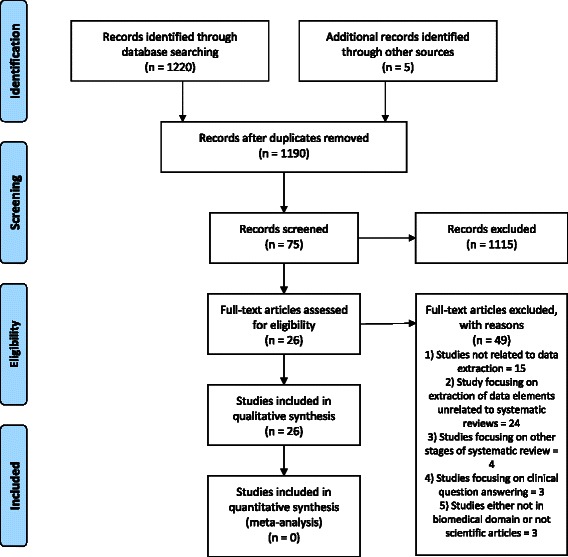
BACKGROUND: Automation of the parts of systematic review process, specifically the data extraction step, may be an important strategy to reduce the time necessary to complete a systematic review. However, the state of the science of automatically extracting data elements from full texts has not been well described. This paper performs a systematic review of published and unpublished methods to automate data extraction for systematic reviews. METHODS: We systematically searched PubMed, IEEEXplore, and ACM Digital Library to identify potentially relevant articles. We included reports that met the following criteria: 1) methods or results section described what entities were or need to be extracted, and 2) at least one entity was automatically extracted with evaluation results that were presented for that entity. We also reviewed the citations from included reports. RESULTS: Out of a total of 1190 unique citations that met our search criteria, we found 26 published reports describing automatic extraction of at least one of more than 52 potential data elements used in systematic reviews. For 25 (48 %) of the data elements used in systematic reviews, there were attempts from various researchers to extract information automatically from the publication text. Out of these, 14 (27 %) data elements were completely extracted, but the highest number of data elements extracted automatically by a single study was 7. Most of the data elements were extracted with F-scores (a mean of sensitivity and positive predictive value) of over 70 %. CONCLUSIONS: We found no unified information extraction framework tailored to the systematic review process, and published reports focused on a limited (1-7) number of data elements. Biomedical natural language processing techniques have not been fully utilized to fully or even partially automate the data extraction step of systematic reviews.
Overview
The claims and statistics of this paper haven’t been checked yet.
Free: it reads the open-access text and checks the first 5 claims that cite a source we can check. Create a free account to check every claim.
Integrity signals
Registry
Cites
Statistics
Figures
Verification
Claims the paper makes
The claims and statistics of this paper haven’t been checked yet.
Free: it reads the open-access text and checks the first 5 claims that cite a source we can check. Create a free account to check every claim.
Claims other papers make about this one
Each is checked against this paper’s own text: does it say what the citing paper says it does?
The source backs part of the claim, not all of it — or backs it for a different population, condition or comparison.
In the citing paper
“The time from the last search to publication takes commonly over 1 year for an SLR study”
From Automation of systematic literature reviews: A systematic literature review (2021) · cites this paper as [8]
Experimental — accuracy not yet measuredThe source backs part of the claim, not all of it — or backs it for a different population, condition or comparison.
In the citing paper
“However, almost all of this work has considered retrospective evaluation of ML/NLP methods applied to existing datasets, providing only indirect evidence of the utility of such methods for EBM.”
From Machine learning to help researchers evaluate biases in clinical trials: a prospective, randomized user study (2019) · cites this paper as [6]
Experimental — accuracy not yet measuredThe cited source says what the claim attributes to it.
In the citing paper
“The most efficient use and application of the machine-learning technologies would be in the areas allowing automation of specific SR processes, in particular those involving time-consuming and resource-intensive tasks such as language translation [15], study selection [11, 16–18], data extraction [19] and risk of bias assessment [20].”
From How to conduct systematic reviews more expeditiously? (2015) · cites this paper as [19]
The cited source says what the claim attributes to it.
In the citing paper
“for a primary study, it takes 2.5 - 6.5 years before it is incorporated in an SLR study [7,8].”
From Automation of systematic literature reviews: A systematic literature review (2021) · cites this paper as [8]
The cited source says what the claim attributes to it.
In the citing paper
“Additionally, 23% of all SLR studies are outdated within 2 years of publication, as reviewers failed to incorporate novel evidence on their subject of interest [8,9].”
From Automation of systematic literature reviews: A systematic literature review (2021) · cites this paper as [8]
1 more claim about this paper
Create a free account to see every claim other papers make about this one.
Self-check
Percentages, sums and reported differences re-computed from the paper’s own numbers.
The self-check needs the paper’s full text.
Citations
Cites
(2003) · Journal of Machine Learning Research · doi:10.5555/944919.944937 · Cited by 32,337
Text categorization with Support Vector Machines: Learning with many relevant features
Joachims, T. (1998) · Lecture Notes in Computer Science · doi:10.1007/bfb0026683 · Cited by 7,999
Whiting, P., Rutjes, A. W., Reitsma, J. B., Bossuyt, P. M., & Kleijnen, J. (2003) · BMC Medical Research Methodology · doi:10.1186/1471-2288-3-25 · Cited by 3,592
Towards complete and accurate reporting of studies of diagnostic accuracy: The STARD Initiative.
Bossuyt, P. M., Reitsma, J. B., Bruns, D. E., Gatsonis, C. A., Glasziou, P. P., Irwig, L. M., Lijmer, J. G., Moher, D., Rennie, D., de Vet, H. C. W., et al. (2003) · Annals of Internal Medicine · doi:10.7326/0003-4819-138-1-200301070-00010 · Cited by 3,219
Towards complete and accurate reporting of studies of diagnostic accuracy: the STARD initiative
Bossuyt, P. M., Reitsma, J. B., Bruns, D. E., Gatsonis, C. A., Glasziou, P. P., Irwig, L. M., Lijmer, J. G., Moher, D., Rennie, D., & de Vet, H. C. W. (2003) · BMJ · doi:10.1136/bmj.326.7379.41 · Cited by 3,215
Towards Complete and Accurate Reporting of Studies of Diagnostic Accuracy: The STARD Initiative
Bossuyt, P. M., Reitsma, J. B., Bruns, D. E., Gatsonis, C. A., Glasziou, P. P., Irwig, L. M., Lijmer, J. G., Moher, D., Rennie, D., & de Vet, H. C. W. (2003) · Radiology · doi:10.1148/radiol.2261021292 · Cited by 3,215
Improving the Quality of Reporting of Randomized Controlled Trials: The CONSORT Statement
Begg, C. (1996) · JAMA · doi:10.1001/jama.1996.03540080059030 · Cited by 3,127
The well-built clinical question: A key to evidence-based decisions
(1995) · ACP Journal Club · doi:10.7326/acpjc-1995-123-3-a12 · Cited by 2,931 · cited 2×
“…the Cochrane Handbook for Systematic Reviews [1], the CONsolidated Standards Of Reporting Trials (CONSORT) [9] statement, the Standards for Reporting of Diagnostic Accuracy (STARD) initiative [10], and PICO [11], PECODR [12], and PIBOSO [13] frameworks to obtain the data elements to be considered.”
MethodEddy, S. R. (1996) · Current Opinion in Structural Biology · doi:10.1016/s0959-440x(96)80056-x · Cited by 1,430
Clinical practice guidelines : directions for a new program
Field, M. J., & Lohr, K. N. (1990) · Cited by 1,415
Research works printed but not linked: 2
- Khan KS Ter Riet G Glanville J Sowden AJ Kleijnen J Undertaking systematic reviews of research on effectiveness: CRD’s guidance for carrying out or commissioning reviews, NHS Centre for Reviews and Dissemination 2001
- Woolf SH Manual for conducting systematic reviews, Agency for Health Care Policy and Research 1996
Cited by
Items 101–200 of 351
Smith, L. C. (2023) · Journal of the Association for Information Science and Technology · doi:10.1002/asi.24851 · Cited by 22
“Jonnalagadda et al. (2015) provided a systematic review of studies discussing automation of data extraction.”
BackgroundMuller, A. E., Ames, H. M. R., Jardim, P. S. J., & Rose, C. J. (2022) · Research Synthesis Methods · doi:10.1002/jrsm.1541 · Cited by 21
“Automatic data extraction and analysis represent subsequent areas of development.(19,21) Weißer et al.”
MethodDu, J., Wang, D., Lin, B., He, L., Huang, L., Wang, J., Manion, F. J., Li, Y., Cossrow, N., & Yao, L. (2025) · Scientific Reports · doi:10.1038/s41598-025-03979-5 · Cited by 21
Hilkenmeier, F., Pelzer, M., Stierle, C. M. G., & Fink‐Lamotte, J. (2025) · Social Science Computer Review · doi:10.1177/08944393251404052 · Cited by 23
Transformative Automation: AI in Scientific Literature Reviews
Zala, K., Acharya, B., Mashru, M., Palaniappan, D., Gerogiannis, V. C., Kanavos, A., & Karamitsos, I. (2024) · International Journal of Advanced Computer Science and Applications · doi:10.14569/ijacsa.2024.01501122 · Cited by 22
“Despite the more standardized disclosure practices in the medical professions, tools for extracting features such as Population, Intervention, Comparison, and Outcome (PICO) criteria are still in their early stages of development [26].”
BackgroundMethodSilva, N., & Wickramaarachchi, D. (2025) · International Conference on Advanced Research in Computing (ICARC) · doi:10.1109/icarc64760.2025.10963273 · Cited by 24
“Questions about the reliability of AI-generated outputs, the variability in result quality, and the necessity of human oversight remain critical [7] [8].”
Elkins, M. R. (2017) · Journal of physiotherapy · doi:10.1016/j.jphys.2017.11.009 · Cited by 21
Halamoda‐Kenzaoui, B., Rolland, E., Piovesan, J., Puertas Gallardo, A., & Bremer‐Hoffmann, S. (2022) · Journal of Applied Toxicology · doi:10.1002/jat.4204 · Cited by 21
Advancing Meta‐Analytic Methods in L2 Research
Plonsky, L., Hu, Y., Sudina, E., & Oswald, F. L. (2023) · Wiley eBooks · doi:10.1002/9781394259670.ch14 · Cited by 20
Jap, J., Saldanha, I. J., Smith, B. T., Lau, J., Schmid, C. H., Li, T., & on behalf of the Data Abstraction Assistant Investigators (2018) · Research Synthesis Methods · doi:10.1002/jrsm.1326 · Cited by 20
“13 A few tools are able to abstract information about study objective and certain aspects of study design (eg, study duration and participant flow) and risk of bias.”
BackgroundWhitton, J., & Hunter, A. (2023) · Artificial Intelligence in Medicine · doi:10.1016/j.artmed.2023.102661 · Cited by 21
Deep learning in automated text classification: a case study using toxicological abstracts
Varghese, A., Agyeman-Badu, G., & Cawley, M. A. (2020) · Environment Systems & Decisions · doi:10.1007/s10669-020-09763-2 · Cited by 20
Liu, J., Lai, H., Zhao, W., Huang, J., Xia, D., Liu, H., Luo, X., Wang, B., Pan, B., Hou, L., et al. (2025) · International Journal of Surgery · doi:10.1097/js9.0000000000002215 · Cited by 19
“While semi-automated tools have been developed to assist this process, they exhibit constraints in efficacy and application [ 3 , 4 ] .”
Chauhan, A. S., Singh, K., Bhatia, R., Khetrapal, S., & Naskar, A. (2023) · COVID · doi:10.3390/covid3080081 · Cited by 20
Label-based meta-analysis of functional brain dysconnectivity across mood and psychotic disorders
Grot, S., Smine, S., Potvin, S., Darcey, M., Pavlov, V., Genon, S., Nguyen, H. D., & Orban, P. (2024) · Progress in Neuro-Psychopharmacology and Biological Psychiatry · doi:10.1016/j.pnpbp.2024.110950 · Cited by 19
Commentary on EPC methods: an exploration of the use of text-mining software in systematic reviews
Paynter, R., Bañez, L. L., Erinoff, E., Lege-Matsuura, J., & Potter, S. (2017) · Journal of Clinical Epidemiology · doi:10.1016/j.jclinepi.2016.11.019 · Cited by 17
Tapia, E. C. H., Yosa, J. L., García, M. H. O., Morocho, N. J. C., & Calle, Y. A. S. (2025) · Cureus · doi:10.7759/cureus.89957 · Cited by 17
Gong, E. J., Bang, C. S., & Shin, Y. S. (2026) · Bioengineering · doi:10.3390/bioengineering13030365 · Cited by 19
Towards semantic-driven boolean query formalization for biomedical systematic literature reviews
Pourreza, M., & Ensan, F. (2022) · International Journal of Medical Informatics · doi:10.1016/j.ijmedinf.2022.104928 · Cited by 17
Automated data analysis of unstructured grey literature in health research: A mapping review
Schmidt, L., Mohamed, S., Meader, N., Bacardit, J., & Craig, D. (2023) · Research Synthesis Methods · doi:10.1002/jrsm.1692 · Cited by 17
“13,22,23 We furthermore decided to keep this 2005 date filter because the availability of data sources changes over the years, and methods published prior to this date are not representative anymore or are becoming unlikely to be usable in practice due to changes and updates in programming…”
MethodLachowicz, J. I., & Gać, P. (2025) · Journal of Clinical Medicine · doi:10.3390/jcm14082846 · Cited by 17
“The data extraction process was conducted following the instructions of Pedder et al. [15] and Jonnalagadda et al. [16].”
Artificial intelligence and automation of systematic reviews in women's health
Amezcua‐Prieto, C., Fernández-Luna, J. M., Huete, J. F., Bueno‐Cavanillas, A., & Khan, K. S. (2020) · Current Opinion in Obstetrics & Gynecology · doi:10.1097/gco.0000000000000643 · Cited by 17
“For any text classification tasks in AIRES, like study selection or data extraction, there are many algorithms, for example, Support Vector Machines (SVM), which held to offer the highest performance [44], logistic regression, Bayesian approaches, neural networks (including deep learning), and so forth [6].”
MethodSercombe, J., Bryant, Z., & Wilson, J. (2025) · JMIR Formative Research · doi:10.2196/68666 · Cited by 16
“Rule-based and natural language processing (NLP)–driven named entity recognition approaches have been used for structured data extraction from full-text articles [14].”
Peng, Z., Wu, X., Qin, Z., Doi, S. A. R., Furuya‐Kanamori, L., Hong, Y., Lin, L., Chu, H., Xu, C., & Liu, M. (2025) · Sleep Medicine Reviews · doi:10.1016/j.smrv.2025.102192 · Cited by 16
Synthesizing Knowledge through A Data Analytics-Based Systematic Literature Review Protocol
Xiong, R. R., Liu, C. Z., & Choo, K. R. (2023) · Information Systems Frontiers · doi:10.1007/s10796-023-10432-3 · Cited by 17
“…the majority of these studies are from well-established disciplines such as software engineering or medical fields (e.g., Feng et al., 2018; Jonnalagadda et al., 2015; O’Mara-Eves et al., 2015; van Dinter et al., 2021), and there has been very few studies that examine ways to enhance the…”
Legate, A. E., Nimon, K., & Noblin, A. (2024) · F1000Research · doi:10.12688/f1000research.151493.1 · Cited by 15
“As in prior reviews, English language reports, published 2005 or later were considered for inclusion (Jonnalagadda et al., 2015; O ’ Mara-Eves et al., 2015; Schmidt et al., 2020).”
BackgroundResultPrior Knowledge for Predictive Modeling: The Case of Acute Aquatic Toxicity
Shavalieva, G., Papadokonstantakis, S., & Peters, G. M. (2022) · Journal of Chemical Information and Modeling · doi:10.1021/acs.jcim.1c01079 · Cited by 15
“Researchers have been striving to reduce the amount of manual work required to process this information, 23 which is a challenging process in itself.”
BackgroundA data extraction template for the behaviour change intervention ontology
Norris, E., Zhang, L. M., Wuerstl, K. R., Froome, H. M., & Michie, S. (2024) · Wellcome Open Research · doi:10.12688/wellcomeopenres.20872.1 · Cited by 15
“Developments such as natural language processing, machine learning and artificial intelligence provide new opportunities for automated data extraction, reducing the time necessary to complete or update an evidence synthesis (Jonnalagadda et al. , 2015).”
BackgroundVarghese, A., Hong, T., Hunter, C., Agyeman-Badu, G., & Cawley, M. A. (2019) · Environment Systems & Decisions · doi:10.1007/s10669-019-09717-3 · Cited by 16
Detect and Classify – Joint Span Detection and Classification for Health Outcomes
Abaho, M., Bollegala, D., Williamson, P. R., & Dodd, S. R. (2021) · Conference on Empirical Methods in Natural Language Processing (EMNLP) · doi:10.18653/v1/2021.emnlp-main.686 · Cited by 15
“With the rapid growth of literature that reports outcomes, researchers have acknowledged and addressed the need to automate the extraction of outcomes from systematic reviews (Jonnalagadda et al., 2015; Nye et al., 2018) and answering clinical questions (Demner-Fushman and Lin, 2007).”
BackgroundŞahin, A., Kara, B. C., & Dirsehan, T. (2025) · SoftwareX · doi:10.1016/j.softx.2025.102198 · Cited by 15
Sundaram, G., & Berleant, D. (2022) · arXiv (Cornell University) · doi:10.48550/arxiv.2211.15397 · Cited by 14
“[12] focus on automatic data extraction of critical data elements from full text medical texts as part of the SLR process.”
BackgroundHow to Report Systematic Literature Reviews in Management Using SyReMa
Riaño-Casallas, M. I., & Berrío, S. P. R. (2023) · Innovar · doi:10.15446/innovar.v34n92.99156 · Cited by 14
“…(authors, year, country, affiliation, title, and type of publication); characteristics of the study (objectives, population, sample, and methods); and findings of interest; some studies have provided examples of the latter feature (Chicaíza-Becerra et al ., 2017; Jonnalagadda et al ., 2015).”
BackgroundAliyu, M. B., Iqbal, R., & James, A. E. (2018) · International Conference on Social Networks Analysis, Management and Security (SNAMS) · doi:10.1109/snams.2018.8554896 · Cited by 14
“A survey of the data extraction approaches by [33] concluded that there is no uniform framework for the data extraction”
MethodBegert, D., Granek, J., Irwin, B., & Brogly, C. (2020) · Canada Communicable Disease Report · doi:10.14745/ccdr.v46i06a04 · Cited by 14
“Although rapid publication of relevant, high-quality systematic reviews is ideal, in practice the publication process has generally been slow (1,2).”
BackgroundCrowdsourcing Information Extraction for Biomedical Systematic ReviewsPreprint
Sun, Y., Cheng, P., Wang, S., Lyu, H., Lease, M., Marshall, I. J., & Wallace, B. (2016) · Research Portal (King's College London) · doi:10.48550/arxiv.1609.01017 · Cited by 14
Accuracy of LLMs to retrieve numeric data for meta-analysis in dentistry
Caponio, V. C. A., Lorenzo‐Pouso, A. I., Magalhães, M. A. O., Ali, A. A., Adamo, D., Cirillo, N., López‐Pintor, R. M., & Musella, G. (2025) · Journal of Dentistry · doi:10.1016/j.jdent.2025.106245 · Cited by 13
Zhou, L., Siddiqui, T., Seliger, S. L., Blumenthal, J. B., Kang, Y., Doerfler, R. M., & Fink, J. C. (2019) · International Journal of Medical Informatics · doi:10.1016/j.ijmedinf.2019.06.020 · Cited by 13
Yan, H., Rahgozar, A., Sethuram, C., Karunananthan, S., Archibald, D., Bradley, L., Hakimjavadi, R., Helmer‐Smith, M., Jolin‐Dahel, K., McCutcheon, T., et al. (2022) · JMIR Research Protocols · doi:10.2196/34575 · Cited by 13
“Previous studies have utilized NLP to reduce the burden of the literature review process by automating the identification and selection of latent topics in papers [25-29].”
MethodHassanzadeh, H., Nguyen, A. N., & Verspoor, K. M. (2019) · Journal of Biomedical Informatics · doi:10.1016/j.jbi.2019.103321 · Cited by 13
Xiao, M., Rong, W., Amzah, F., & Khalid, N. A. M. (2025) · Education and Information Technologies · doi:10.1007/s10639-024-13274-x · Cited by 13
A multi-source heterogeneous medical data enhancement framework based on lakehouse
Sheng, M., Wang, S., Zhang, Y., Hao, R., Liang, Y., Luo, Y., Yang, W., Wang, J., Li, Y., Zheng, W., et al. (2024) · Health Information Science and Systems · doi:10.1007/s13755-024-00295-6 · Cited by 12
“Currently, data extraction techniques have been widely applied, facilitating the transformation of data from one modality [35, 36].”
Wang, X., & Luo, G. (2024) · EdArXiv (OSF Preprints) · doi:10.35542/osf.io/wn3cd · Cited by 12
Lee, C., Thomas, M., Ejaredar, M., Kassam, A., Whittle, S., Buchbinder, R., Tugwell, P., Wells, G. A., Pardo, J. P., & Hazlewood, G. S. (2022) · Journal of Clinical Epidemiology · doi:10.1016/j.jclinepi.2022.03.019 · Cited by 11
Mutinda, F. W., Liew, K., Yada, S., Wakamiya, S., & Aramaki, E. (2022) · Workshop on Information Extraction from Scientific Publications (WIESP) · doi:10.18653/v1/2022.wiesp-1.4 · Cited by 11
“Despite their importance, meta-analyses are labor-intensive and time-consuming as they involve manually reading hundreds of unstructured research articles and extracting data from them (Jonnalagadda et al., 2015).”
BackgroundChristopoulou, S. C. (2022) · BioMedInformatics · doi:10.3390/biomedinformatics2030032 · Cited by 11
“Ho ever, the authors of [13] fo nd no unified information extraction framework tailored to the systematic revie process, and published reports focused on a limited (1–7) umber of data elem nts.”
BackgroundJiang, L., Vorland, C. J., Ying, X., Brown, A. W., Menke, J. D., Hong, G., Lan, M., Mayo‐Wilson, E., & Kilicoglu, H. (2025) · Scientific Data · doi:10.1038/s41597-025-04629-1 · Cited by 11
Secondary Use of Laboratory data: Potentialities and Limitations
Hajia, M. (2019) · Iranian journal of pathology · doi:10.30699/ijp.2019.95692.1942 · Cited by 10
“The step can be repeated a few times (19-22).”
BackgroundBasu, T., Goldsworthy, S., & Gkoutos, G. V. (2021) · Information · doi:10.3390/info12040139 · Cited by 10
“The experts manually extract these data elements from the relevant literature, following a predefined protocol, and build a systematic review, a process which typically requires a substantial amount of time [1].”
BackgroundInfluentialIntroduction to Systematic Reviews
Li, T., Saldanha, I. J., & Robinson, K. A. (2022) · Springer eBooks · doi:10.1007/978-3-319-52636-2_194 · Cited by 10
Stewart‐Evans, J., Wilson, E. E., Langley, T. E., Prayle, A., Hands, A., Exley, K. S., & Leonardi‐Bee, J. (2025) · arXiv (Cornell University) · doi:10.48550/arxiv.2507.06623 · Cited by 10
A distantly supervised dataset for automated data extraction from diagnostic studies.
Norman, C., Leeflang, M., Spijker, R., Kanoulas, E., & Névéol, A. (2019) · Proceedings of the 18th BioNLP Workshop and Shared Task · doi:10.18653/v1/w19-5012 · Cited by 9
Collaborative Large Language Models for Automated Data Extraction in Living Systematic Reviews
Khan, M. A., Ayub, U., Naqvi, S. A. A., Khakwani, K. Z. R., Sipra, Z. B. R., Raina, A., Zou, S., He, H., Hossein, S. A., Hasan, B., et al. (2024) · doi:10.1101/2024.09.20.24314108 · Cited by 54
Meng, X., Chen, Y., Rudasill, K. M., Xu, L., Yu, D., & Harrell, D. R. (2025) · Journal of Youth and Adolescence · doi:10.1007/s10964-025-02212-w · Cited by 9
“However, with the rapid expansion and capabilities of AI, the ability to quickly translate these studies may be possible with a well-constructed prompt asking about certain study information (Jonnalagadda et al., 2015).”
Prevalent User-centered Monetization Techniques in Social Media
Bruce, M. R., Adekoya, A. F., Boateng, S. T., & Appiahene, P. (2023) · International Review of Management and Marketing · doi:10.32479/irmm.14005 · Cited by 9
Machine learning for semi-automated scoping reviews
Mozgai, S., Kaurloto, C., Winn, J. G., Leeds, A., Heylen, D., Hartholt, A., & Scherer, S. J. (2023) · Intelligent Systems with Applications · doi:10.1016/j.iswa.2023.200249 · Cited by 9
Kamso, M. M., Pardo, J. P., Whittle, S., Buchbinder, R., Wells, G. A., Glennon, V., Tugwell, P., Deardon, R., Sajobi, T. T., TOMLINSON, G. A., et al. (2023) · Journal of Clinical Epidemiology · doi:10.1016/j.jclinepi.2023.10.007 · Cited by 9
Enslaved to the Trapped Data: A Cognitive Work Analysis of Medical Systematic Reviews
Knight, I. A., Wilson, M. L., Brailsford, D. F., & Milić-Frayling, N. (2019) · Conference on Human Information Interaction and Retrieval · doi:10.1145/3295750.3298937 · Cited by 9
“5 years between new research being published and that research being incorporated into a review [26], and there is also commonly at least a year between completing the literature search and publishing the final review [12], meaning that systematic reviews are often out of date from the moment they are written, or miss…”
BackgroundHolub, K. J., Hardy, N. J., & Kallmes, K. M. (2021) · JMIR Formative Research · doi:10.2196/33124 · Cited by 9
“Notably, the majority of previous extraction efforts have focused on textual extraction [8], despite the varied presentation styles and unstructured nature of both contextual information and the data themselves.”
InfluentialAguirre, A. M. G., & Figueroa-Vallejo, C. J. (2022) · Revista de Investigación Desarrollo e Innovación · doi:10.19053/20278306.v12.n2.2022.15271 · Cited by 9
Steps Towards an Infrastructure for Scholarly SynthesisPreprint
Chan, J., Akamatsu, M., Vargas, D., Kawerau, L., & Gärtner, M. (2024) · arXiv (Cornell University) · doi:10.48550/arxiv.2407.20666 · Cited by 9
Using AI to Automate the Literature Review Process: A Topic Brief
Haßler, B., Hassan, M., Klune, C., Mansour, H., & Friese, L. (2024) · doi:10.53832/edtechhub.1003 · Cited by 10
Ning, W., Li, M., Reimers, J. R., & Kobayashi, R. (2026) · Digital Discovery · doi:10.1039/d5dd00482a · Cited by 8
Rapid review: A review of methods and recommendations based on current evidence
Guo, Q., Jiang, G., Zhao, Q., Long, Y., Feng, K., Gu, X., Xu, Y., Li, Z., Huang, J., & Du, L. (2024) · Journal of Evidence-Based Medicine · doi:10.1111/jebm.12594 · Cited by 8
Tomczyk, P., Brüggemann, P., & Doligalski, T. (2024) · International Journal of Artificial Intelligence Tools · doi:10.1142/s0218213024500234 · Cited by 8
Overview of the TAC 2018 Systematic Review Information Extraction Track.
Schmitt, C., Walker, V. R., Williams, A. R., Varghese, A., Ahmad, Y., Rooney, A., & Wolfe, M. S. (2018) · Theory and applications of categories · Cited by 8
Meta-analyzing Corpus Linguistic Research
Mizumoto, A., Plonsky, L., & Egbert, J. (2020) · Springer eBooks · doi:10.1007/978-3-030-46216-1_27 · Cited by 8
Goswami, S., Pal, S., Goldsworthy, S., & Basu, T. (2019) · Lecture notes in business information processing · doi:10.1007/978-3-030-20485-3_19 · Cited by 8
Systematic review automation methods
Norman, C. R. (2020) · theses.fr (ABES) · doi:10.70675/044ffa34z5c9bz433az99c8z64697dcd28a2 · Cited by 8
Basu, T., Kumar, S., Kalyan, A., Jayaswal, P., Goyal, P., Pettifer, S., & Jonnalagadda, S. R. (2016) · arXiv · doi:10.48550/arxiv.1606.06424 · Cited by 7
“It has been discussed that only three out of 26 studies included in that systematic review, use a common corpus, namely 1000 medical abstracts from the PIBOSO corpus [2].”
BackgroundInfluentialSelf-citationADVANCING TOURISM DESTINATION AMIDST COVID-19 IN KAZAKHSTAN: A FOCUS ON SOCIAL TOURISM INITIATIVES
Aktymbayeva, A., Nuruly, Y., Медеуовна, Б. М., KULAKHMETOVA, G. A., Zhakupova, A. А., Archi, Y. E., Benbba, B., Issakov, Y., & Dávid, L. D. (2023) · GeoJournal of Tourism and Geosites · doi:10.30892/gtg.50435-1153 · Cited by 7
Liu, S., Bourgeois, F. T., Narang, C., & Dunn, A. G. (2023) · Research Synthesis Methods · doi:10.1002/jrsm.1672 · Cited by 7
Towards the Utilization of AI-Powered Assistance for Systematic Literature Review
Đukić, M., Škembarević, M., Jejić, O., & Luković, I. (2024) · Communications in computer and information science · doi:10.1007/978-3-031-70421-5_16 · Cited by 8
The Effect of Natural Language Processing on the Analysis of Unstructured Text: A Systematic Review
Baluis, W. L. R., Zapata, N. A., & Vásquez, M. S. M. (2022) · International Journal of Advanced Computer Science and Applications · doi:10.14569/ijacsa.2022.0130507 · Cited by 7
“The author in [12] indicates that NLP is a technique of automatic extraction of information from different electronically written resources at the level of documents, words, grammar, meaning, and context.”
MethodHoanga, L., Jiang, L., & Kilicoglu, H. (2022) · PubMed Central · Cited by 7
Edlinger, M., Huber, S. L., & Ninaus, M. (2025) · Computers in Human Behavior Reports · doi:10.1016/j.chbr.2025.100850 · Cited by 6
Peng, Z., Fan, S., Tian, Y. Y., Wang, Y., Qin, Z., Doi, S. A. R., & Xu, C. (2025) · BMJ Open · doi:10.1136/bmjopen-2025-106546 · Cited by 6
“To prevent data sharing among participants within or between groups, the order of the studies in the data extraction form will also be randomised for each participant.”
Artificial Intelligence in Evidence-Based Medicine: On the Verge of Breakthrough
Nowak, A. J. (2022) · Springer eBooks · doi:10.1007/978-3-030-64573-1_43 · Cited by 6
Software engineering principles address current problems in the systematic review ecosystem
Bashir, R., & Dunn, A. G. (2018) · Journal of Clinical Epidemiology · doi:10.1016/j.jclinepi.2018.12.014 · Cited by 6
AUTOMETA: Automatic Meta-Analysis System Employing Natural Language Processing
Mutinda, F. W., Yada, S., Wakamiya, S., & Aramaki, E. (2022) · Studies in health technology and informatics · doi:10.3233/shti220150 · Cited by 6
Timely, Efficient, and Living Systematic Reviews: Opportunities in International Development
Snilstveit, B., Stevenson, J., Shemilt, I., Clarke, M. J., Jiménez, E., & Thomas, J. (2018) · doi:10.51744/cip7 · Cited by 6
“However, a recent systematic review assessing automation and semi-automation of data extraction (Jonnalagadda et al., 2015) concludes there is a need for significant further development in this area.”
BackgroundHoang, L., Jiang, L., & Kilicoglu, H. (2021) · doi:10.1101/2021.09.14.21263586 · Cited by 5
Unveiling 30 years of research on speech biomarker of dementia using text mining
Oh, C., & Park, M. S. (2025) · Digital Health · doi:10.1177/20552076251360901 · Cited by 5
“18,19 A key advantage of this computer-assisted method lies in the capacity to extract and synthesize knowledge from texts using a range of metrics (e.g., co-occurrence networks, term frequency-inverse document frequency).”
Nanoparticle-mediated modulation of microalgae to heavy metal co-exposure stress: A meta-analysis
Li, Y., Yu, Z., Cui, Y., Kayani, S., Xue, X., Hu, X., Qian, J., Zhu, F., & Huo, S. (2025) · Journal of Hazardous Materials · doi:10.1016/j.jhazmat.2025.140534 · Cited by 6
Terpene-based hydrophobic (D)ESs: A systematic review of physiochemical properties
Manyoni, L., Tumba, K., Nkosi, N., & Ngema, T. (2025) · Chemical Thermodynamics and Thermal Analysis · doi:10.1016/j.ctta.2025.100249 · Cited by 5
Wilkins, A. A., Whaley, P., Persad, A. S., Druwe, I. L., Lee, J. S., Taylor, M., Shapiro, A. J., Southard, N. B., Lemeris, C., & Thayer, K. A. (2022) · Heliyon · doi:10.1016/j.heliyon.2022.e09095 · Cited by 5
“…more effectively utilize machine learning approaches to mine text [for extraction] but the success of such algorithms depends heavily on the availability of manually annotated data, which is limited in the biomedical health field (Ma et al., 2020; Jonnalagadda et al., 2015; Mishra et al., 2014).”
BackgroundKarystianis, G., Lukmanjaya, W., Buchan, I. E., Simpson, P. L., Ginnivan, N., Nenadić, G., & Butler, T. G. (2024) · BMC Medical Research Methodology · doi:10.1186/s12874-024-02186-6 · Cited by 6
“Methods which enable the automatic extraction of salient features of published research (e.g., study design) can provide a quick means of reporting on large numbers of documents by reducing the time required to detect, summarise and incorporate key information from relevant literature [18, 19].”
BackgroundKalibatienė, D., & Miliauskaitė, J. (2025) · Computer Standards & Interfaces · doi:10.1016/j.csi.2025.104073 · Cited by 5
Convolutional Neural Network for Core Sections Identification in Scientific Research Publications
Muhammad, B. A., Iqbal, R., James, A. E., & Nkantah, D. (2019) · Lecture notes in computer science · doi:10.1007/978-3-030-33607-3_29 · Cited by 5
Extracting experimental parameter entities from scientific articles
Farnsworth, S., Gurdin, G., Vargas, J., Mulyar, A., Lewinski, N. A., & McInnes, B. T. (2021) · Journal of Biomedical Informatics · doi:10.1016/j.jbi.2021.103970 · Cited by 5
de Lisenko, N. R., Gray, H. L., & Bohn, J. (2022) · Maternal and Child Health Journal · doi:10.1007/s10995-022-03503-5 · Cited by 5
“Each reviewer ensured the quality of content by detecting PICO (population, intervention, comparison, outcomes) elements in the journal abstracts (Jonnalagadda et al., 2015).”
MethodParental perceptions to new-born screening for hearing loss in Nigeria: A systematic review
Nwankwo, C. J., Vite, B.-I. N., & Udom, G. J. (2023) · International Journal of Pediatric Otorhinolaryngology · doi:10.1016/j.ijporl.2023.111517 · Cited by 5
Kim, H., Bian, J., Mostafa, J., Jonnalagadda, S., & Fiol, G. D. (2016) · PubMed · Cited by 5
Self-citationIntroduction to Systematic Reviews
Li, T., Saldanha, I. J., & Robinson, K. A. (2021) · Springer eBooks · doi:10.1007/978-3-319-52677-5_194-1 · Cited by 5
Artificial Intelligence in Evidence-Based Medicine: On the Verge of Breakthrough
Nowak, A. J. (2021) · Springer eBooks · doi:10.1007/978-3-030-58080-3_43-1 · Cited by 5
Sequential short-text classification with neural networks
Dernoncourt, F. (2017) · DSpace@MIT (Massachusetts Institute of Technology) · Cited by 5
Using a hybrid methodology for literature review: a case study in depression research
Abdallah, S., & Khalil, A. (2023) · Information Discovery and Delivery · doi:10.1108/idd-03-2022-0020 · Cited by 4
Andrade-Cabrera, A., Ayala-Tipan, C., Suntaxi, G., & Recalde, L. (2025) · Communications in computer and information science · doi:10.1007/978-3-031-98290-3_28 · Cited by 4
Data Extraction from Included Studies
Moon, K., & Rao, S. C. (2021) · Springer eBooks · doi:10.1007/978-3-030-71921-0_6 · Cited by 4
Big Data Bot with a Special Reference to Bioinformatics
Al-Omari, A., Tawalbeh, S. M., Akkam, Y. H., Al-Tawalbeh, M., Younis, S., Mustafa, A. A., & Arnold, J. (2023) · Computers, materials & continua/Computers, materials & continua (Print) · doi:10.32604/cmc.2023.036956 · Cited by 4
Metadata
- Authors
- Jonnalagadda, S. R., Goyal, P., & Huffman, M. D.
- Affiliations
- Northwestern University (US)
- Indian Institute of Technology Kharagpur (IN)
- Corresponding author
- Jonnalagadda, Siddhartha R.
- Venue
- Systematic Reviews
- Published
- 2015-06-15
- Volume
- 4
- Issue
- 1
- Pages
- 78-78
- ISSN
- 2046-4053 (ISSN-L)
- PMC
- PMC4514954
- OpenAlex
- W1629765770
- Cited by
- 287
- References
- 79
- Citations by year
- 2026: 21 · 2025: 43 · 2024: 31 · 2023: 32 · 2022: 32 · 2021: 42 · 2020: 25 · 2019: 24 · 2018: 17 · 2017: 11 · 2016: 8 · 2015: 1
- FWCI
- 2.03
- Type
- journal article
- Language
- en
- Open access
- gold
- doi.org
- Locations
- Systematic Reviews (publishedVersion, cc-by)
- Europe PMC (PubMed Central) (publishedVersion, cc-by)
- PubMed Central (publishedVersion, cc-by)
- PubMed (publishedVersion)
- Funders
- Feinberg School of Medicine
- U.S. National Library of Medicine (R00LM011389)
- Topics
- Social Sciences › Decision Sciences › Statistics, Probability and Uncertainty › Meta-analysis and systematic reviews
- Health Sciences › Medicine › Health Informatics › Biomedical Text Mining and Ontologies
- Physical Sciences › Computer Science › Artificial Intelligence › Advanced Text Analysis Techniques
- Keywords
- automated data extraction, information extraction, natural language processing, biomedical text mining, data elements
- MeSH terms
- Humans, Publishing, Review Literature as Topic, Information Storage and Retrieval, Data Mining, Research Report
About these checks
Registry, retraction, Cites and statistics results are computed, not judged, with one exception: a printed reference that no index lists is read once by a model before it counts as a citation error. Claims are extracted by a model and kept only when their quote appears verbatim in the text; each cited source is then checked, with a model’s help, for whether it says what the claim relies on. Those verdicts can be wrong — read the claim’s quote and the cited source before relying on one.
Statistics and arithmetic are recomputed, not judged.
Confidence bands are shown only for fields calibrated on our annotated test set. None is calibrated yet, so no band is shown.
What counts as a claim ›How we measure confidence ›How we check this ›
Are you an author, or do you see a problem with this page? Request a review
Data sources
Bibliographic data: Semantic Scholar, OpenAlex, Crossref.
Contains information from the Semantic Scholar Academic Graph Datasets, made available under the ODC Attribution License (ODC-BY 1.0).
Semantic Scholar’s data is described in: Kinney, R., et al. (2023). The Semantic Scholar Open Data Platform. arXiv:2301.10140.
