

Automating data extraction in systematic reviews: a systematic review
Open accessThe DOI matches its Crossref record; 80 of the 80 references it cites were found in a registry or an index.
Abstract
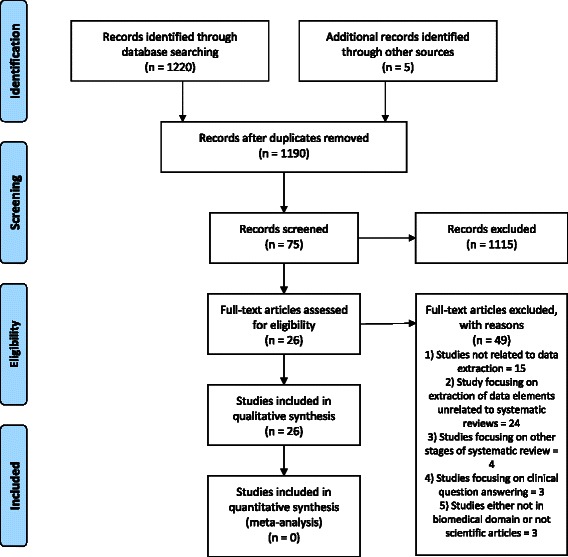
BACKGROUND: Automation of the parts of systematic review process, specifically the data extraction step, may be an important strategy to reduce the time necessary to complete a systematic review. However, the state of the science of automatically extracting data elements from full texts has not been well described. This paper performs a systematic review of published and unpublished methods to automate data extraction for systematic reviews. METHODS: We systematically searched PubMed, IEEEXplore, and ACM Digital Library to identify potentially relevant articles. We included reports that met the following criteria: 1) methods or results section described what entities were or need to be extracted, and 2) at least one entity was automatically extracted with evaluation results that were presented for that entity. We also reviewed the citations from included reports. RESULTS: Out of a total of 1190 unique citations that met our search criteria, we found 26 published reports describing automatic extraction of at least one of more than 52 potential data elements used in systematic reviews. For 25 (48 %) of the data elements used in systematic reviews, there were attempts from various researchers to extract information automatically from the publication text. Out of these, 14 (27 %) data elements were completely extracted, but the highest number of data elements extracted automatically by a single study was 7. Most of the data elements were extracted with F-scores (a mean of sensitivity and positive predictive value) of over 70 %. CONCLUSIONS: We found no unified information extraction framework tailored to the systematic review process, and published reports focused on a limited (1-7) number of data elements. Biomedical natural language processing techniques have not been fully utilized to fully or even partially automate the data extraction step of systematic reviews.
Overview
The claims and statistics of this paper haven’t been checked yet.
Free: it reads the open-access text and checks the first 5 claims that cite a source we can check. Create a free account to check every claim.
Integrity signals
Registry
Cites
Statistics
Figures
Verification
Claims the paper makes
The claims and statistics of this paper haven’t been checked yet.
Free: it reads the open-access text and checks the first 5 claims that cite a source we can check. Create a free account to check every claim.
Claims other papers make about this one
Each is checked against this paper’s own text: does it say what the citing paper says it does?
The source backs part of the claim, not all of it — or backs it for a different population, condition or comparison.
In the citing paper
“The time from the last search to publication takes commonly over 1 year for an SLR study”
From Automation of systematic literature reviews: A systematic literature review (2021) · cites this paper as [8]
Experimental — accuracy not yet measuredThe source backs part of the claim, not all of it — or backs it for a different population, condition or comparison.
In the citing paper
“However, almost all of this work has considered retrospective evaluation of ML/NLP methods applied to existing datasets, providing only indirect evidence of the utility of such methods for EBM.”
From Machine learning to help researchers evaluate biases in clinical trials: a prospective, randomized user study (2019) · cites this paper as [6]
Experimental — accuracy not yet measuredThe cited source says what the claim attributes to it.
In the citing paper
“The most efficient use and application of the machine-learning technologies would be in the areas allowing automation of specific SR processes, in particular those involving time-consuming and resource-intensive tasks such as language translation [15], study selection [11, 16–18], data extraction [19] and risk of bias assessment [20].”
From How to conduct systematic reviews more expeditiously? (2015) · cites this paper as [19]
The cited source says what the claim attributes to it.
In the citing paper
“for a primary study, it takes 2.5 - 6.5 years before it is incorporated in an SLR study [7,8].”
From Automation of systematic literature reviews: A systematic literature review (2021) · cites this paper as [8]
The cited source says what the claim attributes to it.
In the citing paper
“Additionally, 23% of all SLR studies are outdated within 2 years of publication, as reviewers failed to incorporate novel evidence on their subject of interest [8,9].”
From Automation of systematic literature reviews: A systematic literature review (2021) · cites this paper as [8]
1 more claim about this paper
Create a free account to see every claim other papers make about this one.
Self-check
Percentages, sums and reported differences re-computed from the paper’s own numbers.
The self-check needs the paper’s full text.
Citations
Cites
(2003) · Journal of Machine Learning Research · doi:10.5555/944919.944937 · Cited by 32,337
Text categorization with Support Vector Machines: Learning with many relevant features
Joachims, T. (1998) · Lecture Notes in Computer Science · doi:10.1007/bfb0026683 · Cited by 7,999
Whiting, P., Rutjes, A. W., Reitsma, J. B., Bossuyt, P. M., & Kleijnen, J. (2003) · BMC Medical Research Methodology · doi:10.1186/1471-2288-3-25 · Cited by 3,592
Towards complete and accurate reporting of studies of diagnostic accuracy: The STARD Initiative.
Bossuyt, P. M., Reitsma, J. B., Bruns, D. E., Gatsonis, C. A., Glasziou, P. P., Irwig, L. M., Lijmer, J. G., Moher, D., Rennie, D., de Vet, H. C. W., et al. (2003) · Annals of Internal Medicine · doi:10.7326/0003-4819-138-1-200301070-00010 · Cited by 3,219
Towards complete and accurate reporting of studies of diagnostic accuracy: the STARD initiative
Bossuyt, P. M., Reitsma, J. B., Bruns, D. E., Gatsonis, C. A., Glasziou, P. P., Irwig, L. M., Lijmer, J. G., Moher, D., Rennie, D., & de Vet, H. C. W. (2003) · BMJ · doi:10.1136/bmj.326.7379.41 · Cited by 3,215
Towards Complete and Accurate Reporting of Studies of Diagnostic Accuracy: The STARD Initiative
Bossuyt, P. M., Reitsma, J. B., Bruns, D. E., Gatsonis, C. A., Glasziou, P. P., Irwig, L. M., Lijmer, J. G., Moher, D., Rennie, D., & de Vet, H. C. W. (2003) · Radiology · doi:10.1148/radiol.2261021292 · Cited by 3,215
Improving the Quality of Reporting of Randomized Controlled Trials: The CONSORT Statement
Begg, C. (1996) · JAMA · doi:10.1001/jama.1996.03540080059030 · Cited by 3,127
The well-built clinical question: A key to evidence-based decisions
(1995) · ACP Journal Club · doi:10.7326/acpjc-1995-123-3-a12 · Cited by 2,931 · cited 2×
“…the Cochrane Handbook for Systematic Reviews [1], the CONsolidated Standards Of Reporting Trials (CONSORT) [9] statement, the Standards for Reporting of Diagnostic Accuracy (STARD) initiative [10], and PICO [11], PECODR [12], and PIBOSO [13] frameworks to obtain the data elements to be considered.”
MethodEddy, S. R. (1996) · Current Opinion in Structural Biology · doi:10.1016/s0959-440x(96)80056-x · Cited by 1,430
Clinical practice guidelines : directions for a new program
Field, M. J., & Lohr, K. N. (1990) · Cited by 1,415
Research works printed but not linked: 2
- Khan KS Ter Riet G Glanville J Sowden AJ Kleijnen J Undertaking systematic reviews of research on effectiveness: CRD’s guidance for carrying out or commissioning reviews, NHS Centre for Reviews and Dissemination 2001
- Woolf SH Manual for conducting systematic reviews, Agency for Health Care Policy and Research 1996
Cited by
Items 301–351 of 351
Gates, A., Gates, M., DaRosa, D., Elliott, S. A., Pillay, J., Rahman, S., Vandermeer, B., & Hartling, L. (2020) · Figshare · doi:10.6084/m9.figshare.13294966
Gates, A., Gates, M., Sim, S., Elliott, S. A., Pillay, J., & Hartling, L. (2021) · Figshare · doi:10.6084/m9.figshare.15179126
Nama, N., Hennawy, M., Barrowman, N., O'Hearn, K., Sampson, M., & McNally, J. D. (2021) · Figshare · doi:10.6084/m9.figshare.14374733
Nama, N., Hennawy, M., Barrowman, N., O'Hearn, K., Sampson, M., & McNally, J. D. (2021) · Figshare · doi:10.6084/m9.figshare.14374745
Gates, A., Gates, M., Sim, S., Elliott, S. A., Pillay, J., & Hartling, L. (2021) · Figshare · doi:10.6084/m9.figshare.15179117
Nama, N., Hennawy, M., Barrowman, N., O'Hearn, K., Sampson, M., & McNally, J. D. (2021) · Figshare · doi:10.6084/m9.figshare.14374739
Gates, A., Gates, M., Sim, S., Elliott, S. A., Pillay, J., & Hartling, L. (2021) · Figshare · doi:10.6084/m9.figshare.15179120
Nama, N., Hennawy, M., Barrowman, N., O'Hearn, K., Sampson, M., & McNally, J. D. (2021) · Figshare · doi:10.6084/m9.figshare.14374730
Nama, N., Hennawy, M., Barrowman, N., O'Hearn, K., Sampson, M., & McNally, J. D. (2021) · Figshare · doi:10.6084/m9.figshare.14374736
Karystianis, G., Lukmanjaya, W., Buchan, I. E., Simpson, P. L., Ginnivan, N., Nenadić, G., & Butler, T. G. (2024) · Figshare · doi:10.6084/m9.figshare.26694534
Nama, N., Hennawy, M., Barrowman, N., O'Hearn, K., Sampson, M., & McNally, J. D. (2021) · Figshare · doi:10.6084/m9.figshare.14374742
NIST TAC 2018 Systematic Review Evaluation Software
Schmitt, C. (2023) · Zenodo (CERN European Organization for Nuclear Research) · doi:10.5281/zenodo.7987875
Karystianis, G., Lukmanjaya, W., Buchan, I. E., Simpson, P. L., Ginnivan, N., Nenadić, G., & Butler, T. G. (2024) · Figshare · doi:10.6084/m9.figshare.26694537
Gates, A., Gates, M., DaRosa, D., Elliott, S. A., Pillay, J., Rahman, S., Vandermeer, B., & Hartling, L. (2020) · Figshare · doi:10.6084/m9.figshare.13294972
Zhang, Y., Liang, S., Feng, Y., Wang, Q., Sun, F., Chen, S., Yang, Y., He, X., Zhu, H., & Pan, H. (2022) · Figshare · doi:10.6084/m9.figshare.18462027
Schmidt, L., Finnerty, A. N., Elmore, R., Olorisade, B. K., Thomas, J., & Higgins, J. P. T. (2023) · UCL Discovery (University College London)
Grot, S. (2023) · Papyrus : Institutional Repository (Université de Montréal) · doi:10.71781/29681
Sustainable customer development strategies in Nordic countries
Valeh, M. (2024) · Theseus (Ammattikorkeakoulujen)
Catastrophizing and acute post-op pain
Φεγγουδάκη, Μ. Γ., & Φεγγουδάκη, Μ. Γ. (2025) · University of Thessaly Institutional Repository (University of Thessaly)
Perillo, M. (2025) · AMS Dottorato Institutional Doctoral Theses Repository (University of Bologna) · doi:10.48676/unibo/amsdottorato/12346
Pumbhadiya, Y. N. (2024) · University Of Wales Trinity Saint David Research Repository (University of Wales Trinity Saint David) · doi:10.82227/repository.uwtsd.ac.uk.00003357
Analysing Extraction Process Influence In Big Data Mining And A Proposed Hybrid Model
(2026) · International Journal of Progressive Research in Engineering Management and Science · doi:10.58257/ijprems44106
Muhammed, S. B., Tari, E., & Zrubka, Z. (2026) · IEEE International Conference on Intelligent Engineering Systems (INES) · doi:10.1109/ines69513.2026.11661271
“Furthermore, these tools inadequately support the extraction of diverse data types, including quantitative data and various formats (e.g., images, PDFs) [20], which are frequently encountered in SLRs.”
Guerrero, K. B., Amaro, A. S., & Fernandes, P. T. (2026) · BRAZILIAN JOURNAL OF SPORT PSYCHOLOGY & HUMAN DEVELOPMENT (BJSPHD) · doi:10.5016/bjsphd.v2i1.20132
Mutinda, F. W. (2023) · Institutional Repositories DataBase (IRDB) · doi:10.34413/dr.01944
Méta-analyse en réseau cumulative et dynamique
Créquit, P. (2016) · theses.fr (ABES) · doi:10.70675/52a51803z6b92z4efdzbcacz872b6188d3f1
Haroutunian, L. (2022) · theses.fr (ABES) · doi:10.70675/a3de09d0z30faz4d04z846fz1d75d3f69a3a
Ahn, S., Kim, S., & Valdes, J. (2026) · Springer international handbooks of education · doi:10.1007/978-3-031-88898-4_24-1
Toward an NLP Toolkit for Extracting Requirements from Standards
Ali, N., Carmichael, R., Gross, D. C., Bosworth, M., Araujo, C. E., & Schoder, K. (2026) · IEEE International Systems Conference (SysCon) · doi:10.1109/syscon66367.2026.11503554
“The updated approach will rely on MIL-STD-962D formatting conventions, which define the required format and content for Department of Defense (DoD) standards, including structural and numbering conventions used to organize sections and subordinate elements [19].”
Large language models accelerate the acquisition of mycotoxin-degrading enzyme information
Gao, L., Chen, H., Ding, X., Huang, S., Ma, Q., Nussio, L. G., Ni, K., Yang, F., & Xu, G. (2026) · Genomics Communications · doi:10.48130/gcomm-0026-0010
Boyce, J., Patton, D., Watson, C. L., O'Connor, T., Moore, Z. E. H., & Nugent, L. (2026) · The Journal of Frailty & Aging · doi:10.1016/j.tjfa.2026.100150
Henninger, M., Radek, J., Snijder, J.-P., & Pauly, M. (2026) · Advances in Methods and Practices in Psychological Science · doi:10.1177/25152459261473490
Alharbi, E., & Stevenson, M. (2026) · doi:10.18653/v1/2026.bionlp-1.68
“…body of work has sought to reduce the manual burden of systematic review production through automation (Cohen et al., 2006; Marshall et al., 2016; Jonnalagadda et al., 2015; Marshall and Wallace, 2019), and Large Language Models (LLMs) show promise for biomedical reasoning (Jin et al., 2019;…”
Zhang, Y., Zhao, Y., Zhang, P., Zhu, S., Tian, T., Zhang, Y., Li, D., Chen, T., Li, J., & Xie, Y. (2026) · Trials · doi:10.1186/s13063-026-09923-w
“Previously, researchers pioneered the use of machine learning for literature screening and data extraction [13, 14 ].”
LLM-UMLS-PICO: A Large Language Model-Based PICO Extraction Method with UMLS Semantic Validation
Qiao, C., Zhang, M., Huang, H., Yin, Y., & Xiao, W. (2026) · Lecture notes in computer science · doi:10.1007/978-3-032-31666-0_34
Advancing Data Extraction Workflows for Single-Case Design Meta-Analysis Using Large Language Models
Lou, Y. (2026) · Scholars Archive - University at Albany (University at Albany, State University of New York)
A Comprehensive Review of Privacy-Preserving Techniques in Federated Learning for IoT Networks
Lawson, J., & Wilson, D. (2026) · Journal of Global IT Dynamics · doi:10.67808/jgidv1i1-001-260807110403
Alsaqqa, H. H. (2026) · Frontiers in Public Health · doi:10.3389/fpubh.2026.1853616
Marco-Pérez, I., Pérez, B., & Rubio, Á. L. (2026) · Lecture notes in computer science · doi:10.1007/978-3-032-36587-3_13
Yin, Y., Feng, H., Shao, M., Pan, Y., Zhao, C., Zhu, C., Wan, Y., Tong, T., & Tang, X. (2026) · Research Square · doi:10.21203/rs.3.rs-10662331/v1
Debele, S. E., Bozzani, F. M., Mushinda-Musonda, G., Kovats, S. R., Bonnet, G., Chama‐Chiliba, C. M., Foss, A. M., da Silva, E. N., & Borghi, J. (2026) · BMJ Open · doi:10.1136/bmjopen-2026-123914
“41”
Kampman, S. L., Braun, K. P. J., & Otte, W. M. (2026) · medRxiv · doi:10.64898/2026.09.09.26362643
Sattar, K. A., Ishak, I., Affendy, L. S., Rum, S. N. M., & Rahman, S. M. (2026) · Heliyon · doi:10.1016/j.heliyon.2026.e45513
An Auditable Large Language Model Pipeline for Data Extraction in Systematic Literature ReviewsPreprint
Macháček, P. A., Segelcke, D., Vollert, J., Pogatzki-Zahn, E. M., & Pradier, B. (2026) · Research Square · doi:10.21203/rs.3.rs-11150018/v1
Natural language processing to support evidence quality assessment of clinical literature
Hoang, K. L. (2023) · Illinois Digital Environment for Access to Learning and Scholarship (University of Illinois at Urbana-Champaign) · Cited by 1
Martinis, M. C., Popello, V., Lazzaro, I., Zucco, C., & Cannataro, M. (2026) · AI · doi:10.3390/ai7100424
Employee cybersecurity awareness impact on cybersecurity posture of business organizations in Canada
Kasa, A., & Koranteng, R. (2026) · Security Journal · doi:10.1057/s41284-026-00576-7
“Consistent with Jonnalagadda et al. (2015), a standardized data extraction process was adopted to ensure consistency and comprehensiveness.”
Manoj, A., Aiyer, A., Lee, A., Saini, N., Birla, P., & Datta, D. (2026) · arXiv (Cornell University) · doi:10.48550/arxiv.2610.34642
“Combining assays from different sources adds variance of the size of the effects being modelled [18, 19], extraction errors in meta-analyses are frequent [22, 23], and automating the extraction speeds up systematic reviews but does not by itself guarantee correctness [56, 57].”
Ko, Y. S., Sharief, N., & Lu, X. (2026) · Findings of the Association for Computational Linguistics: EMNLP (Findings of EMNLP) · doi:10.18653/2026.findings-emnlp.597
Guerra, E. A. C., Garijo, D., & Corcho, Ó. (2026) · Semantic Web · doi:10.1177/22104968261506439
Metadata
- Authors
- Jonnalagadda, S. R., Goyal, P., & Huffman, M. D.
- Affiliations
- Northwestern University (US)
- Indian Institute of Technology Kharagpur (IN)
- Corresponding author
- Jonnalagadda, Siddhartha R.
- Venue
- Systematic Reviews
- Published
- 2015-06-15
- Volume
- 4
- Issue
- 1
- Pages
- 78-78
- ISSN
- 2046-4053 (ISSN-L)
- PMC
- PMC4514954
- OpenAlex
- W1629765770
- Cited by
- 287
- References
- 79
- Citations by year
- 2026: 21 · 2025: 43 · 2024: 31 · 2023: 32 · 2022: 32 · 2021: 42 · 2020: 25 · 2019: 24 · 2018: 17 · 2017: 11 · 2016: 8 · 2015: 1
- FWCI
- 2.03
- Type
- journal article
- Language
- en
- Open access
- gold
- doi.org
- Locations
- Systematic Reviews (publishedVersion, cc-by)
- Europe PMC (PubMed Central) (publishedVersion, cc-by)
- PubMed Central (publishedVersion, cc-by)
- PubMed (publishedVersion)
- Funders
- Feinberg School of Medicine
- U.S. National Library of Medicine (R00LM011389)
- Topics
- Social Sciences › Decision Sciences › Statistics, Probability and Uncertainty › Meta-analysis and systematic reviews
- Health Sciences › Medicine › Health Informatics › Biomedical Text Mining and Ontologies
- Physical Sciences › Computer Science › Artificial Intelligence › Advanced Text Analysis Techniques
- Keywords
- automated data extraction, information extraction, natural language processing, biomedical text mining, data elements
- MeSH terms
- Humans, Publishing, Review Literature as Topic, Information Storage and Retrieval, Data Mining, Research Report
About these checks
Registry, retraction, Cites and statistics results are computed, not judged, with one exception: a printed reference that no index lists is read once by a model before it counts as a citation error. Claims are extracted by a model and kept only when their quote appears verbatim in the text; each cited source is then checked, with a model’s help, for whether it says what the claim relies on. Those verdicts can be wrong — read the claim’s quote and the cited source before relying on one.
Statistics and arithmetic are recomputed, not judged.
Confidence bands are shown only for fields calibrated on our annotated test set. None is calibrated yet, so no band is shown.
What counts as a claim ›How we measure confidence ›How we check this ›
Are you an author, or do you see a problem with this page? Request a review
Data sources
Bibliographic data: Semantic Scholar, OpenAlex, Crossref.
Contains information from the Semantic Scholar Academic Graph Datasets, made available under the ODC Attribution License (ODC-BY 1.0).
Semantic Scholar’s data is described in: Kinney, R., et al. (2023). The Semantic Scholar Open Data Platform. arXiv:2301.10140.
