

Effects of education to facilitate knowledge about chronic pain for adults: a systematic review with meta-analysis
Open accessThe DOI matches its Crossref record; 42 of the 43 references it cites were found in a registry or an index, and 1 are not checked yet.
Abstract
BACKGROUND: Chronic pain can contribute to disability, depression, anxiety, sleep disturbances, poor quality of life and increased health care costs, with close to 20 % of the adult population in Europe reporting chronic pain. To empower the person to self-manage, it is advocated that education and training about the nature of pain and its effects and how to live with pain is provided. The objective of this review is to determine the level of evidence for education to facilitate knowledge about chronic pain, delivered as a stand-alone intervention for adults, to reduce pain and disability. METHODS: We identified randomised controlled trials of educational intervention for chronic pain by searching CENTRAL, MEDLINE, EMBASE and ongoing trials registries (inception to December 2013). Main inclusion criteria were (1) pain >3 months; (2) study design that allowed isolation of effects of education and (3) measures of pain or disability. Two reviewers independently screened and appraised each study. RESULTS: Nine studies were analysed. Pooled data from five studies, where the comparator group was usual care, showed no improvement in pain or disability. In the other four studies, comparing different types of education, there was no evidence for an improvement in pain; although, there was evidence (from one study) of a decrease in disability with a particular form of education-pain neurophysiology education (PNE). Post-hoc analysis of psychosocial outcomes reported in the studies showed evidence of a reduction in catastrophising and an increase of knowledge about pain following PNE. CONCLUSIONS: The evidence base is limited by the small numbers of studies, their relatively small sample sizes, and the diversity in types of education studied. From that limited evidence, the only support for this type of education is for PNE, though it is insufficiently strong to recommend conclusively that PNE should be delivered as a stand-alone intervention. It therefore remains sensible to recommend that education be delivered in conjunction with other pain management approaches as we cannot confidently conclude that education alone is effective in reducing pain intensity or related disability in chronic pain in adults.
Overview
The claims and statistics of this paper haven’t been checked yet.
Free: it reads the open-access text and checks the first 5 claims that cite a source we can check. Create a free account to check every claim.
Integrity signals
Registry
Cites
Statistics
Figures
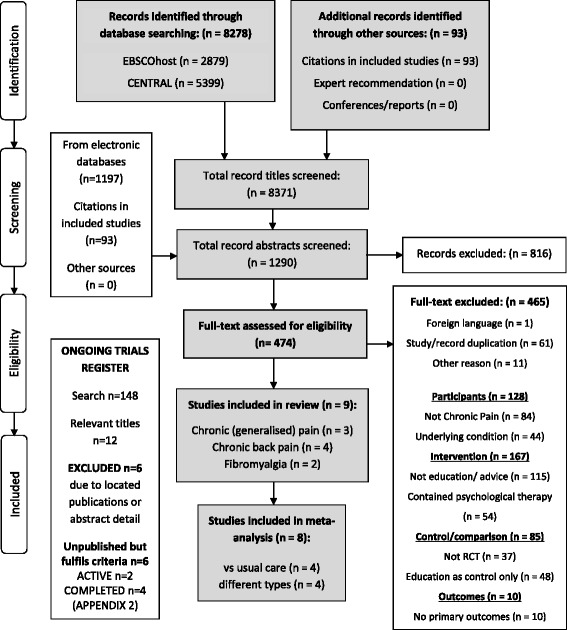
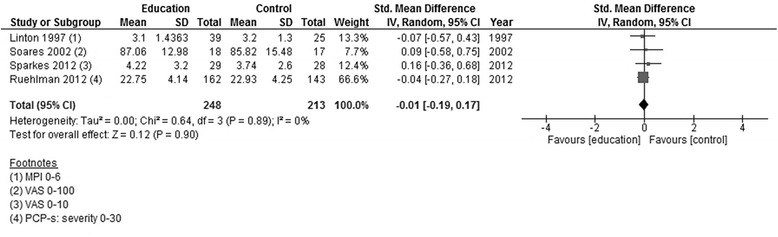
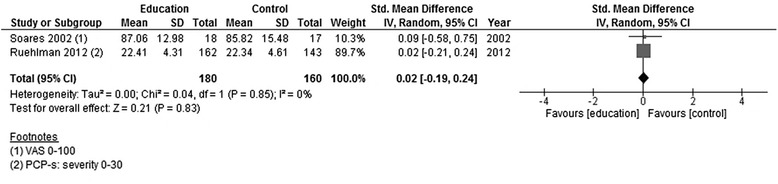
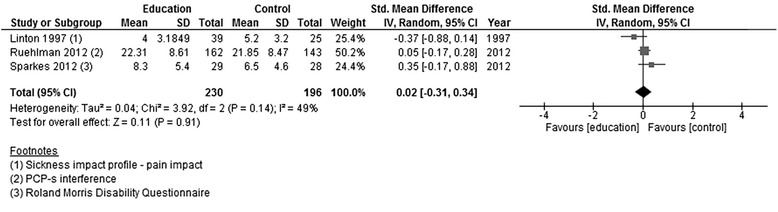





Verification
Claims the paper makes
The claims and statistics of this paper haven’t been checked yet.
Free: it reads the open-access text and checks the first 5 claims that cite a source we can check. Create a free account to check every claim.
Claims other papers make about this one
Each is checked against this paper’s own text: does it say what the citing paper says it does?
The check wasn’t confident either way, so it gives no verdict — never disputed.
In the citing paper
“Evidence shows that the beneficial effects of hypnosis are specific to the suggestion.[27, 61]”
From The chronic pain skills study: Protocol for a randomized controlled trial comparing hypnosis, mindfulness meditation and pain education in Veterans (2020) · cites this paper as [61]
Experimental — accuracy not yet measured
Self-check
Percentages, sums and reported differences re-computed from the paper’s own numbers.
The self-check needs the paper’s full text.
Citations
Cites
1 retracted
Transcutaneous electrical nerve stimulation (TENS) for chronic pain
Nnoaham, K. E., & Kumbang, J. (2008) · Cochrane Database of Systematic Reviews · doi:10.1002/14651858.cd003222.pub2 · Cited by 261
RetractedPreferred Reporting Items for Systematic Reviews and Meta-Analyses: the PRISMA statement
Moher, D., Liberati, A., Tetzlaff, J., Altman, D. G., & for the PRISMA Group (2009) · BMJ · doi:10.1136/bmj.b2535 · Cited by 83,823
Preferred reporting items for systematic reviews and meta-analyses: the PRISMA Statement.
(2009) · PubMed Central · Cited by 44,859
Preferred Reporting Items for Systematic Reviews and Meta-Analyses: The PRISMA Statement
Moher, D., Liberati, A., Tetzlaff, J., & Altman, D. G. (2009) · Journal of Clinical Epidemiology · doi:10.1016/j.jclinepi.2009.06.005 · Cited by 19,575
Survey of chronic pain in Europe: Prevalence, impact on daily life, and treatment
Breivik, H., Collett, B., Ventafridda, V., Cohen, R., & Gallacher, D. (2006) · European Journal of Pain · doi:10.1016/j.ejpain.2005.06.009 · Cited by 5,486 · cited 1×
“anxiety, sleep disturbances, poor quality of life, and increased health care costs, with close to 20 % of the adult population in Europe reporting chronic pain [1].”
BackgroundPsychological therapies for the management of chronic pain (excluding headache) in adults
Williams, A. C. D. C., Eccleston, C., & Morley, S. (2012) · Cochrane Database of Systematic Reviews · doi:10.1002/14651858.cd007407.pub3 · Cited by 1,634
The epidemiology of chronic pain in the community
Elliott, A. M., Smith, B. H., Penny, K. I., Cairns Smith, W., & Alastair Chambers, W. (1999) · The Lancet · doi:10.1016/s0140-6736(99)03057-3 · Cited by 1,208 · cited 1×
“The issues with aging and pain are more complex than simply pain being a direct correlate of biological age, though there does appear to be justification for considering pain in older people as a distinct issue [13–16].”
BackgroundSelf-citationGuidance on the management of pain in older people
(2013) · Age and Ageing · doi:10.1093/ageing/afs200 · Cited by 727 · cited 1×
“The issues with aging and pain are more complex than simply pain being a direct correlate of biological age, though there does appear to be justification for considering pain in older people as a distinct issue [13–16].”
BackgroundSelf-citationLouw, A., Diener, I., Butler, D. S., & Puentedura, E. J. (2011) · Archives of Physical Medicine and Rehabilitation · doi:10.1016/j.apmr.2011.07.198 · Cited by 687 · cited 3×
“Four studies fulfilled both criteria for low risk of bias [28, 32, 33, 35], and one fulfilled one of the two criteria [36].”
BackgroundMethodA Randomized Controlled Trial of Intensive Neurophysiology Education in Chronic Low Back Pain
Moseley, G. L., Nicholas, M. K., & Hodges, P. W. (2004) · The Clinical Journal of Pain · doi:10.1097/00002508-200409000-00007 · Cited by 537 · cited 19×
“Nine studies were included (Ferrell et al. 1997 [17], Gallagher et al. 2013 [18]; Linton et al. 1997 [11], Morrison et al. 1988 [12], Moseley et al. 2004 [19], PAIN INTENSITY Education versus usual care “average pain” Soares 2002; Ruehlman 2013 18 17 35 SMD random 0 0.02 [−0.19, 0.24] 0.21 0.83…”
BackgroundMethodInfluentialBurckhardt, C. S., Mannerkorpi, K., Hedenberg, L., & BJELLE, A. O. (1994) · PubMed · Cited by 393
Ashburn, M. A., & Staats, P. S. (1999) · The Lancet · doi:10.1016/s0140-6736(99)04088-x · Cited by 371
Psychological therapies (Internet-delivered) for the management of chronic pain in adults
Eccleston, C., Fisher, E., Craig, L., Duggan, G. B., Rosser, B. A., & Keogh, E. (2014) · Cochrane Database of Systematic Reviews · doi:10.1002/14651858.cd010152.pub2 · Cited by 271
Dworkin, S. F., Huggins, K. H., Wilson, L., Mancl, L., Turner, J. A., Massoth, D. L., LeResche, L., & Truelove, E. L. (2002) · PubMed · Cited by 260
(1996) · PubMed · Cited by 234
Yoga treatment for chronic non-specific low back pain
Wieland, L. S., Skoetz, N., Pilkington, K., Vempati, R., D'Adamo, C. R., & Berman, B. M. (2017) · Cochrane Database of Systematic Reviews · doi:10.1002/14651858.cd010671.pub2 · Cited by 229
Van Oosterwijck, J., Meeus, M., Paul, L., De Schryver, M., Pascal, A., Lambrecht, L., & Nijs, J. (2013) · The Clinical Journal of Pain · doi:10.1097/ajp.0b013e31827c7a7d · Cited by 212 · cited 3×
“…on statistic used; Random = random effects model; heterogeneity is not applicable (n/a) when reported as single study Geneen et al. Systematic Reviews (2015) 4:132 Page 10 of 21 Ruehlman et al. 2012 [20], Soares et al. 2002 [21], Sparkes et al. 2012 [22] and van Oosterwijck et al. 2013 [23]).”
MethodLeFort, S. M., Gray-Donald, K., Rowat, K. M., & Jeans, M. E. (1998) · Pain · doi:10.1016/s0304-3959(97)00190-5 · Cited by 211 · cited 2×
“…component alone) Harpole et al. 2003 Includes detailed clinical assessment and tailored treatment plan Jerjes et al. 2007 Pilot study, non-randomised LeFort et al. 1998 Uses Stanford Self-management model (multi-disciplinary, unable to assess educational component alone) Matchar et al. 2008…”
BackgroundPain and aging: the emergence of a new subfield of pain research
Gagliese, L. (2009) · The Journal of Pain · doi:10.1016/j.jpain.2008.10.013 · Cited by 187 · cited 1×
“The issues with aging and pain are more complex than simply pain being a direct correlate of biological age, though there does appear to be justification for considering pain in older people as a distinct issue [13–16].”
BackgroundClarke, C. L., Ryan, C. G., & Martin, D. J. (2011) · Manual Therapy · doi:10.1016/j.math.2011.05.003 · Cited by 187 · cited 7×
“Other reviews have been published in the past 5 years examining education for cancer pain [37], PNE for chronic musculoskeletal pain [36], PNE for chronic low back pain [35], education for neck pain [38, 39], educational interventions by pharmacists for chronic pain [40] and knowledge translation for chronic non-cance…”
BackgroundMethodResultInfluentialSelf-citationGallagher, L., McAuley, J., & Moseley, G. L. (2013) · The Clinical Journal of Pain · doi:10.1097/ajp.0b013e3182465cf7 · Cited by 178 · cited 14×
“Nine studies were included (Ferrell et al. 1997 [17], Gallagher et al. 2013 [18]; Linton et al. 1997 [11], Morrison et al. 1988 [12], Moseley et al. 2004 [19], PAIN INTENSITY Education versus usual care “average pain” Soares 2002; Ruehlman 2013 18 17 35 SMD random 0 0.02 [−0.19, 0.24] 0.21 0.83…”
BackgroundMethodInfluentialA randomized controlled evaluation of an online chronic pain self management program
Ruehlman, L. S., Karoly, P., & Enders, C. (2012) · Pain · doi:10.1016/j.pain.2011.10.025 · Cited by 172 · cited 16×
“There was no upper age limit in five studies [12, 17, 19, 20, 22], one of which used a sample that was exclusively over 65 years old [17].”
BackgroundMethodInfluentialMichelotti, A., Iodice, G., Vollaro, S., Steenks, M. H., & Farella, M. (2012) · The Journal of the American Dental Association · doi:10.14219/jada.archive.2012.0018 · Cited by 166 · cited 6×
“Earlier publications [28, 29, 31] did not mention blinding.”
BackgroundMethodInfluentialpainACTION-Back Pain: A Self-Management Website for People with Chronic Back Pain
Chiauzzi, E., Pujol, L. A., Wood, M., Bond, K., Black, R., Yiu, E., & Zacharoff, K. (2010) · Pain Medicine · doi:10.1111/j.1526-4637.2010.00879.x · Cited by 130 · cited 2×
“Ongoing trials were searched using the World Health Organization International Clinical Trials Registry Platform (ICTRP) (http://apps.who.int/trialsearch/) and the metaRegister of Controlled Trials (mRCT) (http:// www.controlledtrials.com/), which includes the ISRCTN Table 2 Excluded studies Author (year) Reason for e…”
BackgroundPatient education for neck pain
Gross, A., Forget, M., St George, K., Fraser, M. M., Graham, N., Perry, L., Burnie, S. J., Goldsmith, C. H., Haines, T., & Brunarski, D. (2012) · Cochrane Database of Systematic Reviews · doi:10.1002/14651858.cd005106.pub4 · Cited by 108
Chronic Disease Self-Management Program for Low Back Pain in the Elderly
Haas, M., Groupp, E., Muench, J., Kraemer, D., Brummel-Smith, K., Sharma, R., Ganger, B., Attwood, M., & Fairweather, A. (2005) · Journal of Manipulative and Physiological Therapeutics · doi:10.1016/j.jmpt.2005.03.010 · Cited by 99 · cited 2×
“…were tailored to patient’s needs”, suggesting psychotherapy in addition to education Dworkin et al. 2002 Involves relaxation and coping skills training Haas et al. 2005 Uses Stanford Self-management model (multi-disciplinary, unable to assess educational component alone) Harpole et al. 2003…”
BackgroundA randomized trial of walking versus physical methods for chronic pain management
Ferrell, B. A., Josephson, K. R., Pollan, A. M., Loy, S. F., & FERRELL, B. R. (1997) · Aging Clinical and Experimental Research · doi:10.1007/bf03340134 · Cited by 88 · cited 3×
“…s (2015) 4:132 Page 4 of 21 Table 1 Characteristics of Included studies (Continued) Author (year) in chronological order Specialty Patient eligibility and recruitment Trial characteristics Participant characteristics Intervention and follow-up periods Outcome measures reported Ferrell et al. 1997.”
BackgroundInfluentialBennett, M. I., Bagnall, A.-M., Raine, G., Closs, S. J., Blenkinsopp, A., Dickman, A., & Ellershaw, J. (2011) · The Clinical Journal of Pain · doi:10.1097/ajp.0b013e31821b6be4 · Cited by 82
Yu, H., Côté, P., Southerst, D., Wong, J. J., Varatharajan, S., Shearer, H. M., Gross, D. P., van der Velde, G., Carroll, L., Mior, S. A., et al. (2014) · The Spine Journal · doi:10.1016/j.spinee.2014.03.039 · Cited by 72 · cited 1×
“Other reviews have been published in the past 5 years examining education for cancer pain [37], PNE for chronic musculoskeletal pain [36], PNE for chronic low back pain [35], education for neck pain [38, 39], educational interventions by pharmacists for chronic pain [40] and knowledge translation for chronic non-cance…”
BackgroundLing, C., Lui, L. Y. Y., & So, W. K. W. (2011) · Journal of Advanced Nursing · doi:10.1111/j.1365-2648.2011.05841.x · Cited by 71 · cited 6×
“Other reviews have been published in the past 5 years examining education for cancer pain [37], PNE for chronic musculoskeletal pain [36], PNE for chronic low back pain [35], education for neck pain [38, 39], educational interventions by pharmacists for chronic pain [40] and knowledge translation for chronic non-cance…”
BackgroundInfluentialSoares, J. J. F., & Grossi, G. (2002) · Scandinavian Journal of Occupational Therapy · doi:10.1080/110381202753505845 · Cited by 50 · cited 12×
“Stockholm (Sweden) Fibromyalgia FM diagnosed in previous 2 years, female, 18–64 years, no other serious illness, no ongoing drug/alcohol abuse, not involved in other therapies.”
BackgroundMethodInfluentialOspina, M. B., Taenzer, P., Rashiq, S., MacDermid, J. C., Carr, E., Chojecki, D., Harstall, C., & Henry, J. L. (2013) · Pain Research and Management · doi:10.1155/2013/120784 · Cited by 48 · cited 2×
“The review of knowledge translations targeting patients showed short-term improvements in patient function with chronic low back pain, but no change in migraine-related complaints [41], suggesting as we have in the inclusion and exclusion criteria of the present review that underlying conditions (such as migraine) sho…”
BackgroundBack pain: treatment and prevention in a community hospital.
Morrison, G. E., Chase, W., Young, & Wl, R. (1988) · PubMed · Cited by 28
Yoga treatment for chronic non-specific low-back pain
Wieland, L. S., Skoetz, N., Manheimer, E., Pilkington, K., Vempati, R., & Berman, B. M. (2013) · Cochrane Database of Systematic Reviews · doi:10.1002/14651858.cd010671 · Cited by 25 · cited 1×
“and low-intensity movement therapy [6, 8]), that level of evidence is less readily available to inform the use of education to facilitate knowledge about chronic pain in adults.”
BackgroundBridging the Gap: Support Groups Do Not Enhance Long-Term Outcome in Chronic Back Pain
Linton, S. J., Hellsing, A.-L., & Larsson, I. (1997) · Clinical Journal of Pain · doi:10.1097/00002508-199709000-00007 · Cited by 23 · cited 15×
“Nine studies were included (Ferrell et al. 1997 [17], Gallagher et al. 2013 [18]; Linton et al. 1997 [11], Morrison et al. 1988 [12], Moseley et al. 2004 [19], PAIN INTENSITY Education versus usual care “average pain” Soares 2002; Ruehlman 2013 18 17 35 SMD random 0 0.02 [−0.19, 0.24] 0.21 0.83…”
BackgroundMethodResultInfluentialvan Ittersum, M. W., van Wilgen, C. P., Groothoff, J. W., & van der Schans, C. P. (2010) · Patient Education and Counseling · doi:10.1016/j.pec.2010.09.006 · Cited by 22 · cited 1×
“…(psychological intervention) and includes a large physiotherapy (exercise) component (multi-disciplinary, unable to assess educational component alone) Van Ittersum et al. 2011 No control group Vlaeyen et al. 1996 Includes physical exercise at the end of each session, therefore, cannot…”
BackgroundChronic Pain in Later Life: A Review of Current Issues and Challenges
Schofield, P., Clarke, A., Jones, D., Martin, D., McNamee, P., & Smith, B. (2011) · Aging Health · doi:10.2217/ahe.11.41 · Cited by 21
Self-citationPsychological therapies (internet delivered) for the management of chronic pain in adults
Eccleston, C., Fisher, E., Craig, L., Duggan, G. B., Rosser, B. A., & Keogh, E. (2012) · Cochrane Database of Systematic Reviews · doi:10.1002/14651858.cd010152 · Cited by 20
Psycho-education programme for temporomandibular disorders: a pilot study
Jerjes, W., Madland, G., Feinmann, C., El Maaytah, M., Kumar, M., Hopper, C., Upile, T., & Newman, S. (2007) · Journal of Negative Results in BioMedicine · doi:10.1186/1477-5751-6-4 · Cited by 17
de Andrade, S. C., de Araújo, A. G. R., & Vilar, M. J. P. (2009) · PubMed · Cited by 15
Dirmaier, J., Härter, M., & Weymann, N. (2013) · BMC Medical Informatics and Decision Making · doi:10.1186/1472-6947-13-66 · Cited by 15 · cited 1×
“…to “a contract for individual behaviour change”, suggesting CBT/BT Chiauzzi et al. 2010 Second main component of website “CBT to improve self-efficacy” Dirmaier et al. 2013 Protocol only Dush et al. 2006 Mentions “psychotherapy components were tailored to patient’s needs”, suggesting…”
BackgroundSparkes, V., Chidwick, N., & Coales, P. (2012) · International Journal of Therapy and Rehabilitation · doi:10.12968/ijtr.2012.19.2.79 · Cited by 13 · cited 15×
“There was no upper age limit in five studies [12, 17, 19, 20, 22], one of which used a sample that was exclusively over 65 years old [17].”
BackgroundMethodInfluentialUntitled work
Moher (2009) · doi:10.1371/journal.pmed1000097
Research works printed but not linked: 5
- 7. Review Manager (RevMan). [Computer program]. Version 5.3. Copenhagen: The Nordic Cochrane Centre, The Cochrane Collaboration; 2014.
- 8. Higgins J, Green S. The Cochrane Handbook for Systematic Reviews of Interventions. Version 5.1.0 edition. The Cochrane Collaboration, 2011; 2011.
- 21. Van Oosterwijck J, Meeus M, Paul L, et al. Pain physiology education improves health status and endogenous pain inhibition in fibromyalgia. Clin. 2013;29(10):873-82.
- 28. Dush D. Effectiveness of home-study extended patient education for chronic pain. Am J Pain Manag. 2006;16(1):5-11.
- 40. Andrade SC, Araújo AGR, Vilar MJ. Escola de coluna para pacientes com lombalgia cronica inespecifica: Beneficios da associacao de exercicios e educacao ao paciente. Acta Reumatol Port. 2008;33:443-50.
Cited by
Watson, J. A., Ryan, C. G., Cooper, L., Ellington, D., Whittle, R., Lavender, M., Dixon, J., Atkinson, G., Cooper, K., & Martin, D. J. (2019) · The Journal of Pain · doi:10.1016/j.jpain.2019.02.011 · Cited by 428
Self-citationPatient Education and Health Literacy
Wittink, H., & Oosterhaven, J. (2018) · Musculoskeletal Science and Practice · doi:10.1016/j.msksp.2018.06.004 · Cited by 267
Wood, L., & Hendrick, P. A. (2019) · European Journal of Pain · doi:10.1002/ejp.1314 · Cited by 257
Reframing chronic pain as a disease, not a symptom: rationale and implications for pain management
Clauw, D. J., Essex, M. N., Pitman, V., & Jones, K. D. (2019) · Postgraduate Medicine · doi:10.1080/00325481.2019.1574403 · Cited by 256
Multi-disciplinary interventions for chronic pain involving education: a systematic review
Joypaul, S., Kelly, F., McMillan, S. S., & King, M. A. (2019) · PLOS ONE · doi:10.1371/journal.pone.0223306 · Cited by 119
“More recent meta-analyses were restricted to small numbers of included papers and the investigation of education as a solitary intervention rather than as part of MD programs [31, 32].”
Background
Metadata
- Authors
- Geneen, L. J., Martin, D. J., Adams, N., Clarke, C., Dunbar, M., Jones, D., McNamee, P., Schofield, P., & Smith, B. H.
- Affiliations
- University of Dundee (GB)
- Teesside University (GB)
- Northumbria University (GB)
- University of Glasgow (GB)
- University of Aberdeen (GB)
- University of Greenwich (GB)
- Corresponding author
- Geneen, Louise J.
- Venue
- Systematic Reviews
- Published
- 2015-10-01
- Volume
- 4
- Issue
- 1
- Pages
- 132-132
- ISSN
- 2046-4053 (ISSN-L)
- PMC
- PMC4591560
- OpenAlex
- W2113885172
- Cited by
- 129
- References
- 43
- Citations by year
- 2026: 8 · 2025: 10 · 2024: 20 · 2023: 14 · 2022: 5 · 2021: 14 · 2020: 21 · 2019: 16 · 2018: 13 · 2017: 5 · 2016: 3
- FWCI
- 0.88
- Type
- journal article
- Language
- en
- Open access
- gold
- doi.org
- Licence
- Locations
- Systematic Reviews (publishedVersion, cc-by)
- Europe PMC (PubMed Central) (publishedVersion, cc-by)
- PubMed Central (publishedVersion, cc-by)
- PubMed (publishedVersion)
- Discovery Research Portal (University of Dundee) (publishedVersion, cc-by)
- Northumbria Research Link (Northumbria University) (acceptedVersion)
- SHURA (Sheffield Hallam University Research Archive) (Sheffield Hallam University) (acceptedVersion)
- Anglia Ruskin Research Online (Anglia Ruskin University) (submittedVersion)
- Aberdeen University Research Archive (Aberdeen University) (submittedVersion)
- Teesside University Research Portal (Teesside University) (submittedVersion, cc-by-nc-nd)
- Figshare (submittedVersion, cc-by)
- Edinburgh Research Explorer (University of Edinburgh) (submittedVersion, cc-by)
- Funders
- Medical Research Council
- Topics
- Health Sciences › Health Professions › Physical Therapy, Sports Therapy and Rehabilitation › Musculoskeletal pain and rehabilitation
- Health Sciences › Medicine › Anesthesiology and Pain Medicine › Pain Management and Treatment
- Health Sciences › Medicine › Pediatrics, Perinatology and Child Health › Pediatric Pain Management Techniques
- Keywords
- chronic pain, patient education, pain knowledge, pain catastrophizing, disability, pain self-management, psychosocial outcomes, pain intensity
- MeSH terms
- Adult, Disability Evaluation, Humans, Health Knowledge, Attitudes, Practice, Patient Education as Topic, Self Care, Treatment Outcome, Catastrophization, Chronic Pain, Pain Management
About these checks
Registry, retraction, Cites and statistics results are computed, not judged, with one exception: a printed reference that no index lists is read once by a model before it counts as a citation error. Claims are extracted by a model and kept only when their quote appears verbatim in the text; each cited source is then checked, with a model’s help, for whether it says what the claim relies on. Those verdicts can be wrong — read the claim’s quote and the cited source before relying on one.
Statistics and arithmetic are recomputed, not judged.
Confidence bands are shown only for fields calibrated on our annotated test set. None is calibrated yet, so no band is shown.
What counts as a claim ›How we measure confidence ›How we check this ›
Are you an author, or do you see a problem with this page? Request a review
Data sources
Bibliographic data: Semantic Scholar, OpenAlex, Crossref.
Contains information from the Semantic Scholar Academic Graph Datasets, made available under the ODC Attribution License (ODC-BY 1.0).
Semantic Scholar’s data is described in: Kinney, R., et al. (2023). The Semantic Scholar Open Data Platform. arXiv:2301.10140.
