

How to update a living systematic review and keep it alive during a pandemic: a practical guide
Open accessPublished version of a preprint
The DOI matches its Crossref record; 39 of the 39 references it cites were found in a registry or an index.
Abstract
Background: The covid-19 pandemic has highlighted the role of living systematic reviews. The speed of evidence generated during the covid-19 pandemic accentuated the challenges of managing high volumes of research literature. Methods: In this article, we summarise the characteristics of ongoing living systematic reviews on covid-19, and we follow a life cycle approach to describe key steps in a living systematic review. Results: We identified 97 living systematic reviews on covid-19, published up to 7th November 2022, which focused mostly on the effects of pharmacological interventions ( n = 46, 47%) or the prevalence of associated conditions or risk factors ( n = 30, 31%). The scopes of several reviews overlapped considerably. Most living systematic reviews included both observational and randomised study designs ( n = 45, 46%). Only one-third of the reviews has been updated at least once ( n = 34, 35%). We address practical aspects of living systematic reviews including how to judge whether to start a living systematic review, methods for study identification and selection, data extraction and evaluation, and give recommendations at each step, drawing from our own experience. We also discuss when it is time to stop and how to publish updates. Conclusions: Methods to improve the efficiency of searching, study selection, and data extraction using machine learning technologies are being developed, their performance and applicability, particularly for reviews based on observational study designs should improve, and ways of publishing living systematic reviews and their updates will continue to evolve. Finally, knowing when to end a living systematic review is as important as knowing when to start.
Overview
The claims and statistics of this paper haven’t been checked yet.
Free: it reads the open-access text and checks the first 5 claims that cite a source we can check. Create a free account to check every claim.
Integrity signals
Registry
Cites
Statistics
Figures
Verification
Claims the paper makes
The claims and statistics of this paper haven’t been checked yet.
Free: it reads the open-access text and checks the first 5 claims that cite a source we can check. Create a free account to check every claim.
Claims other papers make about this one
Each is checked against this paper’s own text: does it say what the citing paper says it does?
The source backs part of the claim, not all of it — or backs it for a different population, condition or comparison.
In the citing paper
“We acknowledge that LSRs face major challenges beyond adequate reporting, including the vast workload needed to maintain an LSR, 7 19 as well as the publication platforms not being fit for purpose.”
From Extension of the PRISMA 2020 statement for living systematic reviews (PRISMA-LSR): checklist and explanation (2024) · cites this paper as [7]
Experimental — accuracy not yet measuredThe check wasn’t confident either way, so it gives no verdict — never disputed.
In the citing paper
“Methodological studies have found variability in the reporting of some aspects of LSRs (eg, study flow diagrams 13 ), and the absence of important information (eg, whether the LSR has been retired from a living mode 7 14 ).”
From Extension of the PRISMA 2020 statement for living systematic reviews (PRISMA-LSR): checklist and explanation (2024) · cites this paper as [7]
Experimental — accuracy not yet measured
Self-check
Percentages, sums and reported differences re-computed from the paper’s own numbers.
The self-check needs the paper’s full text.
Citations
Cites
The PRISMA 2020 statement: An updated guideline for reporting systematic reviews
Page, M. J., McKenzie, J. E., Bossuyt, P. M., Boutron, I., Hoffmann, T. C., Mulrow, C. D., Shamseer, L., Tetzlaff, J. M., Akl, E. A., Brennan, S. E., et al. (2021) · BMJ · doi:10.1136/bmj.n71 · Cited by 108,283
Harris, P. A., Taylor, R., Thielke, R., Payne, J., Gonzalez, N., & Conde, J. G. (2009) · Journal of Biomedical Informatics · doi:10.1016/j.jbi.2008.08.010 · Cited by 51,384
Wynants, L., Van Calster, B., Bonten, M. M., Collins, G. S., Debray, T. P., De Vos, M., Haller, M. C., Heinze, G., Moons, K. G., Riley, R. D., et al. (2020) · doi:10.1101/2020.03.24.20041020 · Cited by 3,070 · cited 7×
“Wynants et al. built a custom classification model to speed up the selection process in their living systematic review of prognostic models for covid-19 [8].”
BackgroundMethodInfluentialInterpretation of random effects meta-analyses
Riley, R. D., Higgins, J. P. T., & Deeks, J. J. (2011) · BMJ · doi:10.1136/bmj.d549 · Cited by 2,884 · cited 1×
“Instead, we reported an interquartile range for the results from included studies and estimated a prediction interval [44] to show the range of values in a future hypothetical study.”
BackgroundAllotey, J., Fernandez, S., Bonet, M., Stallings, E., Yap, M., Kew, T., Zhou, D., Coomar, D., Sheikh, J., Lawson, H., et al. (2020) · BMJ · doi:10.1136/bmj.m3320 · Cited by 2,304 · cited 3×
“…and the scale of the workload, reviewers should make sure that their living systematic review question has not already been addressed, or is being addressed, by searching the published literature, systematic review registries, such as the PROSPERO international register of systematic reviews [3–5,”
BackgroundMethodBuitrago-Garcia, D., Egli-Gany, D., Counotte, M. J., Hossmann, S., Imeri, H., Ipekci, A. M., Salanti, G., & Low, N. (2020) · PLOS Medicine · doi:10.1371/journal.pmed.1003346 · Cited by 1,000 · cited 1×
“In our case study (Table 2), we have published both preprints [24, 47] and peer-reviewed articles [10, 48].”
Self-citationDrug treatments for covid-19: living systematic review and network meta-analysis
Siemieniuk, R. A., Bartoszko, J. J., Zeraatkar, D., Kum, E., Qasim, A., Díaz Martinez, J. P., Izcovich, A., Rochwerg, B., Lamontagne, F., Han, M. A., et al. (2020) · BMJ · doi:10.1136/bmj.m2980 · Cited by 846 · cited 7×
“…review and living guidelines teams who maintain dedicated websites can display updated results as soon as they are incorporated and include links to articles, protocols, and datasets using FAIR principles (findability, accessibility, interoperability, and reuse of digital assets) [3–6, 8, 10, 22].”
BackgroundMethodInfluentialLiving systematic review: 1. Introduction-the why, what, when, and how
Elliott, J. H., Synnot, A., Turner, T., Simmonds, M., Akl, E. A., McDonald, S., Salanti, G., Meerpohl, J., MacLehose, H., Hilton, J., et al. (2017) · Journal of Clinical Epidemiology · doi:10.1016/j.jclinepi.2017.08.010 · Cited by 655 · cited 7×
“A protocol for a living systematic review is also a living document, which should reduce potential biases and avoid posthoc decisions [1, 18, 30].”
BackgroundMethodInfluentialSelf-citationHarrison, H., Griffin, S. J., Kuhn, I., & Usher-Smith, J. A. (2020) · BMC Medical Research Methodology · doi:10.1186/s12874-020-0897-3 · Cited by 449
When and how to update systematic reviews: consensus and checklist
Garner, P., Hopewell, S., Chandler, J., MacLehose, H., Schünemann, H. J., Akl, E. A., Beyene, J., Chang, S., Churchill, R., Dearness, K., et al. (2016) · BMJ · doi:10.1136/bmj.i3507 · Cited by 426 · cited 1×
“Researchers are advised to take a living approach when the topic is a priority for decision-making, new evidence is emerging and changing quickly, and certainty in the existing evidence is low [1, 2].”
BackgroundLiving systematic reviews: 2. Combining human and machine effort
Thomas, J., Noel-Storr, A., Marshall, I., Wallace, B., McDonald, S., Mavergames, C., Glasziou, P., Shemilt, I., Synnot, A., Turner, T., et al. (2017) · Journal of Clinical Epidemiology · doi:10.1016/j.jclinepi.2017.08.011 · Cited by 355 · cited 2×
“Crowdsourcing is a valuable tool for large reviews [17] and can be mutually beneficial for the volunteers [28], but the core team must weigh up the time spent training volunteers against the time saved.”
BackgroundSelf-citationAllen, L., O’Connell, A., & Kiermer, V. (2019) · Learned Publishing · doi:10.1002/leap.1210 · Cited by 310
revtools: An R package to support article screening for evidence synthesis
Westgate, M. J. (2019) · Research Synthesis Methods · doi:10.1002/jrsm.1374 · Cited by 261 · cited 1×
“The open-source R package revtools [37] support the screening of titles and abstracts and deduplication.”
MethodAsymptomatic SARS-CoV-2 infections: a living systematic review and meta-analysisPreprint
Buitrago‐García, D., Egli-Gany, D., Counotte, M. J., et al. (2020) · medRxiv · doi:10.1101/2020.04.25.20079103 · Cited by 194 · cited 2×
“Over the seven versions of the protocol for our review of asymptomatic SARS-CoV-2, the scope has narrowed over time [27].”
BackgroundSelf-citationInterleukin-6 blocking agents for treating COVID-19: a living systematic review
Ghosn, L., Chaimani, A., Evrenoglou, T., Davidson, M., Graña, C., Schmucker, C., Bollig, C., Henschke, N., Sguassero, Y., Nejstgaard, C. H., et al. (2021) · Cochrane Database of Systematic Reviews · doi:10.1002/14651858.cd013881 · Cited by 181 · cited 6×
“Cochrane reviews have indexed updates for many years and assign a DOI that incorporates the same review number for all updates and includes an extension with the update number [4].”
BackgroundMethodInfluentialLiving systematic reviews: 3. Statistical methods for updating meta-analyses
Simmonds, M. C., Salanti, G., McKenzie, J. E., Elliott, J., Agoritsas, T., Hilton, J., Perron, C., Akl, E. A., Hodder, R. K., Pestridge, C., et al. (2017) · Journal of Clinical Epidemiology · doi:10.1016/j.jclinepi.2017.08.008 · Cited by 163 · cited 3×
“Guidance about methods for several aspects of the conduct, reporting, and publication of living systematic reviews is available [1, 16–19] or in development [20, 21].”
MethodSelf-citationChou, R., Dana, T., Jungbauer, R., Weeks, C., & McDonagh, M. S. (2020) · Annals of Internal Medicine · doi:10.7326/m20-3213 · Cited by 156
Decision makers need constantly updated evidence synthesis
Elliott, J., Lawrence, R. N., Minx, J. C., Oladapo, O. T., Ravaud, P., Jeppesen, B. T., Thomas, J., Turner, T., Vandvik, P. O., & Grimshaw, J. (2021) · Nature · doi:10.1038/d41586-021-03690-1 · Cited by 147 · cited 3×
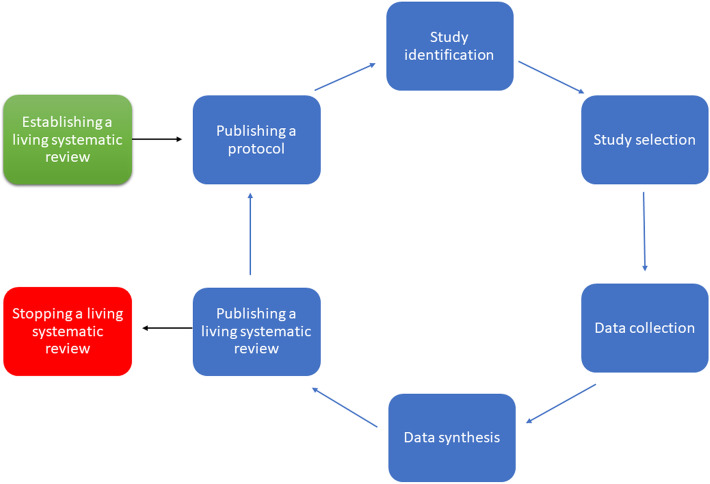
“These challenges include needs for the urgent decision-making [22]; managing high volumes of research, especially on observational study designs; and judging whether to start a living systematic review, when it is time to stop, and how to publish updates [23].”
BackgroundData extraction methods for systematic review (semi)automation: a living systematic review
Schmidt, L., Olorisade, B. K., McGuinness, L. A., Thomas, J., & Higgins, J. P. T. (2021) · F1000Research · doi:10.12688/f1000research.51117.1 · Cited by 106
Hamel, C., Hersi, M., Kelly, S. E., Tricco, A. C., Straus, S., Wells, G., Pham, B., & Hutton, B. (2021) · BMC Medical Research Methodology · doi:10.1186/s12874-021-01451-2 · Cited by 104
Korang, S. K., von Rohden, E., Veroniki, A. A., Ong, G., Ngalamika, O., Siddiqui, F., Juul, S., Nielsen, E. E., Feinberg, J. B., Petersen, J. J., et al. (2022) · PLOS ONE · doi:10.1371/journal.pone.0260733 · Cited by 95
(2022) · doi:10.1371/journal.pmed.1003987 · Cited by 81
Self-citationPandor, A., Kaltenthaler, E., Martyn-St James, M., Wong, R., Cooper, K., Dimairo, M., O'Cathain, A., Campbell, F., & Booth, A. (2019) · Journal of Clinical Epidemiology · doi:10.1016/j.jclinepi.2019.06.005 · Cited by 72 · cited 2×
“In these living systematic reviews, distinctions between approaches recommended for rapid reviews [13] and standard systematic reviews [1], which living systematic reviews are supposed to follow, are also becoming blurred.”
BackgroundMethodSearch strategies to identify observational studies in MEDLINE and Embase
Li, L., Smith, H. E., Atun, R. A., & Car, L. T. (2019) · Cochrane Database of Systematic Reviews · doi:10.1002/14651858.mr000041.pub2 · Cited by 71 · cited 1×
“Indexing and reporting of observational study designs are less consistent, and authors may use different terms to describe the same approach [26].”
BackgroundHoffmann, F., Eggers, D., Pieper, D., Zeeb, H., & Allers, K. (2020) · Journal of Clinical Epidemiology · doi:10.1016/j.jclinepi.2019.12.003 · Cited by 56 · cited 1×
“A substantial proportion of living systematic reviews rely on observational studies (Table 1), in which levels of between heterogeneity are often high [43], and for which meta-analysis might not be appropriate.”
BackgroundContinuously updated network meta-analysis and statistical monitoring for timely decision-making
Nikolakopoulou, A., Mavridis, D., Egger, M., & Salanti, G. (2018) · Statistical Methods in Medical Research · doi:10.1177/0962280216659896 · Cited by 50 · cited 1×
“However, reviewers can employ methods that control the type I error if they want [16, 42].”
MethodSelf-citationKahale, L. A., Elkhoury, R., El Mikati, I., Pardo-Hernandez, H., Khamis, A. M., Schünemann, H. J., Haddaway, N. R., & Akl, E. A. (2022) · F1000Research · doi:10.12688/f1000research.51723.3 · Cited by 48
Iannizzi, C., Dorando, E., Burns, J., Weibel, S., Dooley, C., Wakeford, H., Estcourt, L. J., Skoetz, N., & Piechotta, V. (2022) · Journal of Clinical Epidemiology · doi:10.1016/j.jclinepi.2021.09.013 · Cited by 45 · cited 2×
“Guidance about methods for several aspects of the conduct, reporting, and publication of living systematic reviews is available [1, 16–19] or in development [20, 21].”
BackgroundMethodBoutron, I., Chaimani, A., Devane, D., Meerpohl, J. J., Rada, G., Hróbjartsson, A., Tovey, D., Grasselli, G., & Ravaud, P. (2020) · Cochrane Database of Systematic Reviews · doi:10.1002/14651858.cd013769 · Cited by 41 · cited 2×
“Some review teams have anticipated the workload and used crowdsourcing from the outset, increasing the size of the team to more than 100 volunteers to help with screening and data extraction [3], and other reviews mention the use of volunteers [4, 7].”
BackgroundMethodLiving systematic reviews at The BMJ
Macdonald, H., Loder, E., & Abbasi, K. (2020) · BMJ · doi:10.1136/bmj.m2925 · Cited by 35
Methods for developing and reporting living evidence synthesis
Bendersky, J., Auladell-Rispau, A., Urrútia, G., & Rojas, M. X. (2022) · Journal of Clinical Epidemiology · doi:10.1016/j.jclinepi.2022.09.020 · Cited by 34 · cited 1×
“Guidance about methods for several aspects of the conduct, reporting, and publication of living systematic reviews is available [1, 16–19] or in development [20, 21].”
MethodPRISMA flow diagrams for living systematic reviews: a methodological survey and a proposal
Kahale, L. A., Elkhoury, R., El Mikati, I., Pardo-Hernandez, H., Khamis, A. M., Schünemann, H. J., Haddaway, N. R., & Akl, E. A. (2021) · F1000Research · doi:10.12688/f1000research.51723.1 · Cited by 33 · cited 1×
“For reporting the results of searching, selection, and inclusion, a specific flow chart for living systematic reviews allows a logical way of updating [39].”
BackgroundA systematic review that is ``rapid'' and ``living'': A specific answer to the COVID-19 pandemic
Négrini, S., Ceravolo, M. G., Côté, P., & Arienti, C. (2021) · Journal of Clinical Epidemiology · doi:10.1016/j.jclinepi.2021.05.025 · Cited by 27
Extension of the PRISMA 2020 statement for living systematic reviews (LSRs): protocol
Kahale, L. A., Piechotta, V., McKenzie, J. E., Dorando, E., Iannizzi, C., Barker, J. M., Page, M. J., Skoetz, N., & Akl, E. A. (2022) · F1000Research · doi:10.12688/f1000research.75449.1 · Cited by 24
Keeping Up With Emerging Evidence in (Almost) Real Time
Laine, C. M., Taichman, D. B., Güallar, E., & Mulrow, C. D. (2020) · Annals of Internal Medicine · doi:10.7326/m20-2627 · Cited by 21 · cited 1×
“The Annals of Internal Medicine uses a similar approach, with minor updates published as letters [14, 46].”
MethodAn efficient way to assess the effect of COVID-19 on mental health in the general population
Salanti, G., Cipriani, A., Furukawa, T. A., Peter, N. L., Tonia, T., Papakonstantinou, T., Holloway, A., & Leucht, S. (2021) · The Lancet Psychiatry · doi:10.1016/s2215-0366(21)00067-5 · Cited by 17 · cited 10×
“We also draw on covid-19-related living systematic reviews on changes in mental health in the general population, SARS-CoV-2 diagnostics, epidemiology of covid-19 in pregnancy, and effectiveness of treatments and vaccines, which cover a variety of methods used to conduct and manage reviews [3–10].”
BackgroundMethodInfluentialSelf-citationOutbreaks of publications about emerging infectious diseases: the case of SARS-CoV-2 and Zika virus
Ipekci, A. M., Buitrago-Garcia, D., Meili, K. W., Krauer, F., Prajapati, N., Thapa, S., Wildisen, L., Araujo-Chaveron, L., Baumann, L., Shah, S., et al. (2021) · BMC Medical Research Methodology · doi:10.1186/s12874-021-01244-7 · Cited by 16 · cited 1×
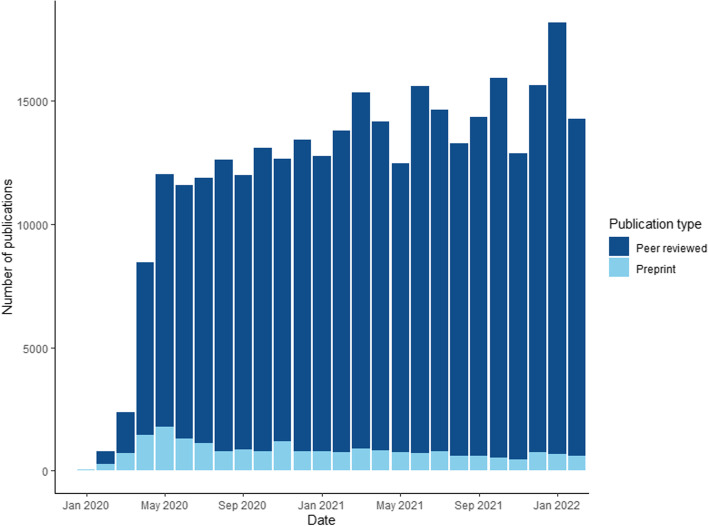
“Types of publication have changed over time [12], and the evidence itself is changing, for example, as new viral variants arise and new vaccines and treatments are developed.”
BackgroundSelf-citation(2022) · doi:10.1101/2022.01.20.22269581 · Cited by 13
Self-citationLee, C., Thomas, M., Ejaredar, M., Kassam, A., Whittle, S., Buchbinder, R., Tugwell, P., Wells, G. A., Pardo, J. P., & Hazlewood, G. S. (2022) · Journal of Clinical Epidemiology · doi:10.1016/j.jclinepi.2022.03.019 · Cited by 11 · cited 1×
“Crowdsourcing is a valuable tool for large reviews [17] and can be mutually beneficial for the volunteers [28], but the core team must weigh up the time spent training volunteers against the time saved.”
Background
Research works printed but not linked: 1
- Covidence systematic review software. www.covidence.org. Accessed 25 Nov 2022.
Cited by
Villacampa, G. J., Navarro, V., Matikas, A., Ribeiro, J. M., Schettini, F., Tolosa, P., Martínez‐Sáez, O., Sánchez-Bayona, R., Ferrero-Cafiero, J. M., Salvador, F., et al. (2024) · JAMA Oncology · doi:10.1001/jamaoncol.2024.3456 · Cited by 101
Berkhout, W. E. M., van Wijngaarden, J. J., Workum, J. D., van de Sande, D., Hilling, D. E., Jung, C., Meyfroidt, G., Gommers, D., Buijsman, S. N. R., & van Genderen, M. E. (2025) · JAMA Network Open · doi:10.1001/jamanetworkopen.2025.22866 · Cited by 75
Akl, E. A., Khabsa, J., Iannizzi, C., Piechotta, V., Kahale, L. A., Barker, J. M., McKenzie, J. E., Page, M. J., & Skoetz, N. (2024) · BMJ · doi:10.1136/bmj-2024-079183 · Cited by 103
“Furthermore, they could ensure easy access to the most recent version of the LSR, earlier versions, and track changes between versions.”
InfluentialSmith, L. C. (2023) · Journal of the Association for Information Science and Technology · doi:10.1002/asi.24851 · Cited by 22
“Heron et al. (2023) address practical aspects of developing living systematic reviews, with recommendations at each step drawing from their own experience.”
BackgroundLópez‐Alcalde, J., Wieland, L. S., Barth, J., Grainger, R., Baxter, N. N., Heron, N., Triantafyllidis, A. K., Carrión, C., Trecca, E. M. C., Holl, F., et al. (2024) · International Journal of Medical Informatics · doi:10.1016/j.ijmedinf.2024.105345 · Cited by 10
“Lessons learned during the COVID-19 pandemic for updating living SRs may be applicable to mHealth living SRs [27].”
Background
Metadata
- Authors
- Heron, L., Buitrago-Garcia, D., Ipekci, A. M., Baumann, R., Imeri, H., Salanti, G., Counotte, M. J., & Low, N.
- Affiliations
- University of Bern (CH)
- Wageningen University & Research (NL)
- Corresponding author
- Low, Nicola
- ORCID
- Venue
- Systematic Reviews
- Published
- 2023-09-02
- Volume
- 12
- Issue
- 1
- Pages
- 156-156
- ISSN
- 2046-4053 (ISSN-L)
- PMC
- PMC10474670
- OpenAlex
- W4386387294
- Semantic Scholar
- 97920eac3d2ad0471f4c64de98ad9a19739b87e5
- Cited by
- 26
- References
- 39
- Citations by year
- 2026: 4 · 2025: 13 · 2024: 7 · 2023: 2
- FWCI
- 1.84
- Type
- journal article
- Language
- en
- Open access
- gold
- doi.org
- Licence
- cc-by
- creativecommons.org/licenses/by/4.0 (tdm)
- creativecommons.org/licenses/by/4.0 (vor)
- Locations
- Systematic Reviews (publishedVersion, cc-by)
- PubMed Central (publishedVersion, cc-by)
- PubMed (publishedVersion)
- Socio-Environmental Systems Modeling (submittedVersion, cc-by)
- DOAJ (DOAJ: Directory of Open Access Journals) (submittedVersion, cc-by-sa)
- Funders
- Schweizerischer Nationalfonds zur Förderung der Wissenschaftlichen Forschung (176233, National Research Programme 78 COVID-19 (grant number 198418))
- HORIZON EUROPE Framework Programme (101003688)
- Topics
- Social Sciences › Decision Sciences › Statistics, Probability and Uncertainty › Meta-analysis and systematic reviews
- Social Sciences › Library and Information Sciences › Academic Publishing and Open Access
- Health Sciences › Medicine › Public Health, Environmental and Occupational Health › Clinical practice guidelines implementation
- Keywords
- living systematic review, COVID-19 pandemic, data extraction, observational studies, randomised trials
- MeSH terms
- Machine Learning, Systematic Reviews as Topic, COVID-19, Humans, Research Design, Risk Factors, Pandemics, Observational Studies as Topic
About these checks
Registry, retraction, Cites and statistics results are computed, not judged, with one exception: a printed reference that no index lists is read once by a model before it counts as a citation error. Claims are extracted by a model and kept only when their quote appears verbatim in the text; each cited source is then checked, with a model’s help, for whether it says what the claim relies on. Those verdicts can be wrong — read the claim’s quote and the cited source before relying on one.
Statistics and arithmetic are recomputed, not judged.
Confidence bands are shown only for fields calibrated on our annotated test set. None is calibrated yet, so no band is shown.
What counts as a claim ›How we measure confidence ›How we check this ›
Are you an author, or do you see a problem with this page? Request a review
Data sources
Bibliographic data: Semantic Scholar, OpenAlex, Crossref.
Contains information from the Semantic Scholar Academic Graph Datasets, made available under the ODC Attribution License (ODC-BY 1.0).
Semantic Scholar’s data is described in: Kinney, R., et al. (2023). The Semantic Scholar Open Data Platform. arXiv:2301.10140.
