

Mindfulness-based treatment of addiction: current state of the field and envisioning the next wave of research
Open accessThe DOI matches its Crossref record; 89 of the 91 references it cites were found in a registry or an index; 18 of the 105 sources its claims cite were checked for support.
Abstract
Contemporary advances in addiction neuroscience have paralleled increasing interest in the ancient mental training practice of mindfulness meditation as a potential therapy for addiction. In the past decade, mindfulness-based interventions (MBIs) have been studied as a treatment for an array addictive behaviors, including drinking, smoking, opioid misuse, and use of illicit substances like cocaine and heroin. This article reviews current research evaluating MBIs as a treatment for addiction, with a focus on findings pertaining to clinical outcomes and biobehavioral mechanisms. Studies indicate that MBIs reduce substance misuse and craving by modulating cognitive, affective, and psychophysiological processes integral to self-regulation and reward processing. This integrative review provides the basis for manifold recommendations regarding the next wave of research needed to firmly establish the efficacy of MBIs and elucidate the mechanistic pathways by which these therapies ameliorate addiction. Issues pertaining to MBI treatment optimization and sequencing, dissemination and implementation, dose-response relationships, and research rigor and reproducibility are discussed.
Overview
CoChat Summary
TL;DR
This integrative review concludes that mindfulness-based interventions (MBIs) are promising treatments for addiction, reducing substance misuse and craving by modulating cognitive, affective, and psychophysiological self-regulation and reward processes. It also outlines a next-wave research agenda focused on rigor, mechanisms, treatment sequencing, dose–response, dissemination, and mindfulness as a long-term recovery lifestyle.
Key findings
- In the only published meta-analysis solely focused on MBIs for substance misuse, Li et al. identified 34 randomized controlled trials and concluded that “virtually all studies found that mindfulness treatments were associated with superior treatment outcomes at posttreatment and follow-up assessments compared to comparison conditions.” Pooled effects ranged from moderate to large: substance use d = 0.33, cigarette smoking OR = 1.76 (p = 0.056), craving d = 0.68 (p < 0.01), and stress d = 1.12 (p < 0.05).
- MBIs increased Five Factor Mindfulness Questionnaire scores in all eight studies using that measure (d = 0.62, p = 0.057), and individual studies reported increases in emotion regulation, substance-related self-efficacy, and positive emotions, plus decreases in attentional bias, addictive automaticity, dysphoric affect, and pain severity/interference.
- Subgroup analyses indicated that MORE was associated with larger effects than other MBIs for substance use, craving, stress, and mindfulness measures; studies comprised entirely of men also reported larger effects for MBIs across craving, stress, and mindfulness measures.
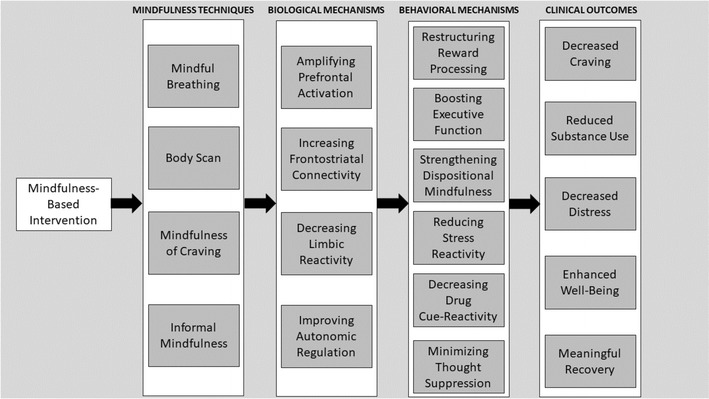
- Mechanistic evidence reviewed includes MBI-related reductions in cue-reactivity and craving, increased heart rate variability and stress recovery, altered reward-circuit responses to natural versus drug cues, and mediation of outcomes by increases in dispositional mindfulness.
Methods
- Design: integrative/narrative review of current research on MBIs as addiction treatment, with a focus on clinical outcomes and biobehavioral mechanisms.
- Data: synthesized prior systematic reviews, meta-analyses, and randomized controlled trials, including Li et al.’s meta-analysis of 34 RCTs and studies of MBRP, MORE, mindfulness training for smokers, and related interventions.
- Analysis: qualitative synthesis of clinical and mechanistic findings; no new primary data are reported, and pooled effect sizes are drawn from the cited meta-analysis.
Limitations
- Stated in the paper: few psychophysiological and neuroimaging studies of MBIs for addiction exist, so little data support or refute proposed neural mechanistic models; little is known about neurobiological mechanisms, mediators, and moderators; few long-term follow-ups assess durability; many studies have small samples; and dissemination/implementation questions remain unresolved.
- Stated in the paper: the Li et al. meta-analysis did not include a formal search for gray literature, though funnel plots and Egger’s test suggested findings were not likely due to publication bias.
- Evident from the text: as an integrative review, this paper does not report a systematic search strategy, inclusion/exclusion criteria, or formal risk-of-bias assessment for the literature it summarizes.
Model-written summary. Check it against the paper before relying on it.
Integrity signals
Registry
Cites
Statistics
Figures
Verification
Claims the paper makes
13 Valid · 2 Not valid · 66 Not checked · 29 Own results and interpretations
Every source the paper cites for this claim was checked and supports it.
In the paper
“increases in the trajectory of state mindfulness produced over time through meditation predicts increases in trait mindfulness [11]”
§ Mindfulness-based treatment of addiction: current state of the field and envisioning the next wave of research > Mindfulness as a means of targeting mechanisms of addiction > Mindfulness operationalized
What the sources say
- Supportedcites [11] Kiken LG Garland EL Bluth K Palsson OS Gaylord SA From a state to a trait: trajectories of state mindfulness in meditation during intervention predict changes in trait mindfulness Pers Individ Dif 2015 81 41 46 10.1016/j.paid.2014.12.044 25914434 PMC4404745 source
The Discussion reports that participants with greater rates of increase in state mindfulness during repeated meditation practice increased more in trait mindfulness. The claim describes this as a prediction, consistent with the study’s finding; the Discussion also cautions that the observational design cannot establish causation. (LLM, conf=0.92)
plainstates a cause- Asserted: passes — The authors put it forward as true.
- Checkable: passes — It can be checked against evidence.
- Load-bearing: passes — The paper’s conclusions depend on it.
- Based: passes — The paper gives a reason why it holds.
- Supported
Every source the paper cites for this claim was checked and supports it.
In the paper
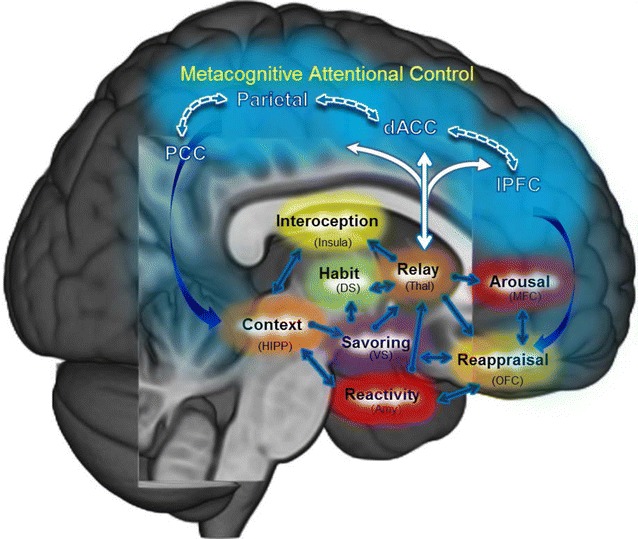
“Garland, Froeliger, & Howard conceptualized MBIs as means of mental training designed to exercise a number of neurocognitive processes that become dysregulated during the process of addiction [22].”
§ Mindfulness-based treatment of addiction: current state of the field and envisioning the next wave of research > Mindfulness as a means of targeting mechanisms of addiction > Therapeutic mechanisms of mindfulness as a treatment for addiction
What the sources say
- Supportedcites [22] Garland EL, Froeliger B, Howard MO. Mindfulness training targets neurocognitive mechanisms of addiction at the attention-appraisal-emotion interface. Front Psychiatry [Internet]. 2013 [cited 2017 Sep 27];4. https://www.ncbi.nlm.nih.gov/pmc/articles/PMC3887509/. PMC3887509 24454293 source
The section “Mindfulness Training Ameliorates Addiction by Targeting Neurocognitive Mechanisms” explicitly says that MBIs exercise neurocognitive processes believed to go awry in addiction and conceptualizes them as training cognitive-control networks. This directly supports the citing sentence’s characterization of the authors’ framework. (LLM, conf=0.95)
plain- Asserted: passes — The authors put it forward as true.
- Checkable: passes — It can be checked against evidence.
- Load-bearing: passes — The paper’s conclusions depend on it.
- Based: passes — The paper gives a reason why it holds.
- Supported
Every source the paper cites for this claim was checked and supports it.
In the paper
“As adaptive cognitive control is restored through mindfulness exercises, MBIs may increase functional connectivity between these top-down prefrontal networks and bottom-up limbic-striatal brain circuitry involved in reward processing and motivated behavior [22].”
§ Mindfulness-based treatment of addiction: current state of the field and envisioning the next wave of research > Mindfulness as a means of targeting mechanisms of addiction > Therapeutic mechanisms of mindfulness as a treatment for addiction
What the sources say
- Supportedcites [22] Garland EL, Froeliger B, Howard MO. Mindfulness training targets neurocognitive mechanisms of addiction at the attention-appraisal-emotion interface. Front Psychiatry [Internet]. 2013 [cited 2017 Sep 27];4. https://www.ncbi.nlm.nih.gov/pmc/articles/PMC3887509/. PMC3887509 24454293 source
The main section 'MINDFULNESS TRAINING AMELIORATES ADDICTION BY TARGETING NEUROCOGNITIVE MECHANISMS' states that MBIs train/exercise 'prefrontally mediated cognitive control networks which have become atrophied or usurped in the service of drug seeking and use' and 'may restructure dysregulated processes by strengthening functional connectivity and efficiency of prefrontally mediated self-regulatory circuits'. The 'SUMMARY OF THE NEUROCOGNITIVE MODEL' and 'HABIT RESPONSES' sections supply the bottom-up limbic-striatal side: fronto-parietal top-down modulation of amygdala and ventral striatum 'during reward processing', and enhanced functional connectivity in a cortico-thalamic loop 'providing feedback to the striatum'. The claim's hedge ('may') matches the source's own hypothetical framing, and motivated behavior corresponds to the drug-seeking/urge-motivation circuitry the paper describes. (LLM, conf=0.88)
hedgedstates a possible cause- Asserted: passes — The authors put it forward as true.
- Checkable: passes — It can be checked against evidence.
- Load-bearing: passes — The paper’s conclusions depend on it.
- Based: passes — The paper gives a reason why it holds.
- Supported
Every source the paper cites for this claim was checked and supports it.
In the paper
“a mindfulness training intervention based on MBRP for individuals with alcohol and/or cocaine use disorders was associated with significantly attenuated sympathovagal HRV ratio during stress exposure [46].”
§ Mindfulness-based treatment of addiction: current state of the field and envisioning the next wave of research > Mindfulness as a means of targeting mechanisms of addiction > Therapeutic mechanisms of mindfulness as a treatment for addiction
What the sources say
- Supportedcites [46] Brewer JA Sinha R Chen JA Michalsen RN Babuscio TA Nich C Mindfulness training and stress reactivity in substance abuse: results from a randomized, controlled stage I pilot study Subst Abus 2009 30 306 317 10.1080/08897070903250241 19904666 PMC3045038 source
The Methods describe an intervention adapted from MBRP for participants with alcohol and/or cocaine use disorders. The Results report a significantly lower sympathetic/vagal heart-rate-variability ratio in the mindfulness group than in the CBT group during the stress-reactivity assessment (p = 0.02). (LLM, conf=0.94)
plainstates an association- Asserted: passes — The authors put it forward as true.
- Checkable: passes — It can be checked against evidence.
- Load-bearing: passes — The paper’s conclusions depend on it.
- Based: passes — The paper gives a reason why it holds.
- Supported
Every source the paper cites for this claim was checked and supports it.
In the paper
“A mindfulness-based smoking cessation intervention derived from MBRP significantly reduced the association between craving and cigarette smoking [57].”
§ Mindfulness-based treatment of addiction: current state of the field and envisioning the next wave of research > Mindfulness as a means of targeting mechanisms of addiction > Therapeutic mechanisms of mindfulness as a treatment for addiction
What the sources say
- Supportedcites [57] Elwafi HM Witkiewitz K Mallik S Thornhill TA IV Brewer JA Mindfulness training for smoking cessation: moderation of the relationship between craving and cigarette use Drug Alcohol Depend 2013 130 1 222 229 10.1016/j.drugalcdep.2012.11.015 23265088 PMC3619004 source
The Methods (2.3 Intervention) say the smoking-cessation training was adapted from a mindfulness-training manual for drug relapse prevention. The Results (3.2) report that the craving–smoking correlation fell from r=0.582 at baseline to r=0.126 at the end of treatment, with a significant difference between the correlations (p=0.04). (LLM, conf=0.93)
plainstates a cause- Asserted: passes — The authors put it forward as true.
- Checkable: passes — It can be checked against evidence.
- Load-bearing: passes — The paper’s conclusions depend on it.
- Based: passes — The paper gives a reason why it holds.
- Supported
64 more claims · 5 with their cited sources checked
Create a free account to see all 110 claims and to verify the 87 references still open.
- It may state two separate claims as one. 31
- Probably not a substantial claim. 11
Claims other papers make about this one
Each is checked against this paper’s own text: does it say what the citing paper says it does?
The source backs part of the claim, not all of it — or backs it for a different population, condition or comparison.
In the citing paper
“MBIs show promise as a treatment for SUDs, possibly because they develop mindfulness, self-compassion, and interoceptive awareness – three key processes involved in coping with pain and anxiety, and healthy emotion regulation 9,10.”
From Effects of a trauma-informed mindful recovery program on comorbid pain, anxiety, and substance use during primary care buprenorphine treatment: A proof-of-concept study (2023) · cites this paper as [10]
Experimental — accuracy not yet measuredThe source backs part of the claim, not all of it — or backs it for a different population, condition or comparison.
In the citing paper
“As the positive association between problematic use level and mental health (i.e., loneliness, anxiety and stress) has been established [46,47].”
From Comparative effectiveness of mind-body exercise versus cognitive behavioral therapy for college students with problematic smartphone use: A randomized controlled trial (2020) · cites this paper as [47]
Experimental — accuracy not yet measuredThe cited source says what the claim attributes to it.
In the citing paper
“Mindfulness-based interventions have also shown promise in behavior change and addiction treatment [15].”
From Mindfulness meditation and psychedelics: potential synergies and commonalities (2023) · cites this paper as [15]
The cited source says what the claim attributes to it.
In the citing paper
“They help develop a greater awareness of addiction triggers and automatic reactions, enabling practitioners to respond more skillfully to challenging situations [15].”
From Mindfulness meditation and psychedelics: potential synergies and commonalities (2023) · cites this paper as [15]
Self-check
Percentages, sums and reported differences re-computed from the paper’s own numbers.
Each contradiction between two passages listed here was confirmed by an independent check.
Rated minor: it would not touch a result — a value no result rests on, a p-value that stays on the same side of the significance level, or a conflict that is clerical, resolved elsewhere in the paper, or outside its own findings.
In the paper
§ Mindfulness-based treatment of addiction: current state of the field and envisioning the next wave of research > Mindfulness as a means of targeting mechanisms of addiction > Therapeutic mechanisms of mindfulness as a treatment for addiction
“Garland et al. [20] model of mindfulness-centered regulation”
§ Mindfulness-based treatment of addiction: current state of the field and envisioning the next wave of research > References
“20. Langer EJ Matters of mind: mindfulness/mindlessness in perspective”
Rated minor: it would not touch a result — a value no result rests on, a p-value that stays on the same side of the significance level, or a conflict that is clerical, resolved elsewhere in the paper, or outside its own findings.
In the paper
§ Mindfulness-based treatment of addiction: current state of the field and envisioning the next wave of research > Current state of the field: a review of clinical outcomes of mindfulness-based treatments for addiction
“MBIs produced significant increases on the Five Factor Mindfulness Questionnaires in all eight studies that used this measure”
§ Mindfulness-based treatment of addiction: current state of the field and envisioning the next wave of research > Current state of the field: a review of clinical outcomes of mindfulness-based treatments for addiction
“(d = 0.62, − 0.02 to 1.26, p = 0.057)”
Rated minor: it would not touch a result — a value no result rests on, a p-value that stays on the same side of the significance level, or a conflict that is clerical, resolved elsewhere in the paper, or outside its own findings.
In the paper
§ Mindfulness-based treatment of addiction: current state of the field and envisioning the next wave of research > Current state of the field: a review of clinical outcomes of mindfulness-based treatments for addiction
“stress (d = 1.12, − 2.24 to –0.01, p < 0.05)”
§ Mindfulness-based treatment of addiction: current state of the field and envisioning the next wave of research > Current state of the field: a review of clinical outcomes of mindfulness-based treatments for addiction
“Effects (Cohen’s d/odds ratios) ranged from moderate-to-large across the synthesized effect sizes”
Citations
Cites
Using Self-Report Assessment Methods to Explore Facets of Mindfulness
Baer, R. A., Smith, G. T., Hopkins, J., Krietemeyer, J., & Toney, L. (2006) · Assessment · doi:10.1177/1073191105283504 · Cited by 7,511 · cited 1×
“According to operationalizations of the construct derived from factor analytic research, dispositional or trait mindfulness is characterized by the capacity to remain nonreactive to and accepting of distressing thoughts and emotions; observe interoceptive and exteroceptive experience; discriminate emotional states; an…”
MethodKabat-Zinn, J. (1982) · General Hospital Psychiatry · doi:10.1016/0163-8343(82)90026-3 · Cited by 4,255 · cited 10×
“Such tailoring is presumed necessary for maximizing clinical effects of MBIs as treatments for addiction, though no quantitative comparisons of tailored (e.g., MBRP) versus general (e.g., MBSR) MBIs have been conducted for individuals with substance use disorders.”
BackgroundInfluentialNeurobiology of addiction: a neurocircuitry analysis
Koob, G. F., & Volkow, N. D. (2016) · The Lancet Psychiatry · doi:10.1016/s2215-0366(16)00104-8 · Cited by 3,698 · cited 1×
“This large body of research suggests that addiction is best regarded as a cycle of compulsive substance use subserved by dysregulation in neural circuitry governing motivation and hedonic experience, habit behavior, and executive function [1].”
BackgroundA model of neurovisceral integration in emotion regulation and dysregulation
Thayer, J. F., & Lane, R. D. (2000) · Journal of Affective Disorders · doi:10.1016/s0165-0327(00)00338-4 · Cited by 3,092
The Neuroscience of Mindfulness Meditation
Tang, Y.-Y., Hölzel, B. K., & Posner, M. I. (2015) · Nature reviews. Neuroscience · doi:10.1038/nrn3916 · Cited by 2,889
Attention regulation and monitoring in meditation
Lutz, A., Slagter, H. A., Dunne, J. D., & Davidson, R. J. (2008) · Trends in Cognitive Sciences · doi:10.1016/j.tics.2008.01.005 · Cited by 2,659 · cited 2×
“Focused attention practices often precede the practice of open monitoring, in which one observes both the arising of mental contents as well as the field of awareness in which those contents arise [7].”
Chronic stress, drug use, and vulnerability to addiction
Sinha, R. (2008) · Annals of the New York Academy of Sciences · doi:10.1196/annals.1441.030 · Cited by 1,904
Gu, J., Strauss, C., Bond, R., & Cavanagh, K. (2015) · Clinical Psychology Review · doi:10.1016/j.cpr.2015.01.006 · Cited by 1,712 · cited 1×
“In partial support of this hypothesis, increases in the trajectory of state mindfulness produced over time through meditation predicts increases in trait mindfulness [11], and meta-analysis demonstrates that the effects of MBIs on clinical outcomes are mediated by increases in trait mindfulness [12].”
BackgroundA cognitive model of drug urges and drug-use behavior: role of automatic and nonautomatic processes
Tiffany, S. T. (1990) · Psychological Review · doi:10.1037/0033-295x.97.2.147 · Cited by 1,554
Mindfulness-based cognitive therapy for depression
(2006) · Buddhist Thought and Applied Psychological Research · doi:10.4324/9780203098899-33 · Cited by 1,324
Research works printed but not linked: 3
- Garland EL Mindfulness-oriented recovery enhancement for addiction, stress, and pain 2013 Washington, DC NASW Press
- Garland EL Mindfulness-oriented recovery enhancement modulates neurocognitive mechanisms and reward system function in addiction, stress, and pain 2015 New York, NY In Sloan Kettering Memorial Hospital
- Spears CA, Hedeker D, Li L, Wu C, Anderson NK, Houchins SC, et al. Mechanisms underlying mindfulness-based addiction treatment versus cognitive behavioral therapy and usual care for smoking cessation. J Consult Clin Psychol [Internet]. 2017 [cited 2017 Aug 7]. https://www.ncbi.nlm.nih.gov/pubmed/28650195. PMC5662477 28650195
Cited by
Items 201–298 of 298
Ram, D., Joseph, B., Mushtaq, N. F., Gopegowda, S. M., & Mathew, A. (2024) · Journal of the Scientific Society · doi:10.4103/jss.jss_130_23 · Cited by 2
Memória, C. M., Caverni, J. L. T., & Figlie, N. B. (2025) · Springer eBooks · doi:10.1007/978-3-031-82614-6_32 · Cited by 1
Tobacco Economics, Banks, and Mindful Solutions for Long-Term Sustainability
Singha, R., & Singha, S. (2025) · Springer eBooks · doi:10.1007/978-981-96-1785-2_12 · Cited by 1
Research hotspots and trends on illicit drugs: a bibliometric and visualized analysis
Chen, Y., Zheng, G., Yang, X., Wu, G., Nie, Q., & Zhang, P. (2025) · Frontiers in Medicine · doi:10.3389/fmed.2025.1583173 · Cited by 1
Thérapies corps-esprit en addictologie : apports de la psychomotricité
Nguyen-Xuan, D., Ancelin, D., & Héron, A. (2020) · Soins Psychiatrie · doi:10.1016/s0241-6972(20)30018-9 · Cited by 1
“Il permettrait de rester paisible, d’accepter les pensées et émotions désagréables, d’observer les expériences intéroceptives et extéroceptives, de discriminer les états émotionnels et de prendre conscience des automatismes pour s’en libérer (17).”
BackgroundAdolescent Drug Misuse Prevention: Challenges in School-Based Programming
Scheier, L. M. (2020) · Cambridge University Press eBooks · doi:10.1017/9781108632591.021 · Cited by 1
Measurement, Prevention, and Treatment of Exercise Addiction
Hausenblas, H. A., Mann, D. T. Y., & Downs, D. S. (2020) · Cambridge University Press eBooks · doi:10.1017/9781108632591.036 · Cited by 4
Interoception and Addiction: Etiological Mechanisms and a Root for Intervention
Angioletti, L., & Balconi, M. (2021) · Advances in mental health and addiction · doi:10.1007/978-3-030-82408-2_9 · Cited by 2
E-cigarette Polysubstance Vaping in Youth: Public Health Concerns
Lyzwinski, L. N., & Eisenberg, M. J. (2022) · Springer eBooks · doi:10.1007/978-3-030-67928-6_38-1 · Cited by 1
Psychopharmacotherapy of Sexual Disorders
Malandain, L., Chagraoui, A., & Thibaut, F. (2022) · Springer eBooks · doi:10.1007/978-3-030-62059-2_255 · Cited by 1
Satyal, M. K., Basso, J. C., Wilding, H. E., Athamneh, L. N., & Bickel, W. K. (2023) · Journal of Substance Use and Addiction Treatment · doi:10.1016/j.josat.2023.209007 · Cited by 1
Mindfulness-Based Interventions for Psychiatry
Ivkovic, A., Evans, S., Mirsky, P., Ashar, Y. K., & Muskin, P. R. (2023) · Springer eBooks · doi:10.1007/978-3-030-42825-9_159-1 · Cited by 1
Embracing the intersection of pedagogy and technology
Raj, K. (2023) · ASCILITE Publications · doi:10.14742/apubs.2023.610 · Cited by 1
Brami, C., Sultan, S., de la Londe, J. G., Piot, M., Robieux, L., & Zenasni, F. (2022) · Research Square · doi:10.21203/rs.3.rs-1768070/v1 · Cited by 1
Daniel Jason Frasca, D. (2021) · Osteopathic Family Physician · doi:10.33181/13023
Kruse, I. M. (2019) · European Journal of Neuroscience · doi:10.1111/ejn.14519
“…‘minimally conscious’ aversive body and mind states and maintain an attitude of acceptance towards them rather than resisting them (Bishop et al., 2004; Kabat‐Zinn, Lipworth, & Burney, 1985) have been increasingly used in recent years to treat addiction (see Garland & Howard, 2018, for review).”
BackgroundWeyers-Lucci, D. (2020) · Advances in media, entertainment and the arts (AMEA) book series · doi:10.4018/978-1-7998-2433-6.ch021
Loganathan, K., & Ho, E. T. W. (2020) · Neuroscience Research Notes · doi:10.31117/neuroscirn.v3i2.48 · Cited by 1
“• Mindfulness is the systematic training of attention and self-control (Garland and Howard, 2018) to reduce stress as well as improve attention, emotional regulation, and cognitive performance across large-scale networks (Tang et al., 2017).”
BackgroundComorbid Posttraumatic Stress and Substance Use Disorders: Treatment Guidelines for Counselors
Miller, E. (2020) · Open Access Journal of Addiction and Psychology · doi:10.33552/oajap.2020.03.000565 · Cited by 1
Therapeutic Everyday Materialities in the Subjective Smoking Experience
Kasemets, K. (2020) · Human Arenas · doi:10.1007/s42087-020-00131-9
Compton, W. M., & Blanco, C. (2020) · Cambridge University Press eBooks · doi:10.1017/9781108632591.001
Novel Psychoactive Substances: A New Challenge for Prevention and Treatment
Kapitány‐Fövény, M., Corazza, O., Marrinan, S., & Demetrovics, Z. (2020) · Cambridge University Press eBooks · doi:10.1017/9781108632591.032
Human Laboratory Paradigms in Addictions Research
Morris, V. L., Arshad, F., Balodis, I. M., Reed, D. D., MacKillop, J. M., & Amlung, M. T. (2020) · Cambridge University Press eBooks · doi:10.1017/9781108632591.010
Anhedonia in Addictive Behaviors
Dyer, W. G., Leventhal, A. M., Goldenson, N. I., & Bello, M. S. (2020) · Cambridge University Press eBooks · doi:10.1017/9781108632591.039 · Cited by 2
American Legal Issues in Addiction Treatment and Research
Willick, D. H. (2020) · Cambridge University Press eBooks · doi:10.1017/9781108632591.041
Strack, R. W., Orsini, M. M., Ewald, D. R., & Scheier, L. M. (2020) · Cambridge University Press eBooks · doi:10.1017/9781108632591.019
Chronicle of an Indian psychiatrist's mindfulness journey retold
Sivasubramoney, K. (2021) · BJPsych International · doi:10.1192/bji.2021.33
Clinical and Research Methods in the Addictions
Sussman, S. Y. (2020) · Cambridge University Press eBooks · doi:10.1017/9781108632591.008
Levels of Analysis and Etiology
Sussman, S. Y. (2020) · Cambridge University Press eBooks · doi:10.1017/9781108632591.014
Ongoing and Future Research Directions
Sussman, S. Y. (2020) · Cambridge University Press eBooks · doi:10.1017/9781108632591.030
Sussman, S. Y. (2020) · Cambridge University Press eBooks · doi:10.1017/9781108632591.002
Srivastava, A. B., & Gold, M. S. (2020) · Cambridge University Press eBooks · doi:10.1017/9781108632591.033
E-cigarette Polysubstance Vaping in Youth: Public Health Concerns
Lyzwinski, L. N., & Eisenberg, M. J. (2022) · Springer eBooks · doi:10.1007/978-3-030-67928-6_38-2 · Cited by 1
Weyers-Lucci, D. (2021) · IGI Global eBooks · doi:10.4018/978-1-7998-8544-3.ch025
Sussman, S. Y. (2020) · Cambridge University Press eBooks · doi:10.1017/9781108632591.042
Ram, D., Joseph, B., Mushtaq, N. F., Gopegowda, S. M., & Mathew, A. (2022) · Research Square · doi:10.21203/rs.3.rs-2296189/v1
E-cigarette Polysubstance Vaping in Youth: Public Health Concerns
Lyzwinski, L. N., & Eisenberg, M. J. (2022) · Springer eBooks · doi:10.1007/978-3-030-92392-1_38
Third Wave Therapies and Substance Use Disorders: A Case Example
Stotts, A. L., Villarreal, Y. R., Spellman, M., & Northrup, T. F. (2022) · Springer eBooks · doi:10.1007/978-3-031-11677-3_25
General therapy strategies in opioid addiction
Marambage, K., Edinoff, A. N., Kongchum, T., Rosa, C. A., Cornett, E. M., Kaye, A. D., & Giepert, S. (2023) · Elsevier eBooks · doi:10.1016/b978-0-323-98814-8.00015-9
Nirmala, N., & Hemavathy, V. (2023) · Cardiometry · doi:10.18137/cardiometry.2023.26.658662 · Cited by 1
Jafari, E., HamidieRad, H., Rasoolzadeh, B., Nikoozadeh, E. K., & Koluri, F. P. (2023) · فصلنامه علمی و پژوهشی اعتیادپژوهی · doi:10.52547/etiadpajohi.16.66.91
Cultivating Mindfulness in the Therapeutic Space
Li, T. (2023) · Journal of Health Service Psychology · doi:10.1007/s42843-023-00082-z · Cited by 2
“Mindfulness can be a middle ground between attachment to pleasure and aversion to pain with more opportunities to manage the dysregulation underlying addiction (Garland & Howard, 2018).”
BackgroundPemberdayaan Kesehatan Ibu Hamil dengan Aplikasi Mindfulness Pregnancy
Kundarti, F. I., Titisari, I., & Rahayu, D. E. (2023) · Poltekita Jurnal Pengabdian Masyarakat · doi:10.33860/pjpm.v4i3.2882 · Cited by 2
Sauvage, K., & Maruani, J. (2023) · Elsevier eBooks · doi:10.1016/b978-2-294-77934-3.00065-2
de Freitas, C. D., Januário, F. E. P., Rodrigues, N. L. S., Ferreira, B. M., Santos, G. I., Soares, V. R. B., Perseguino, M. G., Lemos, B. F., & Neto, J. C. G. L. (2024) · Revista Científica Integrada · doi:10.59464/2359-4632.2024.3259 · Cited by 1
石, 威. (2024) · Advances in Psychology · doi:10.12677/ap.2024.143132
Culturally Responsive CBT and Mindfulness: Minimizing Suicidality in Correctional Settings
Tadros, E. (2024) · Clinical Social Work Journal · doi:10.1007/s10615-024-00928-z · Cited by 2
“Mindfulness-based interventions have proved to be effective in balancing cog - nitive, affective, and psychophysiology processes as they reduce behaviors affiliated with savings and substance usage (Garland & Howard, 2018).”
Ameri, N., & Jamali, S. (2024) · فصلنامه علمی و پژوهشی اعتیادپژوهی · doi:10.61186/etiadpajohi.17.70.107
EMDR Therapy, Mindfulness, and Posttraumatic Growth
Marich, J. (2024) · Oxford University Press eBooks · doi:10.1093/oxfordhb/9780192898357.013.38
(2024) · Duke University Press eBooks · doi:10.1215/9781478059813-010
(2024) · Duke University Press eBooks · doi:10.1215/9781478059813-011
Three Problems With the Addiction as Akrasia Thesis That Ethnography Can Solve
(2024) · Duke University Press eBooks · doi:10.1215/9781478059813-006
“Out There”: The Ecology of Addiction in Drug Abuse Treatment Discourse
(2024) · Duke University Press eBooks · doi:10.1215/9781478059813-005
(2024) · Duke University Press eBooks · doi:10.1215/9781478059813-013
(2024) · Duke University Press eBooks · doi:10.1215/9781478059813-008
(2024) · Duke University Press eBooks · doi:10.1215/9781478059813-001
SOCIOLOGICAL PERSPECTIVES ON ADDICTION
Weinberg, D. (2024) · Duke University Press eBooks · doi:10.1215/9781478059813-002
Freedom and Addiction in Four Discursive Registers
(2024) · Duke University Press eBooks · doi:10.1215/9781478059813-003
LINDESMITH ON ADDICTION: A Critical History of a Classic Theory
Weinberg, D. (2024) · Duke University Press eBooks · doi:10.1215/9781478059813-004
An Exchange With John F. Galliher on Lindesmith's Theory of Addiction
Weinberg, D. (2024) · Duke University Press eBooks · doi:10.1215/9781478059813-009
6 Toward an Ecological Understanding of Addiction
Weinberg, D. (2024) · Duke University Press eBooks · doi:10.1215/9781478059813-007
Mindfulness-based interventions for people living with HIV and HIV prevention: a scoping review
Lu, J., Johnson, K. A., Lewis, P. D., Obuya, C., & Jones, S. (2024) · Journal of HIV/AIDS & Social Services · doi:10.1080/15381501.2024.2413967
“…outcome and serves as a model based upon which many other MBIs were developed to address different stress-related mental health problems (Garland & Howard, 2018; Korecki et al., 2020) and promote health across many clinical and non-clinical populations (Chiesa & Serretti, 2009;…”
Alessi, S. M., Contreras-Pérez, M. E., Langwerden, R. J., Perez, K. R., Quintana, J. E., Morris, S. L., Castellanos, A., Fernandez, S. B., & Wagner, E. F. (2024) · medRxiv · doi:10.1101/2024.11.18.24315992
Drug Abuse: From Biological to Psychological Dynamics
Marcela, S., & Agamennoni, O. E. (2024) · Springer eBooks · doi:10.1007/978-3-031-72219-6_12 · Cited by 1
A Novel Instagram Intervention for College Students Who Binge Drink
Thomas, H. A., & Grekin, E. R. (2024) · Substance Use & Misuse · doi:10.1080/10826084.2024.2446728 · Cited by 1
“Mindfulness has become an integral component of many cognitive behavioral approaches to alcohol use disorder treatment (Garland & Howard, 2018; Witkiewitz et al., 2005), and has been used as an effective coping strategy for craving in brief interventions (Schmidt et al., 2023; Wisener & Khoury,…”
Tobin, S. Y., Smith, J. K., DeSalvo, K., Beacham, A. O., Chamberlain, E., Cornier, M., & Halliday, T. M. (2024) · American Journal of Health Behavior · doi:10.5993/ajhb.48.6.18
Choi, M., Hwang, H., Seong, G., Lee, D., & Jung, Y. (2025) · 신경정신의학 · doi:10.4306/jknpa.2025.64.2.84
Liu, N., Chen, H., Zhang, G., Niu, X., Zhang, Y., Zheng, Y., Lv, W., Hu, L., & Dai, X. (2025) · SSRN Electronic Journal · doi:10.2139/ssrn.5320421
From triple-mode network to triple-layered model – novel insights in social cognition
Dubey, S., Sengupta, S., Chatterjee, S., Ghosh, R., Dewasi, S., Das, S., Pandit, A., & Dubey, M. J. (2025) · Indian Journal of Psychiatry · doi:10.4103/indianjpsychiatry_446_25
Sip, savor, but don’t spill: mindfulness enhances alcohol enjoyment without boosting consumption
Ma, R., Wu, X., & Xu, W. (2025) · Addictive Behaviors · doi:10.1016/j.addbeh.2025.108505 · Cited by 3
Denier, N., Zahnd, K., Stein, M., Moggi, F., Kupper, Z., Federspiel, A., Wiest, R., Grieder, M., Soravia, L. M., & Bracht, T. (2025) · Addiction Biology · doi:10.1111/adb.70036
Bennett, C., Barratt, L. J., & O'Brien, A. J. (2025) · Nutrients · doi:10.3390/nu17233745
“This profile points to alcohol use for stress or emotional regulation, indicating a need for more intensive responses such as mindfulness-based support, integrated mental health and alcohol services, or workplace wellbeing programmes [41–43].”
Beyer, E., Skumlien, M., Poudel, G. R., Arun, A. H., McTavish, E., Thomson, H. M., Sehl, H., Segrave, R. A., Clemente, A., Labuschagne, I., et al. (2026) · Psychopharmacology · doi:10.1007/s00213-026-07073-0
Asif, M., Khoso, A. B., Husain, M., Shahzad, S., Van Hout, M.-C., Rafiq, N.-U.-Z., Lane, S., Chaudhry, I. B., & Husain, N. (2024) · Figshare · doi:10.6084/m9.figshare.26584416
Mercado, D., Werthmann, J., Duarte, T. A., Campbell, I. C., & Schmidt, U. (2024) · Figshare · doi:10.6084/m9.figshare.26581886
Mercado, D., Werthmann, J., Duarte, T. A., Campbell, I. C., & Schmidt, U. (2024) · Figshare · doi:10.6084/m9.figshare.26581889
Mindfulness and the Addictive Process: Psychological Models and Neurobiological Mechanisms
Brewer, J. A., Houlihan, S. D., Yetter, K. M., & Davis, J. H. (2025) · Springer eBooks · doi:10.1007/978-3-031-91451-5_17 · Cited by 1
Calderone, A., Latella, D., Todaro, A., Luca, R. D., Militi, D., Fauci, E. L., Sergi, A., Quartarone, A., & Calabrò, R. S. (2026) · Substance Use & Misuse · doi:10.1080/10826084.2025.2606861
“…mindfulness and acceptance interventions tend to exert their strongest and most durable influence on mechanisms such as attention regulation, decentering, and psychological flexibility, with downstream but more variable impact on substance consumption (Garland & Howard, 2018; Wilson et al., 2017).”
InfluentialThe impact of virtual reality-based forest therapy in psychiatric inpatient care: a pilot study
Martins, R., de Sousa, S., Viana, J., Fortuna, R., Henriques, A., Silva, A., & de Almeida, R. S. (2026) · Advances in Mental Health · doi:10.1080/18387357.2026.2615679 · Cited by 2
The Effectiveness of Positive Psychology Intervention (PPI) for Persons Who Use Drugs (PWUDs)
Masanda, A. B. (2026) · Journal of Primary Care & Community Health · doi:10.1177/21501319251380631 · Cited by 1
Singh, S., & Kumar, A. (2026) · Emerald Group Publishing Limited eBooks · doi:10.1108/978-1-83662-964-120261004
Kim, S.-M., Jung, S.-J., Kang, M.-J., Chon, Y., Lee, N.-R., Hwang, K., Choi, I., Kim, D.-J., & Chun, J. (2026) · Journal of Medical Internet Research · doi:10.2196/99718
Enhancing Workplace Mental Health and Organisational Wellness: An Integrative Approach
Sahoo, A., Benya, A., Pamidimarri, D., & Sahoo, P. K. (2026) · IGI Global eBooks · doi:10.4018/979-8-2600-1202-4.ch004
Association between internet addiction and mindfulness
Kubaru, A., & Murakami, H. (2026) · Frontiers in Psychology · doi:10.3389/fpsyg.2026.1810492
“These findings suggest that mindfulness-based interventions may strengthen a domain-general neurocognitive resource that can modulate a variety of mechanisms implicated in addiction, including reward processing, cue reactivity, and stress reactivity (Garland and Howard, 2018).”
Murphy, E., Poudel, G., Dakhili, A. H., Ganesan, S., Zalesky, A., Glarin, R., Thomson, H. M., Lin, S. C., Paloubis, A., Kamboj, S. K., et al. (2026) · Addictive Behaviors · doi:10.1016/j.addbeh.2026.108741
O’Brien, V., & Rickert, N. P. (2026) · Journal of Affective Disorders · doi:10.1016/j.jad.2026.122062
Karavolis, Z. A., Hendler, R. A., Sedgewick, A. E., Mosquera, M. J., McHugh, R. K., & Kim, J. (2026) · Harvard Review of Psychiatry · doi:10.1097/hrp.0000000000000469
Dar, D. R., Kharlukhi, A. R., Malla, V. A., & Machoko, F. T. (2026) · Indian Journal of Social Psychiatry · doi:10.4103/ijsp.ijsp_395_24
Vatani, S., Nia, A. A. A., Ghasemzade, S., & Bonab, B. G. (2026) · The Neuroscience Journal of Shefaye Khatam · doi:10.66224/shefa.14.2.11
Holas, P., & Roczon, P. (2026) · Research Square · doi:10.21203/rs.3.rs-10562583/v1
Dashtbani, S., Ramesh, H., Norouzkhani, N., Saghebi, A., Khoshkangin, A., & Habibi, M. R. M. (2026) · Health Science Reports · doi:10.1002/hsr2.73103
Petry, J. (2026) · Psychotherapie: Praxis · doi:10.1007/978-3-662-72268-8_82
La thérapie comportementale dialectique
Speranza, M., & Perroud, N. (2025) · Carrefour des psychothérapies · doi:10.3917/dbu.chiro.2025.01.0295
Mouatassim, S., Callahan, S., & Chassagne, J. F. (2026) · Personality and Individual Differences · doi:10.1016/j.paid.2026.114083
Maleeh, R. (2026) · Cognitive Affective & Behavioral Neuroscience · doi:10.3758/s13415-026-01506-1
Metadata
- Authors
- Garland, E. L., & Howard, M. O.
- Affiliations
- University of Utah (US)
- University of North Carolina at Chapel Hill (US)
- Corresponding author
- Garland, Eric L.
- Venue
- Addiction Science & Clinical Practice
- Published
- 2018-04-18
- Volume
- 13
- Issue
- 1
- Pages
- 14-14
- ISSN
- 1940-0632 (ISSN-L)
- 1940-0640
- PMC
- PMC5907295
- OpenAlex
- W2804135251
- Cited by
- 300
- References
- 91
- Citations by year
- 2026: 23 · 2025: 32 · 2024: 51 · 2023: 42 · 2022: 35 · 2021: 29 · 2020: 69 · 2019: 11 · 2018: 8
- FWCI
- 4.93
- Type
- journal article
- Language
- en
- Open access
- gold
- doi.org
- Licence
- cc-by
- creativecommons.org/licenses/by/4.0/ (tdm)
- creativecommons.org/licenses/by/4.0/ (vor)
- Locations
- Addiction Science & Clinical Practice (publishedVersion, cc-by)
- Europe PMC (PubMed Central) (publishedVersion, other-oa)
- PubMed Central (publishedVersion, cc-by)
- PubMed (publishedVersion)
- Carolina Digital Repository (University of North Carolina at Chapel Hill) (submittedVersion)
- DOAJ (DOAJ: Directory of Open Access Journals) (submittedVersion, cc-by-sa)
- UNC Libraries
- Funders
- National Institute on Drug Abuse (R01DA042033)
- National Center for Complementary and Integrative Health (R61AT009296)
- Topics
- Social Sciences › Psychology › Clinical Psychology › Mindfulness and Compassion Interventions
- Health Sciences › Medicine › Epidemiology › Substance Abuse Treatment and Outcomes
- Health Sciences › Medicine › Public Health, Environmental and Occupational Health › Opioid Use Disorder Treatment
- Keywords
- mindfulness-based interventions, addiction treatment, substance use disorders, craving reduction, neurobiology of addiction, self-regulation, reward processing, alcohol consumption, smoking cessation, opioid misuse, cocaine use, heroin use, treatment sequencing, dissemination and implementation, dose-response relationship, research reproducibility
- MeSH terms
- Data Accuracy, Mentalization, Attention, Combined Modality Therapy, Humans, Research Design, Reward, Socioeconomic Factors, Stress, Psychological, Reproducibility of Results, Behavior, Addictive, Executive Function, Mindfulness, Craving
About these checks
Registry, retraction, Cites and statistics results are computed, not judged, with one exception: a printed reference that no index lists is read once by a model before it counts as a citation error. Claims are extracted by a model and kept only when their quote appears verbatim in the text; each cited source is then checked, with a model’s help, for whether it says what the claim relies on. Those verdicts can be wrong — read the claim’s quote and the cited source before relying on one.
The claim verdicts this report counts are experimental: their accuracy is not yet measured.
A language model drew the claims from the paper on 2026-10-05, under version 3 of the claim definition (model deepseek-v4.1-flash, prompt extract-v3).
A second model labelled each claim on 2026-10-05 (model jev-1.13-20260917, definition revision gold-guideline-v0.2).
Cited sources are checked with a language model’s help (gpt-6-sol and qwen3.8-omni-flash).
Statistics and arithmetic are recomputed, not judged.
Confidence bands are shown only for fields calibrated on our annotated test set. None is calibrated yet, so no band is shown.
What counts as a claim ›How we measure confidence ›How we check this ›
Are you an author, or do you see a problem with this page? Request a review
Data sources
Bibliographic data: Semantic Scholar, OpenAlex, Crossref.
Contains information from the Semantic Scholar Academic Graph Datasets, made available under the ODC Attribution License (ODC-BY 1.0).
Semantic Scholar’s data is described in: Kinney, R., et al. (2023). The Semantic Scholar Open Data Platform. arXiv:2301.10140.
