

MySafeRx: a mobile technology platform integrating motivational coaching, adherence monitoring, and electronic pill dispensing for enhancing buprenorphine/naloxone adherence during opioid use disorder treatment: a pilot study
Open accessThe DOI matches its Crossref record; 70 of the 70 references it cites were found in a registry or an index.
Abstract
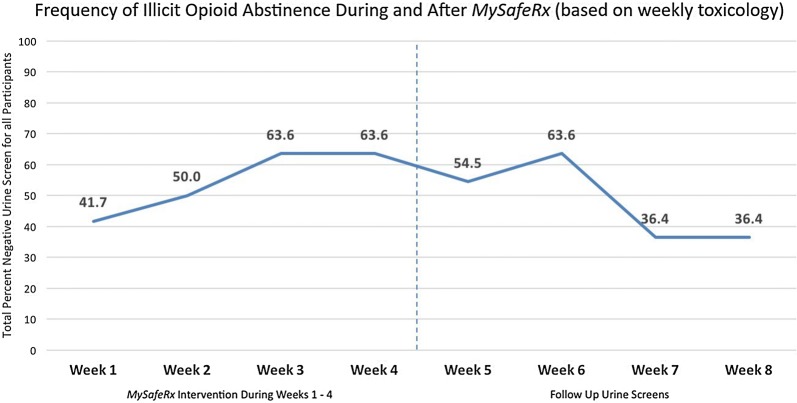
BACKGROUND: While buprenorphine/naloxone (B/N) is approved for opioid use disorder treatment, effective delivery of B/N comes with significant challenges. Most notably, many patients do not take medication daily as prescribed; this non-adherence worsens treatment outcomes, increases healthcare costs, and leads to persistent worries of diversion among providers and policymakers. The present study examines the feasibility, usability, and acceptability of MySafeRx-a mobile technology platform integrating motivational coaching, adherence monitoring, and electronic pill dispensing designed to address the challenges of office-based opioid treatment (OBOT) with B/N. METHODS: The MySafeRx platform integrates electronic pill dispensers, text-messaging, and videoconferencing to provide supervised self-administration of medication and daily motivational coaching through an Android app interface. High-risk early adults (18-39 years old) who were enrolled in OBOT with B/N and had documented illicit opioid use in the past month during opioid agonist therapy (n = 12) participated in a 28-day single-arm observational study of the MySafeRx platform in addition to standard care. RESULTS: Two-thirds of participants who completed the study achieved an average of > 5 days per week of supervised B/N self-administration. Visual confirmation of medication adherence was demonstrated for an average of 72% of study days among all participants. All participants achieved platform technical proficiency within 60 min, reporting good levels of usability and acceptability. Illicit opioid abstinence rates confirmed by urine toxicology increased by 53% during MySafeRx but fell 43% within 3 weeks post-intervention. CONCLUSION: The MySafeRx medication adherence and remote coaching mobile platform is acceptable and can be feasibly implemented in real-world opioid use disorder treatment settings during high-risk periods (i.e., initial stabilization, after illicit opioid lapse), resulting in reduced illicit opioid use; however, the effect did not last after intervention completion, suggesting longer duration or extended taper of program may be needed. ClinicalTrials.Gov NCT02942199 10/24/16 https://clinicaltrials.gov/ct2/show/NCT02942199.
Overview
The claims and statistics of this paper haven’t been checked yet.
Free: it reads the open-access text and checks the first 5 claims that cite a source we can check. Create a free account to check every claim.
Integrity signals
Registry
Cites
Statistics
Figures
Verification
Claims the paper makes
The claims and statistics of this paper haven’t been checked yet.
Free: it reads the open-access text and checks the first 5 claims that cite a source we can check. Create a free account to check every claim.
Claims other papers make about this one
Each is checked against this paper’s own text: does it say what the citing paper says it does?
The source backs part of the claim, not all of it — or backs it for a different population, condition or comparison.
In the citing paper
“Automated or smart pill dispensers may support adherence among patients who have memory or cognitive concerns or are at risk of medication misuse.202,203”
From Joint Clinical Practice Guideline on Benzodiazepine Tapering: Considerations When Risks Outweigh Benefits (2025) · cites this paper as [203]
Experimental — accuracy not yet measured
Self-check
Percentages, sums and reported differences re-computed from the paper’s own numbers.
The self-check needs the paper’s full text.
Citations
Cites
Harris, P. A., Taylor, R., Thielke, R., Payne, J., Gonzalez, N., & Conde, J. G. (2009) · Journal of Biomedical Informatics · doi:10.1016/j.jbi.2008.08.010 · Cited by 51,384
The Montreal Cognitive Assessment, MoCA: a brief screening tool for mild cognitive impairment
Nasreddine, Z. S., Phillips, N. A., Bédirian, V., Charbonneau, S., Whitehead, V., Collin, I., Cummings, J. L., & Chertkow, H. (2005) · Journal of the American Geriatrics Society · doi:10.1111/j.1532-5415.2005.53221.x · Cited by 25,553
Emerging adulthood: A theory of development from the late teens through the twenties.
Arnett, J. J. (2000) · American Psychologist · doi:10.1037/0003-066x.55.5.469 · Cited by 16,843
SUS: A 'Quick and Dirty' Usability Scale
(1996) · Usability Evaluation In Industry · doi:10.1201/9781498710411-35 · Cited by 8,989
Osterberg, L., & Blaschke, T. (2005) · New England Journal of Medicine · doi:10.1056/nejmra050100 · Cited by 7,974
An Empirical Evaluation of the System Usability Scale
Bangor, A., Kortum, P. T., & Miller, J. T. (2008) · International Journal of Human–Computer Interaction · doi:10.1080/10447310802205776 · Cited by 5,181
Motivational Interviewing: Helping People Change
Tober, G. (2013) · Alcohol and Alcoholism · doi:10.1093/alcalc/agt010 · Cited by 4,268
Kirk, J., MacDonald, A., Lavender, P., Dean, J., & Rubin, G. (2017) · Biomedicine Hub · doi:10.1159/000480347 · Cited by 3,887
(2013) · Cited by 2,393
Chronic stress, drug use, and vulnerability to addiction
Sinha, R. (2008) · Annals of the New York Academy of Sciences · doi:10.1196/annals.1441.030 · Cited by 1,904
Free, C., Phillips, G., Galli, L., Watson, L., Felix, L., Edwards, P., Patel, V., & Haines, A. (2013) · PLoS Medicine · doi:10.1371/journal.pmed.1001362 · Cited by 1,766
A Role for Brain Stress Systems in Addiction
Koob, G. F. (2008) · Neuron · doi:10.1016/j.neuron.2008.06.012 · Cited by 1,056
The Media and Technology Usage and Attitudes Scale: An empirical investigation
Rosen, L. D., Whaling, K., Carrier, L. M., Cheever, N. A., & Rokkum, J. (2013) · Computers in Human Behavior · doi:10.1016/j.chb.2013.06.006 · Cited by 788
Mobile phone messaging for facilitating self-management of long-term illnesses
de Jongh, T., Gurol-Urganci, I., Vodopivec-Jamsek, V., Car, J., & Atun, R. (2012) · Cochrane Database of Systematic Reviews · doi:10.1002/14651858.cd007459.pub2 · Cited by 599
Fudala, P. J., Bridge, T. P., Herbert, S., Williford, W. O., Chiang, C. N., Jones, K., Collins, J., Raisch, D., Casadonte, P., Goldsmith, R. J., et al. (2003) · New England Journal of Medicine · doi:10.1056/nejmoa022164 · Cited by 577
The effects of opioids and opioid analogs on animal and human endocrine systems
Vuong, C., Van Uum, S. H. M., O'Dell, L. E., Lutfy, K., & Friedman, T. C. (2010) · Endocrine Reviews · doi:10.1210/er.2009-0009 · Cited by 564
Moyers, T. B., Rowell, L. N., Manuel, J. K., Ernst, D., & Houck, J. M. (2016) · Journal of Substance Abuse Treatment · doi:10.1016/j.jsat.2016.01.001 · Cited by 562
Weiss, R. D. (2011) · Archives of General Psychiatry · doi:10.1001/archgenpsychiatry.2011.121 · Cited by 540
Health Beliefs, Disease Severity, and Patient Adherence: A Meta-Analysis
DiMatteo, M. R., Haskard, K. B., & Williams, S. L. (2007) · Medical Care · doi:10.1097/mlr.0b013e318032937e · Cited by 482
Determining what individual SUS scores mean
(2009) · Journal of Usability Studies archive · doi:10.5555/2835587.2835589 · Cited by 412
Number of people required for usability evaluation: the 10±2 rule
Hwang, W., & Salvendy, G. (2010) · Communications of the ACM · doi:10.1145/1735223.1735255 · Cited by 410
Emerging Adulthood: Developmental Period Facilitative of the Addictions
Sussman, S., & Arnett, J. J. (2014) · Evaluation & the Health Professions · doi:10.1177/0163278714521812 · Cited by 364
Comparison of the respiratory effects of intravenous buprenorphine and fentanyl in humans and rats
Dahan, A., Yassen, A., Bijl, H., Romberg, R., Sarton, E., Teppema, L., Olofsen, E., & Danhof, M. (2005) · British Journal of Anaesthesia · doi:10.1093/bja/aei145 · Cited by 326
Does retention matter? Treatment duration and improvement in drug use
Zhang, Z., Friedmann, P. D., & Gerstein, D. R. (2003) · Addiction · doi:10.1046/j.1360-0443.2003.00354.x · Cited by 314
Clausen, T., Anchersen, K., & Waal, H. (2008) · Drug and Alcohol Dependence · doi:10.1016/j.drugalcdep.2007.11.003 · Cited by 287
Alford, D. P., LaBelle, C. T., Kretsch, N., Bergeron, A., Winter, M., Botticelli, M., & Samet, J. H. (2011) · Archives of Internal Medicine · doi:10.1001/archinternmed.2010.541 · Cited by 267
Lofwall, M. R., & Walsh, S. L. (2014) · Journal of Addiction Medicine · doi:10.1097/adm.0000000000000045 · Cited by 248
LaBelle, C. T., Han, S. C., Bergeron, A., & Samet, J. H. (2016) · Journal of Substance Abuse Treatment · doi:10.1016/j.jsat.2015.06.010 · Cited by 228
Buprenorphine: dose-related blockade of opioid challenge effects in opioid dependent humans.
Bickel, W. K., Stitzer, M. L., Bigelow, G. E., Liebson, I. A., Jasinski, D. R., & Johnson, R. E. (1988) · The Journal of Pharmacology and Experimental Therapeutics · doi:10.1016/s0022-3565(25)20047-7 · Cited by 226 · cited 1×
“Under-dosing not only increases rates of relapse and treatment dropout, but also increases opioid over-dose susceptibility, as under-dosing medication may not achieve adequate mu-opioid receptor (MOR) blockade [18, 19].”
BackgroundCLINICAL ACTIONS OF FENTANYL AND BUPRENORPHINE
BOAS, R. A., & VILLIGER, J. W. (1985) · British Journal of Anaesthesia · doi:10.1093/bja/57.2.192 · Cited by 212
Shi, C. (2013) · International Journal of Evidence-Based Healthcare · doi:10.1111/1744-1609.12041 · Cited by 205
Barriers Rural Physicians Face Prescribing Buprenorphine for Opioid Use Disorder
Andrilla, C. H. A., Coulthard, C., & Larson, E. H. (2017) · The Annals of Family Medicine · doi:10.1370/afm.2099 · Cited by 204
Access to Treatment for Opioid Dependence in Rural America: Challenges and Future Directions
Sigmon, S. C. (2014) · JAMA Psychiatry · doi:10.1001/jamapsychiatry.2013.4450 · Cited by 176
Greenwald, M. K., Comer, S. D., & Fiellin, D. A. (2014) · Drug and Alcohol Dependence · doi:10.1016/j.drugalcdep.2014.07.035 · Cited by 174
Distance Traveled and Cross-State Commuting to Opioid Treatment Programs in the United States
Rosenblum, A., Cleland, C. M., Fong, C., Kayman, D. J., Tempalski, B., & Parrino, M. (2011) · Journal of Environmental and Public Health · doi:10.1155/2011/948789 · Cited by 161
Effect of Buprenorphine Dose on Treatment Outcome
Fareed, A., Vayalapalli, S., Casarella, J., & Drexler, K. (2012) · Journal of Addictive Diseases · doi:10.1080/10550887.2011.642758 · Cited by 159
Masand, P. S., Roca, M., Turner, M. S., & Kane, J. M. (2009) · The Primary Care Companion to The Journal of Clinical Psychiatry · doi:10.4088/pcc.08r00612 · Cited by 151
Office-Based Treatment of Opioid-Dependent Patients
Fiellin, D. A., & O'Connor, P. G. (2002) · New England Journal of Medicine · doi:10.1056/nejmcp013579 · Cited by 148
mHealth Interventions To Support Self-Management In HIV: A Systematic Review
Cooper, V., Clatworthy, J., Whetham, J., & Consortium, E. (2017) · The Open AIDS Journal · doi:10.2174/1874613601711010119 · Cited by 139
Substance User Treatment Dropout from Client and Clinician Perspectives: A Pilot Study
Palmer, R. S., Murphy, M. K., Piselli, A., & Ball, S. A. (2009) · Substance Use & Misuse · doi:10.1080/10826080802495237 · Cited by 134
Emerging adult age status predicts poor buprenorphine treatment retention
Schuman-Olivier, Z., Weiss, R. D., Hoeppner, B. B., Borodovsky, J., & Albanese, M. J. (2014) · Journal of Substance Abuse Treatment · doi:10.1016/j.jsat.2014.04.006 · Cited by 127
Self-citationGreenwald, M., Johanson, C.-E., Bueller, J., Chang, Y., Moody, D. E., Kilbourn, M., Koeppe, R., & Zubieta, J.-K. (2007) · Biological Psychiatry · doi:10.1016/j.biopsych.2006.04.043 · Cited by 124
Physician Capacity to Treat Opioid Use Disorder With Buprenorphine-Assisted Treatment
Stein, B. D., Sorbero, M., Dick, A. W., Pacula, R. L., Burns, R. M., & Gordon, A. J. (2016) · JAMA · doi:10.1001/jama.2016.10542 · Cited by 113
Overdose Deaths Related to Fentanyl and Its Analogs — Ohio, January–February 2017
Daniulaityte, R., Juhascik, M. P., Strayer, K. E., Sizemore, I. E., Harshbarger, K. E., Antonides, H. M., & Carlson, R. R. (2017) · MMWR. Morbidity and Mortality Weekly Report · doi:10.15585/mmwr.mm6634a3 · Cited by 112
Compliance with Buprenorphine Medication‐Assisted Treatment and Relapse to Opioid Use
Tkacz, J., Severt, J., Cacciola, J., & Ruetsch, C. (2012) · The American Journal on Addictions · doi:10.1111/j.1521-0391.2011.00186.x · Cited by 104
Comer, S. D., Sullivan, M. A., Vosburg, S. K., Manubay, J., Amass, L., Cooper, Z. D., Saccone, P., & Kleber, H. D. (2010) · Addiction · doi:10.1111/j.1360-0443.2009.02843.x · Cited by 104
Self-treatment: Illicit buprenorphine use by opioid-dependent treatment seekers
Schuman‐Olivier, Z., Albanese, M. A., Nelson, S. E., Roland, L., Puopolo, F., Klinker, L., & Shaffer, H. J. (2010) · Journal of Substance Abuse Treatment · doi:10.1016/j.jsat.2010.03.014 · Cited by 96
Self-citationOpioid partial agonist buprenorphine dampens responses to psychosocial stress in humans
Bershad, A. K., Jaffe, J. H., Childs, E., & de Wit, H. (2015) · Psychoneuroendocrinology · doi:10.1016/j.psyneuen.2014.12.004 · Cited by 94
Stigma associated with medication treatment for young adults with opioid use disorder: a case series
Hadland, S. E., Park, T. W., & Bagley, S. M. (2018) · Addiction Science & Clinical Practice · doi:10.1186/s13722-018-0116-2 · Cited by 93
Sporer, K. A. (2004) · Annals of Emergency Medicine · doi:10.1016/j.annemergmed.2003.11.006 · Cited by 92
Tkacz, J. P., Volpicelli, J. R., Un, H., & Ruetsch, C. R. (2013) · Journal of Substance Abuse Treatment · doi:10.1016/j.jsat.2013.10.014 · Cited by 88
Allen, B., & Harocopos, A. (2016) · Journal of Substance Abuse Treatment · doi:10.1016/j.jsat.2016.08.002 · Cited by 83
Amass, L., Kamien, J. B., & Mikulich, S. K. (2001) · Drug and Alcohol Dependence · doi:10.1016/s0376-8716(00)00141-1 · Cited by 79
Inability to access buprenorphine treatment as a risk factor for using diverted buprenorphine
Lofwall, M. R., & Havens, J. R. (2012) · Drug and Alcohol Dependence · doi:10.1016/j.drugalcdep.2012.05.025 · Cited by 76
Mobile Technology Interventions for Asthma Self-Management: Systematic Review and Meta-Analysis
Miller, L., Schüz, B., Walters, J., & Walters, E. H. (2017) · JMIR mHealth and uHealth · doi:10.2196/mhealth.7168 · Cited by 75
Practical Consideration for the Clinical Use of Buprenorphine
Jones, H. E. (2004) · Science & Practice Perspectives · doi:10.1151/spp04224 · Cited by 70
Supervised dosing with a long-acting opioid medication in the management of opioid dependence
Saulle, R., Vecchi, S., & Gowing, L. (2017) · Cochrane Database of Systematic Reviews · doi:10.1002/14651858.cd011983.pub2 · Cited by 70
Interim Buprenorphine vs. Waiting List for Opioid Dependence
Sigmon, S., Ochalek, T. A., Meyer, A. C., Hruska, B., Heil, S., Badger, G., Rose, G. L., Brooklyn, J., Schwartz, R., Moore, B. A., et al. (2016) · New England Journal of Medicine · doi:10.1056/nejmc1610047 · Cited by 70
Parks, C. L., Reif, S., Haq, S., Wallack, S. S., Hoyt, A., & Ritter, G. A. (2008) · Psychiatric Services · doi:10.1176/ps.2008.59.8.909 · Cited by 69
Use and misuse of buprenorphine in the management of opioid addiction
Cicero, P., Surratt, P., & Inciardi, P. (2007) · Journal of Opioid Management · doi:10.5055/jom.2007.0018 · Cited by 67
Predictors of attrition with buprenorphine/naloxone treatment in opioid dependent youth
Warden, D., Subramaniam, G. A., Carmody, T., Woody, G. E., Minhajuddin, A., Poole, S. A., Potter, J., Fishman, M., Bogenschutz, M., Patkar, A., et al. (2012) · Addictive Behaviors · doi:10.1016/j.addbeh.2012.04.011 · Cited by 66
Office-Based Treatment for Opioid Dependence: Reaching New Patient Populations
Fiellin, D. A., Rosenheck, R. A., & Kosten, T. R. (2001) · American Journal of Psychiatry · doi:10.1176/appi.ajp.158.8.1200 · Cited by 53
Factors Affecting Noncompliance With Buprenorphine Maintenance Treatment
Fareed, A., Eilender, P., Ketchen, B., Buchanan-Cummings, A. M., Scheinberg, K., Crampton, K., Nash, A., Shongo-Hiango, H., & Drexler, K. (2014) · Journal of Addiction Medicine · doi:10.1097/adm.0000000000000057 · Cited by 48
Professionals’ perception on the management of patients with dual disorders
Roncero, C., Szerman, N., Terán, A., Pino, C., Vázquez, J. M. V., Velasco, E., Dorado, M. G., & Casas, M. (2016) · Patient Preference and Adherence · doi:10.2147/ppa.s108678 · Cited by 40
Dayal, P., & Balhara, Y. P. S. (2017) · Journal of Substance Abuse Treatment · doi:10.1016/j.jsat.2017.06.004 · Cited by 37
Accurso, A. J., & Rastegar, D. A. (2015) · Journal of Substance Abuse Treatment · doi:10.1016/j.jsat.2015.09.004 · Cited by 24
Steps Physicians Report Taking to Reduce Diversion of Buprenorphine
Yang, A., Arfken, C. L., & Johanson, C. E. (2013) · American Journal on Addictions · doi:10.1111/j.1521-0391.2012.00335.x · Cited by 23
Steps Physicians Report Taking to Reduce Diversion of Buprenorphine
Yang, A., Arfken, C. L., & Johanson, C. (2013) · American Journal on Addictions · doi:10.1111/j.1521-0391.2013.00335.x · Cited by 19
Tervonen, H. E., Pentikäinen, H., & Tacke, U. (2013) · Journal of Substance Abuse Treatment · doi:10.1016/j.jsat.2013.01.003 · Cited by 15
New Freedom Commission on Mental Health Subcommittee on Rural Issues: Background paper.
(2007) · Rural Mental Health · doi:10.1037/h0095978 · Cited by 2
Research works printed but not linked: 4
- Center for Substance Abuse Treatment, Clinical Guidelines for the Use of Buprenorphine in the Treatment of Opioid Addiction. Treatment Improvement Protocol (TIP) Series 40, 2004, Substance Abuse and Mental Health Services Administration: Rockville, MD. 22514846
- Schuman-Olivier Z et al. MySafeRx: an integrated mobile platform for buprenorphine adherence. In: American academy of addiction psychiatry (AAAP) 27th annual meeting and symposium 2016. Bonita Springs: Wiley/Blackwell (10.1111).
- First MB et al. Structured clinical interview for DSM-IV-TR axis I disorders, research version, patient edition. Vol. SCID-I/P. 2002, New York: Biometrics Research, New York State Psychiatric Institute.
- Schuman-Olivier Z et al. Feasibility for ActiWatch score (TM) for recording skills practice and conducting ecological momentary assessment in a RCT of mindfulness training vs. cognitive-behavioral therapy for tobacco smoking cessation. In: Poster presentation, international symposium on contemplative studies; 2012.
Cited by
Mason, M., Cho, Y., Rayo, J., Gong, Y., Harris, M., & Jiang, Y. (2022) · JMIR mHealth and uHealth · doi:10.2196/35157 · Cited by 164
“Information regarding adherence monitoring technologies was extracted and organized into a table for further synthesis (Multimedia Appendix 2 [1-6,9-13,15-18,20,26-99]).”
MethodSteinkamp, J. M., Goldblatt, N., Borodovsky, J. T., LaVertu, A., Kronish, I. M., Marsch, L. A., & Schuman-Olivier, Z. (2019) · JMIR Mental Health · doi:10.2196/12493 · Cited by 106
Self-citationStandardising the role of a digital navigator in behavioural health: a systematic review
Perret, S., Alon, N., Carpenter-Song, E. A., Myrick, K. J., Thompson, K., Li, S., Sharma, K., & Torous, J. B. (2023) · The Lancet Digital Health · doi:10.1016/s2589-7500(23)00152-8 · Cited by 107
Marrero, R. J., Fumero, A., de Miguel, A., & Peñate, W. (2020) · Patient Education and Counseling · doi:10.1016/j.pec.2020.04.030 · Cited by 65
Remote Methods for Conducting Tobacco-Focused Clinical Trials
Dahne, J., Tomko, R. L., McClure, E. A., Obeid, J. S., & Carpenter, M. J. (2020) · Nicotine & Tobacco Research · doi:10.1093/ntr/ntaa105 · Cited by 56
Metadata
- Authors
- Schuman-Olivier, Z., Borodovsky, J. T., Steinkamp, J., Munir, Q., Butler, K., Greene, M. A., Goldblatt, J., Xie, H. Y., & Marsch, L. A.
- Affiliations
- Dartmouth College (US)
- Boston University (US)
- Tufts University (US)
- Venue
- Addiction Science & Clinical Practice
- Published
- 2018-09-24
- Volume
- 13
- Issue
- 1
- Pages
- 21-21
- ISSN
- 1940-0632 (ISSN-L)
- 1940-0640
- PMC
- PMC6154900
- OpenAlex
- W2891084063
- Cited by
- 44
- References
- 70
- Citations by year
- 2026: 5 · 2025: 5 · 2024: 2 · 2023: 7 · 2022: 7 · 2021: 7 · 2020: 8 · 2019: 2 · 2018: 1
- FWCI
- 4.29
- Type
- journal article
- Language
- en
- Open access
- gold
- doi.org
- Licence
- cc-by
- creativecommons.org/licenses/by/4.0/ (tdm)
- creativecommons.org/licenses/by/4.0/ (vor)
- Locations
- Addiction Science & Clinical Practice (publishedVersion, cc-by)
- Europe PMC (PubMed Central) (publishedVersion, other-oa)
- PubMed Central (publishedVersion, cc-by)
- PubMed (publishedVersion)
- DOAJ (DOAJ: Directory of Open Access Journals) (submittedVersion, cc-by-sa)
- Funders
- National Institute on Drug Abuse (P30DA029926, R34DA040086, R43DA033702)
- Topics
- Health Sciences › Medicine › Public Health, Environmental and Occupational Health › Opioid Use Disorder Treatment
- Health Sciences › Health Professions › General Health Professions › Mobile Health and mHealth Applications
- Health Sciences › Medicine › Family Practice › Medication Adherence and Compliance
- Keywords
- buprenorphine/naloxone, opioid use disorder, medication adherence, motivational coaching, mobile health, office-based opioid treatment, opioid substitution therapy, illicit opioid use, opioid diversion, early adults, urine toxicology, feasibility and acceptability
- MeSH terms
- Smartphone, Buprenorphine, Naloxone Drug Combination, Mentoring, Adolescent, Adult, Female, Humans, Male, Motivation, Opioid-Related Disorders, Pilot Projects, Reminder Systems, Patient Satisfaction, Videoconferencing, Medication Adherence, Young Adult, Text Messaging, Mobile Applications
About these checks
Registry, retraction, Cites and statistics results are computed, not judged, with one exception: a printed reference that no index lists is read once by a model before it counts as a citation error. Claims are extracted by a model and kept only when their quote appears verbatim in the text; each cited source is then checked, with a model’s help, for whether it says what the claim relies on. Those verdicts can be wrong — read the claim’s quote and the cited source before relying on one.
Statistics and arithmetic are recomputed, not judged.
Confidence bands are shown only for fields calibrated on our annotated test set. None is calibrated yet, so no band is shown.
What counts as a claim ›How we measure confidence ›How we check this ›
Are you an author, or do you see a problem with this page? Request a review
Data sources
Bibliographic data: Semantic Scholar, OpenAlex, Crossref.
Contains information from the Semantic Scholar Academic Graph Datasets, made available under the ODC Attribution License (ODC-BY 1.0).
Semantic Scholar’s data is described in: Kinney, R., et al. (2023). The Semantic Scholar Open Data Platform. arXiv:2301.10140.
