

The DOI matches its Crossref record; 139 of the 140 references it cites were found in a registry or an index.
Current understanding of metal ions in the pathogenesis of Alzheimer’s disease
Open accessAbstract
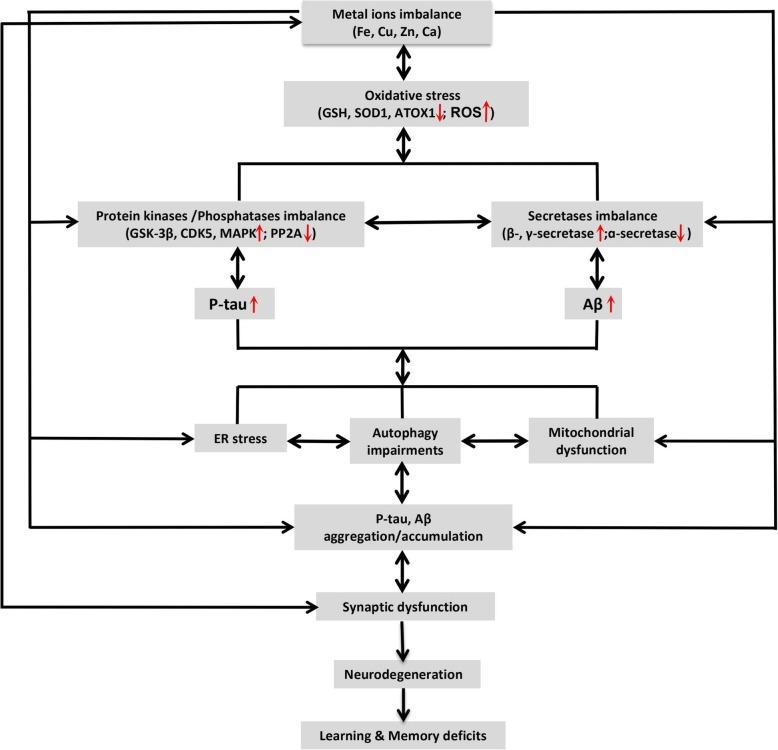
Background: The homeostasis of metal ions, such as iron, copper, zinc and calcium, in the brain is crucial for maintaining normal physiological functions. Studies have shown that imbalance of these metal ions in the brain is closely related to the onset and progression of Alzheimer's disease (AD), the most common neurodegenerative disorder in the elderly. Main body: Erroneous deposition/distribution of the metal ions in different brain regions induces oxidative stress. The metal ions imbalance and oxidative stress together or independently promote amyloid-β (Aβ) overproduction by activating β- or γ-secretases and inhibiting α-secretase, it also causes tau hyperphosphorylation by activating protein kinases, such as glycogen synthase kinase-3β (GSK-3β), cyclin-dependent protein kinase-5 (CDK5), mitogen-activated protein kinases (MAPKs), etc., and inhibiting protein phosphatase 2A (PP2A). The metal ions imbalances can also directly or indirectly disrupt organelles, causing endoplasmic reticulum (ER) stress; mitochondrial and autophagic dysfunctions, which can cause or aggravate Aβ and tau aggregation/accumulation, and impair synaptic functions. Even worse, the metal ions imbalance-induced alterations can reversely exacerbate metal ions misdistribution and deposition. The vicious cycles between metal ions imbalances and Aβ/tau abnormalities will eventually lead to a chronic neurodegeneration and cognitive deficits, such as seen in AD patients. Conclusion: The metal ions imbalance induces Aβ and tau pathologies by directly or indirectly affecting multiple cellular/subcellular pathways, and the disrupted homeostasis can reversely aggravate the abnormalities of metal ions transportation/deposition. Therefore, adjusting metal balance by supplementing or chelating the metal ions may be potential in ameliorating AD pathologies, which provides new research directions for AD treatment.
Overview
The claims and statistics of this paper haven’t been checked yet.
Run the check — free, no account needed. It reads the open-access text and checks the sources it cites.
Integrity signals
Registry
Cites
Statistics
Figures
Verification
Claims the paper makes
The claims and statistics of this paper haven’t been checked yet.
Run the check — free, no account needed. It reads the open-access text and checks the sources it cites.
Claims other papers make about this one
Each is checked against this paper’s own text: does it say what the citing paper says it does?
The source backs part of the claim, not all of it — or backs it for a different population, condition or comparison.
In the citing paper
“However, in AD, this finely tuned balance is disrupted. Misdistribution and pathological accumulation of these metals occur in Aβ plaques and NFTs, where they promote protein aggregation, oxidative stress, and neurotoxicity [107].”
From Toward a Unified Framework in Molecular Neurobiology of Alzheimer’s Disease: Revisiting the Pathophysiological Hypotheses (2026) · cites this paper as [107]
Experimental — accuracy not yet measuredIn the citing paper
“This protein known as the BACE performs proteolysis by generating a soluble fragment in the extracellular space known as “soluble APPβ” and an additional fragment bound to the plasma membrane, CTFβ peptide that undergoes proteolysis yet again by γ-secretase to generate toxic neuropeptides Aβ with 40–43 amino acids, finally causing the amyloid plaques characteristic of AD [165,166,167].”
From Multi-Target Mechanisms of Phytochemicals in Alzheimer’s Disease: Effects on Oxidative Stress, Neuroinflammation and Protein Aggregation (2022) · cites this paper as [165]
In the citing paper
“The absence of Aβ in neurons may inhibit adequate chelation of metal ions and appropriate removal of O2-, resulting in an increased rather than a reduced oxidative stress.424”
From Amyloid β-based therapy for Alzheimer’s disease: Challenges, successes and future (2023) · cites this paper as [424]
Self-check
Percentages, sums and reported differences re-computed from the paper’s own numbers.
The self-check needs the paper’s full text.
Citations
Cites
The amyloid hypothesis of Alzheimer's disease at 25 years
Selkoe, D. J., & Hardy, J. (2016) · EMBO Molecular Medicine · doi:10.15252/emmm.201606210 · Cited by 6,164
Guidelines for the use and interpretation of assays for monitoring autophagy (3rd edition).
Klionsky, D. J., Abdelmohsen, K., Abe, A., Abedin, M. J., Abeliovich, H., Acevedo Arozena, A., Adachi, H., Adams, C. M., Adams, P. D., Adeli, K., et al. (2016) · Autophagy · doi:10.1080/15548627.2015.1100356 · Cited by 5,894
Methods in Mammalian Autophagy Research
Mizushima, N., Yoshimori, T., & Levine, B. (2010) · Cell · doi:10.1016/j.cell.2010.01.028 · Cited by 4,497
Guidelines for the use and interpretation of assays for monitoring autophagy
Klionsky, D. J., Abdalla, F. C., Abeliovich, H., Abraham, R. T., Acevedo-Arozena, A., Adeli, K., Agholme, L., Agnello, M., Agostinis, P., Aguirre-Ghiso, J. A., et al. (2012) · Autophagy · doi:10.4161/auto.19496 · Cited by 3,996
Oxidative stress and the amyloid beta peptide in Alzheimer’s disease
Cheignon, C., Tomas, M., Bonnefont-Rousselot, D., Faller, P., Hureau, C., & Collin, F. (2018) · Redox Biology · doi:10.1016/j.redox.2017.10.014 · Cited by 2,185
Preclinical Alzheimer’s Disease: Definition, Natural History, and Diagnostic Criteria
Dubois, B., Hampel, H., Feldman, H. H., Scheltens, P., Aisen, P., Andrieu, S., Bakardjian, H., Benali, H., Bertram, L., Blennow, K., et al. (2016) · Alzheimer's & Dementia · doi:10.1016/j.jalz.2016.02.002 · Cited by 1,925
Lysosomal calcium signalling regulates autophagy through calcineurin and TFEB
Medina, D. L., Paola, S. D., Peluso, I., Armani, A., Stefani, D. D., Venditti, R., Montefusco, S., Rosato, A. S., Prezioso, C., Forrester, A. R., et al. (2015) · Nature Cell Biology · doi:10.1038/ncb3114 · Cited by 1,452
Woods, A., Dickerson, K., Heath, R. B., Hong, S. P., Momcilovic, M., Johnstone, S. R., Carlson, M., & Carling, D. (2005) · Cell Metabolism · doi:10.1016/j.cmet.2005.06.005 · Cited by 1,418
Oxidative Stress and the Central Nervous System
Salim, S. (2016) · Journal of Pharmacology and Experimental Therapeutics · doi:10.1124/jpet.116.237503 · Cited by 1,268
Boland, B., Kumar, A., Lee, S., Platt, F. M., Wegiel, J., Yu, W. H., & Nixon, R. A. (2008) · Journal of Neuroscience · doi:10.1523/jneurosci.0800-08.2008 · Cited by 1,119
The coordinate release of cytochrome c during apoptosis is rapid, complete and kinetically invariant
Goldstein, J. C., Waterhouse, N. J., Juin, P. P., Evan, G. I., & Green, D. R. (2000) · Nature Cell Biology · doi:10.1038/35004029 · Cited by 1,073
Demuro, A., Mina, E. W., Kayed, R., Milton, S. C. F., Parker, I., & Glabe, C. G. (2005) · Journal of Biological Chemistry · doi:10.1074/jbc.m500997200 · Cited by 1,057
Oxidative stress in Alzheimer’s disease
Chen, Z., & Zhong, C. (2014) · Neuroscience Bulletin · doi:10.1007/s12264-013-1423-y · Cited by 797
Zinc in the physiology and pathology of the CNS
Sensi, S. L., Paoletti, P., Bush, A. I., & Sekler, I. (2009) · Nature Reviews Neuroscience · doi:10.1038/nrn2734 · Cited by 759
Tau-mediated iron export prevents ferroptotic damage after ischemic stroke
Tuo, Q.-Z., Lei, P., Jackman, K. A., Li, X.-L., Xiong, H., Li, X.-L., Liuyang, Z.-Y., Roisman, L. C., Zhang, S.-T., Ayton, S., et al. (2017) · Molecular Psychiatry · doi:10.1038/mp.2017.171 · Cited by 715
The Amyloid Precursor Protein of Alzheimer's Disease in the Reduction of Copper(II) to Copper(I)
Multhaup, G., Schlicksupp, A., Hesse, L., Beher, D., Ruppert, T., Masters, C. L., & Beyreuther, K. T. (1996) · Science · doi:10.1126/science.271.5254.1406 · Cited by 681
Kuchibhotla, K. V., Goldman, S. T., Lattarulo, C. R., Wu, H.-Y., Hyman, B. T., & Bacskai, B. J. (2008) · Neuron · doi:10.1016/j.neuron.2008.06.008 · Cited by 614
Iron neurochemistry in Alzheimer's disease and Parkinson's disease: targets for therapeutics
Belaidi, A. A., & Bush, A. I. (2015) · Journal of Neurochemistry · doi:10.1111/jnc.13425 · Cited by 594
In Situ Oxidative Catalysis by Neurofibrillary Tangles and Senile Plaques in Alzheimer’s Disease
Sayre, L. M., Perry, G. L., Harris, P. L. R., Liu, Y. A., Schubert, K. A., & Smith, M. A. (2000) · Journal of Neurochemistry · doi:10.1046/j.1471-4159.2000.0740270.x · Cited by 543
Copper in the brain and Alzheimer’s disease
Hung, Y. H., Bush, A. I., & Cherny, R. A. (2009) · JBIC Journal of Biological Inorganic Chemistry · doi:10.1007/s00775-009-0600-y · Cited by 503
Sparks, D. L., & Schreurs, B. G. (2003) · Proceedings of the National Academy of Sciences · doi:10.1073/pnas.1832769100 · Cited by 455
Zinc at glutamatergic synapses
Paoletti, P., Vergnano, A. M., Barbour, B., & Casado, M. (2008) · Neuroscience · doi:10.1016/j.neuroscience.2008.01.061 · Cited by 417
Regulation of hippocampal synaptic plasticity by BDNF
Leal, G., Afonso, P. M., Salazar, I. L., & Duarte, C. B. (2015) · Brain Research · doi:10.1016/j.brainres.2014.10.019 · Cited by 410
Smith, M. A., Zhu, X., Tabaton, M., Liu, G., McKeel, D. W., Cohen, M. L., Wang, X., Siedlak, S. L., Dwyer, B. E., Hayashi, T., et al. (2010) · Journal of Alzheimer s Disease · doi:10.3233/jad-2010-1239 · Cited by 406
Microtubule-associated protein tau in development, degeneration and protection of neurons
Wang, J., & Liu, F. (2008) · Progress in Neurobiology · doi:10.1016/j.pneurobio.2008.03.002 · Cited by 405
Adlard, P. A., Parncutt, J. M., Finkelstein, D. I., & Bush, A. I. (2010) · Journal of Neuroscience · doi:10.1523/jneurosci.5255-09.2010 · Cited by 376
Iron Toxicity in Diseases of Aging: Alzheimer's Disease, Parkinson's Disease and Atherosclerosis
Altamura, S., & Muckenthaler, M. U. (2009) · Journal of Alzheimer's Disease · doi:10.3233/jad-2009-1010 · Cited by 369
Drayer, B. P., Burger, P. C., Darwin, R. H., Riederer, S. J., Herfkens, R. J., & Johnson, G. A. (1986) · American Journal of Roentgenology · doi:10.2214/ajr.147.1.103 · Cited by 368
Two-Step Mechanism of Membrane Disruption by Aβ through Membrane Fragmentation and Pore Formation
Sciacca, M. F. M., Kotler, S. A., Brender, J., Chen, J., Lee, D.-K., & Ramamoorthy, A. (2012) · Biophysical Journal · doi:10.1016/j.bpj.2012.06.045 · Cited by 363
Wang, J.-Z., Grundke-Iqbal, I., & Iqbal, K. (1996) · Nature Medicine · doi:10.1038/nm0896-871 · Cited by 360
Metal Ions in Alzheimer’s Disease: A Key Role or Not?
Liu, Y., Nguyen, M., Robert, A., & Meunier, B. (2019) · Accounts of Chemical Research · doi:10.1021/acs.accounts.9b00248 · Cited by 353
Alzheimer's Association Calcium Hypothesis Workgroup, & Khachaturian, Z. S. (2017) · Alzheimer's & Dementia · doi:10.1016/j.jalz.2016.12.006 · Cited by 311
Zinc ions promote Alzheimer Aβ aggregation via population shift of polymorphic states
Miller, Y., Ma, B., & Nussinov, R. (2010) · Proceedings of the National Academy of Sciences · doi:10.1073/pnas.0913114107 · Cited by 305
Synaptic Mitochondria Are More Susceptible to Ca2+Overload than Nonsynaptic Mitochondria
Brown, M. R., Sullivan, P. G., & Geddes, J. W. (2006) · Journal of Biological Chemistry · doi:10.1074/jbc.m510303200 · Cited by 301
Kardos, J., Kovács, I., Hajós, F., Kálmán, M., & Simonyi, M. (1989) · Neuroscience Letters · doi:10.1016/0304-3940(89)90565-x · Cited by 298
Form follows function: BDNF and its involvement in sculpting the function and structure of synapses
Zagrebelsky, M., & Korte, M. (2014) · Neuropharmacology · doi:10.1016/j.neuropharm.2013.05.029 · Cited by 241
Luo, H.-B., Xia, Y.-Y., Shu, X.-J., Liu, Z.-C., Feng, Y., Liu, X.-H., Yu, G., Yin, G., Xiong, Y.-S., Zeng, K., et al. (2014) · Proceedings of the National Academy of Sciences · doi:10.1073/pnas.1417548111 · Cited by 236
Self-citationZinc oxide nanoparticles induce apoptosis by enhancement of autophagy via PI3K/Akt/mTOR inhibition
Roy, R., Singh, S. K., Chauhan, L. K. S., Das, M., Tripathi, A., & Dwivedi, P. D. (2014) · Toxicology Letters · doi:10.1016/j.toxlet.2014.02.024 · Cited by 222
Iron Promotes the Toxicity of Amyloid β Peptide by Impeding Its Ordered Aggregation
Liu, B., Moloney, A. M., Meehan, S., Morris, K. L., Thomas, S. E., Serpell, L. C., Hider, R. C., Marciniak, S. J., Lomas, D. A., & Crowther, D. C. (2010) · Journal of Biological Chemistry · doi:10.1074/jbc.m110.158980 · Cited by 222
Histochemical Distribution of Non-Haem Iron in the Human Brain
Morris, C. M., Candy, J., Oakley, A. E., Bloxham, C. A., & Edwardson, J. A. (1992) · Cells Tissues Organs · doi:10.1159/000147312 · Cited by 218
Feng, Q., Luo, Y., Zhang, X., Yang, X., Hong, X.-Y., Sun, D., Li, X., Hu, Y., Li, X., Zhang, J., et al. (2019) · Autophagy · doi:10.1080/15548627.2019.1633862 · Cited by 213
The role of Ca2+ in cell death caused by oxidative glutamate toxicity and ferroptosis
Maher, P. A., van Leyen, K., Dey, P. N., Honrath, B., Dolga, A. M., & Methner, A. (2017) · Cell Calcium · doi:10.1016/j.ceca.2017.05.007 · Cited by 208
Guo, C., Wang, P., Zhong, M., Wang, T., Huang, X., Li, J., & Wang, Z. (2012) · Neurochemistry International · doi:10.1016/j.neuint.2012.12.005 · Cited by 192
Inhibition of MMPs and ADAM/ADAMTS
Malemud, C. J. (2019) · Biochemical Pharmacology · doi:10.1016/j.bcp.2019.02.033 · Cited by 184
Yin, Y., Gao, D., Wang, Y., Wang, Z.-H., Wang, X., Ye, J., Wu, D., Fang, L., Pi, G., Yang, Y., et al. (2016) · Proceedings of the National Academy of Sciences · doi:10.1073/pnas.1604519113 · Cited by 179
Atrián‐Blasco, E., Gonzalez, P., Santoro, A., Aliès, B., Faller, P., & Hureau, C. (2018) · Coordination Chemistry Reviews · doi:10.1016/j.ccr.2018.04.007 · Cited by 175
Cortical iron reflects severity of Alzheimer's disease
van Duijn, S., Bulk, M., van Duinen, S. G., Nabuurs, R. J. A., van Buchem, M. A., van der Weerd, L., & Natté, R. (2017) · Journal of Alzheimer s Disease · doi:10.3233/jad-161143 · Cited by 172 · cited 1×
“An increased iron level is correlated with the amount of Aβ plaques and tau pathologies, and iron increases Aβ toxicity by impeding the ordered aggregation of Aβ [31].”
BackgroundStructural Basis for Regulated Proteolysis by the α-Secretase ADAM10
Seegar, T. C. M., Killingsworth, L. B., Saha, N., Meyer, P. A., Patra, D., Zimmerman, B., Janes, P. W., Rubinstein, E., Nikolov, D. B., Skiniotis, G., et al. (2017) · Cell · doi:10.1016/j.cell.2017.11.014 · Cited by 170
Neurodegeneration with brain iron accumulation: update on pathogenic mechanisms
Levi, S., & Finazzi, D. (2014) · Frontiers in Pharmacology · doi:10.3389/fphar.2014.00099 · Cited by 164
Localization of copper and copper transporters in the human brain
Davies, K. M., Hare, D. J., Cottam, V., Chen, N., Hilgers, L., Halliday, G. M., Mercer, J. F. B., & Double, K. L. (2012) · Metallomics · doi:10.1039/c2mt20151h · Cited by 163
Metals and Alzheimer’s Disease: How Far Have We Come in the Clinic?
Adlard, P. A., & Bush, A. I. (2018) · Journal of Alzheimer s Disease · doi:10.3233/jad-170662 · Cited by 155
Myhre, O., Utkilen, H., Duale, N., Brunborg, G., & Hofer, T. (2013) · Oxidative Medicine and Cellular Longevity · doi:10.1155/2013/726954 · Cited by 154
Copper is an endogenous modulator of neural circuit spontaneous activity
Dodani, S. C., Firl, A. J., Chan, J., Nam, C. I., Aron, A. T., Onak, C. S., Ramos‐Torres, K. M., Paek, J., Webster, C. M., Feller, M. B., et al. (2014) · Proceedings of the National Academy of Sciences · doi:10.1073/pnas.1409796111 · Cited by 151
Yin, H. Z., Sensi, S. L., Ogoshi, F., & Weiss, J. H. (2002) · The Journal of Neuroscience · doi:10.1523/jneurosci.22-04-01273.2002 · Cited by 143
A potential pathogenetic role of iron in Alzheimer's disease
Silvestri, L., & Camaschella, C. (2008) · Journal of Cellular and Molecular Medicine · doi:10.1111/j.1582-4934.2008.00356.x · Cited by 139
Sun, X., Wei, Y., Xiong, Y., Wang, X., Xie, A., Wang, X., Yang, Y., Wang, Q., Lu, Y., Liu, R., et al. (2012) · Journal of Biological Chemistry · doi:10.1074/jbc.m111.309070 · Cited by 137
James, S., Churches, Q. I., de Jonge, M. D., Birchall, I. E., Streltsov, V. A., McColl, G., Adlard, P. A., & Hare, D. J. (2016) · ACS Chemical Neuroscience · doi:10.1021/acschemneuro.6b00362 · Cited by 136
Trejo‐Solís, C., Jiménez‐Farfán, D., Rodríguez‐Enríquez, S., Fernández‐Valverde, F., Cruz-Salgado, A., Ruíz-Azuara, L., & Sotelo, J. (2012) · BMC Cancer · doi:10.1186/1471-2407-12-156 · Cited by 133
Developing Effective Alzheimer’s Disease Therapies: Clinical Experience and Future Directions
Elmaleh, D. R., Farlow, M. R., Conti, P. S., Tompkins, R. G., Kundakovic, L., & Tanzi, R. E. (2019) · Journal of Alzheimer’s Disease · doi:10.3233/jad-190507 · Cited by 129
Yang, L., Wang, Z., Wang, B., Justice, N. J., & Zheng, H. (2009) · Journal of Neuroscience · doi:10.1523/jneurosci.4104-09.2009 · Cited by 122
Xiong, Y., Jing, X.-P., Zhou, X.-W., Wang, X.-L., Yang, Y., Sun, X.-Y., Qiu, M., Cao, F.-Y., Lu, Y.-M., Liu, R., et al. (2013) · Neurobiology of Aging · doi:10.1016/j.neurobiolaging.2012.07.003 · Cited by 122
Self-citationCaM KINASE II IN LONG-TERM POTENTIATION
Fukunaga, K., Müller, D., & Miyamoto, E. (1996) · Neurochemistry International · doi:10.1016/0197-0186(95)00097-6 · Cited by 116
Iron-induced oxidative stress modify tau phosphorylation patterns in hippocampal cell cultures
Egaña, J. T., Zambrano, C. A., Núñez, M. T., González-Billault, C. E., & Maccioni, R. B. (2003) · BioMetals · doi:10.1023/a:1020727218493 · Cited by 114
Evidence for widespread, severe brain copper deficiency in Alzheimer's dementia
Xu, J., Church, S. J., Patassini, S., Begley, P., Waldvogel, H. J., Curtis, M. A., Faull, R. L. M., Unwin, R. D., & Cooper, G. J. S. (2017) · Metallomics · doi:10.1039/c7mt00074j · Cited by 113
An, W., Björkdahl, C., Liu, R., Cowburn, R. F., Winblad, B. G., & Pei, J.-J. (2005) · Journal of Neurochemistry · doi:10.1111/j.1471-4159.2004.02948.x · Cited by 107
Calcium Dysregulation in Alzheimer's Disease: A Target for New Drug Development
Wang, Y., Shi, Y., & Wei, H. (2017) · Journal of Alzheimer’s Disease & Parkinsonism · doi:10.4172/2161-0460.1000374 · Cited by 106
Mammalian Metallothionein-3: New Functional and Structural Insights
Vašák, M., & Meloni, G. (2017) · International Journal of Molecular Sciences · doi:10.3390/ijms18061117 · Cited by 105
Ahuja, A., Dev, K., Tanwar, R. S., Selwal, K. K., & Tyagi, P. K. (2014) · Journal of Trace Elements in Medicine and Biology · doi:10.1016/j.jtemb.2014.05.003 · Cited by 103
Alzheimer paired helical filaments: Immunochemical identification of polypeptides
Grundke, I., Iqbal, K., Tung, Y. C., & Wisniewski, H. M. (1984) · Acta Neuropathologica · doi:10.1007/bf00687607 · Cited by 103
Potential oxidative stress biomarkers of mild cognitive impairment due to Alzheimer disease
García‐Blanco, A., Baquero, M., Vento, M., Gil, E., Bataller, L., & Cháfer‐Pericás, C. (2017) · Journal of the Neurological Sciences · doi:10.1016/j.jns.2017.01.020 · Cited by 102
Zhang, Z., Li, X., Wang, Z.-H., Song, M., Yu, S. P., Kang, S. S., Liu, X., Zhang, Z., Xie, M., Liu, G., et al. (2018) · Molecular Psychiatry · doi:10.1038/s41380-018-0286-z · Cited by 91
Huang, X., Qian, Z., He, X. M., Gong, Q., Wu, K.-C., Jiang, L., Lü, L., Zhu, Z.-J., Zhang, H., Yung, W., et al. (2013) · Neurobiology of Aging · doi:10.1016/j.neurobiolaging.2013.11.004 · Cited by 90
The emerging role of lysosomes in copper homeostasis
Polishchuk, E. V., & Polishchuk, R. (2016) · Metallomics · doi:10.1039/c6mt00058d · Cited by 89
Trehalose Improves Cognition in the Transgenic Tg2576 Mouse Model of Alzheimer’s Disease
Portbury, S. D., Hare, D. J., Sgambelloni, C., Perronnes, K., Portbury, A. J., Finkelstein, D. I., & Adlard, P. A. (2017) · Journal of Alzheimer s Disease · doi:10.3233/jad-170322 · Cited by 87
Modulation of tau phosphorylation by environmental copper
Voss, K., Harris, C., Ralle, M., Duffy, M., Murchison, C., & Quinn, J. F. (2014) · Translational Neurodegeneration · doi:10.1186/2047-9158-3-24 · Cited by 83
Marked Age-Related Changes in Brain Iron Homeostasis in Amyloid Protein Precursor Knockout Mice
Belaidi, A. A., Gunn, A. P., Wong, B. X., Ayton, S., Appukuttan, A. T., Roberts, B. R., Duce, J. A., & Bush, A. I. (2018) · Neurotherapeutics · doi:10.1007/s13311-018-0656-x · Cited by 83
Tau accumulation triggers STAT1‐dependent memory deficits by suppressing NMDA receptor expression
Li, X., Hong, X., Wang, Y., Zhang, S., Zhang, J., Li, X., Liu, Y., Sun, D., Feng, Q., Ye, J., et al. (2019) · The EMBO Reports · doi:10.15252/embr.201847202 · Cited by 81 · cited 4×
“Given that many kinases can be activated by Ca, dysregulation of Ca homeostasis, such as seen during ER stress, can increase tau phosphorylation [14, 72, 73].”
BackgroundInfluentialPi, H., Li, M., Tian, L., Yang, Z., Yu, Z., & Zhou, Z. (2017) · Scientific Reports · doi:10.1038/srep43466 · Cited by 80
Bandyopadhyay, S., & Rogers, J. T. (2014) · Biochemical Pharmacology · doi:10.1016/j.bcp.2014.01.032 · Cited by 77
Tau Promoter Confers Neuronal Specificity and Binds Sp1 and AP‐2
Heicklen‐Klein, A., & Ginzburg, I. (2000) · Journal of Neurochemistry · doi:10.1046/j.1471-4159.2000.0751408.x · Cited by 77
Wang, J., Wang, Z.-H., & Tian, Q. (2014) · Neuroscience Bulletin · doi:10.1007/s12264-013-1415-y · Cited by 74
Noxious Iron–Calcium Connections in Neurodegeneration
Núñez, M., & Hidalgo, C. (2019) · Frontiers in Neuroscience · doi:10.3389/fnins.2019.00048 · Cited by 71
Neuroinflammation and Copper in Alzheimer’s Disease
Choo, X. Y., Alukaidey, L., White, A. R., & Grubman, A. (2013) · International Journal of Alzheimer s Disease · doi:10.1155/2013/145345 · Cited by 70
Decreased Copper in Alzheimer’s Disease Brain Is Predominantly in the Soluble Extractable Fraction
Rembach, A., Hare, D. J., Lind, M., Fowler, C. J., Cherny, R. A., McLean, C., Bush, A. I., Masters, C. L., & Roberts, B. R. (2013) · International Journal of Alzheimer s Disease · doi:10.1155/2013/623241 · Cited by 69
Effect of iron on the activation of the MAPK/ERK pathway in PC12 neuroblastoma cells
Muñoz, P., Zavala, G., Castillo, K., Aguirre, P., Hidalgo, C., & Núñez, M. T. (2006) · Biological Research · doi:10.4067/s0716-97602006000100021 · Cited by 66
Zhang, L., Fang, Y., Cheng, X., Lian, Y., Xu, H., Zeng, Z., & Zhu, H. (2017) · Cellular Physiology and Biochemistry · doi:10.1159/000484449 · Cited by 65
Matheou, C. J., Younan, N. D., & Viles, J. H. (2014) · Biochemical Journal · doi:10.1042/bj20141168 · Cited by 64
Kumar, V., Singh, D., Singh, B. K., Singh, S., Mittra, N., Jha, R. R., Patel, D. K., & Singh, C. (2017) · Molecular and Cellular Biochemistry · doi:10.1007/s11010-017-3239-y · Cited by 64
Wärmländer, S. K. T. S., Österlund, N., Wallin, C., Wu, J., Luo, J., Tiiman, A., Jarvet, J., & Gräslund, A. (2019) · JBIC Journal of Biological Inorganic Chemistry · doi:10.1007/s00775-019-01723-9 · Cited by 64
Kim, I., Park, E. J., Seo, J., Ko, S. J., Lee, J., & Kim, C. H. (2011) · Neuroreport · doi:10.1097/wnr.0b013e32834c0a2d · Cited by 63
Cavallucci, V., Berretta, N., Nobili, A., Nisticò, R., Mercuri, N. B., & D’Amelio, M. (2013) · NeuroMolecular Medicine · doi:10.1007/s12017-013-8241-2 · Cited by 61
Olesen, R. H., Hyde, T. M., Kleinman, J. E., Smidt, K., Rungby, J., & Larsen, A. (2016) · Translational Psychiatry · doi:10.1038/tp.2016.83 · Cited by 60
Kenche, V. B., Zawisza, I., Masters, C. L., Bal, W., Barnham, K. J., & Drew, S. C. (2013) · Inorganic Chemistry · doi:10.1021/ic302289r · Cited by 59
Song, W.-J., Jeong, M.-S., Choi, D.-M., Kim, K., & Wie, M. (2019) · Nanomaterials · doi:10.3390/nano9071043 · Cited by 57
Moos, T., Trinder, D., & Morgan, E. H. (2000) · PubMed · Cited by 56
The synaptic proteome in Alzheimer's disease
Chang, R. Y. K., Nouwens, A. S., Dodd, P. R., & Etheridge, N. (2012) · Alzheimer s & Dementia · doi:10.1016/j.jalz.2012.04.009 · Cited by 52
Banerjee, P., Sahoo, A., Anand, S., Ganguly, A., Righi, G., Bovicelli, P., Saso, L., & Chakrabarti, S. (2014) · NeuroMolecular Medicine · doi:10.1007/s12017-014-8328-4 · Cited by 52
Xu, Z., Yang, S., Zhao, S., Zheng, C., Li, H., Zhang, Y., Huang, R., Li, M., Gao, Y., Zhang, S., et al. (2016) · EBioMedicine · doi:10.1016/j.ebiom.2016.02.014 · Cited by 50
Jin, Y., Bai, Y., Ni, H., Li, Q., Ye, L., Shan, Y., & Zhou, M. (2016) · FEBS Letters · doi:10.1002/1873-3468.12090 · Cited by 48
Copper activates TrkB in cortical neurons in a metalloproteinase‐dependent manner
Hwang, J. J., Park, M., & Koh, J. (2007) · Journal of Neuroscience Research · doi:10.1002/jnr.21350 · Cited by 47
Copper, BDNF and Its N‐terminal Domain: Inorganic Features and Biological Perspectives
Travaglia, A., Mendola, D. L., Magrì, A. L., Nicoletti, V. G., Pietropaolo, A., & Rizzarelli, E. (2012) · Chemistry - A European Journal · doi:10.1002/chem.201202775 · Cited by 47
Rogers, J. T., Venkataramani, V., Washburn, C., Liu, Y., Tummala, V., Jiang, H. F., Smith, A., & Cahill, C. M. (2016) · Journal of Neurochemistry · doi:10.1111/jnc.13671 · Cited by 46
Nature of Tau-Associated Neurodegeneration and the Molecular Mechanisms
Yang, Y., & Wang, J. (2018) · Journal of Alzheimer s Disease · doi:10.3233/jad-170788 · Cited by 46
A mathematical model for the effects of amyloid beta on intracellular calcium
Latulippe, J., Lotito, D., & Murby, D. (2018) · PLoS ONE · doi:10.1371/journal.pone.0202503 · Cited by 46
Rogers, J. T., Xia, N., Wong, A. Y., Bakshi, R., & Cahill, C. M. (2019) · International Journal of Molecular Sciences · doi:10.3390/ijms20040994 · Cited by 46
Wang, Z., Zhang, Y., Zhang, W., Gao, H., Zhong, M., Huang, T., Guo, R., Liu, N., Li, D., Li, Y., et al. (2018) · Journal of Pineal Research · doi:10.1111/jpi.12502 · Cited by 44
Zhang, Y., Xie, J., Xu, X., Hu, J., Xu, T., Jin, S., Yang, S., & Wang, J. (2019) · Neuroscience Bulletin · doi:10.1007/s12264-018-00336-7 · Cited by 44
Endoplasmic reticulum stress induces spatial memory deficits by activating GSK ‐3
Li, L., Cao, J., Yang, S., Fu, Z., Zeng, P. H., Chu, J., Ning, L., Zhang, T., Shi, Y., Tian, Q., et al. (2018) · Journal of Cellular and Molecular Medicine · doi:10.1111/jcmm.13626 · Cited by 43
Frazzini, V., Granzotto, A., Bomba, M., Massetti, N., Castelli, V., D’Aurora, M., Punzi, M., Iorio, M., Mosca, A., Pizzi, S. D., et al. (2018) · Scientific Reports · doi:10.1038/s41598-018-28083-9 · Cited by 42
Amici, M., Forti, K., Nobili, C., Lupidi, G., Angeletti, M., Fioretti, E., & Eleuteri, A. M. (2002) · JBIC Journal of Biological Inorganic Chemistry · doi:10.1007/s00775-002-0352-4 · Cited by 41
Breuer, W. V., Ghoti, H., Shattat, A., Goldfarb, A. W., Koren, A., Levin, C., Rachmilewitz, E. A., & Cabantchik, Z. I. (2011) · American Journal of Hematology · doi:10.1002/ajh.22203 · Cited by 41
Zinc(II) Complexes of Ubiquitin: Speciation, Affinity and Binding Features
Arena, G., Fattorusso, R., Grasso, G., Grasso, G. I., Isernia, C., Malgieri, G., Milardi, D., & Rizzarelli, E. (2011) · Chemistry - A European Journal · doi:10.1002/chem.201101364 · Cited by 41
Dopamine- and zinc-induced autophagosome formation facilitates PC12 cell survival
Hung, H., Huang, W., & Pan, C. (2013) · Cell Biology and Toxicology · doi:10.1007/s10565-013-9261-2 · Cited by 39
The active role of Ca 2+ ions in Aβ-mediated membrane damage
Sciacca, M. F. M., Monaco, I., Rosa, C. L., & Milardi, D. (2018) · Chemical Communications · doi:10.1039/c8cc01132j · Cited by 39
Iron increases APP translation and amyloid-beta production in the retina
Guo, L. Y., Alekseev, O., Li, Y., Song, Y., & Dunaief, J. L. (2014) · Experimental Eye Research · doi:10.1016/j.exer.2014.10.012 · Cited by 38
Role of iron in UPS impairment model of Parkinson's disease
Le, W. (2013) · Parkinsonism & Related Disorders · doi:10.1016/s1353-8020(13)70038-5 · Cited by 36
The physiology and pathology of microtubule-associated protein tau
Wang, J., Gao, X., & Wang, Z.-H. (2014) · Essays in Biochemistry · doi:10.1042/bse0560111 · Cited by 35
SIL1 Rescued Bip Elevation-Related Tau Hyperphosphorylation in ER Stress
Liu, Z.-C., Chu, J., Li, L., Song, J., Ning, L., Luo, H., Yang, S., Shi, Y., Wang, Q., Qu, N., et al. (2015) · Molecular Neurobiology · doi:10.1007/s12035-014-9039-4 · Cited by 32
The mechanistic role of chemically diverse metal ions in the induction of autophagy
Sahni, S., Bae, D.-H., Jansson, P. J., & Richardson, D. R. (2017) · Pharmacological Research · doi:10.1016/j.phrs.2017.01.009 · Cited by 31
Impaired hippocampal long-term potentiation in microtubule-associated protein 1B-deficient mice
Zervas, M., Opitz, T., Edelmann, W., Wainer, B. H., Kucherlapati, R., & Stanton, P. K. (2005) · Journal of Neuroscience Research · doi:10.1002/jnr.20624 · Cited by 29
Huang, X., Dai, J., Huang, C., Zhang, Q., Bhanot, O. S., & Pelle, E. (2007) · Free Radical Research · doi:10.1080/10715760701609061 · Cited by 25
Kwiatek-Majkusiak, J., Dickson, D., Tacik, P., Aoki, N., Tomasiuk, R., Koziorowski, D., & Friedman, A. (2015) · Acta Neurobiologiae Experimentalis · doi:10.55782/ane-2015-2044 · Cited by 25
Iron Deficiency Reduces Synapse Formation in the Drosophila Clock Circuit
Rudisill, S. S., Martin, B. R., Mankowski, K. M., & Tessier, C. R. (2018) · Biological Trace Element Research · doi:10.1007/s12011-018-1442-7 · Cited by 25
Zhao, J. J., Gao, W., Yang, Z., Li, H., & Gao, Z. (2018) · Journal of Inorganic Biochemistry · doi:10.1016/j.jinorgbio.2018.10.005 · Cited by 25
Bisceglie, F., Alinovi, R., Pinelli, S., Galetti, M., Pioli, M., Tarasconi, P., Mutti, A., Goldoni, M., & Pelosi, G. (2016) · Metallomics · doi:10.1039/c6mt00170j · Cited by 24
Figueiredo, L. S., de Freitas, B. S., Garcia, V. A., Dargél, V. A., Köbe, L. M., Kist, L. W., Bogo, M. R., & Schröder, N. (2015) · Molecular Neurobiology · doi:10.1007/s12035-015-9514-6 · Cited by 23
Furuta, T., Ohshima, C., Matsumura, M., Takebayashi, N., Hirota, E., Mawaribuchi, T., Nishida, K., & Nagasawa, K. (2016) · Life Sciences · doi:10.1016/j.lfs.2016.03.025 · Cited by 23
Wang, J., & Wang, Z.-H. (2015) · Experimental Gerontology · doi:10.1016/j.exger.2015.03.007 · Cited by 20
Biase, D. D., Costagliola, A., Pagano, T. B., Piegari, G., Wojcik, S. P., Dziewíatkowski, J., Grieco, E., Raso, G. M., Russo, V., Papparella, S., et al. (2017) · BMC Veterinary Research · doi:10.1186/s12917-017-1028-1 · Cited by 19
Rai, R. K., Chalana, A., Karri, R., Das, R., Kumar, B., & Roy, G. (2019) · Inorganic Chemistry · doi:10.1021/acs.inorgchem.8b03212 · Cited by 19
Wang, X., Zhang, J., Zhou, L., Xu, B., Ren, X., He, K., Nie, L., Li, X., Liu, J., Yang, X., et al. (2019) · Food and Chemical Toxicology · doi:10.1016/j.fct.2019.05.038 · Cited by 19
Ranjan, B., Chong, K. H., & Zheng, J. (2018) · BMC Systems Biology · doi:10.1186/s12918-018-0529-2 · Cited by 16
Zhao, L., Liu, Q., Ma, S., Zhang, Y., & Liang, P. (2018) · PubMed · Cited by 16
Magnetoencephalographic Correlates of Perceptual State During Auditory Bistability
Sanders, R. D., Winston, J. S., Barnes, G. R., & Rees, G. E. (2018) · Scientific Reports · doi:10.1038/s41598-018-19287-0 · Cited by 13
Zinc mediates the neuronal activity–dependent anti-apoptotic effect
Qiu, M., Shentu, Y., Zeng, J., Wang, X., Yan, X., Zhou, X., Jing, X., Wang, Q., Man, H., Wang, J., et al. (2017) · PLoS ONE · doi:10.1371/journal.pone.0182150 · Cited by 11
Guo, J., Xu, C., Ni, S.-Z., Zhang, S., Li, Q., Zeng, P. H., Pi, G., Liu, E., Sun, D., Liu, Y., et al. (2019) · Journal of Alzheimer s Disease · doi:10.3233/jad-180978 · Cited by 11
Liu, E., Zhou, Q., Xie, A., Li, M., Zhang, S., Huang, H., Liuyang, Z., Wang, Y., Liu, B., Li, X., et al. (2019) · Translational Neurodegeneration · doi:10.1186/s40035-019-0149-9 · Cited by 10
Ubiquitin Associates with the N‐Terminal Domain of Nerve Growth Factor: The Role of Copper(II) Ions
Lanza, V., Travaglia, A., Malgieri, G., Fattorusso, R., Grasso, G., Natale, G. D., Zito, V., Arena, G., Milardi, D., & Rizzarelli, E. (2016) · Chemistry - A European Journal · doi:10.1002/chem.201603650 · Cited by 5
Calcium Regulation in Alzheimer's Disease: Mechanistic Understanding.
Samad, N., Ishaq, S., Bano, S., & Manzoor, N. (2017) · PubMed · Cited by 4
Cited by
Sorted by citations
Amyloid β-based therapy for Alzheimer’s disease: Challenges, successes and future
Zhang, Y., Chen, H., Li, R., Sterling, K., & Song, W. (2023) · Signal Transduction and Targeted Therapy · doi:10.1038/s41392-023-01484-7 · Cited by 988
“The absence of Aβ in neurons may inhibit adequate chelation of metal ions and appropriate removal of O2, resulting in an increased rather than a reduced oxidative stress.(424) Thus, the physiological anti-oxidant activity of Aβ peptides should be taken into account when designing therapeutic drugs to lower Aβ levels.”
BackgroundBrain-Derived Neurotrophic Factor in Alzheimer’s Disease and Its Pharmaceutical Potential
Gao, L., Zhang, Y., Sterling, K., & Song, W. (2022) · Translational Neurodegeneration · doi:10.1186/s40035-022-00279-0 · Cited by 606
Chen, L.-L., Fan, Y.-G., Zhao, L.-X., Zhang, Q., & Wang, Z.-Y. (2023) · Bioorganic Chemistry · doi:10.1016/j.bioorg.2022.106301 · Cited by 200
Iron Dyshomeostasis and Ferroptosis: A New Alzheimer’s Disease Hypothesis?
Wang, F., Wang, J., Shen, Y., Li, H., Rausch, W., & Huang, X. (2022) · Frontiers in Aging Neuroscience · doi:10.3389/fnagi.2022.830569 · Cited by 180
Current Understanding of Hydrogel for Drug Release and Tissue Engineering
Lei, L., Bai, Y., Qin, X., Liu, J., Huang, W. P., & Lv, Q. (2022) · Gels · doi:10.3390/gels8050301 · Cited by 174
Metadata
- Authors
- Wang, L., Yin, Y.-L., Liu, X.-Z., Shen, P., Zheng, Y.-G., Lan, X.-R., Lu, C.-B., & Wang, J.-Z.
- Affiliations
- Henan Medical University (CN)
- Huazhong University of Science and Technology (CN)
- Corresponding author
- Wang, Jian-Zhi
- Venue
- Translational Neurodegeneration
- Published
- 2020-04-03
- Volume
- 9
- Issue
- 1
- Pages
- 10-10
- ISSN
- 2047-9158 (ISSN-L)
- PMC
- PMC7119290
- OpenAlex
- W3015096020
- Cited by
- 454
- References
- 140
- Citations by year
- 2026: 61 · 2025: 86 · 2024: 93 · 2023: 84 · 2022: 66 · 2021: 48 · 2020: 15
- FWCI
- 6.91
- Type
- journal article
- Language
- en
- Open access
- gold
- doi.org
- Locations
- Translational Neurodegeneration (publishedVersion, cc-by)
- PubMed Central (publishedVersion, cc-by)
- PubMed (publishedVersion)
- DOAJ (DOAJ: Directory of Open Access Journals) (submittedVersion, cc-by-sa)
- Funders
- Science and Technology Department of Henan Province (182102310209)
- National Natural Science Foundation of China (81771517, U1804197)
- Topics
- Life Sciences › Neuroscience › Cellular and Molecular Neuroscience › Alzheimer's disease research and treatments
- Health Sciences › Nursing › Nutrition and Dietetics › Trace Elements in Health
- Health Sciences › Medicine › Psychiatry and Mental health › Dementia and Cognitive Impairment Research
- Keywords
- Alzheimer's disease, metal homeostasis, iron, copper, zinc, calcium, oxidative stress, amyloid-beta, tau hyperphosphorylation, GSK3β, cyclin-dependent kinase 5, mitogen-activated protein kinase, protein phosphatase 2A, endoplasmic reticulum stress, mitochondrial dysfunction, autophagy, synaptic dysfunction, metal chelation, metal supplementation
- MeSH terms
- Alzheimer Disease, Brain Chemistry, Humans, Ions, Metals, Amyloid beta-Peptides, tau Proteins
About these checks
Registry, retraction, Cites and statistics results are computed, not judged, with one exception: a printed reference that no index lists is read once by a model before it counts as a citation error. Claims are extracted by a model and kept only when their quote appears verbatim in the text; each cited source is then checked, with a model’s help, for whether it says what the claim relies on. Those verdicts can be wrong — read the claim’s quote and the cited source before relying on one.
Statistics and arithmetic are recomputed, not judged.
Confidence bands are shown only for fields calibrated on our annotated test set. None is calibrated yet, so no band is shown.
What counts as a claim ›How we measure confidence ›How we check this ›
Are you an author, or do you see a problem with this page? Request a review
