

The DOI matches its Crossref record; 139 of the 140 references it cites were found in a registry or an index.
Current understanding of metal ions in the pathogenesis of Alzheimer’s disease
Open accessAbstract
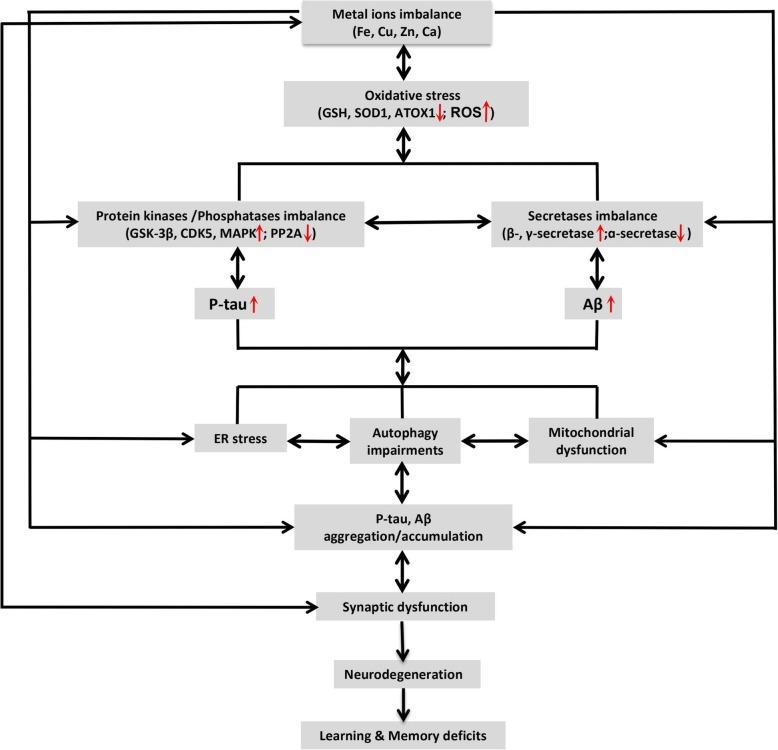
Background: The homeostasis of metal ions, such as iron, copper, zinc and calcium, in the brain is crucial for maintaining normal physiological functions. Studies have shown that imbalance of these metal ions in the brain is closely related to the onset and progression of Alzheimer's disease (AD), the most common neurodegenerative disorder in the elderly. Main body: Erroneous deposition/distribution of the metal ions in different brain regions induces oxidative stress. The metal ions imbalance and oxidative stress together or independently promote amyloid-β (Aβ) overproduction by activating β- or γ-secretases and inhibiting α-secretase, it also causes tau hyperphosphorylation by activating protein kinases, such as glycogen synthase kinase-3β (GSK-3β), cyclin-dependent protein kinase-5 (CDK5), mitogen-activated protein kinases (MAPKs), etc., and inhibiting protein phosphatase 2A (PP2A). The metal ions imbalances can also directly or indirectly disrupt organelles, causing endoplasmic reticulum (ER) stress; mitochondrial and autophagic dysfunctions, which can cause or aggravate Aβ and tau aggregation/accumulation, and impair synaptic functions. Even worse, the metal ions imbalance-induced alterations can reversely exacerbate metal ions misdistribution and deposition. The vicious cycles between metal ions imbalances and Aβ/tau abnormalities will eventually lead to a chronic neurodegeneration and cognitive deficits, such as seen in AD patients. Conclusion: The metal ions imbalance induces Aβ and tau pathologies by directly or indirectly affecting multiple cellular/subcellular pathways, and the disrupted homeostasis can reversely aggravate the abnormalities of metal ions transportation/deposition. Therefore, adjusting metal balance by supplementing or chelating the metal ions may be potential in ameliorating AD pathologies, which provides new research directions for AD treatment.
Overview
The claims and statistics of this paper haven’t been checked yet.
Run the check — free, no account needed. It reads the open-access text and checks the sources it cites.
Integrity signals
Registry
Cites
Statistics
Figures
Verification
Claims the paper makes
The claims and statistics of this paper haven’t been checked yet.
Run the check — free, no account needed. It reads the open-access text and checks the sources it cites.
Claims other papers make about this one
Each is checked against this paper’s own text: does it say what the citing paper says it does?
The source backs part of the claim, not all of it — or backs it for a different population, condition or comparison.
In the citing paper
“However, in AD, this finely tuned balance is disrupted. Misdistribution and pathological accumulation of these metals occur in Aβ plaques and NFTs, where they promote protein aggregation, oxidative stress, and neurotoxicity [107].”
From Toward a Unified Framework in Molecular Neurobiology of Alzheimer’s Disease: Revisiting the Pathophysiological Hypotheses (2026) · cites this paper as [107]
Experimental — accuracy not yet measuredIn the citing paper
“This protein known as the BACE performs proteolysis by generating a soluble fragment in the extracellular space known as “soluble APPβ” and an additional fragment bound to the plasma membrane, CTFβ peptide that undergoes proteolysis yet again by γ-secretase to generate toxic neuropeptides Aβ with 40–43 amino acids, finally causing the amyloid plaques characteristic of AD [165,166,167].”
From Multi-Target Mechanisms of Phytochemicals in Alzheimer’s Disease: Effects on Oxidative Stress, Neuroinflammation and Protein Aggregation (2022) · cites this paper as [165]
In the citing paper
“The absence of Aβ in neurons may inhibit adequate chelation of metal ions and appropriate removal of O2-, resulting in an increased rather than a reduced oxidative stress.424”
From Amyloid β-based therapy for Alzheimer’s disease: Challenges, successes and future (2023) · cites this paper as [424]
Self-check
Percentages, sums and reported differences re-computed from the paper’s own numbers.
The self-check needs the paper’s full text.
Citations
Cites
The amyloid hypothesis of Alzheimer's disease at 25 years
Selkoe, D. J., & Hardy, J. (2016) · EMBO Molecular Medicine · doi:10.15252/emmm.201606210 · Cited by 6,164
Guidelines for the use and interpretation of assays for monitoring autophagy (3rd edition).
Klionsky, D. J., Abdelmohsen, K., Abe, A., Abedin, M. J., Abeliovich, H., Acevedo Arozena, A., Adachi, H., Adams, C. M., Adams, P. D., Adeli, K., et al. (2016) · Autophagy · doi:10.1080/15548627.2015.1100356 · Cited by 5,894
Methods in Mammalian Autophagy Research
Mizushima, N., Yoshimori, T., & Levine, B. (2010) · Cell · doi:10.1016/j.cell.2010.01.028 · Cited by 4,497
Guidelines for the use and interpretation of assays for monitoring autophagy
Klionsky, D. J., Abdalla, F. C., Abeliovich, H., Abraham, R. T., Acevedo-Arozena, A., Adeli, K., Agholme, L., Agnello, M., Agostinis, P., Aguirre-Ghiso, J. A., et al. (2012) · Autophagy · doi:10.4161/auto.19496 · Cited by 3,996
Oxidative stress and the amyloid beta peptide in Alzheimer’s disease
Cheignon, C., Tomas, M., Bonnefont-Rousselot, D., Faller, P., Hureau, C., & Collin, F. (2018) · Redox Biology · doi:10.1016/j.redox.2017.10.014 · Cited by 2,185
Preclinical Alzheimer’s Disease: Definition, Natural History, and Diagnostic Criteria
Dubois, B., Hampel, H., Feldman, H. H., Scheltens, P., Aisen, P., Andrieu, S., Bakardjian, H., Benali, H., Bertram, L., Blennow, K., et al. (2016) · Alzheimer's & Dementia · doi:10.1016/j.jalz.2016.02.002 · Cited by 1,925
Lysosomal calcium signalling regulates autophagy through calcineurin and TFEB
Medina, D. L., Paola, S. D., Peluso, I., Armani, A., Stefani, D. D., Venditti, R., Montefusco, S., Rosato, A. S., Prezioso, C., Forrester, A. R., et al. (2015) · Nature Cell Biology · doi:10.1038/ncb3114 · Cited by 1,452
Woods, A., Dickerson, K., Heath, R. B., Hong, S. P., Momcilovic, M., Johnstone, S. R., Carlson, M., & Carling, D. (2005) · Cell Metabolism · doi:10.1016/j.cmet.2005.06.005 · Cited by 1,418
Oxidative Stress and the Central Nervous System
Salim, S. (2016) · Journal of Pharmacology and Experimental Therapeutics · doi:10.1124/jpet.116.237503 · Cited by 1,268
Boland, B., Kumar, A., Lee, S., Platt, F. M., Wegiel, J., Yu, W. H., & Nixon, R. A. (2008) · Journal of Neuroscience · doi:10.1523/jneurosci.0800-08.2008 · Cited by 1,119
Cited by
Sorted by citations
Amyloid β-based therapy for Alzheimer’s disease: Challenges, successes and future
Zhang, Y., Chen, H., Li, R., Sterling, K., & Song, W. (2023) · Signal Transduction and Targeted Therapy · doi:10.1038/s41392-023-01484-7 · Cited by 988
“The absence of Aβ in neurons may inhibit adequate chelation of metal ions and appropriate removal of O2, resulting in an increased rather than a reduced oxidative stress.(424) Thus, the physiological anti-oxidant activity of Aβ peptides should be taken into account when designing therapeutic drugs to lower Aβ levels.”
BackgroundBrain-Derived Neurotrophic Factor in Alzheimer’s Disease and Its Pharmaceutical Potential
Gao, L., Zhang, Y., Sterling, K., & Song, W. (2022) · Translational Neurodegeneration · doi:10.1186/s40035-022-00279-0 · Cited by 606
Chen, L.-L., Fan, Y.-G., Zhao, L.-X., Zhang, Q., & Wang, Z.-Y. (2023) · Bioorganic Chemistry · doi:10.1016/j.bioorg.2022.106301 · Cited by 200
Iron Dyshomeostasis and Ferroptosis: A New Alzheimer’s Disease Hypothesis?
Wang, F., Wang, J., Shen, Y., Li, H., Rausch, W., & Huang, X. (2022) · Frontiers in Aging Neuroscience · doi:10.3389/fnagi.2022.830569 · Cited by 180
Current Understanding of Hydrogel for Drug Release and Tissue Engineering
Lei, L., Bai, Y., Qin, X., Liu, J., Huang, W. P., & Lv, Q. (2022) · Gels · doi:10.3390/gels8050301 · Cited by 174
Fasae, K. D., Abolaji, A. O., Faloye, T. R., Odunsi, A., Oyetayo, B. O., Enya, J. I., Rotimi, J. A., Akinyemi, R., Whitworth, A. J., & Aschner, M. (2021) · Journal of Trace Elements in Medicine and Biology · doi:10.1016/j.jtemb.2021.126779 · Cited by 161
The Important Role of Zinc in Neurological Diseases
Li, Z., Liu, Y., Wei, R., Yong, V. W., & Xue, M. (2022) · Biomolecules · doi:10.3390/biom13010028 · Cited by 170
Tripathi, P. N., Lodhi, A., Rai, S., Nandi, N., Dumoga, S., Yadav, P., Tiwari, A., Singh, S. K., El‐Shorbagi, A., & Chaudhary, S. (2024) · Degenerative Neurological and Neuromuscular Disease · doi:10.2147/dnnd.s452009 · Cited by 151
Chen, S., Chang, Y., Li, L., Acosta, D., Li, Y., Guo, Q., Wang, C., Turkes, E., Morrison, C., Julian, D., et al. (2022) · Acta Neuropathologica Communications · doi:10.1186/s40478-022-01494-6 · Cited by 144
Role of natural products for the treatment of Alzheimer’s disease
Noori, T., Dehpour, A. R., Sureda, A., Sobarzo-Sanchez, E., & Shirooie, S. (2021) · European Journal of Pharmacology · doi:10.1016/j.ejphar.2021.173974 · Cited by 141
Role of metals in Alzheimer’s disease
Das, N., Raymick, J. B., & Sarkar, S. (2021) · Metabolic Brain Disease · doi:10.1007/s11011-021-00765-w · Cited by 132
Cano, A., Turowski, P., Ettcheto, M., Duskey, J. T., Tosi, G., Sánchez-López, E., García, M. L., Camins, A., Souto, E. B., Ruiz, A., et al. (2021) · Journal of Nanobiotechnology · doi:10.1186/s12951-021-00864-x · Cited by 122
Sharifi-Rad, J., Rapposelli, S., Sestito, S., Herrera-Bravo, J., Arancibia-Diaz, A., Salazar, L. A., Yeskaliyeva, B., Beyatli, A., Leyva-Gómez, G., González-Contreras, C., et al. (2022) · Journal of Personalized Medicine · doi:10.3390/jpm12091515 · Cited by 125
Poudel, P., & Park, S. (2022) · Pharmaceutics · doi:10.3390/pharmaceutics14040835 · Cited by 124
Two Decades of Studying Functional Amyloids in Microorganisms
Levkovich, S. A., Gazit, E., & Bar‐Yosef, D. L. (2020) · Trends in Microbiology · doi:10.1016/j.tim.2020.09.005 · Cited by 117
De Simone, A., Tumiatti, V., Andrisano, V., & Milelli, A. (2021) · Journal of Medicinal Chemistry · doi:10.1021/acs.jmedchem.0c00931 · Cited by 110
Fekete, M., Lehoczki, A., Tarantini, S., Fazekas‐Pongor, V., Csípő, T., Csizmadia, Z., & Varga, J. T. (2023) · Nutrients · doi:10.3390/nu15245116 · Cited by 126
Advances of Zebrafish in Neurodegenerative Disease: From Models to Drug Discovery
Wang, X., Zhang, J., He, K.-J., Wang, F., & Liu, C. (2021) · Frontiers in Pharmacology · doi:10.3389/fphar.2021.713963 · Cited by 106
Common and Trace Metals in Alzheimer’s and Parkinson’s Diseases
Doroszkiewicz, J., Farhan, J. A., Mroczko, J., Winkel, I., Perkowski, M., & Mroczko, B. (2023) · International Journal of Molecular Sciences · doi:10.3390/ijms242115721 · Cited by 108
Copper homeostasis and neurodegenerative diseases
Wang, Y., Li, D., Xu, K., Wang, G., & Zhang, F. (2024) · Neural Regeneration Research · doi:10.4103/nrr.nrr-d-24-00642 · Cited by 108
Hossain, M. S., & Hussain, M. H. (2025) · Pharmacology Research & Perspectives · doi:10.1002/prp2.70131 · Cited by 105
Dighe, S., Jog, S., Momin, M. M., Sawarkar, S. P., & Omri, A. (2023) · Pharmaceutics · doi:10.3390/pharmaceutics16010058 · Cited by 95
Multipronged diagnostic and therapeutic strategies for Alzheimer's disease
Ramesh, M., & Govindaraju, T. (2022) · Chemical Science · doi:10.1039/d2sc03932j · Cited by 87
Naturally Occurring Antioxidant Therapy in Alzheimer’s Disease
Collins, A. E., Saleh, T. M., & Kalisch, B. E. (2022) · Antioxidants · doi:10.3390/antiox11020213 · Cited by 93
Oxygen metabolism abnormality and Alzheimer's disease: An update
Liu, G., Yang, C., Wang, X., Chen, X., Wang, Y., & Le, W. (2023) · Redox Biology · doi:10.1016/j.redox.2023.102955 · Cited by 87
Redox changes and cellular senescence in Alzheimer's disease
Yu, N., Pasha, M., & Chua, J. J. E. (2024) · Redox Biology · doi:10.1016/j.redox.2024.103048 · Cited by 80
New advances in brain-targeting nano-drug delivery systems for Alzheimer's disease
Ouyang, Q., Meng, Y., Zhou, W., Tong, J., Cheng, Z., & Zhu, Q. (2021) · Journal of drug targeting · doi:10.1080/1061186x.2021.1927055 · Cited by 80
Huang, D., Chen, L., Ji, Q., Xiang, Y., Zhou, Q., Chen, K., Zhang, X., Zou, F., Zhang, X., Zhao, Z., et al. (2023) · Redox Biology · doi:10.1016/j.redox.2023.102990 · Cited by 78
Pentón-Rol, G., Marín-Prida, J., & McCarty, M. F. (2021) · Current Neuropharmacology · doi:10.2174/1570159x19666210408123807 · Cited by 73
Calcium (Ca2+) signaling in plants: A plant stress perspective
Naz, M., Afzal, M. R., Raza, M. A., Pandey, S., Qi, S., Dai, Z., & Du, D. (2024) · South African Journal of Botany · doi:10.1016/j.sajb.2024.04.047 · Cited by 73
Valverde-Salazar, V., Ruiz-Gabarre, D., & García‐Escudero, V. (2023) · Antioxidants · doi:10.3390/antiox12071460 · Cited by 76
Arowoogun, J., Akanni, O. O., Adefisan, A. O., Owumi, S. E., Tijani, A. S., & Adaramoye, O. A. (2020) · Journal of Biochemical and Molecular Toxicology · doi:10.1002/jbt.22623 · Cited by 76
The Role of Copper in Tau-Related Pathology in Alzheimer’s Disease
Zubčić, K., Hof, P. R., Šimić, G., & Jembrek, M. J. (2020) · Frontiers in Molecular Neuroscience · doi:10.3389/fnmol.2020.572308 · Cited by 71
Copper-mediated β-amyloid toxicity and its chelation therapy in Alzheimer's disease
Singh, S. K., Balendra, V., Obaid, A. A., Esposto, J., Tikhonova, M. A., Gautam, N. K., & Pöeggeler, B. (2022) · Metallomics · doi:10.1093/mtomcs/mfac018 · Cited by 68
Puentes-Díaz, N., Chaparro, D., Morales-Morales, D., Flores-Gaspar, A., & Alí-Torres, J. (2023) · ACS Omega · doi:10.1021/acsomega.2c06939 · Cited by 67
The potential role of mitochondria in the microbiota-gut-brain axis: Implications for brain health
Qiao, L., Yang, G., Wang, P., & Xu, C. (2024) · Pharmacological Research · doi:10.1016/j.phrs.2024.107434 · Cited by 73
A mechanistic survey of Alzheimer's disease
Tang, Y., Zhang, D., Gong, X., & Zheng, J. (2021) · Biophysical Chemistry · doi:10.1016/j.bpc.2021.106735 · Cited by 66
Leko, M. B., Horvat, L. L., Španić, E., Zubčić, K., Hof, P. R., & Šimić, G. (2023) · Biomedicines · doi:10.3390/biomedicines11041161 · Cited by 64
Chang, J., Yin, W., Zhi, H., Chen, S., Sun, J., Zhao, Y., Huang, L., Xue, L., Zhang, X., Zhang, T., et al. (2024) · Small · doi:10.1002/smll.202308565 · Cited by 63
Impact of Metal Ions on Cellular Functions: A Focus on Mesenchymal Stem/Stromal Cell Differentiation
Peters, K., Staehlke, S., Rebl, H., Jonitz‐Heincke, A., & Hahn, O. (2024) · International Journal of Molecular Sciences · doi:10.3390/ijms251810127 · Cited by 68
New insight into protein glycosylation in the development of Alzheimer’s disease
Zhao, J., & Lang, M. (2023) · Cell Death Discovery · doi:10.1038/s41420-023-01617-5 · Cited by 63
Zhang, Y., Zhang, J., Yan, J., Qi, X., Wang, Y., Zheng, Z., Liang, J., Ling, J., Chen, Y., Tang, X., et al. (2024) · Trends in Food Science & Technology · doi:10.1016/j.tifs.2024.104410 · Cited by 60
Song, W.-J., Jeong, M.-S., Choi, D.-M., Kim, K., & Wie, M. (2019) · Nanomaterials · doi:10.3390/nano9071043 · Cited by 57
Song, S., Liu, N., Wang, G., Wang, Y., Zhang, X., Zhao, X., Chang, H., Yu, Z., & Liu, X. (2023) · Nutrients · doi:10.3390/nu15132874 · Cited by 56
Molecular mechanism of zinc neurotoxicity in Alzheimer’s disease
Narayanan, S. E., Rehuman, N. A., Harilal, S., Vincent, A., Rajamma, R. G., Behl, T., Uddin, M. S., Ashraf, G. M., & Mathew, B. (2020) · Environmental Science and Pollution Research · doi:10.1007/s11356-020-10477-w · Cited by 71
Hou, M., Bao, W., Gao, Y., Chen, J., & Song, G. (2021) · Chemico-Biological Interactions · doi:10.1016/j.cbi.2021.109741 · Cited by 56
Martins, B., Vieira, M., Delerue-Matos, C. M., Grosso, C., & Soares, C. M. D. (2022) · Marine Drugs · doi:10.3390/md20060362 · Cited by 58
Shang, N., Zhang, L., Wang, S., Huang, T., Wang, Y., Gao, X., Xu, S., Zhang, J., Zhang, L., Niu, Q. L., et al. (2021) · Ecotoxicology and Environmental Safety · doi:10.1016/j.ecoenv.2021.112110 · Cited by 54
Ding, M., Ding, S., Du, D., Wang, X., Hu, X., Guan, P., Lyu, Z., & Lin, Y. (2023) · TrAC Trends in Analytical Chemistry · doi:10.1016/j.trac.2023.117087 · Cited by 56
Neuropeptides: Roles and Activities as Metal Chelators in Neurodegenerative Diseases
Ben-Shushan, S., & Miller, Y. (2021) · The Journal of Physical Chemistry B · doi:10.1021/acs.jpcb.0c11151 · Cited by 53
Current understanding of metal-dependent amyloid-β aggregation and toxicity
Yi, Y., & Lim, M. H. (2022) · RSC Chemical Biology · doi:10.1039/d2cb00208f · Cited by 50
Lai, C., Chen, Z., Ding, Y., Qian, C., Su, S., Liu, H., Ni, R., & Tang, Z. (2022) · Frontiers in Immunology · doi:10.3389/fimmu.2022.782434 · Cited by 47
Chaudhari, V., Bagwe‐Parab, S., Buttar, H. S., Gupta, S., Vora, A., & Kaur, G. (2023) · Neurotoxicity Research · doi:10.1007/s12640-023-00634-7 · Cited by 47
Targeting cuproptosis by zinc pyrithione in triple-negative breast cancer
Xu, Y., Deng, L., Diao, X., Yang, S., Zou, L., Yang, Q., Li, J., Nie, J., Zhao, L., & Jiao, B. (2023) · iScience · doi:10.1016/j.isci.2023.108218 · Cited by 46
A matter of concern – Trace element dyshomeostasis and genomic stability in neurons
Wandt, V. K., Winkelbeiner, N., Bornhorst, J., Witt, B., Raschke, S., Simon, L., Ebert, F., Kipp, A. P., & Schwerdtle, T. (2021) · Redox Biology · doi:10.1016/j.redox.2021.101877 · Cited by 45
Martins, M. M., Branco, P. S., & Ferreira, L. M. (2023) · ChemistrySelect · doi:10.1002/slct.202300461 · Cited by 50
Small-molecule theranostics in Alzheimer's disease
Sarabia‐Vallejo, Á., López‐Alvarado, P., & Menéndez, J. C. (2023) · European Journal of Medicinal Chemistry · doi:10.1016/j.ejmech.2023.115382 · Cited by 48
Yoo, J., Han, J., & Lim, M. H. (2023) · RSC Chemical Biology · doi:10.1039/d3cb00052d · Cited by 45
Role of Mitochondrial Dysfunctions in Neurodegenerative Disorders: Advances in Mitochondrial Biology
Kathiresan, D. S., Balasubramani, R., Marudhachalam, K., Jaiswal, P., Ramesh, N., Suruthi, G. S., Moorthi, P. V., & Vijayan, M. (2024) · Molecular Neurobiology · doi:10.1007/s12035-024-04469-x · Cited by 49
Andrikopoulos, N., Li, Y., Nandakumar, A., Quinn, J. F., Davis, T. P., Ding, F., Saikia, N., & Ke, P. C. (2023) · ACS Applied Materials & Interfaces · doi:10.1021/acsami.2c20334 · Cited by 44
Hein, Z. M., Karikalan, B., Gopalakrishna, P. K., Dhevi, K., Alkatiri, A., Hussan, F., Mohd Moklas, M. A., Jagadeesan, S., Che Ramli, M. D., Che Mohd Nassir, C. M. N., et al. (2026) · Molecular Neurobiology · doi:10.1007/s12035-025-05602-0 · Cited by 43
Cadmium desynchronizes neurotransmitter release in the neuromuscular junction: Key role of ROS
Tsentsevitsky, A. N., Zakyrjanova, G. F., & Petrov, A. M. (2020) · Free Radical Biology and Medicine · doi:10.1016/j.freeradbiomed.2020.05.017 · Cited by 44
Singh, Y. P., Shankar, G., Jahan, S., Singh, G., Kumar, N., Barik, A., Upadhyay, P., Singh, L., Kamble, K., Singh, G. K., et al. (2021) · Bioorganic & Medicinal Chemistry · doi:10.1016/j.bmc.2021.116385 · Cited by 42
Zhou, X., Tang, X., Li, T., Li, D., Gong, Z., Zhang, X., Li, Y., Zhu, J., Wang, Y., & Zhang, B. (2023) · Mediators of Inflammation · doi:10.1155/2023/6739691 · Cited by 41
Afsar, A., Castro, M. D. C. C., Soladogun, A. S., & Li, Z. (2023) · International Journal of Molecular Sciences · doi:10.3390/ijms24087258 · Cited by 45
Mao, Y., Zhang, L., Zhang, C., Qin, L., Liao, X., & Zhao, L. (2025) · Journal of Trace Elements in Medicine and Biology · doi:10.1016/j.jtemb.2025.127692 · Cited by 43
Mukherjee, S., & Panda, D. (2021) · ACS Chemical Neuroscience · doi:10.1021/acschemneuro.1c00377 · Cited by 40
Peptide-Based Materials That Exploit Metal Coordination
Bassan, G. A., & Marchesan, S. (2022) · International Journal of Molecular Sciences · doi:10.3390/ijms24010456 · Cited by 39
Davison, C., Beste, D. J. V., Bailey, M. J., & Felipe-Sotelo, M. (2023) · Analytical and Bioanalytical Chemistry · doi:10.1007/s00216-023-04721-8 · Cited by 39
Recent progress of nanomedicine in the treatment of Alzheimer’s disease
Hu, L., Tao, Y., Jiang, Y., & Qin, F. (2023) · Frontiers in Cell and Developmental Biology · doi:10.3389/fcell.2023.1228679 · Cited by 49
Liu, J., Chi, M., Li, L., Zhang, Y., & Xie, M. (2024) · Journal of Colloid and Interface Science · doi:10.1016/j.jcis.2024.02.219 · Cited by 40
Chen, L., Xu, S., Shen, Q., Yu, H., Pei, S., Zhang, Y., He, X., Wang, Q., & Li, D. (2021) · Journal of Alzheimer s Disease · doi:10.3233/jad-215217 · Cited by 38
Chen, R., Li, X., Chen, H., Wang, K., Xue, T., Mi, J., Ban, Y., Zhu, G., Zhou, Y. M., Dong, W., et al. (2023) · European Journal of Medicinal Chemistry · doi:10.1016/j.ejmech.2023.115253 · Cited by 38
New Pathways Identify Novel Drug Targets for the Prevention and Treatment of Alzheimer’s Disease
Penke, B., Szűcs, M., & Bogár, F. (2023) · International Journal of Molecular Sciences · doi:10.3390/ijms24065383 · Cited by 39
Neurotoxicity of Micro- and Nanoplastics: A Comprehensive Review of Central Nervous System Impacts
Ma, Q., Lei, J., Pang, Y., Yu, S., & Zhang, T. (2025) · Environment & Health · doi:10.1021/envhealth.5c00087 · Cited by 43
Cao, Z., Song, Q., Yu, G., Liu, Z., Cong, S., Tan, Z., & Deng, Y. (2021) · Bioorganic & Medicinal Chemistry · doi:10.1016/j.bmc.2021.116074 · Cited by 37
Do glutathione and copper interact to modify Alzheimer's disease pathogenesis?
Ho, T., Ahmadi, S., & Kerman, K. (2022) · Free Radical Biology and Medicine · doi:10.1016/j.freeradbiomed.2022.01.025 · Cited by 37
Drug Development for Alzheimer’s and Parkinson’s Disease: Where Do We Go Now?
Sequeira, L., Benfeito, S., Fernandes, C., Gaspar, A., Lima, I., Peixoto, J., Alves, C., Machado, C. S., Borges, F., & Chavarria, D. (2024) · Pharmaceutics · doi:10.3390/pharmaceutics16060708 · Cited by 37
Current strategies of detecting Aβ species and inhibiting Aβ aggregation: Status and prospects
Li, J., Liao, W., Huang, D., Ou, M., Chen, T., Wang, X., Zhao, R., Zhang, L., Mei, L., Liu, J., et al. (2023) · Coordination Chemistry Reviews · doi:10.1016/j.ccr.2023.215375 · Cited by 37
Hu, J., Sha, W., Yuan, S., Wu, J., & Huang, Y. (2023) · International Journal of Molecular Sciences · doi:10.3390/ijms241915023 · Cited by 40
The relationship between hypoxia and Alzheimer’s disease: an updated review
Tao, B., Gong, W., Xu, C., Ma, Z., Mei, J., & Chen, M. (2024) · Frontiers in Aging Neuroscience · doi:10.3389/fnagi.2024.1402774 · Cited by 36
Nanomedicines for Alzheimer's disease: Therapies based on pathological mechanisms
Cheng, G., Xie, A., Yan, Z., Zhu, X., Song, Y., & Chen, T. (2023) · Brain‐X · doi:10.1002/brx2.27 · Cited by 35
Liquid-liquid phase separation in Alzheimer’s disease
Fu, Q., Zhang, B., Chen, X., & Chu, L. (2024) · Journal of Molecular Medicine · doi:10.1007/s00109-023-02407-3 · Cited by 33
Hickey, J. P., Collins, A. E., Nelson, M. L., Chen, H., & Kalisch, B. E. (2024) · Current Issues in Molecular Biology · doi:10.3390/cimb46050266 · Cited by 39
Campos-Escamilla, C. (2020) · Advances in protein chemistry and structural biology · doi:10.1016/bs.apcsb.2020.09.002 · Cited by 34
Karcz, D., Starzak, K., Ciszkowicz, E., Lecka-Szlachta, K., Kamiński, D. M., Creaven, B. S., Miłoś, A., Jenkins, H., Ślusarczyk, L., & Matwijczuk, A. P. (2022) · International Journal of Molecular Sciences · doi:10.3390/ijms23116314 · Cited by 33
Marcuello, C., Lim, K., Nisini, G., Pokrovsky, V. S., Conde, J., & Ruggeri, F. S. (2025) · Small Science · doi:10.1002/smsc.202500351 · Cited by 40
The Role of Heme and Copper in Alzheimer’s Disease and Type 2 Diabetes Mellitus
Pal, I., & Dey, S. G. (2023) · JACS Au · doi:10.1021/jacsau.2c00572 · Cited by 32
Ye, X., Zhang, M., Gong, Z., Jiao, W., Li, L., Dong, M., Xiang, T., Feng, N., & Wu, Q. (2024) · Phytomedicine · doi:10.1016/j.phymed.2024.155589 · Cited by 30
Nanoscale drug formulations for the treatment of Alzheimer's disease progression
Liqin, L., He, H., Du, B., & He, Y. (2025) · RSC Advances · doi:10.1039/d4ra08128e · Cited by 38
Zhang, Y., Gao, H., Zheng, W., & Xu, H. J. (2022) · Neurobiology of Disease · doi:10.1016/j.nbd.2022.105824 · Cited by 31
Giménez, V. M. M., Heras, N. D. L., Ferder, L., Lahera, V., Reiter, R. J., & Manucha, W. A. (2021) · Diseases · doi:10.3390/diseases9020030 · Cited by 30
Mechanisms of cuproptosis and its relevance to distinct diseases
Lou, Q.-M., Lai, F., Li, J., Mao, K., Wan, H., & He, Y. G. (2024) · APOPTOSIS · doi:10.1007/s10495-024-01983-0 · Cited by 34
Singh, K., Kaur, A., Goyal, B., & Goyal, D. (2024) · ACS Chemical Neuroscience · doi:10.1021/acschemneuro.4c00246 · Cited by 28
An analysis of heavy metals contamination and estimating the daily intakes of vegetables from Uganda
Kasozi, K. I., Otim, E. O., Ninsiima, H. I., Zirintunda, G., Tamale, A., Ekou, J., Musoke, G. H., Muyinda, R., Matama, K., Mujinya, R., et al. (2021) · Toxicology Research and Application · doi:10.1177/2397847320985255 · Cited by 28
Nagu, P., Sharma, V., Behl, T., Pathan, A. K., & Mehta, V. (2022) · Journal of Molecular Neuroscience · doi:10.1007/s12031-021-01940-5 · Cited by 28
Second Sphere Interactions in Amyloidogenic Diseases
Roy, M., Nath, A. K., Pal, I., & Dey, S. G. (2022) · Chemical Reviews · doi:10.1021/acs.chemrev.1c00941 · Cited by 29
Dazhong, S., Peng, H., & Wu, Z. (2022) · Frontiers in Aging Neuroscience · doi:10.3389/fnagi.2022.921906 · Cited by 28
Man, V. H., Wu, X., He, X., Xie, X., Brooks, B. R., & Wang, J. (2021) · Journal of Chemical Theory and Computation · doi:10.1021/acs.jctc.0c01267 · Cited by 28
Ghaderi, S., Mohammadi, S., Nezhad, N. J., Karami, S., & Sayehmiri, F. (2024) · Frontiers in Neuroscience · doi:10.3389/fnins.2024.1338891 · Cited by 28
Metadata
- Authors
- Wang, L., Yin, Y.-L., Liu, X.-Z., Shen, P., Zheng, Y.-G., Lan, X.-R., Lu, C.-B., & Wang, J.-Z.
- Affiliations
- Henan Medical University (CN)
- Huazhong University of Science and Technology (CN)
- Corresponding author
- Wang, Jian-Zhi
- Venue
- Translational Neurodegeneration
- Published
- 2020-04-03
- Volume
- 9
- Issue
- 1
- Pages
- 10-10
- ISSN
- 2047-9158 (ISSN-L)
- PMC
- PMC7119290
- OpenAlex
- W3015096020
- Cited by
- 454
- References
- 140
- Citations by year
- 2026: 61 · 2025: 86 · 2024: 93 · 2023: 84 · 2022: 66 · 2021: 48 · 2020: 15
- FWCI
- 6.91
- Type
- journal article
- Language
- en
- Open access
- gold
- doi.org
- Locations
- Translational Neurodegeneration (publishedVersion, cc-by)
- PubMed Central (publishedVersion, cc-by)
- PubMed (publishedVersion)
- DOAJ (DOAJ: Directory of Open Access Journals) (submittedVersion, cc-by-sa)
- Funders
- Science and Technology Department of Henan Province (182102310209)
- National Natural Science Foundation of China (81771517, U1804197)
- Topics
- Life Sciences › Neuroscience › Cellular and Molecular Neuroscience › Alzheimer's disease research and treatments
- Health Sciences › Nursing › Nutrition and Dietetics › Trace Elements in Health
- Health Sciences › Medicine › Psychiatry and Mental health › Dementia and Cognitive Impairment Research
- Keywords
- Alzheimer's disease, metal homeostasis, iron, copper, zinc, calcium, oxidative stress, amyloid-beta, tau hyperphosphorylation, GSK3β, cyclin-dependent kinase 5, mitogen-activated protein kinase, protein phosphatase 2A, endoplasmic reticulum stress, mitochondrial dysfunction, autophagy, synaptic dysfunction, metal chelation, metal supplementation
- MeSH terms
- Alzheimer Disease, Brain Chemistry, Humans, Ions, Metals, Amyloid beta-Peptides, tau Proteins
About these checks
Registry, retraction, Cites and statistics results are computed, not judged, with one exception: a printed reference that no index lists is read once by a model before it counts as a citation error. Claims are extracted by a model and kept only when their quote appears verbatim in the text; each cited source is then checked, with a model’s help, for whether it says what the claim relies on. Those verdicts can be wrong — read the claim’s quote and the cited source before relying on one.
Statistics and arithmetic are recomputed, not judged.
Confidence bands are shown only for fields calibrated on our annotated test set. None is calibrated yet, so no band is shown.
What counts as a claim ›How we measure confidence ›How we check this ›
Are you an author, or do you see a problem with this page? Request a review
